

B2B Lead Generation in 2026: The Data-Driven Playbook
A RevOps lead we know ran a 10,000-contact cold email campaign last quarter. Reply rate: 1.8%. Bounce rate: 12%. Two domains flagged. Estimated cost including tools, SDR time, and opportunity cost: north of $15,000 for a handful of lukewarm replies. The database vendor's response? "Try cleaning your list."
That's the state of B2B lead generation for most teams - expensive tools, dirty data, and a playbook that stopped working two years ago.
Here's the thing: 92% of buyers already have a vendor in mind before they start evaluating, and the winning vendor lands on the Day One shortlist 95% of the time. Generating pipeline in 2026 isn't about blasting more contacts. It's about being known before the search starts - and then executing with surgical precision when you do reach out.
What You Need (Quick Version)
If you're short on time, here are the three priorities that separate teams generating pipeline from teams burning budget:
- Fix your data before your strategy. Bad contacts kill deliverability, tank your sender reputation, and waste every dollar downstream. This is the single highest-leverage fix most teams ignore. (If you need a starting point, see data enrichment options.)
- Signal-based prospecting over big-list blasting. Smaller, enriched lists built around job changes, hiring signals, and intent data outperform 10x-sized spray-and-pray campaigns. (More on sales prospecting techniques that still work.)
- Build inbound for long-term CPL efficiency. Content, SEO, and community compound over time. Outbound gets you meetings this month. Inbound gets you meetings next year at a fraction of the cost. (Tie this to a real lead generation workflow so it compounds.)
What Does B2B Lead Generation Mean in 2026?
You know what lead generation is - identifying potential buyers and getting them into your pipeline. But the mechanics have shifted dramatically.
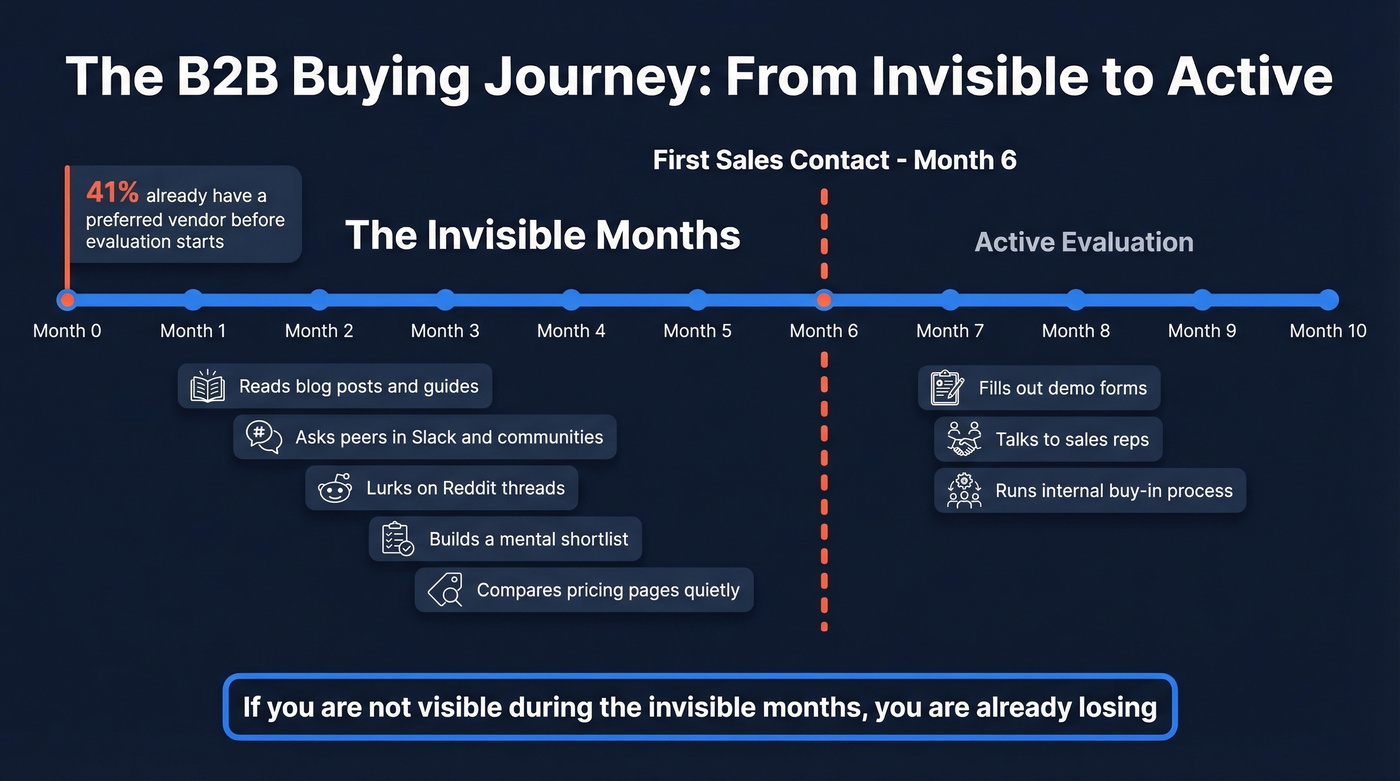
The average B2B buying cycle runs 10.1 months. First contact with a sales rep doesn't happen until 61% of the way through that journey. By the time someone fills out your demo form, they've already consumed content, asked peers for recommendations, lurked in communities, and built a shortlist. Your job isn't to "generate" that lead - it's to have been visible enough during those invisible months that you're already on the list when they're ready. 41% of buyers have a preferred vendor before formal evaluation even begins. If you're not in that 41%, you're fighting for scraps in a competitive bake-off where the incumbent already has a head start.
This is the fundamental shift: lead gen in 2026 is demand creation first, demand capture second. The teams winning aren't the ones with the biggest databases. They're the ones showing up in the right conversations, producing content that answers real questions, and then reaching out with verified data when buying signals fire. (If you're formalizing this, start with identifying buying signals.)
MQLs, SQLs, and the Numbers That Matter
The MQL/SQL framework gets criticized constantly, but it's still how most teams measure pipeline health. An MQL shows interest - downloaded a whitepaper, attended a webinar, visited pricing three times. An SQL has been qualified by sales as a real opportunity with budget, authority, and timeline.
Where teams get into trouble is the conversion math between them.
| Stage | Typical Conversion Rate | What Drives It |
|---|---|---|
| Visitor → MQL | 2-5% | Content relevance, offer quality |
| MQL → SQL | 10-30% | Lead scoring accuracy, ICP fit |
| SQL → Closed-Won | 15-25% | Sales execution, deal size |
A simple lead scoring model helps separate signal from noise. Give +10 points for visiting pricing, +15 for requesting a demo, +5 for opening three emails in a week. Subtract 10 for being outside your ICP firmographics, 15 for a free email domain like Gmail or Yahoo, and 20 for competitor company names. Teams that score leads send fewer junk leads to sales, which improves conversion and reduces rep churn. (If you want a deeper setup, use a dedicated lead scoring model.)
Strategies That Actually Work
We're skipping the filler strategies - gated PDFs nobody reads, generic posts that get 12 impressions. These are the channels with measurable ROI.
Signal-Based Prospecting
The output is 200 highly targeted contacts instead of 5,000 unqualified ones - and the reply rates reflect it.
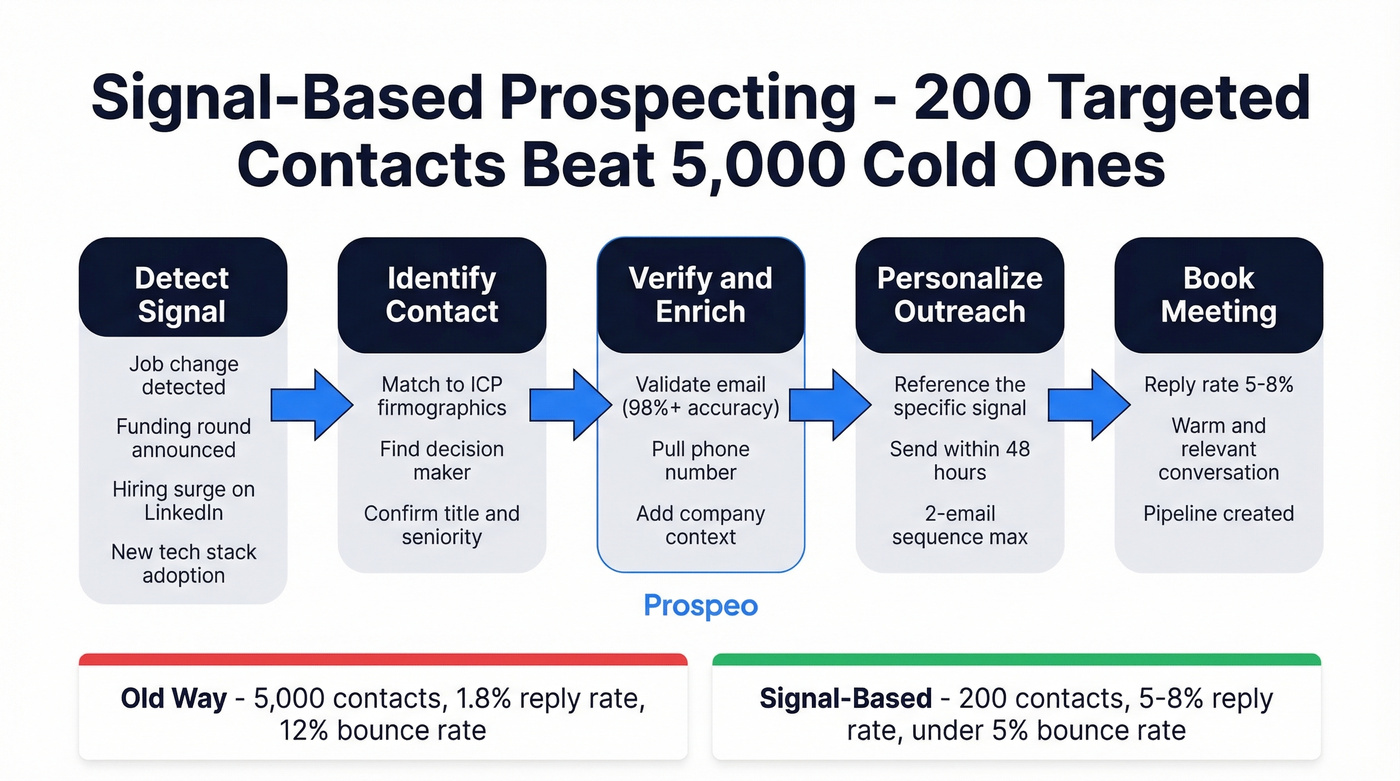
The consensus on r/b2bmarketing is clear: practitioners have stopped buying big contact lists and shifted to smaller, enriched lists built around buying signals. Job changes, hiring surges, funding rounds, technology adoption - these are the triggers that tell you someone's likely in-market.
The workflow: identify a signal (VP of Sales just started at a Series B company), enrich the contact with verified data, and send a hyper-relevant message within 48 hours. Tools like Clay handle the orchestration layer - monitoring signals, pulling enrichment data, and routing contacts into sequences automatically. Some teams also layer in newer enrichment tools like FullEnrich and Airscale for additional coverage. (If you're building this motion, see Clay list building.)
LinkedIn Outreach
LinkedIn remains one of the highest-converting outbound channels, especially when paired with signal-based targeting. Connect with a relevant, non-salesy note, engage with the prospect's content for a week or two, then send a direct message that references something specific about their situation. Reddit practitioners consistently say the "warm before you pitch" approach outperforms cold InMails by a wide margin. Treat it as a relationship channel, not a blast channel.
Content and SEO
SEO delivers leads at $206 CPL - one of the cheapest scalable channels in B2B. Yes, 58% of marketers say search traffic is down. But AI referral traffic carries higher intent, and the compounding nature of content means your cost per lead drops every month the asset stays live. (If you're tying SEO to revenue, use this SEO sales leads framework.)
The play isn't to rank for generic head terms. It's to own the long-tail queries your buyers actually search during those invisible 10.1 months - comparison pages, integration guides, workflow tutorials. Content that answers a specific question for a specific buyer at a specific stage.
Cold Email (The New Rules)
Cold email still works. But the margin for error has collapsed.
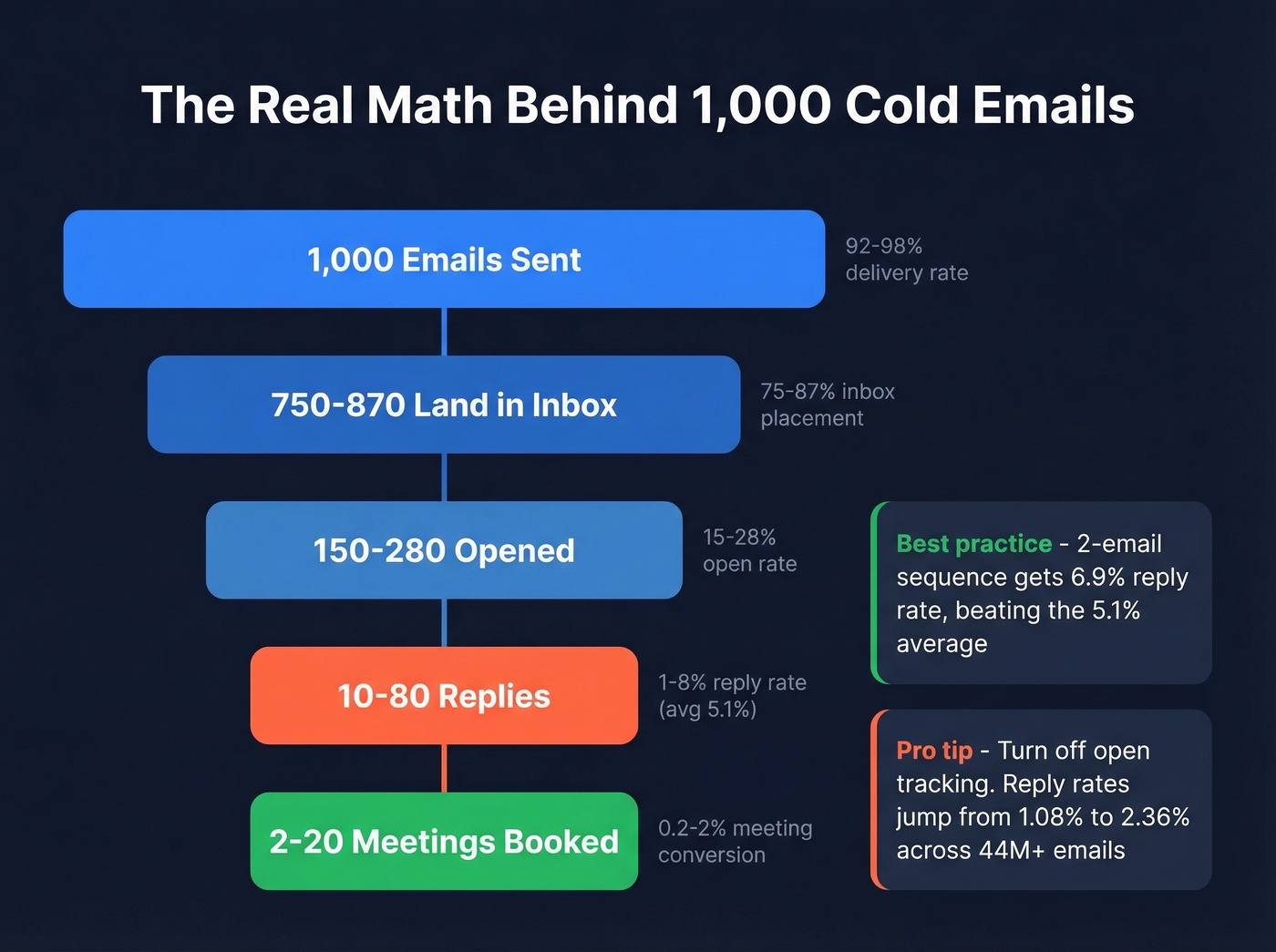
Here's the funnel math every outbound team needs to internalize:
- Delivery rate: 92-98%
- Inbox placement: 75-87%
- Open rate: 15-28%
- Reply rate: 1-8% (average: 5.1%)
- Meeting conversion: 0.2-2%
That means for every 1,000 emails sent, you're looking at 2-20 meetings. The variance is enormous, and it's almost entirely driven by two things: data quality and deliverability hygiene. (If you're tightening the system, start with cold email marketing benchmarks.)
Google and Yahoo's bulk sender requirements are non-negotiable now. SPF and DKIM authentication are mandatory. DMARC must be published. One-click unsubscribe is required. Spam complaint rate must stay under 0.3%. Miss any of these, and your emails hit spam - regardless of how good your copy is. (For the technical side, see DMARC alignment.)
Two tactical insights from the data: a 2-email sequence - one initial plus one follow-up - produces the highest response rate at 6.9%, compared to the 5.1% average across all sequence lengths. And turning off open tracking nearly doubles reply rates - 2.36% vs 1.08% across 44M+ emails analyzed. Open tracking pixels trigger spam filters. Kill them. (If you need copy, pull from these cold email follow-up templates.)
Data Quality and Verification
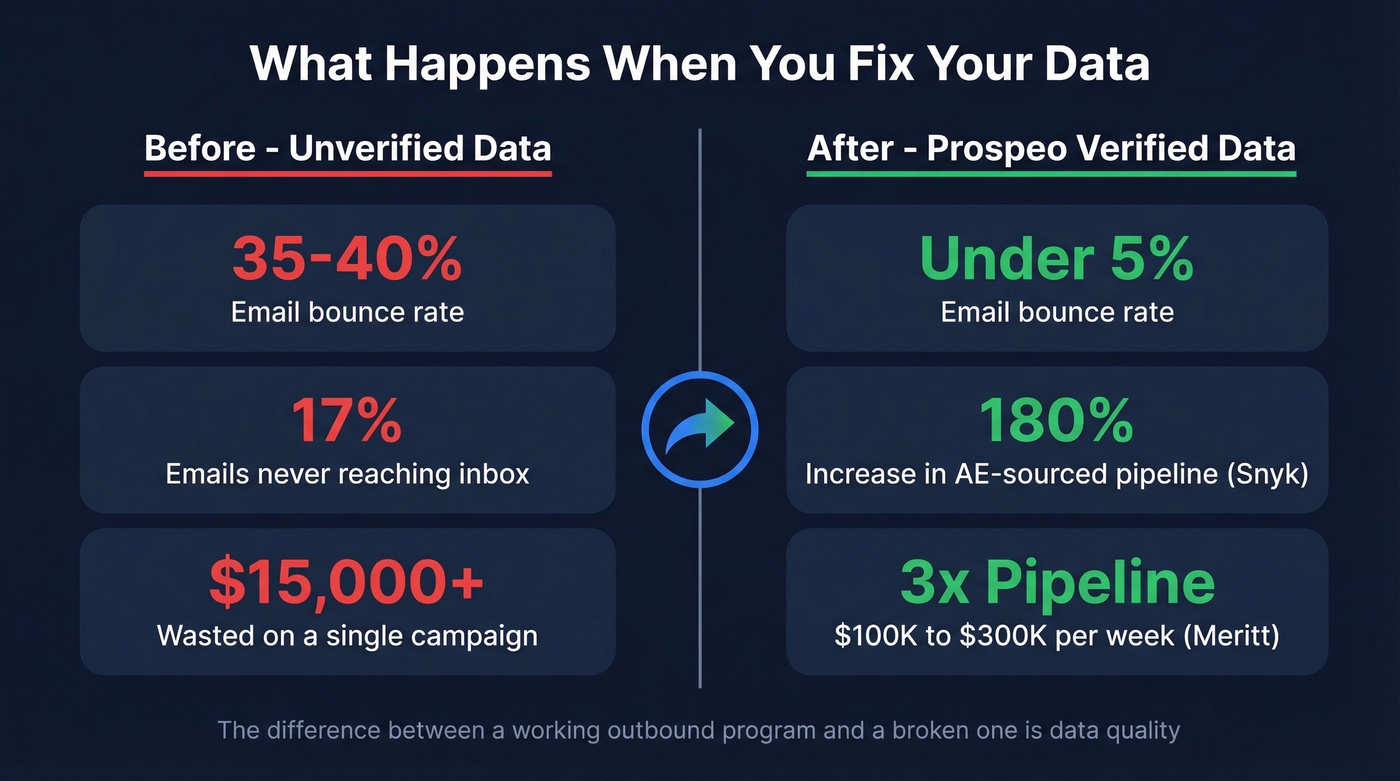
Look, this is the most underrated lever in all of lead gen. The average cold email bounce rate is 7.5%. 17% of cold emails never reach the inbox. Every bounced email damages your sender reputation, which damages deliverability for every subsequent email you send. It's a death spiral, and we've watched teams burn through three domains before they figured out the problem was their data, not their copy. (To diagnose, start with email bounce rate.)
Reddit threads are full of practitioners who ditched Apollo and ZoomInfo specifically because of bad data - wrong emails, disconnected phone numbers, outdated titles. The real fix isn't switching from one stale database to another. It's a verification-first approach where every contact is validated before it enters your sequence. (If you're comparing sources, see best sales prospecting databases.)
When Snyk rolled out Prospeo's verified data to 50 AEs, their bounce rate dropped from 35-40% to under 5%, and AE-sourced pipeline jumped 180%. Meritt saw similar results - pipeline tripled from $100K to $300K per week, with bounce rates falling from 35% to under 4%. That's not a marginal improvement. That's the difference between a working outbound program and a broken one.
Community-Led Lead Gen
Reddit and niche industry forums are two of the best free lead gen channels practitioners consistently recommend. The approach isn't to spam links - it's to show up with genuinely helpful answers, build recognition, and let inbound interest follow. CPL is effectively zero. The investment is time and expertise, which most sales teams have in surplus if they'd redirect it from writing cold emails nobody reads.
Video and Creator Partnerships
78% of B2B marketers use video, and over half are increasing investment in 2026. But the bigger signal is the trust multiplier: brands that partner with creators and industry voices are 2.2x more likely to be trusted and 1.8x more likely to be well known. A 3-minute video from a respected practitioner explaining why they use your product outperforms any whitepaper you'll ever write.
Webinars, ABM, Paid, and Referrals
The remaining channels break down by cost and intent. Referrals deliver leads at $25 CPL - the cheapest channel by a wide margin. Webinars run $267. PPC averages $463. Trade shows and events sit at the top at $840 per lead.
The smart move isn't picking one channel. 94% of marketers diversified their channel mix last year, and 45% allocate 10-20% of their budget specifically to testing new channels. For most B2B teams, that means heavy investment in referrals and content for low CPL and high intent, moderate spend on cold email and webinars for scalability, and selective use of events and paid ads where brand visibility and ABM targeting justify the premium.

This article makes it clear: signal-based prospecting on small, enriched lists crushes big-list blasting. Prospeo gives you 30+ filters - buyer intent, job changes, funding, technographics - across 300M+ profiles with 98% email accuracy. Build the 200-contact list that outperforms your 5,000-contact spray-and-pray.
Replace your bloated contact lists with surgically targeted, verified leads.
What It Actually Costs
Real numbers. The average CPL across all B2B channels is $391.80, and that number has held essentially flat since 2023.
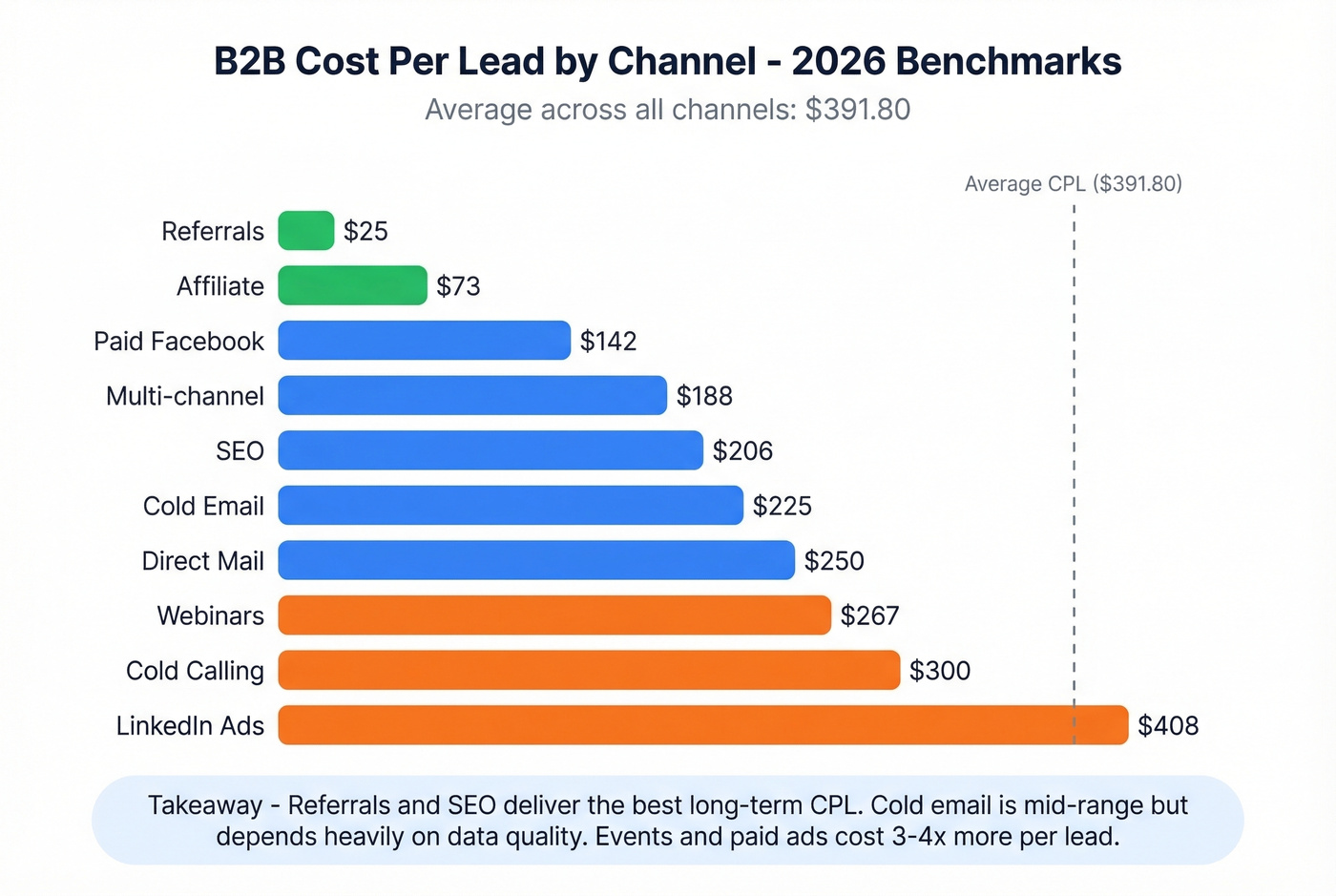
CPL by Channel
| Channel | Avg CPL |
|---|---|
| Referrals | $25 |
| Affiliate | $73 |
| Paid Facebook | $142 |
| Multi-channel | $188 |
| SEO | $206 |
| Cold email | $225 |
| Direct mail | $250 |
| Webinars | $267 |
| Cold calling | $300 |
| LinkedIn ads | $408 |
| PPC | $463 |
| Events | $840 |
CPL by Industry
| Industry | Avg CPL |
|---|---|
| B2B SaaS | $188 |
| Construction | $227 |
| Manufacturing | $391 |
| Financial services | $461 |
| Staffing | $497 |
| IT/Managed services | $501 |
| Software dev | $595 |
| Legal | $650 |
If you're in B2B SaaS, you're in the best position - $188 average CPL gives you room to experiment. If you're selling into legal or enterprise software, every lead is expensive, which makes conversion optimization and data quality even more critical. (To pressure-test your funnel, track lead generation metrics.)
Hot take: If your average deal size is under $10K, you probably don't need ZoomInfo-level data spend. A $99/month verified data tool and a $30/month sequencer will outperform a $30K/year platform you only use for email lookups. Most teams are over-tooled and under-verified.
The Modern Lead Gen Stack
The lead gen software market hit $7.4B in 2025 and is projected to reach $16.2B by 2034. Most of that growth is going to tools that help teams do more with less - not bloated platforms that try to do everything.
We think about the stack in six layers: Find, Verify, Enrich, Engage, Convert, Manage. Each layer has a job. Pick one tool per layer, make sure they integrate, and move on. (If you're shopping, start with outbound lead generation tools.)
| Stack Layer | Tool | Starting Price |
|---|---|---|
| Enrich/Orchestrate | Clay | ~$149/mo |
| Sequence | Instantly | ~$30-97/mo |
| CRM | HubSpot | Free to $15/mo/user |
| CRM (Enterprise) | Salesforce | $25-550/user/mo |
| Automation | Zapier | From $19.99/mo |
An SMB team can run a complete outbound stack for under $200/month. Enterprise teams with Salesforce, intent data, and multi-channel orchestration will spend $50K+/year. Start lean and add layers only when you've maxed out the previous one.
Skip the all-in-one platforms if you're under 20 reps. They're built for procurement committees, not for teams that need to move fast. You'll spend more time configuring than prospecting.
You just saw the math: 12% bounce rates kill domains and burn budgets. Prospeo's 5-step verification and 7-day data refresh keep bounce rates under 4% - the same results Snyk saw across 50 AEs generating 200+ opportunities per month. At $0.01 per email, fixing your data is the cheapest pipeline lever you'll ever pull.
Fix your data first. Everything downstream depends on it.
How AI Changes the Game
Daily AI usage in the workplace is up 233% in six months, and daily AI users report being 64% more productive. Juniper Research projects AI-automated customer interactions will jump from 3.3B in 2025 to 34B+ by 2027.
The reality is more modest than the hype. Only about a third of B2B organizations have implemented agentic AI at scale. For most teams, AI's practical value comes down to four things: lead scoring through pattern matching on who converts, routing that assigns leads to the right rep instantly, sequence optimization for testing subject lines and send times, and enrichment workflows that auto-fill missing data points when a lead enters the CRM. (If you're going deeper, see generative AI lead generation.)
The teams getting the most from AI aren't replacing their SDRs. They're eliminating the manual work that keeps SDRs from actually selling - research, data entry, list building, and qualification. That's where the 64% productivity gain lives.
Mistakes That Kill Your Pipeline
1. Weak or nonexistent ICP. If you can't describe your ideal customer in two sentences - industry, company size, buyer title, pain point - you're not ready to prospect. Every dollar spent on leads outside your ICP is wasted.
2. Buying big unverified lists. The average cold email bounce rate is 7.5%. Buy a 10,000-contact list from a vendor with stale data, and you'll bounce 750+ emails in your first campaign. Your domain reputation won't recover for weeks.
3. Ignoring deliverability rules. SPF, DKIM, DMARC, one-click unsubscribe, complaint rate under 0.3%. These aren't suggestions. Google and Yahoo enforce them. Skip any one and your emails go to spam.
4. Slow follow-up. Responding to an inbound lead within 60 seconds produces a 391% increase in conversion compared to waiting even five minutes. Most teams take hours. Some take days. Speed-to-lead is the easiest conversion lever you're not pulling.
5. Single-channel dependence. If all your pipeline comes from one source - cold email, paid ads, whatever - you're one algorithm change away from zero.
6. No lead scoring. Passing every MQL to sales without scoring wastes rep time and creates friction between marketing and sales. Even a basic point system combining firmographic fit with behavioral signals cuts noise dramatically.
7. Sales and marketing misalignment. If marketing is measured on MQL volume and sales is measured on closed revenue, you'll get a lot of leads nobody wants to call. Align on a shared pipeline number - say $2M in qualified pipeline per quarter - and reverse-engineer the MQL targets from there.
Why Getting This Right Compounds
When your data's clean, your signals are accurate, and your channels are diversified, the benefits compound fast. You spend less per meeting because verified contacts don't bounce. Your reps focus on prospects who are actually in-market instead of chasing dead ends. Your domain reputation stays healthy, which means every subsequent campaign performs better than the last.
And because you're building inbound assets alongside outbound motions, your CPL drops over time even as pipeline grows. That's what B2B lead generation looks like when it's done right - a system that gets cheaper and more effective the longer it runs.
FAQ
What does B2B lead generation mean?
B2B lead generation is the process of identifying and attracting potential business buyers into your sales pipeline through a mix of outbound prospecting, inbound content, and signal-based targeting. In 2026, it emphasizes demand creation - building awareness before buyers enter a buying cycle - paired with demand capture using verified data at the right moment.
What's the most cost-effective channel?
Referrals at $25 CPL consistently deliver the lowest cost per lead across B2B. SEO at $206 CPL is the cheapest scalable channel. Multi-channel prospecting at $188 CPL performs well when contact data is verified and enriched before outreach.
How long does it take to produce results?
Outbound campaigns with verified data can generate meetings within two to three weeks. Inbound channels like SEO and content marketing typically take three to six months to build momentum. The average B2B buying cycle runs 10.1 months, so pipeline planning should account for both short-term and long-term motions.
Is cold email still effective in 2026?
Yes, but only with verified contact data and proper email authentication. The average reply rate is 5.1%, and top performers hit 6-8% using short, personalized two-email sequences with open tracking disabled. Teams blasting large unverified lists see reply rates under 2% and risk domain damage.
What tools should I start with?
A verified data source like Prospeo for clean contacts at roughly $0.01 per email, a free CRM like HubSpot, and a sequencing tool like Instantly at around $30/mo. Total cost: under $200/month. Add Clay for enrichment workflows once you've outgrown manual list building.