Generative AI for Lead Generation: What Actually Works in 2026
Your AI SDR just sent 500 beautifully personalized emails. 180 bounced. Your domain reputation dropped. And now your real reps' emails are landing in spam too.
That's the generative AI lead generation failure mode nobody puts in the case study - and it's where most teams go wrong.
What You Need (Quick Version)
Signal-personalized outreach hits 15-25% reply rates, but only if your contact data is accurate. Start with a verified data source, a sequencing tool like Instantly or Smartlead, and a GenAI layer for personalization (Clay or your LLM of choice). Everything else is optional until you're sending 1,000+ emails a day.
Generative vs. Predictive AI in Lead Gen
Most content about "AI lead generation" conflates two different technologies. Predictive AI analyzes historical data to forecast outcomes - it tells you who to contact and when. Think lead scoring, intent signals, and churn prediction. Generative AI creates new content from prompts - it writes what to say. Think personalized first lines, email copy, and follow-up sequences tailored to a prospect's recent funding round or job change.
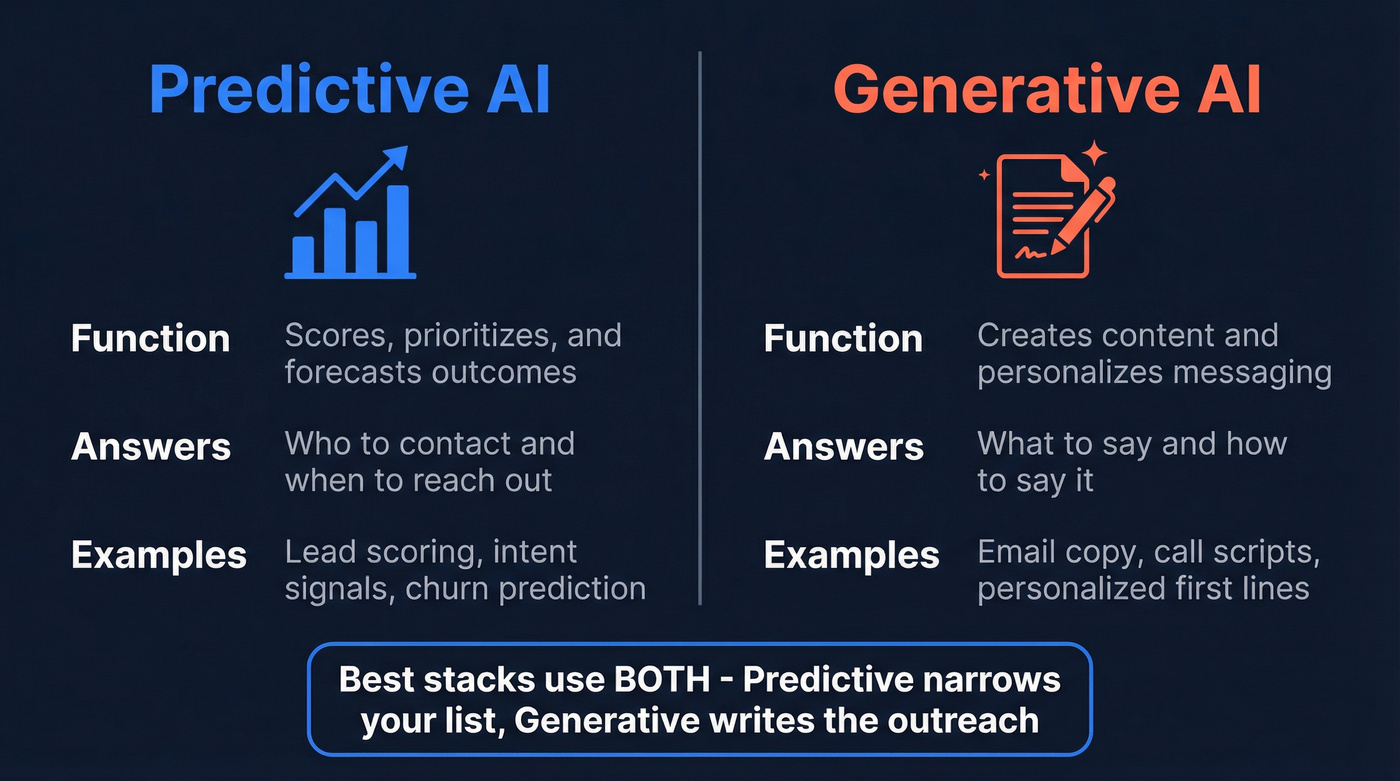
| Predictive AI | Generative AI | |
|---|---|---|
| Function | Scores, prioritizes, forecasts | Creates content, personalizes |
| Answers | Who to contact, when | What to say, how to say it |
| Examples | Lead scoring, intent signals | Email copy, call scripts |
The best stacks use both. Predictive narrows your list to in-market buyers. Generative writes the outreach that resonates. Beyond outreach, GenAI also powers guided selling and dynamic pricing in complex sales - Deloitte's lead-to-quote framework uses it to configure proposals and recommendations far faster than manual workflows.
One distinction worth watching: fully autonomous AI agents versus AI-assisted workflows. Most teams today use AI-assisted, where a human triggers and reviews the output. Fully automated AI SDR setups scale faster, but the meeting-quality gap is real, which is why 45% of teams run a hybrid model.
Does AI-Personalized Outreach Actually Work?
The data is genuinely compelling. Signal-personalized outreach - emails tailored to buyer signals like job changes, funding events, or tech stack shifts - achieves 15-25% reply rates versus the 3-5% cold email average. That's a 4-5x lift.
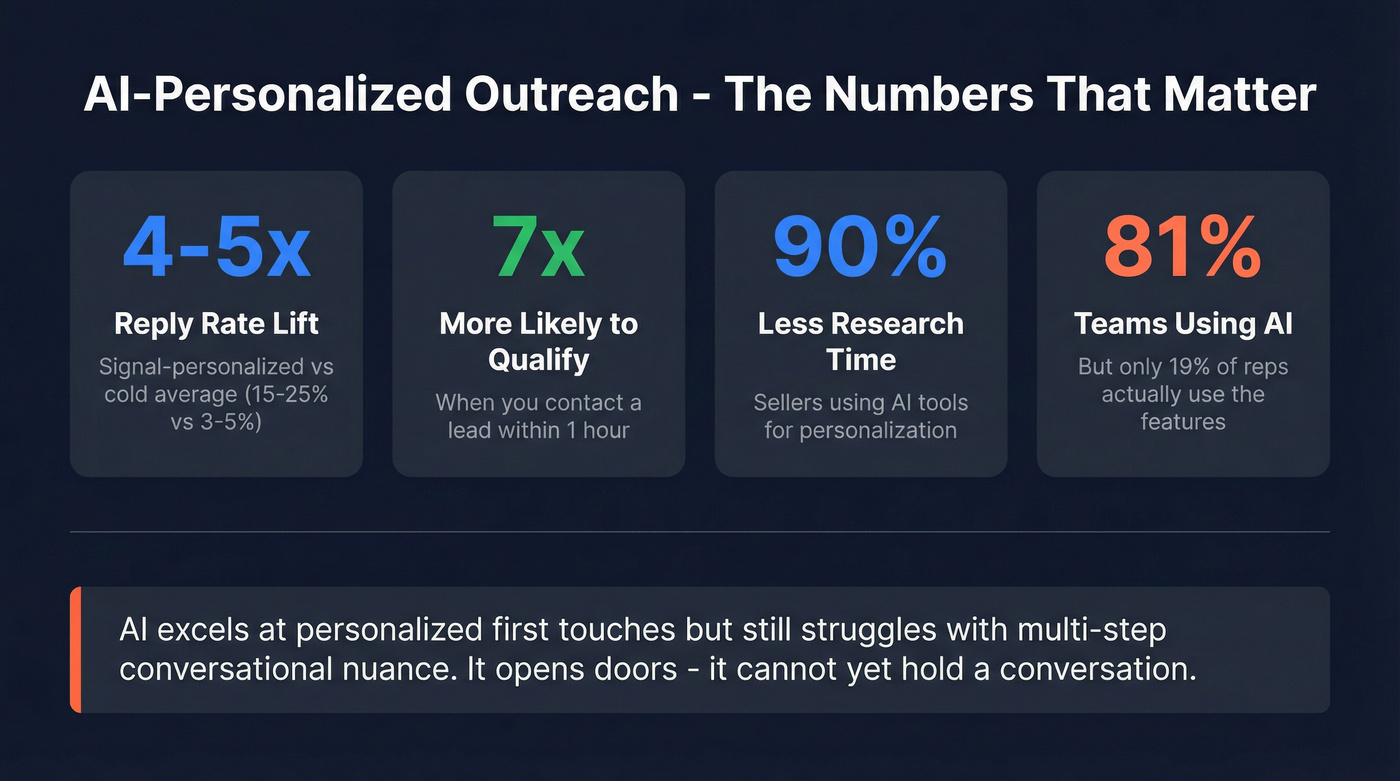
A Belkins study across 20M+ outreach attempts found AI-driven first messages hit a 4.19% response rate versus 2.60% without AI. But AI follow-ups performed slightly worse than human-written ones (3.48% vs 3.91%). Here's the thing: AI excels at personalized first touches but still struggles with multi-step conversational nuance. It can open doors. It can't yet hold a conversation.
Speed matters too. Per HBR's speed-to-lead research, contacting a lead within one hour makes you roughly 7x more likely to qualify them. AI makes sub-hour response at scale possible - sellers using Outreach's AI tools cut research and personalization time by 90%, and deals close 11 days faster on average. Razorpay's ML lead scoring cut conversion time by a full month and reduced sales effort 70% while maintaining close rates.
Adoption tells its own story: 81% of sales teams are experimenting with or have implemented AI, and AI-using teams are 1.3x more likely to see revenue growth. But only 19% of reps actually use the AI features built into their tools. The gap between buying AI and using AI is enormous.
The Data Quality Prerequisite
AI on bad data is automated spam. Worse than regular spam, actually, because it's convincing spam sent to addresses that don't exist. That torches your sender reputation faster than any human SDR could manage.
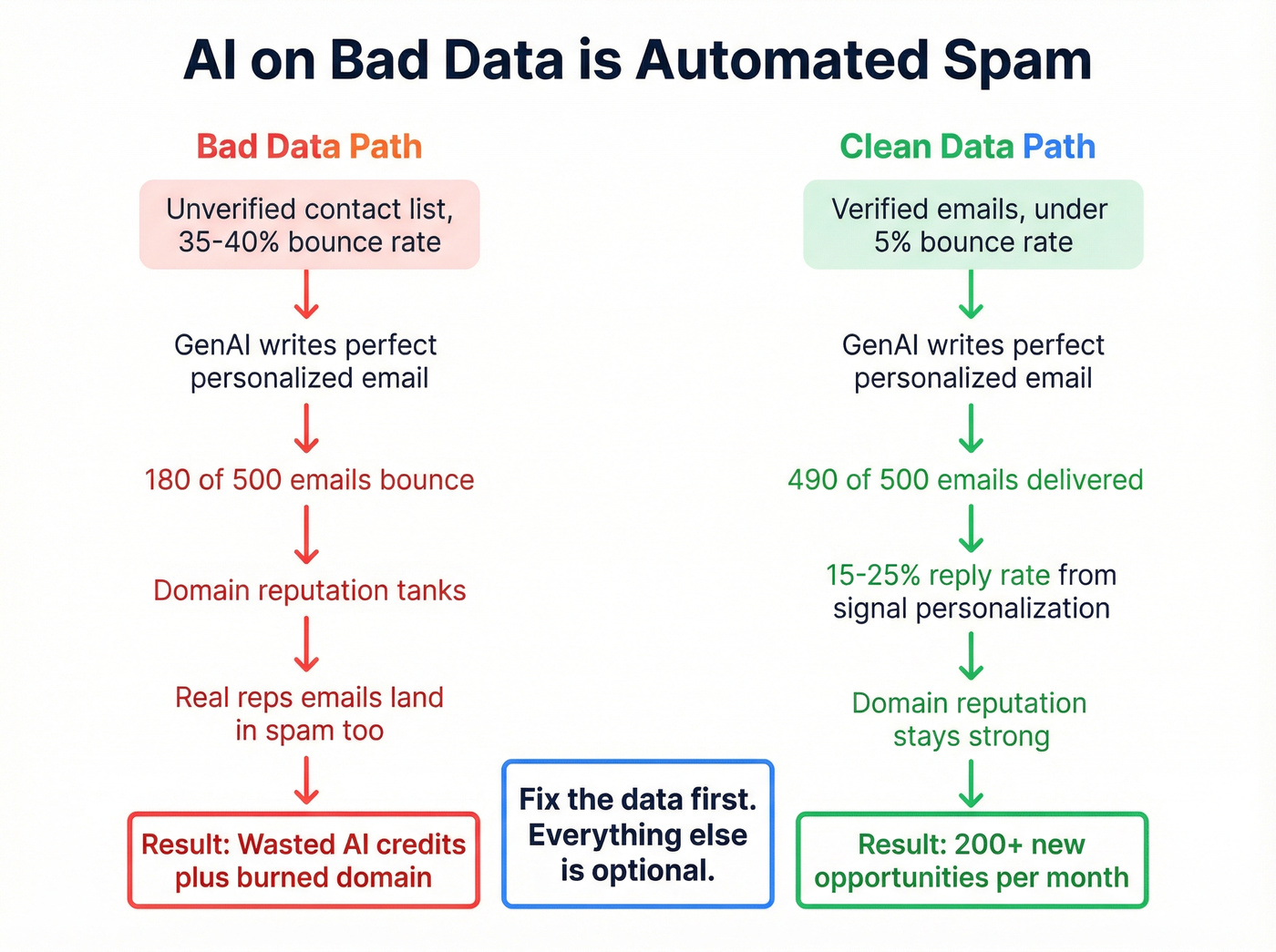
The deliverability environment has gotten brutal. AI-generated phishing now accounts for 73-83% of phishing campaigns, so email providers have cranked spam filters to their most aggressive settings in years. SPF, DKIM, and DMARC authentication aren't optional - they're table stakes (use a proper SPF, DKIM, DMARC setup). And even with perfect authentication, a bounce rate above 5% is a deliverability problem.
We've seen this play out repeatedly in our own customer base. Snyk ran 50 AEs through Prospeo and dropped their bounce rate from 35-40% to under 5% - AE-sourced pipeline jumped 180%, generating 200+ new opportunities per month. Meritt tripled their pipeline from $100K to $300K per week, with bounce rates falling from 35% to under 4%. In both cases, the outreach strategy didn't change. The data did.
If your GenAI writes a perfect email and it bounces, you've wasted the AI credits and damaged your domain. Fix the data first (start with email verification for outreach).

AI-personalized outreach hits 15-25% reply rates - but only when emails actually land. Prospeo's 98% email accuracy and 7-day data refresh keep your bounce rate under 5%, so your GenAI stack generates pipeline instead of spam complaints.
Stop burning domains with bad data. Start at $0.01 per verified email.
AI SDR Economics
A human SDR runs $110,000-$168,000/year when you factor in salary, commission, benefits, tools, training, and turnover. AI SDR tools range from $31,000-$147,000/year.
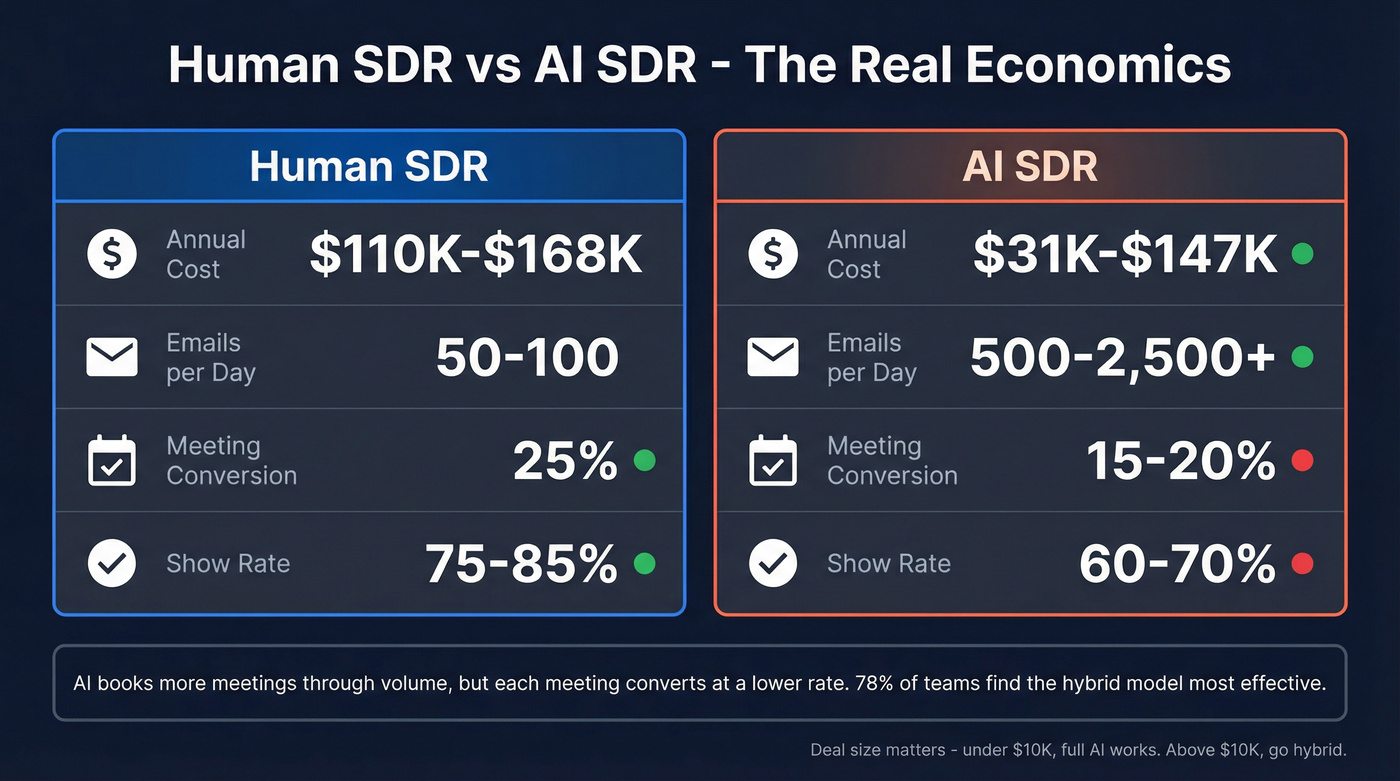
| Human SDR | AI SDR | |
|---|---|---|
| Annual cost | $110K-$168K | $31K-$147K |
| Emails/day | 50-100 | 500-2,500+ |
| Meeting conversion | ~25% | 15-20% |
| Show rate | 75-85% | 60-70% |
The economics work, but the performance gap is real. AI books more meetings in absolute terms because of sheer volume, but each meeting converts and shows at a lower rate. 22% of teams have fully replaced human SDRs with AI, though most find the hybrid model more effective - AI handles top-of-funnel volume, humans take over once a prospect engages. We've seen this pattern consistently outperform either approach alone (more detail in our AI SDR for SMB and Enterprise guide).
Let's be honest about the deal-size threshold. If your average deal is under $10K, a fully autonomous AI SDR is probably fine. Above that, the lower show rates and conversion rates will cost you more in lost deals than you save on headcount. The hybrid model exists for a reason.
Tools Worth Evaluating
You don't need six tools. You need three: a verified data source, a sequencing platform, and a GenAI personalization layer (see our full list of cold email marketing tools).
| Tool | Starting Price | Core Strength |
|---|---|---|
| Prospeo | Free (75 emails/mo); ~$0.01/email | 98% email accuracy, 7-day refresh |
| Apollo | Free; paid from $49/mo | All-in-one prospecting |
| Clay | Free; paid from $134/mo | Workflow + enrichment |
| Lusha | Free; paid from $22/mo | Quick contact lookups |
| ZoomInfo | Custom; typically $15K+/yr | Enterprise data + intent |
| Instantly | From ~$30/mo | Sending infrastructure |
| AiSDR | From $900/mo | Autonomous AI SDR |
| 11x.ai | From $5,000-$6,000/mo | Enterprise AI SDR |
Before you commit to anything, run a 100-lead data quality audit. Pull 100 contacts from your target ICP, verify them, and measure bounce rate. If it's above 5%, your data source is the problem - not your messaging. In our testing, this single exercise reveals more about your stack's readiness than any demo or trial period (use a dedicated email checker tool if you need a quick baseline).
Skip 11x.ai unless you're running enterprise-scale outbound with budget to match. For teams under 10 reps, the $5K+/month price tag rarely pays back. The consensus on r/sales tends to agree - most smaller teams get better ROI from a Clay + Instantly combo with verified data underneath.
Risks Nobody Talks About
Every vendor says "AI-powered." Most bolted a ChatGPT wrapper onto an existing feature and raised the price. The real risks go beyond wasted spend.
Regulatory enforcement is accelerating. The SEC settled charges against two investment advisers for $400,000 in penalties over misleading AI claims. The FTC launched "Operation AI Comply" targeting deceptive AI marketing. And in Moffatt v. Air Canada, a tribunal held the airline liable for its chatbot's misrepresentations - disclaimers didn't help.
The compliance numbers are sobering. One in five marketing assets gets flagged for potential compliance issues. Shadow AI - employees using unapproved tools - creates data leakage risks most sales teams aren't tracking.
Practical controls that actually hold up:
- Maintain a claim inventory for AI-generated content
- Enforce human-in-the-loop review for anything customer-facing
- Log prompts and outputs for audit trails
- Set chatbot escalation rules so AI doesn't make promises your team can't keep
I've watched teams skip the audit trail step and regret it within a quarter. When a prospect screenshots a hallucinated claim from your AI-written email and posts it publicly, you want receipts showing what prompt produced it and who approved it.
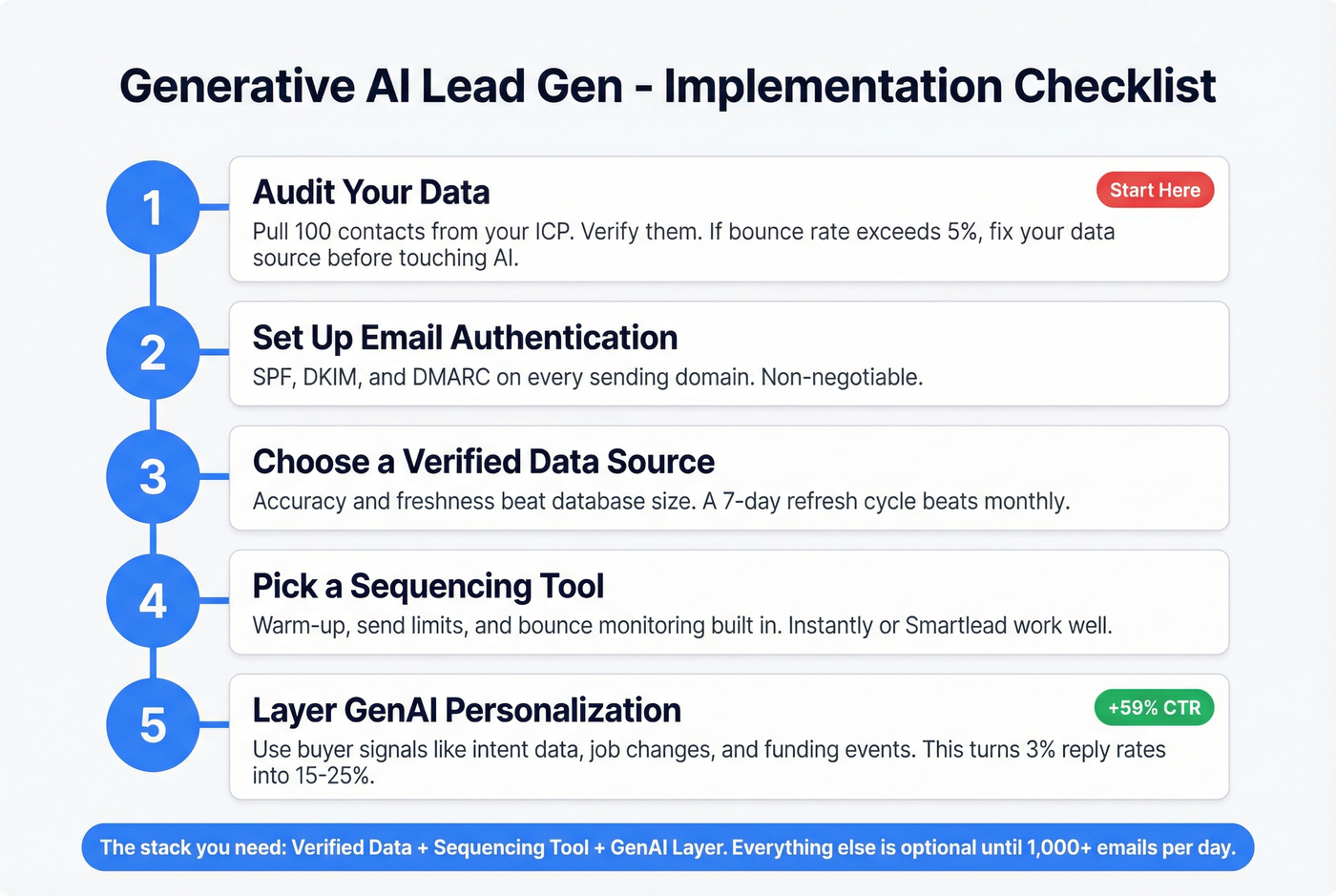
Implementation Checklist
- Audit your data. Pull 100 contacts from your ICP. Verify them. If bounce rate exceeds 5%, fix your data source before touching AI (see B2B contact data decay benchmarks).
- Set up email authentication. SPF, DKIM, and DMARC on every sending domain. Non-negotiable (use this email deliverability checklist).
- Choose a verified data source. Accuracy and freshness matter more than database size. A 7-day refresh cycle beats monthly - stale data is the silent killer of AI outreach.
- Pick a sequencing tool with deliverability controls. Warm-up, send limits, and bounce monitoring built in (follow cold email volume best practices).
- Layer GenAI personalization using buyer signals. Intent data, job changes, funding events - these are the signals that turn 3% reply rates into 15-25%. Dell saw +59% email CTR and +79% conversions with signal-personalized GenAI campaigns.
Snyk dropped bounce rates from 35-40% to under 5% and generated 200+ new opportunities per month. Meritt tripled pipeline to $300K/week. The AI outreach didn't change. The data source did. Prospeo gives you 300M+ profiles with 5-step verification - no contracts, no sales calls.
Run your 100-lead data quality audit with 75 free verified emails.
FAQ
What role does generative AI play in lead generation vs. predictive AI?
Predictive AI scores and prioritizes leads based on historical data - it tells you who to contact and when. Generative AI creates personalized outreach content - it writes what to say. The best stacks use both: predictive to narrow your list, generative to craft the message.
How much does an AI SDR cost compared to a human SDR?
A human SDR costs $110,000-$168,000/year including salary, benefits, tools, and management overhead. AI SDR tools range from $31,000-$147,000/year, though they convert meetings at 15-20% versus 25% for humans. Most teams run a hybrid model for the best balance of volume and quality.
Are AI-generated leads as good as manually sourced ones?
AI-generated leads match or exceed manually sourced leads in volume and targeting precision, but quality depends entirely on your data inputs and signal filters. Built on verified contact data and strong intent signals, they convert at comparable rates - the key difference is speed and scale.