

Appointment Setting Pricing Models: A Buyer's Playbook for 2026
You're staring at three proposals on your desk. One agency charges $200 per meeting. Another wants $5,000 a month on retainer. The third pitches a hybrid - $3,000 base plus $250 per booked appointment. All three promise "qualified meetings with decision-makers." That's appointment setting pricing models in a nutshell: three wildly different structures, zero easy comparisons, and a lot hiding in the fine print.
The Short Answer
Most mid-market buyers should start with a hybrid model (base retainer plus per-meeting bonus). It balances risk and accountability better than either extreme. Expect to pay $150-$400 per qualified meeting or $3,000-$10,000/month on retainer, depending on ICP complexity and channel mix. The biggest hidden cost isn't the pricing structure itself - it's data quality issues swinging your effective cost per meeting by 20-40%.
What Each Model Costs in 2026
Here are the numbers in one table. These ranges reflect what we're seeing across agencies, platforms, and Clutch provider listings as of early 2026.
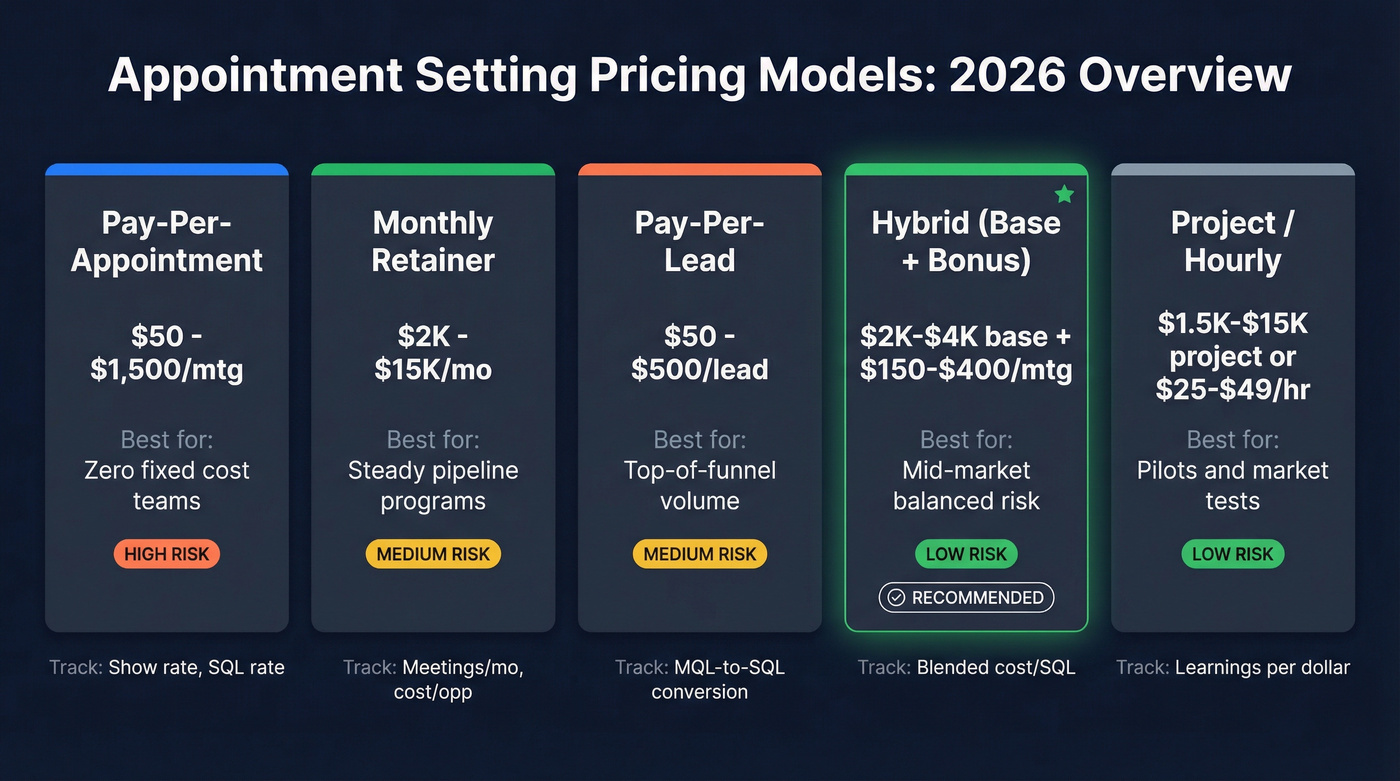
| Model | Typical Range | Best For | Risk Level | Track This |
|---|---|---|---|---|
| Pay-per-appointment | $50-$1,500+/mtg | Teams wanting zero fixed cost | High (quality) | Show rate, SQL rate |
| Monthly retainer | $2,000-$15,000+/mo | Steady pipeline programs | Medium (accountability) | Meetings/mo, cost/opp |
| Pay-per-lead | $50-$500/lead | Top-of-funnel volume | Medium (qualification) | MQL-to-SQL conversion |
| Hybrid (base + bonus) | $2K-$4K base + $150-$400/mtg | Mid-market balanced risk | Low | Blended cost/SQL |
| Project / hourly | $1,500-$15K project; $25-$49+/hr | Pilots, market tests | Low (short commitment) | Learnings per dollar |
The spread is wide because "appointment setting" covers everything from a freelancer booking demos for a SaaS startup to a multi-channel agency targeting C-suite executives at Fortune 500s. LaGrowthMachine's analysis puts agency retainers around $3,000-$10,000/month, often $5,000-$15,000/month for full-service contracts, while self-serve outbound platforms can start as low as ~$37-$80/user/month. The gap between those two numbers is where most of the confusion lives.
In-House vs. Outsourced Costs
The outsourcing conversation only makes sense against the real cost of doing it yourself.
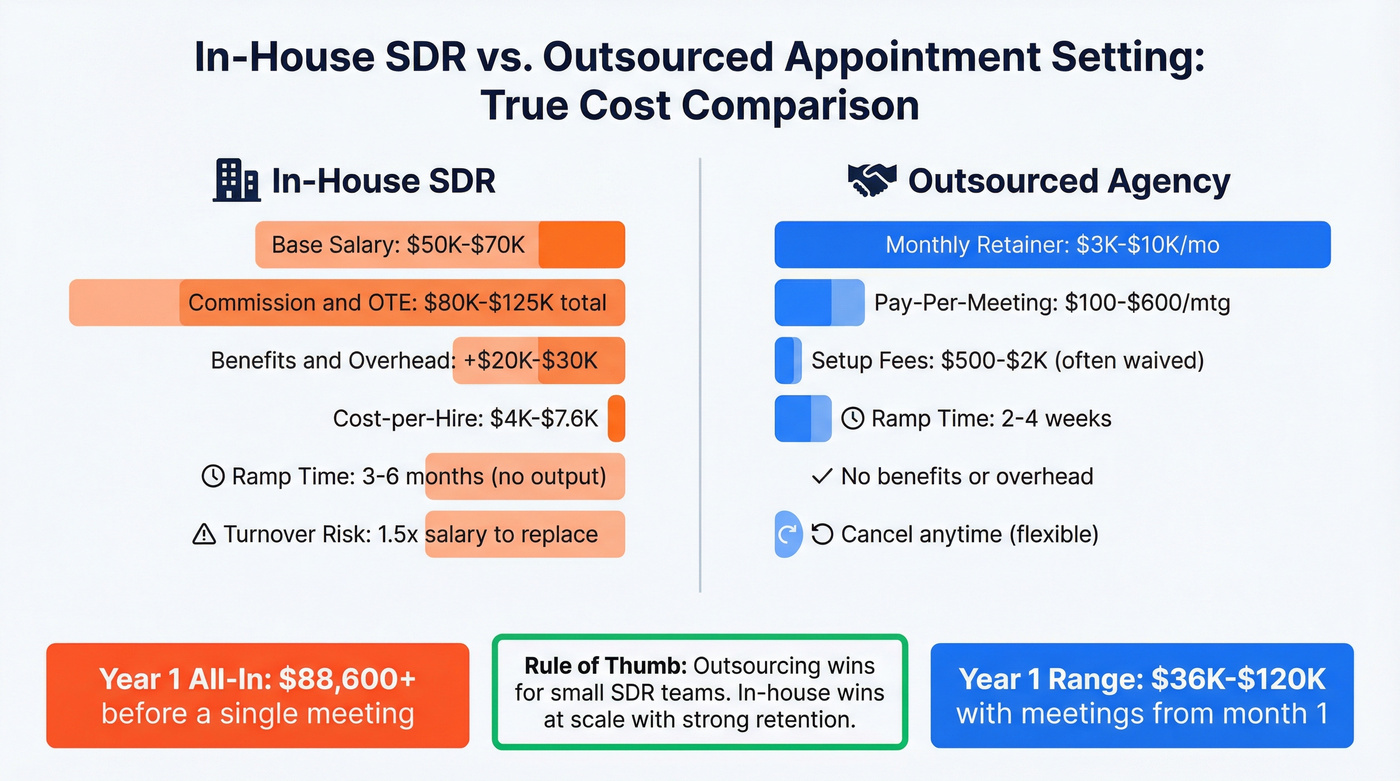
In-house SDR (fully loaded):
- Base salary: $50K-$70K/Salary)
- Total comp with commission: $80K-$125K
- Benefits and overhead: add $20K-$30K
- [Cost-per-hire: $4,000-$7,645](https://www.shrm.org/about/press-room/shrm-releases-2025-benchmarking-reports - how-does-your-organizat)
- Ramp to productivity: 3-6 months
- Turnover replacement cost: ~1.5x annual salary
That's $88,600+ per year before they book a single meeting - and you're carrying the ramp risk. We've seen teams burn through two SDR hires in a year, spending $15K+ in recruiting costs alone, before a single pipeline dollar materializes.
Outsourced appointment setting:
- Monthly retainer: $3,000-$10,000
- Pay-per-meeting: $100-$600 depending on seniority and targeting difficulty
- Setup/onboarding fees: $500-$2,000, often waived for annual contracts
As a rule of thumb, outsourcing wins for small SDR teams. At larger scale with strong retention and solid enablement, in-house starts to pencil out.
5 Models Explained
Pay-Per-Appointment
You pay $50-$300 per meeting for SMB targets, $300-$600 for enterprise, and $600-$1,500+ for C-suite. Simplest model to budget. Riskiest to run.
The sticker price rarely tells the full story - show rates and qualification rates determine what you actually pay for pipeline. And the core danger is incentive misalignment: providers optimize for meetings booked, not meetings that convert. On r/sales and r/b2bmarketing, the most common complaint about PPA providers is calendar-stuffing - meetings that technically count but never close. Worse, providers chasing volume sometimes burn through sending domains to hit their numbers, tanking your deliverability in the process.
Skip this if you care about pipeline quality more than calendar volume.
Monthly Retainer
Basic retainers run $2,000-$5,000/month, mid-tier programs $5,000-$10,000, and enterprise multi-channel engagements $10,000-$15,000+. You get a dedicated team running outreach as an extension of your sales org. This works best when you need consistent pipeline month over month and can commit to a 3-6 month engagement window.
The risk is accountability. Retainers without performance tracking become expensive fast. Demand weekly reporting on meetings booked, show rates, and cost per opportunity - not just activity metrics like "emails sent." If your provider resists that level of transparency, that tells you everything.
Pay-Per-Lead
Expect $50-$200 per MQL and $200-$500 per SQL. The distinction matters enormously - a "lead" that's just a name and email is worth a fraction of a lead qualified against your ICP criteria.
Skip this if you can't clearly define what "qualified" means before signing. Vague lead definitions are how providers hit their numbers while your pipeline stays empty.
Hybrid (Base + Performance)
This is the model we recommend for most teams. A typical structure is $2,000-$4,000/month base plus $150-$400 per qualified meeting. The base covers infrastructure, data, and dedicated reps. The bonus aligns incentives.
Here's the break-even math: at $400/meeting on a pure PPA deal, a $4,000 retainer breaks even at just 10 meetings/month. If your provider consistently delivers 15+, the retainer saves you $2,000/month. The hybrid captures that upside while still keeping the provider accountable for output. Budget under $3,000/month? You won't get enough base coverage to be meaningful - look at project-based instead.
Project-Based / Hourly
Running a 30-60 day pilot before committing? This is your model. Project fees range from $1,500-$15,000 depending on scope, and hourly rates on Clutch commonly land in the $25-$49/hr band, with specialized firms charging more. It's the lowest-commitment way to test an agency's quality, but it won't build the compounding momentum that outbound requires - most conversions happen after 5+ follow-ups across 8-12 touches over 14-21 days.

The article says it plainly: data quality swings your effective cost per meeting by 20-40%. At $0.01 per verified email with 98% accuracy and a 7-day refresh cycle, Prospeo eliminates the hidden cost that inflates every pricing model - bounced emails, burned domains, and wasted SDR hours chasing dead contacts.
Stop paying $400 per meeting when $200 of it is bad data.
What Drives Costs Up and Down
Not all meetings are created equal. A SaaS company targeting CFOs at $500M+ enterprises will pay 3-4x more per meeting than a manufacturing firm booking demos with plant managers. Here's what moves the needle:
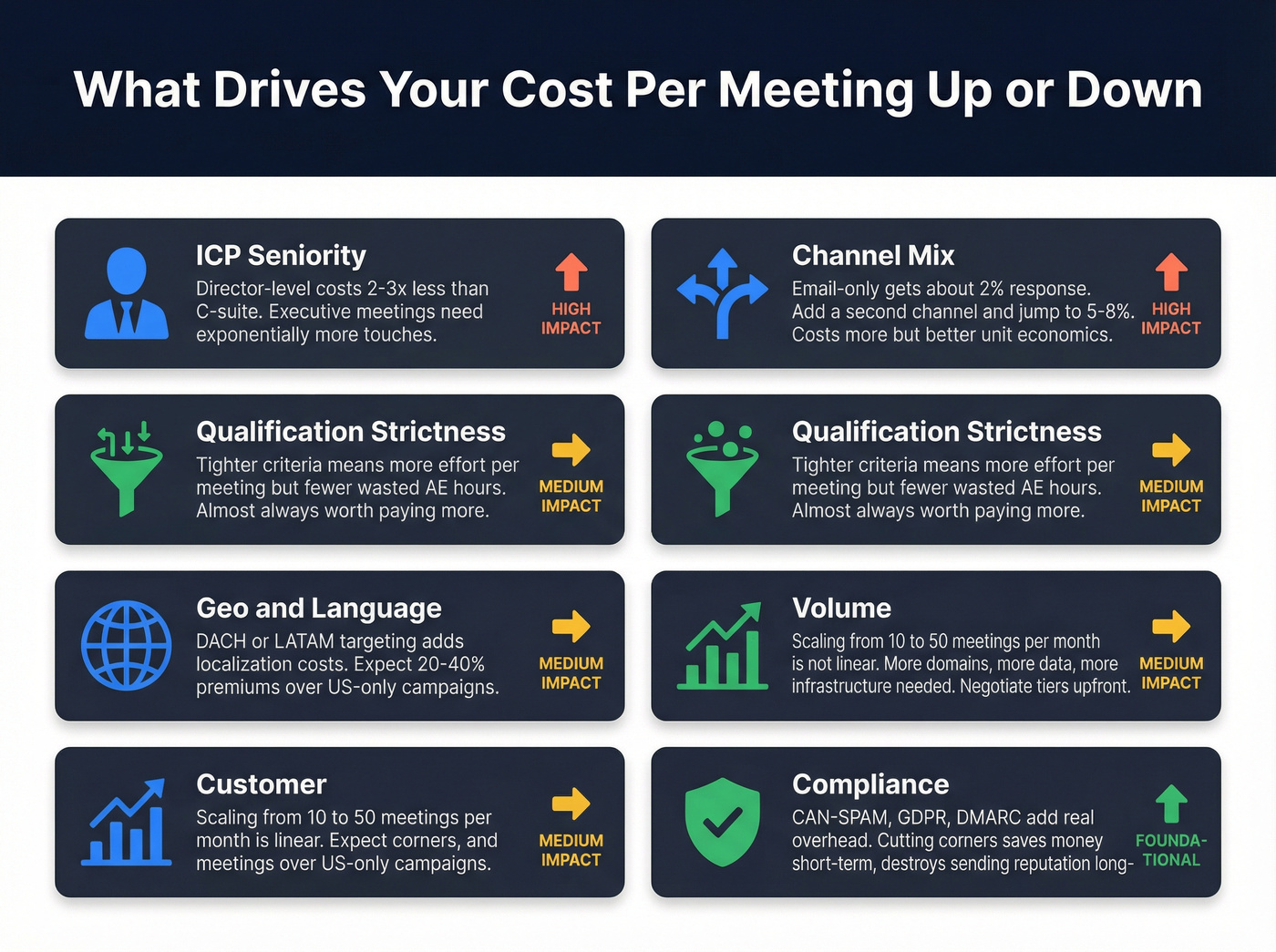
ICP seniority. Booking a meeting with a Director of Marketing costs 2-3x less effort than reaching a CFO. Executive meetings take exponentially more touches and personalization.
Channel mix. Email-only campaigns average ~2% response rates. Add a coordinated second channel and that jumps to 5-8%. Multi-channel costs more but dramatically improves unit economics.
Qualification strictness. Tighter criteria means more upfront effort per meeting, but fewer wasted AE hours downstream. It's almost always worth paying more per meeting for better qualification.
Geo and language. Targeting DACH or LATAM markets adds localization costs - expect 20-40% premiums over US-only campaigns.
Volume. Scaling from 10 to 50 meetings/month isn't linear. Providers need more infrastructure, more domains, more data. Negotiate volume tiers upfront.
Compliance. CAN-SPAM, GDPR, and email authentication requirements like DMARC add real overhead. Agencies that cut corners here save money short-term and destroy your sending reputation long-term. Ask about compliance processes before you ask about price. (If you need the operational checklist, start with SPF, DKIM, DMARC.)
The Hidden Cost Nobody Talks About
Look - every pricing model discussion focuses on what you pay the agency. Nobody talks about what bad data costs you on top of that.
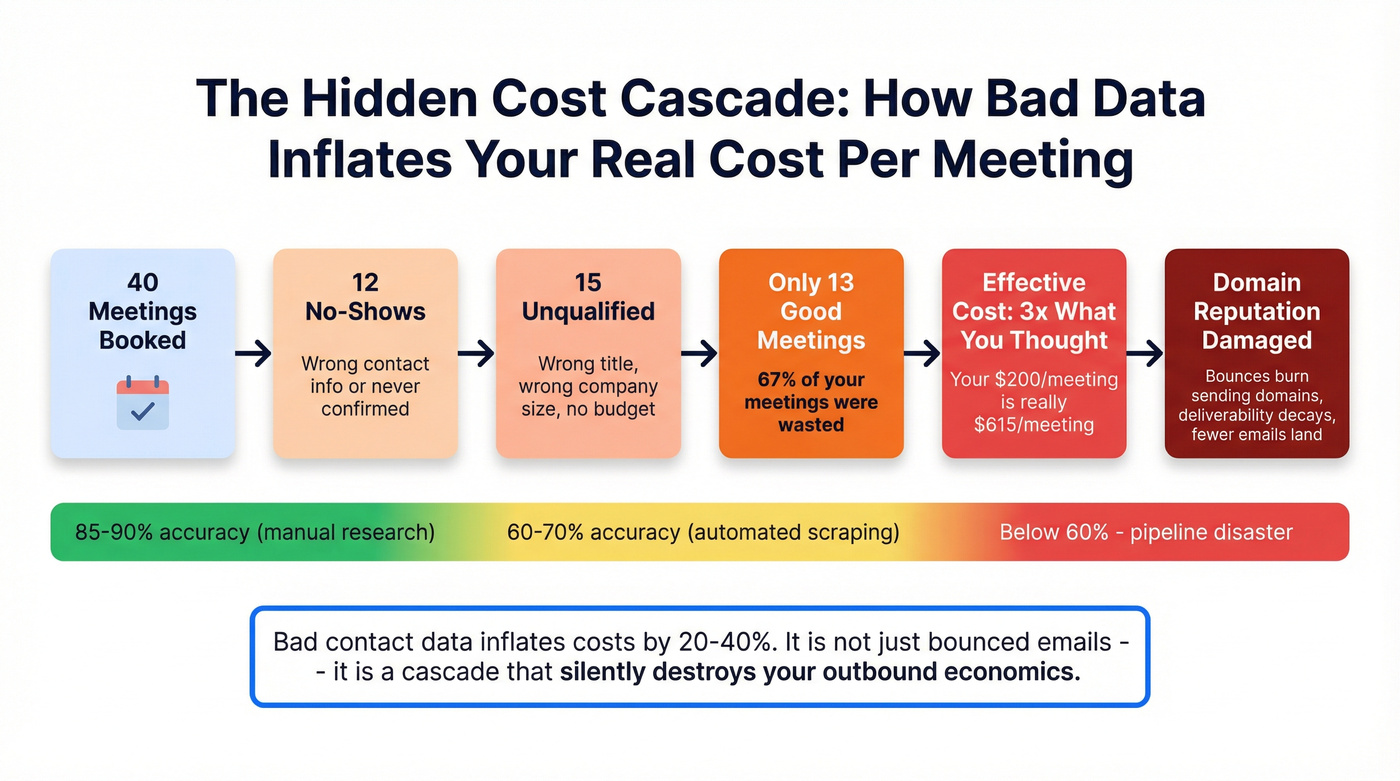
Let's say your provider books 40 meetings in a month. Twelve are no-shows because the contact info was wrong or the prospect never confirmed. Fifteen more turn out to be unqualified - wrong title, wrong company size, no budget. Your AEs just wasted 60% of their meeting time. The effective cost of those 13 good meetings? Triple what you thought you were paying.
Bad contact data inflates costs by 20-40%. It's not just bounced emails - it's a cascade. Bounces burn your sending domains. Domain reputation drops. Deliverability decays. Fewer emails land in inboxes. Fewer meetings get booked. Your cost per meeting climbs silently while your provider's dashboard still shows "emails sent." A blacklisted sending domain can force you to replace infrastructure entirely and lose outreach capacity while you rebuild. (If you want the triage steps, see blacklist alert.)
Manual research gets you 85-90% data accuracy. Automated scraping? 60-70% valid contacts. Neither is good enough when your domain reputation is on the line. If you're cleaning lists at scale, use an email checker tool or a dedicated email ID validator before you send.
Whether you run appointment setting in-house or outsource it, the math breaks down without accurate contact data. Prospeo gives you 300M+ profiles, 125M+ verified mobiles with a 30% pickup rate, and 30+ filters to match your exact ICP - so every dollar you spend on outreach actually reaches a real buyer.
Build the list your appointment setters actually need - in minutes.
How to Calculate ROI
Let's work through real numbers. A-Sales published a case study: $5,500 spend over 45 days, running cold email, cold calling, and social outreach.
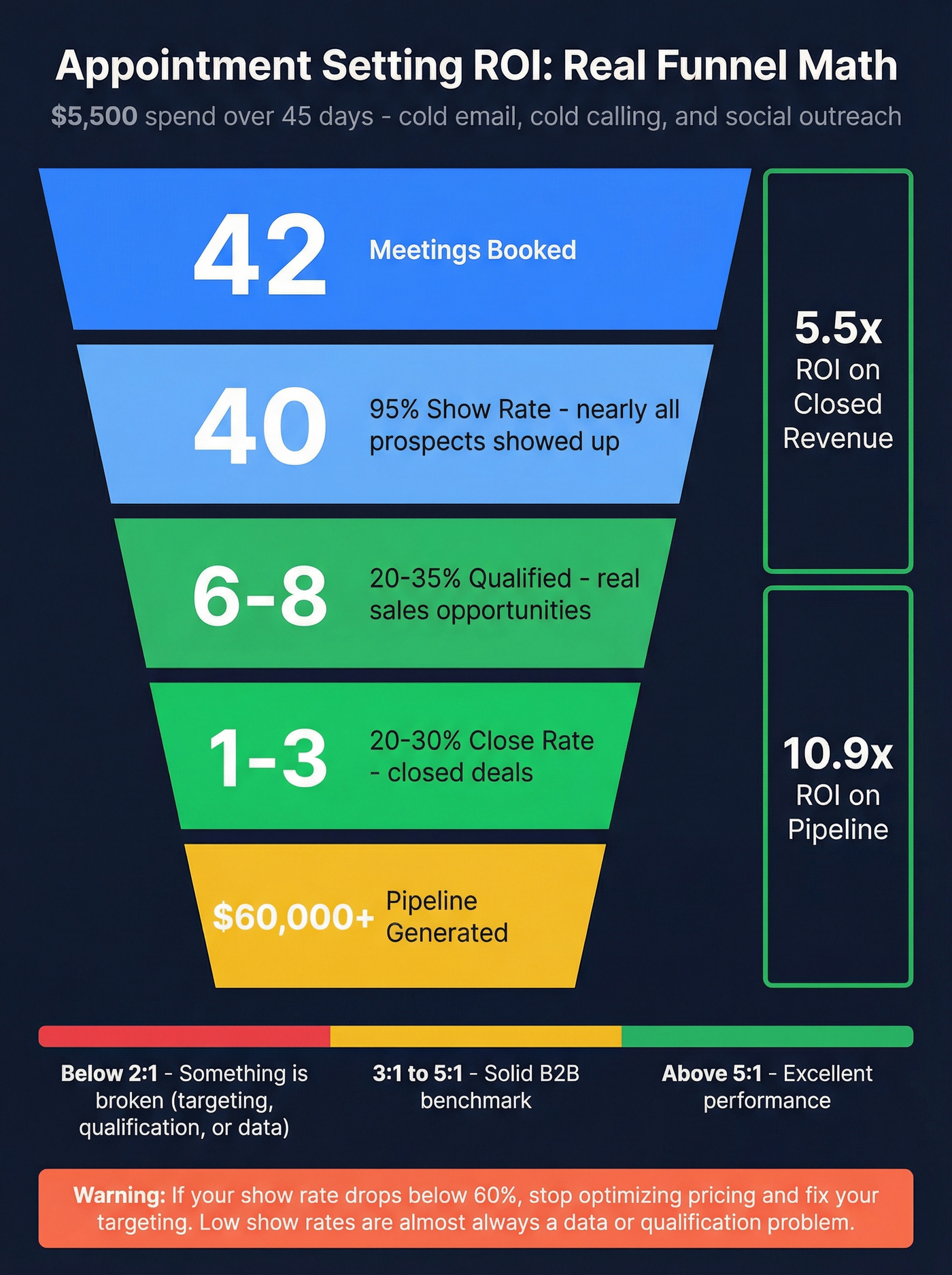
The funnel:
- 42 meetings booked
- 95% show rate - ~40 conversations
- 20-35% qualified - 6-8 real opportunities
- 20-30% close rate - 1-3 closed deals
- $60,000+ in pipeline generated
That's a 5.5x ROI on closed revenue and 10.9x on pipeline. Strong, but not unusual for a well-targeted campaign.
A solid B2B appointment setting ROI lands in the 3:1 to 5:1 range. Anything above 5:1 is excellent. Below 2:1, something's broken - usually targeting, qualification, or data quality. If you need a clean way to model it, use a sales ROI calculator.
One critical warning: if your show rate drops below 60%, stop optimizing the pricing model and fix your targeting. A low show rate is almost always a data or qualification problem, not a scheduling problem.
How AI Is Changing the Math
What used to require a team of SDRs and a $30K+ annual data contract now runs on a stack costing $80-$500/user/month. According to HubSpot's 2025 Sales Report, sales teams spend 40% of their time on prospecting - AI handles exactly that: data sourcing, initial qualification, copy personalization, and sequence optimization. If you're evaluating the build-vs-buy decision, compare AI SDR vs agency tradeoffs before you sign a long retainer.
Traditional scheduling coordinators cost ~$4,200/month in fully-loaded labor. AI scheduling tools run $139/month - though that's inbound scheduling, not outbound prospecting. The gap is still instructive.
Here's our hot take: the agency model isn't dead, but agencies that don't use AI tooling are charging $10,000/month for work that a tech-enabled team can do for $3,000-$5,000. If your average deal size sits below $15K, you probably don't need a full-service agency at all. A self-serve data platform, an AI sequencing tool, and one sharp SDR will outperform most agencies at a third of the cost. That gap will only widen through 2026.
Contract Checklist
Clutch reviews consistently flag inconsistent service quality as a top complaint about appointment setting providers. That's why these seven items need to be in the contract, not discussed verbally:
- Meeting definition. What counts as "qualified"? Specify title seniority, company size, and intent signals. "Decision-maker at a target account" is too vague.
- Replacement policy. If a meeting is a no-show or clearly unqualified, how many business days do you have to flag it? What triggers a replacement?
- Data ownership. Who owns the contact list and enrichment data after the contract ends? If the agency keeps your prospect data, you're paying twice to rebuild it.
- Exit terms. What's the minimum commitment? What's the cancellation window? Early termination fees above one month's retainer are a red flag.
- SLAs. Minimum meetings per month, show-rate guarantee, and response time for issues. Get these in writing, not in a slide deck.
- No-show handling. Define what constitutes a no-show versus a cancellation. Specify whether no-shows count toward the provider's meeting quota.
- Reporting cadence. Weekly reporting on activity metrics, bi-weekly on pipeline metrics. You need dashboard access, not a monthly PDF.
If a provider pushes back on putting meeting definitions and replacement policies in the contract, walk away. The good agencies welcome specificity because it protects them too.
FAQ
How much does B2B appointment setting cost per meeting?
Expect $50-$300 for SMB and mid-market targets, $300-$600 for enterprise, and $600-$1,500+ for C-suite meetings. A common mid-market band is $350-$700, though Clutch-cited benchmarks often land higher ($550-$1,700) for qualified appointments once ICP complexity and channel mix are factored in.
Is pay-per-appointment or retainer better?
Hybrid wins for most buyers. Pure pay-per-appointment incentivizes volume over quality, while a pure retainer removes provider accountability if performance SLAs aren't baked in. The hybrid structure - base fee plus performance bonus - keeps both sides honest and gives the provider enough stability to invest in your campaign properly.
How long before outsourced appointment setting shows ROI?
Expect 60-90 days for meaningful data. In-house SDR ramp takes 3-6 months. Outsourced providers should deliver qualified meetings within 30-45 days, with reliable funnel metrics by month three.
What's a good show rate for booked meetings?
70-90% is strong. Below 60% signals a targeting or data quality problem, not a scheduling issue. Agencies claiming 90%+ consistently should prove it with historical data across multiple clients.
How can I reduce appointment setting costs without switching providers?
Verify your contact data before it enters any outreach sequence - bad emails inflate costs 20-40% through bounces and burned domains. Prospeo verifies emails at 98% accuracy for ~$0.01/lead, which typically pays for itself within the first week by cutting bounce rates below 3% and protecting sender reputation.
The pricing model matters less than the inputs feeding it. Get the data right, define "qualified" in writing, and the rest is negotiation. Whichever of these appointment setting pricing models you choose, the math only works when the contacts are real and the meetings are qualified.