

AI Email Outreach ROI: What It Actually Looks Like in 2026
You just ran the numbers on your outbound program and something doesn't add up. The AI tools are sending more emails than ever, open rates look fine, but pipeline isn't growing proportionally. Teams using AI for outreach are 1.3x more likely to see revenue growth - 83% of AI-equipped teams report revenue increases versus 66% without. That gap only materializes when the fundamentals are right, though. And most teams are getting the fundamentals wrong.
The $36-Per-$1 Myth
You've seen the stat everywhere: email returns $36-$50 for every $1 spent. Software companies report 36:1 returns. Retail hits 45:1. Those numbers are real - for opt-in marketing email. Newsletters, drip campaigns, promotional blasts to people who already signed up.
Cold outbound is a completely different animal. You're emailing strangers with no existing relationship. The realistic cost per qualified lead from cold email runs $25-$50, still 2-6x cheaper than paid ads and about 2-3x cheaper than cold calling, but nowhere near $36 per dollar. Teams that confuse these two benchmarks set wildly wrong expectations, then blame the tools when reality hits.
What Separates Winners From Money Pits
Three things determine whether AI-powered outreach prints money or burns it:
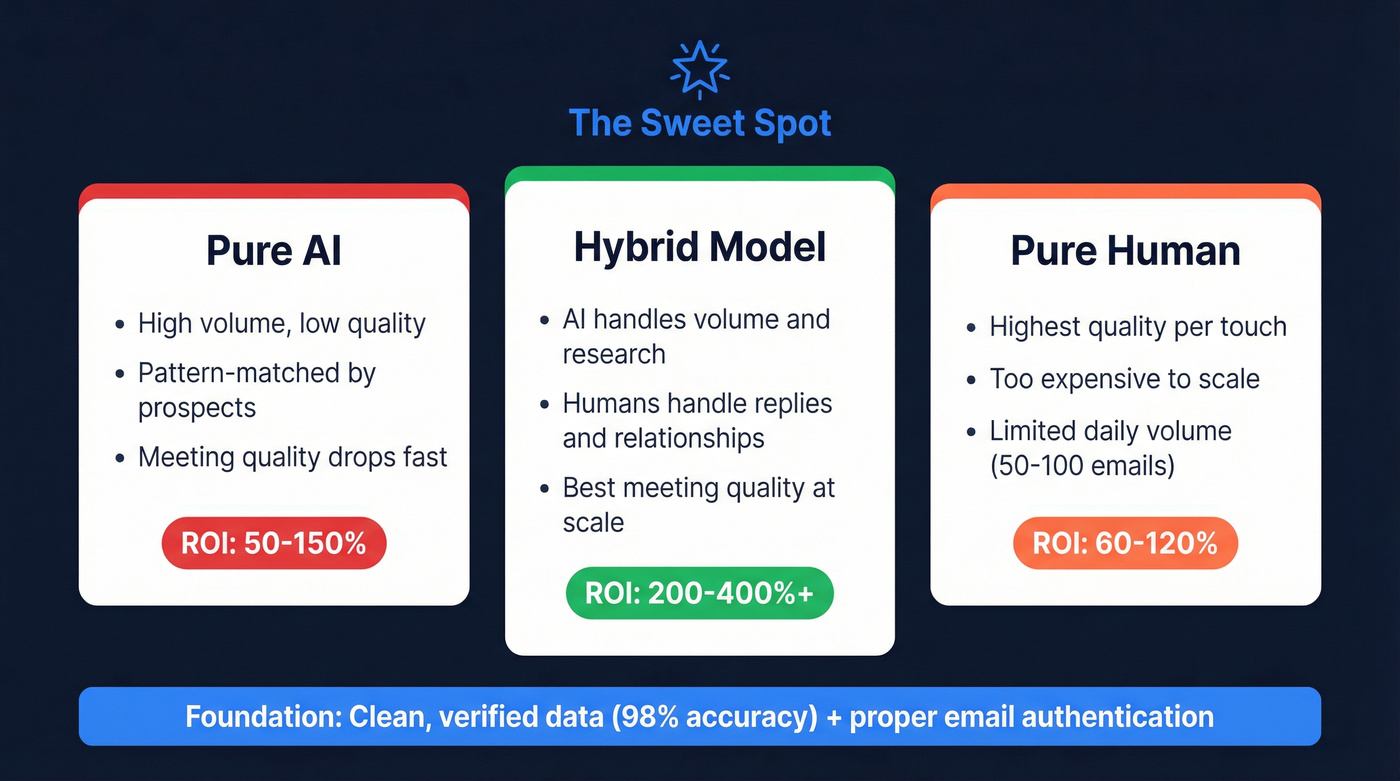
The hybrid model wins. AI + human outreach can deliver 200-400%+ ROI when the funnel is tracked end-to-end and meeting quality stays high. Pure AI underperforms on meeting quality. Pure human is too expensive per meeting. The sweet spot is AI handling volume and research while humans handle replies and relationships.
Data quality is the #1 lever. Start with clean, verified data. With Prospeo's 98% email accuracy, everything downstream - deliverability, sender reputation, reply rates - starts on solid ground. Skip this step and nothing else matters.
Expect churn. AI SDR tools churn 50-70% annually. Don't over-invest in any single platform until you've proven returns over 90 days.
2026 Benchmarks That Matter
The average cold email reply rate sits at 3.43%. That's the median. What separates the bottom from the top is personalization depth, list quality, and who you're targeting. C-level executives reply at 6.4%, and executives overall respond 23% more often than individual contributors - so your list composition matters as much as your copy.
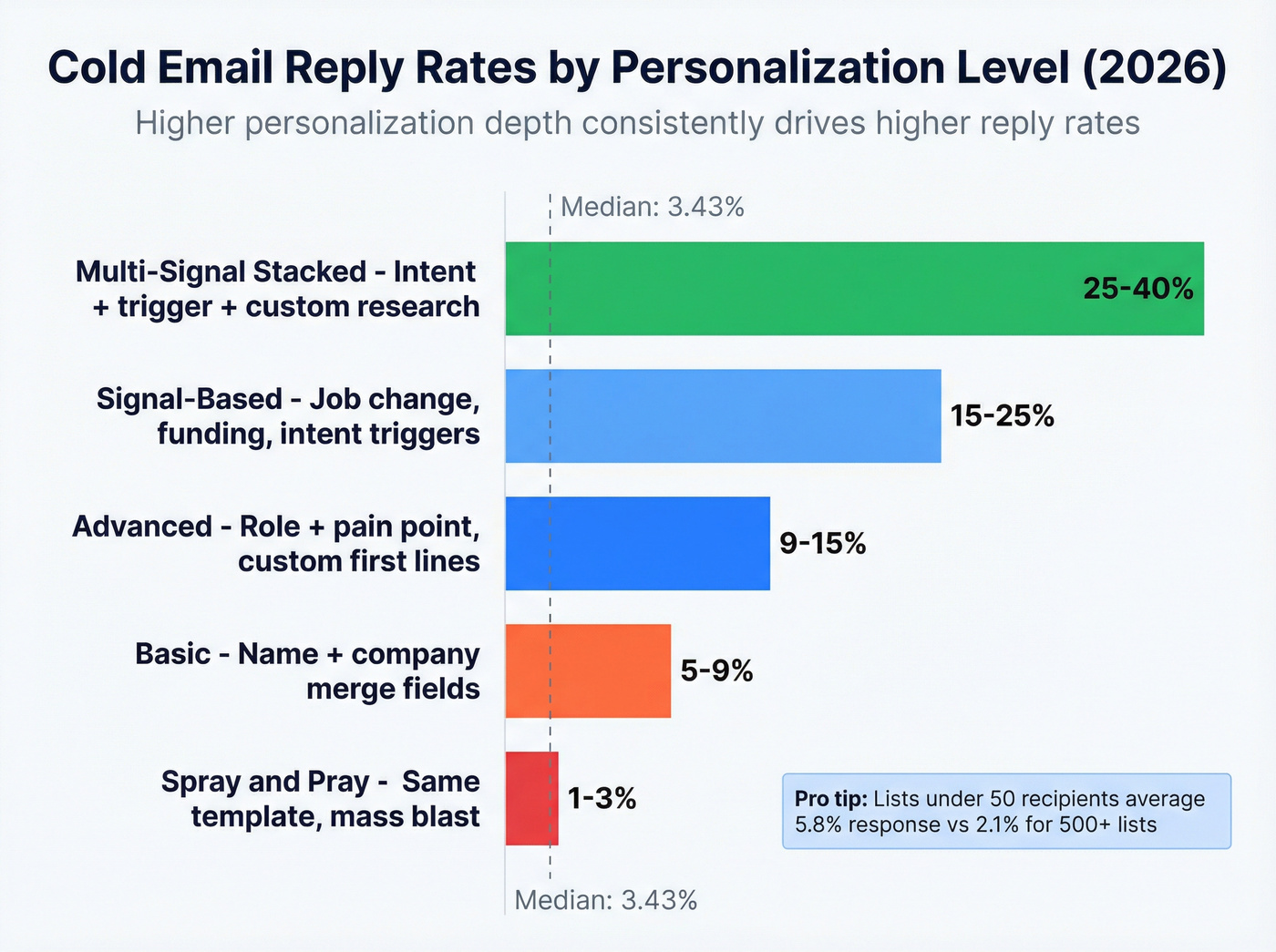
| Personalization Level | Reply Rate | What It Looks Like |
|---|---|---|
| None (spray and pray) | 1-3% | Same template, mass blast |
| Basic (name + company) | 5-9% | Merge fields, light research |
| Advanced (role + pain) | 9-15% | Custom first lines, ICP fit |
| Signal-based | 15-25% | Job change, funding, intent |
| Multi-signal stacked | 25-40% | Intent + trigger + custom |
Here's the thing: list size matters as much as personalization. Campaigns targeting 50 or fewer recipients average 5.8% response rates versus just 2.1% for lists over 500. Smaller, tighter lists consistently outperform volume plays.
| Channel | CPL | Meeting Rate |
|---|---|---|
| Cold email | $25-$50 | 1-3% |
| Cold calling | $75-$150 | 1-2% |
| Social outreach | $50-$100 | 2-5% |
| Paid ads | $100-$300+ | 0.5-2% |
Cold email is still the cheapest way to generate B2B meetings. The question isn't whether to do it - it's whether AI makes it more profitable or just louder.
The AI Outreach Paradox
Here's the contrarian take most vendors won't share: AI is simultaneously improving and degrading cold email. Every AI tool has converged on the same skeleton - soft opener, light personalization, broad value prop, low-friction CTA. Prospects pattern-match it in under two seconds.
We've watched this play out across multiple outbound stacks. Open rates hold steady while reply rates trend down over 4-8 weeks. The emails are landing. People are opening them. They're just not responding because every message in their inbox reads like it was written by the same algorithm.
One practitioner tested Copy.ai against manual writing and got a 4% response rate from AI versus 12% from hand-crafted emails. That's a 3x gap. AI copy isn't bad - it's just become the new generic.
The fix isn't better prompts. It's structural pattern breaks. Timeline-based CTAs ("Do you have 15 minutes this Thursday?") produce a 2.34% meeting rate versus just 0.69% for problem-based CTAs ("Struggling with X?"). Lead with a specific observation, move the insight earlier, and use a firm close instead of the overused "would it make sense to chat?"
If reply rates drop below 2% for two consecutive weeks, stop scaling and audit your list quality and email structure. Most teams do the opposite - they increase volume to compensate for declining rates, which accelerates domain reputation damage. Volume doesn't fix broken fundamentals.
How to Calculate Your Returns
Most teams measure reply rate and call it ROI. That's like measuring how many people walked into your store and ignoring whether anyone bought something.
The formula is straightforward: ROI = (Revenue - Cost) / Cost x 100
But the "cost" side is where teams consistently undercount. Your actual outbound cost isn't just the sending platform - it's domains ($10-$15 each), inboxes ($3-$5/mo each), warmup tools ($30-$100/mo), data and enrichment ($50-$500/mo), sending platforms ($37-$200/mo), AI writing tools ($49-$134/mo), and the human labor managing campaigns, reviewing replies, and booking meetings. Add all of that up before you divide.
You also need to distinguish cost per lead from cost per acquisition. A $30 CPL means nothing if those leads convert at 2% - your CPA is actually $1,500. Track both, and track stage-by-stage drop-off. Outreach's ROI calculator benchmarks show +44% more meetings booked and +20% more opportunities created, which are solid conservative modeling inputs when you want to stress-test your assumptions.

The article says it clearly: data quality is the #1 lever for AI outreach ROI. Prospeo's 98% email accuracy and 7-day refresh cycle mean your AI tools send to real inboxes - not bounces that torch your domain. At $0.01 per email, the data that makes or breaks your 400% ROI costs less than a rounding error.
Stop feeding your AI outreach stack dirty data.
Human vs. AI vs. Hybrid: The Real Math
Let's get concrete. Here are three scenarios for a B2B SaaS company with a $12K average deal size.
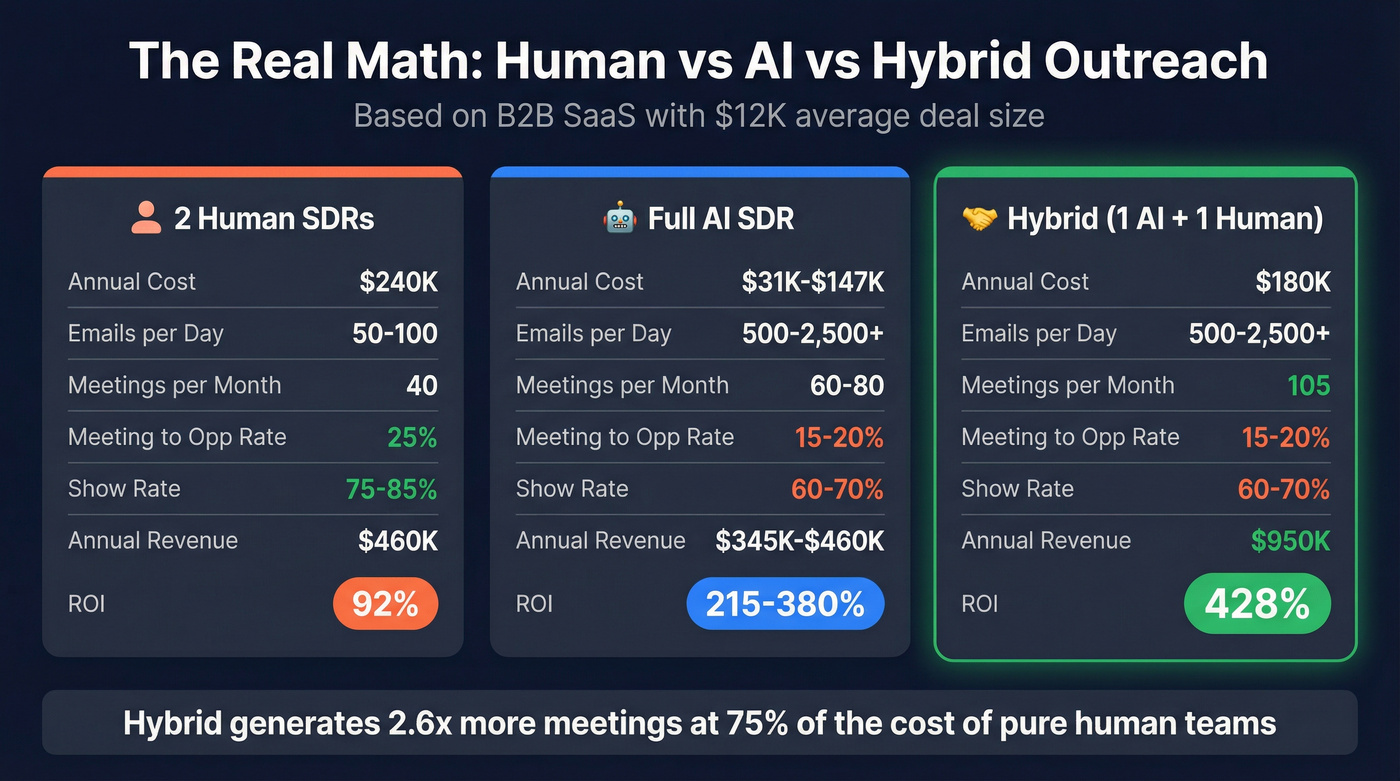
| Metric | 2 Human SDRs | Full AI SDR | Hybrid (1 AI + 1 Human) |
|---|---|---|---|
| Annual cost | $240K | $31K-$147K | $180K |
| Emails/day | 50-100 | 500-2,500+ | 500-2,500+ |
| Meetings/month | 40 | 60-80 | 105 |
| Meeting-to-opp rate | 25% | 15-20% | 15-20% |
| Show rate | 75-85% | 60-70% | 60-70% |
| Annual revenue* | $460,800 | $345K-$460K | $950,400 |
| ROI | 92% | 215-380% | 428% |
*Based on $12K ACV, 25% opp-to-close rate, and the meeting volumes above.
The hybrid model generates 105 vs 40 meetings per month (2.6x more) at 75% of the cost. Full AI looks attractive on paper - especially at the lower end of the cost range - but the quality gap is real. Human SDRs convert 25% of qualified leads to opportunities versus 15-20% for AI-sourced meetings. Show rates run 10-15 points lower too.
In our experience, the teams that see 400%+ returns invest most of their setup time on data quality and deliverability - not copy. AI also saves a lot of rep time on research and writing: one breakdown found 35% of teams save about 2 hours and 15 minutes per day. That's where the hybrid model shines. Humans spend their time on conversations instead of prospecting busywork.
Across outbound communities on Reddit and elsewhere, the most consistent complaint about AI SDR tools isn't performance - it's churn. Teams invest months configuring a platform only to see it pivot or shut down. The hybrid model hedges that risk by keeping institutional knowledge in your human reps.
Two Levers That Move ROI Most
Data Quality
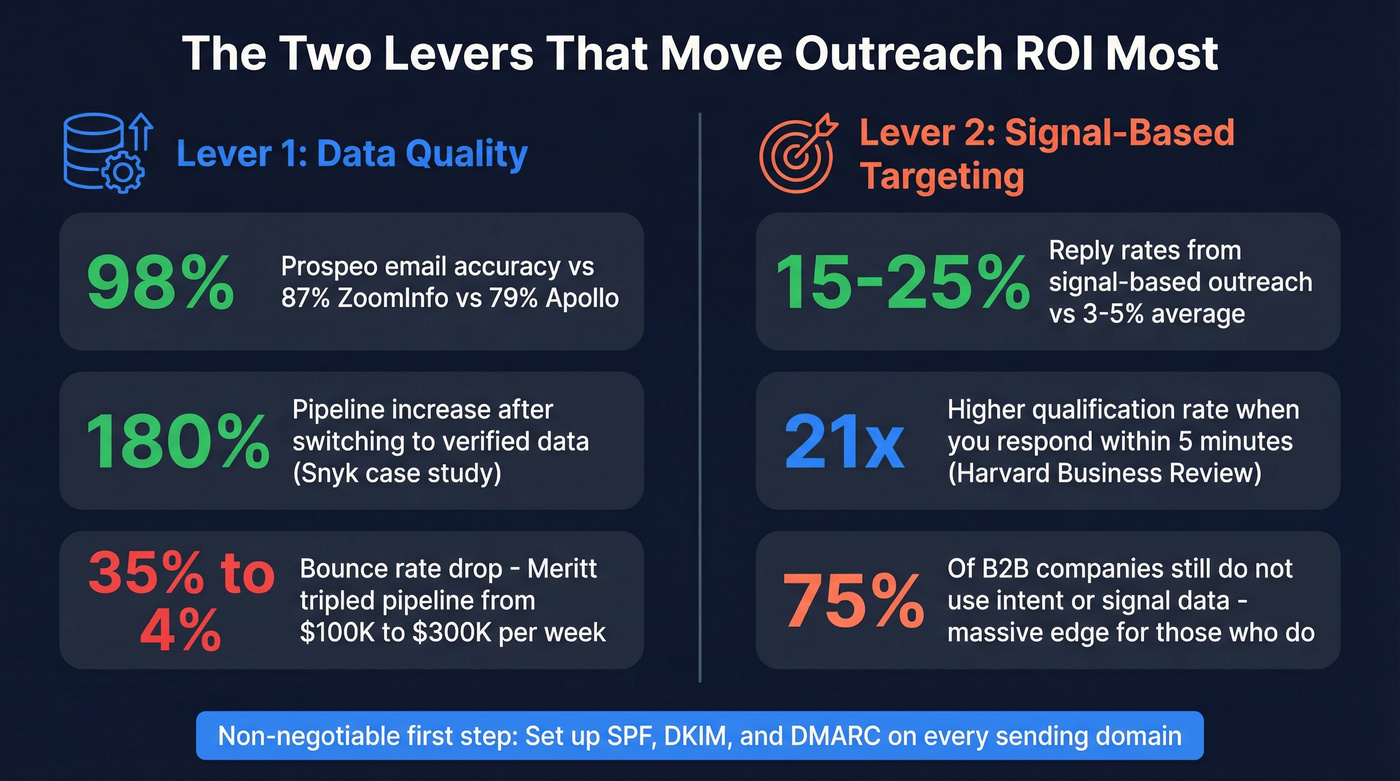
You can optimize copy, sequences, and send times all day. None of it matters if 15-20% of your emails bounce. High bounce rates trigger spam filters, tank your sender reputation, and create a cascading failure that takes weeks to recover from.

Meritt tripled their pipeline from $100K to $300K per week after switching to Prospeo - bounce rates dropped from 35% to under 4%. Snyk's 50-person AE team saw similar results: bounce rates fell from 35-40% to under 5%, AE-sourced pipeline jumped 180%, and they generated 200+ new opportunities per month. At 98% email accuracy versus 87% from ZoomInfo and 79% from Apollo, the difference isn't academic - it's the difference between a healthy sender domain and one that's flagged within two weeks.
If you want a deeper breakdown of what to measure and fix, start with a data quality scorecard and a proper prospect data accuracy audit.
Signal-Based Targeting
Only 25% of B2B companies currently use intent and signal data tools. That's a massive edge for teams that do. Signal-based outreach - targeting prospects showing active buying behavior - delivers 15-25% reply rates versus the 3-5% average.
Speed matters too. Harvard Business Review found that responding within 5 minutes yields 21x higher qualification rates than waiting 30 minutes. Layering intent data across 15,000 topics with job role and company growth filters lets you build lists of prospects actively in-market right now and reach them before competitors do.
If you’re building this motion, use an intent signals framework and a signal-based outbound workflow so your “signals” aren’t just vibes.
One non-negotiable before any of this matters: set up SPF, DKIM, and DMARC on every sending domain. Gmail and Yahoo bulk-sender requirements made authentication table stakes, and Microsoft followed with similar enforcement. Only 33.4% of top domains have valid DMARC records. Get authentication right before you spend a dollar on AI writing tools.
Hybrid outreach wins at 428% ROI - but only when your reps spend time on conversations, not list building. Prospeo's 30+ search filters, intent data across 15,000 topics, and job change signals let you build the tight, signal-stacked lists that drive 25-40% reply rates. Your AI handles volume. Your humans handle replies. Prospeo handles the data.
Build signal-rich lists in minutes, not hours.
What the Stack Actually Costs
Here's what a real outbound infrastructure runs at three volume tiers:
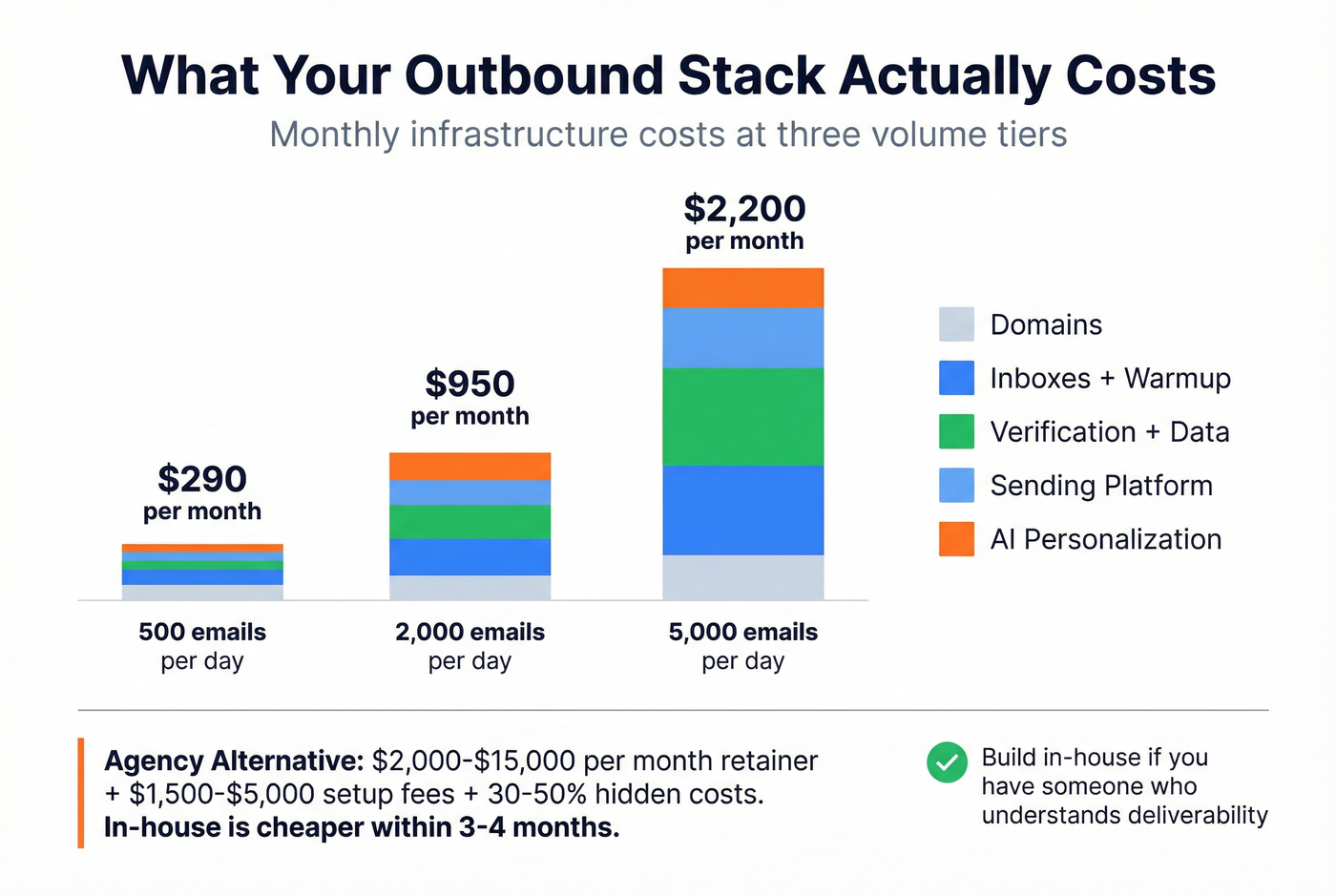
| Component | 500 emails/day | 2,000/day | 5,000/day |
|---|---|---|---|
| Domains (5/20/50) | $75/yr | $300/yr | $750/yr |
| Inboxes + warmup | $150/mo | $500/mo | $1,200/mo |
| Verification + data | $50/mo | $200/mo | $500/mo |
| Sending platform | $37/mo | $97/mo | $200/mo |
| AI personalization | $49/mo | $134/mo | $250/mo |
| Monthly total | ~$290 | ~$950 | ~$2,200 |
The alternative is outsourcing. Cold email agencies charge $2,000-$15,000/month on retainer, with setup fees of $1,500-$5,000 and pay-per-appointment models running $500-$1,000 per meeting. Hidden costs typically add 30-50% to the base retainer. For most teams doing 2,000+ emails per day, building in-house is cheaper within 3-4 months.
Skip the agency route if you already have one person who understands deliverability. The learning curve is steep but the economics are dramatically better once you're past it. If you’re comparing models, see the full breakdown of Cold Email Agency Pricing.
Risks Nobody Mentions
AI SDR tools churn at 50-70% annually. That's not a typo. Gartner projects 40%+ of agentic AI projects will be abandoned by the end of 2027. The tools are improving fast, but the market is volatile - don't sign annual contracts on platforms that might pivot or shut down.
Human SDR attrition isn't much better at 30-40% per year, with a typical tenure of 14-18 months and $4K-$10K in hiring costs per rep. The hybrid model helps here too - you need fewer humans, so turnover hurts less.
One practitioner spent $2,400 across 30 days testing 10 AI sales tools. Some worked brilliantly - Smartlead pushed inbox rates from 68% to 94%. Others flopped. Budget for experimentation. Assume your first tool pick won't be your last.
The Bottom Line
The teams winning at AI email outreach in 2026 aren't the ones with the fanciest AI tools. They're the ones with the cleanest data, the best targeting signals, and a human in the loop for the conversations that matter. Nail those three things and 200-400% ROI on your outreach investment is realistic. Skip them and you're just sending expensive noise.
FAQ
What's a realistic ROI for AI email outreach?
A hybrid model (AI + human) delivers 200-400%+ ROI when data quality and deliverability are solid. Pure AI delivers lower meeting quality with 15-20% opportunity conversion versus 25% for human-sourced meetings. Conservative first-year expectation: 150-250% ROI with proper infrastructure. The biggest variable isn't the AI tool - it's your bounce rate and targeting precision.
How long before AI outreach shows measurable returns?
Expect 4-8 weeks for domain warmup and deliverability stabilization before campaigns hit full stride. Meaningful performance data requires 2-3 months of campaign volume. Teams that see returns fastest invest in data quality first - starting with 98%-accuracy verified emails accelerates the entire warmup and reputation-building timeline.
Is cold email still worth the investment in 2026?
Yes. Cold email CPL ($25-$50) remains 2-6x cheaper than paid ads ($100-$300+) or cold calling ($75-$150). But the execution bar has risen sharply. Deliverability compliance (SPF/DKIM/DMARC), data accuracy, and signal-based targeting are table stakes now - not differentiators. Teams that nail the fundamentals still generate pipeline at scale.