

Sales Outreach: What the Data Says Actually Works in 2026
It takes 344 cold emails to book a single meeting. That's the average across millions of outbound emails. Meanwhile, the top 10% of reps book 8.1x more meetings than everyone else - using the same channels, the same hours in the day, and often the same tools.
The gap isn't effort. It's method.
The Short Version
That 344-email stat isn't a death sentence - it's what happens when reps send mediocre messages to unverified lists. Here's what separates top performers:
- Fix your data before your copy. Untargeted lists get 67% fewer replies. A perfect email sent to a bad address is just a bounce waiting to happen.
- Use a 5-7 touch multi-channel cadence. 58% of replies come from the first email, but the other 42% come from follow-ups most reps never send.
- Keep emails short and problem-first. Pitching in a cold email drops reply rates by up to 57%. Lead with the prospect's problem, not your product. Top performers keep emails under 80 words.
What Is Sales Outreach?
Sales outreach is the act of proactively contacting potential buyers who haven't raised their hand. It's the opposite of inbound - you're initiating the conversation, not waiting for it. The meaning has shifted over the past decade: it's no longer just cold calling from a spreadsheet. Modern outreach is multi-channel by default - cold email, phone, social touches, and occasionally direct mail, run as a structured cadence. The goal isn't to sell on the first touch. It's to earn the right to a conversation.
2026 Outreach Benchmarks
Before you optimize anything, you need to know what "good" looks like.
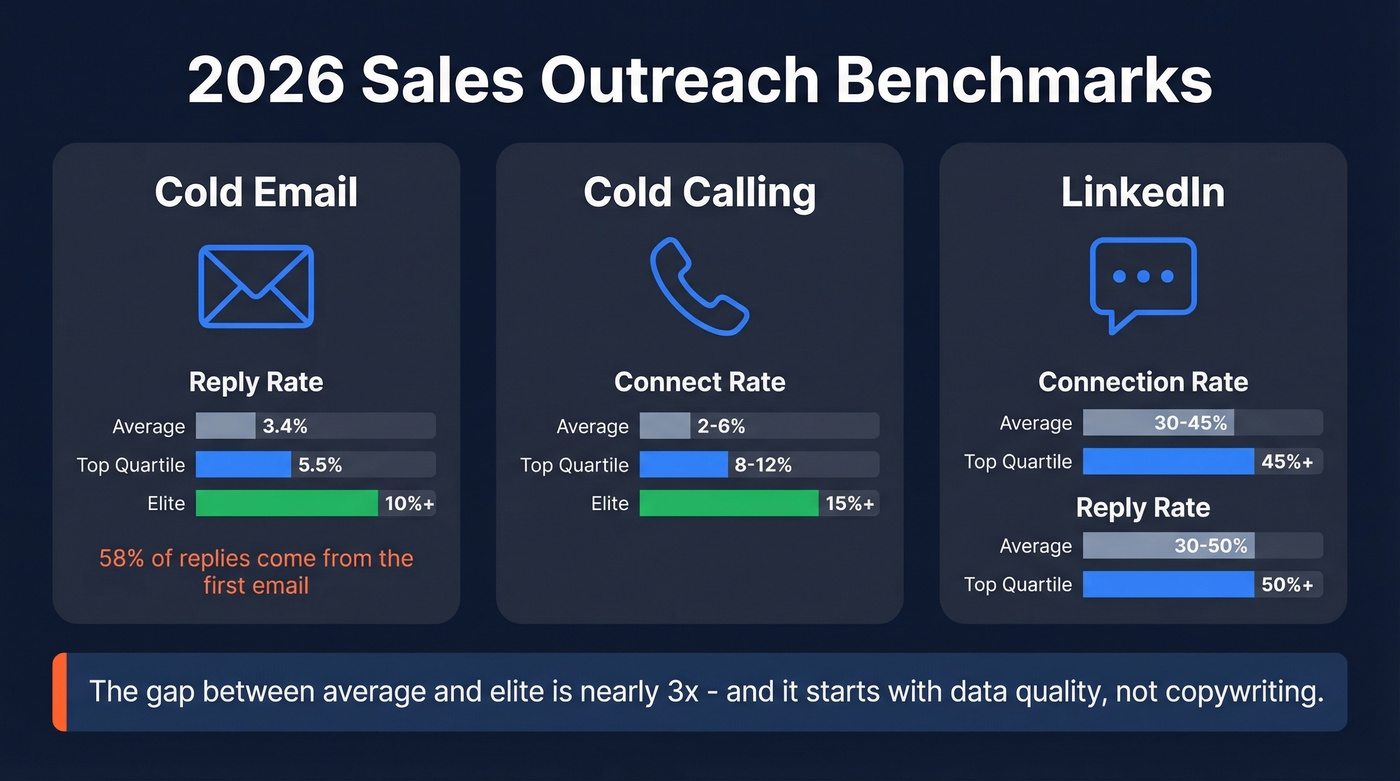
| Channel | Metric | Average | Top Quartile | Elite |
|---|---|---|---|---|
| Cold Email | Reply rate | 3.43% | 5.5%+ | 10%+ |
| Cold Email | Replies from step 1 | 58% | - | - |
| Cold Call | Connect rate | 2-6% | 8-12% | 15%+ |
| Connection rate | 30-45% | 45%+ | - | |
| Reply rate | 30-50% | 50%+ | - |
A few things jump out. Cold email reply rates are low in absolute terms, but the spread between average and elite is enormous - nearly 3x. LinkedIn connection and reply rates are surprisingly strong, yet most teams still treat social as an afterthought. And deals that close within 50 days hit a 47% win rate versus 20% or lower after that threshold, which means speed compounds at every stage of the pipeline.
If you're below 3% on cold email reply rates, don't rewrite your subject lines yet. Check your data quality and deliverability first - those are the silent killers. (If you need a full checklist, use this email deliverability playbook.)
Build Your Target List First
The single biggest lever in outbound prospecting isn't copywriting. It's targeting.
Small campaigns of 50 or fewer recipients achieve 5.8% reply rates versus 2.1% for large blasts. That's nearly 3x the performance just from tightening your list. We've seen this pattern over and over: teams that spend an extra hour building a precise list outperform teams that spend that hour agonizing over email copy.
Here's the thing - if your average deal size is under $10K, you probably don't need a $30K/year data platform. But you absolutely need verified contacts. Bad data costs more than good tools. (If you're comparing vendors, start with data enrichment services and email list providers.)
The ICP checklist that actually matters:
- Role and seniority - Are you reaching the decision-maker or an adjacent title?
- Company size and revenue band - Does this company have the budget and pain your product solves?
- Tech stack signals - Are they running a competitor's tool or a complementary platform?
- Intent and trigger events - Job changes, new funding rounds, hiring surges, and topic-level intent signals all indicate timing.
Untargeted lists don't just underperform - they actively damage your domain reputation when bounces pile up. Prospeo's 30+ search filters, including buyer intent across 15,000 topics and technographics, with records refreshed on a 7-day cycle, are built to solve exactly this problem. That targeting precision is what turns a 2% reply rate into a 6% one. (For a scoring rubric, use an ideal customer profile template.)
Three Mistakes That Kill Reply Rates
Before we get into cadences, here are the three errors we see tank outbound campaigns most often:
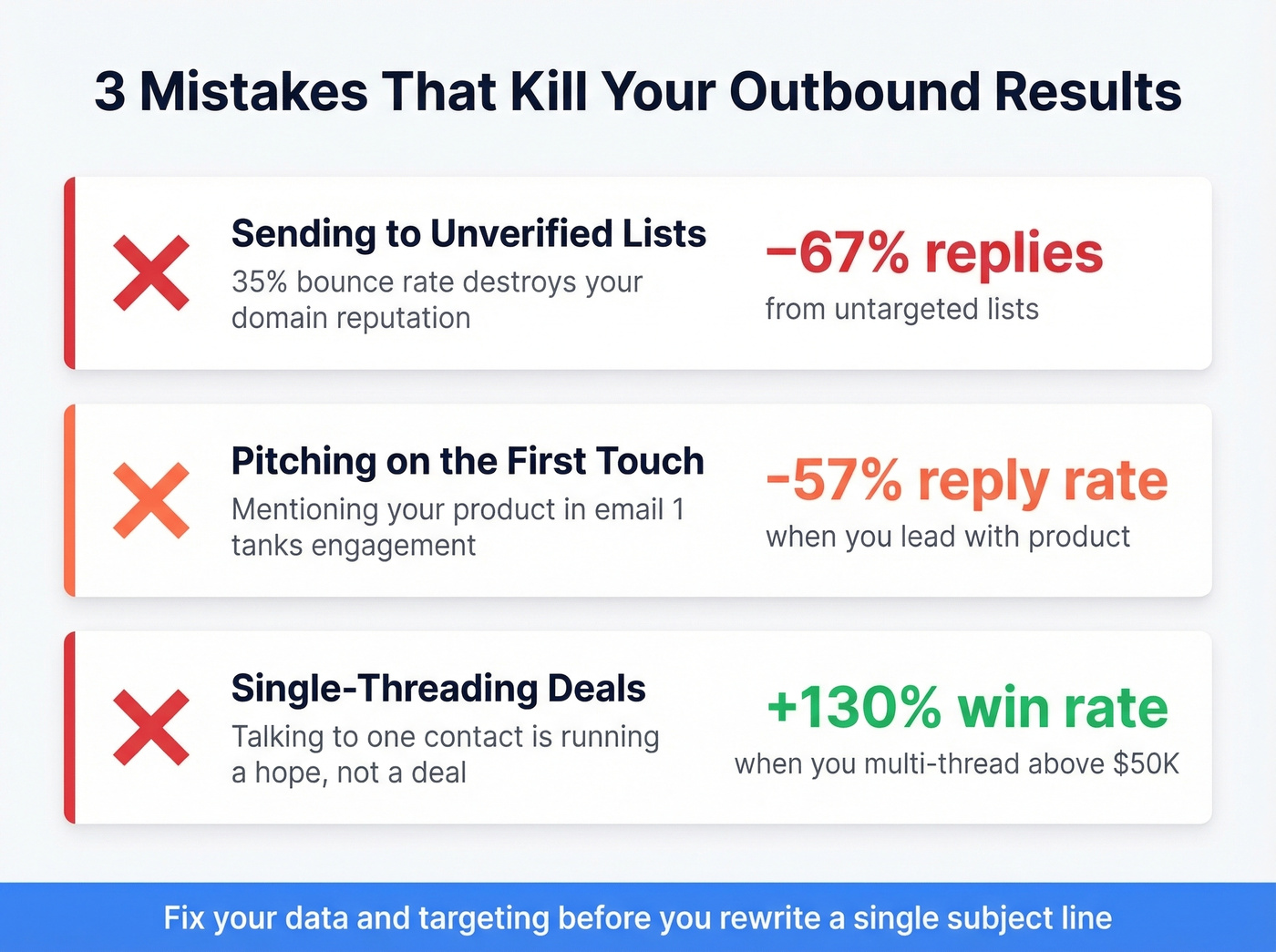
Sending to unverified lists. A 35% bounce rate doesn't just waste sends - it actively destroys your domain reputation, which takes months to rebuild. Run every list through verification before a single email goes out. (More benchmarks and fixes: email bounce rate.)
Pitching on the first touch. Cold email data across millions of messages is unambiguous: mentioning your product in the opening email drops reply rates by up to 57%. Lead with the prospect's problem instead. (If you want a deeper framework, see emails that get responses.)
Single-threading deals. Talking to one contact at a target account isn't running a deal - it's running a hope. Closed-won deals have roughly 2x as many buyer contacts as closed-lost. For anything over $50K, multi-threading boosts win rates by 130%. (This pairs well with account-based selling when deal size is high.)

You just read that untargeted lists get 67% fewer replies and 35% bounce rates destroy domains. Prospeo's 30+ filters - buyer intent, technographics, job changes, funding - with 98% email accuracy and a 7-day refresh cycle, turn those numbers around before you write a single word of copy.
Stop optimizing emails that bounce. Start with data that connects.
Outreach Cadence Templates
Most reps either send one email and give up, or blast seven messages that all say "just checking in." Both fail. The sweet spot is 4-7 touches spaced 3-4 days apart, where each touch adds genuinely new value. (If you need ready-to-send copy, use these sales follow-up templates.)
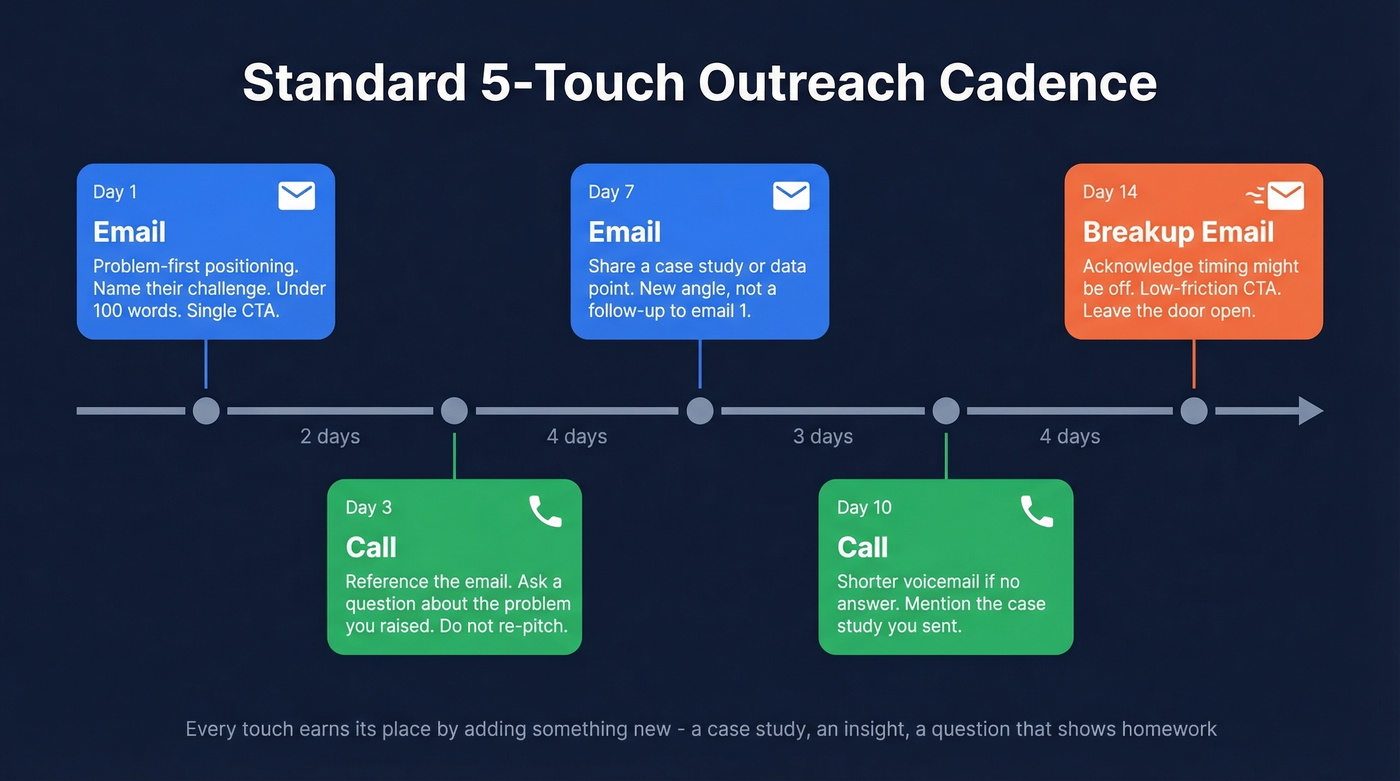
Template 1: Standard 5-Touch Cadence
- Day 1 - Email: Problem-first positioning. Name a specific challenge their role faces. Single CTA. Under 100 words.
- Day 3 - Call: Reference the email. Don't re-pitch - ask a question about the problem you raised.
- Day 7 - Email: Share a case study or data point relevant to their industry. New angle, not a follow-up to the first email.
- Day 10 - Call: Shorter voicemail if no answer. Mention the case study you sent.
- Day 14 - Breakup email: Acknowledge you might have the wrong timing. Leave the door open with a low-friction CTA.
Template 2: Intent-Triggered Burst
When a prospect shows active buying signals - visiting your pricing page, spiking on an intent topic, or changing jobs - compress the cadence:
- Within 24 hours - Email: Reference the signal directly. "Saw your team's been evaluating [category]" or "Congrats on the new role."
- Day 2 - Call: Strike while the signal is fresh.
- Day 4 - Email: Different angle - industry insight or competitive comparison.
- Day 6 - Social touch: Short, conversational message. No pitch.
- Day 7 - Final call/email: Direct ask or clean breakup.
The design principle behind both templates: every touch earns its place by adding something new. A case study, a relevant insight, a question that shows you've done your homework. "Just bumping this to the top of your inbox" is the fastest way to get archived. (Alternatives here: how to say just checking in professionally.)
Sample Cold Email (Under 100 Words)
Subject: hiring 3 AEs?
Hi {{firstName}},
Noticed {{company}} posted three AE roles this month - usually means pipeline targets just went up.
When teams scale that fast, the bottleneck shifts from closing to feeding reps enough qualified pipeline. That's the problem we solve for teams like [similar company].
Worth a 15-minute call to see if it's relevant?
- [Your name]
That's 62 words. Problem-first, one CTA, no pitch. This format consistently outperforms longer, feature-heavy emails.
Channel Playbook
Cold Email
The highest-performing cold emails run 3-4 sentences and stay under 100 words. Pitching your product in the first email drops reply rates by up to 57% - lead with the prospect's problem instead.
Subject lines matter more than most reps think. Buzzwords and numbers reduce open rates by up to 17.9%. The best-performing subject lines are 4 words or fewer, lowercase, and read like an internal message - think "quick question about [team]" rather than "Unlock 3X Revenue Growth!" Tuesday and Wednesday are peak send days. (More examples: cold email subject line examples.)
One CTA per email. Not "let me know if you'd like to chat or if there's someone else I should reach out to." Pick one ask. (If you want rules + examples, see email call to action.)
Cold Calling
The talk-to-listen ratio for top performers is 43/57 - they listen more than they speak. But here's the underrated insight: consistency matters more than script. High performers maintain a steady talk ratio across won and lost deals, while low performers swing by ~10%. (If you're building a repeatable motion, use a cold calling system.)
Calls compound with email touches. A prospect who's seen your name in their inbox twice is meaningfully more likely to stay on the line. If a prospect opens your email twice but doesn't reply, that's your signal to pick up the phone. Pair calls with your email cadence - don't run them in isolation.
LinkedIn outreach gets surprisingly strong numbers: 30-45% connection acceptance rates and 30-50% reply rates. The tactical advice from practitioners who hit those numbers is consistent - skip the connection note, keep messages short, and use a value-based CTA rather than asking for a meeting on the first touch. Think of LinkedIn as the warmest cold channel.
Direct Mail
In a world where every prospect gets 50 cold emails a week, a personalized physical letter stands out. One practitioner on r/sales reported higher response rates from handwritten-style letters than from any email campaign they'd run. Direct mail isn't scalable, and that's the point. Reserve it for your top 20-30 target accounts where the deal size justifies the effort. (More tactics: direct mail for lead generation.)
Skip this if your average deal size is under $5K - the unit economics won't work.
Deliverability Infrastructure
None of your outreach matters if your emails land in spam. In 2026, the rules are stricter than ever. Google, Yahoo, and Microsoft enforce bulk sender requirements that'll wreck your deliverability if you ignore them. You need all of these:
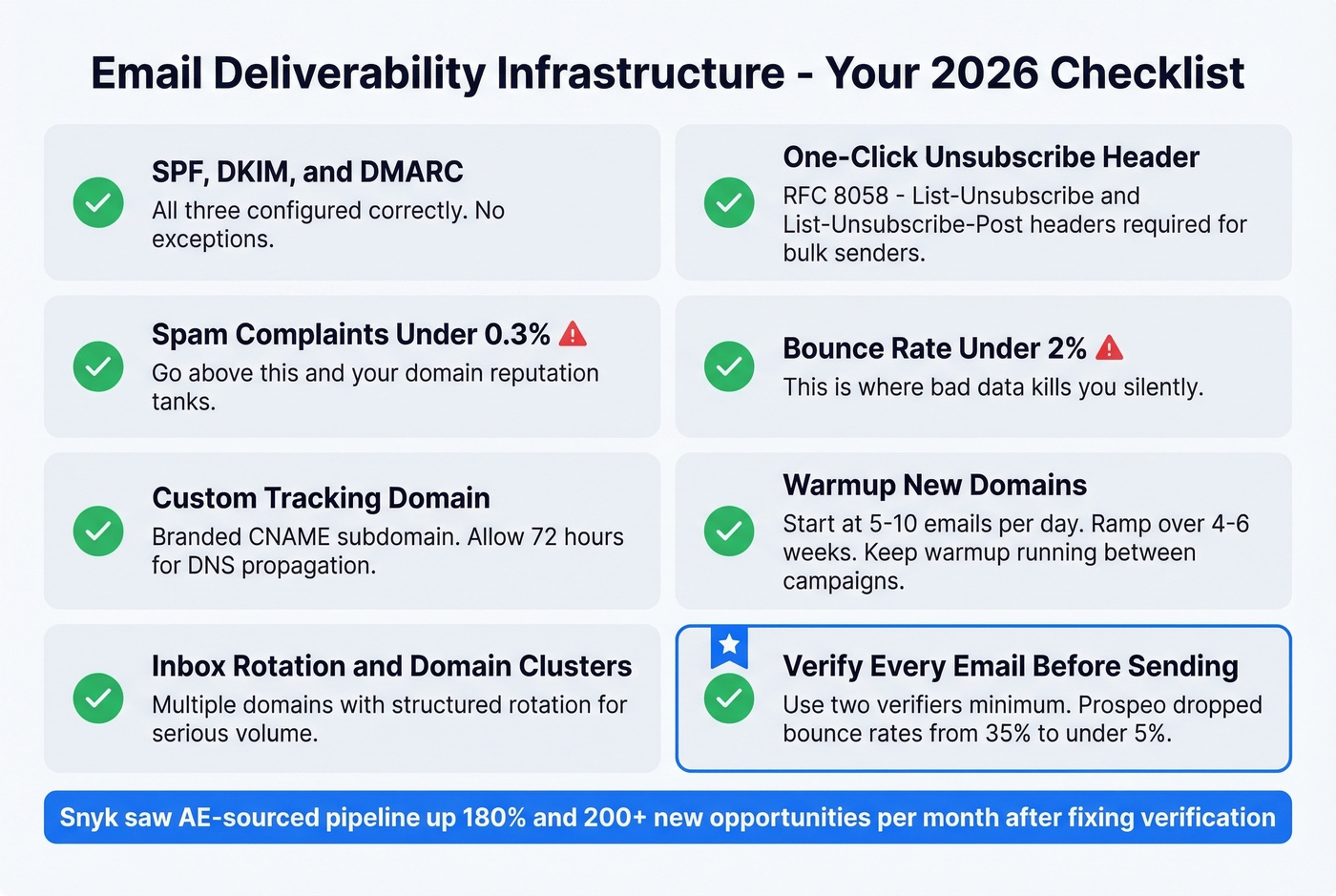
- SPF, DKIM, and DMARC - All three configured correctly. No exceptions.
- One-click unsubscribe header (RFC 8058) - List-Unsubscribe and List-Unsubscribe-Post headers are required for bulk senders.
- Spam complaints under 0.3% - Go above this and your domain reputation tanks.
- Bounce rate under 2% - This is where bad data kills you silently.
- Custom tracking domain - Set up a branded CNAME subdomain. Allow 72 hours for DNS propagation. (Setup guide: tracking domain.)
- Warmup new domains - Start at 5-10 emails per day, ramp gradually over 4-6 weeks. Keep warmup running between campaigns.
- Inbox rotation and domain clusters - The consensus on r/salesdevelopment is that serious cold emailers run multiple domains with structured inbox rotation. Tools like Smartlead handle this.
- Verify every email before sending - Run lists through verification, and practitioners recommend using two verifiers minimum.
That last point deserves emphasis. Snyk's 50 AEs saw bounce rates drop from 35-40% to under 5% after switching to Prospeo's 5-step verification process, with AE-sourced pipeline up 180% and 200+ new opportunities per month. That's what clean data does to outbound performance.
Real talk: if you're running outbound at any meaningful volume and you haven't verified your lists recently, you're probably burning domain reputation right now. The fix takes minutes.
Intent-triggered cadences only work when you catch the signal in time. Prospeo tracks 15,000 intent topics via Bombora and pairs them with verified emails and 125M+ direct dials - so when a prospect spikes on your category, you reach them within hours, not weeks.
Catch buying signals and reach real inboxes at $0.01 per email.
Personalization That Scales
Cold email reply rates have dropped from roughly 8.5% in 2019 to around 4% today. The culprit isn't channel fatigue - it's the flood of generic, AI-generated messages that all sound the same.
The framework that works uses three layers. The industry layer references a trend, regulation, or challenge specific to their vertical - this scales easily across segments. The company layer mentions something specific to their business: a recent funding round, a job posting that signals a priority, a tech stack choice. The individual layer is a detail about the person: a podcast appearance, a post they wrote, a career move. Reserve this for your highest-value targets. (More: personalized outreach.)
Sam McKenna's "Show Me You Know Me" framework distills this perfectly - reference something specific about the prospect in the first line. Teams running it hit 43% open rates and 20% reply rates. Signal-personalized emails hit 18% response rates versus the 3.43% average. That's a 5x lift from targeting and relevance alone. The math is clear: 50 highly personalized emails outperform 500 generic ones every time.
Multi-Threading and AI
Multi-Thread Every Deal
We've seen teams lose deals they should've won because they were single-threaded to one champion who went on vacation. An analysis of 1.8M opportunities makes the case definitively: 77% of deals involve multiple buyer contacts, and closed-won deals have roughly 2x as many as closed-lost. For deals over $50K, multi-threading boosts win rates by 130%.
Enterprise deals average 17 contacts on the buying side. If you're only talking to one or two people, you're not running a deal.
AI in Outreach
AI users generate 77% more revenue than non-users, per an analysis of 7.1M opportunities. And 45% of teams are already running a hybrid AI-SDR model where AI handles research, personalization drafts, and sequencing while humans handle the actual conversations.
But AI can't fix bad inputs. AI personalization built on stale data produces confidently wrong emails - mentioning a job someone left six months ago, or a company that's already been acquired. AI amplifies whatever you feed it. Feed it verified, fresh data and it's a force multiplier. Feed it garbage and you'll fail faster than ever. (If you're operationalizing this, start with AI cold email outreach.)
Sales Outreach Tools Worth Evaluating
The right stack depends on your volume, budget, and how much you want integrated versus best-of-breed. Here's how things break down:
| Tool | Category | Starting Price | Best For |
|---|---|---|---|
| Prospeo | Data + Verification | ~$0.01/email (free tier) | Verified emails + mobiles |
| Apollo.io | Data + Sequencing | ~$49/mo/user | Database + outreach for SMBs |
| Instantly | Cold Email | ~$30/mo | High-volume email + warmup |
| Smartlead | Cold Email | ~$39/mo | Inbox rotation at scale |
| Outreach | Sales Engagement | ~$1,000-$3,000/user/yr | Enterprise sequencing |
| Salesloft | Sales Engagement | ~$1,000-$3,000/user/yr | Enterprise multi-channel |
| HubSpot Sales Hub | CRM + Sequencing | Free-~$100+/mo/seat | CRM-native outreach |
In our experience, the tool doesn't matter if your data is wrong. Pick a sequencer you like, but make sure the contacts going into it are verified and fresh. That's the foundation everything else sits on. (If you're building a shortlist, start with SDR tools.)
FAQ
How many touchpoints should a cadence have?
The sweet spot is 4-7 touches spaced 3-4 days apart. Beyond 7, you hit diminishing returns unless each additional touch delivers genuinely new value. Front-load your strongest message and treat follow-ups as opportunities to add new angles, not reminders.
What's a good cold email reply rate in 2026?
The average is 3.43%, top quartile campaigns hit 5.5%+, and elite campaigns exceed 10%. If you're consistently below 3%, audit your data quality, deliverability setup, and list targeting before rewriting copy - those are the most common root causes.
What does outreach involve day to day?
For most SDRs and AEs, it means running structured multi-channel cadences - sending personalized emails, making cold calls, engaging on LinkedIn, and following up based on prospect behavior signals. The best reps spend more time on research and targeting than on actual sending.
How do you keep cold emails out of spam?
Authenticate your domain with SPF, DKIM, and DMARC. Warm up new sending domains for 4-6 weeks before production volume. Verify every email address before sending - a 5-step verification process that catches spam traps and invalid addresses at 98% accuracy makes a real difference. Keep spam complaints under 0.3% and bounces under 2%.
The reps booking 8x more meetings aren't working harder. They're running tighter sales outreach - fewer, better messages to verified contacts at the right time. Fix your data, tighten your list, and let every touch earn its place.