

List Building in 2026: The Complete Dual-Track Guide
Your SDR spent three hours on list building last Tuesday. Pulled contacts from a database, enriched them, loaded them into the sequencer. Half the emails bounced on the first send. Meanwhile, your marketing team's newsletter signup form has been converting at 0.3% for six months and nobody's noticed. Both sides of most organizations have a broken approach to building lists - and most guides only cover one half of the problem.
Two completely different disciplines hide behind this phrase, and they require different tools, different metrics, and different mindsets.
What You Need (Quick Version)
Building an email subscriber list? Start with Kit or Mailchimp - both have free tiers. Add OptinMonster for popups once you're past 10K monthly visitors. Aim for 2-5% monthly list growth and clean your list quarterly.
Building a B2B prospect list? Use Prospeo paired with HubSpot's free CRM and Instantly ($47/mo) for outreach. That's a complete stack under $100/month that'll outperform most enterprise setups on data quality.
Here's the thing most people miss: the biggest mistake isn't growing too slowly. It's never cleaning. A 10,000-person list with 35% dead emails is worse than a 3,000-person list that's verified and engaged.
Two Kinds of List Building
It's the process of collecting contact information from people you want to communicate with. But the execution splits into two tracks depending on whether those people come to you or you go find them.
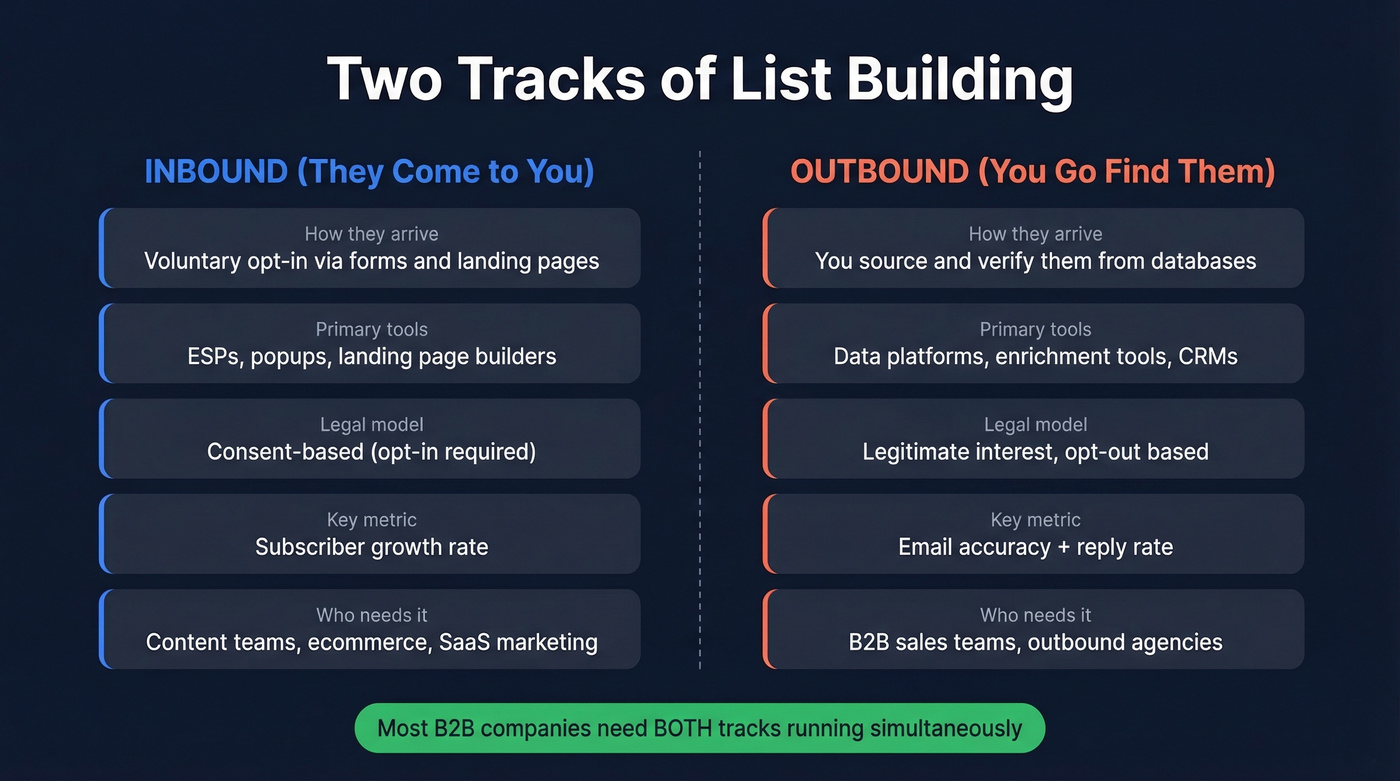
| Inbound Email List | Outbound Prospect List | |
|---|---|---|
| How contacts arrive | They opt in voluntarily | You source and verify them |
| Primary tools | Forms, landing pages, ESPs | Data platforms, enrichment, CRMs |
| Legal model | Consent-based (opt-in) | Legitimate interest / opt-out |
| Key metric | Subscriber growth rate | Email accuracy + reply rate |
| Who needs it | Content, ecommerce, SaaS | B2B sales, outbound agencies |
Most B2B companies need both tracks running simultaneously. Your marketing team builds the inbound list to nurture long-term demand while your sales team assembles prospect lists to generate pipeline right now. The Chet Holmes buyers' pyramid concept puts it well: only the top 3% of your market is actively buying at any given time. Inbound captures the 97% over time. Outbound targets the 3% today.
Email List Building (The Inbound Track)
Signup Forms That Convert
Not all forms are created equal. The conversion gaps are massive. Embedded forms sitting in your sidebar or footer convert at 0.5-1% - they're table stakes, not growth engines. Exit-intent popups perform better at 2-5%, catching visitors who've already consumed your content and are about to leave. Lead magnet landing pages, where the entire page exists to deliver one specific resource, convert at 5-20%.
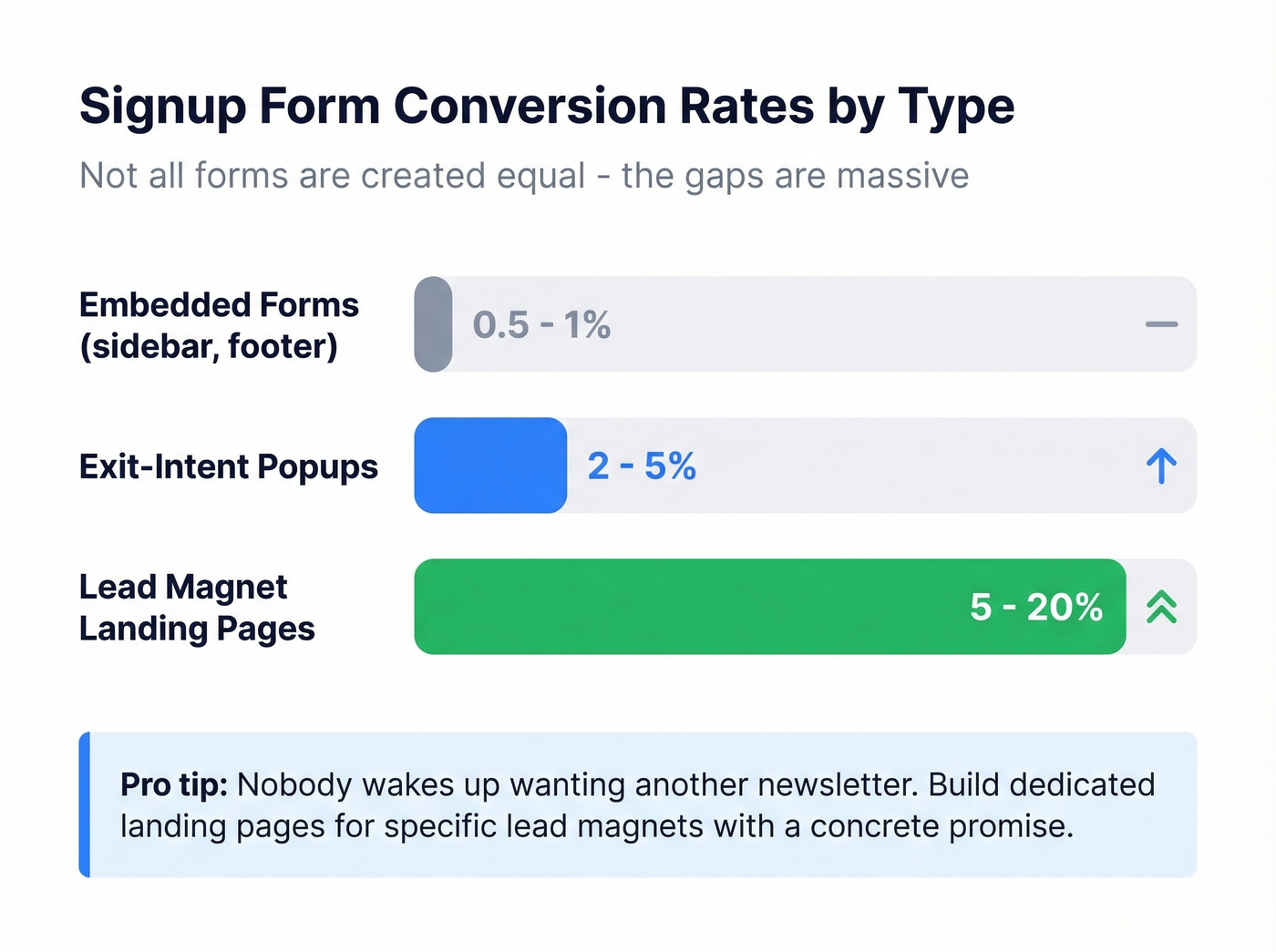
Use embedded forms everywhere as a baseline, then add exit-intent popups on your highest-traffic pages. The biggest waste of traffic? Sending visitors to a generic "subscribe to our newsletter" page. Nobody wakes up wanting another newsletter. Build dedicated landing pages for your best lead magnets and tell visitors exactly what they'll get.
Lead Magnets Worth Building
The lead magnets that convert best are specific and immediately useful. Templates and checklists outperform ebooks almost every time because they promise a concrete outcome, not just information. A "Cold Email Template Pack" beats "The Ultimate Guide to Cold Email" because one saves time today and the other requires homework.
What works right now: templates, checklists, mini-courses of 3-5 emails, free tools or calculators, and swipe files. "7 Subject Lines That Got 40%+ Open Rates" beats "Email Marketing Best Practices" every time because specificity wins. If you need inspiration, pull from proven email subject lines and adapt them to your lead magnet.
Growth Tactics That Compound
Start with your newsletter value proposition - make it so clear that someone can explain it in one sentence. Then layer these tactics in priority order:
- Content upgrades on your top 10 blog posts (highest ROI per effort hour)
- Social promotion of your best lead magnets, not just blog links
- Referral programs - tools like SparkLoop let subscribers earn rewards for sharing
- Cross-promotions with complementary newsletters in your space
Content upgrades should be your first move. In our testing, they convert 3-5x better than generic popups because they're contextually relevant to what the reader is already consuming.
Inbound Tools and Pricing
| Tool | Free Tier | Paid From | Best For |
|---|---|---|---|
| Kit (formerly ConvertKit) | 10K subs | ~$29+/mo | Creators, newsletters |
| Mailchimp | 500 subs | $13/mo | Small business, ecommerce |
| beehiiv | 2.5K subs | ~$49+/mo | Newsletter-first brands |
| ActiveCampaign | None | ~$29/mo | Advanced automation |
| Brevo | Yes | ~$9+/mo | Transactional + marketing |
| OptinMonster | None | ~$9+/mo | Popup/form optimization |
| Unbounce | None | ~$99+/mo | Landing page testing |
Start with Kit or Mailchimp - their free tiers are generous enough to validate your approach before spending anything. Add OptinMonster when your traffic justifies the investment; 10K+ monthly visitors is the inflection point where popup optimization starts paying for itself. Skip Unbounce until you're running paid traffic to dedicated landing pages.
B2B Outbound List Building
Define Your ICP First
If you can't describe your ideal buyer in one sentence, your list will be garbage. Every outbound list starts with a precise Ideal Customer Profile. Nail these down before you touch a data tool:
- Industry and sub-vertical - not just "SaaS" but "B2B SaaS, $5-50M ARR, selling to enterprise"
- Company size by headcount and/or revenue range
- Geography - data coverage varies dramatically by region and provider
- Decision-maker titles - VP Sales, Head of Sales, and CRO aren't interchangeable
- Buying triggers like recent funding, new hires, tech stack changes, or job postings
- Pain points your product actually solves
This isn't busywork. Research shows 20-40% of SDR time goes to manual data research instead of selling. A tight ICP cuts that waste because you're not sifting through irrelevant contacts.
Advanced tactic: Find thought leaders your ICP follows and prospect their commenters. They've already self-identified as interested in the topic.
The 5-Step Workflow
Most teams overcomplicate this. Five steps, and the best tools collapse several into one:
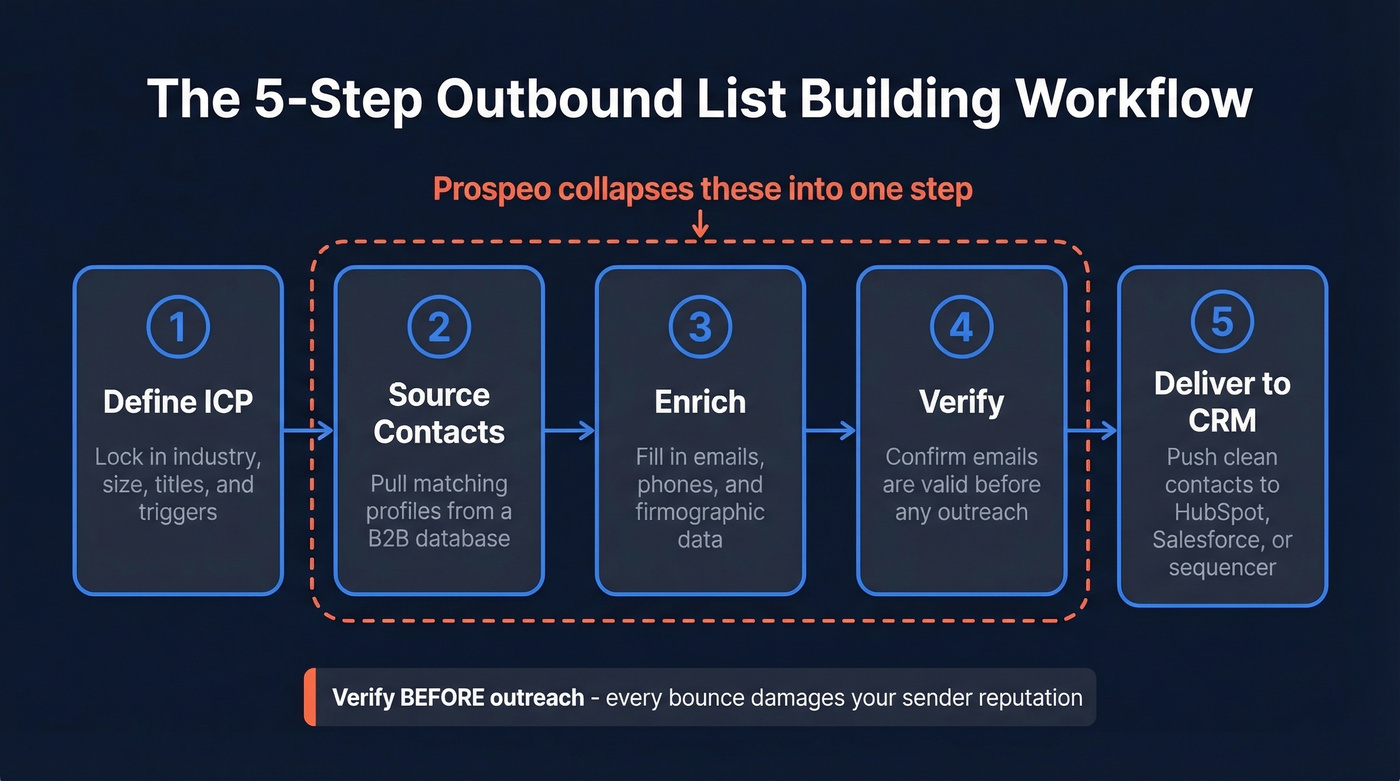
- Define ICP - lock in your filters (industry, size, titles, triggers)
- Source contacts - pull matching profiles from a B2B database
- Enrich - fill in missing emails, phone numbers, and firmographic data
- Verify - confirm emails are valid and phones are direct dials before outreach
- Deliver to CRM - push clean contacts into Salesforce, HubSpot, or your sequencer
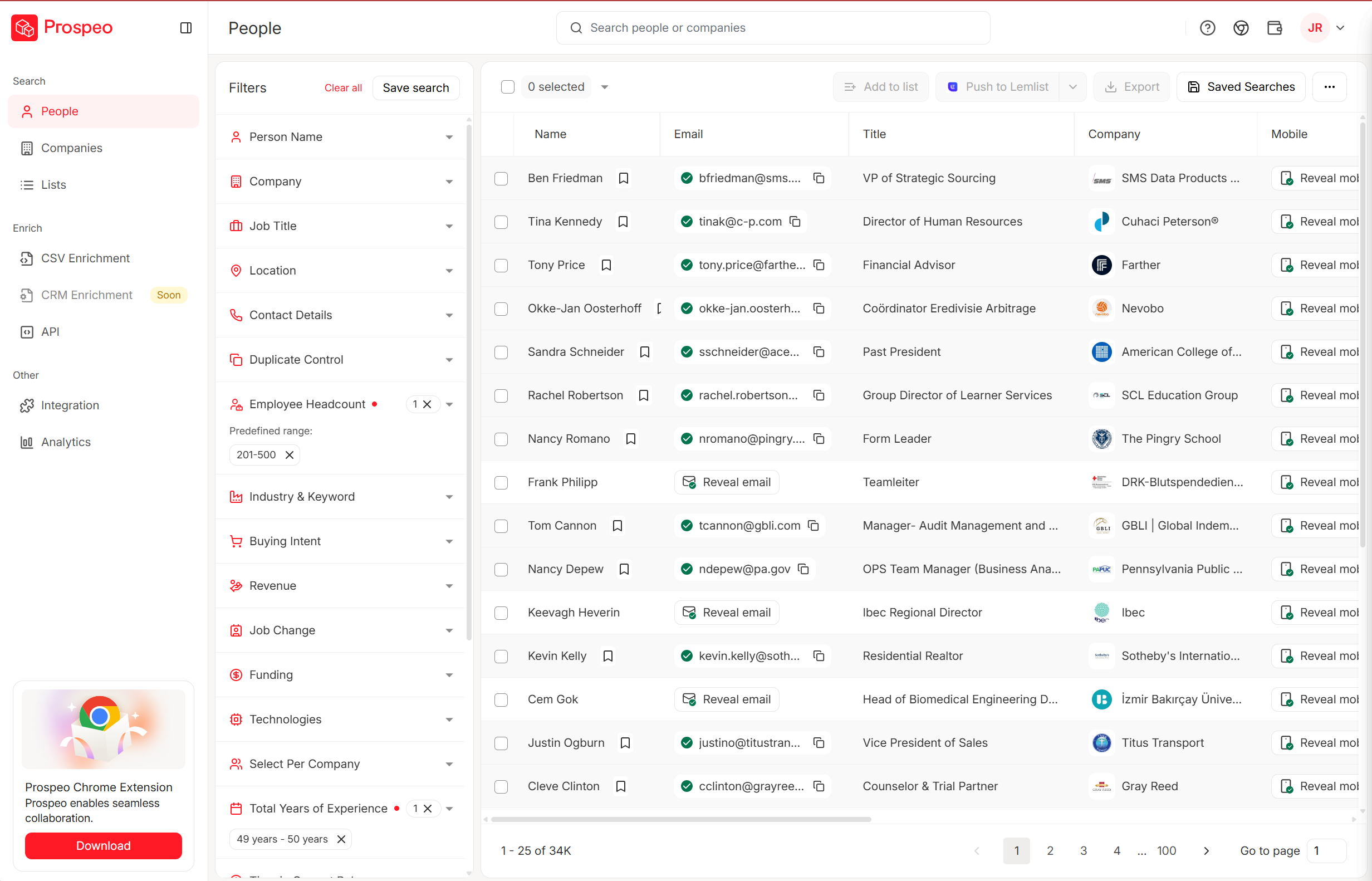
The frustration on r/sales is real: one SDR described spending two hours moving leads from Sales Navigator to Salesforce to SalesLoft. That's a workflow problem, not a volume problem. The right tool collapses steps 2-4 into a single action - search with filters including buyer intent and firmographic and technographic data, get verified emails and mobiles back, and push directly to your CRM or sequencer.
Verification must happen before outreach, not after. Every bounced email damages your sender reputation, and once that's gone, even your good emails land in spam. (If you’re troubleshooting, start with email bounce rate benchmarks and root causes.)
B2B Tools Compared
| Tool | Starting Price | Email Accuracy | Phone Coverage | Best For |
|---|---|---|---|---|
| Prospeo | Free / ~$0.01/email | 98% | 125M+ mobiles, 30% pickup | SMBs, agencies, data quality |
| Apollo | $49/mo | 70-80% | 30-60% | High-volume prospecting |
| ZoomInfo | $14,995/yr | 85-91% | 60-75% | Enterprise, US-focused |
| Hunter | $34/mo | 90%+ (limited find) | No phone data | Email-only use cases |
| Seamless.AI | $147/mo | ~80-85% | ~40-60% | AI-powered discovery |
| Kaspr | Free tier | 75-87% | 50-85% | European prospecting |
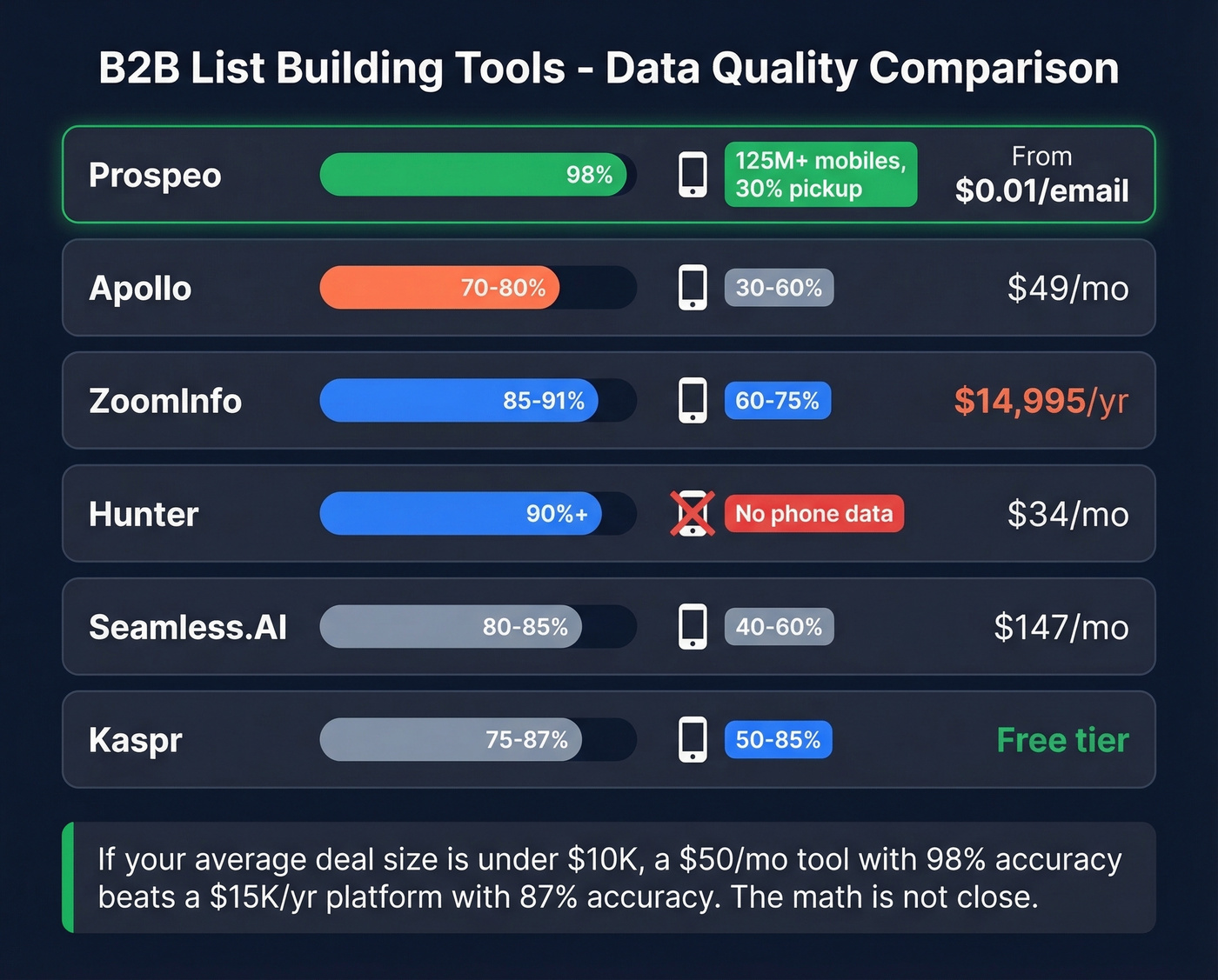
Apollo is the volume play - massive database, solid free tier, and a built-in sequencer that gets reps moving fast. But 70-80% email accuracy means you're bouncing 1 in 4 or 5 emails, which compounds when you're running high-volume campaigns.
ZoomInfo at $14,995/year is overkill for teams under 50 reps. The data quality is strong in the US, but the consensus in sales communities is that European data doesn't justify the price tag. You're also paying for intent, chat, and workflow features most teams never activate.
Hunter is solid for email-only use cases but doesn't include phone data. If your outbound motion includes cold calling - and it should - that's a partial solution at best.
Let's be honest: if your average deal size is under $10K, you don't need ZoomInfo-level tooling. A $50/month data provider with 98% accuracy will outperform a $15K/year platform with 87% accuracy every single time. The math isn't close. If you’re evaluating vendors, start with a shortlist of sales prospecting databases and compare accuracy vs total cost.

That 5-step workflow? Prospeo collapses steps 2-4 into one action. Search 300M+ profiles with 30+ filters - buyer intent, technographics, funding, job changes - and get 98% verified emails back instantly. Push clean lists straight to HubSpot, Salesforce, or your sequencer. Starting at $0.01/email.
Stop spending hours on lists that bounce. Build one that converts.
What to Expect (Timeline)
We've tracked dozens of outbound campaigns, and the 30-60 day timeline holds. Most structured outbound efforts generate meetings within that window. If you're not seeing traction by day 60, the problem is usually list quality or messaging, not volume. Sending more emails to bad addresses won't fix a broken list. For a rep-by-rep rollout, use a 30-60-90 day plan to keep execution consistent.
You read it above: 20-40% of SDR time goes to manual data research. Prospeo's 7-day data refresh cycle means your prospect lists stay current - not stale like the 6-week industry average. 125M+ verified mobiles with 30% pickup rates. 98% email accuracy so you never torch your domain again.
A 10,000-person list means nothing if a third of it bounces.
Benchmarks: What Good Looks Like
Email Performance
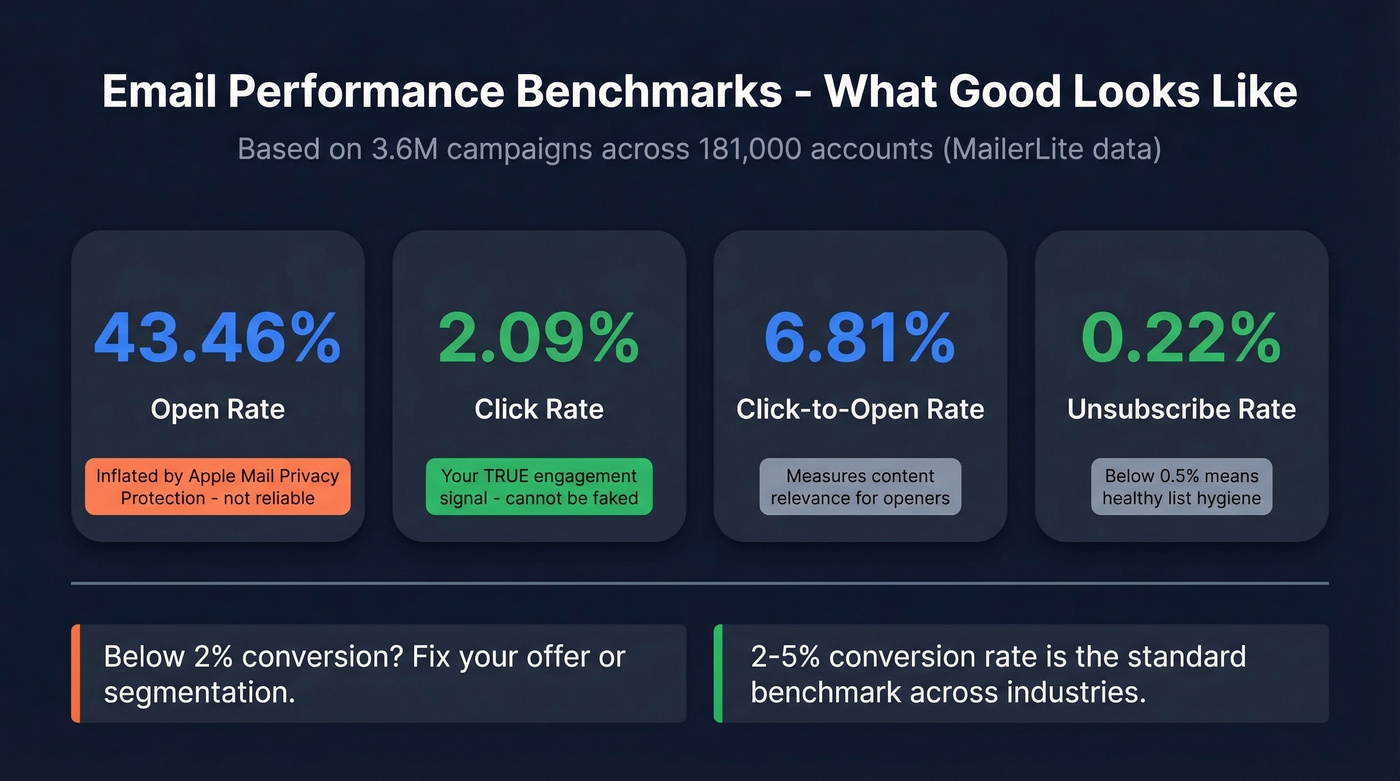
A MailerLite analysis of 3.6M campaigns across 181,000 accounts gives us the most reliable cross-industry medians available:
| Metric | Median (All Industries) |
|---|---|
| Open rate | 43.46% |
| Click rate | 2.09% |
| Click-to-open rate | 6.81% |
| Unsubscribe rate | 0.22% |
One important caveat: Apple Mail Privacy Protection inflates open rates by pre-loading tracking pixels. Real opens are lower than 43%. Focus on click rate - 2.09% median - as your true engagement signal. It can't be faked. Industry-specific rates range from 30% to 56%, so benchmark against your vertical, not the global median. (If you want to go deeper, use the click rate formula consistently across campaigns.)
For conversion rates - subscribers who actually take a desired action - 2-5% across industries is the standard benchmark. Below 2%, your offer or segmentation needs work. Above 5%, you're doing something right.
List Growth Math
The formula that matters:
Net Growth Rate = (New Subs - Unsubs - Bounces) / Total Subs x 100
Healthy lists grow 2-5% per month, which translates to roughly 25-35% annually. That sounds comfortable until you factor in decay: the average email list loses 20-30% of its addresses every year through job changes, abandoned inboxes, and unsubscribes.
Run the math on a 10,000-person list. At 25% annual decay, you're losing 2,500 addresses per year - about 210 per month - just to stay flat. You need at least 25-30% annual growth to maintain your current list size. Anything below that and you're shrinking, even if your signup forms are still collecting addresses every day.
List Hygiene: The Part Everyone Skips
Decay Is Real
A ZeroBounce study found that more than a quarter of the average email database degrades every year. People change jobs - the average tenure at a tech company is under 3 years - abandon inboxes, or simply stop engaging. Every dead address drags down your deliverability metrics and trains inbox providers to treat your emails as unwanted.
A 10,000-person list with 35% dead emails is worse than a 3,000-person list that's clean. The smaller list will outperform on every metric that matters - opens, clicks, replies, and revenue per send. Size without quality is a vanity metric.
Deliverability Guardrails
Keep these thresholds tattooed on your dashboard:
- Bounce rate under 2% - anything higher and you risk spam folder placement
- Spam complaint rate under 0.3% - this is the line Gmail and Yahoo enforce
- Authentication required for anyone sending 5,000+ daily emails to Gmail/Yahoo recipients
If your bounce rate is over 2%, stop sending and start cleaning. Every send above that threshold compounds the damage to your sender reputation. If you need a remediation checklist, follow an email deliverability guide before you scale volume again.
Authentication Setup
You need three protocols configured. SPF tells receiving servers which IP addresses can send on your domain's behalf. DKIM adds a cryptographic signature proving your emails haven't been tampered with in transit. DMARC tells receiving servers what to do when SPF or DKIM checks fail - quarantine, reject, or report.
Gmail and Yahoo already enforce these for high-volume senders. Microsoft is expected to follow. If you haven't set up all three, your deliverability is on borrowed time.
Compliance: What You Can't Ignore
The penalties for getting compliance wrong aren't theoretical. CAN-SPAM violations carry fines of $53,088 per email. GDPR fines reach EUR 20M or 4% of global annual turnover - whichever is higher.
The critical distinction: CAN-SPAM operates on an opt-out model (you can email people until they say stop), while GDPR requires explicit opt-in consent before you send anything. If you're selling into Europe, GDPR applies regardless of where your company is based. CCPA applies if your business has over $25M in revenue or buys/sells personal information of 50,000+ California residents.
Your operational checklist:
- Physical address in every email
- Clear unsubscribe link
- Opt-outs honored within 10 business days
- Consent records stored and accessible
- Documented data retention policy
- No misleading "From" headers or deceptive subject lines
Miss any of these and you're exposed.
Building Your Tool Stack
A modern stack for building and managing lists draws from five categories: popup/form builders, landing page builders, email platforms, B2B prospecting tools, and CRM/automation. You don't need one from each. You need 3-5 that actually connect to each other without manual CSV exports in between.
Lean stack ($100-300/mo): Your data provider, Instantly ($47/mo for outreach), and HubSpot's free CRM. This covers sourcing, verification, sequencing, and pipeline tracking for under $150/month. If you’re auditing your setup, start with the core SDR tools and remove anything that doesn’t reduce manual work.
Mid-market stack ($500-1,500/mo): Add Clay ($149/mo) for multi-source enrichment workflows, upgrade your CRM to Salesforce or HubSpot paid, and layer in an intent data source for ABM motions.
The selection heuristic is straightforward: choose based on your primary outreach channel and ICP geography. For teams selling into Europe, GDPR compliance in your data provider isn't optional - it's the first filter. If your motion is primarily cold email, deliverability and email accuracy matter more than phone coverage. If you're running a blended phone and email approach, mobile number quality becomes the deciding factor.
FAQ
What is list building?
List building is the process of collecting contact information - emails, phone numbers, firmographic data - from people you want to reach. It splits into inbound (subscribers who opt in through forms and lead magnets) and outbound (prospects you identify and verify using B2B data tools). Most B2B companies need both tracks running in parallel.
How fast should my email list grow?
Healthy lists grow 2-5% per month, roughly 25-35% annually. Since lists naturally lose 20-30% of addresses per year through decay, you need at least 25% annual growth just to maintain your current size. Below that, your list is actually shrinking even if new signups keep arriving.
Is buying email lists worth it?
Almost never. Purchased lists carry high bounce rates, trigger spam complaints that damage your sender reputation, and violate GDPR outright. Build your own through opt-in forms for inbound, or use verified B2B data tools for outbound prospecting where every email is verified before export.
How often should I clean my email list?
At minimum, quarterly. Remove hard bounces immediately after every send, re-engage inactive subscribers every 90 days with a win-back sequence, and run your full list through a verification tool before any major campaign. Prevention is cheaper than reputation repair - a single bad send can tank deliverability for weeks.
What's a good email open rate in 2026?
The cross-industry median is 43.46% based on MailerLite's analysis of 3.6M campaigns. Apple Mail Privacy Protection inflates that number by pre-loading tracking pixels, though. Focus on click rate - 2.09% median - as your true engagement signal. It can't be gamed by privacy features.