

Decision Maker Definition: What It Means (And Why the Dictionary Won't Help You Close Deals)
You gave the perfect demo. The prospect nodded along, asked smart questions, even said "this is exactly what we need." Then - radio silence. Three weeks, two follow-ups, nothing. The problem wasn't your pitch. You were talking to someone who couldn't actually say yes.
Getting the decision maker definition right is the difference between a closed deal and a wasted quarter.
The Textbook Definition vs. What Actually Matters
A decision maker is a person who makes decisions - specifically, someone with the authority to choose a course of action from available alternatives. Merriam-Webster traces the first known use to 1887.
That's the dictionary answer. It's technically correct and practically useless if you sell B2B sales. The real meaning in business goes deeper: it's the person who controls budget, can approve a purchase, and has the organizational authority to say yes or no to your deal. That distinction is everything, and to define this role in a way that actually helps your sales team, you need to move well past the dictionary.
The Short Version
- The dictionary says "a person who makes decisions." In B2B, that tells you nothing.
- A real decision maker has budget authority and can approve or kill a purchase.
- The average B2B deal involves 13 stakeholders - only one or two are actual decision makers.
- 86% of B2B purchases stall before completion. Targeting the wrong person is the fastest way to join that statistic.
Why Finding the Real Decision Maker Matters So Much
Here's the math that should keep every sales leader up at night. Buyers spend just 17% of their total purchasing time meeting with vendors - and that's split across every vendor in the running. If you're one of three options, you get maybe 5-6% of the buyer's attention. Spend that sliver on someone who can't sign off, and you've wasted the only window you had.
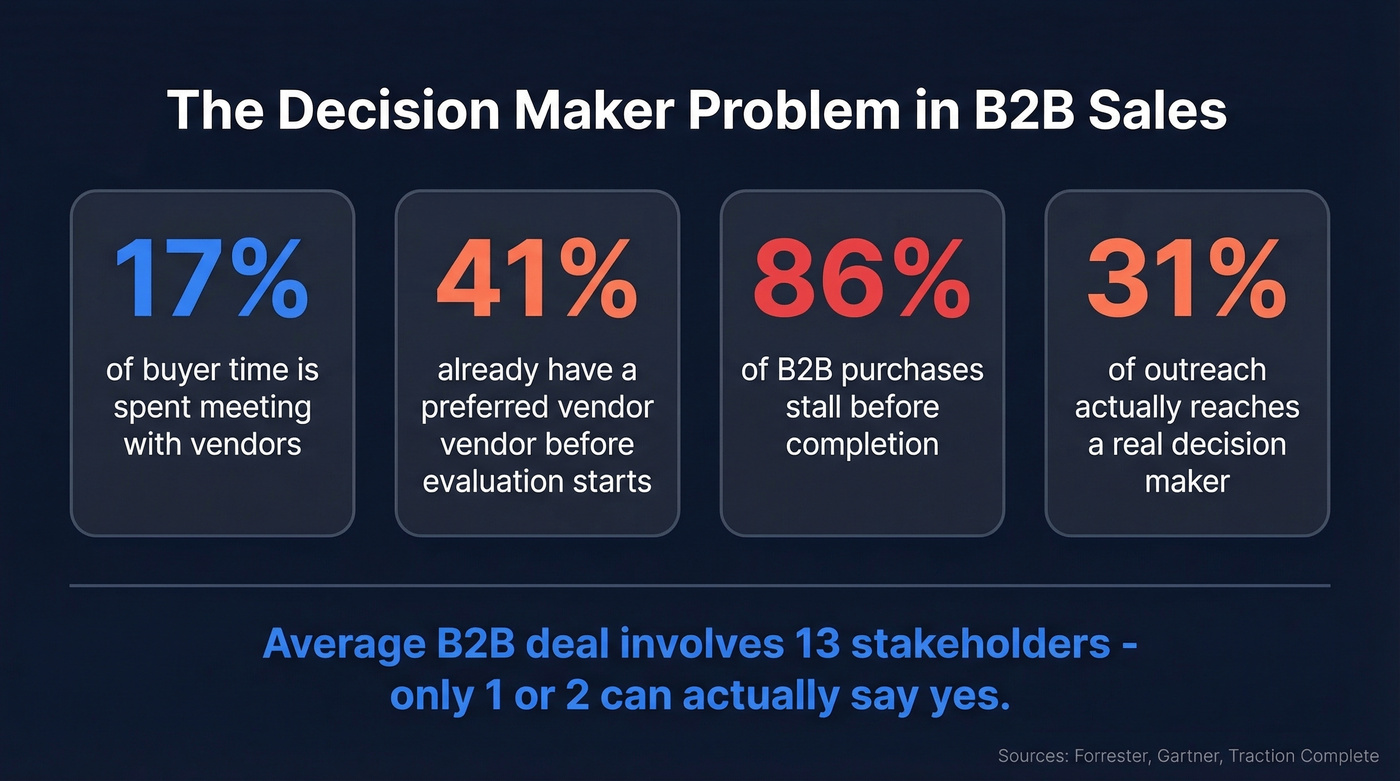
It gets worse. 41% of buyers already have a preferred vendor before the formal evaluation even starts, 86% of B2B purchases stall before completion, and 89% of buying decisions cross multiple departments. The person you're emailing in marketing may need sign-off from finance, IT, and operations before anything moves.
We've seen this pattern dozens of times: a rep builds a great relationship with a mid-level champion, runs a flawless evaluation, and then discovers the real authority sits with a VP of Finance they've never spoken to. The champion didn't lie - they genuinely believed they could push it through. But belief isn't budget authority. The deal stalls, the quarter slips, and the rep starts over.
Sales teams typically reach only about 31% of actual decision makers, according to Gartner research. That means nearly seven out of ten outreach attempts land on someone who can't close the deal. Fixing that ratio is the single highest-leverage thing most B2B teams can do.
Buying Committee Roles Explained
The Classic Framework (Bonoma, 1982)
Thomas Bonoma introduced the "buying center" model in Harvard Business Review back in 1982, and it's still the foundation most sales methodologies build on. He identified six roles: initiators who recognize the need, influencers who shape requirements, deciders who make the final call, purchasers who handle procurement, users who live with the product daily, and gatekeepers who control information flow.
Simple, durable, still relevant. If you use MEDDIC or MEDDPICC, you'll recognize Bonoma's Decider as the "Economic Buyer" and his Influencers as the "Champion" and "Coach" roles. The vocabulary changed; the dynamics didn't.
How It Looks Today
For complex B2B solutions, the core buying group runs 6-10 people, each bringing 4-5 pieces of independent research to the table. And with the average enterprise running 367 apps, the technical buyer's voice has never been louder. Here's how those roles break down:
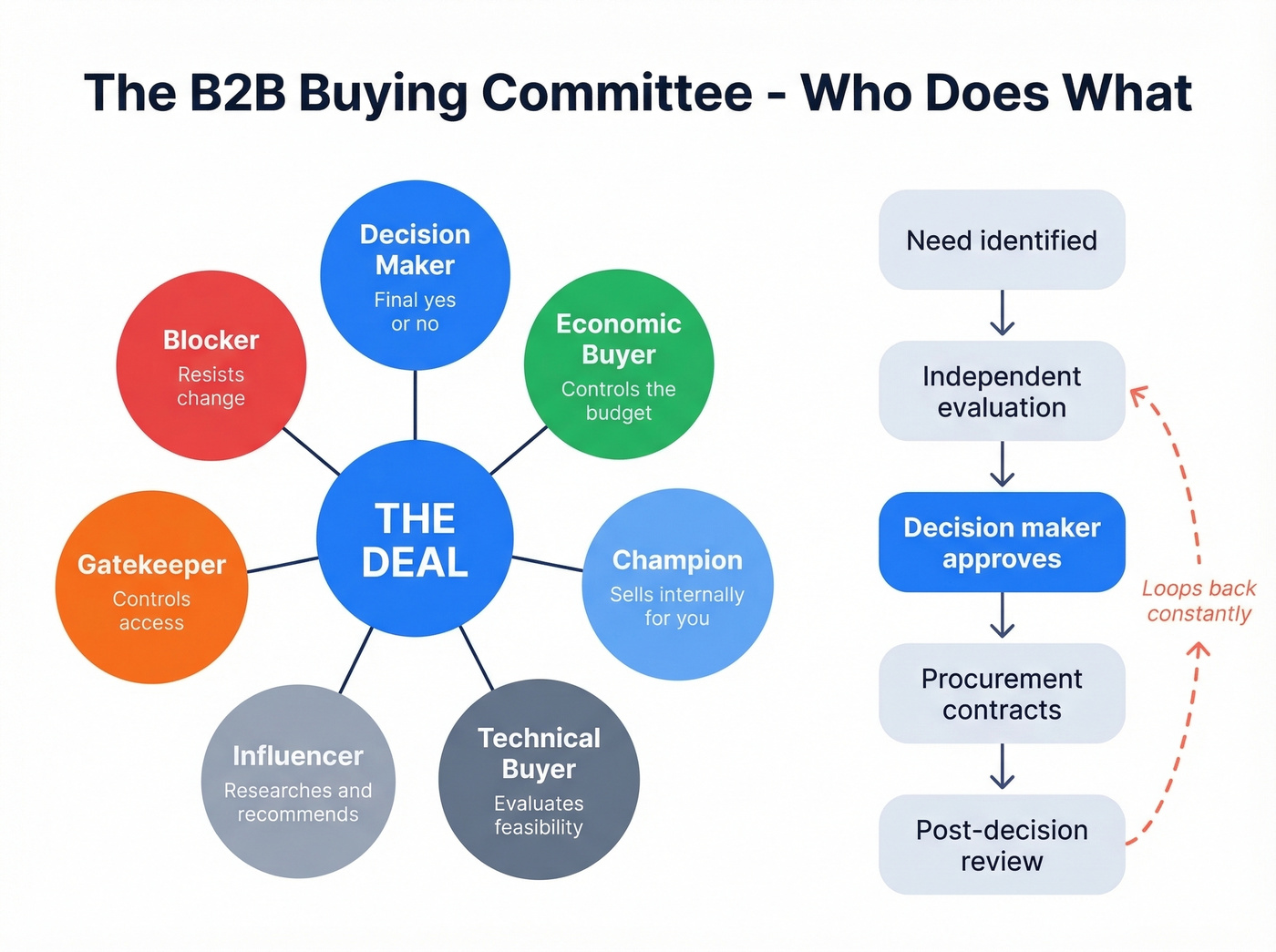
| Role | What They Do | Typical Titles | How to Engage |
|---|---|---|---|
| Decision Maker | Final yes/no authority | VP, Director, C-suite | Lead with business impact |
| Economic Buyer | Controls budget, releases funds | CFO, VP Finance, GM | ROI and payback period |
| Champion | Sells internally on your behalf | Manager, Sr. Director | Arm with decks and proof |
| Technical Buyer | Evaluates feasibility | IT Director, Architect | Security docs, integrations |
| Influencer | Researches and recommends | Analyst, Team Lead | Comparisons, case studies |
| Gatekeeper | Controls access to DM | EA, Chief of Staff | Respect their role, build trust |
| Blocker | Resists change or your solution | Incumbent vendor ally | Go multi-threaded around them |
The typical decision flow looks like this: someone identifies a need, stakeholders evaluate options independently, the decision maker approves, procurement handles contracts, and then there's a post-decision review. Sounds linear. In practice, it loops back on itself constantly - new stakeholders surface, budgets get reshuffled, priorities shift. That's why account-based selling and multi-threading matters so much.
Decision Maker vs. Economic Buyer vs. Technical Buyer
These three roles cause the most confusion, so let's be precise.
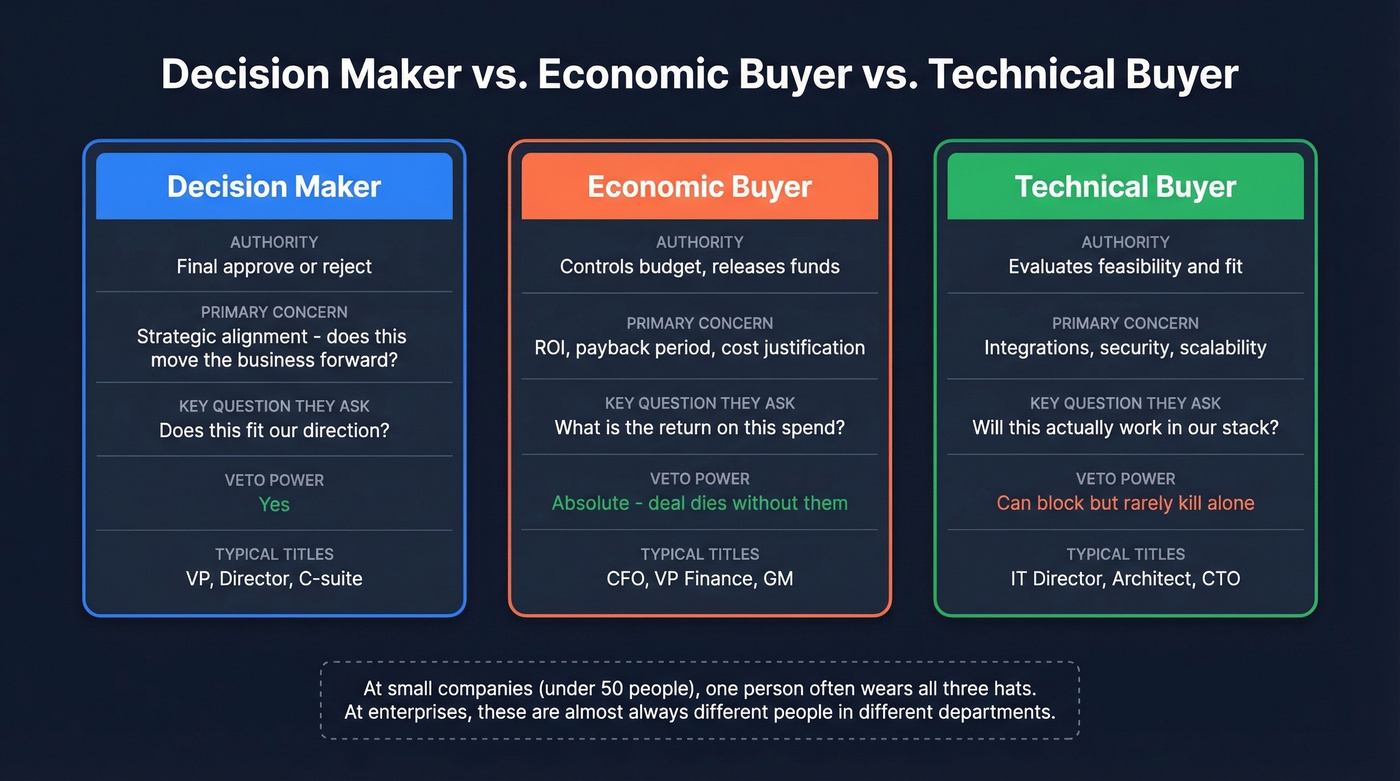
The decision maker has final authority to approve or reject the purchase. They care about strategic alignment - does this move the business forward? The economic buyer controls the budget and can release funds. They have absolute veto power: if they say no, the deal is dead regardless of everyone else's enthusiasm. The technical buyer evaluates whether the solution actually works - integrations, security, scalability.
In smaller organizations, one person often wears all three hats. The CEO of a 20-person startup is the decision maker, economic buyer, and sometimes the technical evaluator. At a 5,000-person enterprise, these are almost always different people sitting in different departments. Knowing which structure you're selling into changes your entire approach.

Sales teams reach only 31% of actual decision makers. Prospeo's 300M+ profile database lets you filter by seniority, department, and budget authority - so you skip the gatekeepers and land in the inbox of the person who can sign off. 98% email accuracy means your message actually arrives.
Stop pitching champions who can't close. Reach the real decision maker.
Who Are Decision Makers by Company Size
Titles are unreliable across company sizes. A "VP of Operations" at a 15-person startup has completely different authority than a VP of Operations at a Fortune 500.
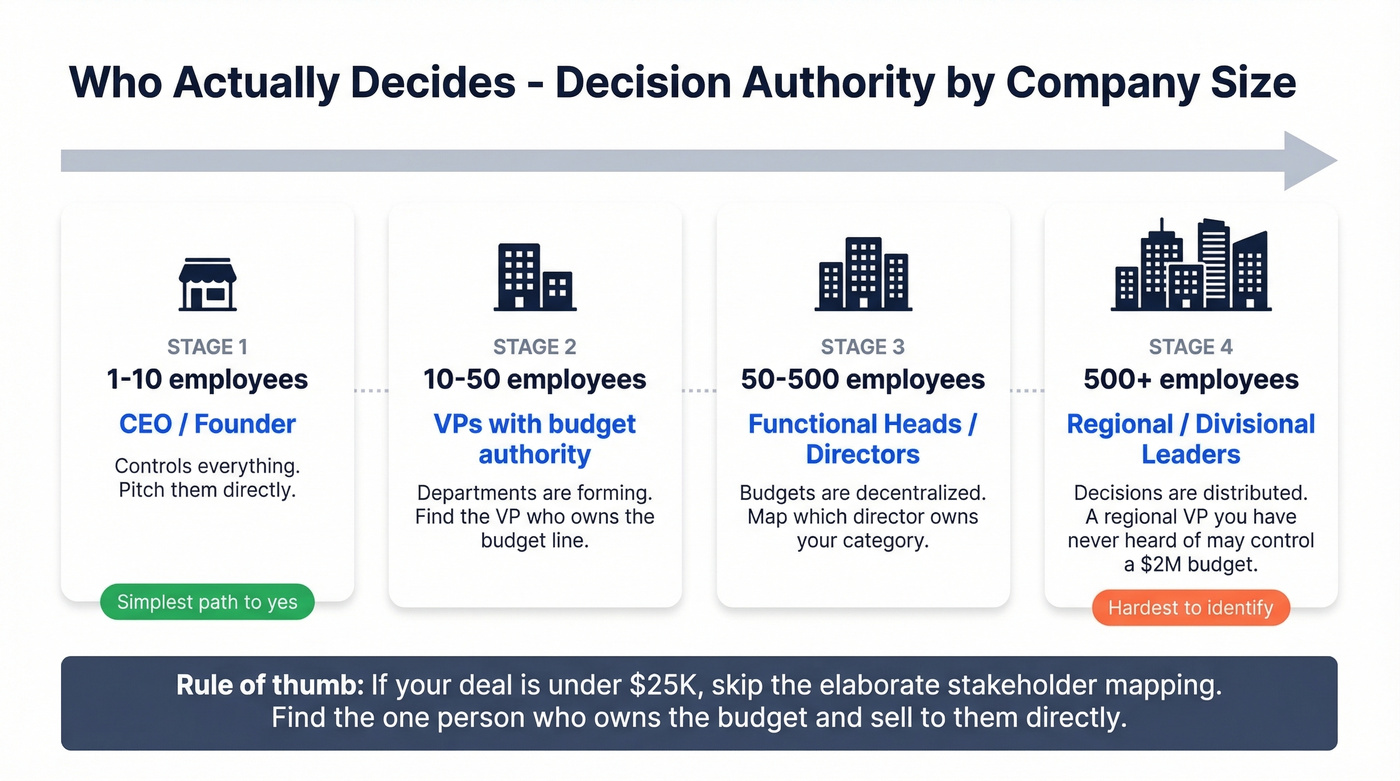
| Company Size | Likely Decision Maker | Why |
|---|---|---|
| 1-10 employees | CEO / Founder | They control everything |
| 10-50 | VPs with budget authority | Departments are forming |
| 50-500 | Functional heads / Directors | Budgets are decentralized |
| 500+ | Regional / divisional leaders | Decisions are distributed |
As companies grow, decision-making authority pushes downward and outward. At a Series A startup, you pitch the founder. At an enterprise, you need to win over a regional VP you've never heard of who controls a $2M discretionary budget. The consensus on r/sales is full of reps frustrated by this exact problem - "12 people with almost identical titles, and you're gambling on which one actually signs."
Here's the thing: if your average contract value is under $25K, you probably don't need to map a full buying committee. Find the one person who owns the budget line and sell to them directly. The elaborate stakeholder mapping frameworks were built for six-figure enterprise B2B sales deals, and applying them to a $15K/year SaaS purchase just slows you down.
Types of Decisions (And Why They Change Who You Sell To)
Not all decisions carry the same weight.
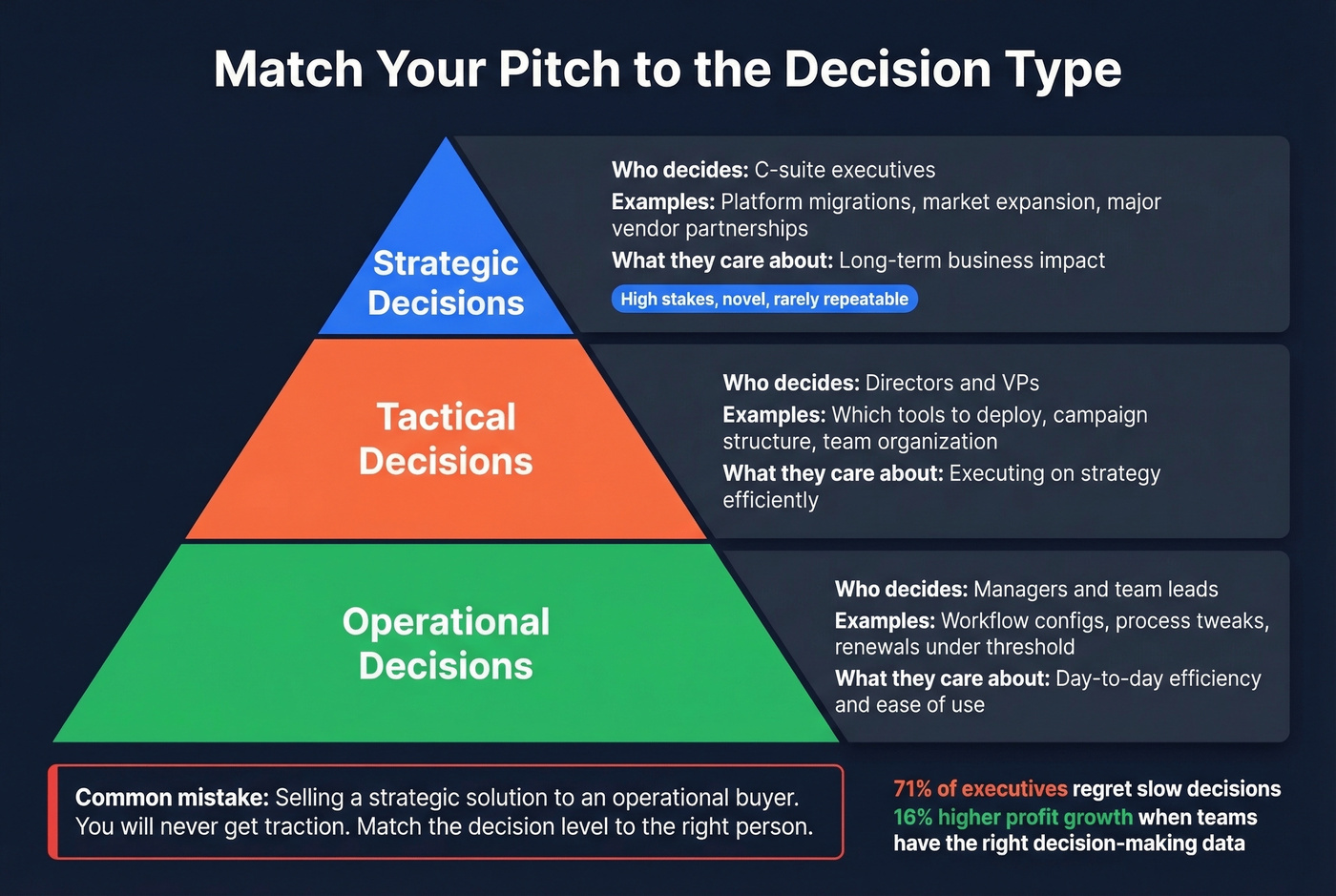
Strategic decisions are long-term, high-stakes, and owned by C-suite executives. Think platform migrations, market expansions, or major vendor partnerships. These are novel, complex, and rarely repeatable.
Tactical decisions sit in the middle. Directors and VPs make these to execute on strategy: which tools to deploy, which campaigns to run, how to structure the team.
Operational decisions are day-to-day. Managers and team leads handle workflow configurations, process tweaks, and vendor renewals under a certain threshold. Orgvue research shows that 71% of executives regret slow decisions, and organizations with access to the right decision-making data see 16% higher profit growth. If you're selling a strategic solution to an operational buyer, you'll never get traction. Match your pitch to the decision type, and you'll find the right person faster.
How to Identify and Reach Decision Makers
Map the Org, Not Just Titles
Start by identifying every department your solution touches. If you're selling a marketing automation platform, that's marketing, IT for integration, finance for budget, and possibly sales for shared data. Each department has stakeholders in the buying process. Map them.
The "three VPs of Operations" scenario is real. Large companies often have overlapping titles across divisions, geographies, or product lines. Your CRM says the VP of Operations is your contact, but the CFO actually controls the budget for your category. Don't guess which one matters - map the org chart, identify reporting lines, and figure out who holds final authority for your specific use case.
Go Beyond Job Titles
Titles lie. A "Director" at one company has more authority than a "VP" at another. Check trade publication bylines, conference speaker rosters, and regulatory filings. Someone speaking at SaaStr about "scaling procurement" is probably involved in purchasing decisions. Dig into GitHub contributions, Slack community activity, podcast appearances, and Substack newsletters - these digital footprints reveal who holds real authority, not just who has a title.
Verify Authority Before You Invest
Before you pour resources into a relationship, verify that your contact actually has authority. Watch for trigger signals: leadership transitions, reorgs, and funding events all reshuffle decision-making power. Ask directly - "Who else needs to be involved in this decision?" is the most underused question in sales.
Pay attention to the red flag: "I'll need to run this by my boss" means you haven't found the right person yet.
Layer in Intent Data
In our experience, reps who layer intent signals on top of org-chart mapping close at nearly double the rate of those who rely on titles alone. Intent data lets you see which companies are actively researching solutions in your category. Instead of cold-calling every VP on a list, you prioritize the ones whose teams are already reading about the problem you solve.
Prospeo pairs Bombora intent data across 15,000 topics with 30+ search filters, so you can zero in on decision makers at companies showing active buying signals rather than spraying emails into the void. With a 7-day data refresh cycle - compared to the 6-week industry average - you're working with current org charts, not stale ones.

Common Mistakes When Targeting Decision Makers
Staying single-threaded. This is the worst mistake in B2B sales. If your entire deal depends on one contact, you're one reorg away from starting over. Multi-thread into at least three stakeholders across the buying committee.
Trusting self-proclaimed authority. People overstate their power - sometimes intentionally, sometimes because they genuinely believe they can push it through. Verify with direct questions and organizational signals before investing weeks in a relationship.
Working around gatekeepers instead of through them. Executive assistants and chiefs of staff aren't obstacles. They're allies if you treat them with respect. Nurture them like you would any key stakeholder - they control access and often influence the final call.
Using outdated contact data. You identified the right VP, crafted the perfect email, and it bounced. Or worse, it went to someone who left six months ago. Skip this if your current data provider refreshes weekly - but most don't. A 7-day refresh cycle should be your baseline expectation.
If you're fixing bounce issues at the source, start with email deliverability and a clean list.
Knowing who the decision maker is means nothing if you can't reach them. Prospeo gives you verified emails and direct dials for VPs, Directors, and C-suite across 300M+ profiles - with 125M+ verified mobile numbers and a 30% pickup rate. Filter by title, company size, and buyer intent to match the exact org structure you're selling into.
Get the direct line to the person who controls the budget.
Decision Maker FAQ
What is a decision maker in B2B sales?
A decision maker is the person with budget authority who can approve or reject a purchase. In B2B, this means someone who controls a specific budget line and can greenlight spending - not just anyone with an opinion. The dictionary says "a person who makes decisions," which is accurate but unhelpful when you're trying to close a deal.
What's the difference between a decision maker and an influencer?
The decision maker holds budget authority and can approve or reject a purchase outright. An influencer researches options and makes recommendations but can't sign off. In B2B deals with 13 average stakeholders, you need both on your side, but only the former closes the deal.
How many decision makers are in a typical B2B purchase?
Forrester found 13 people involved in the average B2B purchasing decision, though only 1-3 hold true sign-off authority. For complex solutions, the buying group commonly includes 6-10 key participants, each bringing 4-5 pieces of independent research. The number scales with deal size and organizational complexity.
How do I find the decision maker at a target company?
Start with company-size heuristics - CEO at startups, VPs at SMBs, functional heads at mid-market. Then map the org chart, verify authority through trigger signals like reorgs or funding events, and use a B2B data platform with seniority and department filters to get verified contact information for the right person.
What is an economic buyer?
The economic buyer controls the budget and can release funds for a purchase - they have absolute veto power. If they say no, the deal dies regardless of other stakeholders' support. This role is central to MEDDIC/MEDDPICC methodologies and isn't defined by title; it could be a CEO, CFO, GM, or VP running a business unit.