

Decision Maker vs Influencer: Who You Should Actually Sell To
You crushed the demo. Your contact said, "This is exactly what we need - let me share this with the team." Then two weeks of silence. The deal dies without you ever knowing why.
The problem wasn't your pitch. You never mapped the decision maker vs influencer dynamic - or whether your contact was just someone who liked your product but couldn't move the needle.
The real question isn't one or the other. It's how you engage both, and in what order.
The Core Difference Explained
A decision maker authorizes a purchase without needing anyone else's sign-off. They control the budget and have final say. An influencer shapes that decision through expertise, evaluation, or internal advocacy, but can't write the check.
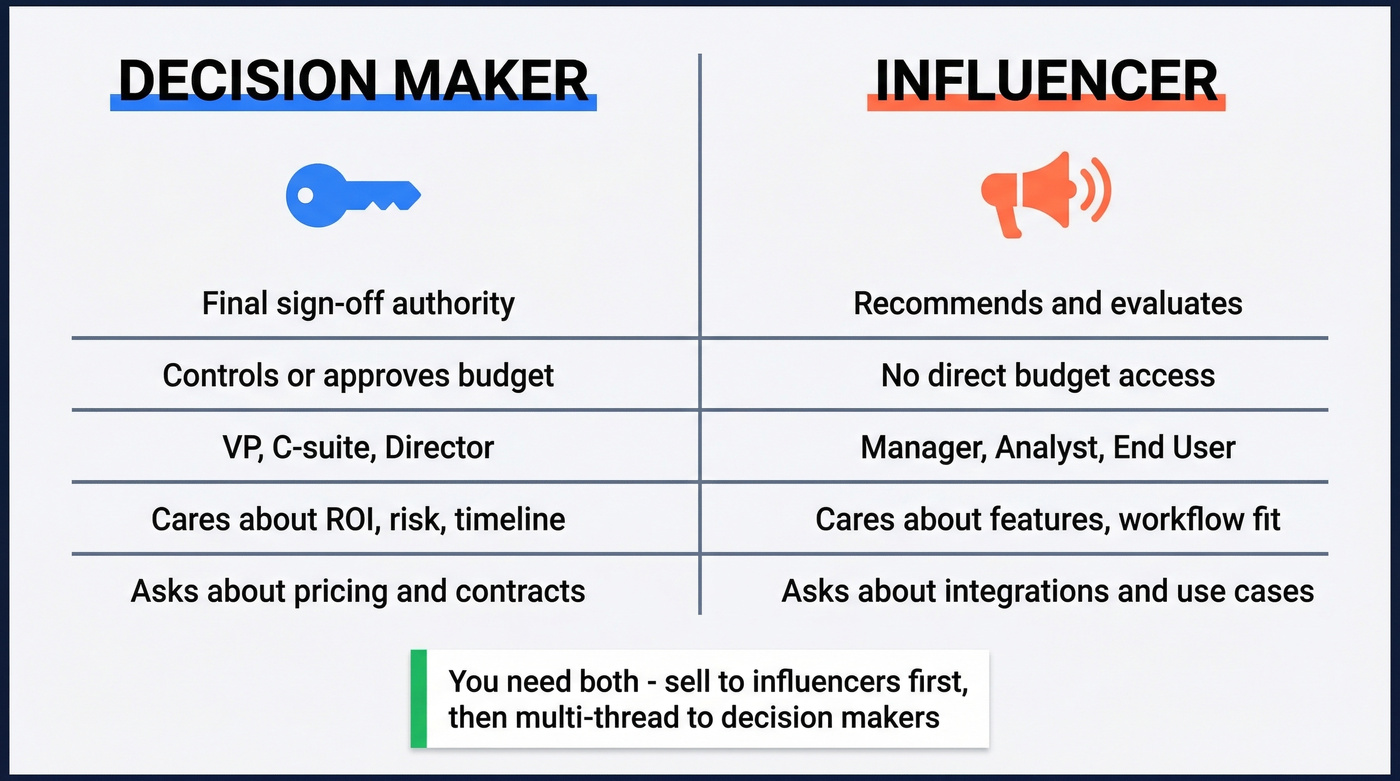
Clean on paper. Messy in practice. As HubSpot warns, never ask "Are you the decision maker?" outright - people want to feel important, and the question either offends or gets you a misleading "yes" from someone who can't actually sign. We've watched reps burn entire quarters chasing self-proclaimed authorities who said "yes, I decide" but actually needed three levels of approval before anything moved.
| Role | Decision Maker | Influencer |
|---|---|---|
| Authority | Final sign-off | Recommends, evaluates |
| Budget access | Controls or approves | None directly |
| Typical titles | VP, C-suite, Director | Manager, analyst, end user |
| Cares about | ROI, risk, timeline | Features, workflow fit |
| How to identify | Asks about pricing, contracts | Asks about integrations, use cases |
The Modern Buying Committee
A typical B2B buying committee involves 6-10 stakeholders - economic buyer, champion, technical evaluator, end users, procurement/purchasing, and gatekeepers. Beyond the "official" roles, you'll also run into blockers: people who look like influencers until they quietly stall the deal.
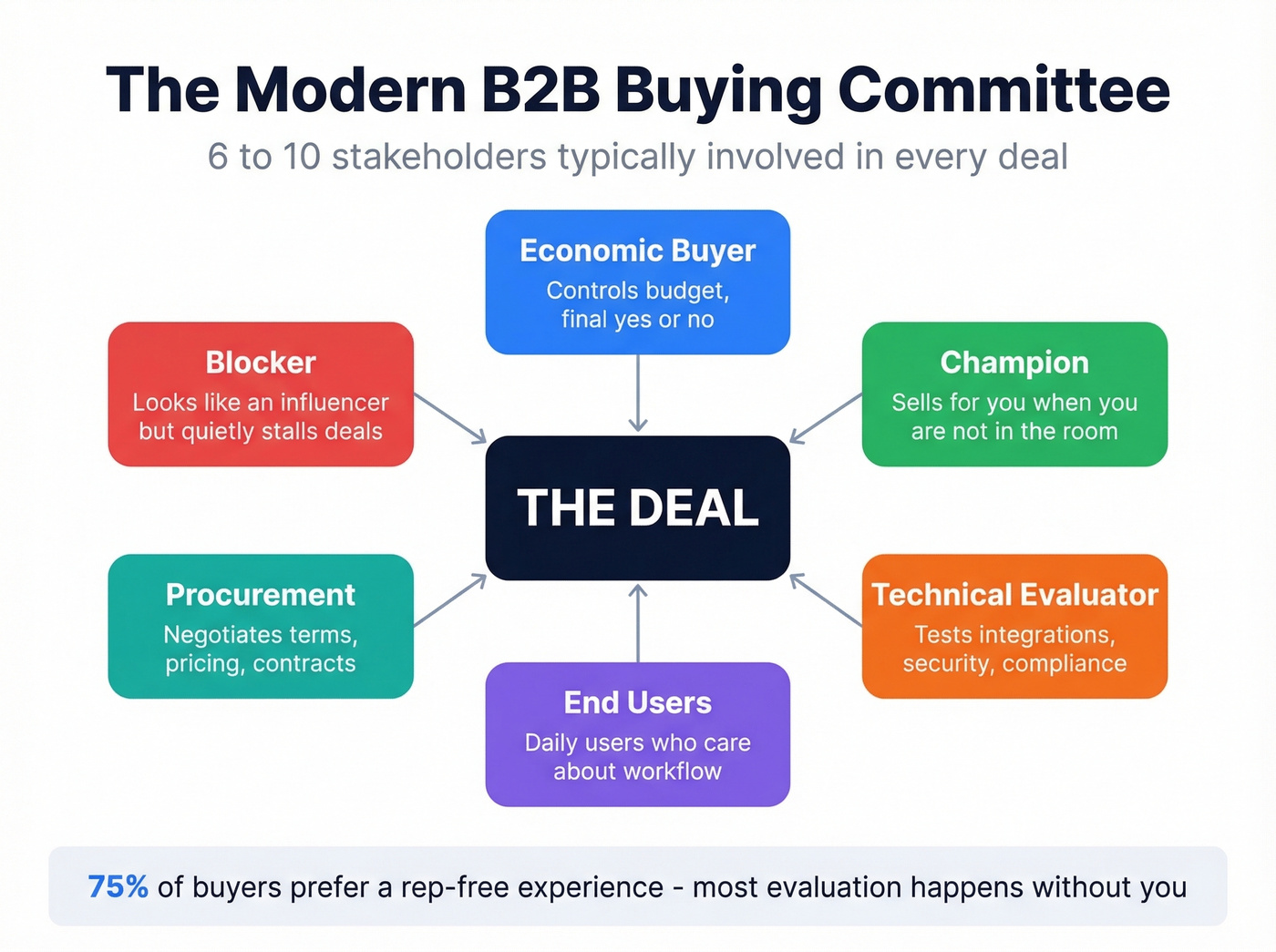
This framework traces back to Bonoma's buying center model from HBR in 1982, and it's only gotten more complex since.
Here's the part that should worry you: 75% of B2B buyers prefer a rep-free experience, which means much of the evaluation happens without you in the room. And 95% of the time, the winning vendor is already on the buyer's Day One shortlist, with the pre-contact favorite winning roughly 80% of deals. If you're not engaging the right people early, you've already lost.

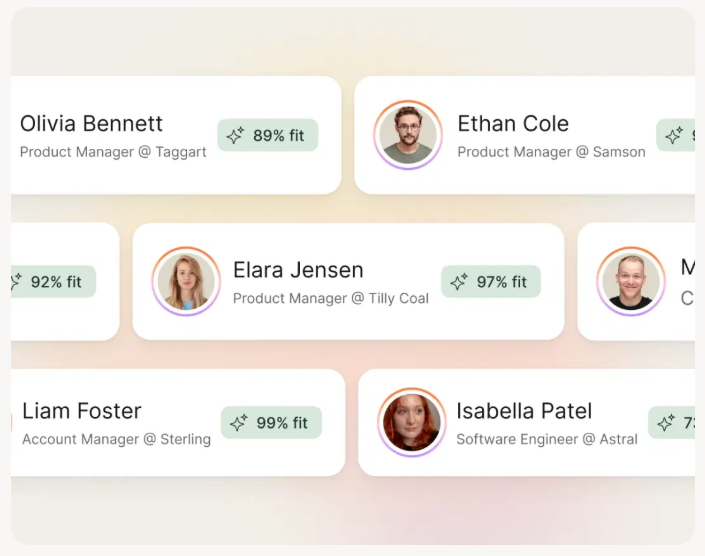
You can't multi-thread a buying committee with bad data. Prospeo gives you verified contact data for every stakeholder - from the end-user influencer to the C-suite decision maker - across 300M+ profiles with 98% email accuracy, refreshed every 7 days.
Stop selling to one contact and hoping. Reach the entire committee.
Who Should You Sell to First?
Start with influencers. They're more reachable, especially at larger companies where economic buyers are insulated by gatekeepers and assistants. An influencer who uses the product daily will take your call. A CFO won't.
But starting with influencers doesn't mean staying with them. The failure mode reps hit constantly - and the consensus on r/sales backs this up - is running a great demo with a manager who then has to "feed it back" to leadership. That person becomes your unpaid, untrained sales rep, sending a weak summary email that dies in someone's inbox. As Janek's research puts it, the person with budget authority often won't decide until internal advocates weigh in, so you need both, and you need to multi-thread immediately.
Aim to get to three stakeholders within the first two weeks. Use these discovery questions to map the committee early:
- "Beyond yourself, who else would need to weigh in before this moves forward?"
- "What does the approval process typically look like for a purchase like this?"
- "Would it make your life easier if we loop in [their boss's title] so you don't have to relay everything?"
That last one is the anti-telephone-game move - it reframes the ask as helping them, not going over their head. If you sense resistance from a specific stakeholder, arm them with data that addresses their exact objection or find a parallel path around them entirely.
How to Test Your Champion
Not every friendly contact is a champion. About 70% of buying conversations happen without the vendor present, which means your champion needs to sell for you when you're not in the room.
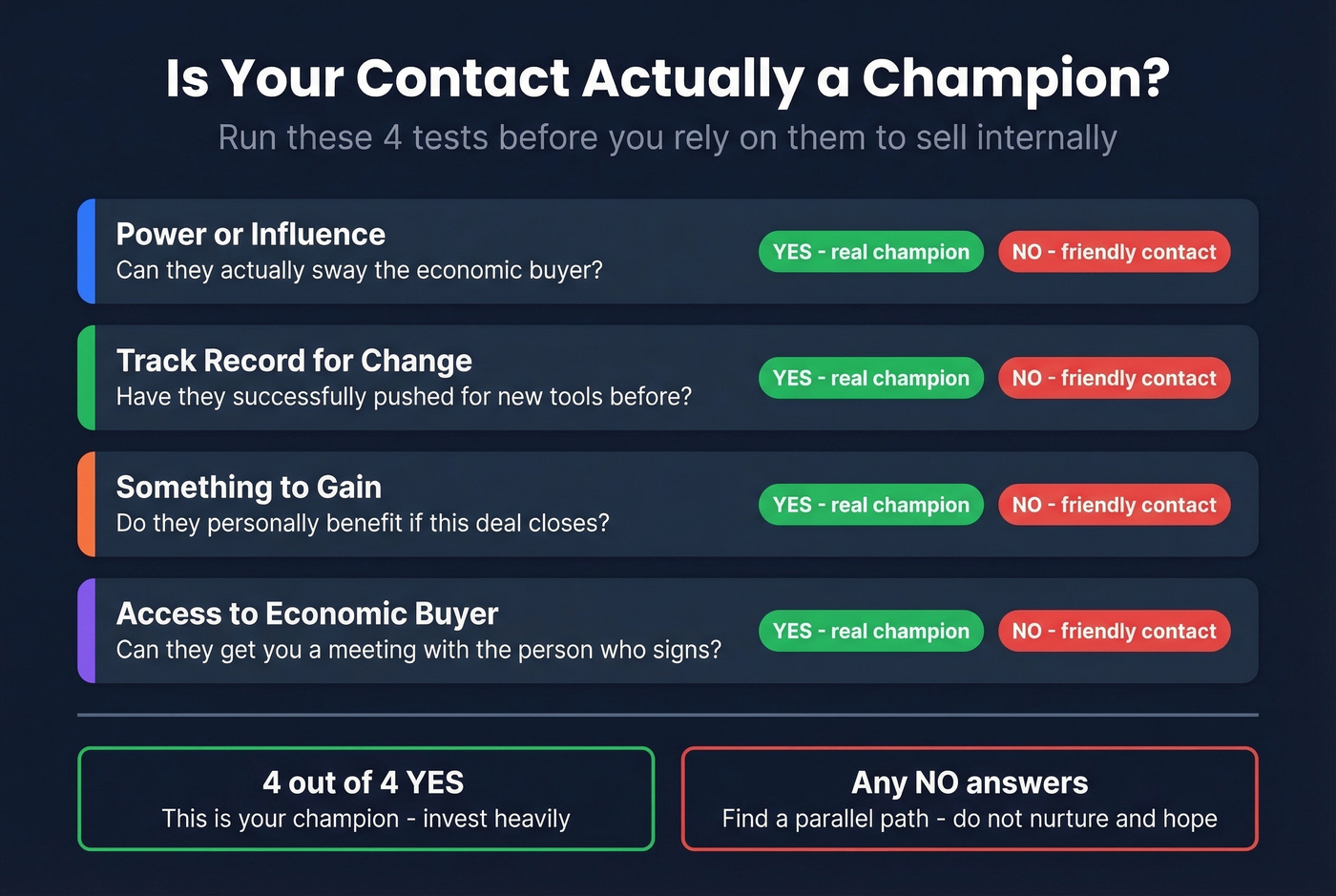
Let's be honest: we've seen deals stall for months because reps mistook enthusiasm for influence. Someone who loves your product demo isn't the same as someone who can walk into a budget meeting and fight for it.
The MEDDPICC framework gives you four markers to test:
- Power or influence - Can they actually sway the economic buyer's opinion?
- Track record for change - Have they successfully pushed for new tools before?
- Something to gain - Do they personally benefit if this deal closes?
- Access to the economic buyer - Can they get you a meeting with the person who signs?
If your champion can't get you that meeting, they're a friendly contact - not a champion. Adjust accordingly. Skip the "nurture and hope" approach and find someone else in the org who can open that door.
The Multi-Threading Playbook
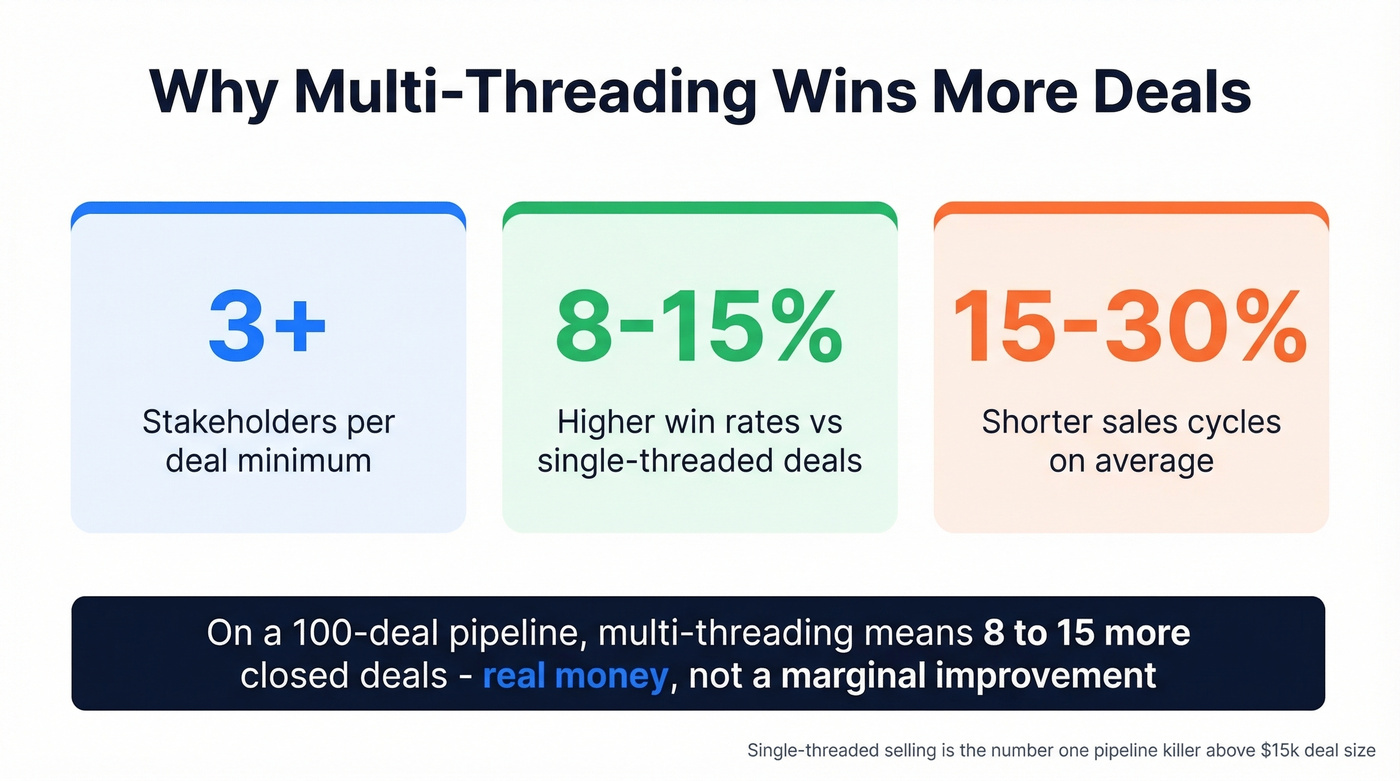
Multi-threading means engaging three or more stakeholders per deal simultaneously. Teams that multi-thread typically see 8-15 percentage point higher win rates and 15-30% shorter sales cycles. On a 100-deal pipeline, that's 8-15 more closed deals - real money, not a marginal improvement.
Most deals don't die because of a bad product or a strong competitor. They die because the rep sold to one person and hoped for the best. If your average deal size exceeds $15k and you're single-threaded, you're gambling with pipeline.
If you want a tighter process end-to-end, align multi-threading with your MEDDIC sales qualification and keep a running stakeholder map in your CRM (or even dedicated contact management software).
You can't multi-thread with bounced emails. If you're reaching out to five stakeholders and two addresses bounce, you've just lost 40% of your committee coverage. Prospeo's database covers 300M+ professional profiles with 98% email accuracy and a 7-day refresh cycle, so the contact data you pull for the VP of Engineering today is still valid when you sequence the CFO tomorrow.
If you're building outbound sequences around committee coverage, pair this with proven sales prospecting techniques and keep a few high-performing sales follow-up templates ready for each stakeholder type.
Every stalled deal in your pipeline has a stakeholder you haven't reached. Prospeo's 30+ search filters let you find decision makers by title, department, company size, and buyer intent - then pull verified emails and direct dials for $0.01 per contact.
Map the full buying committee in minutes, not weeks.
FAQ
Can someone be both a decision maker and an influencer?
Yes - especially at smaller companies. At a 50-person startup, the Head of Sales often evaluates tools hands-on and signs the contract. The line between the two roles blurs when one person owns both evaluation and budget. Map the org chart and ask discovery questions to confirm rather than assuming one person per role.
What if the influencer won't introduce you to the economic buyer?
Try the anti-telephone framing: "Would it make your life easier if we loop in [title] so you don't have to relay everything?" If they still resist, run the MEDDPICC markers above. No access to the budget holder is a red flag - consider finding a parallel contact at the same company by searching for stakeholders by department, seniority, and title.
How many stakeholders should you engage per deal?
Three at minimum. Teams that multi-thread across 3+ contacts see significantly higher win rates - often 8-15 percentage points above single-threaded deals. One bounced email to a key stakeholder can stall an entire deal, so accurate contact data isn't optional here. It's the prerequisite.