

How to Structure a Demand Gen Team That Actually Builds Pipeline
Every VP of Sales has said it: "Marketing sends us garbage leads." Every demand gen leader has fired back: "Sales doesn't follow up on anything we send." The real problem isn't strategy or budget. It's the demand gen team structure - who owns pipeline creation, lead quality, and the handoff - that determines whether you build pipeline or burn money.
The Short Version
At Series A, hire 1-2 generalists, not specialists. You don't need a paid media manager and a lifecycle marketer. You need someone who can do both.
Structure around ownership, not titles. An ownership map - who owns pipeline creation, lead quality, handoff, data - matters more than an org chart with clean boxes.
Fix the marketing-to-sales handoff before hiring anyone else. The #1 structural failure is leads disappearing into a black hole between marketing and sales. No amount of headcount solves a broken handoff.
What a Demand Gen Team Actually Is
Demand gen gets conflated with growth marketing and digital marketing. They're different jobs. SPMB's framework draws the lines clearly: growth marketing owns self-serve and freemium funnels, working tightly with product. Digital marketing focuses on immediate awareness and conversion, usually paid-media heavy.
Demand gen is the enterprise-leaning function. It runs segment-specific campaigns, leans heavily on account-based marketing, and feeds quantifiable pipeline to sales. At many companies, the SDR function reports directly to the demand gen leader - not to sales - to keep alignment tight between campaigns generating interest and the people following up on them.
Building Your Team by Company Stage
Here are concrete stage-based benchmarks to build from.
Series A - The Swiss Army Knife
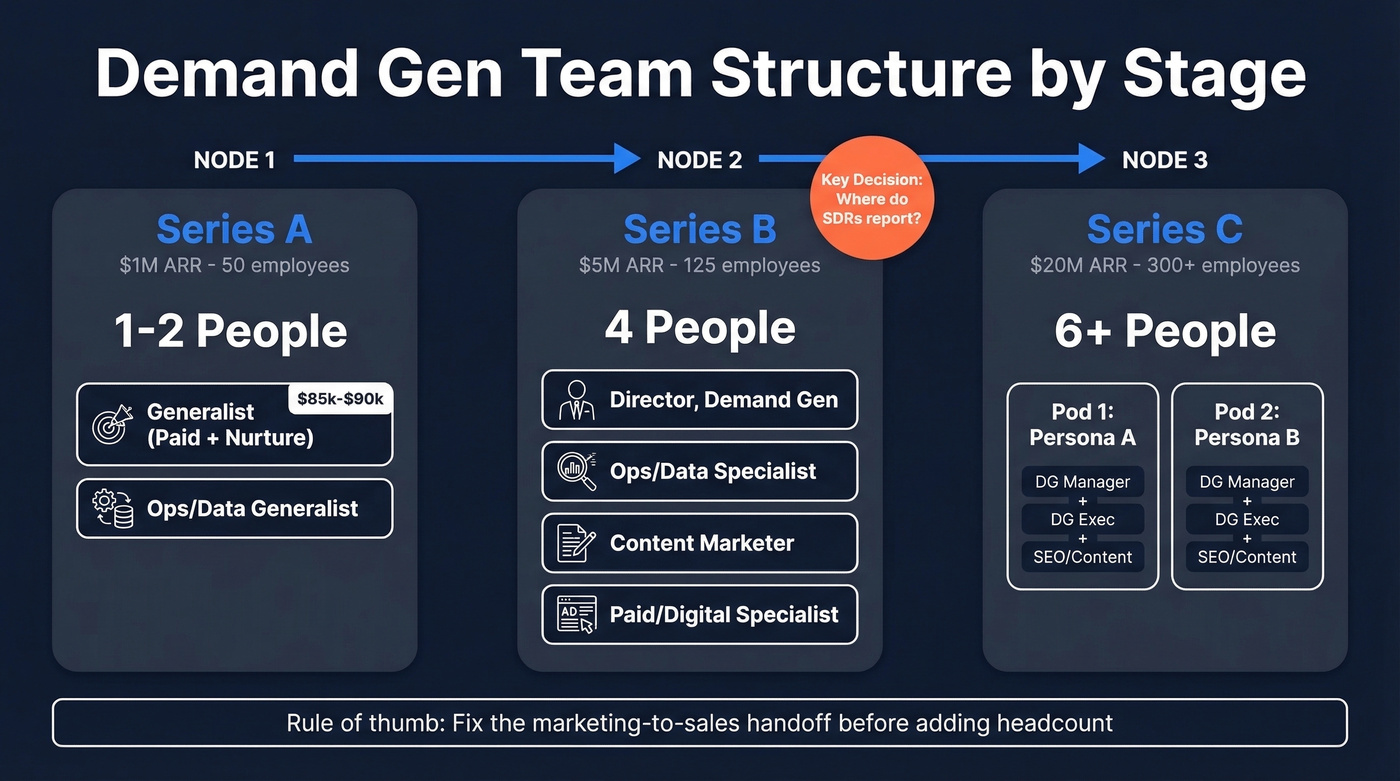
At roughly $1M ARR and 50 employees, your marketing team is about 6 people. Demand gen gets 1-2 of those seats.
Your first hire should be a Swiss Army knife: someone who can run paid campaigns, write nurture sequences, manage basic marketing automation, and pull their own reports. This isn't a "demand gen manager." It's a builder who figures things out. Budget $85k-$90k for an early-career generalist with 1-4 years of experience. Specialization comes later.
If you get a second seat, lean toward ops and data. Someone who keeps your CRM clean, builds routing rules, and makes sure leads reach reps within minutes - not days. We've seen teams treat speed-to-lead as a revenue KPI rather than just an ops metric, and that mindset shift is what separates good early-stage demand gen from bad.
Series B - The SDR Decision
At ~$5M ARR and 125 employees, the benchmark model shows a CMO running a 15-person marketing org. Demand gen now has a dedicated Director plus 3 marketers.
Here's the critical structural decision at this stage: do SDRs report to the demand gen Director or to sales? If your SDRs are doing outbound into cold accounts, they're doing demand gen work, and they should report accordingly. Get this wrong and you'll spend the next two years relitigating it.
Under the Director, you want a dedicated ops/data specialist, a content marketer who understands campaign-level content (not just blog posts), and a paid/digital specialist. The 1:5-10 manager-to-report ratio holds, so your Director can manage this team directly without a middle layer.
Series C - The Pod Transition
At ~$20M ARR and 300-400 employees, the marketing org has grown to 33 people. Demand gen now has a VP or senior Director with 6+ people.
Instead of organizing by function - one person does all paid, another does all content - you organize by persona or segment. Each pod owns the full buyer journey for its persona type. A 1 SDR : 2 AE ratio keeps the pipeline math honest and prevents SDRs from being spread too thin. In our experience, the pod model outperforms functional org structures once you're past 4-5 people on the demand generation team.
Don't outsource demand gen strategy. Ever. Outsource execution - paid media buying, content production, design - all day long. But the person deciding which accounts to target and how to sequence campaigns needs to sit in your building, attend your pipeline reviews, and feel the pain when deals stall.
Hiring Sequence Summary
| Stage | Headcount | First Hire | Second Hire | Third Hire |
|---|---|---|---|---|
| Series A | 1-2 | Generalist (paid + nurture) | Ops/data generalist | - |
| Series B | 4 | Director, Demand Gen | Dedicated ops/data specialist | Content + paid specialists |
| Series C | 6+ | VP/Director, Demand Gen | Pod leads by persona | Specialists per pod |
Two Org Models That Work
Distribution / Nurture / Support
Right Percent's framework splits demand gen into three buckets: distribution (paid search, social, SEO), nurture (email, content), and support (ops, creative, engineering). Your Marketing Lead needs to understand both distribution and nurture deeply. The support layer can be fractional or shared until Series B.
Persona-Based Pods
Cognism's restructuring is a useful real-world example. They initially split their demand gen team by segment - commercial vs. enterprise, aligned to sales. It didn't work. Budgets were impossible to split cleanly. Messaging overlapped. Content sat too far from campaigns.
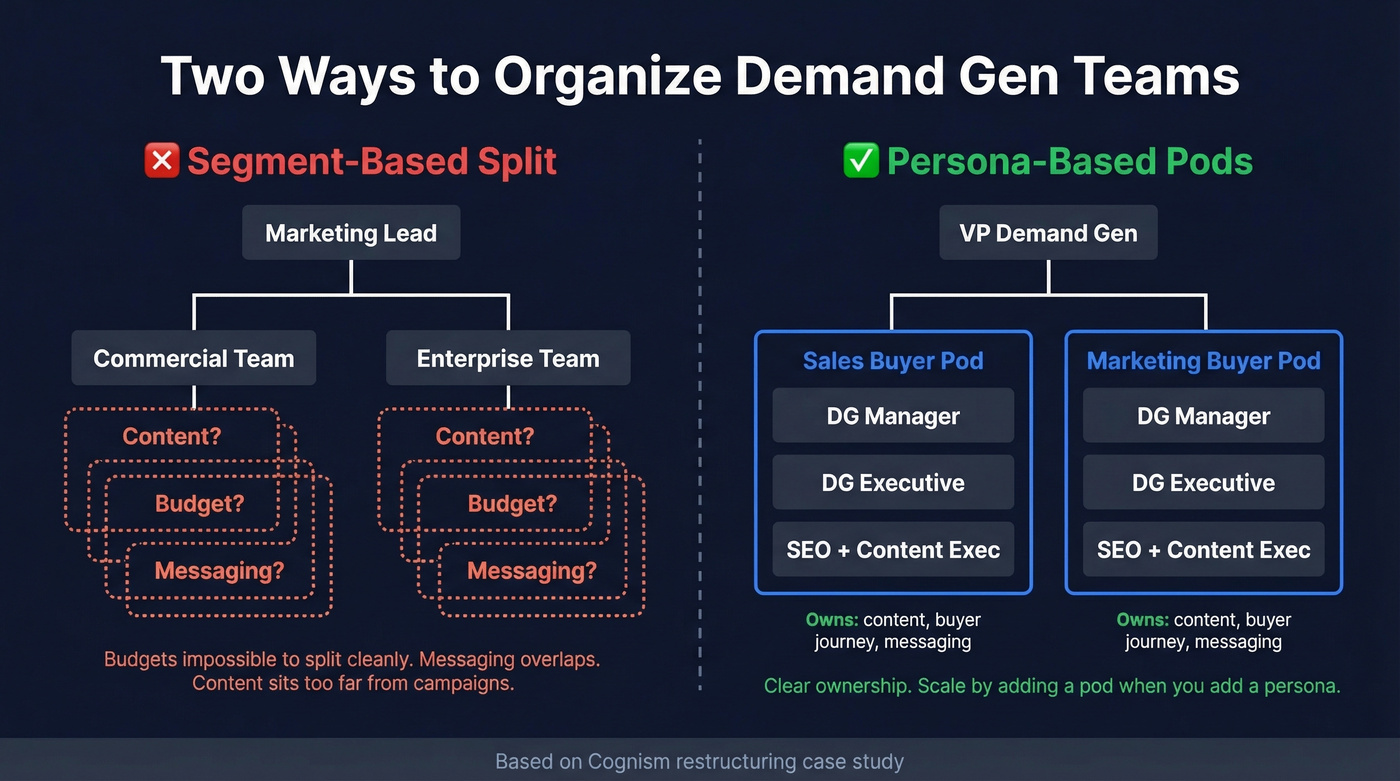
They restructured around two core personas - sales buyers and marketing buyers - with one pod per persona. Each pod includes a Demand Gen Manager, a Demand Gen Executive, and an SEO & Content Executive. The pod owns content, the buyer journey, and messaging for its persona. Accountability got clearer. Scaling became straightforward: add a pod when you add a persona.
The lesson is simple. Segment-based splits create internal confusion. Persona-based pods create ownership. The consensus on r/sales and r/marketing echoes this - handoff failures and blurred accountability are the structural issues that come up again and again in team restructuring threads.

You just read that the #1 structural failure is leads disappearing between marketing and sales. Bad data makes it worse. Prospeo gives your demand gen team 300M+ profiles with 98% email accuracy and 125M+ verified mobiles - refreshed every 7 days, not every 6 weeks.
Give your demand gen team data that actually connects to real buyers.
Core Roles, KPIs, and 2026 Salaries
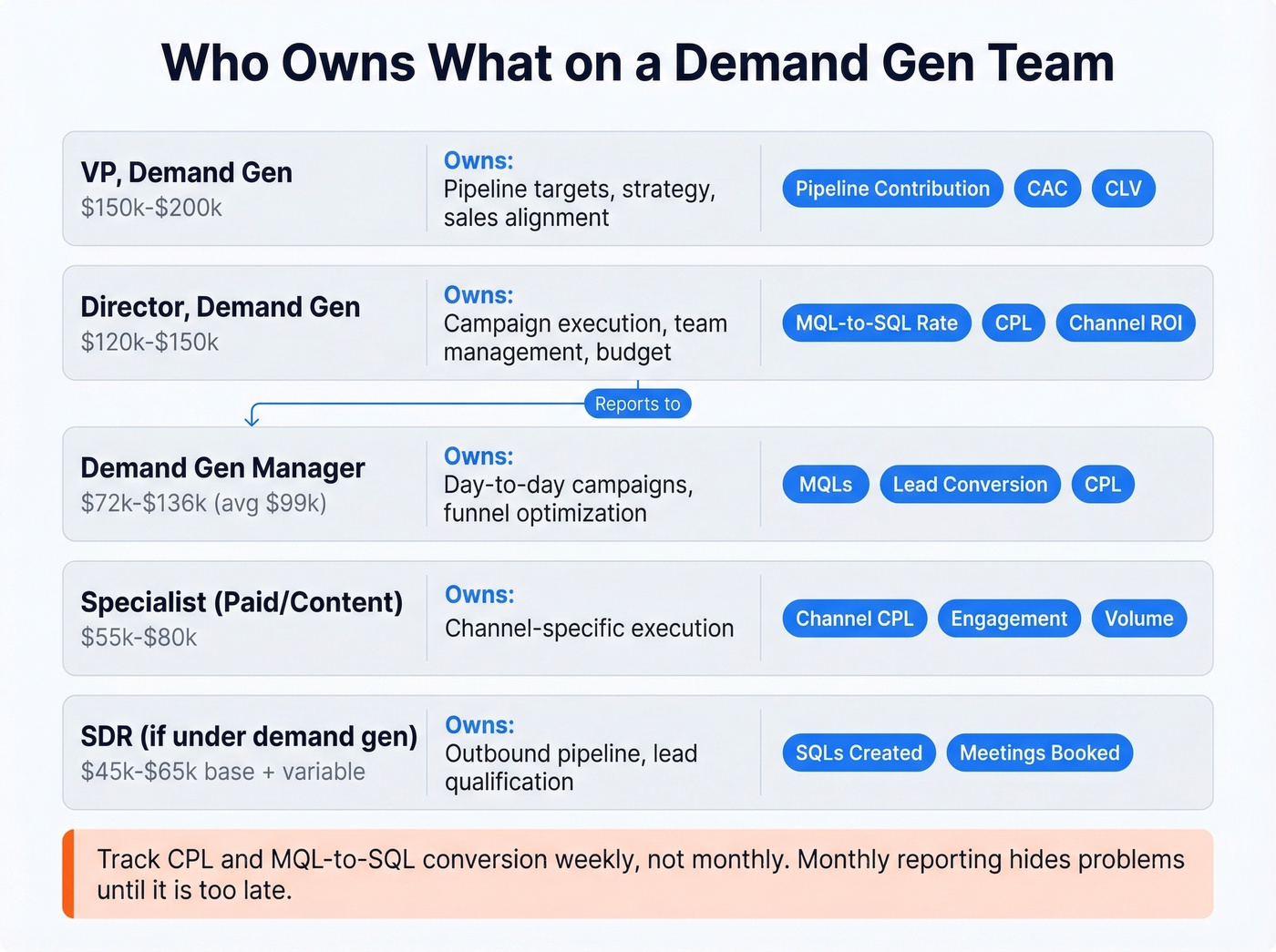
Most demand generation teams don't fail because they hired the wrong people. They fail because nobody agreed on who owns which metrics.
| Role | Owns | Primary KPIs | 2026 Salary Range |
|---|---|---|---|
| VP, Demand Gen | Pipeline targets, strategy, sales alignment | Pipeline contribution, CAC, CLV | $150k-$200k |
| Director, Demand Gen | Campaign execution, team management, budget | MQL-to-SQL rate, CPL, channel ROI | $120k-$150k |
| Demand Gen Manager | Day-to-day campaigns, funnel optimization | MQLs, lead conversion rate, CPL | $72k-$136k (avg $99k) |
| Specialist (paid/content) | Channel-specific execution | Channel CPL, engagement, volume | $55k-$80k |
| SDR (if under demand gen) | Outbound pipeline, lead qualification | SQLs created, meetings booked | $45k-$65k base + variable |
Organize your reporting dashboard around five categories: lead acquisition, lead quality, funnel velocity from MQL to closed-won, channel efficiency, and pipeline contribution. The formulas that matter: CPL = total marketing spend / leads generated. MQL-to-SQL conversion rate = SQLs / MQLs x 100. Track these weekly, not monthly. Monthly reporting hides problems until it's too late.
The SDR Reporting Line Debate
Put SDRs under demand gen to optimize for pipeline quality. Their activity aligns with campaign timing, intent signals, and nurture sequences. They work warmed-up accounts instead of cold-calling into the void. Teams that put SDRs under demand gen see measurably better lead-to-meeting conversion because reps follow up on signals, not guesses.
Put SDRs under sales to optimize for activity volume and tight AE alignment. Sales leaders push call volume and meeting counts. That works if your motion is high-velocity and transactional.
The worst option? Making SDRs responsible for the entire buyer journey with no marketing air cover. As one Reddit practitioner put it, having an SDR do fully cold outreach is essentially "having an SDR do demand gen" - the most expensive, least efficient way to fill a pipeline. That's the demand creation vs. demand capture distinction, and getting it wrong burns out reps fast.
Five Structural Mistakes That Kill Pipeline
1. No shared MQL definition and missing handoff SLAs. If marketing and sales can't agree on what "qualified" means, leads pile up unworked or get rejected as garbage. Write a one-page MQL definition with lead scoring criteria and a response-time SLA. Review it quarterly.
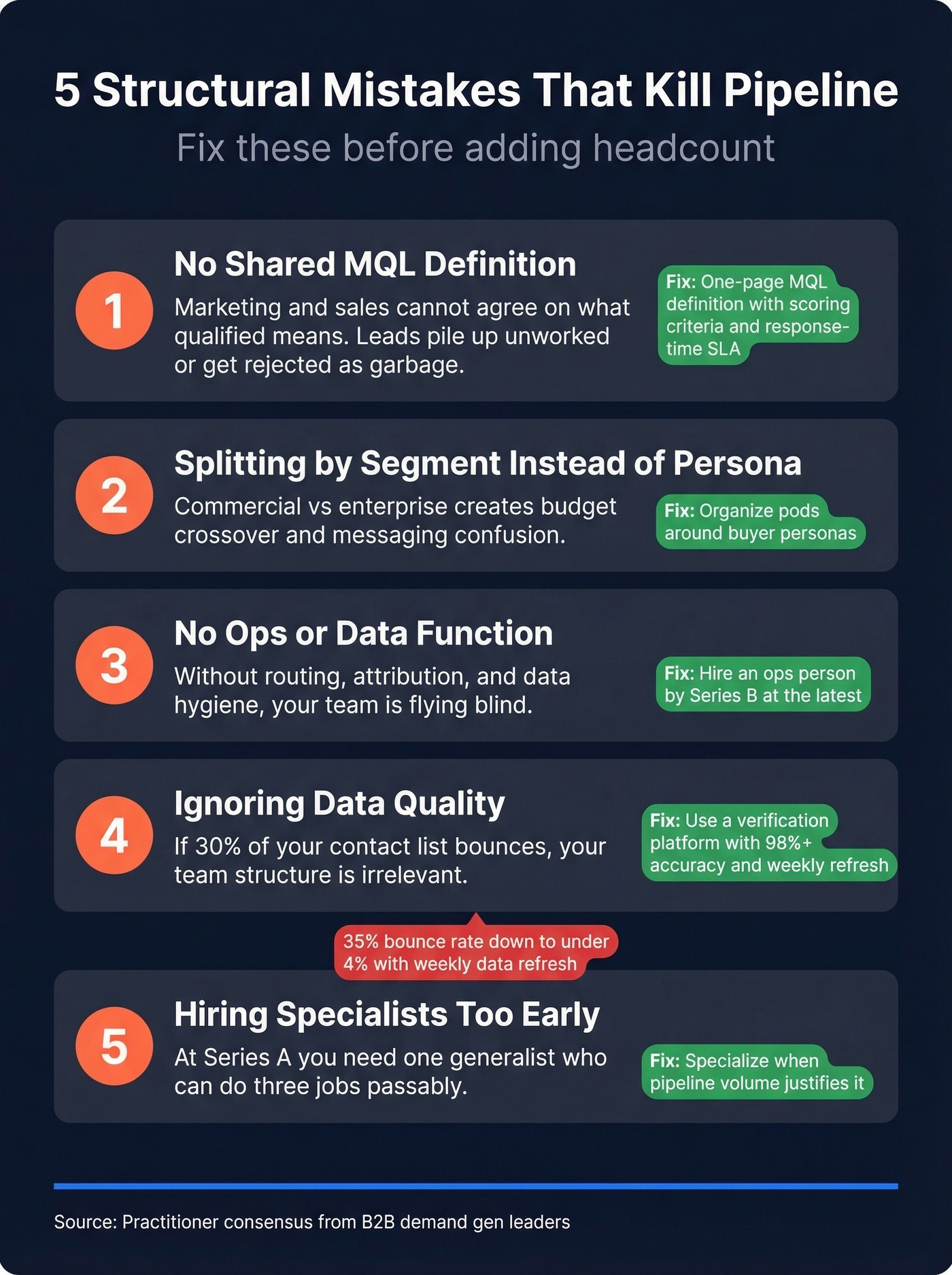
2. Splitting by segment instead of persona. Cognism learned this the hard way. Commercial vs. enterprise creates budget crossover and messaging confusion. Organize pods around buyer personas, not revenue segments.
3. No ops/data function. Without someone owning routing, attribution, and data hygiene, your demand gen team is flying blind. Treat speed-to-lead as a revenue KPI and hire an ops person by Series B at the latest. (If you want a clean owner for this, model it after a RevOps Manager role.)
4. Ignoring data quality. Here's the thing: if 30% of your contact list bounces, your team structure is irrelevant. You're burning sender reputation and wasting SDR time on dead leads. Your ops person should own data quality as a core KPI, using a verification platform that refreshes data weekly and verifies emails at 98%+ accuracy so reps aren't working stale lists. We've seen teams go from 35% bounce rates to under 4% just by switching to Prospeo's 7-day refresh cycle - and the downstream pipeline impact was immediate. (If you're diagnosing the issue, start with email bounce rate benchmarks and root causes.)

5. Hiring specialists too early. At Series A, you don't need a paid media manager, a lifecycle marketer, and a content strategist. You need one generalist who can do all three passably. Specialize when you have the pipeline volume to justify it.
The Demand Gen Tech Stack
Your stack should mirror your team structure - distribution, nurture, support, and data.
| Function | Tool Examples | Cost Tier |
|---|---|---|
| CRM | Salesforce, HubSpot | Free-Enterprise |
| Marketing Automation | HubSpot, Marketo | Mid-Enterprise |
| Paid Media | Google Ads | Variable |
| Analytics | Google Analytics | Free |
| Intent Data | Bombora | Mid-Enterprise |
| Project Management | Asana | Free-Mid |
| Data & Verification | Prospeo | Low (~$0.01/lead) |
| Enrichment & Ops | Clay, Zapier | Low-Mid |

Let's be honest: many demand gen teams still don't measure attribution and performance consistently. If your stack doesn't make attribution easy, you'll never prove demand gen's value to the CFO. Pick tools that talk to each other natively - the fewer manual data transfers, the cleaner your attribution. (A simple way to pressure-test this is to define your lead generation metrics first, then pick tools.)
Skip intent data tools until you're past Series B. They're powerful but expensive, and a 4-person team won't have the bandwidth to act on the signals. Start with CRM, automation, analytics, and verified contact data. Add layers when you can actually use them. (If you're building lists early, start with free lead generation tools before buying enterprise platforms.)
Whether your demand gen team is 2 people or 20, your ops/data specialist needs a source they can trust. Prospeo's CRM enrichment returns 50+ data points per contact at a 92% match rate - for roughly $0.01 per email. No contracts, no sales calls required.
Stop burning pipeline on bounced emails and stale contact data.
FAQ
How big should a demand gen team be?
At Series A (~$1M ARR), 1-2 generalists handle everything. At Series B (~$5M ARR), expect a team of 4 with a dedicated Director. At Series C (~$20M ARR), 6+ people organized into persona-based pods. Staff for ownership clarity, not arbitrary headcount targets.
What's the difference between demand gen and growth marketing?
Growth marketing owns self-serve and freemium funnels - product-led activation, trial-to-paid metrics. Demand gen owns segment-specific pipeline creation, typically enterprise-leaning with heavy ABM. Growth sits close to product; demand gen sits close to sales. Different reporting lines, different KPIs.
Should SDRs report to marketing or sales?
If SDRs primarily work inbound and campaign-sourced leads, put them under the demand gen leader. If your motion is high-velocity outbound with tight AE pairing, sales makes more sense. The key metric is lead-to-meeting conversion rate. Whichever reporting line produces higher conversion wins.
What tools does a small demand gen team need?
At minimum: a CRM (HubSpot or Salesforce), marketing automation, analytics, and a data quality platform for verified contact data. Add intent data and enrichment tools once the team scales past 4 people. Don't buy enterprise tooling at Series A - you'll pay for features nobody has time to use.