

Demand Generation in Marketing: What Actually Works (and What Doesn't)
You've read ten "What Is Demand Gen?" articles and they all say the same thing. This one has actual numbers - conversion benchmarks by funnel stage, channel-level data, and a real timeline from a practitioner who went from zero inbound to a seven-figure pipeline in six months.
What Is Demand Generation?
Demand generation in marketing is the systematic process of building awareness and trust across your total addressable market, then guiding prospects from first touch through purchase to create predictable pipeline. Put simply: it's everything a company does to create interest in its product before a buyer is ready to talk to sales.
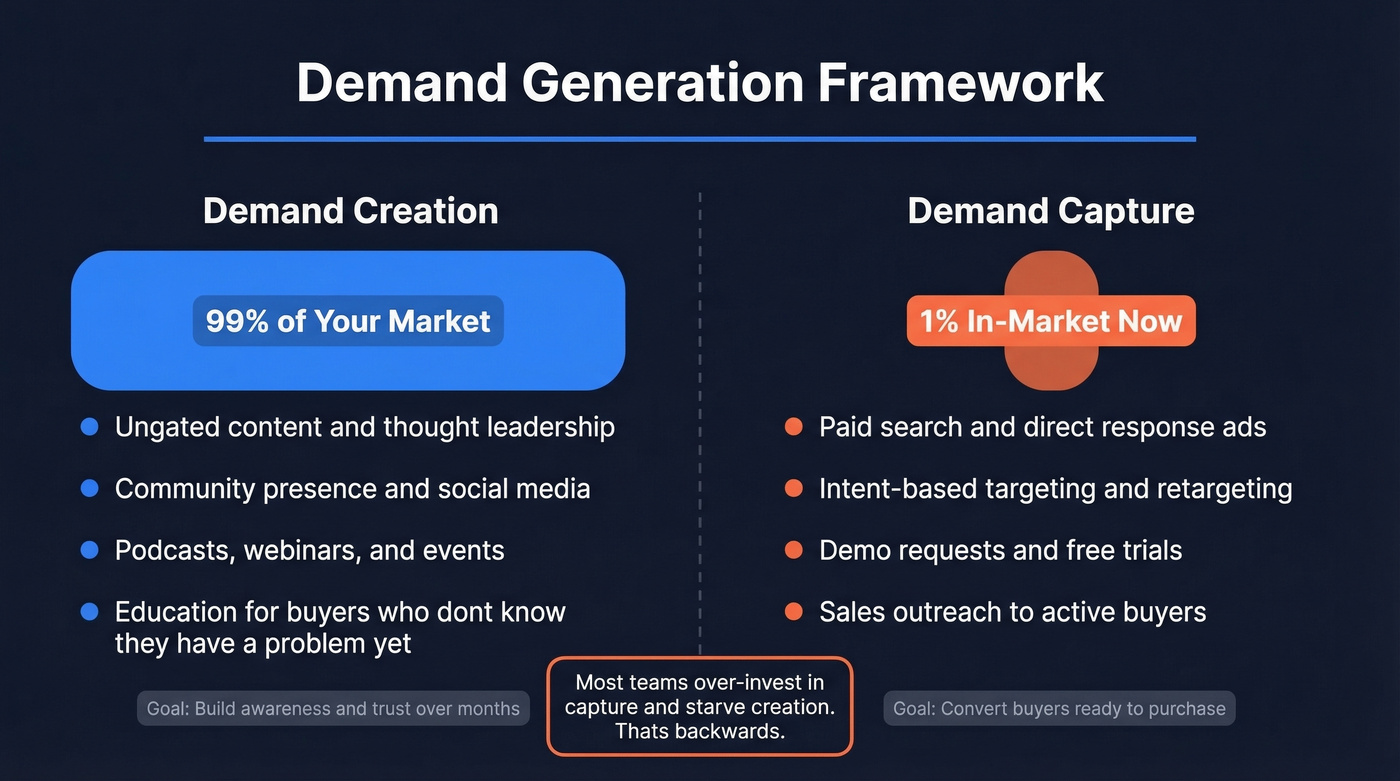
A useful operating framework - popularized in modern B2B by Cognism's leadership - splits the work into demand creation for the 99% of your market that isn't actively buying right now, and demand capture for the 1% that is.
Demand creation means educating audiences who don't yet know they have a problem: ungated content, thought leadership, community presence. Demand capture means converting buyers already in-market: paid search, intent-based targeting, direct response. Most teams over-invest in capture and starve creation. That's backwards, and it's the single biggest strategic mistake we see in B2B programs.
The Quick Version
Your CEO saw a competitor's podcast blow up and now wants a "demand gen strategy by Friday." Here's what to tell them:
- 70% of marketing-sourced pipeline comes from just four channels: SEO, events, social media, and paid search.
- Expect the first 3 months to feel slow. Compounding tends to show up around month 6 if you stay consistent.
- Frame everything as demand creation (build awareness) vs. demand capture (convert in-market buyers).
- Stop measuring it like performance marketing. You shouldn't attribute a 6-month buying journey to a single touchpoint.
Demand Gen vs. Lead Gen
These aren't synonyms. They're different functions that feed each other.
| Dimension | Demand Gen | Lead Gen |
|---|---|---|
| Funnel position | Top + mid | Mid + bottom |
| Timeframe | Ongoing, months | Campaign-based |
| Goal | Build awareness, trust | Capture contact info |
| Key metrics | Pipeline, brand lift | MQLs, SQLs, CPL |
Demand gen creates the conditions for lead gen to work. Without it, lead gen is just cold outreach to people who've never heard of you - and your reply rates will reflect that.
Channels That Actually Drive Pipeline
Half of companies use 11-15 pipeline-generating channels. That's not a strategy; that's spreading budget thin enough to guarantee mediocrity everywhere. Here's how the top channels convert, based on Digital Bloom's pipeline benchmarks:
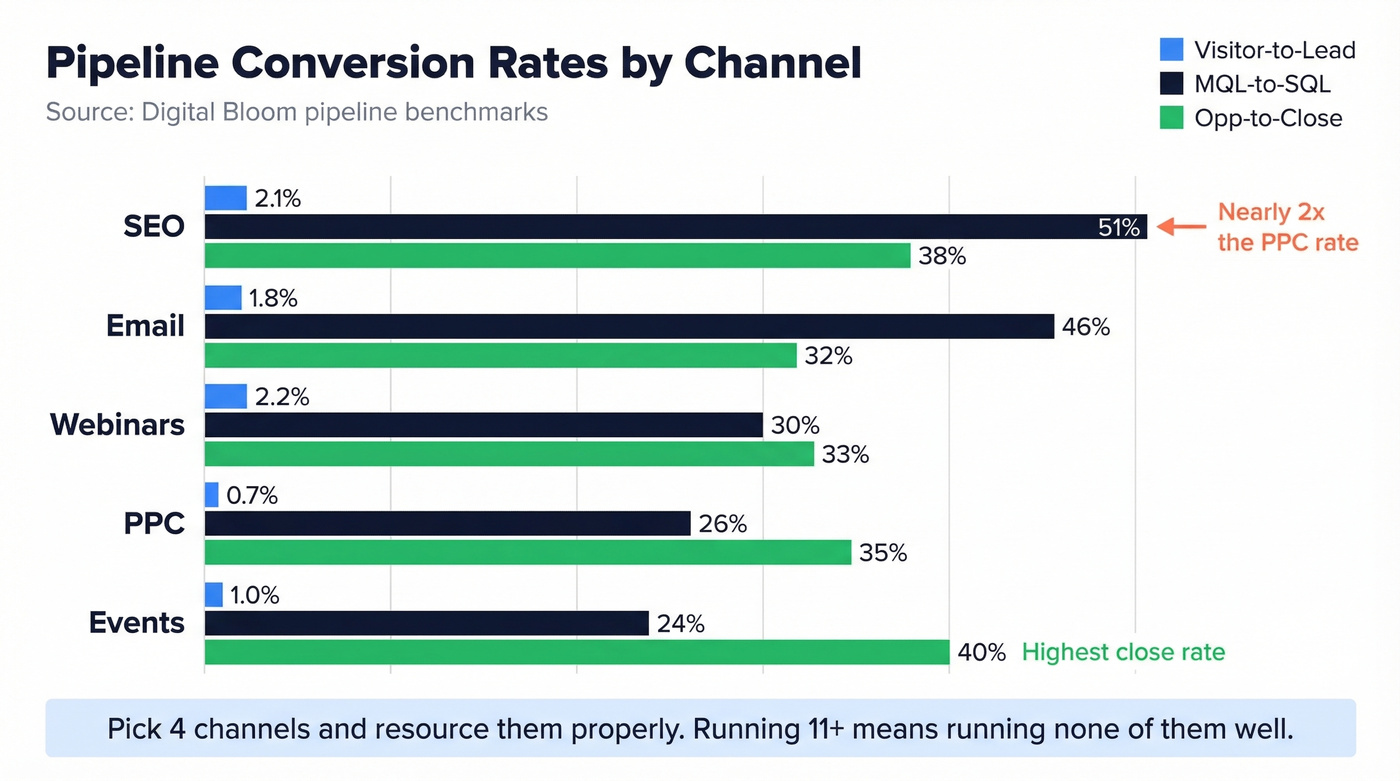
| Channel | Visitor-to-Lead | MQL-to-SQL | Opp-to-Close |
|---|---|---|---|
| SEO | 2.1% | 51% | 38% |
| 1.8% | 46% | 32% | |
| Webinars | 2.2% | 30% | 33% |
| PPC | 0.7% | 26% | 35% |
| Events | 1.0% | 24% | 40% |
Look at SEO's MQL-to-SQL rate. It's nearly double PPC's. Events have the highest close rate. Pick four channels, resource them properly, and iterate. Running 11+ means running none of them well enough to hit these numbers.

SEO and events drive pipeline - but only if you can actually reach the leads they generate. Prospeo delivers 98% email accuracy on a 7-day refresh cycle, so the contacts entering your demand gen funnel don't bounce at 25% and tank your sender reputation.
Stop letting stale data kill your demand gen ROI.
A Real Timeline: What to Expect
Here's the thing most demand gen content won't tell you: the first three months feel like failure.
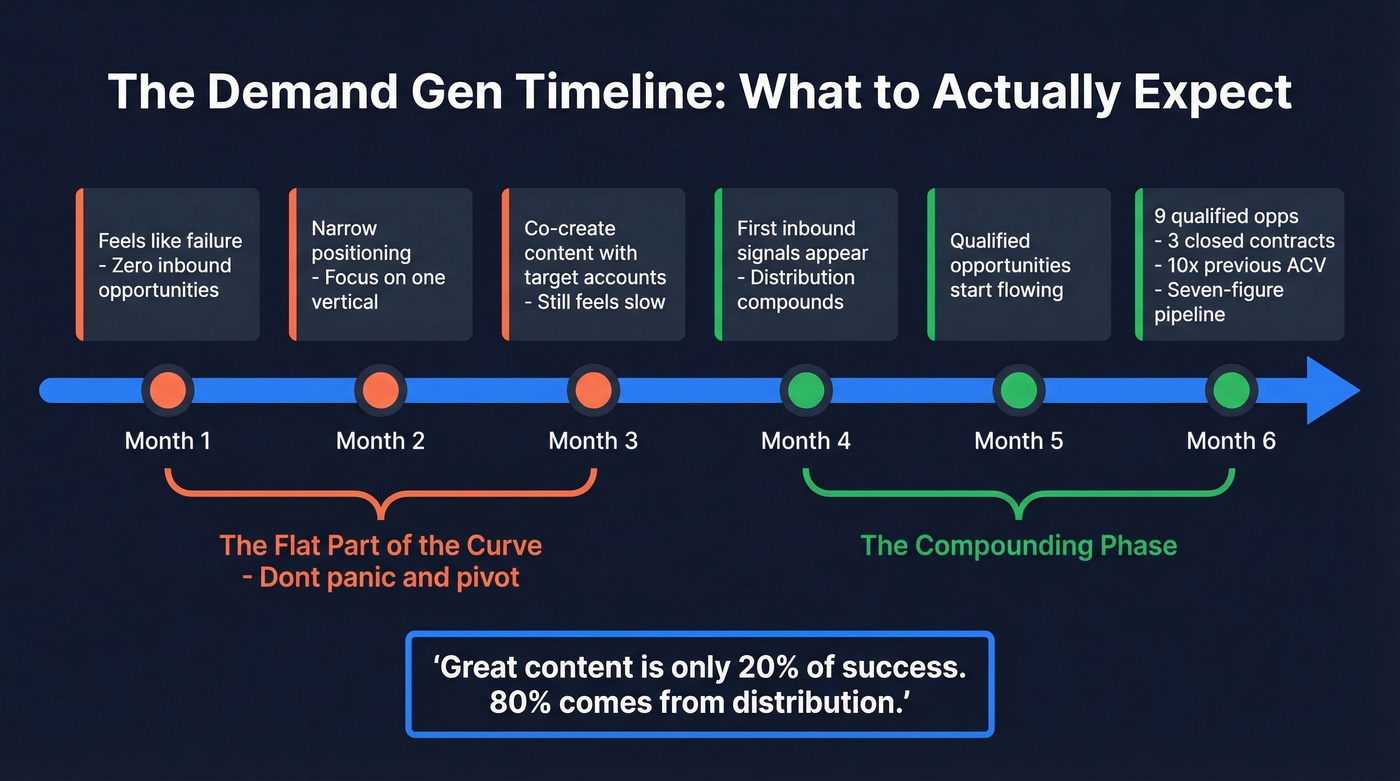
A practitioner shared their results on Reddit after running a program for a software development company. Months one through three produced zero inbound opportunities. Nothing. They narrowed positioning to a single vertical (AdTech), turned executive profiles into landing pages, and co-created an industry report with a target account. By month six, the program had generated 9 qualified opportunities, closed 3 contracts at 10x their previous average ACV, and built a seven-figure pipeline.
Their takeaway: "Great content is only 20% of success. 80% comes from distribution."
B2B demand gen compounds, but only if you survive the flat part of the curve. We've seen this pattern repeatedly - teams panic at month two, pivot everything, and reset the clock to zero. Don't be that team.
Benchmarks by Funnel Stage
Here's where your pipeline actually leaks, based on MarketJoy's aggregated B2B data:
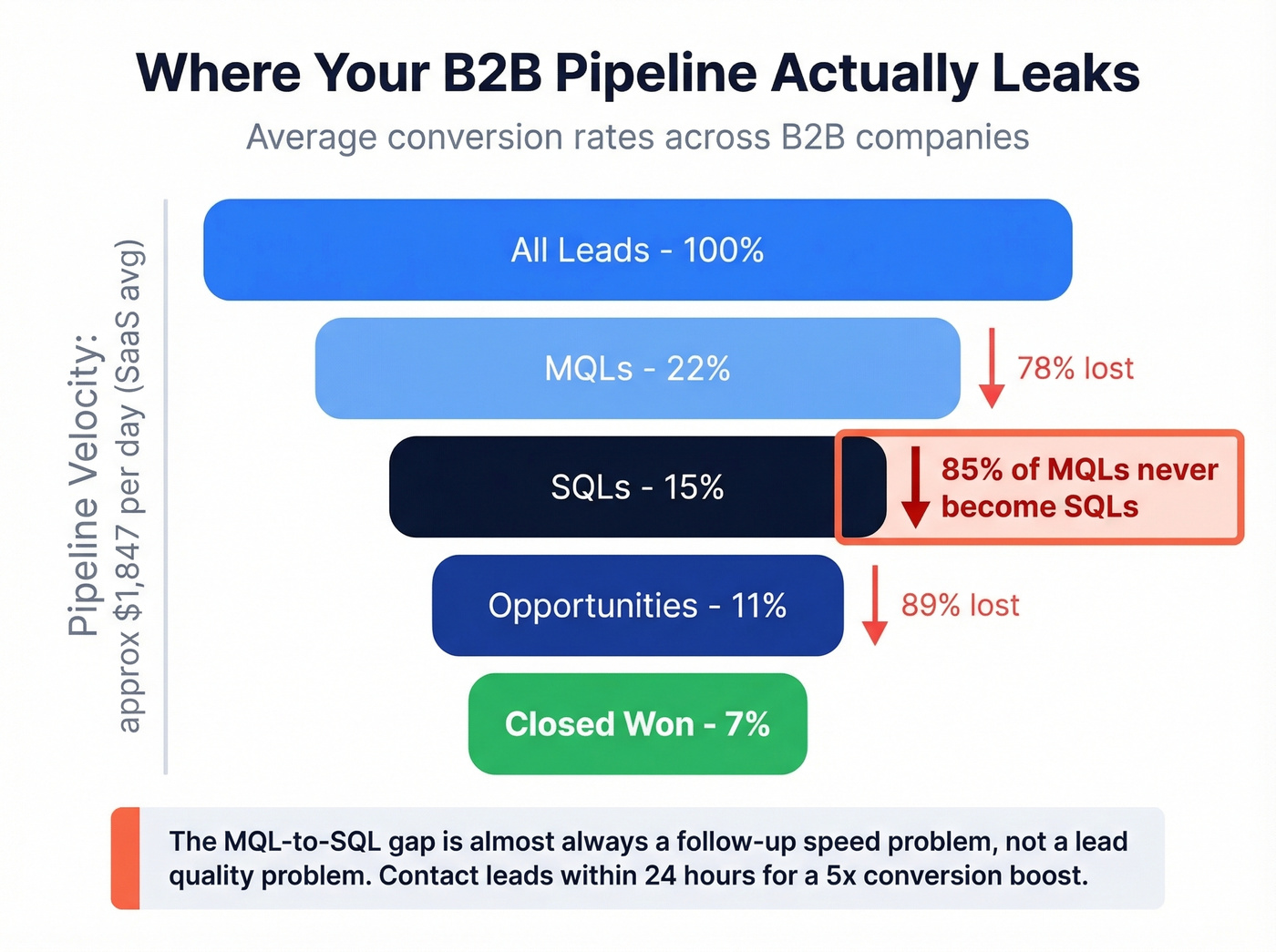
| Stage | Avg Conversion |
|---|---|
| Lead to MQL | 22% |
| MQL to SQL | 15% |
| SQL to Opportunity | 11% |
| Opp to Closed-Won | 7% |
MQL-to-SQL is where programs go to die. That 15% means 85% of your marketing-qualified leads never become sales-qualified. Before you blame marketing for "bad leads," check your follow-up speed - contacting leads within 24 hours can increase conversion by 5x.
In our experience, the MQL-to-SQL gap is almost always a follow-up speed problem, not a lead quality problem. Digital Bloom's compiled benchmarks put SaaS and technology pipeline velocity at about $1,847/day. If your number is significantly lower, the fix is usually in that gap, not in generating more top-of-funnel volume.
What Kills Demand Gen Programs
Let's be honest about the failure modes, because they're predictable and almost always self-inflicted:
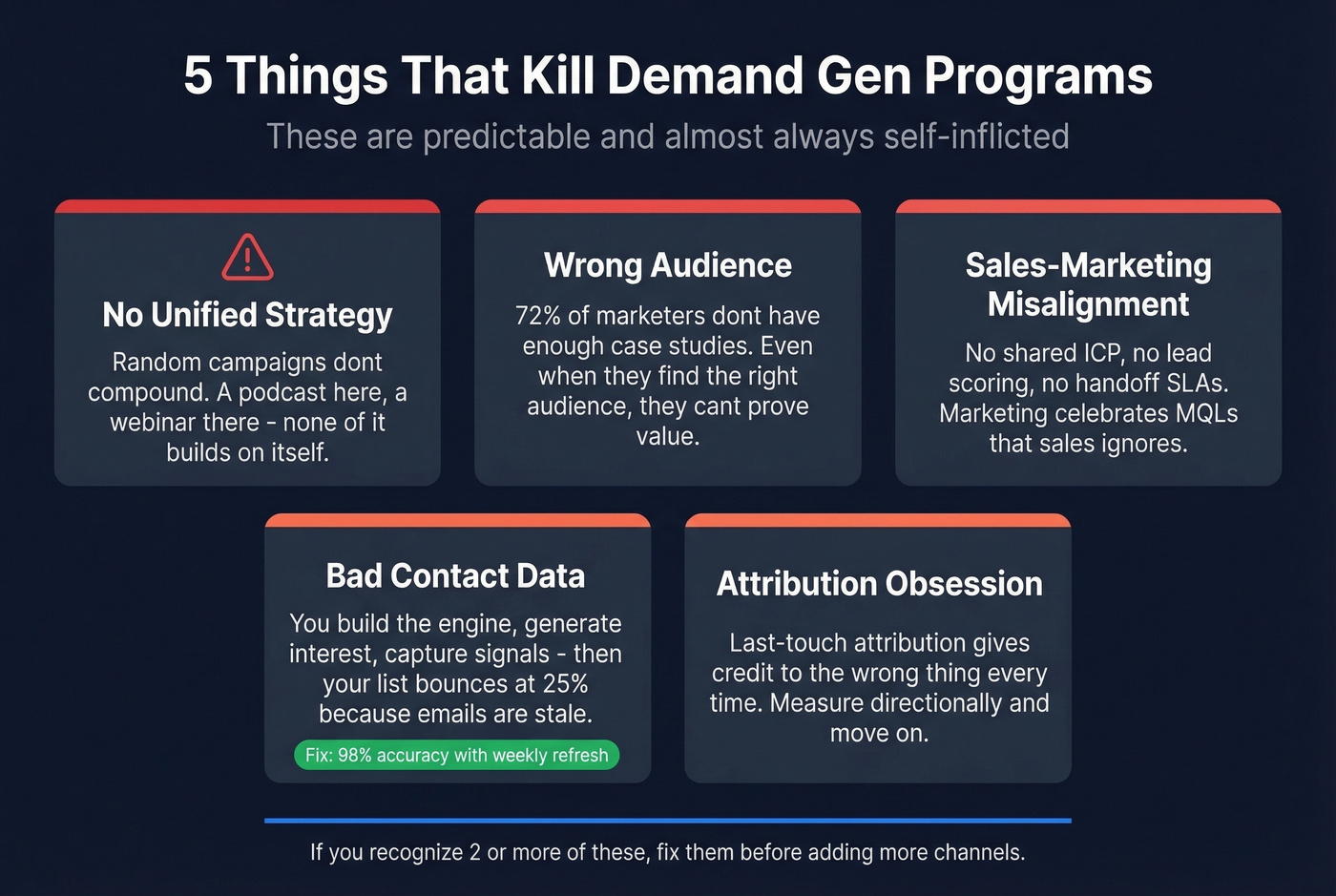
No unified strategy. Random campaigns don't compound. A podcast here, a webinar there, a social push next quarter - none of it builds on itself without a coherent plan tying the pieces together.
Wrong audience. If you haven't done a proper revenue analysis to identify your best-fit segments, you're spraying content into the void. And 72% of marketers say they don't have enough case studies to fuel their programs, which means even when they find the right audience, they can't prove they've solved the problem before.
Sales-marketing misalignment. No shared ICP definition, no lead scoring agreement, no handoff SLAs. The result is marketing celebrating MQLs that sales ignores.
Bad contact data. The silent killer. You build an engine, generate interest, capture intent signals - and then your outbound list bounces 25% because the emails are stale. This is where tools like Prospeo earn their keep: 98% email accuracy on a 7-day refresh cycle means verified contacts that don't bounce, refreshed weekly versus the ~6-week industry average.
Attribution obsession. This is my hot take, and I'll stand by it: attribution obsession kills more demand gen programs than bad strategy does. A buyer sees your social post, Googles you three months later, attends a webinar, disappears, then reaches out through a completely different channel. Last-touch attribution gives credit to the wrong thing every time. We've watched teams spend months building attribution models that told them nothing useful. If you can't measure it perfectly, measure it directionally and move on.
How to Measure Without Lying
Most B2B teams can't state their demand gen ROI by channel. That's not a spreadsheet problem - it's a leadership problem.
B2B sales cycles run 6-12 months with hundreds of touches. Buyers research silently - increasingly through AI tools - before ever talking to sales. What to measure instead: net revenue and margin tied back to marketing-sourced pipeline. Get marketing, sales, and finance aligned on shared definitions. Track through renewal and include customer lifetime value.
If your three teams can't agree on those definitions in a single meeting, that's your first problem to solve. Skip the fancy multi-touch attribution platform until you've nailed the basics.
What Changes in 2026
Gartner predicts that by 2028, 90% of B2B buying will be agent-intermediated - AI agents actively participating in discovery and vendor evaluation. That's not distant future; it's already starting. 87% of companies already use AI in their demand gen tactics.
The practical implication: your content needs to be structured for machine interpretation, not just human consumption. And demand capture increasingly means using intent data to identify in-market buyers before they ever fill out a form - tracking signals across thousands of topics so you can reach the right accounts at the right moment.
The MQL-to-SQL gap isn't just a follow-up speed problem - it's a data problem. When 85% of MQLs never convert, bad contact info is the silent killer. Prospeo's 143M+ verified emails and 125M+ mobile numbers mean your sales team reaches real buyers, not dead inboxes.
Close the MQL-to-SQL gap with contacts that actually connect.
FAQ
What's the difference between demand generation and lead generation?
Demand generation builds awareness and trust over months, targeting buyers who aren't actively shopping yet. Lead generation captures contact info from already-interested prospects. Demand gen feeds lead gen - without it, you're only reaching the small slice already in-market, typically about 1% of your TAM.
How long does demand generation take to show results?
Expect the first three months to feel slow with minimal inbound activity. Compounding tends to show up around month six. One documented B2B program generated zero opportunities in months one through three but built a seven-figure pipeline by month six through consistent distribution.
What channels drive the most B2B pipeline?
SEO, events, social media, and paid search generate roughly 70% of marketing-sourced pipeline. SEO converts MQLs to SQLs at 51%, nearly double PPC's 26%. Events close at 40%. Pick four channels and resource them properly rather than spreading budget across 11+.
What tools do you need for a demand gen program?
A CRM like HubSpot or Salesforce, a verified contact data provider for clean outbound lists and intent signals, analytics for directional attribution, and a content distribution system. Fewer tools with better execution outperform a bloated tech stack every time.