


7 Best Demoboost Alternatives in 2026
Demoboost scores a 4.9/5 on G2 from 103 reviews - people genuinely like the product. But liking a product and being able to buy it transparently are two different things. No published pricing, no free trial, and G2 reviewers flagging slow editing performance and sluggish demo load times mean plenty of teams end up looking elsewhere. Below are seven options with transparent pricing and strong fit by use case.
Our Top Picks (TL;DR)
| Tool | Best For | Starting Price |
|---|---|---|
| Storylane | Marketing + sales demos | Free / $40/mo |
| Arcade | Marketing embeds | Free / $32/mo |
| Navattic | HTML-capture fidelity | Free / $500/mo |
Why Teams Switch From Demoboost
Demoboost's G2 rating is legitimately impressive. The praise centers on ease of use, responsive support, and fast demo creation. So why leave?
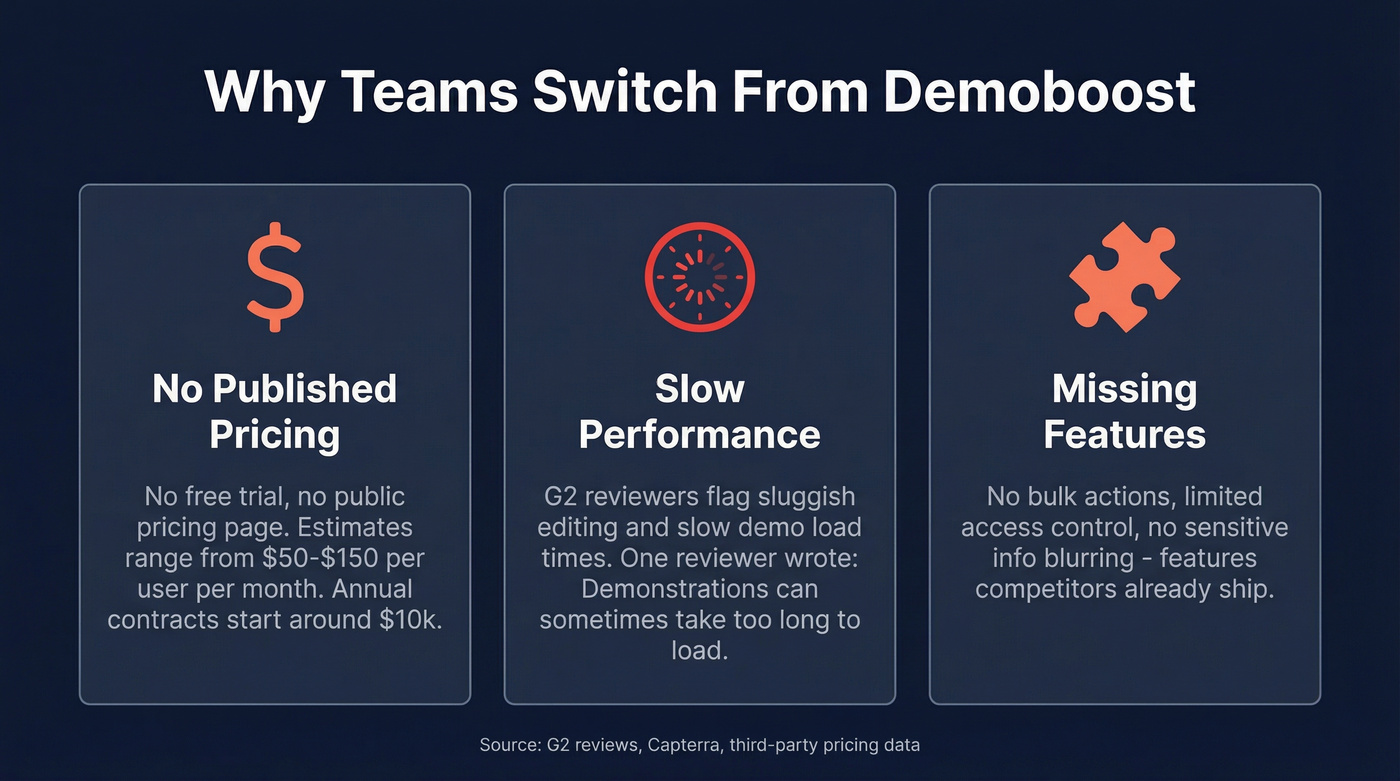
Pricing opacity. Demoboost doesn't publish pricing, doesn't offer a free trial, and Capterra confirms "contact vendor for pricing." Third-party estimates put it at $50-$150/user/month, with contracts often starting around $10k/year. That's a lot of trust to extend before you've even seen the product.
Performance complaints. Multiple G2 reviewers call out slow editing and sluggish demo loading. One wrote: "Demonstrations can sometimes take too long to load." Another: "Interface response time is sometimes really slow." When your demo platform is the thing that's supposed to impress prospects, latency is a dealbreaker.
Missing workflow features. Reviewers want bulk actions, better access control, and sensitive info blurring - features that more mature platforms already ship.

A great demo platform means nothing if your pipeline is empty. Prospeo gives you 300M+ verified contacts with 30+ filters - buyer intent, technographics, headcount growth - so you fill every demo slot with qualified buyers, not tire-kickers.
Build the pipeline your new demo tool deserves - starting at $0.01 per lead.
How to Choose the Right Category
Before comparing tools, know which type you actually need. The demo software space breaks into four subcategories: video demo software (Consensus, Arcade), product tour builders (Navattic, Walnut), live demo software (Saleo, Demoboost), and sandbox/POC environments (TestBox, Reprise-style sandbox builds).
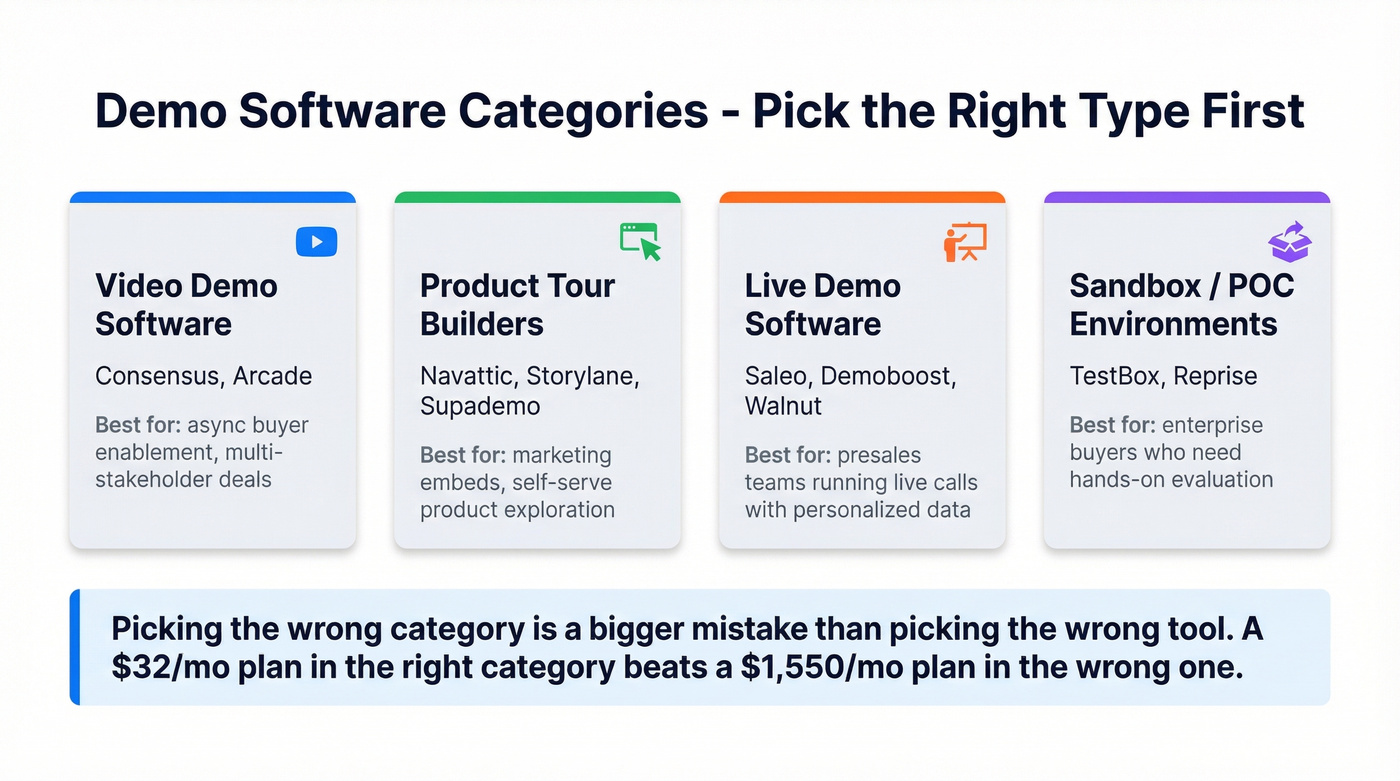
Here's the thing: picking the wrong category is a bigger mistake than picking the wrong tool within a category. A $32/mo Arcade plan in the right category will outperform a $1,550/mo Walnut plan in the wrong one.
The 7 Best Demoboost Alternatives
| Tool | Best For | Starting Price | Free Plan? |
|---|---|---|---|
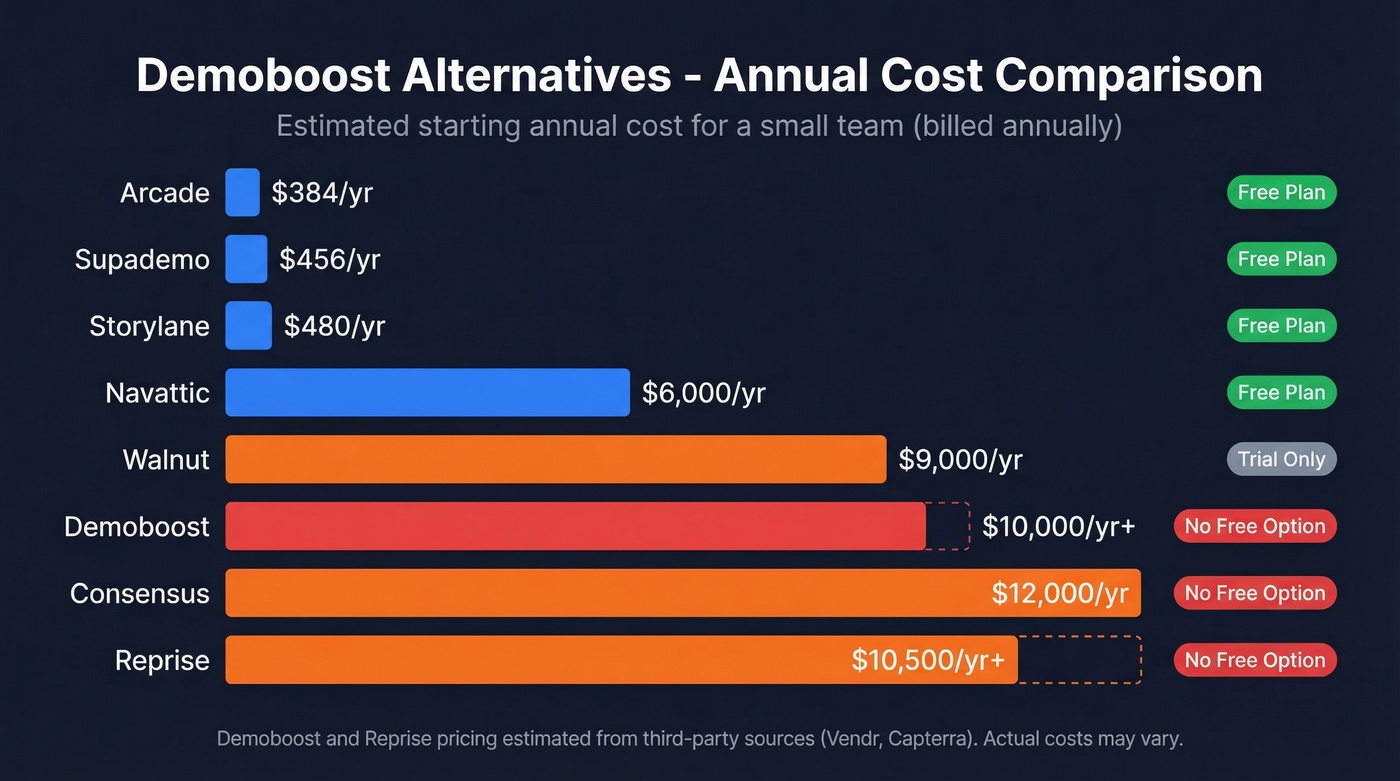
| Storylane | Marketing + sales demos | $40/mo | Yes |
| Arcade | Marketing embeds | $32/mo | Yes |
| Navattic | HTML-capture demos | $500/mo | Yes (1 demo) |
| Walnut | Enterprise presales | $750/mo | No (14-day trial) |
| Consensus | Video demo automation | ~$12,000/yr | No |
| Reprise | Large enterprise | ~$10,500/yr | No |
| Supademo | Solo creators | $38/mo | Yes |
Storylane
Use this if you need one platform that handles both marketing product tours and sales-led demos. Storylane can get a first demo running in 15 minutes with no onboarding calls. The free plan lets you test without commitment, and paid tiers scale cleanly: $40/mo Starter, $500/mo Growth, $1,200/mo Premium.
Skip this if you only need video demos. Storylane is built around interactive tours, not recorded walkthroughs. For video-first workflows, look at Consensus or Arcade instead.
If you're also tightening your software demo process, Storylane is a strong fit for repeatable, self-serve flows.

Arcade
Arcade is the sleeper pick on this list. The free plan gives you 3 demos, and Pro at $32/mo removes watermarks and unlocks unlimited demos. We've tested the workflow end to end - median publish time is about 6 minutes from start to a shareable demo link.
The results back it up: Zapier used interactive demos and saw a 70% increase in contact-sales submissions on a Workflows page. Growth runs $297.50/mo for 5 seats, with extra seats at $150/mo. Arcade's pricing page is refreshingly transparent.
Skip this if you need live demo overlays or sandbox environments. Arcade is a capture-and-publish tool, not a live presentation platform.
Navattic
Most demo tools produce something that looks like a screenshot slideshow. Navattic's HTML-capture approach produces demos that look and feel like the actual product - clicks register, menus expand, and the experience is much closer to a real login session. That difference matters when you're trying to sell complex software to technical buyers who'll notice a fake immediately.
Pricing includes a free Starter plan with 1 seat and 1 demo. Paid tiers run around $500/month for Base (5 seats) and $1,000/month for Growth (10 seats), with custom Enterprise options.
Skip this if you need presenter-mode live demos. Navattic is built for self-serve, on-demand experiences - not for SEs running live calls.
If you're building a repeatable sales POC motion, Navattic is often the better “show, don’t tell” layer than a full sandbox.
Walnut
Let's be honest: $9,000/year for 3 editor seats is overpriced for most teams. In our experience, this only makes sense if you're running a dedicated presales org with multiple presenters who need personalized demo environments for every deal. For everyone else, Storylane or Navattic covers a lot of the same ground at a fraction of the cost.
That said, Walnut earns its price for the right buyer. Ignite starts at $750/mo billed annually for 3 editor seats, Accelerate runs $1,550/mo billed annually for 5 editors plus 5 presenters, and Scale is custom. G2 rates it 4.5/5 from 151 reviews, and there's a 14-day free trial. Walnut also offers Interactive Deal Rooms at $70/user/month, or $35/user/month bundled with a demo plan.
Skip this if you're not running a dedicated presales team with serious deal complexity.
If you’re standardizing sales enablement across a larger org, Walnut can make sense - just budget accordingly.
Consensus
Vendr's contract data tells the story here: median annual cost of $22,812, with a range from $6,653 to $140,985. Starting contracts land around $12,000/year. That's a wide spread, and it reflects the fact that Consensus takes a fundamentally different approach from everything else on this list - it's video-based demo automation where buyers watch on their own time.
G2 ranks it as the top overall Demoboost competitor, which makes sense: both tools target presales teams, but Consensus removes the live component entirely. If your sales cycle involves multiple stakeholders who can never get on the same call, Consensus lets each one consume the demo independently and tracks exactly who watched what.
Skip this if you need interactive product tours. Consensus is video, not clickable HTML - different tool for a different job.
Consensus pairs well with a strong B2B sales funnel where content consumption is a measurable stage.
Reprise
Reprise is the "nobody got fired for buying IBM" pick. It runs $10,500-$64,000+/year with a median around $28,000, and it earns that price tag with enterprise compliance: SOC 2 Type II, ISO 27001, and SSO/RBAC included in every package. The platform supports both HTML-capture demos and full sandbox environments, which is why it shows up so often in large-enterprise demo stacks.
Skip this if you're under 500 employees or don't have a $30k+ budget sitting in your demo tooling line item. Storylane or Navattic gets you most of the way there for a fraction of the cost.
If you’re selling into enterprise B2B sales cycles, Reprise’s compliance posture can remove friction.
Supademo
Supademo is the lowest-cost option here for small teams. The free plan gives you 5 demos, Scale is $38/mo per creator, and Growth is $350/mo for 5 creators. The interface is deliberately simple: screenshot capture, annotation, publish. Done.
Skip this if you need HTML capture or advanced analytics. Supademo trades depth for speed and affordability - and for solo creators or tiny teams, that's often the right trade.
Supademo is a good match if you’re also running lightweight sales follow-up sequences and just need a quick “how it works” asset.
Fix Your Prospect Data First
The best demo platform in the world doesn't matter if 20% of your demo invitations bounce. Demo tools measure completion rates and engagement, but those analytics are meaningless when a chunk of your audience never receives the invite. We've seen teams obsess over demo conversion rates while ignoring the fact that their contact data was rotten - a frustrating problem that's entirely fixable.
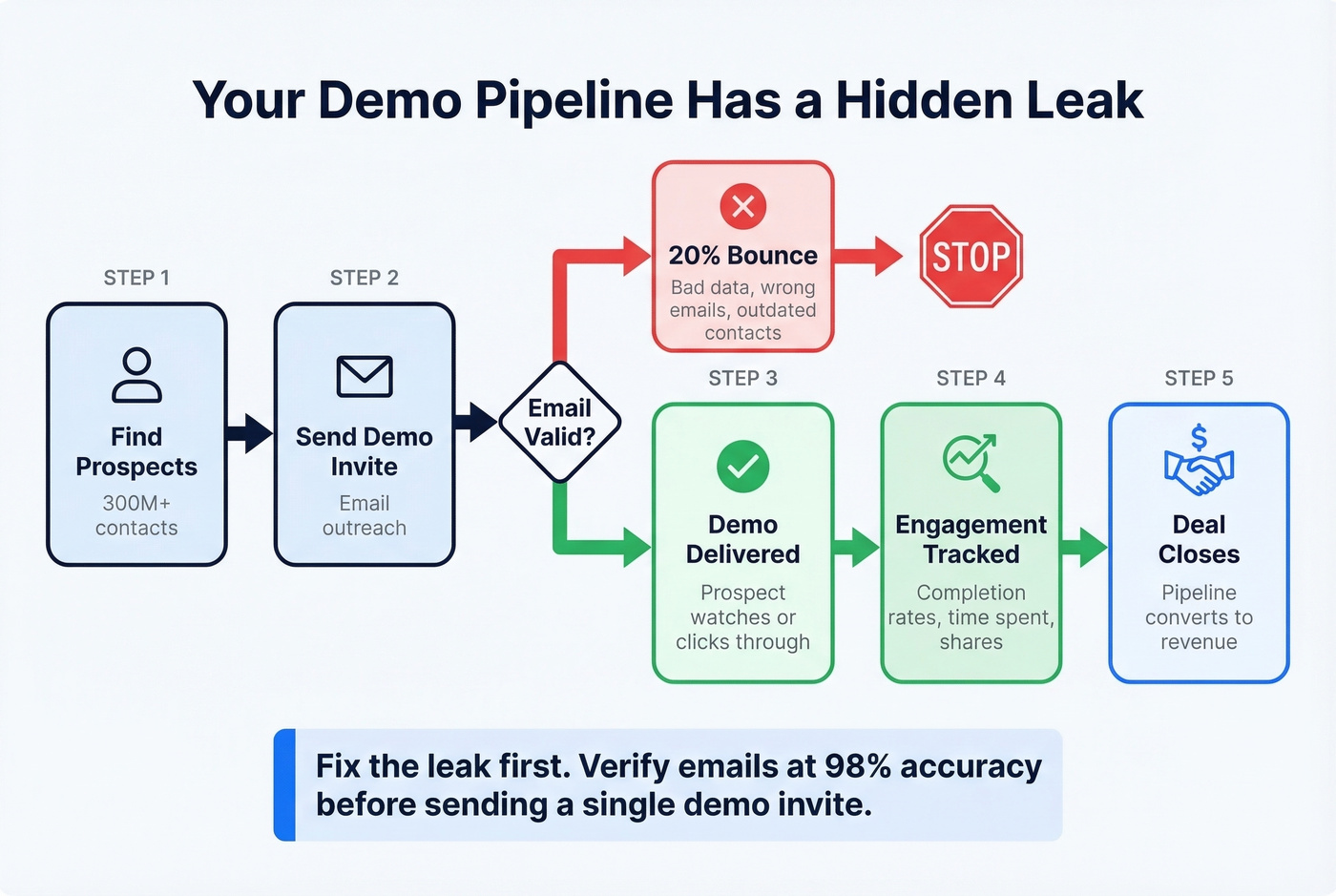
Prospeo finds and verifies B2B emails with 98% accuracy across 300M+ professional profiles, on a 7-day refresh cycle. It starts free, requires no contracts, and plugs directly into your existing outreach stack via native integrations with Salesforce, HubSpot, Instantly, and Lemlist. Before you optimize your demo experience, make sure your prospect data isn't the bottleneck.
If you’re cleaning lists at scale, pair verification with data enrichment so reps aren’t guessing titles and accounts.

You're evaluating demo tools to close more deals. But the biggest bottleneck isn't the demo - it's reaching the right stakeholders. Prospeo delivers 98% accurate emails and 125M+ verified mobile numbers so your presales team actually gets live conversations.
Stop demoing to the wrong people. Start reaching real decision-makers.
FAQ
What does Demoboost cost?
Demoboost doesn't publish pricing and doesn't offer a free trial. Third-party estimates put it at $50-$150/user/month, with annual contracts often starting around $10,000. Expect a sales conversation before you see a number.
Is there a free alternative to Demoboost?
Yes - Storylane, Arcade, Navattic, and Supademo all offer free plans. Arcade's free tier includes 3 demos with 200 AI credits/month. Supademo gives you 5 demos. Storylane and Navattic each offer a free starter plan to test before committing.
How do I make sure demos reach the right prospects?
Verify your contact data before sending demo invitations. Prospeo checks emails at 98% accuracy across 300M+ profiles on a 7-day refresh cycle, so your demos reach real inboxes instead of bouncing. The free tier includes 75 email credits per month - enough to test before scaling.