

Sales Development Representative: What the Role Actually Looks Like in 2026
It's 8:47 on a Tuesday morning. You've got a cold brew going lukewarm, 47 dials queued, and a Slack message from your AE asking why yesterday's demo didn't show. By 9:15, you'll have been hung up on twice, ignored by six inboxes, and - if things go well - booked one meeting that might turn into pipeline three months from now.
That's the sales development representative job. Not the job listing version. The real one.
A lot of people are either considering this role, just started it, or trying to figure out if they should stick with it. Let's skip the recruiter pitch and talk about what actually happens.
The Quick Version
A sales development representative (SDR) generates pipeline. You don't close deals - account executives do that. Your job is to find the right people, get their attention, and book qualified meetings. Everything else is plumbing.
- Median base salary: $60,000. Median OTE: $85,000. Top performers hit $127,955.
- Typical tenure: 12-18 months before promotion or departure.
- Quota attainment: 57.3% of SDRs hit their number in any given period, but 83.4% consistently miss quota. When five out of six reps can't sustain quota, the targets are broken - not the people.
- Burnout reality: 54% of SDRs cite burnout as a top reason they'd leave.
If that doesn't scare you off, keep reading.
What Does an SDR Actually Do?
An SDR is the front end of the B2B sales engine. You sit between marketing (which generates leads) and account executives (who close deals). Your job is qualification and pipeline creation: taking raw leads or cold prospects and turning them into meetings worth an AE's time.
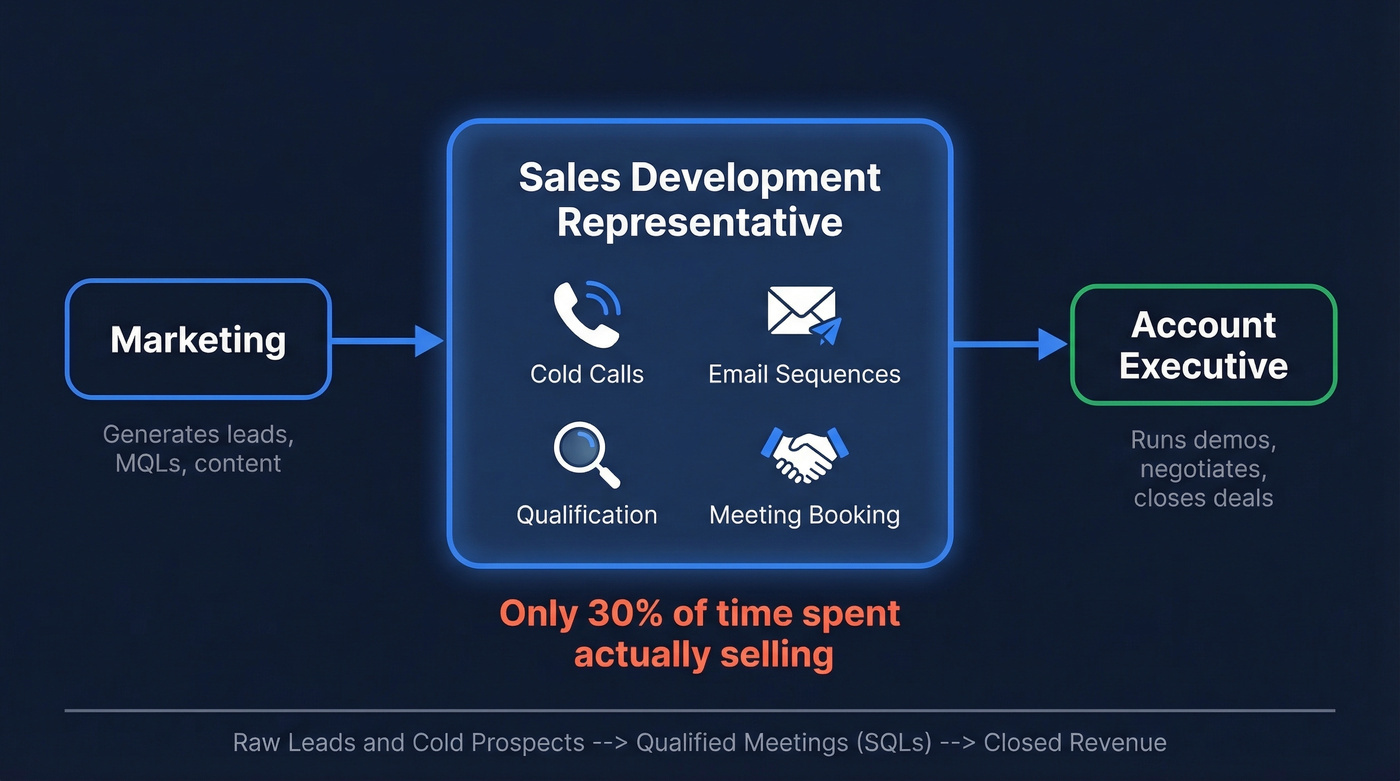
The work is multi-channel. On any given day, you're making cold calls, sending personalized emails, engaging on social platforms, and occasionally sending direct mail to break through the noise. You're qualifying inbound MQLs into SQLs using frameworks like BANT or MEDDIC, and you're creating outbound conversations where none existed before.
Here's the part most job descriptions leave out: SDRs spend only about 30% of their week actually selling. The other 70% goes to research, data entry, CRM updates, internal meetings, and admin work. That ratio is why the best SDR teams obsess over tooling and automation - every hour reclaimed from busywork is an hour that can generate pipeline.
The role isn't glamorous. You won't be on stage at the annual sales kickoff telling war stories about the deal you closed. But every AE who hits their number has an SDR who put them in the room. That leverage is real, and it's why the role remains the most common entry point into B2B tech sales.
SDR vs BDR - The Real Difference
The honest answer? At most companies, there isn't one. The titles are used interchangeably, and the meaningful distinction is inbound versus outbound - not the three letters on your business card.
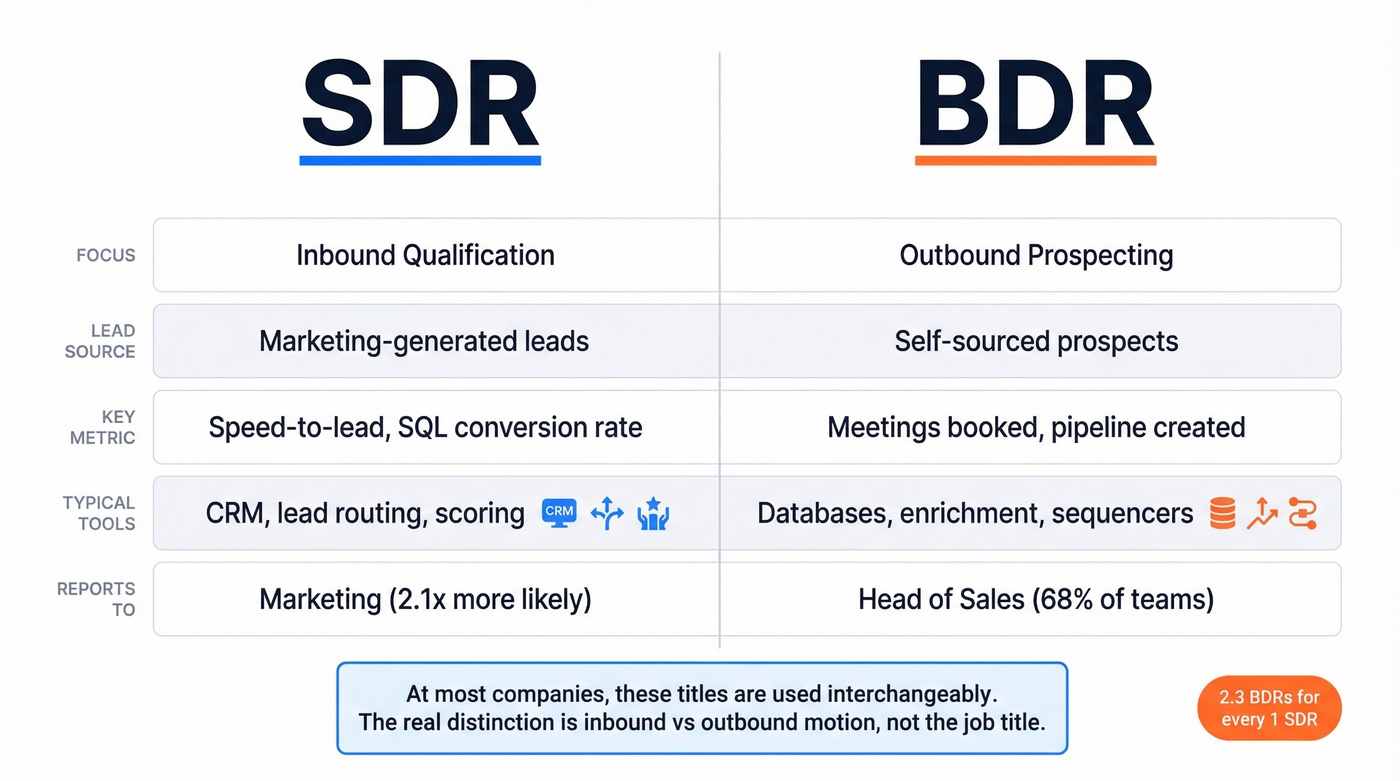
When companies do separate the roles, the split usually looks like this:
| Dimension | SDR | BDR |
|---|---|---|
| Focus | Inbound qualification | Outbound prospecting |
| Lead source | Marketing-generated | Self-sourced |
| Key metric | Speed-to-lead, SQL rate | Meetings booked, pipe created |
| Typical tools | CRM, lead routing | Databases, enrichment, sequencers |
| Reports to | Marketing (2.1x more likely) | Head of sales (68% of SDR/BDR teams) |
Companies run about 2.3 BDRs for every SDR. The median org staffs 1 SDR/BDR per 2.6 AEs.
58% of SDRs juggle 75+ accounts per quarter. Whether you're called an SDR, BDR, or "business development associate," you're doing some version of the same grind. The title matters less than the motion - inbound reps need to respond fast and qualify quickly, while outbound reps need to create conversations from scratch and sustain effort over weeks.
For the rest of this guide, we'll use "SDR" to cover both unless the distinction matters.
Core Responsibilities
Building targeted prospect lists. You're identifying accounts and contacts that match your ICP using filters, enrichment tools, and sometimes manual research to build lists worth calling.
Multi-channel outreach execution. Calls, emails, social touches, video messages, direct mail. The best SDRs run coordinated sequences across channels - multi-channel with deep personalization can outperform averages by 2-3x.
Qualifying inbound leads. When marketing sends you an MQL, your job is to determine if it's worth an AE's time. That means running discovery against frameworks like BANT or MEDDIC and making a judgment call.
CRM hygiene. Every touchpoint logged, every status updated, every note written so the AE walking into a meeting isn't flying blind. Unglamorous and non-negotiable.
Meeting handoff to AEs. Booking the meeting is half the job. The other half is briefing the AE with context - who's in the buying committee, what pain surfaced, what the timeline looks like.
Pipeline and conversion analysis. Tracking your own numbers, identifying what's working, and adjusting. The SDRs who get promoted are the ones who can explain why their numbers look the way they do.
Marketing feedback loop. You're the first person to hear what prospects actually say. Feeding that back - which messaging lands, which personas engage, which objections repeat - makes the whole funnel smarter.
One more thing worth flagging: buying committees now average 10-11 stakeholders. Multi-threading isn't optional. You're not booking a meeting with one person - you're mapping an org chart and finding multiple entry points.
A Day in the Life
Not the idealized version. The real one.
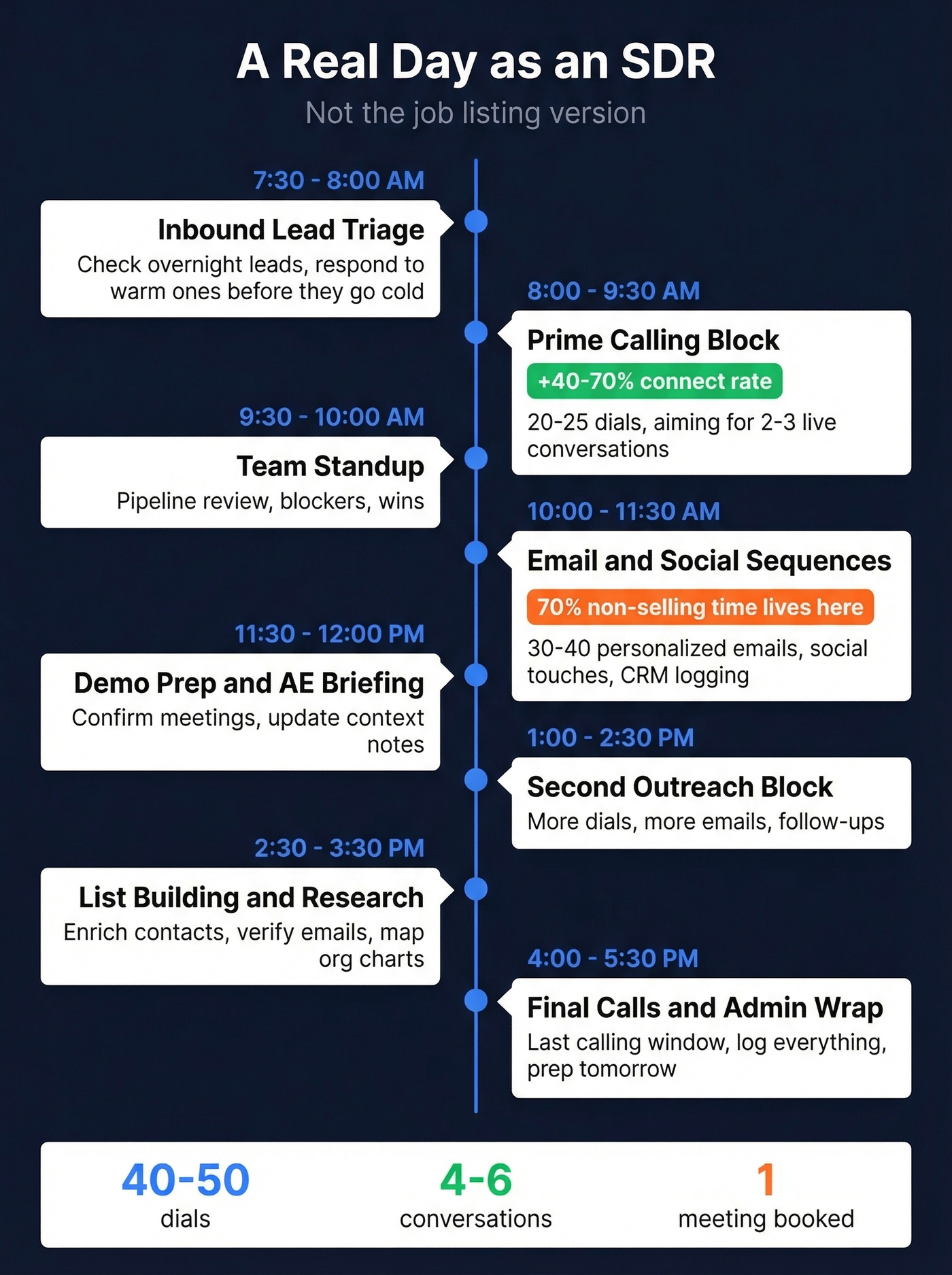
7:30-8:00 AM - Check overnight inbound leads. Respond to anything warm before it goes cold. Speed-to-lead matters: the first rep to respond wins the meeting more often than not.
8:00-9:30 AM - First cold outreach block. Prime calling time - calling between 8-9 AM lifts connect rates 40-70% compared to random times. You're pushing through 20-25 dials in this window, aiming for 2-3 live conversations.
9:30-10:00 AM - Team standup. Pipeline review, blockers, wins from yesterday. Fifteen minutes if your manager respects everyone's time. Thirty if they don't.
10:00-11:30 AM - Email and social sequencing. You're personalizing 30-40 emails, adding social touches to active sequences, and following up on replies. Research, personalization, and CRM logging eat the clock - this is where the 70% non-selling time lives.
11:30 AM-12:00 PM - Confirm afternoon demos for AEs. Brief them on context. Update CRM notes.
1:00-2:30 PM - Second outreach block. More dials, more emails.
2:30-3:30 PM - List building and research for tomorrow's outreach. Enriching contacts, verifying emails, mapping org charts for target accounts.
4:00-5:00 PM - Final calling block. Your second-best connect window. You're pushing to hit your daily number: 40-50 dials, 4-6 quality conversations, and ideally one booked meeting.
5:00-5:30 PM - Admin wrap. Log everything, prep tomorrow's call list, update pipeline notes.
The emotional reality nobody puts in the job listing: you'll hear "no" (or nothing at all) dozens of times a day. It takes an average of 8+ attempts to reach a single prospect. Ramp anxiety is real too - it typically takes 3.1-3.2 months before a new SDR is fully productive.

SDRs who build lists manually burn hours that should go to live conversations. Prospeo's 300M+ profiles with 30+ filters - buyer intent, technographics, headcount growth - let you build ICP-matched lists in minutes, not days. Every email is 98% verified. Every mobile number is confirmed. At $0.01 per email, your list-building cost drops to almost nothing.
Reclaim that 70% and turn it into pipeline.
KPIs and Benchmarks
Numbers are the language of the SDR role. Here's what we've seen across the teams we work with and the public data available:
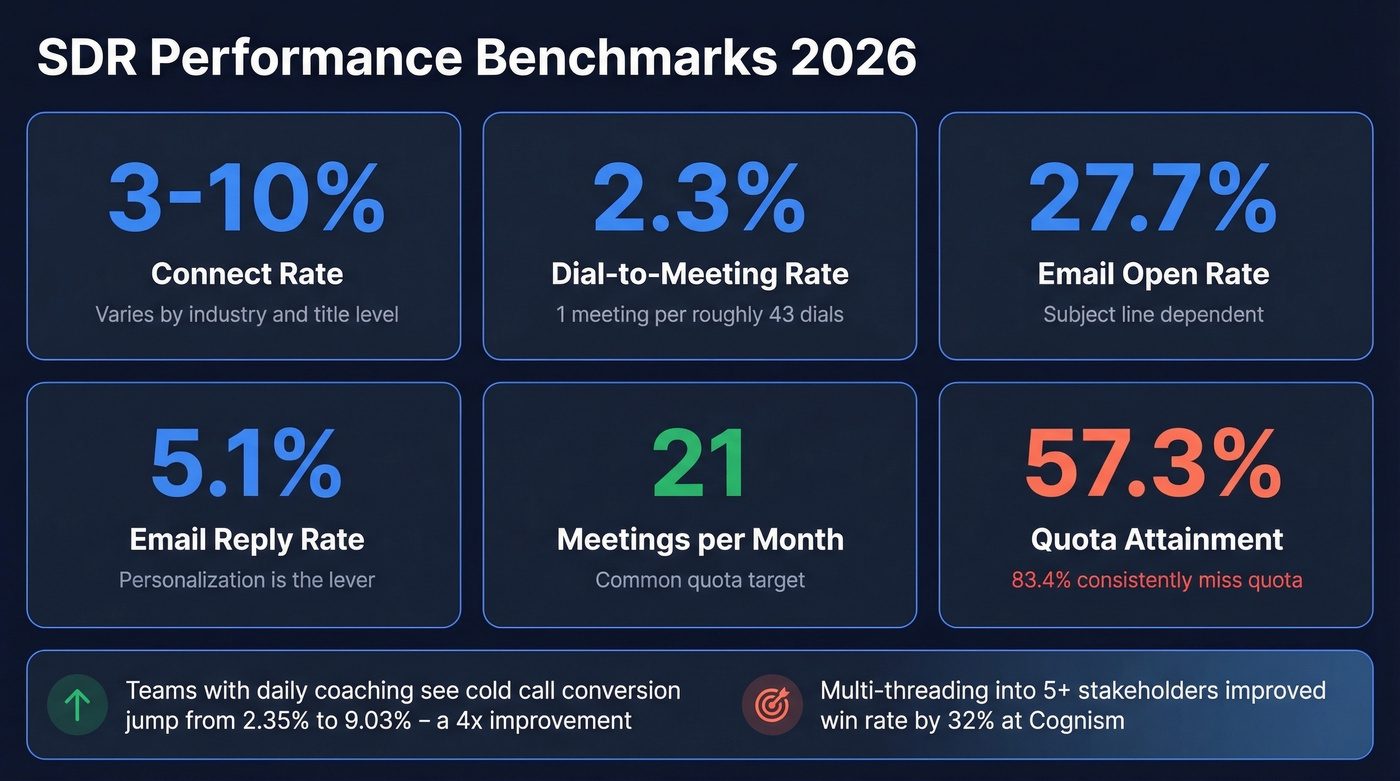
| Metric | Benchmark | Context |
|---|---|---|
| Connect rate | 3-10% | Varies by industry and title level |
| Dial-to-meeting | ~2.3% | 1 meeting per ~43 dials |
| Email open rate | ~27.7% | Subject line dependent |
| Email reply rate | ~5.1% | Personalization is the lever |
| Meetings/month | ~21 | Common quota target |
| Quota attainment | 57.3% | RepVue benchmark |
A few things jump out. First, 83.4% of SDRs consistently miss quota. That's not a people problem - it's a target-setting problem. When five out of six reps can't sustain their number, leadership needs to recalibrate.
Second, coaching moves the needle dramatically. Teams with daily training see cold call conversion jump from 2.35% to 9.03% - roughly a 4x improvement. If your manager isn't coaching you, you're leaving meetings on the table.
Third, multi-threading into buying committees improves outcomes. Cognism improved its win rate by 32% when engaging more than 5 stakeholders in a deal. The SDRs who map org charts and engage multiple contacts don't just book more meetings - they book better ones.
And then there's data quality, the hidden variable behind all of these numbers. Bad data kills connect rates before you even pick up the phone. We've seen teams like Meritt cut bounce rate from 35% to under 4% after switching to Prospeo, tripling their connect rate to 20-25% in the process.
Salary and Compensation
You've got your first offer letter. Here's how to read it.
The RepVue dataset for 2026 gives us clean numbers:
| Metric | Amount |
|---|---|
| Median base | $60,000 |
| Median OTE | $85,000 |
| Top performers | $127,955 |
| Quota attainment | 57.3% |
The Bridge Group benchmark puts OTE at $80,000 with a 68:32 base-to-variable split - roughly $54,400 base and $25,600 variable. Both numbers land in the same range, which gives us confidence in the data.
How Commission Plans Work
The recommended pay mix for SDRs is 65/35 or 70/30 (base/variable). Don't accept a 50/50 split - that's an AE structure, and SDRs don't control the close.
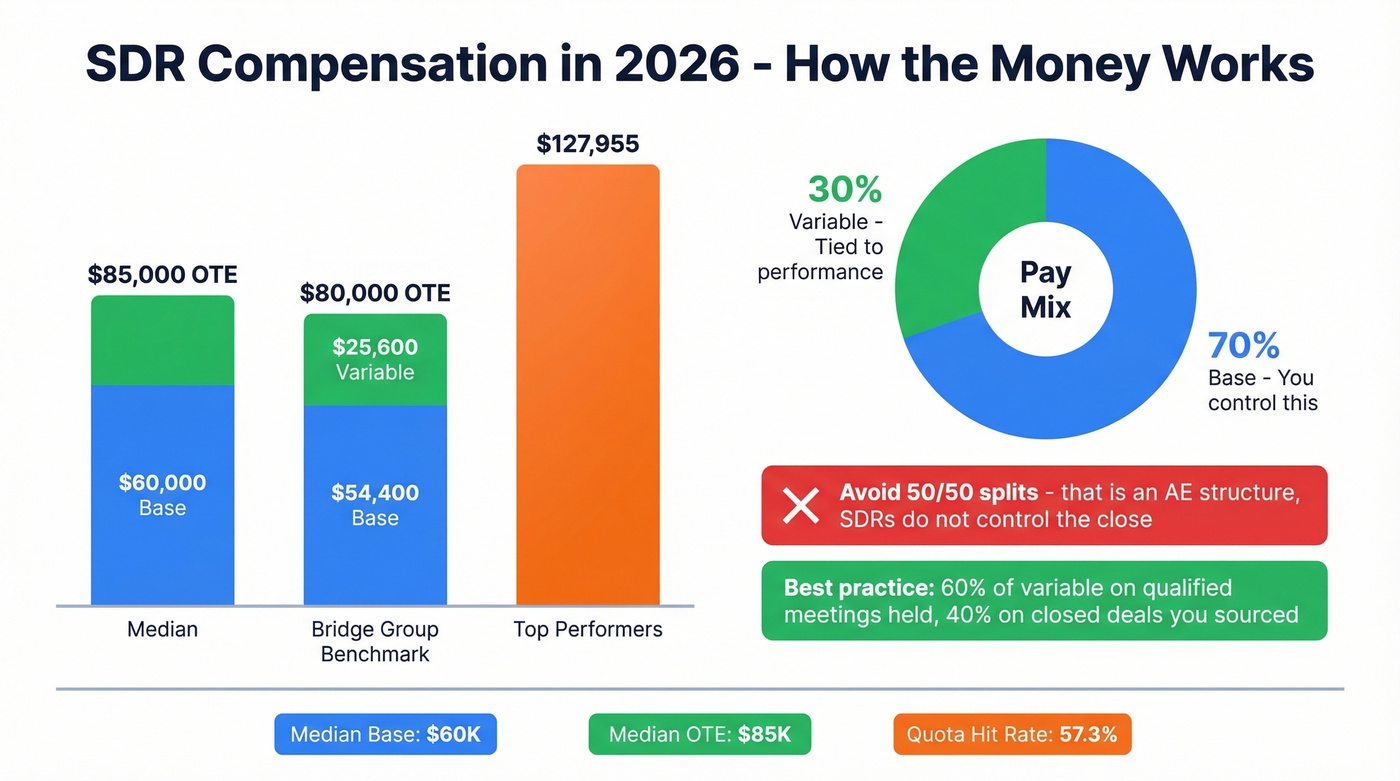
The smartest comp plans use a hybrid model: 60% of variable paid on qualified meetings held, 40% on closed deals sourced by the SDR. This gives you control over most of your earnings while still aligning you with revenue outcomes.
The math on a $30,000 variable target:
- Meetings bucket (60% = $18,000): Goal of 15 qualified meetings per month. That's $100 per meeting held. Miss by 3 meetings and you're leaving $300/month on the table.
- Closed-deal bucket (40% = $12,000): Goal of $500,000 in sourced revenue per year. That's a 2.4% commission on closed-won deals your pipeline generated.
The meetings bucket is where you have leverage. The closed-deal bucket is where upside lives - one big deal can blow out your quarter.
What "OTE" Really Means
OTE stands for "on-target earnings," which means you earn it when you hit 100% of quota. With only 57.3% of SDRs hitting quota in a given period, a lot of reps don't take home the headline OTE number.
When you're evaluating an offer, ask two questions: what percentage of the team hit quota last quarter, and what did the median rep actually take home? If they won't answer, that tells you something.
The SDR Tech Stack
The average SDR team uses 12-15 tools daily, and the total cost runs $2,000-$5,000 per rep per month. That's a staggering number, and it's why RevOps teams spend so much time consolidating.
| Category | Example Tools | Monthly Cost |
|---|---|---|
| CRM | Salesforce, HubSpot | $25-$300/user |
| Prospecting / Data | Prospeo, Apollo, ZoomInfo | $50-$500/user |
| Sales Engagement | Outreach, Salesloft | $100-$150/user |
| Email Sequencing | Instantly, Lemlist | $30-$99/user |
| Dialer | Orum, Nooks, Aircall | $50-$200/user |
| Enrichment | Clearbit | $50-$300/user |
| Intent / Signals | Bombora, 6sense | $200-$500/user |
| Social Selling | LinkedIn Sales Navigator | $80-$140/user |
| Meeting Scheduling | Calendly, Chili Piper | $10-$30/user |
| Conversation Intel | Gong, Chorus | $100-$200/user |

The big-ticket items are ZoomInfo ($20K-$50K/year) and Cognism ($15K-$40K/year). Those make sense for large orgs but are overkill for most SDR teams at startups and mid-market companies. Apollo's free tier is another solid starting point if you need broader search functionality before committing budget.
Look, here's our honest take: most SDR teams are over-tooled and under-coached. We'd rather see a rep with three tools and a great manager than a rep with fifteen tools and no one listening to their calls. The $2,000-$5,000/month per-rep tech spend is often a substitute for the coaching that actually moves numbers.
Buying committees now average 10-11 stakeholders. Multi-threading means you need verified contact data for every decision-maker on the org chart - not just one. Prospeo gives you 143M+ verified emails and 125M+ direct dials with a 30% pickup rate, refreshed every 7 days so you're never calling a number that went stale six weeks ago.
Stop dialing dead numbers. Start multi-threading with data that connects.
Burnout and Turnover
Let's talk about the part nobody puts on the careers page.
Average SDR tenure is 14-18 months. That's not because everyone gets promoted - 20% quit within 90 days. One in five new hires doesn't even make it through ramp. And 23% of new sales hires never reach full productivity before leaving.
67% of sales reps feel burned out at least sometimes, and 54% of SDRs specifically cite burnout as a top reason they'd leave. Combine that with 83.4% consistently missing quota, and you get a role where most people feel like they're failing most of the time. That's a structural problem, not a motivation problem.
The cost to employers is enormous. Each SDR departure runs $115,000-$195,000 when you factor in vacancy costs (45-60 days to backfill), missed meetings (22-30 during the gap), lost pipeline value ($1,100-$1,700 per meeting), recruiting costs, and the 3.1-3.2 months of ramp time before the replacement is productive.
Real talk: if you're an SDR feeling burned out, you're not weak - you're normal. The role is designed to be temporary. The question isn't whether you'll burn out, it's whether you'll get promoted before you do.
Career Path After SDR
The SDR role is a launchpad, and the exit options are better than most people realize.
The standard promotion timeline is 12-18 months, with top performers making the jump in 10-12 months. The benchmark most managers use: hit 90%+ of quota for two consecutive quarters, and you've earned the conversation about what's next.
The simplest decision framework we've found: if money matters most, go AE. If sanity matters most, go Customer Success. Systems thinker? RevOps. Better writer than talker? Demand Gen.
Account Executive is the default next step and the highest-earning path. You're going from $85K OTE to $120K-$180K OTE, but you're also taking on a full sales cycle - discovery, demos, negotiation, close. The pressure shifts from volume to deal management, and the emotional texture of the work changes completely. You'll have fewer at-bats but each one carries real weight.
Customer Success appeals to SDRs who love the relationship side but hate the rejection. Comp runs $80K-$110K, and the work-life balance is meaningfully better. You're retaining and expanding existing accounts rather than cold-prospecting new ones.
Revenue Operations is the path for SDRs who are more analytical than conversational. You're building the systems, dashboards, and processes that make the sales org run. Comp ranges $90K-$130K, and the role has exploded in demand over the past three years.
Demand Generation / Marketing works for SDRs who discovered they're better at crafting messaging than delivering it live. You're moving upstream to create the campaigns that generate the leads you used to call. Comp runs $80K-$110K.
The SDR skillset transfers to all four. No wrong answer - just different tradeoffs for the next 3-5 years.
How the Role Is Changing
The bad SDR role is dying. The data-driven selling development representative is thriving.
61% of B2B buyers prefer a rep-free experience, and 73% actively avoid irrelevant outreach. The spray-and-pray model - 200 generic emails a day, hope for 2 replies - stopped working two years ago. Buyers have too many ways to ignore you.
What's replacing it is signal-based selling. The SDRs thriving in 2026 use intent data, technographic signals, job change triggers, and headcount growth patterns to identify prospects who are actually in-market. They're reaching out to fewer people with dramatically more relevant messages. And they're engaging 10-11 stakeholders per buying committee instead of hammering one contact.
AI is accelerating this shift. The research, personalization, and data entry that eat 70% of an SDR's week are exactly the tasks AI handles well. That doesn't mean AI replaces SDRs - it means the SDRs who learn to use AI tools effectively will outperform those who don't by a widening margin. The role is evolving from "volume machine" to "signal interpreter," and that's a better job for everyone involved.
FAQ
Do you need a degree to become an SDR?
No. Most companies don't require a degree for entry-level SDR roles. What matters is coachability, communication skills, and resilience. Even retail or hospitality experience counts because it proves you can handle rejection and think on your feet.
How long should you stay in the role?
Twelve to eighteen months is the sweet spot. Build a promotion case with 90%+ quota for two consecutive quarters, but don't linger past 24 months. The role is an apprenticeship, and staying too long signals you weren't able to advance.
What's the difference between an SDR and an inside sales rep?
An SDR focuses exclusively on pipeline generation - prospecting, qualifying, and booking meetings. An inside sales rep typically runs a full or partial sales cycle from qualification through close, functioning as a hybrid between an SDR and an AE.
How many calls does an SDR make per day?
The benchmark is 40-50 dials per day, producing 4-6 quality conversations. That translates to roughly one booked meeting per day at a 2.3% dial-to-meeting conversion rate. Some high-activity orgs push for 60-80 dials, but quality drops sharply at that volume.