

Dialpad vs Quo: What the Vendor Pages Won't Tell You
The Dialpad vs Quo decision comes down to team size and workflow - but both vendors bury the fees that actually matter. Both pitch AI, both start at $15/user/month on annual billing, and neither highlights the charges that show up after onboarding. We dug through BBB complaints, Reddit threads, and the fine print so you don't have to.
30-Second Verdict
Quo wins if you're under 10 people and need simple calling, texting, and a shared inbox with shared numbers. It holds a 4.7/5 on G2, and 91.3% of those reviewers are small businesses - so the rating reflects your reality.
Dialpad wins if you're running a 10-50 person sales floor and need deeper AI features, call analytics, and native Salesforce integration. It sits at 4.4/5 on G2 across 4,066 reviews - a broader, more enterprise-weighted sample.
Skip both if your real problem isn't the phone system. It's finding accurate numbers to dial. That's a data problem, not a telephony problem.
What Is Quo, Exactly?
Quo is OpenPhone with a new name. The rebrand happened in September 2025 alongside $105M in growth financing. Same product, same team - roughly 90,000 businesses on the platform.
The headline addition is Sona, their AI phone agent that handles inbound calls. Sona has handled 200,000+ calls since launch, and Quo says businesses using it see 3x more meaningful conversations compared to traditional voicemail. If you spot "OpenPhone" in old reviews or Reddit threads, it's the same tool.
Pricing Breakdown for 2026
Both tools start at $15/user/month on annual billing. That's where the similarity ends.
Quo Pricing
| Starter | Business | Scale | |
|---|---|---|---|
| Annual | $15/user/mo | $23/user/mo | $35/user/mo |
| Monthly | $19/user/mo | $33/user/mo | $47/user/mo |
| Min seats | 1 | 1 | 1 |
Dialpad Pricing (Dialpad Connect)
| Standard | Pro | Enterprise | |
|---|---|---|---|
| Annual | $15/user/mo | $25/user/mo | Custom |
| Monthly | $27/user/mo | $35/user/mo | Custom |
| Min seats | 1 | 3 | 100 |
Quo's pricing comes from its official billing documentation. Dialpad's annual figures and seat minimums are confirmed via PCMag's review. Additional Quo numbers cost $5/month each. Both offer free trials - Dialpad gives you about 14 days, Quo about 7.
The Hidden Fees
Here's the thing: both platforms have costs that don't show up on the pricing page.
Quo charges extra for US texting compliance. There's a one-time $19.50 carrier registration fee, $1.50-$3/month per campaign, and a $15 resubmission fee if your registration gets rejected. These aren't optional - you can't text without them. If you're building an outbound motion, this is where cold texting compliance and process can quietly become the bottleneck.
Dialpad gates its best AI features behind higher tiers or paid add-ons. AI Live Coach Cards and Custom Moments aren't included on Standard. Recording access drops to 45 days on lower plans versus a full year on Enterprise. Toll-free numbers also come with extra charges - $15 per number per month plus $0.02 per minute for calling.

Hidden fees on your phone system hurt. But dialing wrong numbers kills your pipeline entirely. Prospeo's 125M+ verified mobile numbers deliver a 30% pickup rate - and emails land at 98% accuracy. At $0.01 per email, your outbound stack costs less than one bad month on the wrong telephony plan.
Stop paying for a dialer and feeding it dead numbers.
Features That Actually Differ
| Feature | Dialpad | Quo |
|---|---|---|
| AI transcripts | Included across Connect plans | Business + Scale only |
| AI coaching | Pro+ / add-on | Not available |
| Shared inbox | No shared inbox by default; contacts siloed by user | Core feature |
| SMS limit | 250 outbound texts/user/month to US numbers | Included, plan-dependent |
| Video meetings | Yes, via Dialpad Meetings | No |
| Integrations | Strong native CRM ecosystem including Salesforce on Pro | Lighter native ecosystem; Zapier for many workflows |
| International numbers | Available | US & Canada numbers included |
Quo Starter has zero AI features. You need Business or higher for transcripts and summaries.
The shared inbox difference matters more than it looks. A three-person team on Dialpad can end up with separate address books and siloed contacts where everyone manages their own threads independently, which creates real friction when multiple people handle the same customer. On Quo, shared numbers and a unified inbox are the default. For small teams, that's a fundamental workflow gap - and it’s why having solid contact management matters as much as the dialer.
Dialpad's edge is AI depth. Real-time coaching and higher-tier analytics give sales managers visibility that Quo simply doesn't offer. If you're managing reps and need call analytics, Dialpad is the stronger choice - especially if you’re formalizing a repeatable cold calling system.
What Real Users Complain About
Dialpad Complaints
The BBB shows 55 complaints over three years, with 36 in the last 12 months. Billing disputes dominate - unexpected charges, contract lock-in, cancellation friction. On Software Advice, Dialpad drops to 4.2/5 across 562 reviews, notably lower than its G2 score.
On Reddit, a 3+ year customer describes support as "mostly AI" and nearly impossible to escalate. One user waited over two weeks for SMS campaign approval before giving up and switching to Quo, where the same process took under 24 hours. To Dialpad's credit, its mobile apps are consistently praised as intuitive - the problems are on the backend, not the interface. If you're weighing other options, it’s worth scanning Dialpad alternatives before you commit.
Quo Complaints
Quo's BBB profile shows 24 complaints in three years, with 23 in the last 12 months - many tied to SMS registration friction and porting headaches.
One Reddit user documents monthly service interruptions where calls and messages go down for half a day. The same thread describes four failed porting attempts over a month. A2P registration can block texting entirely until approved, and rejections cost $15 each to resubmit.
Let's be honest: neither platform has great support anymore. Both shifted to AI-first customer service, and we've tested both - getting a human on either side feels like a boss fight. If responsive support is a dealbreaker, budget for a higher tier on whichever you choose, because that's the only reliable way to get priority access.
The Verdict - Which One Fits?
1-5 people, mostly calling and texting: Quo. Shared inbox, no seat minimums, lower total cost. Budget $19.50 one-time plus $1.50-$3/month per campaign for texting registration.
10-50 people with a sales floor: Dialpad. Deeper AI features, native Salesforce integration, and call analytics at scale. The Pro plan's 3-seat minimum isn't an issue at this size - but you’ll still want to pressure-test your sales prospecting techniques so the dialer isn’t doing all the work.
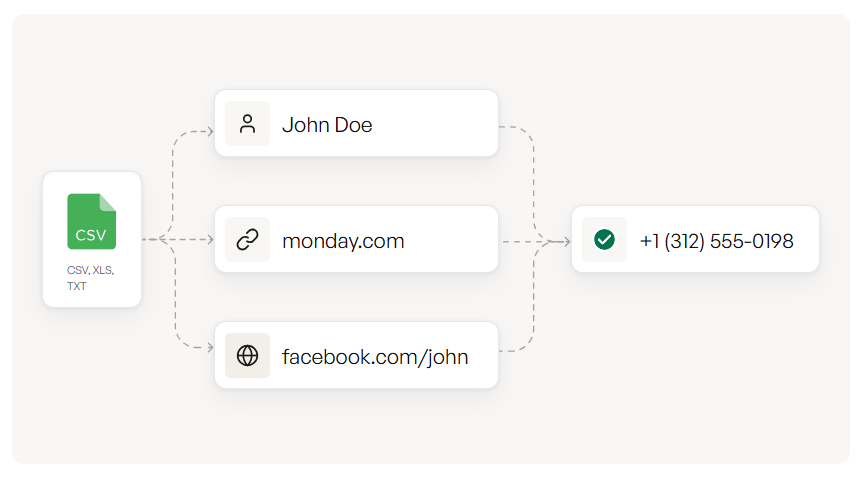
3-9 people doing outbound prospecting: Pick Quo for the phone system, then pair it with a contact data tool like Prospeo for verified numbers to actually dial. Your phone platform is only half the equation - the other half is having accurate contact data to feed into it. If you’re comparing vendors, start with a shortlist of data enrichment services and work backward from accuracy.
If neither fits, RingCentral at around $20-30/user/month offers more mature enterprise features, and Zoom Phone integrates tightly if your team already lives in Zoom. For teams that want a similar “phone-first” stack but different pricing, you can also look at MightyCall alternatives.
Feed Your Phone System Better Data
A phone system without accurate numbers is a sports car without gas. In our experience, the biggest bottleneck for outbound teams isn't the dialer - it's the data going into it. Prospeo covers 125M+ verified mobile numbers with a 30% pickup rate, and on the email side, 143M+ verified addresses at 98% accuracy mean your outbound sequences don't bounce. Free tier to test, no contracts, self-serve from day one. If you’re building lists at scale, a structured lead generation workflow keeps your reps from burning time on bad inputs.
You just spent 20 minutes comparing phone systems. The real bottleneck for outbound teams isn't Dialpad vs Quo - it's having accurate contacts to call. Prospeo refreshes 300M+ profiles every 7 days, so your reps dial real people, not recycled data from six weeks ago.
Feed your phone system numbers that actually pick up.
FAQ
Is Quo the same as OpenPhone?
Yes. OpenPhone rebranded to Quo in September 2025 alongside $105M in growth financing. Same product, same team, new name. Any "OpenPhone" reviews or Reddit threads you find still apply.
Can I use Dialpad with just one person?
Only on the Standard plan at $15/user/month billed annually. Pro requires three seats minimum, and Enterprise requires 100+. Solo operators are locked into the lowest tier, where features like Live Coach Cards and Custom Moments aren't available.
Which has better call quality?
Dialpad generally gets strong marks for usability, but some long-time users report call quality has declined recently, citing noticeable delay. Quo's call quality is solid for US/Canada calling, though reliability complaints - including periodic outages - show up in user threads. Neither is perfect.
What's the best way to get accurate numbers for cold calling?
Prospeo's mobile finder covers 125M+ verified numbers with a 30% pickup rate globally. At roughly $0.10 per mobile, it's significantly cheaper than ZoomInfo and pairs directly with either Dialpad or Quo via CRM integrations or CSV export.