

Dialpad vs RingCentral: What the Vendor Pages Won't Tell You
The "best" UCaaS platform in 2026 is usually the one that stays predictable after month three - when SMS limits, AI add-ons, and support tickets start showing up on your bill. Choosing between Dialpad and RingCentral comes down to more than feature grids. An MSP shared a thread on r/msp about RingCentral hiking their annual bill by 50% and suddenly charging heavily for SMS, which pushed them to evaluate Dialpad.
Stop obsessing over feature grids. The decision that actually matters is total cost of ownership - because that's what determines whether you still like your phone system 18 months from now.
30-Second Verdict
Choose Dialpad if you're an SMB with 10-100 seats and you want AI transcription, summaries, and sentiment tracking right away, without buying a pile of add-ons. It's cheaper at sticker price, faster to roll out, and the UX feels like a modern product. Dialpad claims setting up a new user takes five minutes.
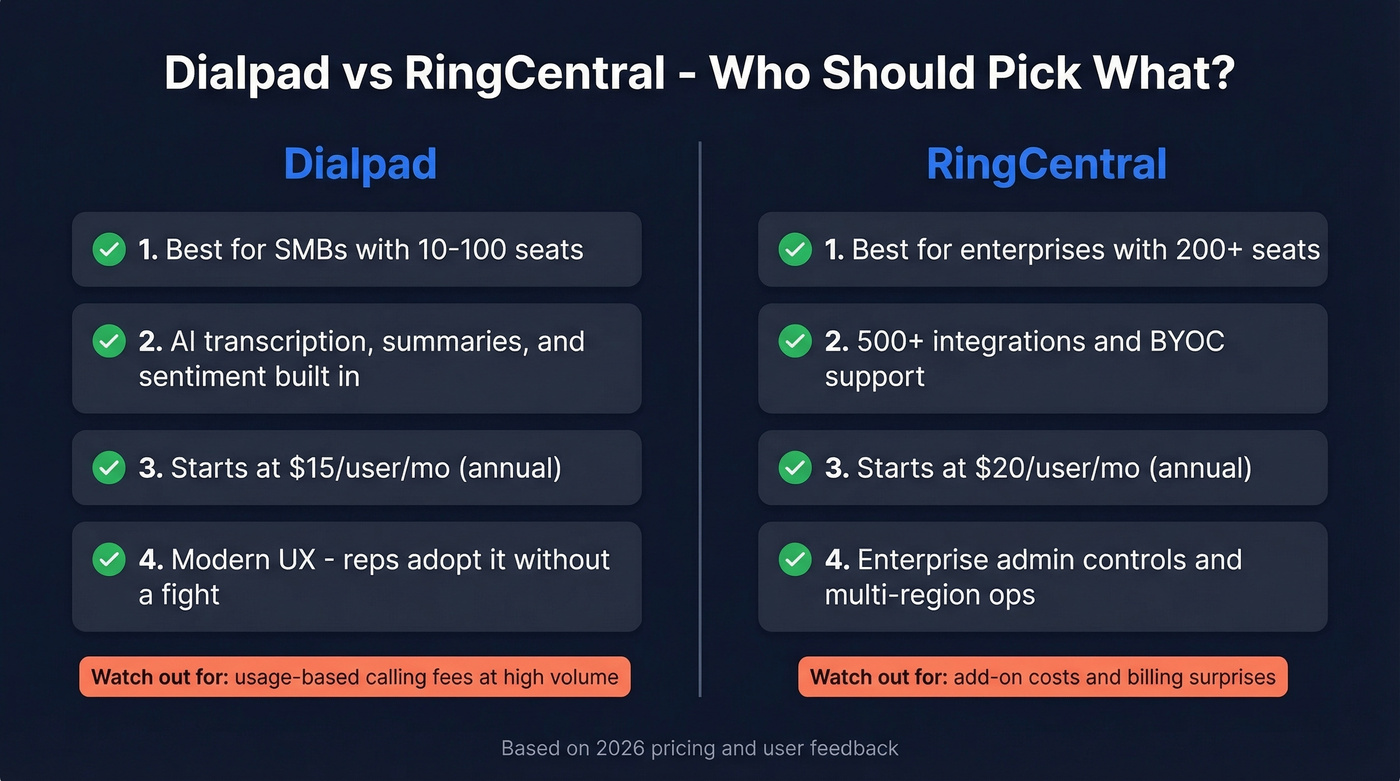
Choose RingCentral if you're 200+ seats and you need BYOC (bring your own carrier) plus a massive integration ecosystem and enterprise-grade admin controls. You'll pay more, but you'll get more platform.
Pricing Side by Side
All prices below assume annual billing. Monthly billing is typically 30-35% higher.
| Plan / Feature | RingCentral MVP | Dialpad |
|---|---|---|
| Entry plan (annual) | Core: $20/user/mo | Standard: $15/user/mo |
| Entry plan (monthly) | Core: $30/user/mo | Standard: $23/user/mo |
| Mid plan (annual) | Advanced: $25/user/mo | Pro: $25/user/mo |
| Mid plan (monthly) | Advanced: $35/user/mo | Pro: $35/user/mo |
| Top plan (annual) | Ultra: $35/user/mo | Enterprise: custom |
| Top plan (monthly) | Ultra: $45/user/mo | Enterprise: custom |
| SMS limit | 25 / 100 / 200 per user (by tier) | 250 messages/user/month included, then overages |
| Toll-free minutes | 100 / 1,000 / 10,000 (by tier) | Usage-based (~$0.02/min) |
| Video participants | Up to 100 (Core) to 200 (Ultra) | 10 on business comms plans |
| Free trial | 14 days | 14 days |
Dialpad wins the entry tier on price. The mid tier is a dead tie. The top tier is where RingCentral is easier to budget because Ultra has a published number, while Dialpad Enterprise is negotiated - so you need a real quote in your spreadsheet.
One more thing buyers underestimate: monthly vs. annual. RingCentral Core jumps from $20 to $30 on monthly billing. That "flexibility" costs real money.
SMS limits matter more every year, too. Between A2P registration rules tightening and customers expecting text-first support, 25 texts per user per month is functionally "no SMS" for many teams.
Hidden Costs and Add-Ons
Here's the thing: this is where the decision actually gets made. On paper, the mid-tier plans match. In real life, they diverge fast.
RingCentral Add-Ons That Inflate the Bill
RingCentral's base plans are fine. The bill balloons when you start unlocking things most teams assume are standard.
Common add-ons you'll hit:
- AI Receptionist (starts at $39/month) for automated answering, routing, and FAQs
- Business SMS Booster ($25/month)
- Call Queues Booster ($35/month)
- AI Conversation Expert (starts at $60/month)
Notice what's happening: these are platform-level fees, not per-seat. That sounds harmless - until you stack two or three of them and they become a permanent tax on your phone system.
Dialpad Usage Fees to Model
Dialpad's pricing looks cleaner, but high-volume calling can turn into a surprise line item if you don't model it up front. Let's break this down with a simple estimate:
- 50 users
- 30 minutes of calls per user per day
- 22 working days per month
- ~$0.015/min blended rate (within the commonly cited $0.01-$0.02/min range)
Math: 50 x 30 x 22 x $0.015 = $495/month in usage fees.
That's not catastrophic. But it's also not "free calling," and it absolutely changes the TCO conversation. Other common Dialpad extras include additional local numbers (~$5/number/month), international or toll-free numbers (~$15+/number/month), internet fax (~$10/month), and a meetings upgrade if you need more than 10 participants.
50-Seat TCO Model
Here's an illustrative annual model for a 50-seat team on mid-tier plans, using assumptions that mirror what we see teams actually buy.
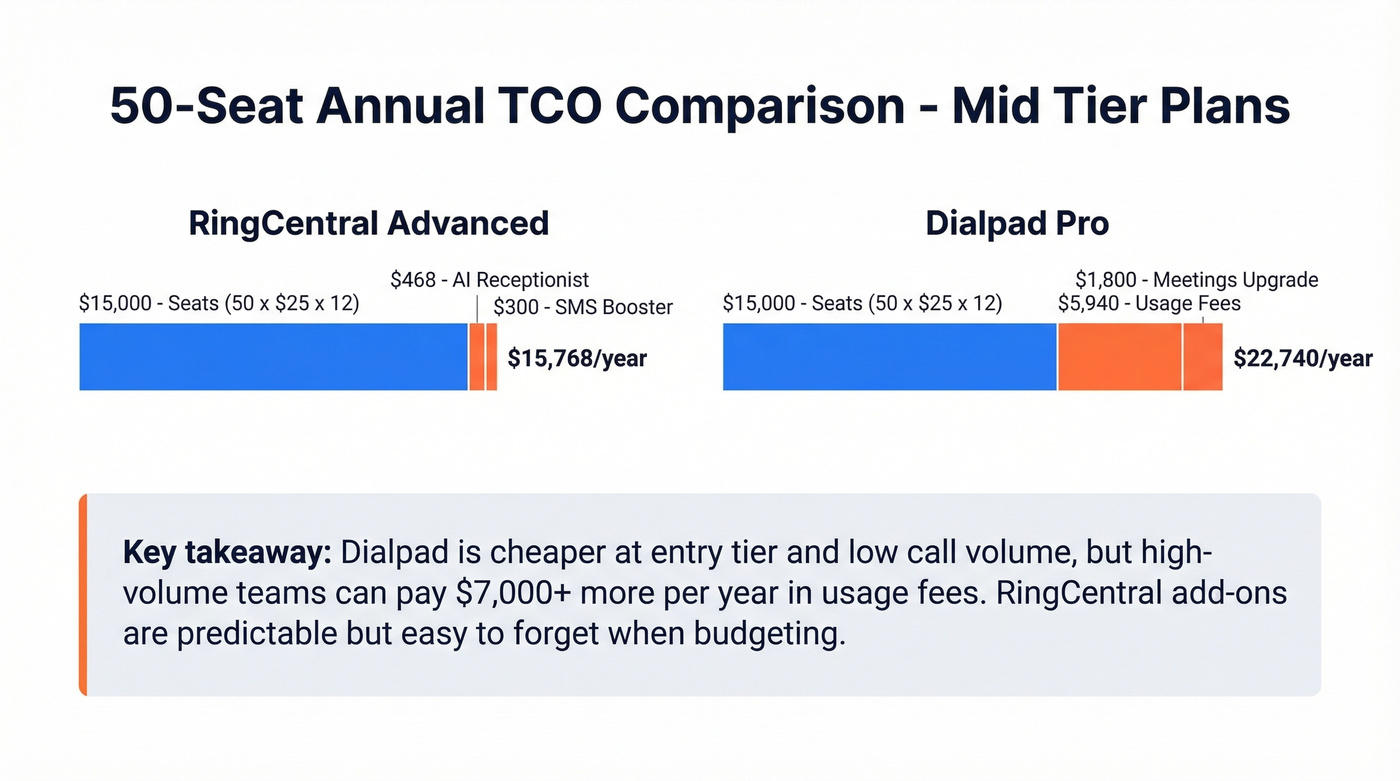
RingCentral Advanced (annual)
- Seats:
50 x $25 x 12 = $15,000 - AI Receptionist:
$39 x 12 = $468 - Business SMS Booster:
$25 x 12 = $300 - Estimated total: ~$15,768/year
Dialpad Pro (annual)
- Seats:
50 x $25 x 12 = $15,000 - Usage fees:
$495 x 12 = $5,940 - Meetings upgrade for 10 heavy meeting hosts:
10 x $15 x 12 = $1,800 - Estimated total: ~$22,740/year
Two takeaways worth sitting with. First, the "Dialpad is cheaper" story is true at entry tier and for lighter calling volumes, but it falls apart for high-volume teams unless your plan already includes the calling you need. Second, RingCentral's add-ons are predictable, but they're still add-ons - in our experience, most RingCentral budgets are wrong because teams price the seats and forget the boosters.
AI Features Compared
In 2026, AI isn't a bonus feature. It's the reason people switch providers.
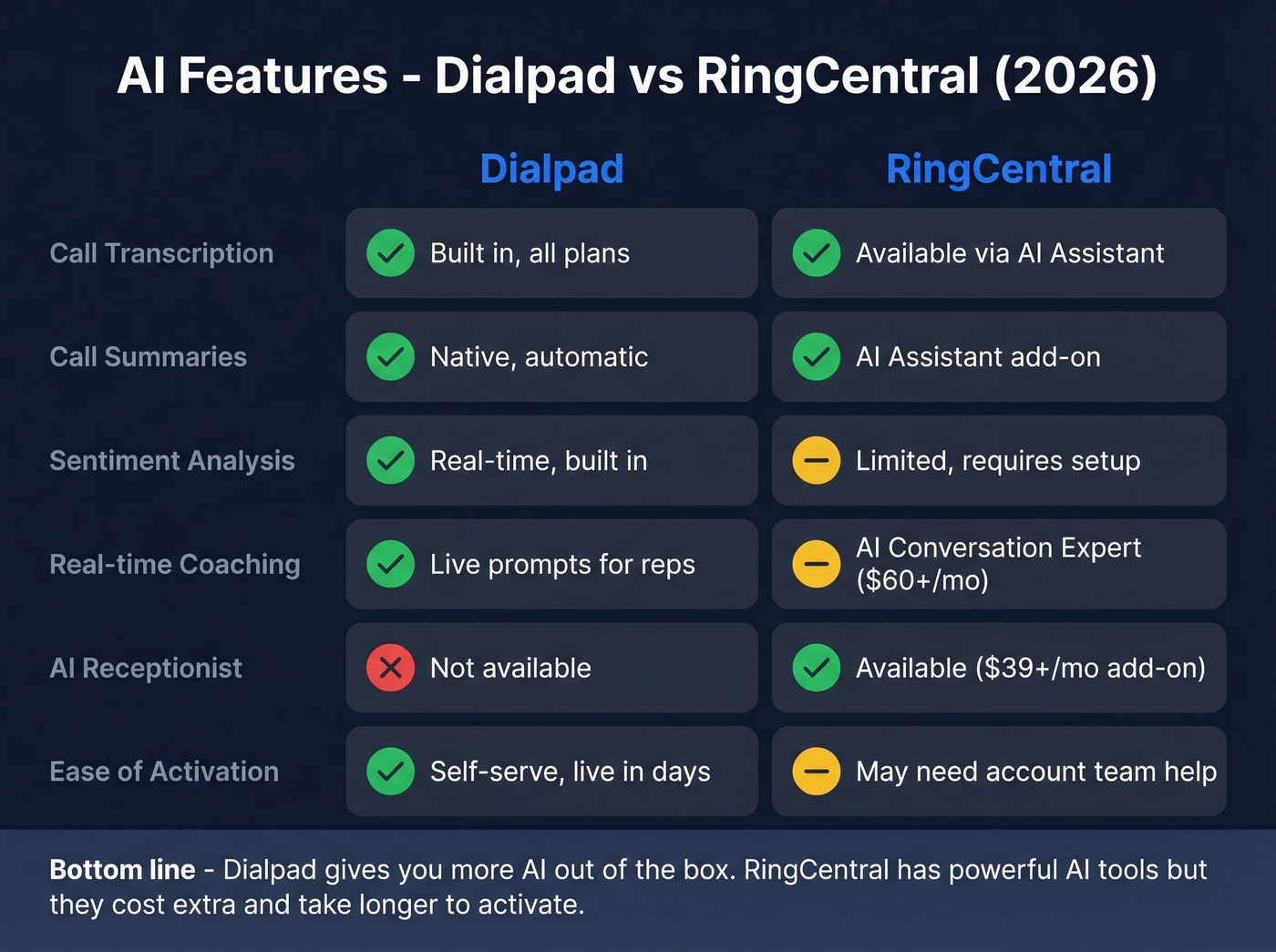
Dialpad delivers the cleanest out-of-the-box AI experience. Transcription, call summaries, sentiment analysis, and real-time coaching feel native because they're built into the product, not bolted on later. We've watched teams adopt it in a week because reps actually enjoy using it - the friction is shockingly low for enterprise software.
RingCentral's AI is powerful but harder to operationalize. Their AI push added AI Assistant features, AI Receptionist, meeting highlights, and workflow automation. The problem is enablement and packaging: when the features you bought still require account-team intervention to activate, you're stuck waiting. We've seen that delay derail rollouts because managers can't train on features that aren't live yet.
If your average deal size is under $15k and you mainly want call summaries plus transcription, RingCentral is usually overkill. You're paying for enterprise plumbing you won't touch.

Choosing between Dialpad and RingCentral matters - but neither platform helps if your reps are dialing wrong numbers. Prospeo gives you 125M+ verified mobile numbers with a 30% pickup rate, so every call your UCaaS system routes actually connects to a real decision-maker.
Stop paying per-minute to reach voicemail. Start dialing verified direct lines.
Integrations
RingCentral: 500+ pre-built integrations. Dialpad: fewer than 80. That's the category.
RingCentral also pushes automation hard with workflow tooling connecting triggers and actions across 6,000+ apps via their marketplace and partners. If you run a messy stack - industry CRMs, custom objects, legacy tools - RingCentral is the safer bet because it's more likely to have a connector that's already been battle-tested by someone with your exact setup.
Dialpad covers the essentials (Salesforce, HubSpot, Microsoft Teams, Google Workspace), but practitioners on G2 describe Dialpad's integrations as "MVP" or "check-the-box." They work, but they're not deep. You'll feel that once you try to build anything beyond basic logging and click-to-call.
If you're comparing other providers in the same category, see Dialpad alternatives and OnSIP alternatives.
Reliability: SLA vs Reality
Both vendors advertise 99.999% uptime SLAs. Here's the reality check.
January 22-24, 2025: RingCentral suffered a widely discussed outage where inbound and outbound calling failed, and even support lines went down. Full restoration was confirmed on January 24 at 17:41 UTC. That's not "five minutes of downtime." That's two business days of chaos - and if you lived through it, you don't forget it.
Dialpad has incidents too (every UCaaS provider does), but the RingCentral event is the kind of outage that should change how you buy. Check status page history, ask about incident communications, and don't sign a long contract without a real escalation path baked in.
Video and Contact Center
Video Meetings
Dialpad's 10-participant limit on its business communications plans is, frankly, embarrassing in 2026. If your team runs customer calls, trainings, or all-hands, you'll hit that ceiling immediately - and the meetings upgrade becomes part of your real price. If video is a core motion for your team, it’s worth pressure-testing your remote sales meeting workflow too.
RingCentral includes up to 100 video participants on Core and up to 200 on Ultra. If video matters, RingCentral wins without debate.
Contact Center
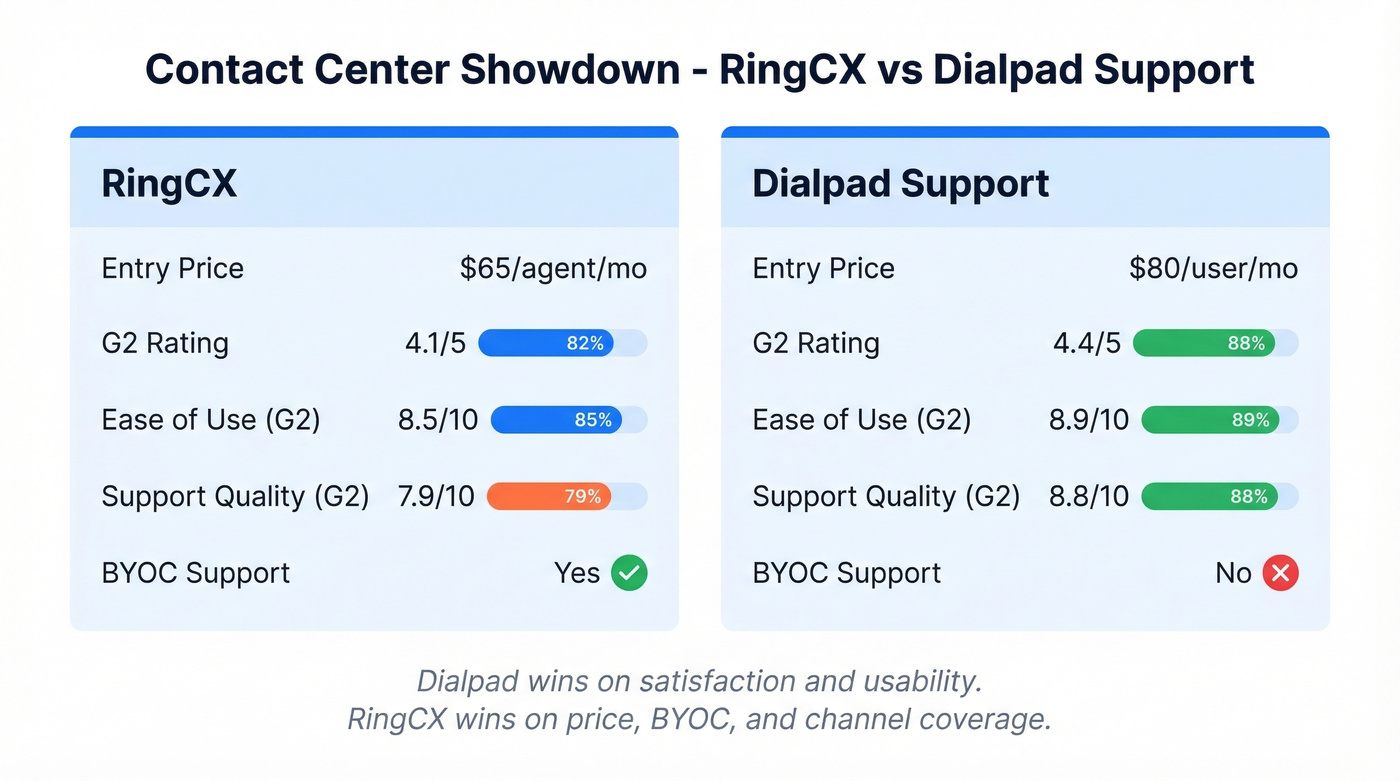
| Metric | RingCX | Dialpad Support |
|---|---|---|
| Entry price | ~$65/agent/mo | ~$80/user/mo |
| Upper tier | ~$145/agent/mo | ~$150/user/mo |
| G2 rating | 4.1/5 (185 reviews) | 4.4/5 (627 reviews) |
| Ease of Use (G2) | 8.5 | 8.9 |
| Support Quality (G2) | 7.9 | 8.8 |
| Product Direction (G2) | 7.1 | 9.0 |
| BYOC support | Yes | No |
Dialpad Support wins on user satisfaction and day-to-day usability. RingCX wins on BYOC and broader channel coverage, including Apple Business Chat and multiple social channels.
What Real Users Say
The loudest RingCentral complaints online aren't about features - they're about billing behavior and transparency. One Reddit thread from an MSP describes a 50% annual increase plus unexpected SMS charges. Another sysadmin thread describes recurring weekly "change order" charges without a signed change order and no clear itemization after multiple contacts. That's not people whining about price. That's a trust problem.
Dialpad feedback is quieter, which in UCaaS is usually a compliment. The most consistent praise centers on UX and the mobile app feeling natural - more like messaging than a clunky enterprise phone client. On Gartner Peer Insights, Dialpad edges RingCentral (4.5 vs 4.3), which matches the pattern: slightly happier users, fewer billing horror stories.
Who Should Choose Which
Pick based on how your company actually operates - not on which demo felt smoother.
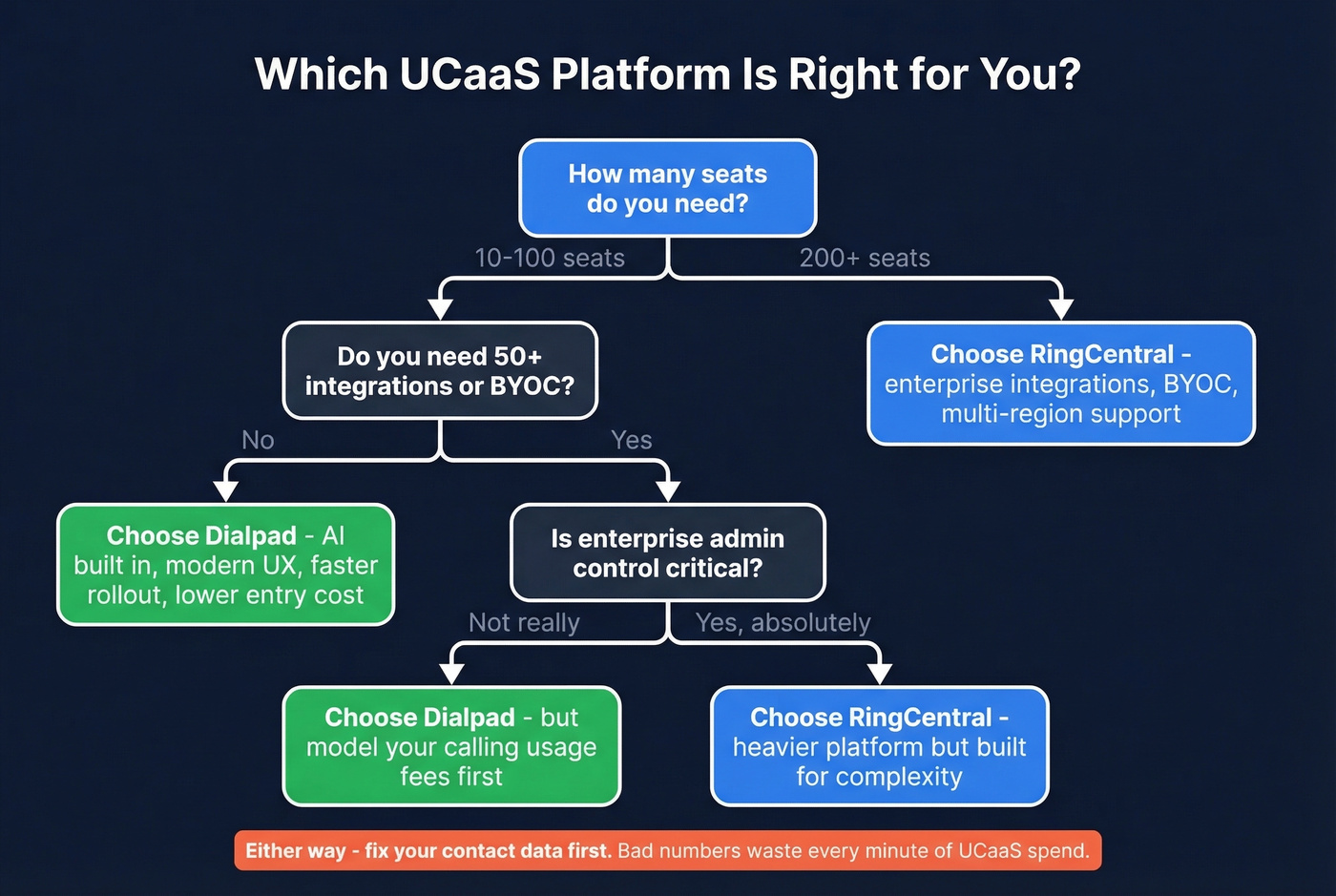
Choose Dialpad if you want AI baked in, you value a modern UI, and your workflows don't depend on dozens of niche integrations. It's the easier product to roll out, and reps tend to adopt it without a fight.
Choose RingCentral if you're running an enterprise environment with complex integrations, strict admin controls, BYOC requirements, and multi-region operations. RingCentral is heavier, but it's built for that world.
For teams where outbound sales is part of the job, fix your data first. Neither platform can rescue bad contact records. Prospeo gives you 125M+ verified mobile numbers with a 30% pickup rate and 143M+ verified emails at 98% accuracy, refreshed every seven days - so reps stop dialing disconnected numbers and start having real conversations. If you're building the rest of the outbound stack, start with sales prospecting techniques and a clean sales prospecting database.
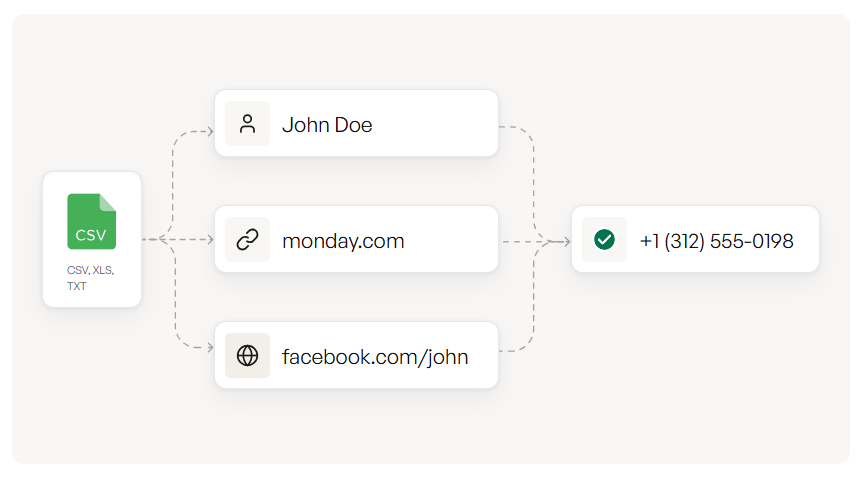
You're modeling 50-seat TCO for your phone system - now model the cost of bad contact data running through it. At $0.01 per email and 98% accuracy, Prospeo ensures the pipeline feeding your new UCaaS platform is clean from day one.
Your phone system deserves a database that actually picks up.
If you want to go deeper on list quality and accuracy, compare data enrichment services and lead enrichment approaches before you commit.
FAQ
Is Dialpad really cheaper than RingCentral?
At entry tier, yes - $15/user vs. $20/user on annual billing. At mid tier, seat pricing ties at $25/user. The real cost depends on call volume and meeting size: heavy calling can add $500+/month in usage fees on Dialpad, while RingCentral grows via boosters and AI add-ons.
Does RingCentral include AI features in all plans?
Basic AI Assistant features are included, but the higher-value pieces - AI Receptionist ($39/mo) and deeper conversation intelligence ($60/mo) - cost extra. Confirm exactly what's enabled in your tenant before you train the team on it.
Which has better uptime?
Both advertise 99.999% SLAs. RingCentral's Jan 22-24, 2025 outage lasted about two days and included support disruption. Treat SLAs as marketing; check each vendor's status history and escalation paths before signing a multi-year contract.
Can I use either platform for outbound sales?
Yes, but your connect rate lives or dies on contact data quality. Pair your phone platform with Prospeo to pull verified direct dials and emails - teams using Prospeo's data report a 30% mobile pickup rate, turning dialer effort into real conversations instead of voicemail loops.
How long does migration take?
Plan one to four weeks for under 100 seats, and four to twelve weeks for multi-site or complex call flows. Number porting is the long pole - start at least two weeks early, and longer if you have multiple carriers or international numbers.