

The Real Difference Between Leads and Prospects in B2B Sales
A sales team we know ran an experiment last quarter. They pulled reps off self-sourced prospecting and forced them to work exclusively from marketing-provided leads. Three of four reps booked zero meetings that month. The fourth booked one. Quota was ten.
That's not a vocabulary problem. It's an operational failure disguised as a definition gap. The difference between leads and prospects in B2B sales determines which names deserve rep time and which ones don't - and getting it wrong costs you pipeline every single week.
Quick Definitions
- Lead: anyone who enters your funnel - a form fill, a list import, a webinar registrant. Unqualified by default.
- Prospect: a lead you've qualified against your ICP who has engaged back. Two-way communication is the threshold.
- Opportunity: a prospect with a confirmed problem, an identified champion, and known budget or timeline.
The distinction matters because treating raw leads like prospects wastes rep hours and poisons pipeline metrics. But here's the thesis that runs through everything below: you don't have a "lead vs prospect" problem. You have a data quality problem. Bad contact info makes every framework, scoring model, and handoff process irrelevant.
What Is a Lead?
A lead is the broadest category in your funnel - a name on a list, a form submission, a badge scan at a trade show. No qualification has happened yet. You know almost nothing about whether this person has budget, authority, need, or timing.
Leads come in two flavors. Inbound leads raise their hand by downloading a whitepaper or requesting a demo. Outbound starts with your team building a target list and reaching out; once the contact responds or confirms interest, they become a lead. Both start unqualified.
Chili Piper's analysis of ~4M form submissions found that 14.1% of inbound form fills didn't even meet basic qualification criteria - spam, personal emails, or completely outside ICP. That's one in seven "leads" dead on arrival before a rep touches them.
A popular r/sales thread makes the same point bluntly: marketing-provided lead lists often include out-of-business companies, bad contact info, and "burned" contacts who've already been hit by a dozen SDR teams.
What Is a B2B Prospect?
A prospect is a lead that's passed through a gate. The Fit + Interest + Intent stage-gate model from Topo (now part of Gartner) frames it cleanly: a lead becomes a prospect only when all three conditions are met.
Fit means they match your ICP - right industry, company size, title, tech stack. Interest means they've engaged with your content or responded to outreach. Intent means there's a signal they're actively evaluating solutions. The critical threshold is two-way communication. A director-level contact at a target account who opened your email isn't a prospect yet. That same person who replied asking for a case study? Now you're talking.
This distinction determines whether a name sits in marketing's nurture sequence or gets a rep's calendar invite.
Leads vs Prospects vs Opportunities
Streak's framework defines an opportunity as a prospect where three things are true: they have a pain you can solve, they show interest in solving it, and they're a good fit for your solution. Beyond that, the deal-level guardrails matter - problem confirmed, champion identified, budget and timeline known.
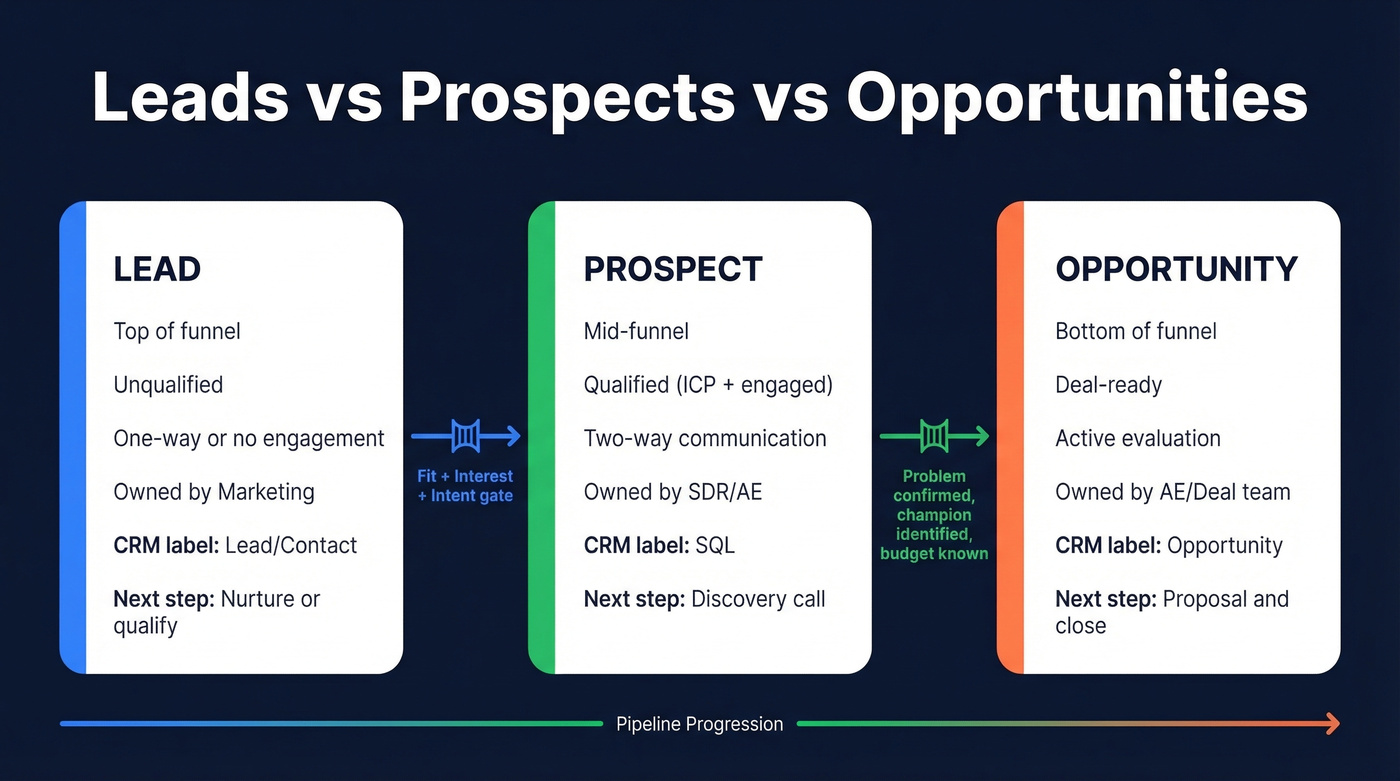
| Attribute | Lead | Prospect | Opportunity |
|---|---|---|---|
| Funnel stage | Top | Mid | Bottom |
| Qualified? | No | Yes (ICP + engaged) | Yes (deal-ready) |
| Engagement | One-way or none | Two-way | Active evaluation |
| Owned by | Marketing | Sales (SDR/AE) | AE / deal team |
| CRM label | Lead / Contact | SQL | Opportunity |
| Next action | Nurture or qualify | Discovery call | Proposal / close |
One stage worth knowing that most guides skip: the Sales Accepted Lead (SAL). Some teams insert this between MQL and SQL to formalize the handoff - sales explicitly accepts the lead before committing to qualification. It adds accountability on both sides and kills the "marketing delivered garbage" / "sales never followed up" blame loop.
Here's the thing: the mistake most teams make is skipping the middle column entirely. A form fill goes straight to an AE's queue, the AE spends 20 minutes researching, discovers the "lead" is a student or a company with three employees, and the pipeline review turns into a blame session. That middle column - the qualification step - is where pipeline quality lives or dies.

Your lead-to-prospect conversion rate is only as good as your contact data. Prospeo's 300M+ profiles with 98% email accuracy and 30+ ICP filters mean every lead enters your funnel pre-matched to your qualification criteria - so reps spend time on prospects, not dead ends.
Kill the 78% lead waste rate before it kills your pipeline.
Where Your Funnel Breaks
This is where definitions meet math. We've watched this play out dozens of times: marketing delivers 500 MQLs, sales says 425 were garbage, and both are right. MarketJoy's aggregated benchmarks paint a clear picture of where deals die:
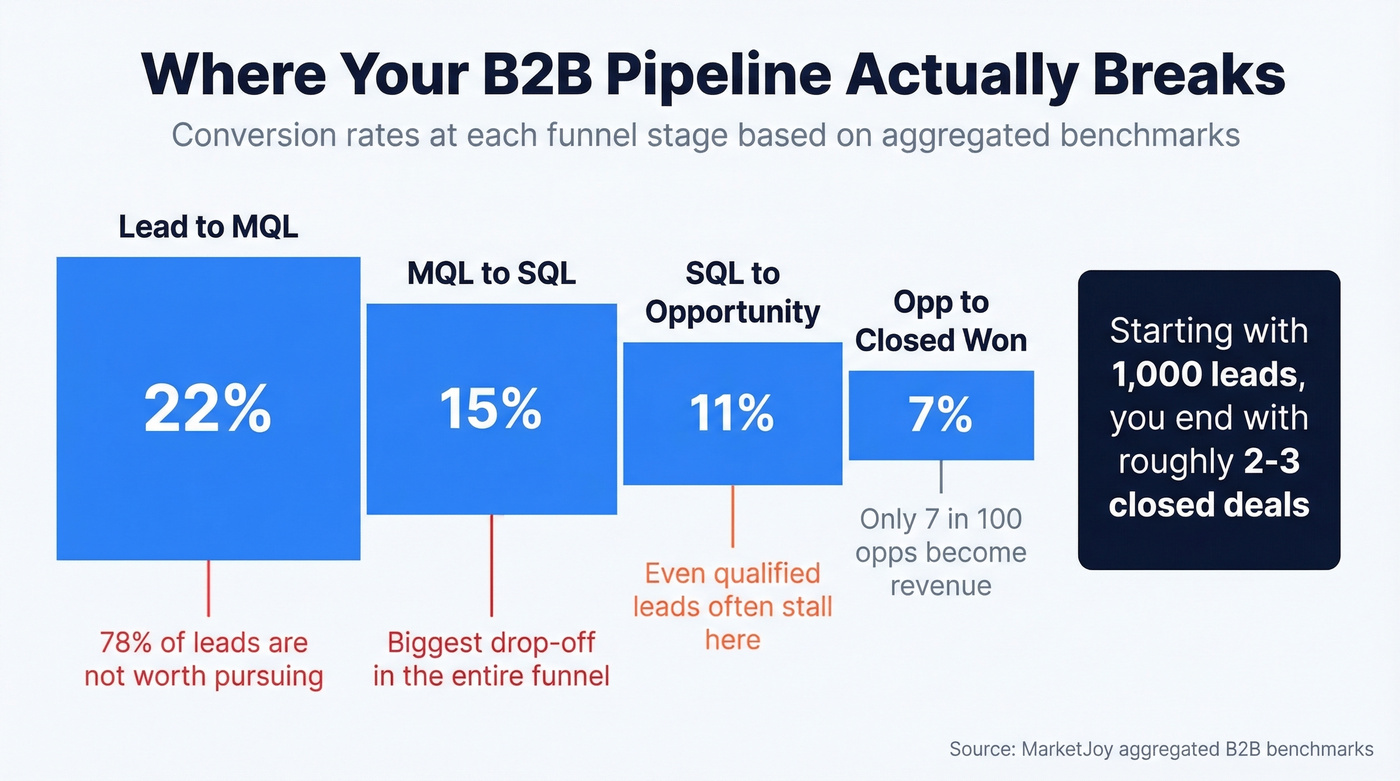
| Stage | Conversion Rate | What It Means |
|---|---|---|
| Lead to MQL | 22% | 78% of leads aren't worth pursuing |
| MQL to SQL | 15% | Biggest drop-off in the funnel |
| SQL to Opportunity | 11% | Even qualified leads often stall |
| Opp to Closed-Won | 7% | Only 7 in 100 opps become revenue |
Other benchmark sets show wider ranges - Lead-to-MQL can run 20-40% depending on how tightly you've defined your ICP. The tighter the definition, the higher the conversion and the smaller the volume. That tradeoff is unavoidable.
The MQL-to-SQL handoff is where most pipelines hemorrhage. Chili Piper's data shows that when qualified form fills get routed to a meeting immediately, 66.7% actually book - more than double the 30% industry average. Speed matters. Contacting leads within 24 hours increases conversion by 5x. After that window, you're chasing ghosts.
Pick the Right Qualification Framework
Let's be honest: BANT is fine for SMB. Stop using it for enterprise.
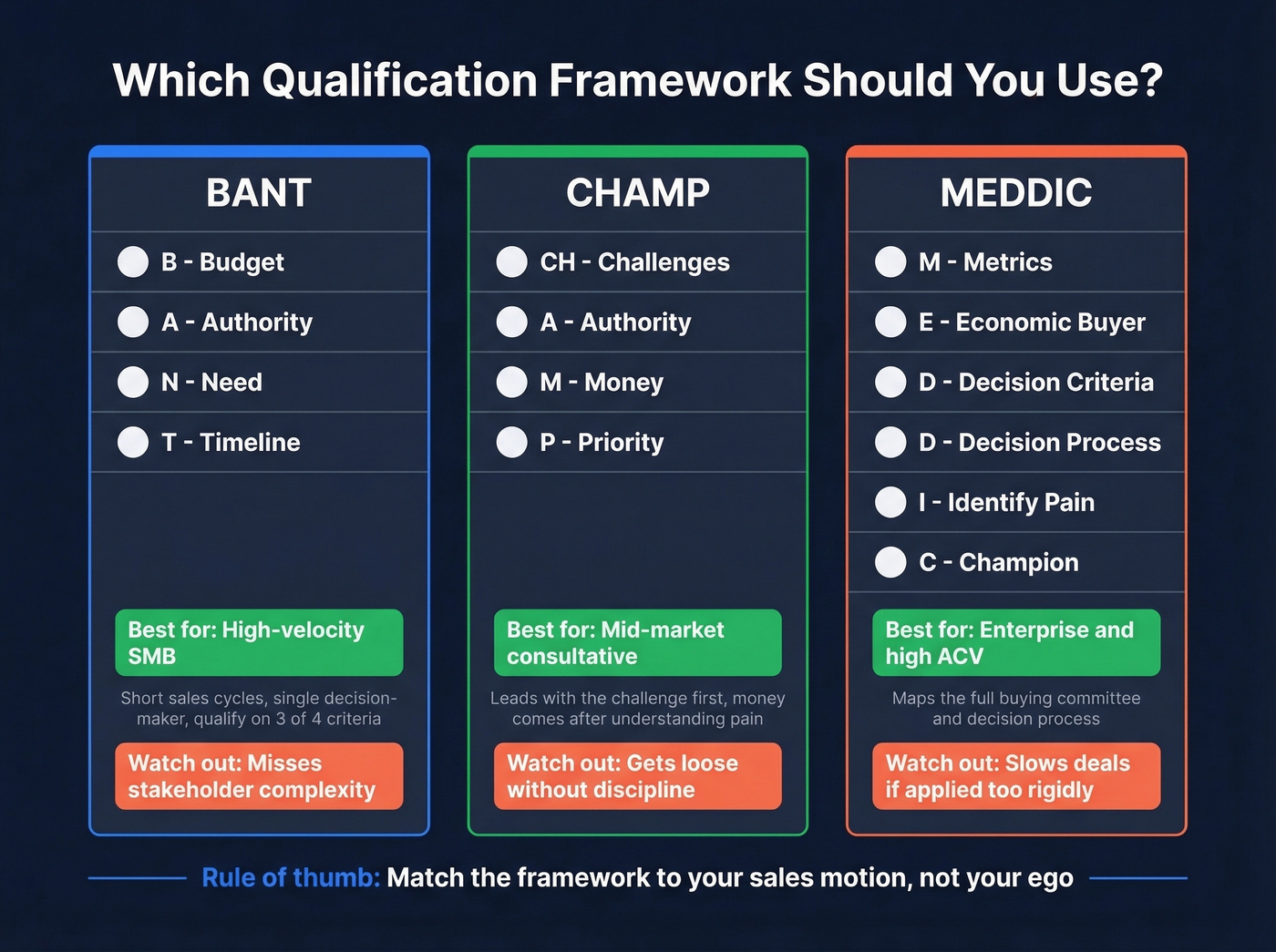
Modern B2B buying committees average seven stakeholders. BANT asks about "authority" as if one person holds the budget - that hasn't been true for complex deals in a decade.
| Framework | Best For | How It Works | Watch Out For |
|---|---|---|---|
| BANT | High-velocity SMB | Budget, Authority, Need, Timeline | Misses stakeholder complexity |
| CHAMP | Mid-market consultative | Challenges, Authority, Money, Priority | Gets loose without discipline |
| MEDDIC | Enterprise / high-ACV | Metrics, Econ Buyer, Decision Criteria, Process, Pain, Champion | Slows deals if applied rigidly |
Use BANT when you're running short sales cycles with single decision-makers. A lead qualifies if it meets at least 3 of 4 BANT criteria. That's a fast, teachable gate for junior SDRs.
Skip BANT when your average deal involves multiple stakeholders, procurement reviews, or sales cycles longer than 60 days. In our experience, teams that match framework to sales motion see the biggest forecast improvements. MEDDIC forces you to map the decision process and identify a champion - the two things that actually predict whether enterprise deals close.
Build a Scoring Model That Works
Most guides tell you to "implement lead scoring" and leave it there. Here's an actual model with point values based on patterns we've seen work across dozens of implementations:
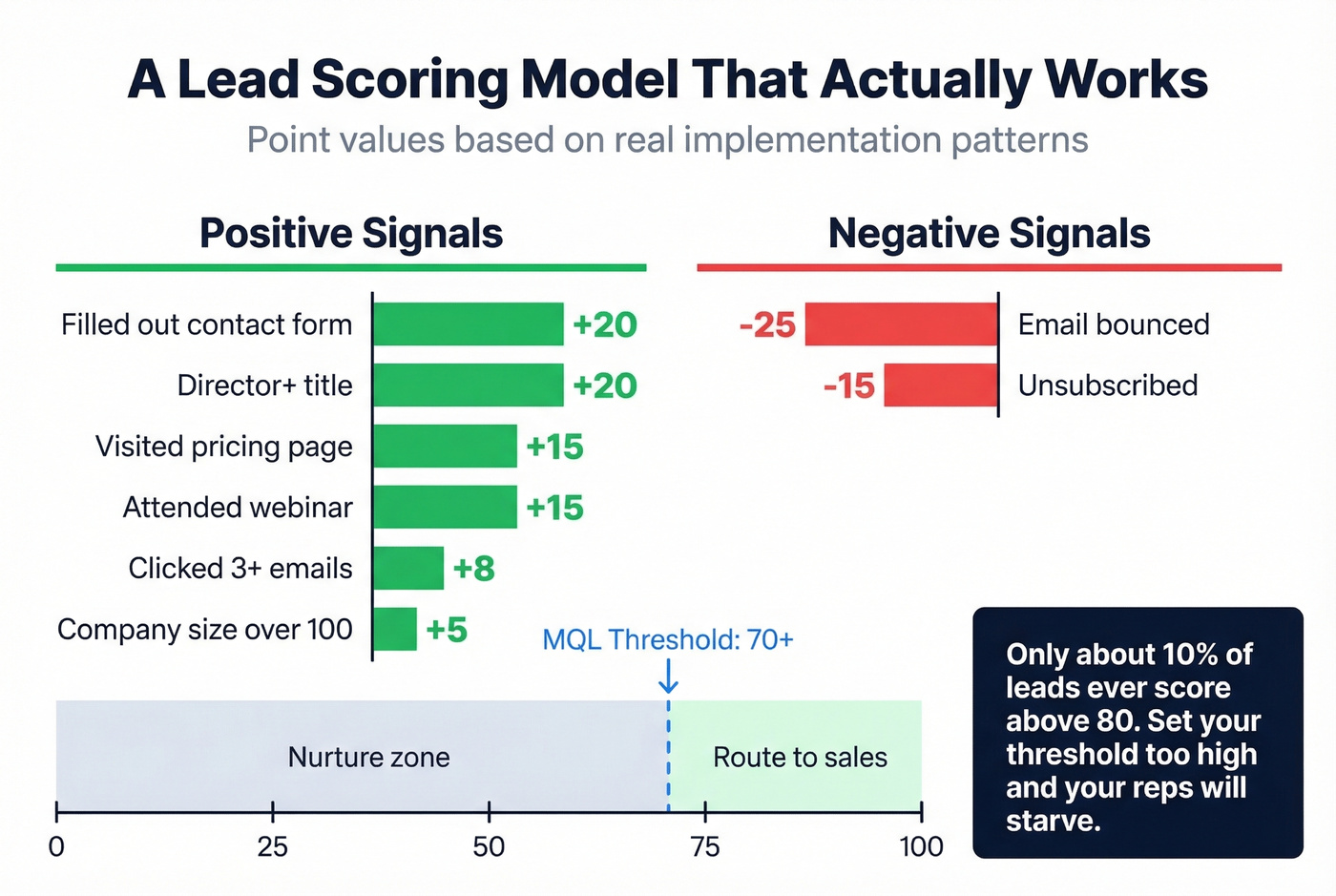
| Signal | Points | Type |
|---|---|---|
| Visited pricing page | +15 | Behavioral |
| Filled out contact form | +20 | Behavioral |
| Director+ title | +20 | Firmographic |
| Attended webinar | +15 | Behavioral |
| Company size >100 | +5 | Firmographic |
| Clicked 3+ emails | +8 | Behavioral |
| Unsubscribed | -15 | Negative |
| Email bounced | -25 | Negative |
A common threshold is score >70 to trigger MQL status. Per LeadsBridge's lead scoring examples, about 40% of leads score between 41-60, and fewer than 10% ever reach 81-100. If you set your threshold at 90, your reps will starve.
Negative scoring is where most teams drop the ball. A lead with a bounced email scores high on paper but converts at zero. Before you score anything, verify the contact data is real - tools like Prospeo catch dead addresses before they inflate your scoring model with phantom MQLs.
Scoring signal to watch in 2026: Email opens are increasingly unreliable. Apple's Mail Privacy Protection and similar features inflate open rates across the board. Smart teams are shifting weight toward on-site behavior - pricing page visits, form submissions, content downloads. Treat scoring as a feedback loop: when high scorers don't convert, audit your criteria. When low scorers close, re-weight your signals.
Fix the Data Layer First
Every framework above assumes one thing: that the contact information in your CRM is accurate. For most teams, it isn't.
Remember that team where three of four reps booked zero meetings? The leads weren't just bad fits - they included out-of-business companies, disconnected phone numbers, and contacts who'd been burned by previous outreach. No scoring model fixes that. No qualification framework fixes that.
The data layer has to come first.
Look, if your average deal size is under $10k, you probably don't need a $30k/year data platform. But you absolutely need verified emails and working phone numbers. The most expensive data in B2B isn't the data you pay for - it's the bad data you don't catch, burning rep hours and domain reputation every day it sits in your CRM. When Meritt switched to Prospeo, their bounce rate dropped from 35% to under 4% and pipeline tripled from $100K to $300K per week. That's the difference between a pipeline that moves and one full of dead ends.

That MQL-to-SQL handoff breaks when reps discover bad emails, wrong titles, or ghost companies. Prospeo refreshes every record on a 7-day cycle and returns 50+ data points per contact - giving your team the fit, intent, and accuracy signals to qualify leads into real prospects instantly.
Qualify faster when every contact comes with verified data attached.
Who Owns What
The ownership model is simple in theory: leads belong to marketing, prospects belong to sales, opportunities belong to the deal team. In practice, it's a mess.
A fractional CMO on r/marketing described the common mismatch perfectly - many companies expect marketing to deliver "very specific, curated leads" when marketing's actual strength is generating awareness and inbound volume. Sales, meanwhile, thinks their job starts at the discovery call, not the qualification step.
The fix isn't arguing about definitions. It's agreeing on what "qualified" means before the first lead ever gets passed. If your CRM definitions don't match your actual process, your forecast is fiction. Aligning on how you classify and route leads versus prospects is the single highest-leverage thing a rev ops team can do before touching any tooling.
FAQ
What's the difference between MQL and SQL?
An MQL has passed a scoring threshold based on engagement and fit. An SQL is sales-qualified - a rep has confirmed need, budget, and authority through direct conversation. The handoff between them is where most B2B pipelines leak; Chili Piper's data shows immediate routing more than doubles booking rates.
How quickly should you qualify a new lead?
Contact within 24 hours - conversion drops 5x after that window. Qualification itself should take one to two touches for inbound and three to five for outbound. Speed-to-lead is the single biggest controllable variable in pipeline conversion.
Does every B2B team need lead scoring?
Teams under 50 leads per week can qualify manually with a simple BANT checklist. Scoring becomes essential when volume exceeds what reps can evaluate by hand - typically 200+ leads per month. Start simple, then add behavioral signals as you collect data.
How do I fix high bounce rates on outbound lists?
Run every list through a verification tool before any outreach goes out. A 5-step verification process that catches invalid addresses, spam traps, and catch-all domains protects your domain reputation and ensures reps reach real contacts, not error messages.