

Different Sales Styles: How to Pick the One That Actually Wins Deals
Your VP just forwarded a post about Challenger selling and wants the whole team trained by Q3. Problem is, half your deals are transactional renewals where Challenger is overkill, and the other half involve buying committees of six people who need a completely different approach. 84% of reps missed quota last year, and understanding different sales styles - then matching the right one to the right deal - is what separates quota-crushers from the 84%.
Here's the uncomfortable truth: 96% of prospects do their own research before they ever talk to a rep, and 53% of customer loyalty is driven by the sales experience itself. Not your brand. Not your price. Not your product. Your selling style is the variable you actually control.
What You Need (Quick Version)
You don't need nine styles. You need two - one default motion and one adaptation for analytical buyers.
- New to sales or switching industries - start with consultative selling.
- Complex B2B, $50K+ ACV, multiple stakeholders - Challenger.
- High-volume, short-cycle, sub-$5K deals - transactional with tight qualification.
7 Sales Styles and Techniques That Matter
Consultative Selling
The Swiss Army knife of sales. You lead with questions, diagnose the problem, then prescribe a solution. SPIN Selling - a heavily researched version of this approach - was built on 35,000+ sales calls across 20+ countries over 12 years. We've seen this work best for mid-market deals in the $5K-$50K range where the buyer hasn't fully articulated the problem yet. It's forgiving, coachable, and scales well across team sizes.
The reason consultative selling keeps showing up in every training program is simple: it forces reps to shut up and listen. That alone fixes half the problems on most sales floors. If you're building a team from scratch or onboarding reps who've never carried a quota, this is where you start. The discovery skills transfer to every other style on this list.
Challenger Selling
CEB studied 6,000+ reps and found 40% of high performers were Challengers - more than double any other profile. The core motion: Teach, Tailor, Take Control. You push back on the buyer's assumptions and reframe the problem entirely, which means you need deep industry knowledge and the confidence to tell a prospect they're thinking about their own business wrong.
This works best in enterprise deals with $50K+ ACV and long cycles where the buyer thinks they already know what they need. It falls apart when reps don't actually have an insight worth sharing - then it's just arrogance with a framework. In one implementation, Xerox saw a 17% increase in sales and $65M in contract value, but that was for complex enterprise deals, not their transactional copier business.
Solution Selling
Consultative selling's more structured cousin. Less open-ended discovery, more "here's how we solve that specific thing." Best when the buyer already knows they have a problem and is actively shopping for a fix. You're not educating - you're matching.
Transactional Selling
One Reddit user in manufacturing nailed this: "straight fact dude" - no schmooze, no weird techniques, just cold calling with direct facts. Speed and efficiency over depth. If your product is under $5K and the decision mostly comes down to price and availability, this is your lane.
Relationship-Based Selling
The tradeoff here is speed. You invest heavily in trust and long-term rapport, which pays off when lifetime value dwarfs the initial deal - enterprise accounts with multi-year expansion potential are the sweet spot. But if your pipeline needs velocity, pure relationship selling will frustrate your manager and your CFO in equal measure.
Insight Selling
A close cousin of Challenger, but you lead with original research or data the buyer hasn't seen rather than reframing their existing thinking. Best for selling to senior executives who've heard every pitch and need a genuinely new perspective to engage. If you don't have proprietary data or a unique point of view, skip this one.
Social Selling
Let's be honest - this isn't really a style. It's a channel. You still need a core approach underneath it. Sharing thought leadership on social platforms is a distribution mechanism; you're still doing consultative or Challenger selling once the conversation starts. Don't confuse the medium with the method. Same goes for high-pressure selling and feature-dumping - those aren't styles, they're bad habits.
Other frameworks like SNAP and Sandler exist but map closely to consultative and transactional approaches above.
Which Style Fits Your Deal?
No single approach wins everywhere. The right fit depends on deal complexity, cycle length, and buyer sophistication.
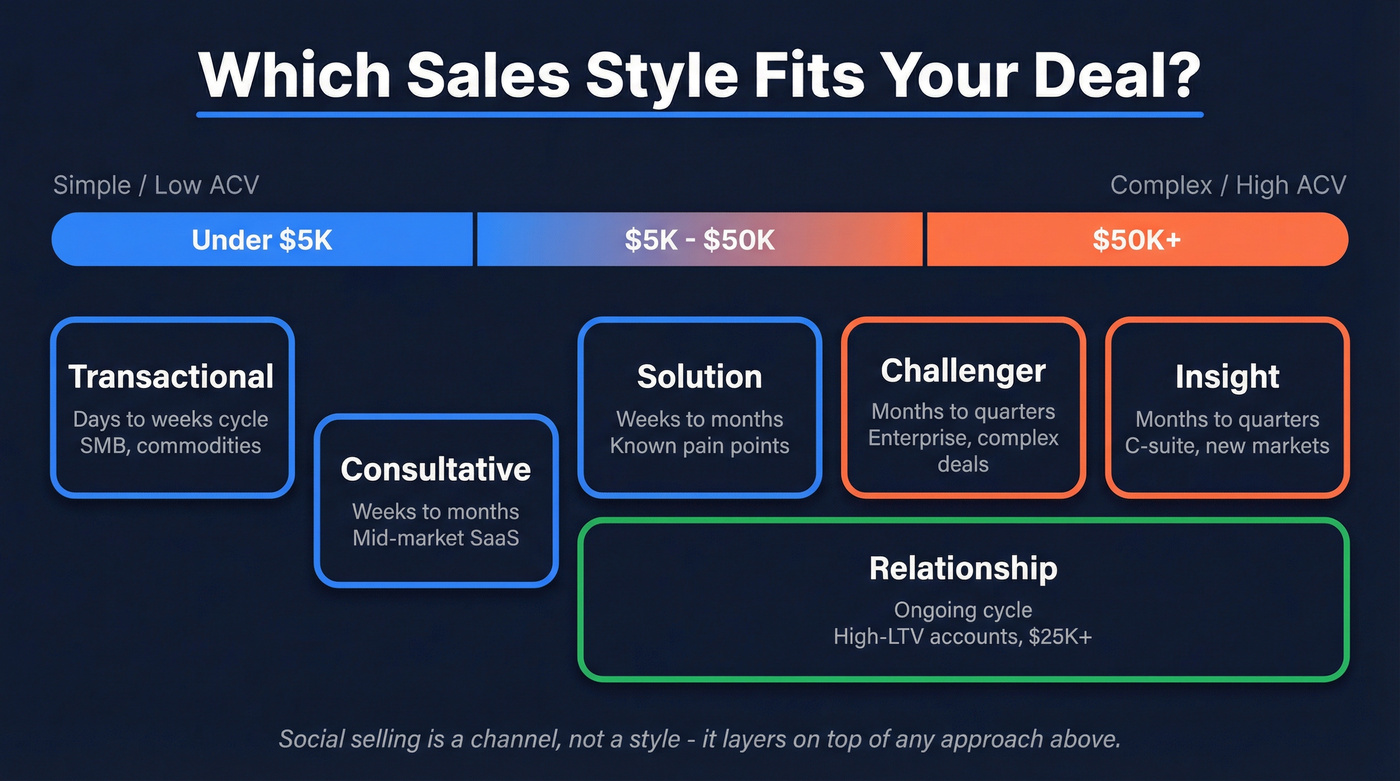
| Style | Deal Size | Cycle | Best For |
|---|---|---|---|
| Transactional | < $5K | Days-weeks | SMB, commodities |
| Consultative | $5K-$50K | Weeks-months | Mid-market SaaS |
| Solution | $5K-$50K | Weeks-months | Known pain points |
| Challenger | $50K+ | Months-quarters | Enterprise, complex |
| Insight | $50K+ | Months-quarters | C-suite, new markets |
| Relationship | $25K+ | Ongoing | High-LTV accounts |
Social selling isn't included - it's a distribution channel, not a standalone style.
Hot take: If your average contract value sits below $10K, you probably don't need Challenger training. Consultative selling covers 80% of mid-market scenarios, and it's dramatically easier to coach. Save Challenger for the deals where the buyer genuinely needs their thinking reframed.

Every sales style on this list fails the same way: the rep nails discovery, builds the perfect pitch, then sends it to a dead email. Prospeo gives you 98% verified emails and 125M+ direct dials so your Challenger insight or consultative question actually reaches a real person.
Match your style to the buyer. Let Prospeo match you to their inbox.
Adapt to the Buyer: The DISC Shortcut
Your default selling motion is one thing. The buyer's personality determines how you deliver it. Fast decision-makers are D or I types. Cautious, methodical buyers are S or C types.
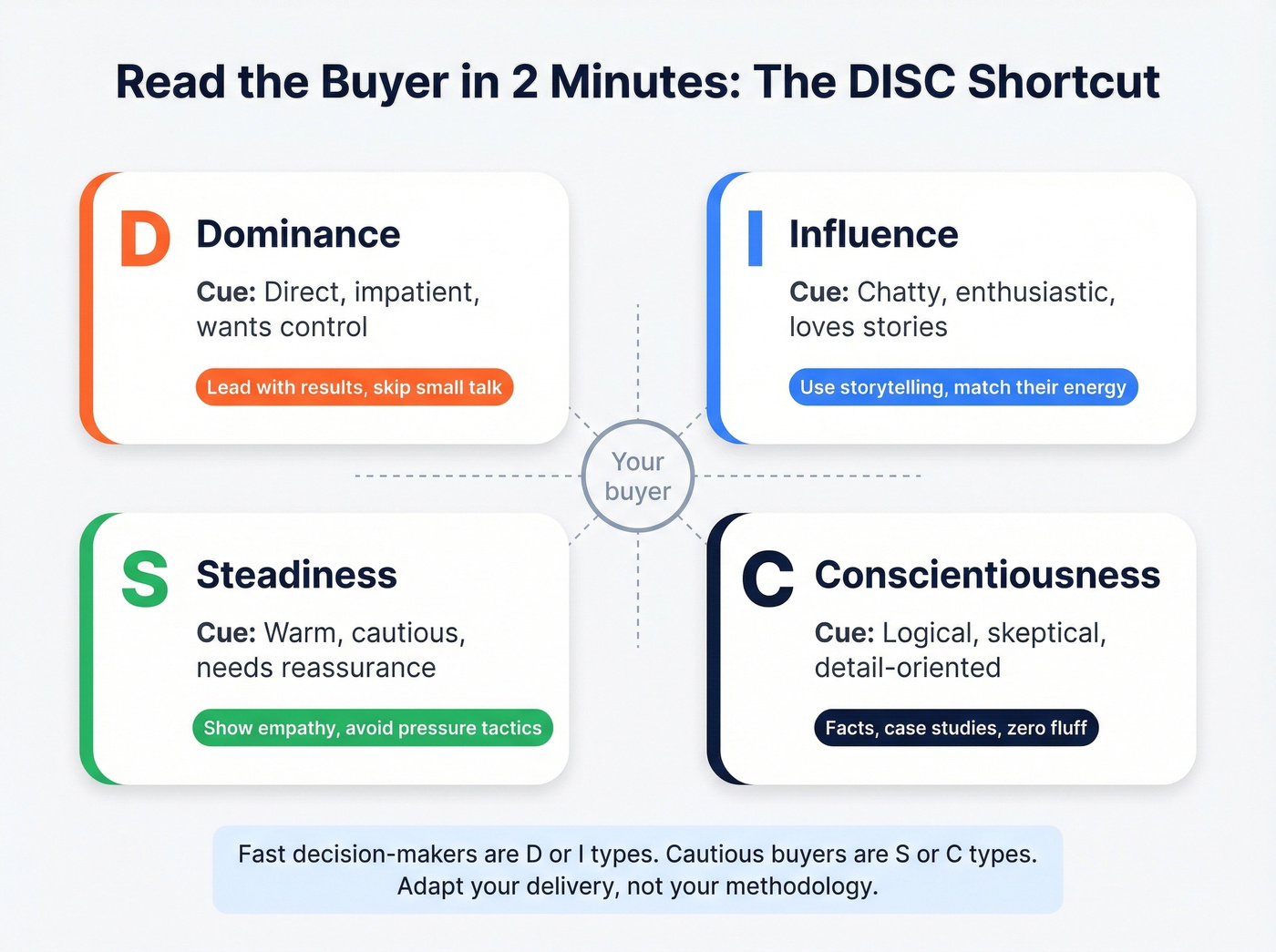
| DISC Type | Cue | Adaptation |
|---|---|---|
| D (Dominance) | Direct, impatient | Lead with results, skip small talk |
| I (Influence) | Chatty, enthusiastic | Use storytelling, match energy |
| S (Steadiness) | Warm, cautious | Show empathy, avoid pressure |
| C (Conscientiousness) | Logical, skeptical | Facts, case studies, no fluff |
In our experience, the biggest unlock isn't picking the perfect sales style - it's reading the buyer in the first two minutes and adjusting your delivery. A consultative rep who adapts to a D-type buyer will outsell a Challenger who treats every prospect the same way.
5 Mistakes That Kill Any Approach
There's a popular Reddit take that all sales methodologies are basically the same - need, budget, stakeholders, timeline. There's truth in that. Mess up those fundamentals and no style saves you.
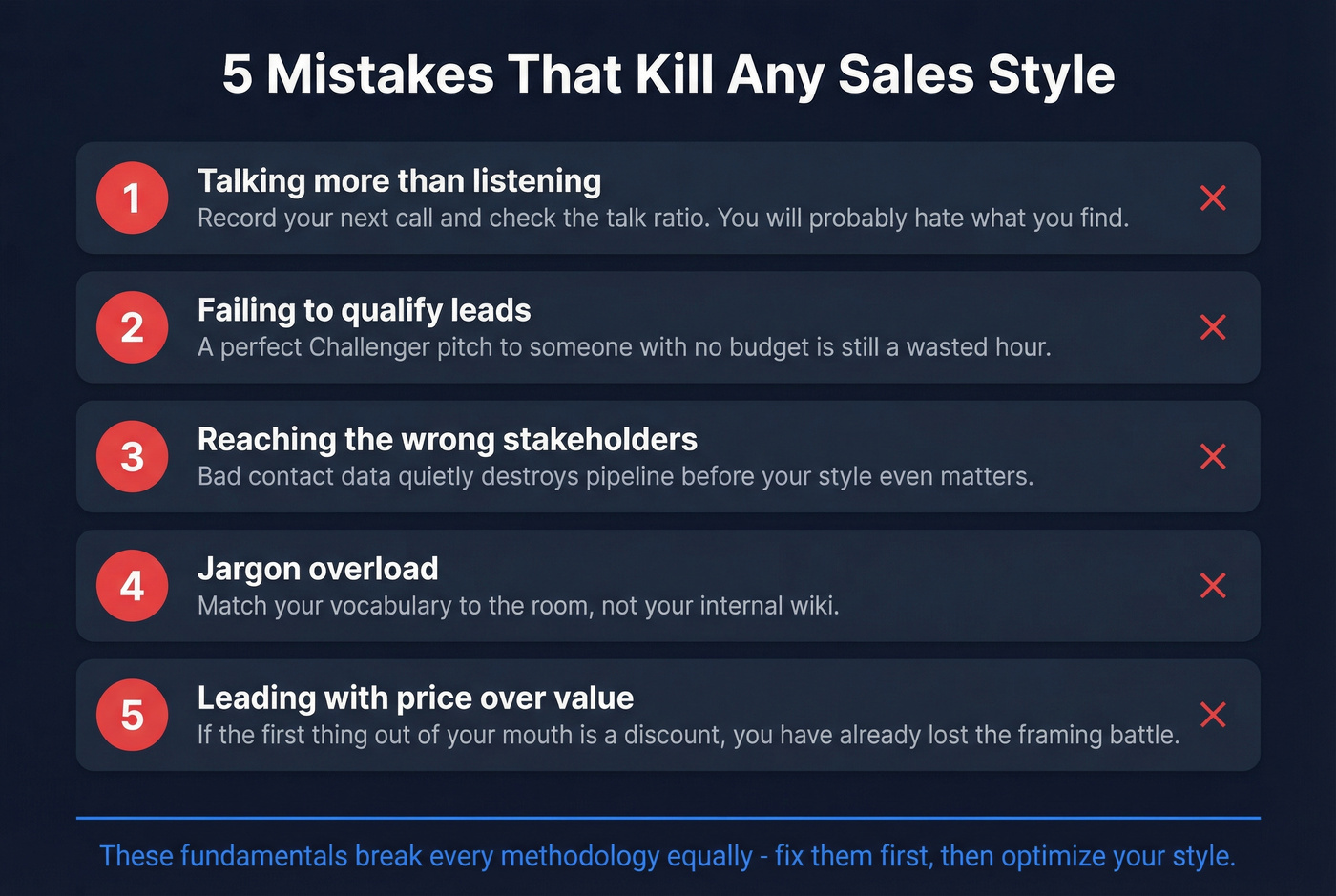
- Talking more than listening. The best consultative reps spend more time asking questions than presenting slides. Record your next call and check the talk ratio. You'll probably hate what you find.
- Failing to qualify leads. A perfect Challenger pitch to someone with no budget is still a wasted hour. If you want a tighter framework, use MEDDIC.
- Reaching the wrong stakeholders. As deal complexity increases, so does the number of people who can kill your deal. This is where bad contact data quietly destroys pipeline - you can't run a great discovery call with someone who doesn't have buying authority. Tools like Prospeo help here with 98% email accuracy and 125M+ direct mobile numbers refreshed weekly, but the principle holds regardless of your data provider: fix your targeting before perfecting your style.
- Jargon overload. Match your vocabulary to the room, not your internal wiki.
- Leading with price over value. If the first thing out of your mouth is a discount, you've already lost the framing battle. Learn how to add value in sales before you negotiate.
Find Your Default Style
Most reps are a blend, but one archetype dominates. HubSpot's framework maps to four types: Hunters thrive on new logos and cold outreach. Farmers build deep relationships and expand existing accounts. Shopkeepers excel when buyers come to them via inbound. Repairpersons are analytical and consultative - complex problems excite them.
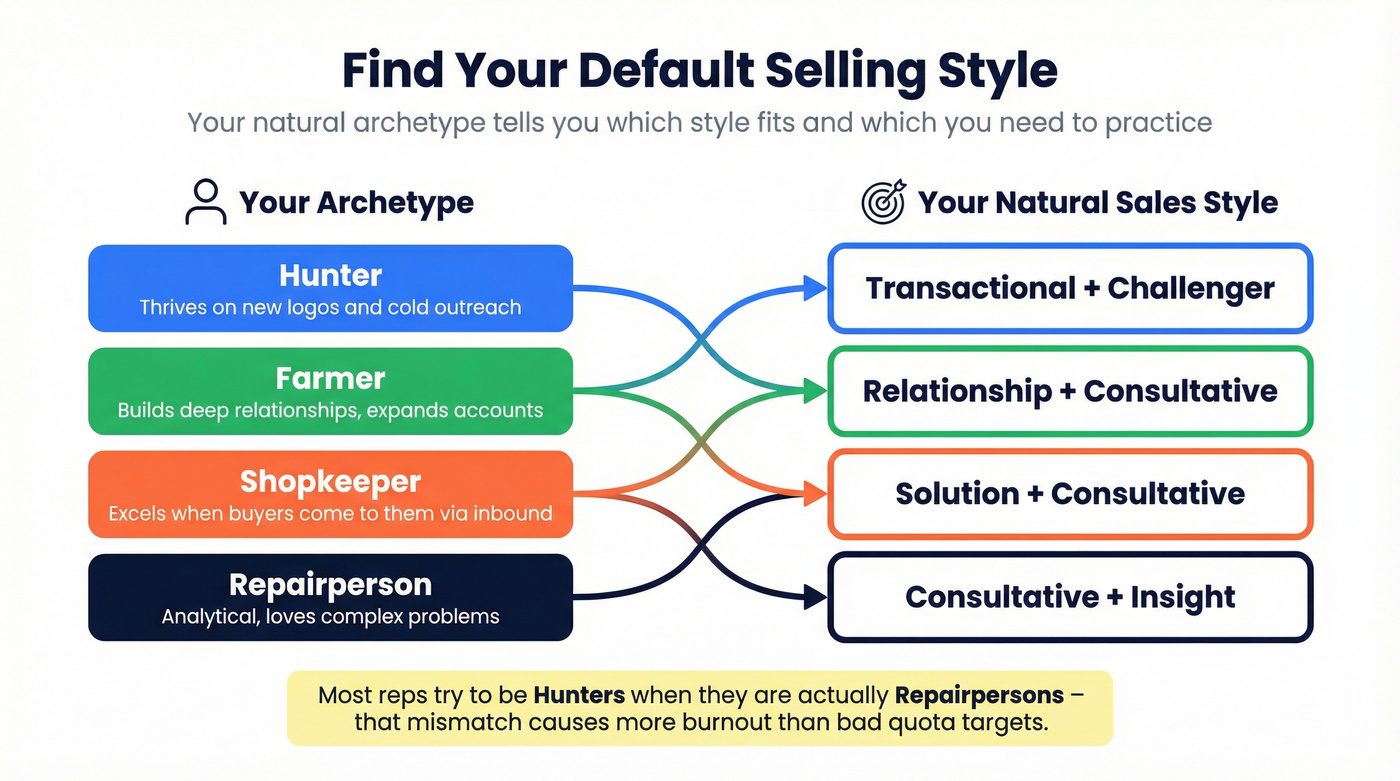
Knowing your archetype tells you which of the seven styles above will feel natural and which you'll need to practice deliberately. I'd argue most reps try to be Hunters when they're actually Repairpersons, and that mismatch is responsible for more burnout than bad quota targets.
If you're leaning Hunter, sharpen your sales prospecting and build a repeatable cold calling system. If you're more consultative, tighten your discovery call and keep your sales follow-up consistent.
Adapting to D-type buyers means leading with results fast. That's hard when your team spends 15 hours a week building lists instead of selling. Prospeo's 30+ filters - including buyer intent, job changes, and headcount growth - let reps find decision-makers in minutes, not days.
Spend your time selling, not searching. Lists built in minutes at $0.01 per lead.
FAQ
What are the main types of selling and which is most effective?
Challenger outperforms in complex B2B - 40% of high performers use it. For simpler deals under $50K, consultative selling is the most versatile default. Deal complexity, not personal preference, determines the right fit.
Can you blend more than one selling style?
Yes - most top reps combine two approaches and adapt based on the buyer's DISC type and deal complexity. Pick a default motion and one complementary style for analytical or executive buyers.
How does contact data quality affect sales style effectiveness?
Even a perfect discovery call fails if you're reaching the wrong person. Weekly data refreshes and verified contact info ensure your outreach lands with the right stakeholder instead of bouncing. Bad data undermines every methodology equally.