

DiscoverOrg vs Revli: Different Tools, Different Jobs
You're comparing a brand that no longer exists to a niche startup-tracking tool. That's not a great starting point. If you're researching DiscoverOrg vs Revli, the first thing to know is these solve completely different problems - and one of them hasn't existed as a standalone product since 2019.
Let's sort out what actually matters here.
DiscoverOrg Is Gone
DiscoverOrg was acquired by ZoomInfo in 2019 for $735 million (and acquired by ZoomInfo in 2019 for $735 million). The brand's been fully retired. Everything DiscoverOrg was known for - human-verified org charts, department-level contacts, Scoops intelligence - now lives inside ZoomInfo's platform under ZoomInfo's pricing and contracts.
So the real comparison is ZoomInfo vs Revli. These are wildly different tools, and the matchup only makes sense once you understand that gap.
30-Second Verdict
Use Revli if your ICP is recently funded startups (Seed to Series B) and you want weekly curated lists with verified founder contacts starting at $55-$199/mo depending on plan and billing.
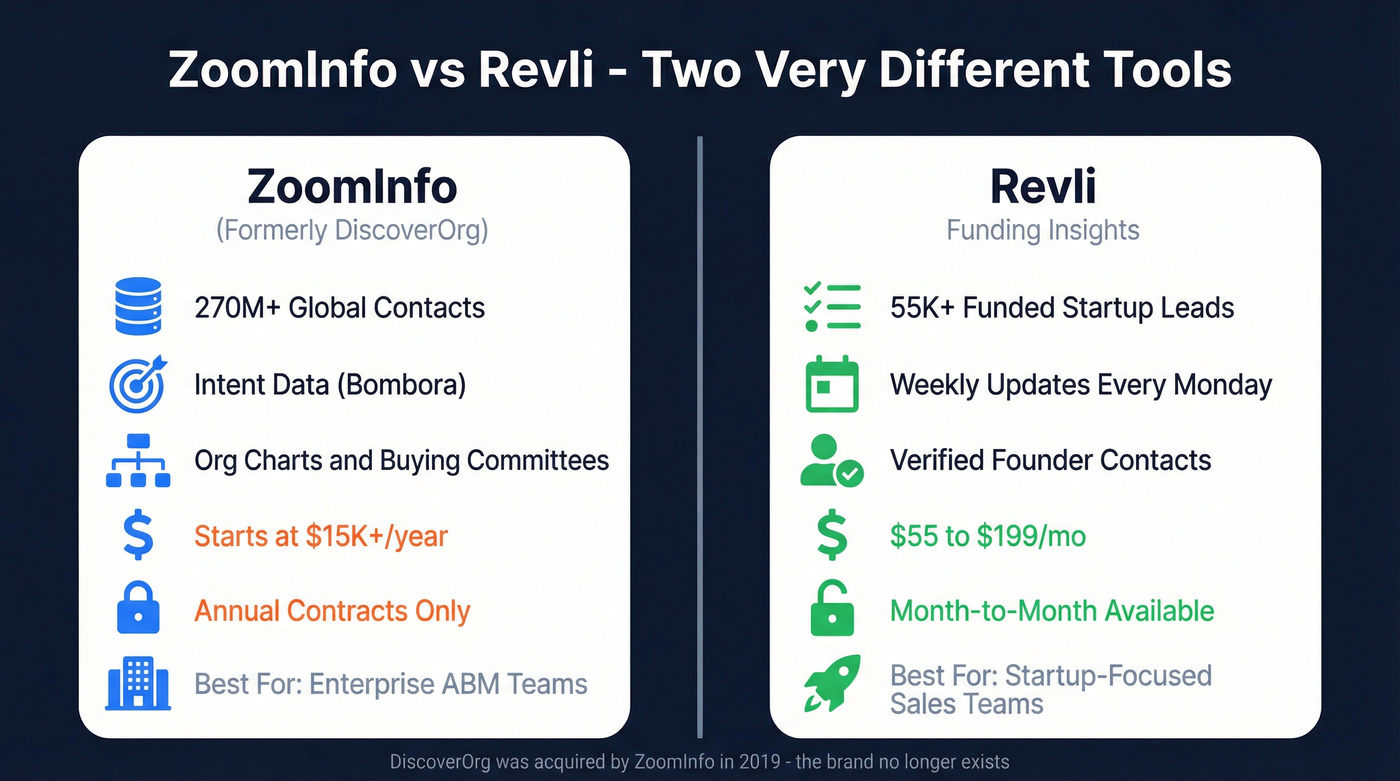
Use ZoomInfo if you need a full-stack B2B intelligence platform with intent data, org charts, and 270M+ global contacts - and you can commit $15k+/year on an annual contract.
What Each Tool Actually Does
ZoomInfo (Formerly DiscoverOrg)
ZoomInfo is the enterprise default for B2B intelligence. The database covers 270M+ global contacts with Bombora intent signals, technographic filters, org charts, and buying signals. It's a full GTM platform - prospecting, enrichment, workflow automation, and analytics under one roof.
The tradeoff is cost and lock-in. Annual contracts only, no month-to-month option, and renewal increases of 10-20% are standard. ZoomInfo users consistently flag these renewal bumps and difficult cancellation windows as pain points. A Professional plan starts around $15k/year for a small team, and adding intent data or advanced segmentation pushes you to $25k-$45k+. Factor that into your total cost of ownership before signing anything.
Revli Funding Insights
Revli is a completely different animal. It delivers weekly updated lists of recently funded startups - every Monday - with verified founder contacts, hiring insights, and funding data. The master database covers 55k+ leads across Seed to Series B rounds.
Think of it as a prospecting layer for teams that specifically target companies right after they raise. Marketing agencies, recruiters, software vendors selling to startups - that's the sweet spot. G2 reviewers rate it 4.8/5 (from a small review pool) and highlight clean data and time savings. It's not trying to be ZoomInfo. It's the fastest path to funded-startup decision-makers, and nothing more.

Revli covers 55K funded startups. ZoomInfo locks you into $15K+/year contracts. Prospeo gives you 300M+ profiles with 98% email accuracy, intent data on 15,000 topics, and funding signals - all on a 7-day refresh cycle at ~$0.01 per lead.
Get startup data and enterprise coverage without the enterprise contract.
Pricing Side by Side
The pricing gap tells the whole story about who these tools are built for.
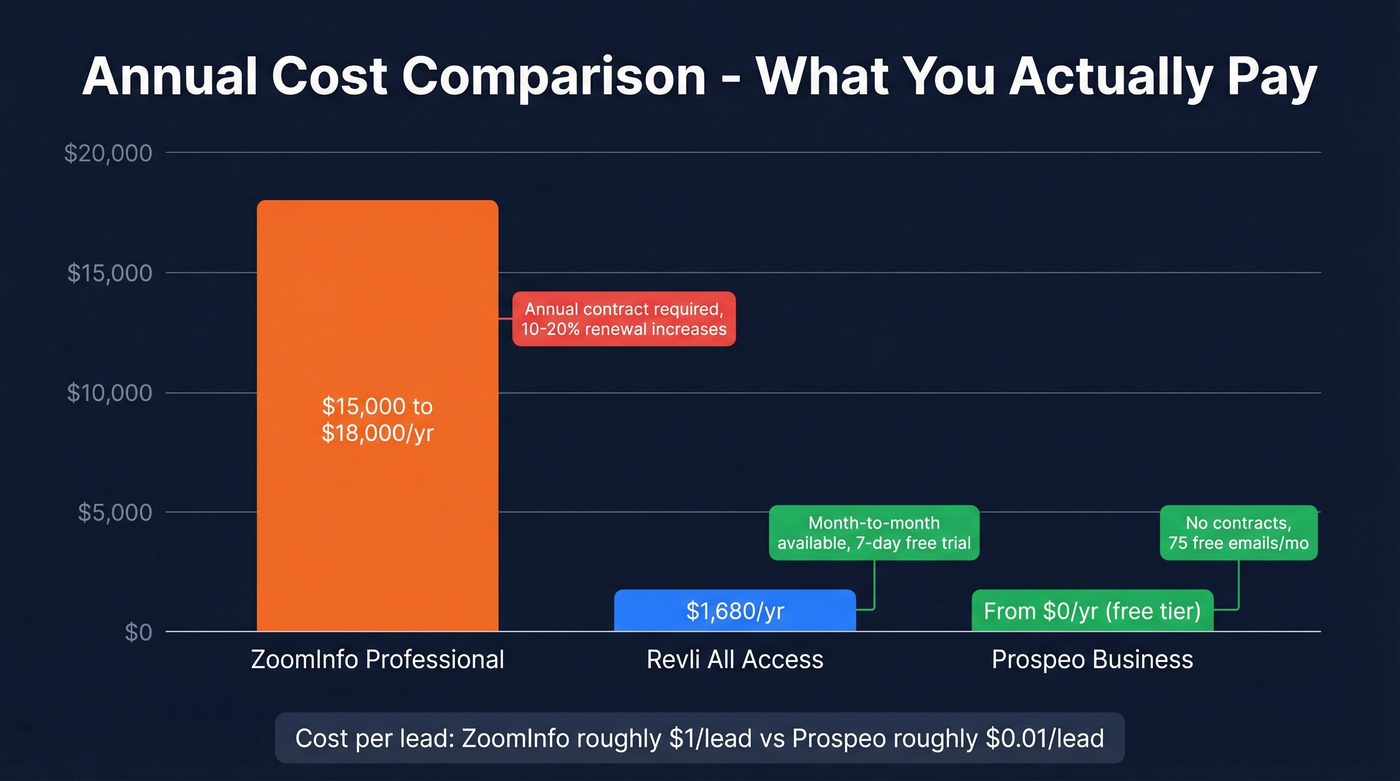
Revli Plans (per Revli's current plans page):
| Plan | Monthly | Annual (per mo) | Annual Total |
|---|---|---|---|
| Growth | $99 | $69 | $828 |
| Pro | $179 | $124 | $1,488 |
| All Access | $199 | $140 | $1,680 |
| Investor | $79 | $55 | $660 |
Revli offers a 7-day free trial with no credit card required, and month-to-month is available on every plan.
ZoomInfo (Industry-Reported Ranges):
| Tier | Annual Cost | Notes |
|---|---|---|
| Professional | $15k-$18k | 1-3 seats, ~5k credits |
| Advanced | $22k-$28k | Intent, technographics |
| Elite | $35k-$45k+ | Org charts, Scoops |
ZoomInfo requires annual contracts only, and credit overages cost extra.
Features That Matter
| Feature | ZoomInfo | Revli |
|---|---|---|
| Database size | 270M+ contacts | 55k+ leads (funded startups) |
| Update cadence | Varies by tier | Weekly (Mondays) |
| Contact types | Email, mobile, dial | Verified emails, mobiles, profile links |
| Intent data | Yes (Bombora) | No |
| Org charts | Yes | No |
| Funding data | Limited | Core feature |
| Hiring signals | Yes | Yes |
| CSV export | Yes | Pro plan+ |
| CRM integrations | Native (Salesforce, HubSpot, etc.) | CSV export only |
| Contract | Annual only | Month-to-month |
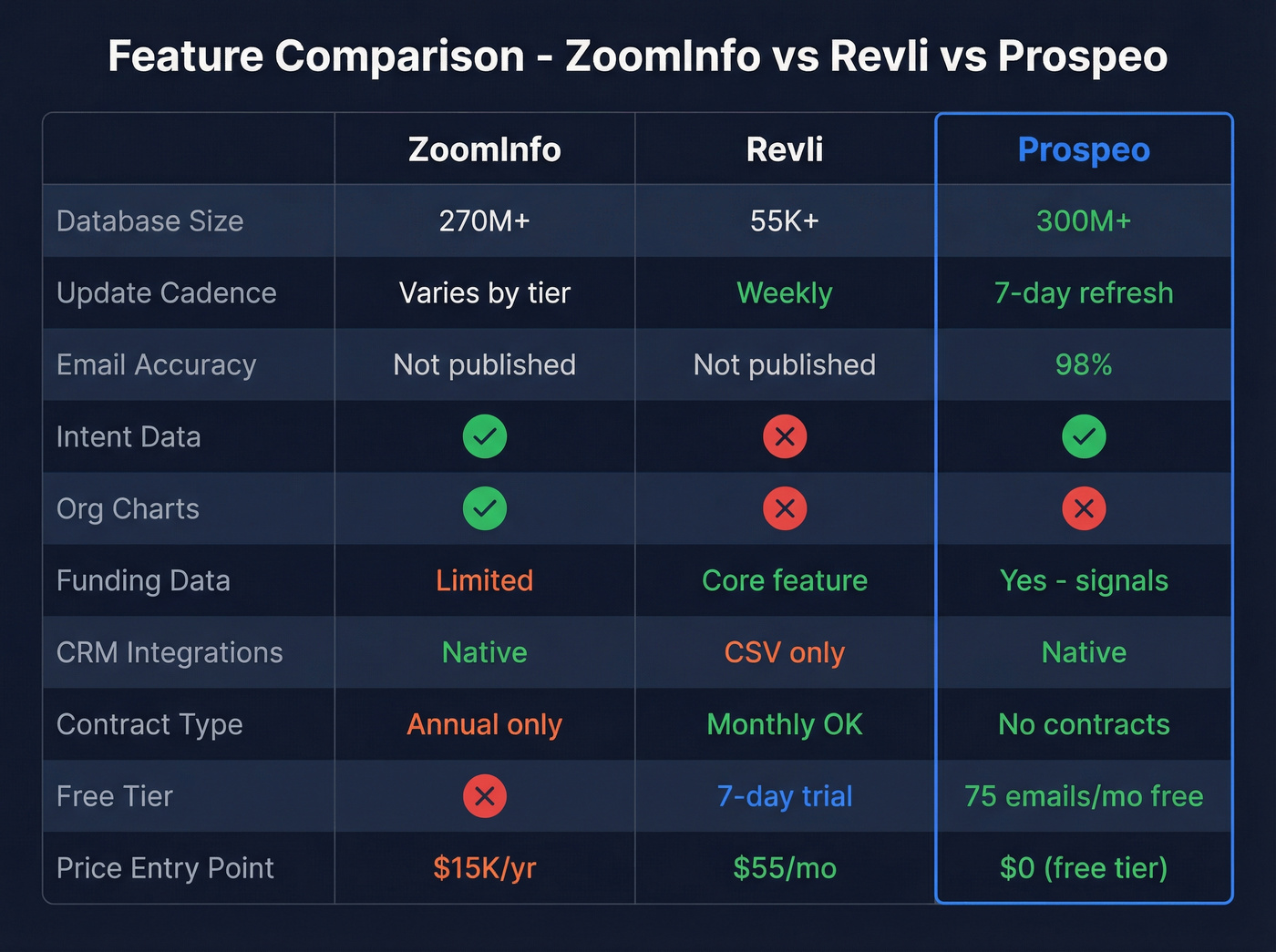
ZoomInfo wins on breadth and intent. Revli wins on funding-data freshness and contract flexibility.
Who Should Use Which
Pick Revli if you're an agency or sales team whose entire playbook revolves around reaching recently funded startups. The $55-$199/mo price point makes it low-risk, and the weekly updates keep your lists fresh without manual research. The smartest practitioners don't use Revli alone - one agency owner on r/agency described layering Revli's weekly lists with SEC Form D filings for faster signals and Dealroom for geo/stage filtering.
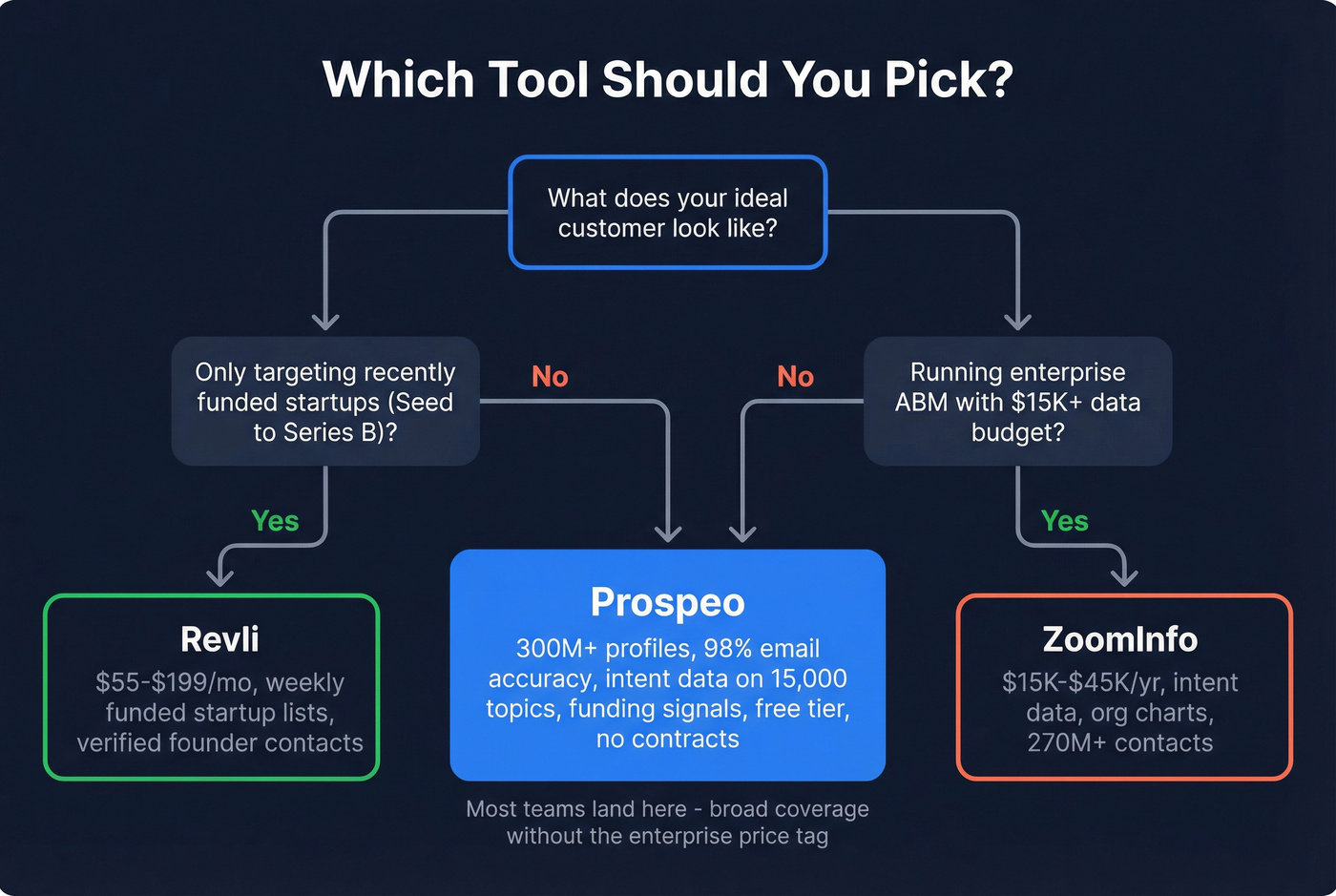
You need ZoomInfo if you check three or more of these boxes:
- Running enterprise ABM with intent-driven plays (see Account-Based Selling)
- Need org charts for multi-threading into buying committees
- Have $15k+ annual budget for a single data tool
- Want native CRM integrations, not CSV imports (compare examples of a CRM)
- Require 270M+ contacts across all industries and stages
If you only check one or two, you're almost certainly overpaying.
What If Neither Fits?
Here's the thing: most teams don't fit neatly into "startup-only prospecting" or "enterprise GTM platform." You want broad coverage, accurate data, and a price that doesn't require CFO approval. That middle ground is where we built Prospeo.
Prospeo covers 300M+ professional profiles with 98% email accuracy and 125M+ verified mobiles, all on a 7-day refresh cycle - four times faster than the six-week industry average. We've run our emails through third-party verification tools and the 98% accuracy holds up consistently. There's a free tier with 75 emails/month and 100 Chrome extension credits/month, no contracts, and a Chrome extension with 40,000+ users for prospecting directly from any website (more sales prospecting techniques).
You also get intent data tracking 15,000 topics via Bombora, 30+ search filters covering technographics, job changes, headcount growth, and funding signals, plus native integrations with Salesforce, HubSpot, Instantly, Lemlist, and Clay (see Clay list building). Full-stack capability at roughly $0.01 per lead versus ZoomInfo's ~$1 per lead.

Choosing between a $55/mo niche tool and a $15K/year platform shouldn't be your only options. Prospeo delivers 125M+ verified mobiles, 30+ search filters including funding and technographics, and native CRM integrations - with a free tier and no contracts.
75 free verified emails per month. No credit card. No sales call.
FAQ
Is DiscoverOrg still available?
No. ZoomInfo acquired DiscoverOrg in 2019 and retired the brand entirely. All legacy features - org charts, Scoops, human-verified contacts - now live inside ZoomInfo's platform under annual contracts starting around $15k/year.
Is Revli worth it for startup prospecting?
If your ICP is recently funded startups from Seed to Series B, Revli delivers weekly curated lists with verified founder contacts starting at $55/month billed annually. G2 reviewers give it 4.8/5 and praise the clean data and time savings. For broader B2B prospecting beyond startups, it's too narrow to be your primary tool.
What's a good free alternative to both tools?
Prospeo offers a free tier with 75 verified emails and 100 Chrome extension credits per month - no credit card or contract required. With 300M+ profiles, 98% email accuracy, and 30+ search filters, it covers far more ground than Revli and costs a fraction of what ZoomInfo charges at scale.
What's the cheapest alternative to ZoomInfo?
Let's be honest: most teams searching for ZoomInfo alternatives don't actually need ZoomInfo-level tooling. If your average deal size is under $15k and you're running outbound with five or fewer reps, a $15k+ annual data contract is overkill. Self-serve tools with transparent pricing and no annual lock-in will get you further than you think - and you won't spend three weeks negotiating a renewal.