

Discovery Call Questions: The Benchmark-Backed Playbook for 2026
You finish a 30-minute discovery call, the prospect says "sounds great, send me some info," and the deal quietly dies in your pipeline three weeks later. The problem isn't that you asked bad questions - it's that you never uncovered impact, a critical event, or how decisions actually get made. 96% of buyers have already researched solutions before they pick up the phone. They don't need a walkthrough. They need you to connect their problem to a number, a deadline, and a decision process.
Most question lists optimize for quantity. The data says the opposite: won deals average 15-16 questions, while lost deals average around 20. More questions isn't thorough - it's usually a sign you're interrogating instead of listening.
What Good Discovery Sounds Like
Four numbers separate top performers from everyone else:
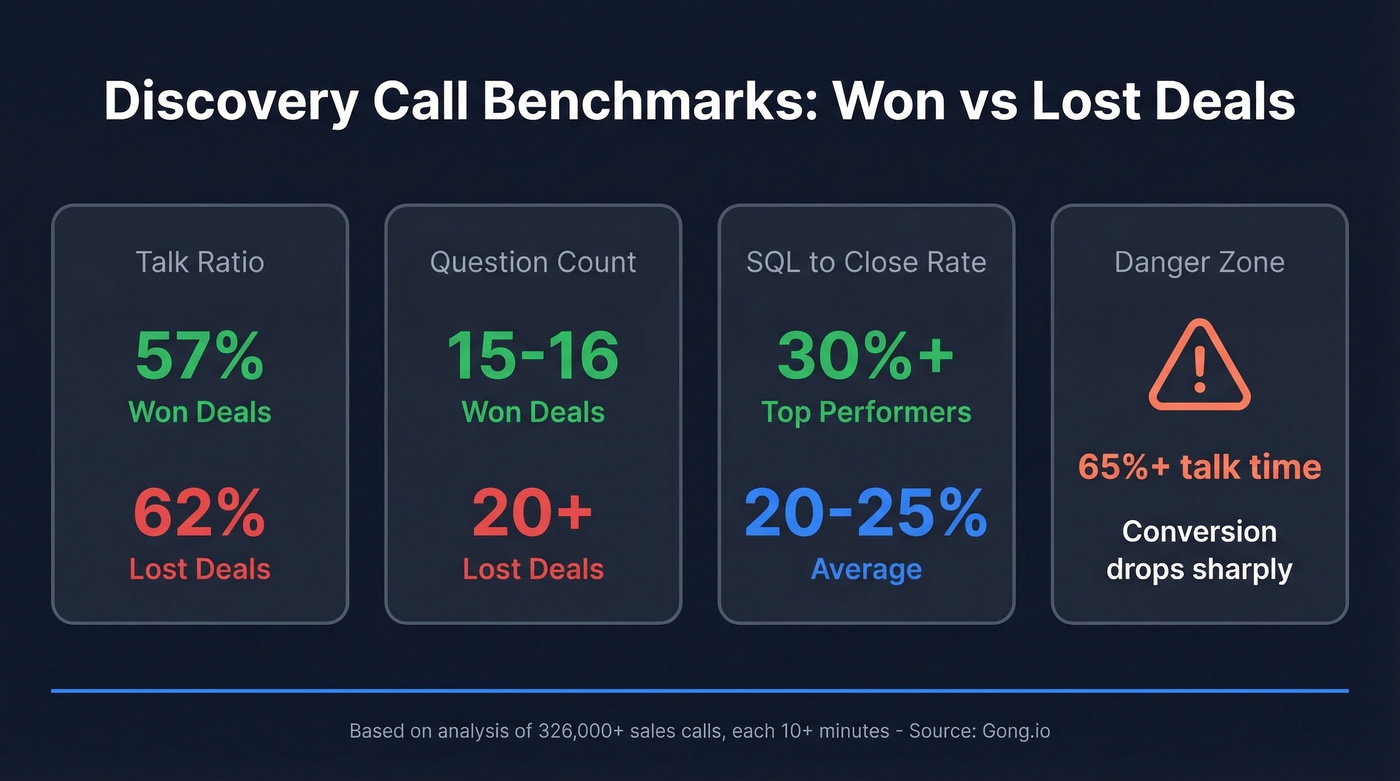
- Talk ratio: 57% or less. Closed-won reps talk less. Lost deals average 62% rep talk time.
- Question count: 15-16 on won deals. Not 20+. Go deeper, not wider.
- Longest monologue: One of the strongest predictors of a lost deal. Top performers keep theirs short.
- SQL-to-close rate: 20-25% average, 30%+ for top performers. Discovery quality is a big lever here.
Framework recommendation: SPICED for most deals, MEDDPICC when you're navigating enterprise procurement with multiple approvers.
Benchmarks Behind Great Discovery
An analysis of 326,000 sales calls - each 10+ minutes - reveals clear patterns. Reps on closed-won deals averaged 57% talk time versus 62% on lost deals. That 5-point gap sounds small until you realize it represents hundreds of hours of prospect insight you're either capturing or missing across a full quarter.
The threshold that matters: once a rep crosses 65% talk time, conversion rates drop measurably. And the question count data is counterintuitive - asking 20+ questions doesn't signal thoroughness. It signals you're running through a checklist instead of following threads.
Here's the thing: nearly 25% of sellers admit that knowing what to ask on a discovery call is a top weakness. The differentiator isn't asking more. It's interactivity - more back-and-forth exchanges, shorter monologues, and follow-up questions that prove you actually heard the answer. We've seen this firsthand reviewing call recordings with our sales team: the best questions come from genuine curiosity about the prospect's business, not from a script taped to your monitor.
Pick Your Framework by Deal Type
If you had to pick two frameworks for 2026: SPICED for most deals, MEDDPICC when procurement and multi-approval are real.
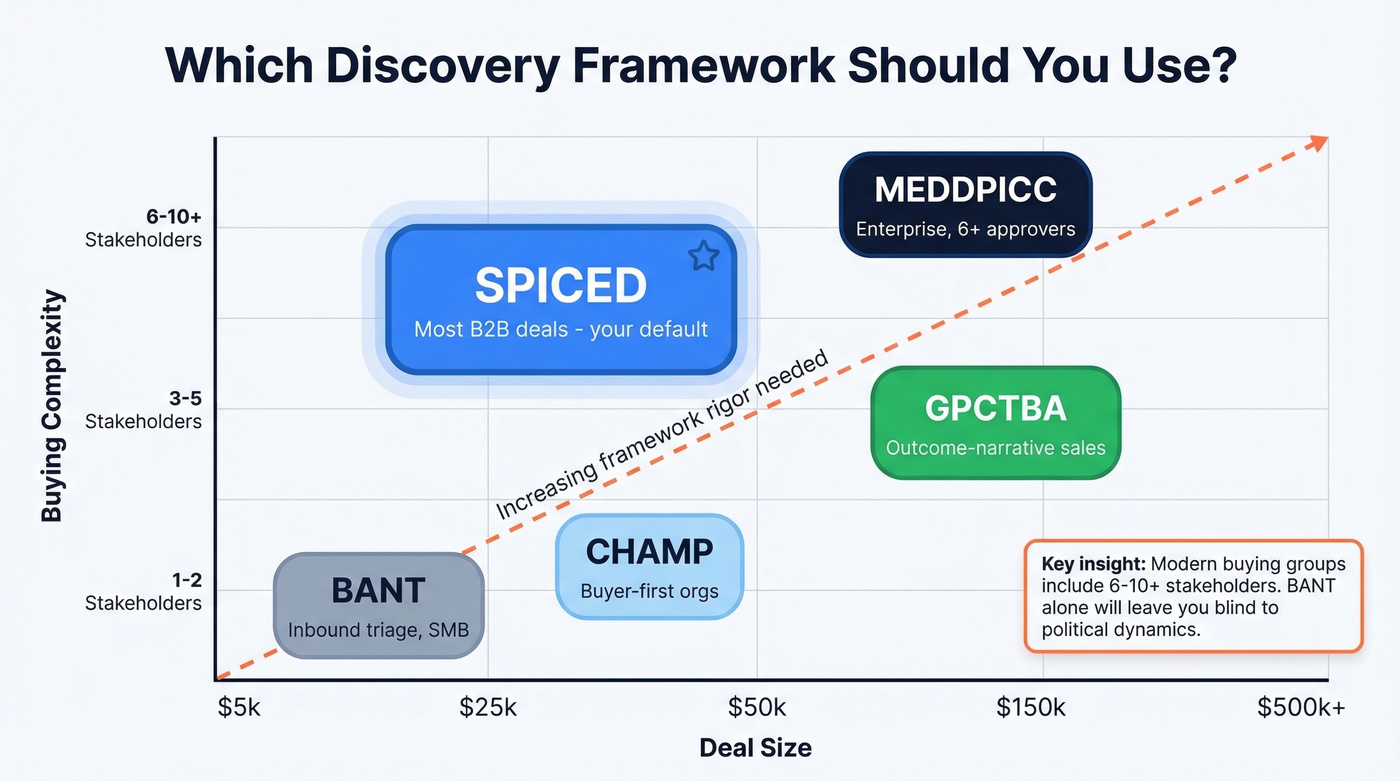
| Framework | Best For | Weakness | When to Skip |
|---|---|---|---|
| BANT | SMB inbound triage | Budget-first; ignores pain | Multi-stakeholder deals |
| CHAMP | Buyer-first orgs | Light on decision process | Complex procurement |
| SPICED | Most B2B deals | Requires rep judgment | Very transactional sales |
| MEDDPICC | Enterprise, 6+ approvers | Heavy; overkill for SMB | Sub-$15k deals |
| GPCTBA | Outcome-narrative sales | Long; hard to train | Fast sales cycles |
Modern buying groups include 6-10+ stakeholders. BANT was built for a world where one person had budget authority and said yes or no. That assumption breaks fast in larger deals. BANT is fine for inbound triage - qualifying whether someone's worth a longer conversation - but it'll leave you blind to the political dynamics that actually kill enterprise deals.
If your average deal is under $15k, you probably don't need MEDDPICC. You need SPICED and the discipline to ask two hard questions about decision process. The framework isn't the bottleneck - the willingness to ask uncomfortable questions is.
One distinction worth internalizing: a real champion spends political capital. They share internal decks, map the org chart, bring detractors into the conversation, and pull procurement in early. If your "champion" just says nice things about you in meetings, they're a fan, not a champion.

Discovery calls only convert when you're talking to the right person. Prospeo gives you 98% accurate emails and 125M+ verified mobile numbers so your 15-16 questions land with actual decision-makers - not gatekeepers.
Stop wasting perfect discovery on unverified contacts.
The SPICED Question Bank
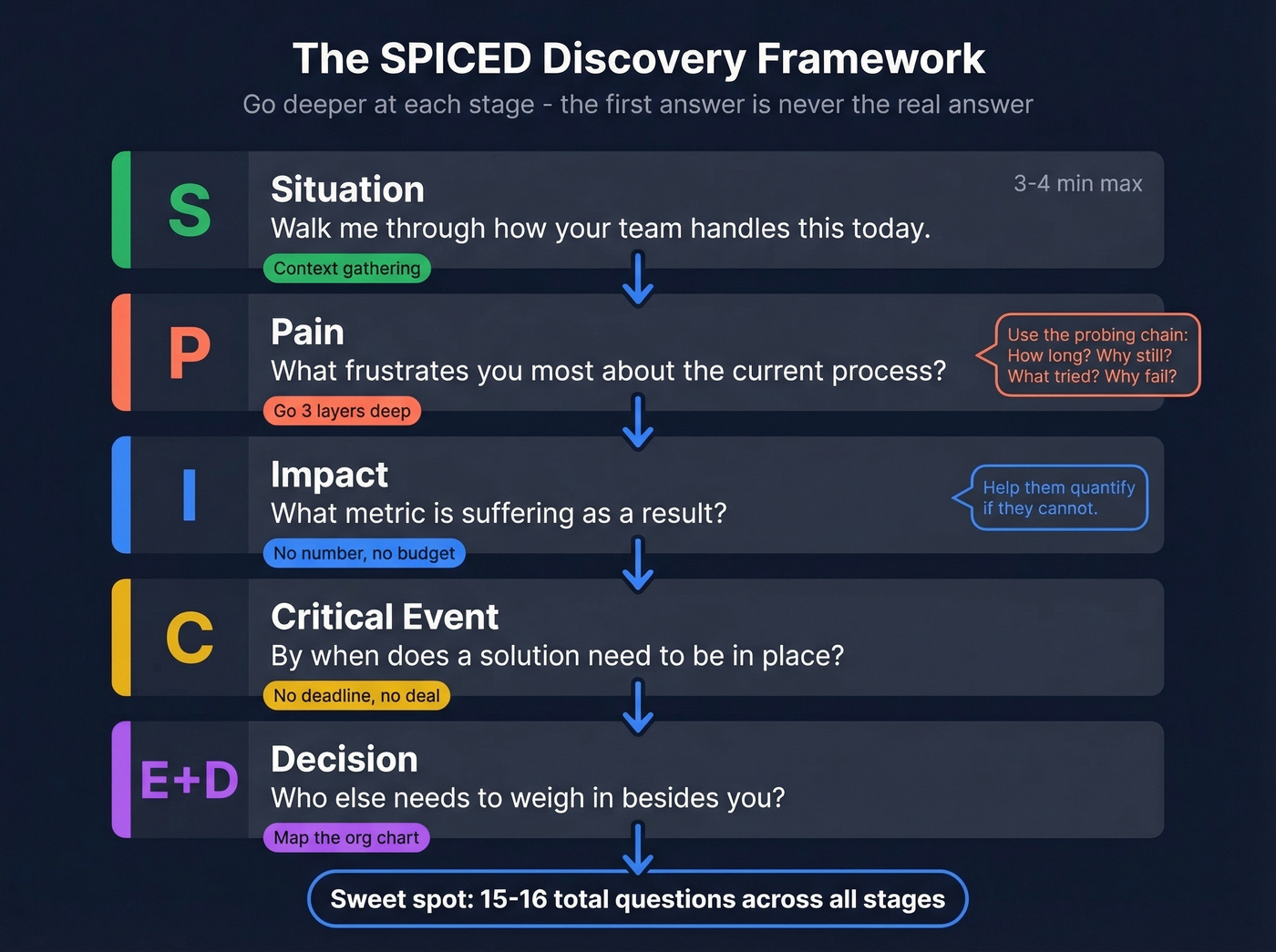
This is the section you'll actually use on calls. Each SPICED category gets questions plus branching follow-ups - because the first answer is almost never the real answer.
Situation
These establish context. Don't spend more than 3-4 minutes here - the prospect will get bored if you're just gathering facts they assume you already know.
- "Walk me through how your team handles [process] today."
- "How many people touch this workflow from start to finish?"
- "What tools are you currently using for [function]?"
- "What does success look like for your team this quarter?"
If they give a surface-level answer, follow with: "Can you help me understand what a typical week looks like for the team doing this?" Phrasing questions as "help me understand" consistently draws out longer, more detailed responses.
Pain
This is where most reps stop too early. The first pain they mention is rarely the real one. Surface-level pain won't survive a budget meeting.
- "What frustrates you most about the current process?"
- "Where does this break down when volume spikes?"
- "What's the workaround your team has built, and how reliable is it?"
- "Where are the biggest friction points right now?"
The SalesFuel probing chain works better than any single clever question: "How long has this been a problem?" then "Why is it still a problem?" then "What have you tried?" then "Why didn't those work?" That four-question sequence peels back layers fast. Use it when the first answer feels rehearsed.
Impact
Picture this: your champion walks into a budget meeting and says "we should buy this tool because our current process is frustrating." That gets a polite nod and no budget. Now picture them saying "we're losing 40 hours a week and $180k annually in manual rework." That gets a PO.
No quantified impact, no budget. It's that simple.
| Question | What You're Really Asking |
|---|---|
| "What metric is suffering as a result?" | Can you tie this to a KPI your CFO tracks? |
| "How much time does your team lose per week - in hours?" | Give me a number I can put in an ROI model |
| "If this doesn't get fixed in two quarters, what happens to [target]?" | Is there organizational consequence, or just annoyance? |
| "What are the ripple effects across other departments?" | How wide is the blast radius? |
If they can't quantify, help them: "Other teams we work with in [industry] typically see [X hours / $Y] lost per month on this. Does that range feel right?" You're not leading the witness - you're giving them a framework to think in numbers.
Critical Event
Urgency separates a live deal from a pipeline placeholder. No deadline means your deal will stall in pipeline review for months. These are among the most important discovery call questions because without a timeline, nothing moves forward.
- "By when does a solution need to be in place?"
- "What's driving that timeline - a board meeting, a contract renewal, a product launch?"
- "What happens if you miss that date?"
- "How satisfied are you with your current provider's ability to hit that window?"
When there's no obvious deadline, probe for a manufactured one: "When does your current contract come up for renewal?" or "Is there a planning cycle where this needs to be budgeted?"
Decision & Disqualification
Skip this on your calls and you'll keep getting surprised by phantom VPs who veto deals you thought were closed.
- "Who else needs to weigh in on this decision besides you?"
- "Walk me through how your company typically evaluates and approves a purchase like this."
- "Is there a procurement or legal review? How long does that usually take?"
- "Are you evaluating other solutions right now?"
- "Are there any blockers that might stop us from getting this in place?"
These are also your disqualification questions. If there's no access to the decision process, no timeline, and no quantified pain, you don't have a deal - you have a conversation. Better to know now.
15/30/45-Minute Agendas
Not every call gets 45 minutes. Here's how to adapt the SPICED flow to your actual timebox. Most discovery calls run 15-30 minutes, so the 30-minute version is your default.
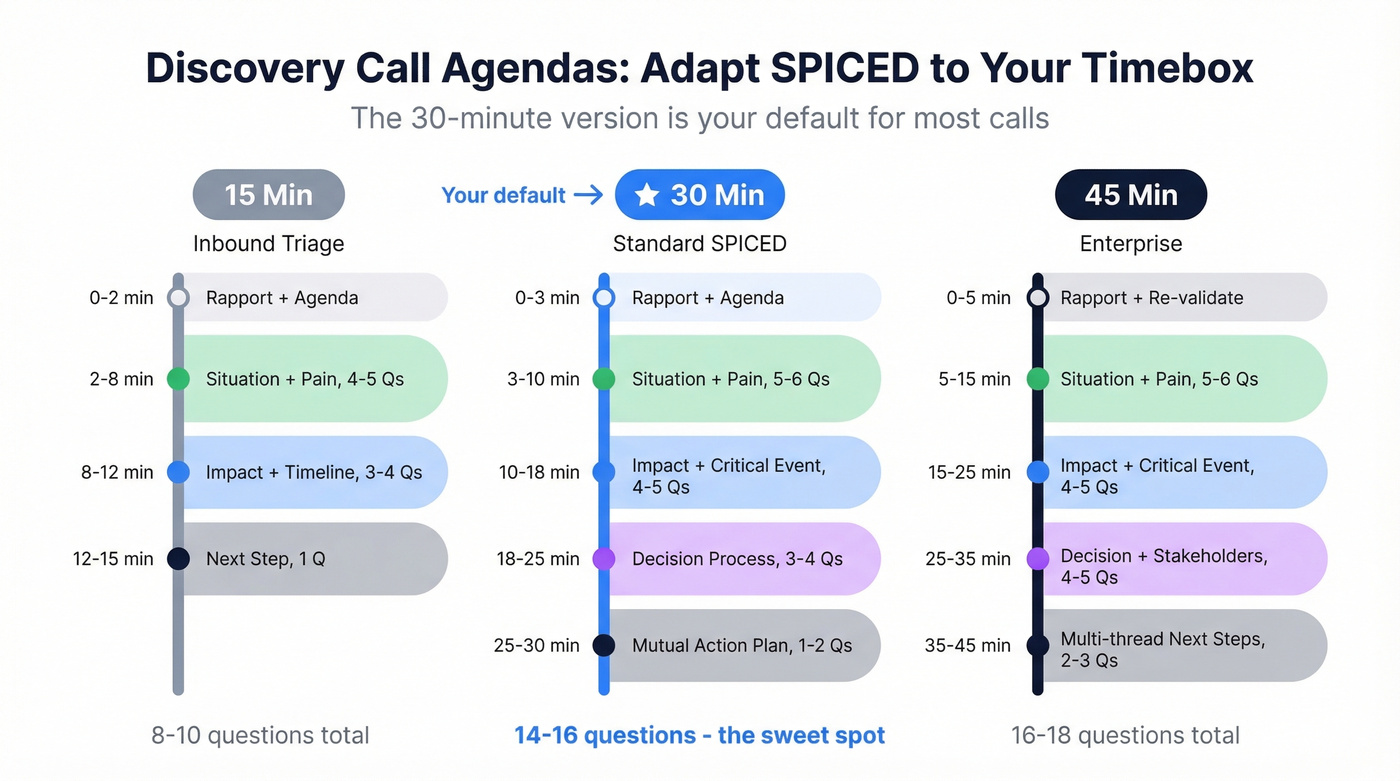
Opening script for any length: "I'd like to learn more about your current situation, understand the challenges you're facing, and see if there's a fit. At the end, we'll decide together on next steps. Sound good?"
15-Minute Agenda (Inbound Triage)
| Minutes | Activity | Questions | Goal |
|---|---|---|---|
| 0-2 | Rapport + agenda | 0 | Set expectations |
| 2-8 | Situation + Pain | 4-5 | Qualify the problem |
| 8-12 | Impact + Timeline | 3-4 | Size the opportunity |
| 12-15 | Next step | 1 | Book or disqualify |
Total: ~8-10 questions.
30-Minute Agenda (Standard SPICED)
| Minutes | Activity | Questions | Goal |
|---|---|---|---|
| 0-3 | Rapport + agenda | 0 | Align on structure |
| 3-10 | Situation + Pain | 5-6 | Deep context |
| 10-18 | Impact + Critical Event | 4-5 | Quantify + urgency |
| 18-25 | Decision process | 3-4 | Map stakeholders |
| 25-30 | Mutual action plan | 1-2 | Commit to next step |
Total: ~14-16 questions. This is the sweet spot.
45-Minute Agenda (Enterprise)
| Minutes | Activity | Questions | Goal |
|---|---|---|---|
| 0-5 | Rapport + re-validate | 1-2 | "What's changed since last time?" |
| 5-15 | Situation + Pain | 5-6 | Full workflow mapping |
| 15-25 | Impact + Critical Event | 4-5 | Build the business case |
| 25-35 | Decision + Stakeholders | 4-5 | Org chart + paper process |
| 35-45 | Mutual action plan | 2-3 | Multi-thread next steps |
Total: ~16-18 questions. Remember that discovery is a process, not an event - start subsequent calls with "What's changed since we last talked?" to re-validate assumptions rather than repeating the same questions.
Mistakes That Kill Discovery
| What Average Reps Do | What Top Performers Do |
|---|---|
| Talk 62%+ of the call | Stay under 57% talk time |
| Ask 20+ surface questions | Ask 15-16 with deep follow-ups |
| Frontload all discovery into one call | Spread discovery across the cycle |
| Skip decision mechanics entirely | Map stakeholders + paper process |
| End with "I'll send you some info" | End with a mutual action plan |
| Rush to demo features | Ask three open-ended questions before mentioning product |
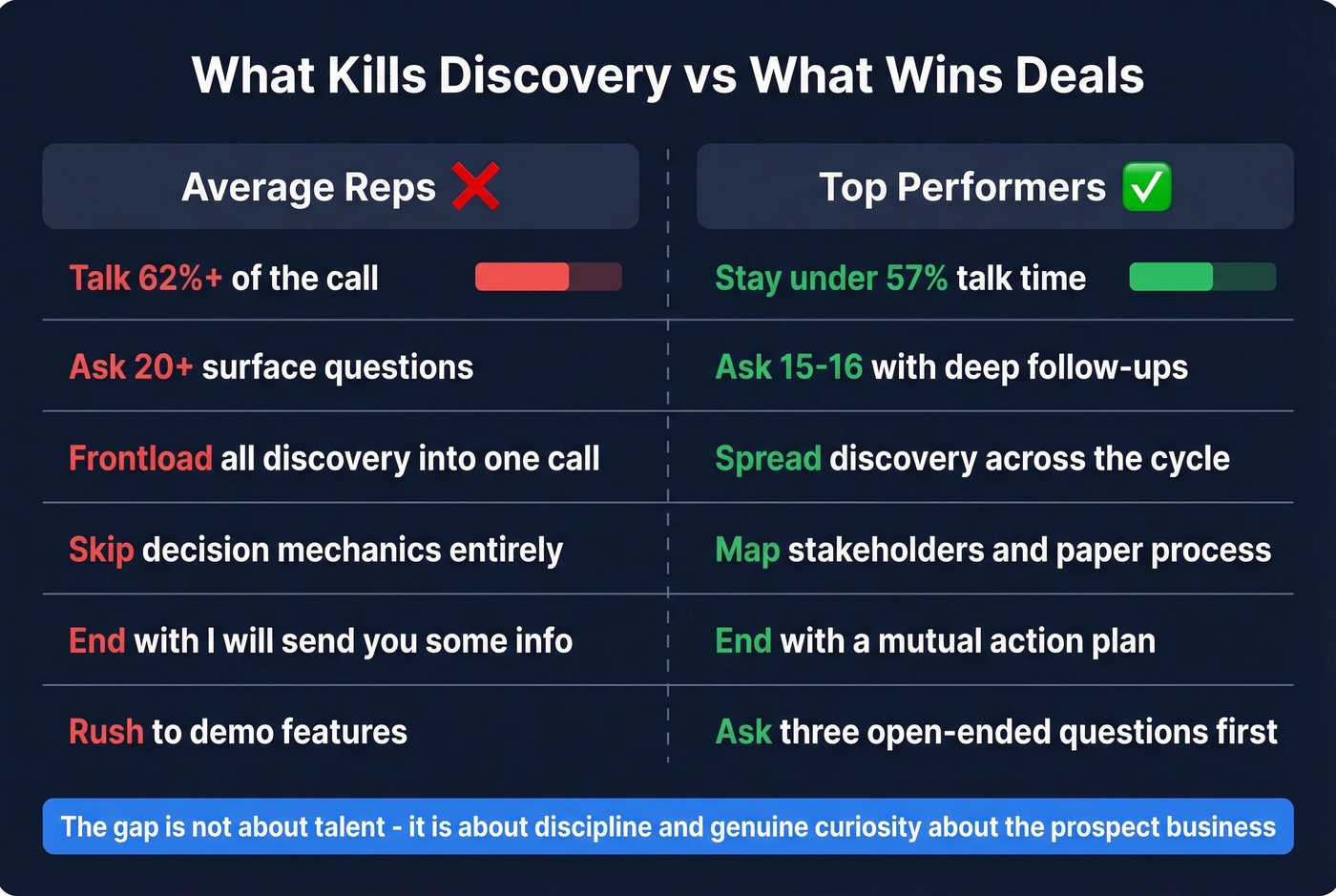
You can "do discovery" for 30 minutes and still leave with nothing actionable because you never asked how decisions get made. The prospect felt heard, you felt productive, and the deal still dies because a VP you never knew about vetoes it in a leadership meeting. We've all been there.
Rushing to solutions before understanding the problem is the most common mistake, and it's especially tempting when the prospect asks "so what does your product do?" five minutes in. Resist. Redirect with: "I want to make sure I show you the right things - can I ask a couple more questions first?"
Discovery to Demo Handoff
Your discovery call is only as valuable as what happens next. After every call, capture these seven items:
- Pain in their words, not yours
- Impact metric - time, revenue, headcount
- Critical event date
- Stakeholders and roles: champion, economic buyer, blocker, end user
- Decision process and timeline
- Competition
- Agreed next step with a date
The mapping rule: If they said "we're losing 10 hours a week on manual data entry" in discovery, show the automation workflow in demo. Skip the reporting dashboard they didn't mention. Every demo minute should trace back to a discovery answer.
The scenario that kills deals: your demo gets derailed by a stakeholder you didn't know existed, asking questions about security or compliance you weren't prepared for. The fix is verifying contact details for every stakeholder mentioned so your follow-up reaches the full buying group. Prospeo handles this in bulk - paste your stakeholder list, get back verified emails with 98% accuracy and direct dials, all refreshed on a 7-day cycle. Momentum dies when your recap email bounces or lands in the wrong inbox.
If you want a tighter post-call workflow, use these sales follow-up templates and a dedicated sales meeting follow-up email format to keep next steps crisp.
SPICED works when you know who the 6-10 stakeholders are before the call. Prospeo's 30+ search filters - including org charts, job changes, and buyer intent across 15,000 topics - let you map the entire buying committee in minutes.
Walk into every discovery call knowing exactly who decides.
If you're building a full outbound motion around discovery, pair this with sales prospecting techniques and a clean lead generation workflow so the right accounts hit your calendar in the first place.
FAQ
How many questions should I ask on a discovery call?
Won deals average 15-16 questions; lost deals average around 20, based on an analysis of 326,000 sales calls. The key is asking fewer, better questions with deeper follow-ups that uncover impact and decision mechanics rather than running through a long checklist.
What's the ideal discovery call length?
Most effective calls run 15-30 minutes for SMB and mid-market deals. Enterprise discovery with multiple stakeholders typically runs 30-45 minutes. A 15-minute call that uncovers a critical event and decision process beats a 45-minute call that stays surface-level every time.
What are the best discovery call questions to close deals?
Focus on questions that uncover quantified impact, a critical event driving urgency, and the actual decision process. The SPICED framework covers all three: Situation and Pain establish context, Impact and Critical Event build the business case, and Decision maps stakeholders. Follow-up questions that dig deeper are more valuable than moving to the next topic.
How do I follow up after a discovery call?
Summarize pain, quantified impact, and the agreed next step in a short email within two hours. Send it to every stakeholder mentioned - not just your main contact. Tools like Prospeo let you verify emails for the full buying group in bulk so your recap actually lands instead of bouncing. The free tier gives you 75 email credits per month to start.