

Discovery Call Slides: How to Use Them Without Killing the Conversation
Your VP told you to bring slides. You know from experience that pulling up a deck turns the conversation into a monologue. Only 10-30% of discovery calls convert, and poorly designed slides make that number worse.
Here's how to thread the needle - whether you're an AE running your twentieth discovery this month or a founder selling solo.
The Short Version
- Slides hurt first discovery calls unless you design them to force dialogue - one question per slide, nothing more.
- Keep it to 2-3 slides for a first discovery, or 6-8 slides tops when you genuinely need more context and proof.
- Design for the champion who forwards the deck after the call, not for yourself during it.
What the Data Actually Says
Gong analyzed 803,402 recorded sales meetings and found a strong negative correlation between using slides in first discovery calls and earning a follow-up. When sellers pull up a deck on that first call, questions drop by 21%, monologues run 25% longer, and sellers talk 15% more than prospects.
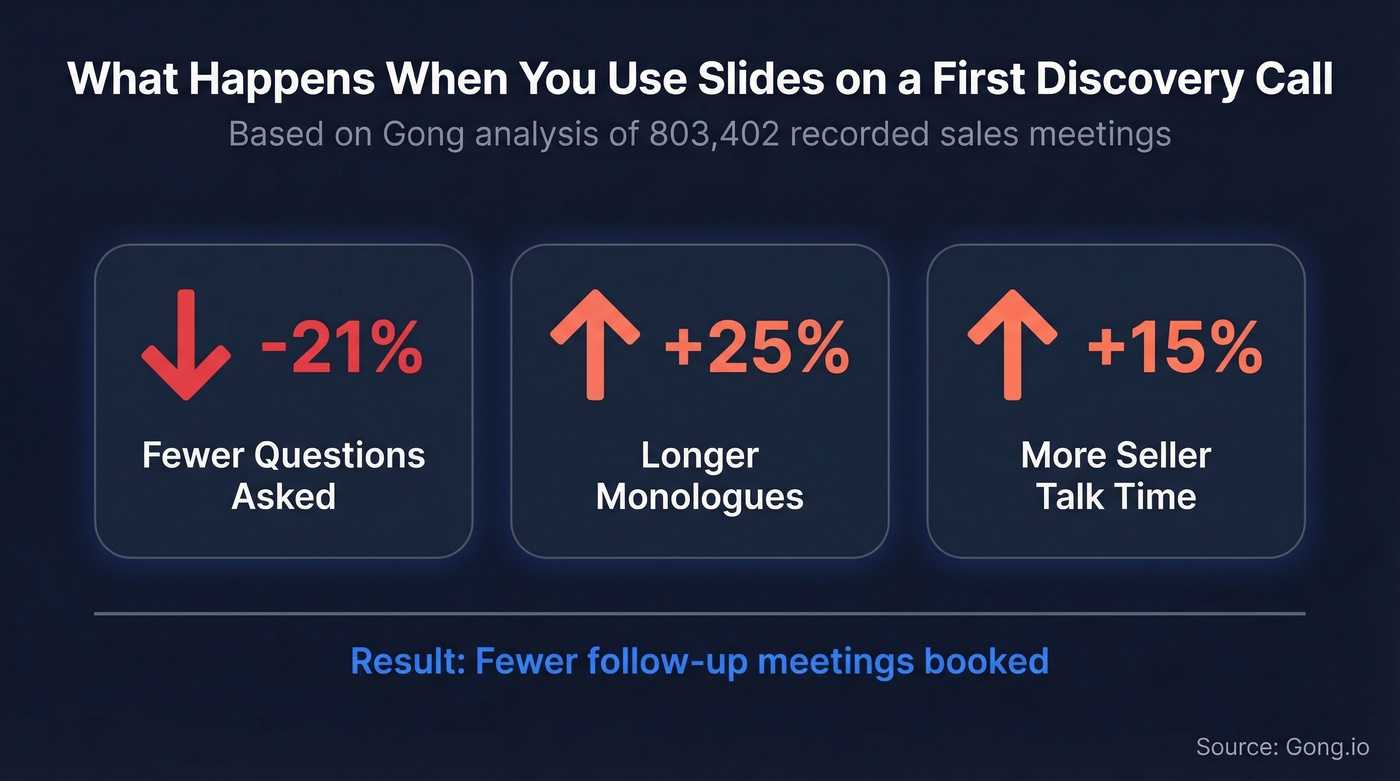
Why? Slides shift the interaction from dialogue to presentation. You stop asking and start telling. The buyer leans back, and the call dies quietly.
But here's the nuance most people miss: slides actually help in mid- and late-stage meetings. The problem isn't the deck itself - it's using one when you should be listening. One SaaS seller on r/sales put it bluntly: demos were "way smoother" when they skipped slides at the beginning entirely.
Let's be honest. Most reps don't have a slide problem. They have a listening problem. If you're closing deals under $30k with a single buyer, you probably don't need a discovery deck at all. You need five great questions and the discipline to shut up.
When to Use Slides vs. Skip Them
| Call Type | Recommendation | Why |
|---|---|---|
| First discovery | Skip or micro-deck only | Slides reduce questions and increase seller talk time |
| Technical deep-dive | Light slides OK | Diagrams aid comprehension |
| Multi-stakeholder | Slides recommended | Helps align different priorities |
| Mid/late-stage | Full deck | Outcomes improve here |
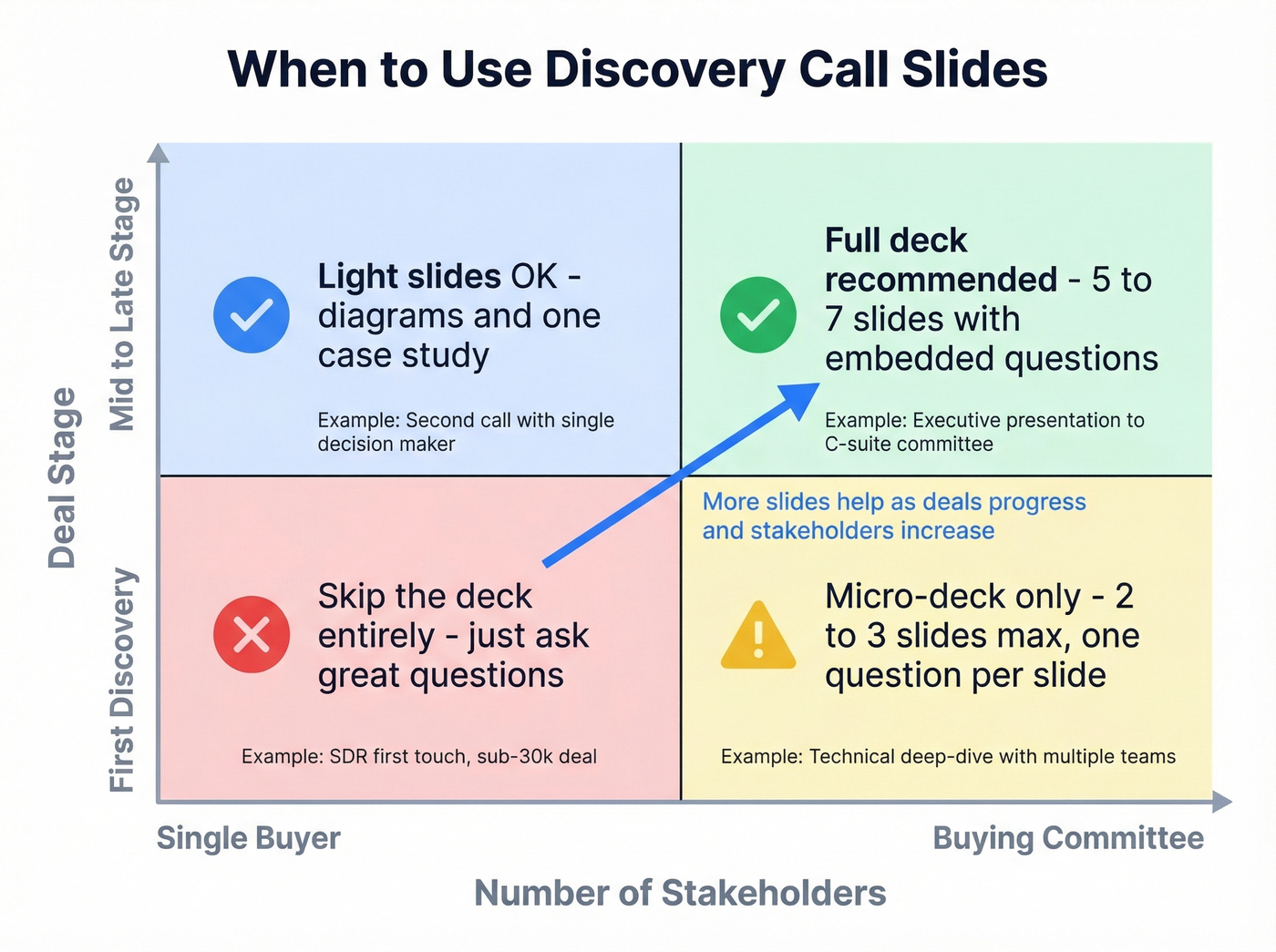
The more people on the call and the further along the deal, the more slides help. On a first discovery with one buyer? You don't need a deck. You need questions.
An executive discovery call with a C-suite audience demands a tighter, more proof-heavy presentation because their time tolerance is measured in seconds - and they'll cut you off the moment you sound like you're reading from a template.

Your discovery deck's case study slide is only as strong as the results behind it. Teams using Prospeo book 26% more meetings than ZoomInfo users - because 98% email accuracy means reps actually reach the buyers they're presenting to.
Give your discovery slides a case study worth showing.
Three Proven Templates
The Power Pitch (3 Slides)
Based on Mereo's "Power Pitch" framework: a short opener you deliver in about a minute, then pivot to questions.
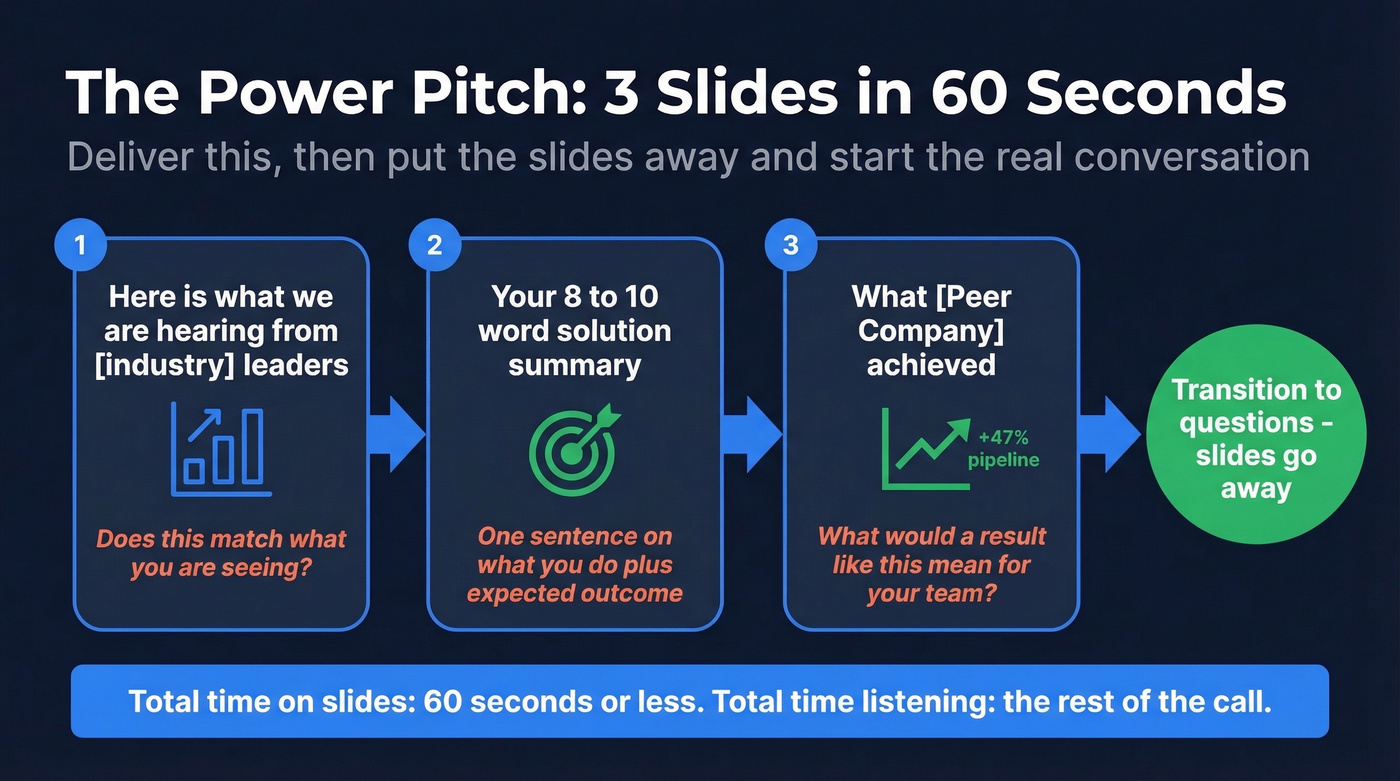
- "Here's what we're hearing from [industry] leaders" - A tailored pain point or industry stat. End with: "Does this match what you're seeing?"
- "[8-10 word solution summary]" - One sentence on what you do, paired with the expected outcome. Keep it visual.
- "What [peer company] achieved" - Relevant proof with a specific number. End with: "What would a result like this mean for your team?"
Deliver this in 60 seconds, then put the slides away. The deck is a conversation starter, not the conversation. This format also doubles as a strong opening before you transition into a product demo - it frames the problem before you ever show a feature.
The Full Discovery Deck (5-7 Slides)
We've found this structure works best in multi-stakeholder calls because it follows a simple narrative - Problem, Cost of inaction, Better approach, Proof, Next steps - and bakes questions into every slide. It's the backbone of a solid discovery strategy that keeps the buyer talking.
- "The challenge facing [industry] teams in 2026" - Frame their world. "How is this showing up for you?"
- "What inaction costs" - Quantify the problem. "What's this costing your team today?"
- "A different approach" - Hint at the solution category, not your product yet. "Have you explored anything like this?"
- "How [customer] solved it" - Case study with hard numbers. "What metrics matter most to your leadership?"
- "What working together looks like" - Timeline and next steps. "Who else needs to weigh in?"
For multi-stakeholder calls, add a slide presenting explicit options - including "do nothing" and "stay with current vendor." Surfacing those choices builds trust and reveals where the committee actually stands. Build this in Google Slides or Canva so you can duplicate it fast and personalize per account.
The Minimal Deck (4 Slides)
A practitioner on r/salestechniques nailed this: "Four slides from Notion and a 10-minute speech is more than enough."
Skip this format if you're selling to a buying committee of three or more. It works best for shorter sales cycles where one person can say yes. The four slides: where they are today, what changes with you, one proof point, and a ballpark pricing range so there's no sticker shock later. Clarity beats theatre.
Embed Questions Into Every Slide
Beautiful.ai's discovery question framework offers a practical rule: disperse questions throughout the deck - don't fire them rapid-fire. Each slide earns you one question.
- Slide 1 (Challenge): "What goal is your business trying to achieve right now?"
- Slide 2 (Cost): "What might happen if you continue your current process?"
- Slide 3 (Approach): "What other solutions has your company tried?"
- Slide 4 (Proof): "What factors are most important in your decision?"
- Slide 5 (Next steps): "Who's involved in purchasing decisions?"
Spread questions across the meeting so it doesn't feel like an interrogation. Strong icebreakers - a quick industry observation or a genuine compliment on a recent company milestone - also help set the tone before you ever advance to slide one.
Map Your Methodology to Your Slides
If your team runs a formal sales methodology, your discovery call slides should reinforce it, not fight it. Korn Ferry's research shows teams with 75%+ methodology adoption see +21% quota attainment, +15% win rates, and +6% revenue lift.
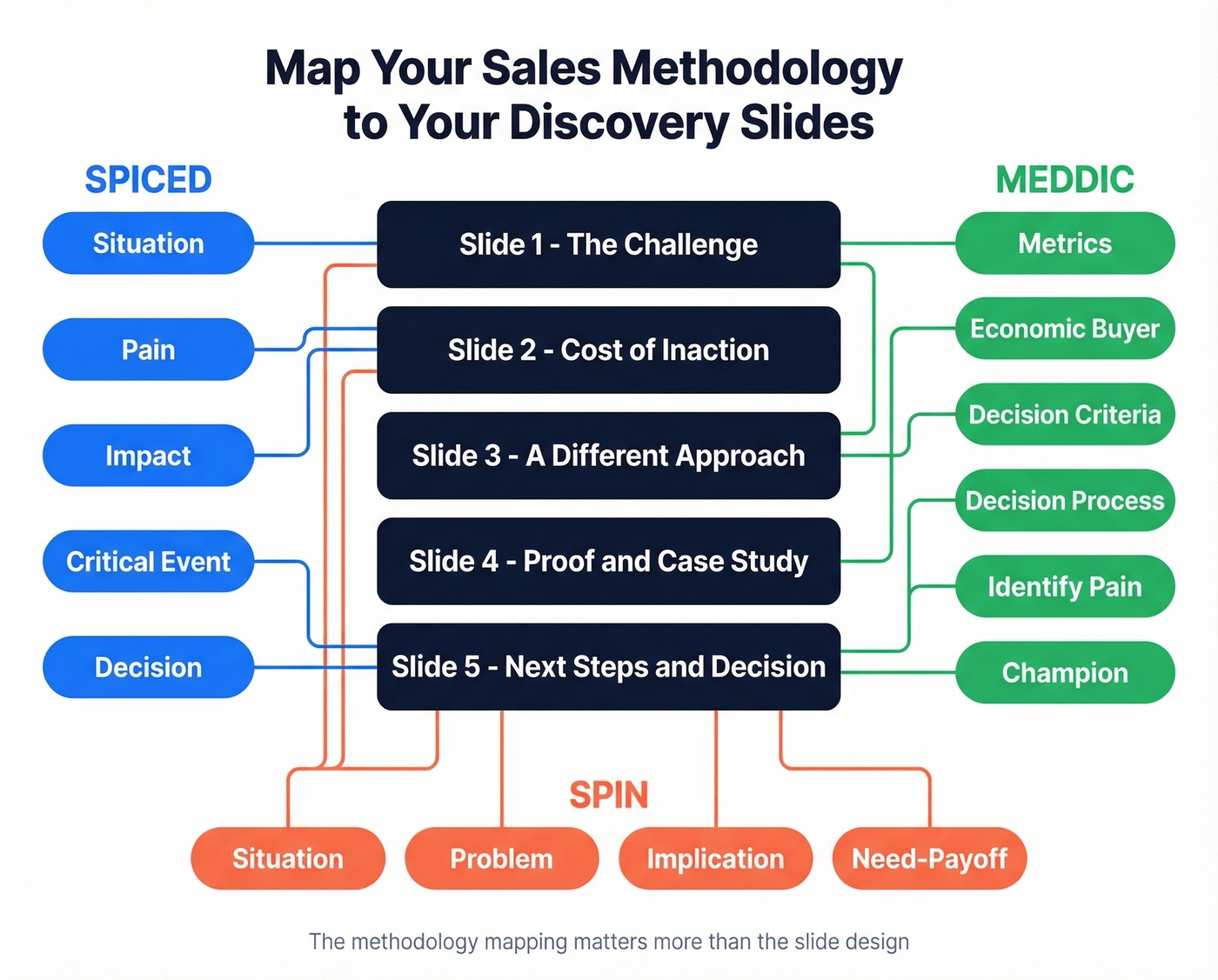
SPICED: Situation maps to Slide 1. Pain and Impact map to Slide 2. Critical Event and Decision map to Slide 5.
MEDDIC: Metrics map to Slide 4. Economic Buyer and Champion map to Slide 5. Decision Criteria map to Slide 3. Identify Pain maps to Slides 1-2. (If you're formalizing this, use a MEDDIC qualification checklist so reps stay consistent.)
SPIN: Situation and Problem questions map to Slides 1-2. Implication questions map to Slide 2. Need-payoff questions map to Slides 3-4.
In our experience, the methodology mapping matters more than the slide design. A beautiful deck that ignores your team's qualification framework creates confusion, not pipeline.
Personalize or Lose Them
Here's the thing: your deck's real audience isn't the person on the call. It's the champion who forwards it to their VP afterward. Dock's data shows personalized decks get 41% more reading time and 2.3x more internal sharing.
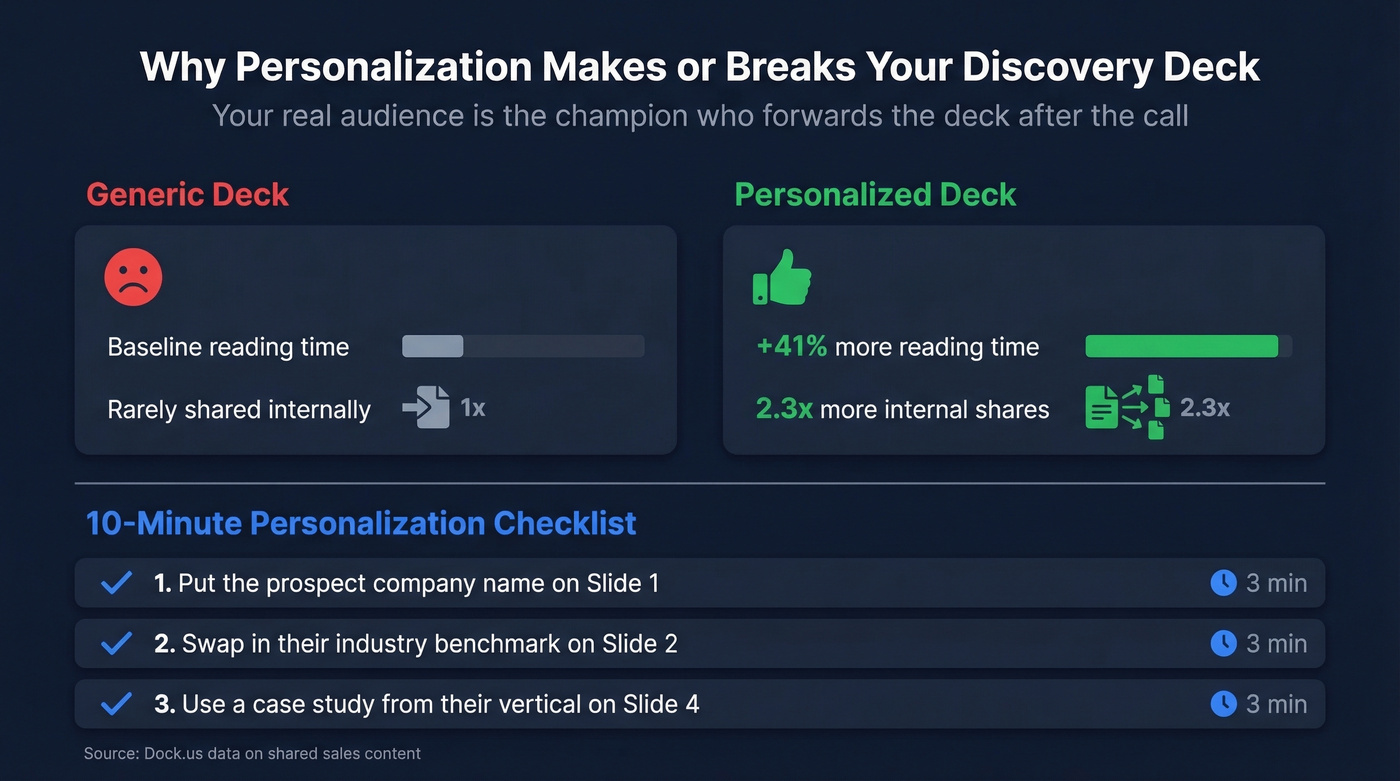
Practical personalization takes 10 minutes. Put the prospect's company name on slide 1, swap in their industry's benchmark on slide 2, use a case study from their vertical on slide 4. Three changes that transform a generic deck into something worth forwarding.
Good personalization starts with accurate data. We use Prospeo to pull verified emails, direct dials, and company signals - technographics, headcount growth, funding, revenue - before the call. Headcount growth becomes an input for the "cost of inaction" slide. Technographics help pick the most relevant case study. The richer your pre-call research, the easier it is to book discovery calls that actually convert, because your outreach already demonstrates you've done the homework. (If you need a repeatable workflow, start with a simple lead enrichment pass before every first call.)
Personalized decks get 2.3x more internal shares - but your champion can't forward results you never got. Prospeo gives you 125M+ verified mobiles and 300M+ profiles so the proof points on your slides turn into real conversations.
Build pipeline worth putting on a slide.
FAQ
How many slides should I use?
Two to three for a first discovery, six to eight for multi-stakeholder calls that need more proof and context. The 803,402-meeting Gong analysis shows each additional slide shifts the dynamic from dialogue to presentation, increasing seller talk time and reducing follow-up rates.
Should I share my deck after the call?
Yes - but only if it's designed for async consumption. Personalized decks get shared internally 2.3x more often. If your slides only make sense with your voiceover, they're useless after the meeting. Design every slide so a champion can forward it with zero context and it still tells a clear story.
What if the prospect asks for a demo during discovery?
Acknowledge it, note it for the next call, and stay in discovery mode. Use a benchmark slide to redirect: "Before I show you the product, let me share what we're seeing in your industry - does this match your experience?" You'll give a better demo once you understand their priorities.
How do I research prospects before building a personalized deck?
Use a B2B data platform to pull company signals - headcount growth, tech stack, funding - before the call. Pair that with public sources like Crunchbase and company 10-Ks for enterprise deals. The goal is to walk into the call with enough context that your slides feel custom, not canned.