

Drip Campaign Definition: Benchmarks and a Sequence You Can Steal
Automated email flows generate a 5.58% click rate across 183,000+ brands. One-off campaign blasts? 1.69%. That's a 3.3x gap, and it's why understanding the drip campaign definition matters for every marketer in 2026. The top 10% of abandoned cart flows pull $28.89 in revenue per recipient. If you're still sending one-off blasts and hoping for the best, you're leaving serious money on the table.
What Is a Drip Campaign?
A drip campaign is a series of pre-written emails sent automatically on a fixed schedule after a trigger event - a signup, a purchase, an abandoned cart, a trial activation. The emails go out whether the recipient engages or not. Day 0, Day 2, Day 5, Day 7, Day 14. That's the "drip."
The name comes from drip irrigation in agriculture, where water is delivered slowly and steadily to plant roots instead of flooding the field. Same idea here: you deliver information in small, timed doses instead of dumping everything into one email.
You'll hear the same concept called different things depending on who's talking: automated email campaigns, lifecycle emails, autoresponders, marketing automation. They all describe the same core mechanic - timed messages delivered without manual intervention.
One thing worth clearing up: you'll occasionally see references to a "Law of 29" claiming prospects need 29 touchpoints before converting. There's no credible research behind this. It's an SEO myth that gets recycled across marketing blogs without citation. Effective drip campaigns work in 3-7 touches. Don't design a 29-email sequence because someone on the internet said so.
Drip vs. Nurture Campaigns
These terms get used interchangeably, but they aren't the same thing. The UnboundB2B framework puts it cleanly: drip is broadcasting, nurture is conversing.
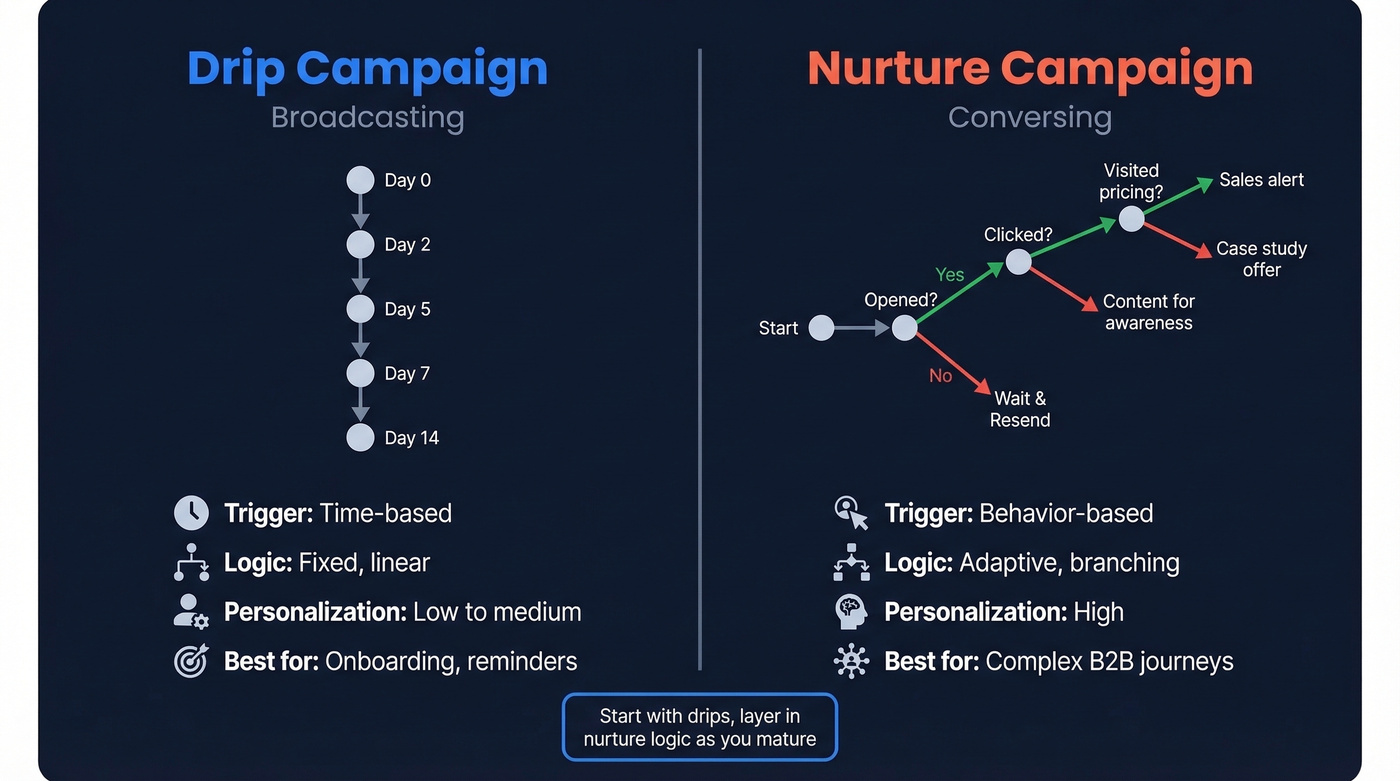
| Feature | Drip Campaign | Nurture Campaign |
|---|---|---|
| Trigger | Time-based | Behavior-based |
| Sequence logic | Fixed (linear) | Adaptive (branching) |
| Personalization | Low-medium | High |
| Best for | Onboarding, reminders | Complex B2B journeys |
| Example | 5-email welcome series | Content shifts based on page visits |
Use drips when the journey is predictable - onboarding a new user, reminding someone about a webinar, educating trial users. Switch to nurture flows when you've got intent data and need the sequence to adapt based on what the prospect actually does. Most teams start with drips and layer in nurture logic as they mature.
Why Automated Flows Outperform
The numbers aren't subtle. 2026 benchmark data from Klaviyo, covering 183,000+ brands, shows a massive gap between automated flows and one-off campaigns.
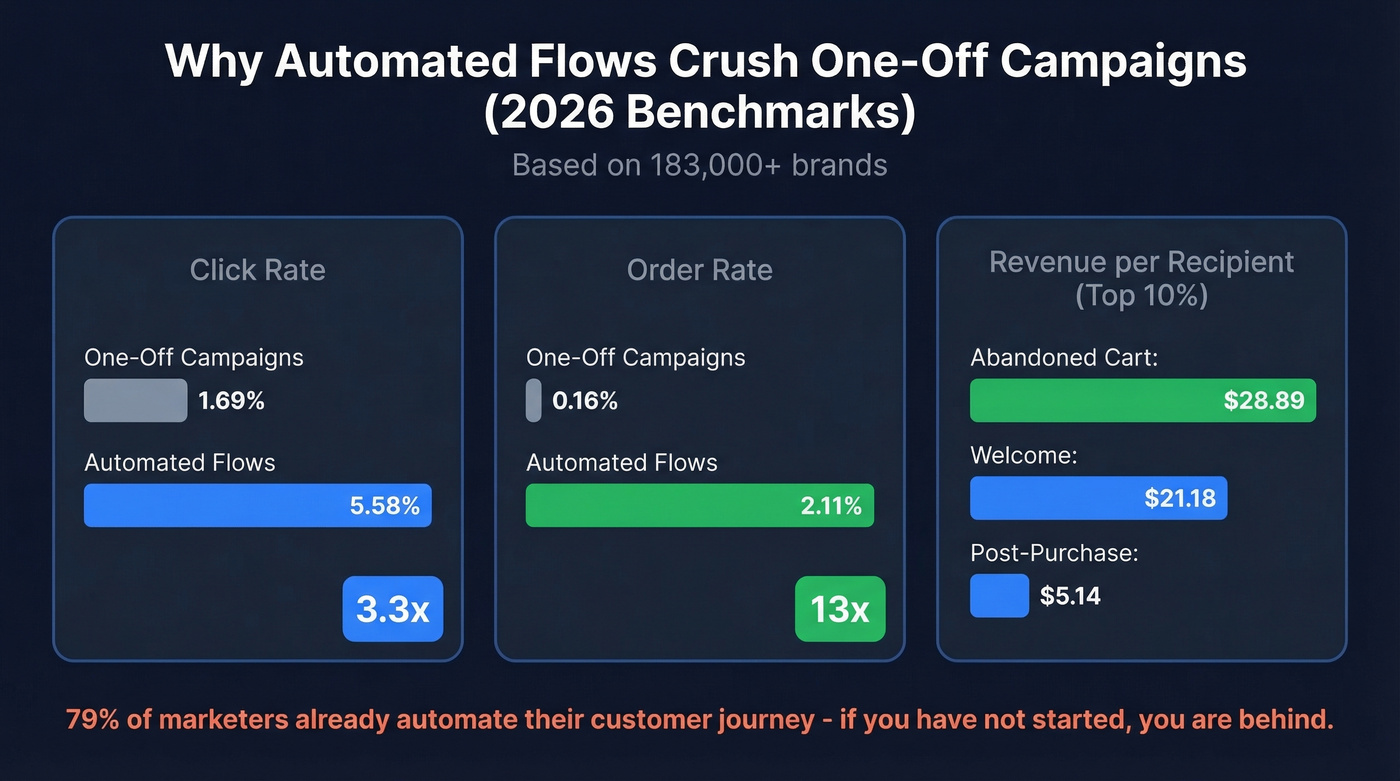
| Metric | One-Off Campaigns | Automated Flows | Difference |
|---|---|---|---|
| Click rate | 1.69% | 5.58% | 3.3x |
| Order rate | 0.16% | 2.11% | 13x |
| Rev/recipient (top 10%) | - | $16.96 | - |
That 13x order rate difference should change how you allocate resources. And 79% of marketers already automate their customer journey - if you haven't started, you're behind.
Revenue per recipient, top 10% of workflows: Abandoned cart: $28.89 - Welcome: $21.18 - Post-purchase: $5.14 Average performers: $3.65 (cart) - $2.65 (welcome) - $0.41 (post-purchase)
One caveat on open rates: Apple Mail Privacy Protection can inflate them by up to 80%. Click rate and order rate are the metrics that actually tell you if your automated sequence is working.

A 13x order rate means nothing if your emails bounce on Day 0. Prospeo's 5-step verification delivers 98% email accuracy across 300M+ profiles - so your drip sequence actually reaches real inboxes from the first touch.
Start every drip with data that doesn't bounce.
Common Drip Campaign Types
So what do these sequences look like in practice?
- Welcome series - Trigger: new signup. Goal: introduce your brand, set expectations, drive first action. Top 10% generate $21.18/recipient.
- Onboarding - Trigger: account creation or trial start. Goal: guide users to activation milestones before they churn.
- Abandoned cart - Trigger: items left in cart. Goal: recover the sale within 48 hours. Top 10% hit $28.89/recipient; average is $3.65.
- Re-engagement - Trigger: inactivity for 30-90 days. Goal: win back dormant contacts or clean your list.
- Post-purchase - Trigger: completed order. Goal: cross-sell, request reviews, reduce buyer's remorse. Top 10% pull $5.14/recipient.
- Renewal/reorder - Trigger: subscription expiry or reorder window. Goal: retain revenue before the customer lapses.
- Lead nurturing - Trigger: content download, webinar attendance, or demo request. Goal: move prospects toward a sales conversation.
- Customer service follow-up - Trigger: support ticket closure, missed payment, or invoice reminder. Goal: reduce churn and recover revenue.
B2B drip performance looks different from ecommerce - expect low single-digit reply rates and meeting conversion that depends heavily on list quality and targeting. Modern drip campaigns also extend beyond email into SMS, in-app messages, and chatbot sequences, but email remains the backbone. It's where the benchmark data lives and where most teams should start.
How to Build a Drip Sequence
Six steps. Before you touch your email platform, define your goals, audience, and success metrics - everything else follows from those decisions.
Step 1: Define Your Audience
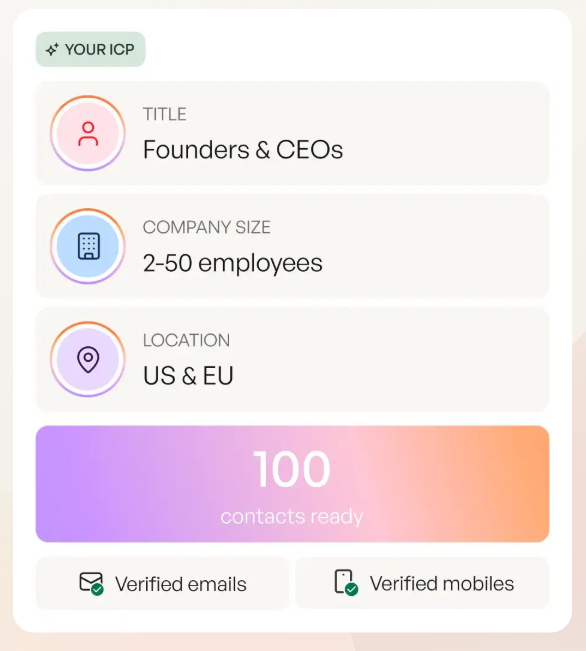
Every drip starts with a list. The tighter your segmentation, the better your results. Start with verified contact data - if emails bounce on Day 0, your sender reputation takes a hit before the sequence even gets going. Prospeo's 30+ search filters and 98% email accuracy mean your drip reaches real inboxes from the start.
Step 2: Choose Your Trigger
What action kicks off the sequence? A form submission, a purchase, a trial signup, a cart abandonment. The trigger determines everything downstream - timing, content, and goal.
Step 3: Map the Sequence
This structure mirrors what we've seen work across a lot of campaigns, and it matches a practitioner blueprint frequently shared on r/sales and r/emailmarketing:
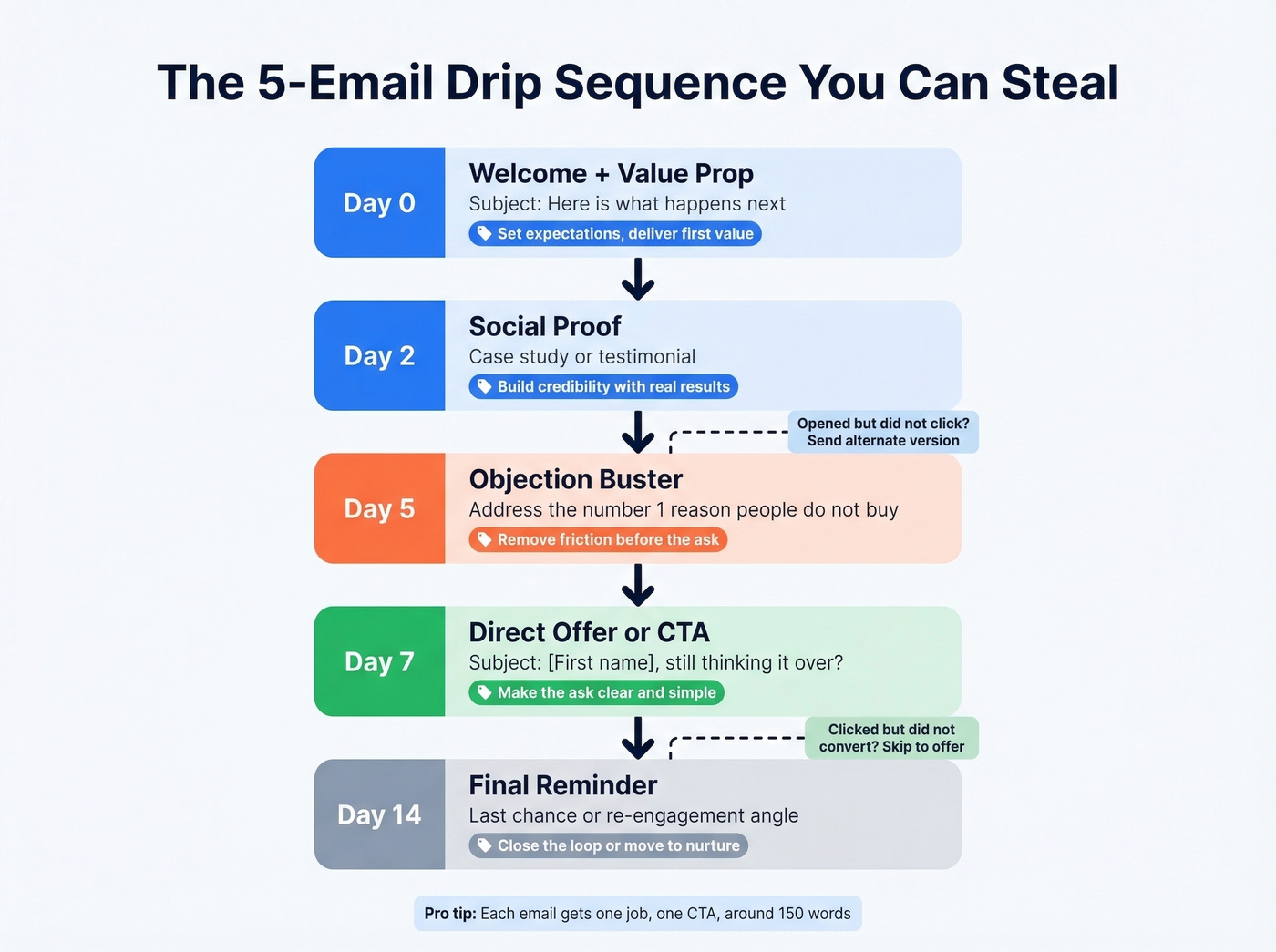
- Day 0: Welcome + value proposition - Subject line: "Here's what happens next" (need ideas? see these subject line patterns)
- Day 2: Case study or testimonial for social proof
- Day 5: Objection buster addressing the #1 reason people don't buy
- Day 7: Direct offer or CTA - Subject line: "[First name], still thinking it over?"
- Day 14: Final reminder or re-engagement
Add branching logic where it makes sense. If someone opened Email 2 but didn't click, send an alternate version with a different angle. If they clicked but didn't convert, skip ahead to the offer.
Step 4: Write the Content
Each email needs one job. Not three. One CTA, one message, one reason to care. Write each email so it makes sense on its own - many recipients will skip earlier messages entirely. Front-load value in the first line since many inboxes show it as preview text. Keep emails short; around 150 words works well for most drip emails. If you're tightening copy, use a simple email copywriting checklist.
Step 5: Set the Cadence
Twice per week is a strong default. For abandoned carts, compress to 2-3 emails within 48 hours. For B2B lead nurture, stretch to weekly. Match the urgency of the trigger.
Step 6: Launch and Monitor
Track click rate and conversion rate, not opens. Check performance weekly for the first month, then monthly. Update content every 3-6 months. If you're diagnosing deliverability issues, start with email bounce rate basics before you change the sequence.
How Often to Send
Here's the thing: consistency matters more than frequency.
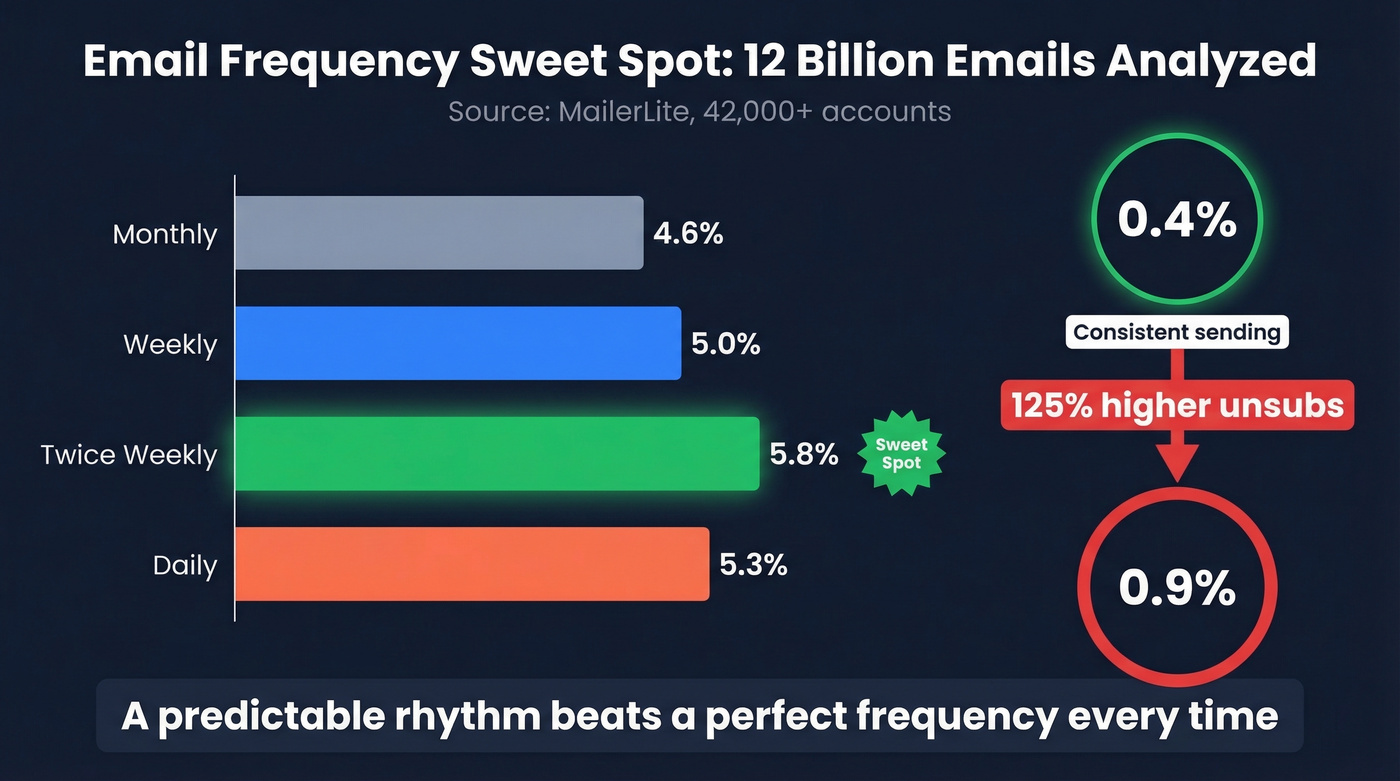
MailerLite analyzed 12 billion emails across 42,000+ accounts. Open rates stay remarkably stable until you hit daily frequency.
| Frequency | Open Rate | CTR | Unsub Rate |
|---|---|---|---|
| Monthly | 35.11% | 4.6% | ~0.4% |
| Weekly | 33.22% | 5.0% | ~0.4% |
| Twice weekly | 32.98% | 5.8% | ~0.4% |
| Daily | 30.04% | 5.3% | ~0.4% |
| Irregular | - | - | 0.9% |
The twice-weekly sweet spot shows up clearly in CTR. But the real killer: irregular sending drives unsubscribe rates 125% higher than consistent schedules - 0.9% vs 0.4%. A predictable rhythm beats a perfect frequency every time.
One important distinction: these numbers come from campaign data, not automations. Automated drips fire based on triggers, not calendar schedules. The cadence data still informs how you space emails within a sequence, but don't confuse campaign frequency with drip timing. Abandoned cart emails should fire within hours, not days. Welcome sequences should deliver several emails in the first week, then taper. Re-engagement flows work at once or twice weekly.
Mistakes That Kill Drip Campaigns
We've reviewed a lot of drip sequences across B2B and ecommerce. These five mistakes show up constantly.
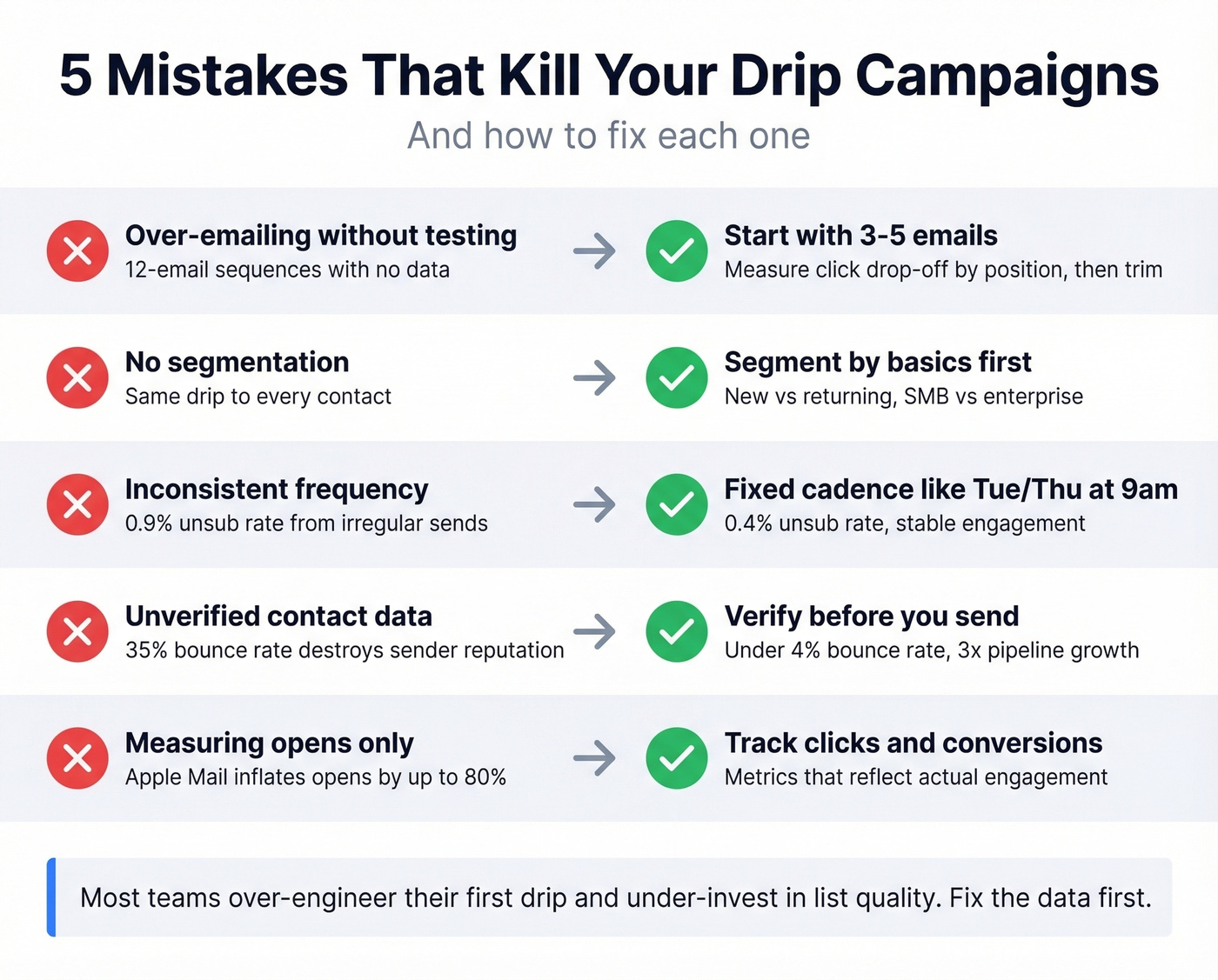
Over-emailing without testing. Don't launch a 12-email sequence because it "feels right." Start with 3-5 emails, measure click-through drop-off by position, and trim. If Email 4 gets half the clicks of Email 2, your sequence is too long.
No segmentation. Sending the same drip to every contact is barely better than a blast. Even basic segmentation - new vs. returning, SMB vs. enterprise - dramatically improves relevance.
Inconsistent frequency is the silent killer. That 125% unsub penalty for irregular sending is real. Sporadic emails train recipients to ignore you - or worse, report you as spam. Pick a rhythm and stick to it.
| Before | After |
|---|---|
| Emails sent "whenever we have something" | Fixed cadence: Tue/Thu at 9am |
| 0.9% unsub rate, declining engagement | 0.4% unsub rate, stable click-through |
Building on unverified contact data. Your drip sequence is only as good as your list. If emails bounce, your sender reputation drops and even valid contacts stop seeing your messages. One Prospeo customer, Meritt, saw their bounce rate drop from 35% to under 4% after switching to verified data - and their pipeline tripled from $100K to $300K per week. If you're serious about inbox placement, follow an email deliverability process, not guesses.
Measuring opens only. Apple Mail Privacy Protection inflates open rates by up to 80%. Optimizing based on opens means optimizing based on noise. Click rate and conversion rate reflect actual engagement.
Let's be honest: if your average deal size is under $15K, you probably don't need a 7-email drip with branching logic and AI send-time optimization. A tight 3-email sequence with verified data will outperform a sophisticated flow built on a dirty list every single time. In our experience, most teams over-engineer their first drip and under-invest in list quality. Skip the fancy automation platform until your data is clean.
You just mapped a 5-email drip sequence. Now you need a list worth sending it to. Prospeo gives you 30+ filters - buyer intent, job changes, technographics - so every contact entering your drip is pre-qualified. At $0.01 per email, building a high-quality segment costs less than a single bounced reply costs your domain reputation.
Build the list your drip sequence deserves.
FAQ
How many emails should a drip campaign have?
Three to seven emails over 7-21 days covers most use cases. Shorter sequences work for abandoned carts - 2-3 emails within 48 hours. Watch click-through drop-off by email position and cut anything that isn't pulling its weight.
What's a good click rate for automated email flows?
Automated flows average 5.58% across 183,000+ brands per 2026 benchmark data. The top 10% hit 10.48%. Below 3%, revisit your segmentation and content - you're sending too generic a message to too broad an audience.
Do drip campaigns still work in 2026?
Automated flows generate 13x higher order rates than one-off campaigns, and the gap hasn't narrowed. Now that you understand the drip campaign definition and the benchmarks behind it, the key is clean contact data and relevant content - the best-written sequence doesn't matter if it bounces.
What's the best free tool for building a drip campaign list?
Prospeo's free tier includes 75 email credits per month with 98% verified accuracy - enough to test a small B2B drip without risking your sender reputation. Mailchimp and Brevo offer free automation tiers for the email-sending side, but you'll still need verified contact data upstream.