

Effective Email Subject Lines: What the Data Actually Says
You've read a guide on email subject lines before. Probably ten of them. They all say the same thing: use curiosity, add personalization, keep it short, throw in an emoji. Then you test those tips, your open rates barely move, and you're back where you started.
Here's what those guides leave out: 47% of recipients decide whether to open an email based on the subject line alone, and 69% use it to decide whether to report the email as spam. Your subject line isn't a creative exercise - it's a binary gate that determines whether your email gets read or gets flagged.
But the real problem isn't your copywriting. It's that most subject line advice ignores deliverability. A boring subject line sent to a clean, verified list will outperform a brilliant one sent to a dirty list every single time. Let's get into the data.
The Short Version
If you're pressed for time, here's what matters:
- Front-load your key message into the first 33 characters. That's the only length guaranteed visible across all tested mobile email clients.
- Shorter wins. Twilio SendGrid's Cyber Week data found 2-4 word subject lines outperformed the average (6 words) in competitive inboxes.
- Personalized subject lines average 46% opens vs. 35% without - that's not a marginal lift, it's the difference between a campaign that works and one that doesn't.
- "Quick question" gets ~39% opens in cold email, but rotate it frequently. Overuse triggers spam filters.
- None of this matters if your bounce rate is bounce rate is above 2%. Fix your list before you fix your subject lines.
Open Rate Benchmarks by Industry
Before optimizing anything, you need to know what "good" looks like. The average email open rate across all industries sits at 21%, based on Campaign Monitor's analysis of 100B+ emails. That average hides enormous variation.
| Industry | Avg Open Rate |
|---|---|
| Education | 28.5% |
| Financial Services | 27.1% |
| IT / Tech | 22.7% |
| Retail | 17.1% |
If you're in retail and hitting 20%, you're outperforming your vertical. If you're in education and hitting 20%, something's broken.
Triggered emails blow these numbers away. Welcome emails average a 68.59% open rate. Abandoned cart emails hit around 49%. These aren't subject line wins - they're relevance wins. The recipient expects the email, so the subject line barely matters.
One thing we've noticed across our own campaigns and those of teams we work with: Apple Mail Privacy Protection has distorted open rate measurement since its rollout. Open rates are up roughly 3.5% year-over-year, while click-to-open rates are down 3.6%. That means your "open rate" is probably inflated. Click rate and reply rate are more honest metrics in 2026.

Subject Line Length: The Real Numbers
Every guide says "keep it short." None of them tell you exactly how short, or why. The answer depends on where your audience reads email.
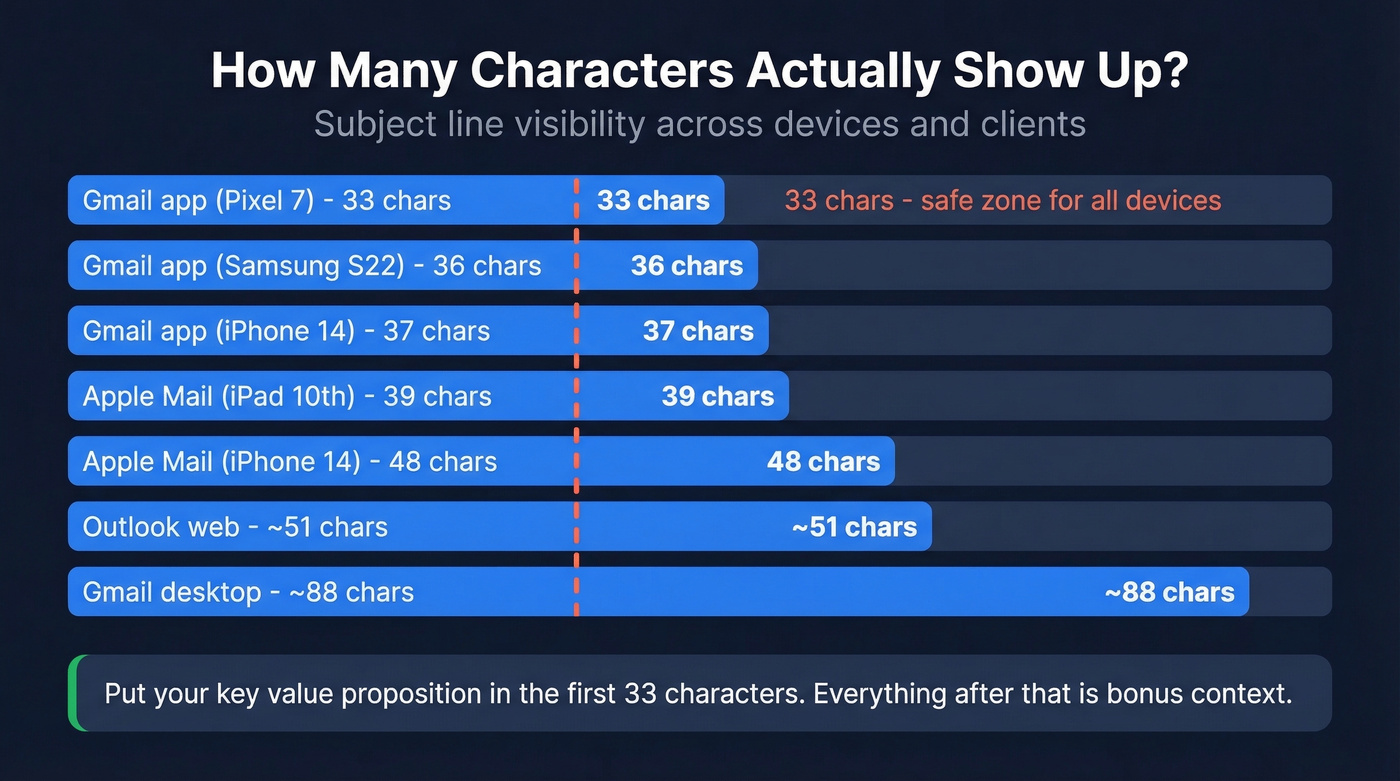
EmailToolTester ran device-by-device tests measuring exactly how many characters display before truncation:
| Device / Client | Max Visible Chars |
|---|---|
| Gmail app (Pixel 7) | 33 |
| Gmail app (Samsung S22) | 36 |
| Gmail app (iPhone 14) | 37 |
| Apple Mail (iPad 10th) | 39 |
| Apple Mail (iPhone 14) | 48 |
| Outlook web (~1400px) | ~51 |
| Gmail desktop (~1400px) | ~88 |
Thirty-three characters. That's the only length that guarantees full visibility across every tested mobile client. Desktop gives you more room, but a huge share of email gets opened on mobile, so assume truncation.
Twilio SendGrid's Cyber Week dataset reinforces this from a performance angle. The average subject line was 6 words. The best performers were 2-4 words. In a crowded inbox - and every inbox is crowded now - brevity isn't just a display constraint. It's a competitive advantage.
The practical rule: put your key value proposition in the first 33 characters. Anything after that is bonus context for desktop readers. Don't count on it being seen.
Don't Forget Your Preheader
Your preheader is your second subject line, and most teams waste it. Keep it under 37 characters for full mobile visibility. Use it to extend the subject line's promise, not repeat it. If your subject line is "3 templates that booked 14 meetings," your preheader should be "Steal them for Q2" - not "3 email templates for booking meetings."
Frameworks That Actually Produce Results
You don't need 110 examples. You need five to seven frameworks and the discipline to test them against your audience. The consensus on r/coldemail is clear: AI-generated subject lines don't feel genuine, and recipients can tell. They're technically correct but sound like every other email in the inbox. Frameworks give you structure while keeping the voice human.
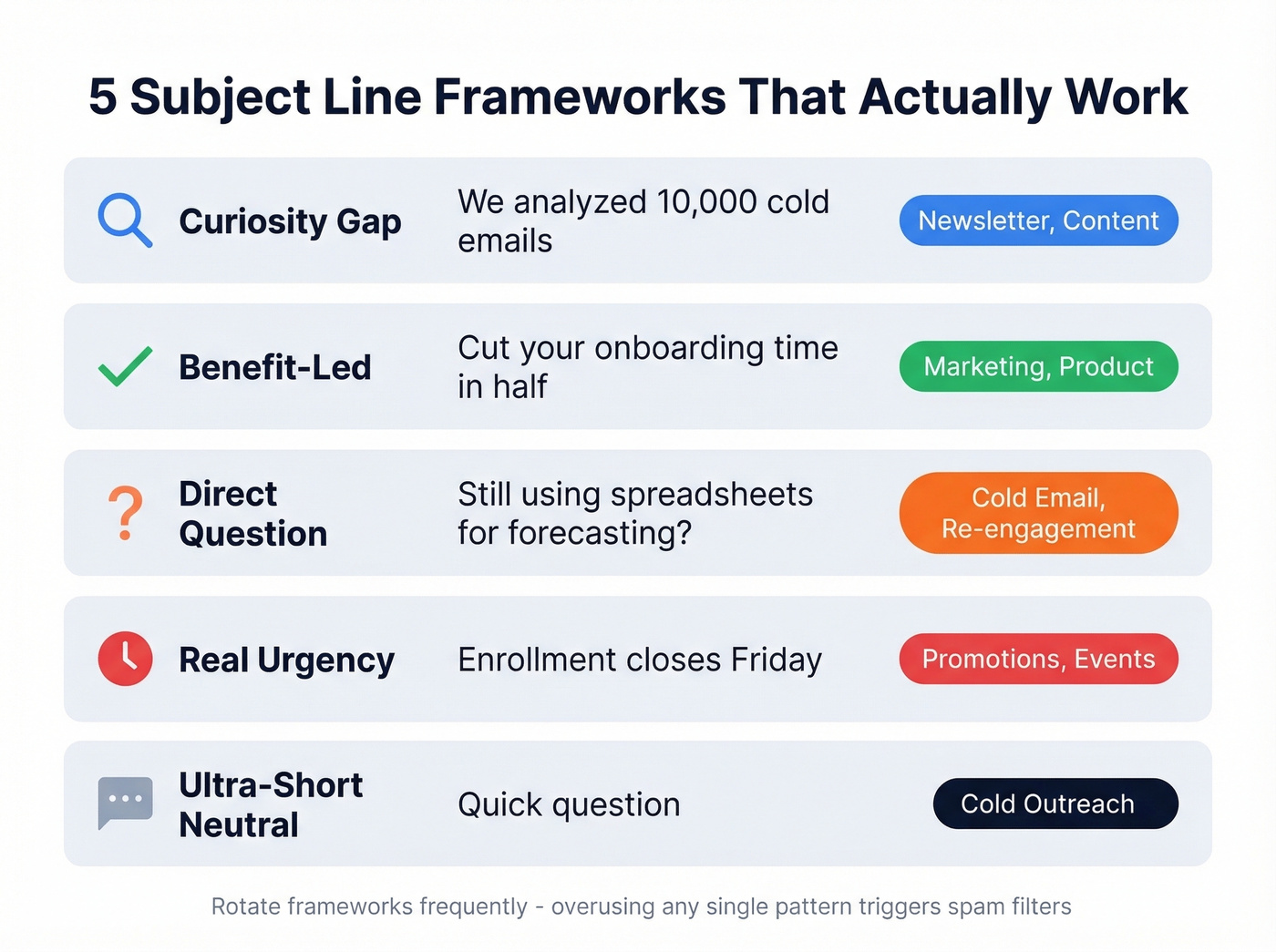
Curiosity Gap
Create an information gap the reader needs to close. The key is specificity - vague curiosity feels like clickbait.
- "The metric your board actually cares about"
- "We analyzed 10,000 cold emails"
- "Something's off with your Q3 numbers"
Curiosity works best when the reader believes the answer is relevant to them specifically. Generic mystery ("You won't believe this...") gets ignored or flagged.
Benefit-Led
Lead with what the reader gets. No cleverness required. This is the workhorse framework for marketing emails - direct, scannable, and it gives the reader a reason to click in under 33 characters. The strongest subject lines in this category state the value proposition plainly and let the offer do the work.
- "Cut your onboarding time in half"
- "3 templates that booked 14 meetings last week"
- "Your pipeline report, automated"
Levi's nails this consistently. Their subject lines read like "Your new favorite jeans, 30% off" - no tricks, just a clear value proposition. When Grammarly sends "Your weekly writing update," they're doing the same thing. The benefit is the subject line.
Direct Question
Questions create a cognitive loop - the reader's brain starts answering before they decide whether to open. Keep them short and answerable.
- "Still using spreadsheets for forecasting?"
- "What's your bounce rate?"
- "Hiring SDRs in Q1?"
Open-ended philosophical questions ("What does success mean to you?") don't work. Skip those.
Urgency: Real vs. Manufactured
Real urgency works. Manufactured urgency doesn't. The difference is a specific date or constraint.
| Vague Urgency | Specific Urgency |
|---|---|
| "Last chance!" | "Enrollment closes Friday" |
| "Don't miss out" | "3 spots left for the March cohort" |
| "Limited time offer" | "Price increases Jan 15" |
If there's no actual deadline, skip this framework entirely. Readers have been trained to ignore fake scarcity, and Gartner's research shows 30.4% of unsubscribes are driven by subject lines that misalign with the actual email content. Manufactured urgency is the fastest way to break that trust.
Ultra-Short and Neutral
Here's the thing: dead simple subject lines win in cold outreach. They don't trigger spam filters, they don't set expectations, and they look like internal emails. The Reddit consensus on r/coldemail and r/Entrepreneur backs this up consistently.
A SaaS founder on r/Entrepreneur tested this systematically over 62 days. "Quick question" hit 39% opens. "Thoughts?" performed similarly. Meanwhile, anything that sounded like a pitch - "Partnership opportunity," "Exciting news" - cratered below 19%. The pattern held across thousands of sends. These high-performing lines share one trait: they sound like a real person wrote them.
Social Proof
Borrow credibility from names your audience recognizes. "How Stripe onboards enterprise accounts" or "What Gartner missed about intent data" work because they attach your email to a brand the reader already trusts. Social proof works best in mid-funnel emails where the reader already knows who you are. In cold email, name-dropping can feel presumptuous - use it carefully.
Cold Email Subject Lines: Real Numbers
Let's look at actual performance data. A practitioner on r/Entrepreneur shared a detailed case study of rebuilding their cold outreach over 62 days, taking reply rates from 3% to 6%. Here's what they tested on subject lines:
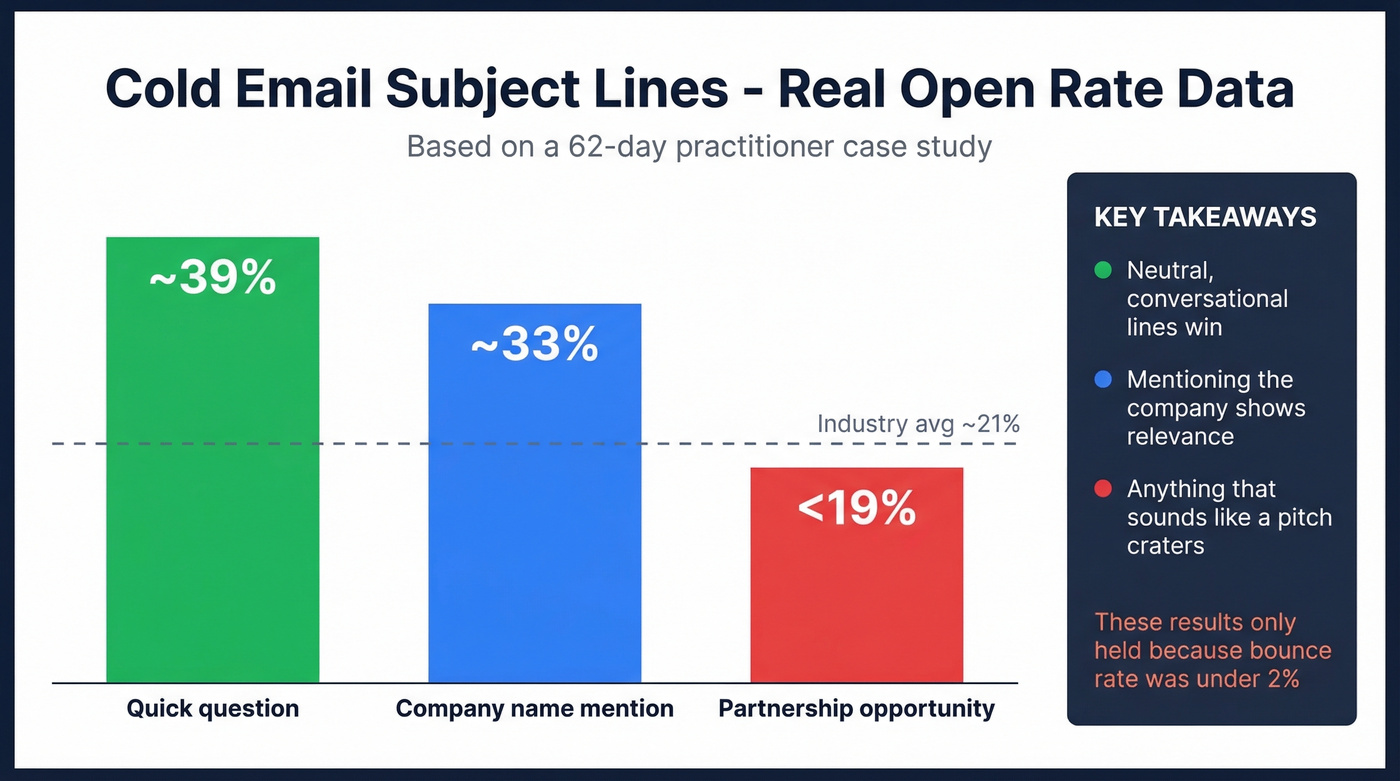
- "Quick question" - ~39% opens
- Company name mention - ~33% opens
- "Partnership opportunity" - <19% opens
The pattern is obvious. Neutral, conversational subject lines that look like they came from a colleague crush anything that sounds like a pitch.
But here's what made the subject line testing meaningful: infrastructure. This team scaled from 3 domains to 7, capped sends at 26 emails per day per address, and dropped their bounce rate from 11% to under 2%. They also cut email body length from 141 words to under 56 - brevity applied to everything, not just the subject line. They sent Tuesday through Thursday, 8-11am in the recipient's timezone, which lifted opens by 16%.
You can't A/B test your way to better opens if your emails aren't reaching the inbox. Most teams spend 80% of their optimization time on subject line copy and 20% on deliverability. Flip that ratio.

The article says it plainly: a boring subject line sent to a clean list beats a brilliant one sent to a dirty list. Prospeo's 5-step verification delivers 98% email accuracy - keeping your bounce rate under 2% so your subject lines actually get a chance to perform.
Stop optimizing subject lines for emails that bounce.
Personalization Beyond First Name
Personalized subject lines average 46% opens vs. 35% without. Reply rates jump from roughly 3% to 7% with meaningful personalization - a 133% lift. But "meaningful" is doing a lot of work in that sentence.
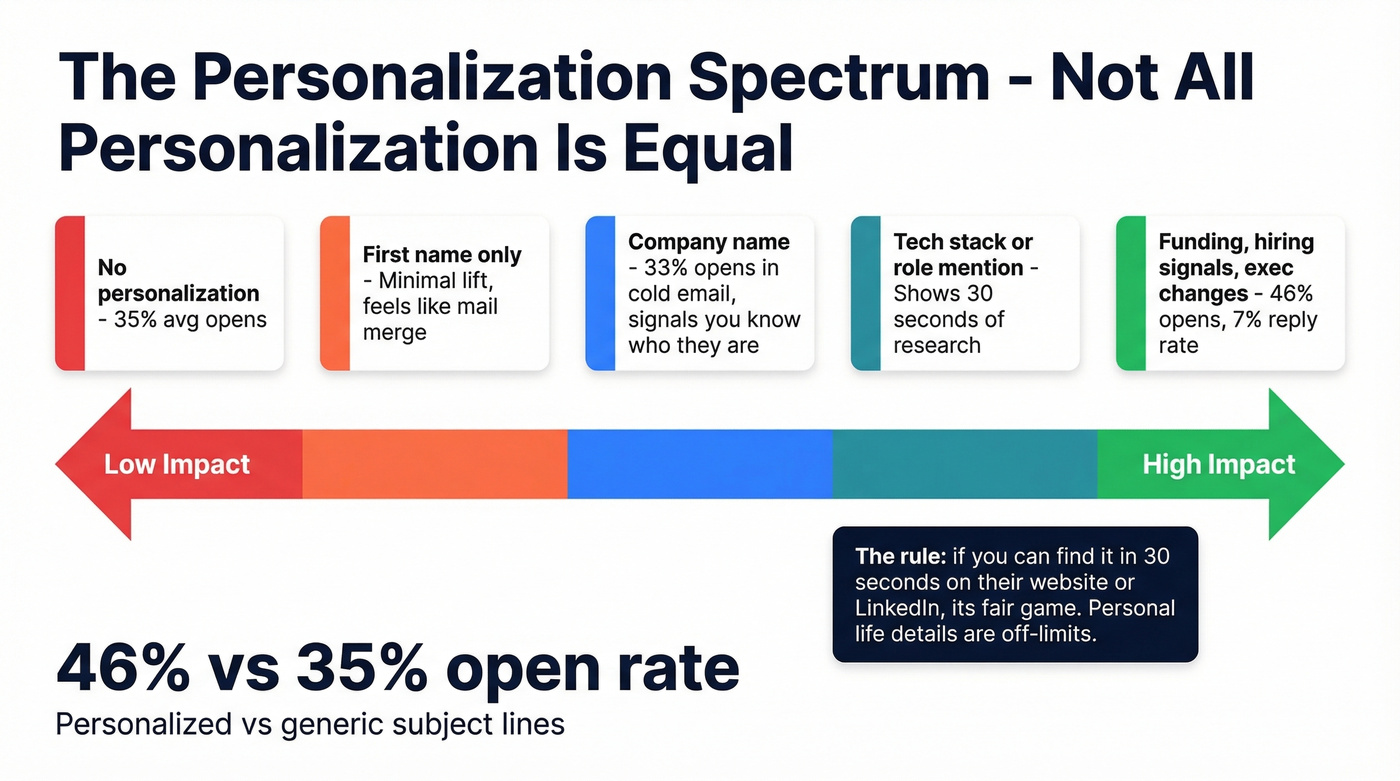
Dropping {{first_name}} into a template isn't personalization. It's a mail merge.
The variables that actually move responses are contextual: company name (cleaned - drop the "Inc." and "LLC"), tech stack ("Thoughts on your HubSpot setup?"), recent funding rounds, hiring signals, and executive changes. These show you did 30 seconds of research, which is all it takes to cross the line from spam to relevance. In our experience, company name in the subject line consistently outperforms first name alone, which makes intuitive sense - it signals you know who you're emailing, not just that you have a spreadsheet.
The "creepy vs. relevant" rule is simple. If you can find it in 30 seconds on a company's website or a professional profile, it's fair game. Personal life details - kids' names, vacation photos, health information - are off-limits and will tank your reply rate.
Mistakes That Kill Deliverability
Subject line optimization is pointless if your emails land in spam. The mistakes that send you there are often invisible until your open rates collapse.
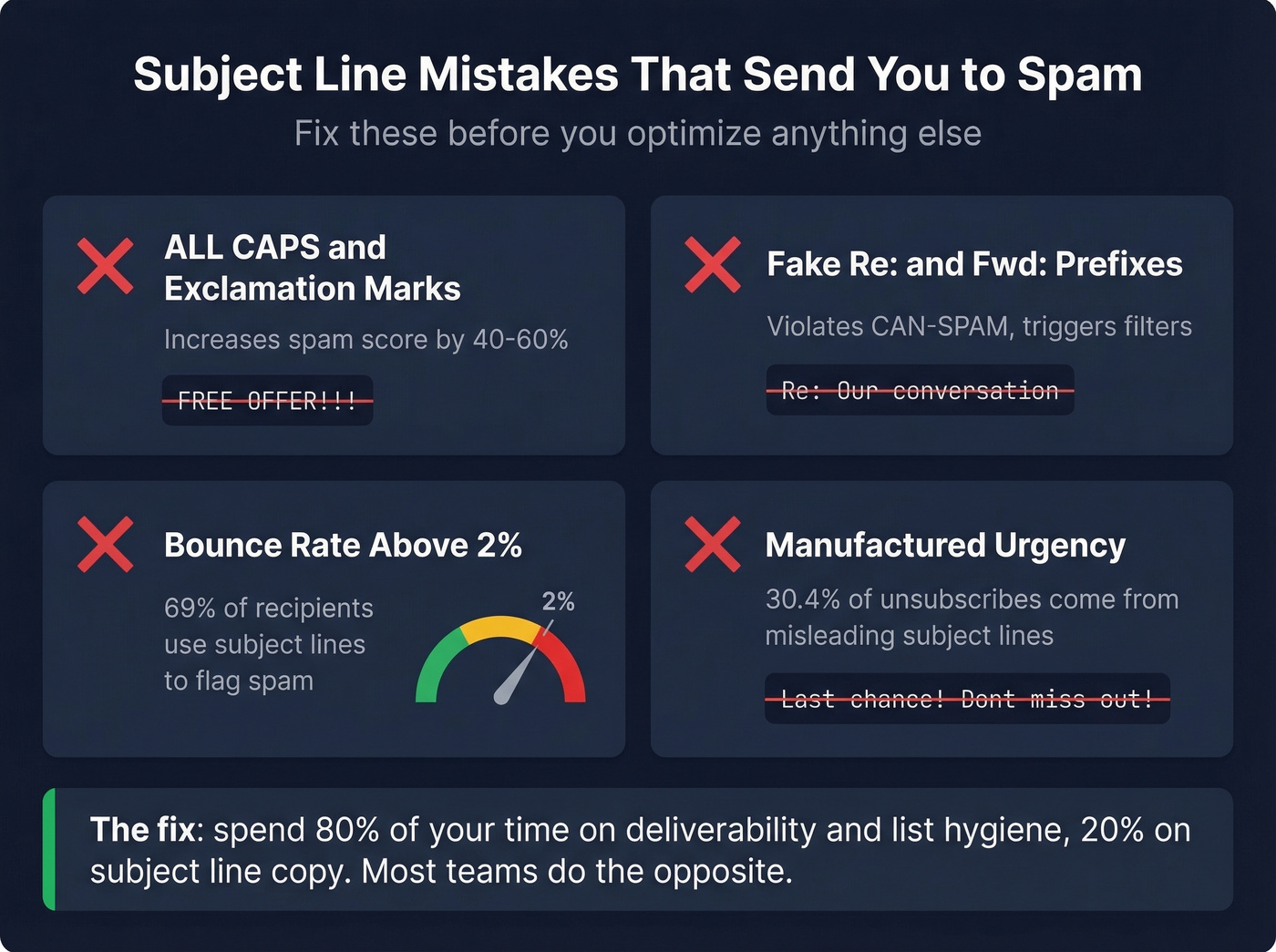
ALL CAPS and excessive punctuation increase spam scores by 40-60%. "FREE OFFER!!!" is the email equivalent of a neon sign in a library - filters catch it instantly. Even a single word in all caps can raise flags when combined with other signals.
Fake Re: and Fwd: prefixes create legal risk, not just a bad look. CAN-SPAM prohibits misleading subject lines and headers. Beyond that, spam filters have been trained on this pattern for years. It doesn't fool anyone.
The "Quick question" paradox deserves its own callout. It works - we covered the 39% open rate data above. But it's becoming a victim of its own success. As more cold emailers adopt it, spam filters flag the pattern more aggressively. Rotate it with other ultra-short variants ("Thoughts?", "One thing", your prospect's company name) to avoid triggering pattern detection.
Subject-content misalignment is the silent killer. Gartner found that 30.4% of unsubscribes stem from a disconnect between what the subject line promises and what the email delivers. A clever subject line that gets the open but disappoints on the click trains your audience to ignore you - and trains spam filters to deprioritize you. Among all the best practices you can follow, alignment between promise and content is the one you can't afford to skip.
Modern spam filtering operates on multiple layers simultaneously: content analysis, sender reputation, recipient engagement history, blacklist checks, and authentication (SPF/DKIM/DMARC). A single spam-trigger word won't sink you. But a spam-trigger word combined with a new domain, high bounce rate, and no DKIM authentication absolutely will.
Spam Words: The Swap Table
There are 349+ known spam trigger words, but modern ML-based filters evaluate patterns and tone, not just individual keywords. "Free" in a password reset email won't trigger a filter. "FREE MONEY GUARANTEED" will. Context matters more than any single word.
That said, certain phrases consistently raise flags. Here's a practical swap table based on Folderly's testing:
| Instead of This | Write This |
|---|---|
| "100% free" | "Complimentary" or "included" |
| "Last chance" | "Enrollment closes [date]" |
| "Act now" | "Before Friday" |
| "No obligation" | "Try it, cancel anytime" |
| "Guaranteed" | "Backed by [specific proof]" |
| "Buy now" | "Get started" |
| "Limited time" | "[Specific deadline]" |
The pattern is clear: replace vague urgency with specific context. Filters are trained to catch emotional manipulation, and specificity reads as legitimate.
Don't forget the authentication layer. SPF, DKIM, and DMARC aren't subject line tactics, but they're the foundation that determines whether your emails reach the inbox at all. If you haven't configured all three, stop reading this article and go do that first. (If you want a deeper technical breakdown, start with our email deliverability guide and DMARC alignment.)
Campaigns vs. Flows: Why Context Matters
This is where conventional subject line advice falls apart. Most guides treat all emails the same. They're not.
Klaviyo benchmarks across 183,000+ customers reveal a striking split: automated flows generate 41% of total email revenue from just 5.3% of sends. Flows deliver a 5.58% click rate versus 1.69% for campaigns - more than 3x higher.
Flows have behavioral context. A welcome email fires because someone just signed up. An abandoned cart email fires because someone left items behind. The subject line is almost irrelevant - the timing and relevance do the heavy lifting. Campaigns don't have that luxury. They're broadcast to a list, and the subject line is the only thing standing between your email and the archive button. This is where crafting effective email subject lines actually matters - and where most teams waste their effort on the wrong problem.
The fastest way to improve your campaign open rates has nothing to do with subject lines. It's cleaning your list. Every bounced email damages your sender reputation. Every spam trap you hit accelerates the damage. Once your sender reputation drops, even perfect subject lines land in the promotions tab - or worse, spam.
Stop optimizing subject lines. Start optimizing your list. The subject lines will take care of themselves once your emails actually reach the inbox.
How to A/B Test Subject Lines
Once your deliverability foundation is solid, systematic testing compounds small wins into meaningful gains. Here's what to test and what to expect.
Emojis deliver up to a 10% open rate lift in promotional emails. In B2B cold email, the effect is negligible or negative. Test before committing - your audience will tell you quickly.
Personalization variables produce a 1-5% open rate lift. Company name tends to outperform first name alone, which makes sense - it signals you know who you're emailing, not just that you have a mail merge.
Removing your brand name from the subject line yields a 1-4% lift. Counterintuitive, but the "From" field already carries that information. Repeating it in the subject line wastes characters.
Send-time optimization drives up to 10% more opens. Tuesday through Thursday, 8-11am in the recipient's timezone is the baseline to beat (and you can go deeper with best time to send cold emails).
Test one variable at a time. Run each test to statistical significance - most email platforms will tell you when you've hit it. A 2% lift doesn't sound exciting in isolation, but compounded monthly across four variables, you're looking at a 15-25% cumulative improvement over a quarter. The trap is testing subject lines while ignoring list quality. A 3% lift from a better subject line gets wiped out by a 5% bounce rate increase from stale data. Test both simultaneously.
If you want more swipeable ideas to test, pull from a curated set of email subject line examples and compare against cold email subject line examples to avoid mixing B2C tactics into outbound.
Personalized subject lines average 46% opens - but personalization requires real data. Prospeo returns 50+ data points per contact, including job title, company size, and tech stack, so every subject line you write is specific to the person reading it.
Write subject lines that feel personal because they actually are.
FAQ
What makes effective email subject lines?
Forty-seven percent of recipients decide to open based on the subject line alone. The strongest subject lines are short (2-7 words), front-load the key message in the first 33 characters, and match the email's actual content. Personalized subject lines average 46% opens versus 35% without.
What's the ideal subject line length?
Thirty-three characters guarantees full visibility across all tested mobile email clients. Aim for 2-7 words and front-load your key message. Desktop clients show more, but don't count on it - many recipients scan on mobile first.
Do emojis improve open rates?
Emojis lift open rates up to 10% in promotional and ecommerce emails. In cold email and B2B contexts, they typically have no effect or a slightly negative one. Always A/B test before rolling them into your templates.
What subject lines work best for cold email?
Ultra-short, neutral lines outperform everything else. "Quick question" hit 39% opens in practitioner testing, while salesy lines like "Partnership opportunity" dropped below 19%. Keep it under four words and avoid anything that sounds like a pitch - the best cold subject lines sound like they came from a colleague.
How do I stop my emails from going to spam?
Authenticate your domain with SPF, DKIM, and DMARC, and keep bounce rates under 2%. Avoid ALL CAPS and excessive punctuation. Verify your list before sending - tools like Prospeo catch invalid addresses, spam traps, and honeypots that damage sender reputation.