

The 7 Best Email Address Validation Checkers in 2026
You send your first sequence to a fresh list. Eight percent bounce rate. Your ESP flags the domain, deliverability tanks, and now you're warming up a new inbox for three weeks. That entire mess was preventable with a $7 verification run before you hit send.
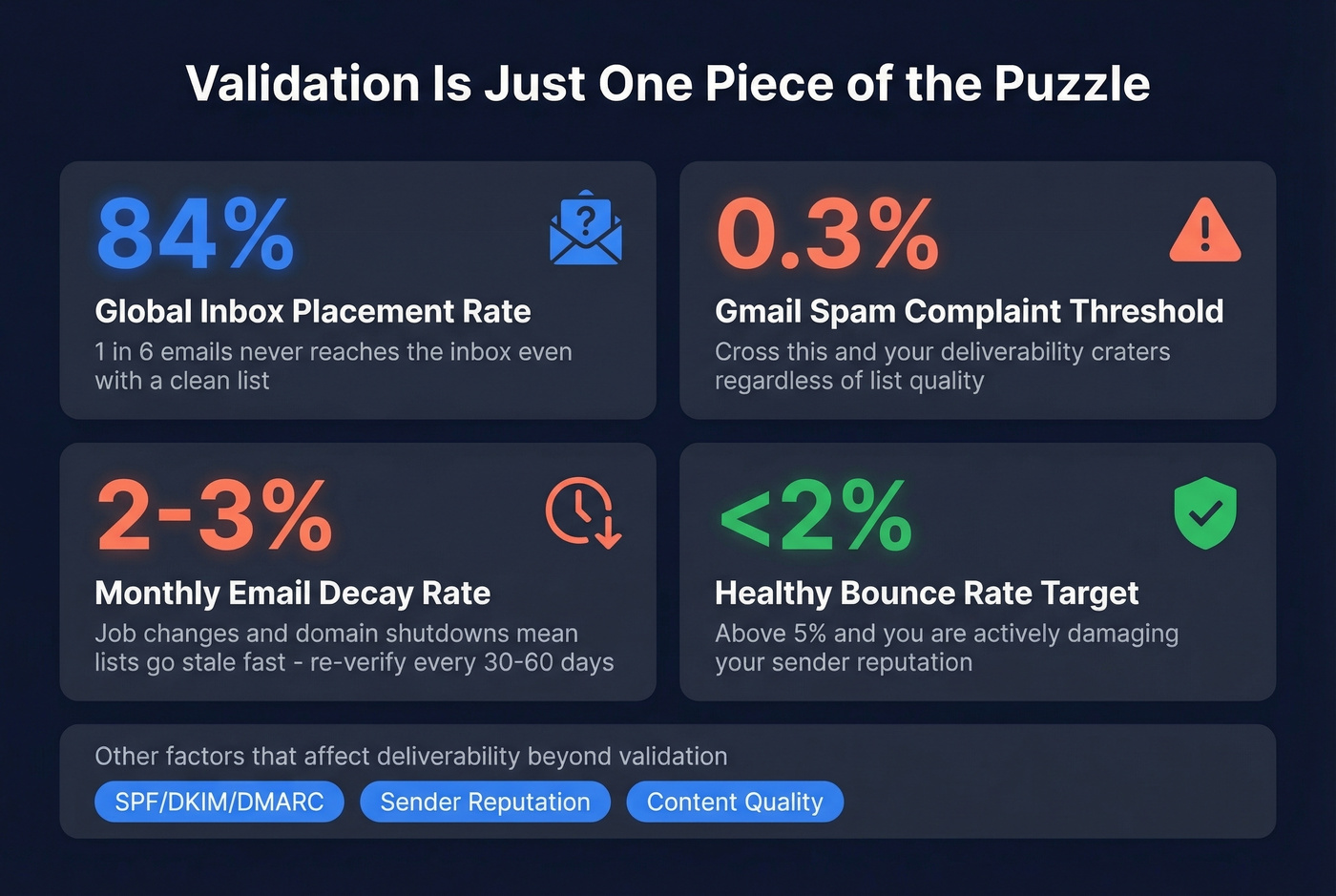
Bounce rates below 2% are healthy, though they vary by industry - IT and tech companies average 0.90%, while advertising and marketing hover around 1.10%. Between 2-5%, you've got a list quality problem. Above 5%, you're actively damaging your sender reputation. We tested all seven tools on this list against the same criteria: accuracy benchmarks, pricing transparency, catch-all handling, and speed. Here's which ones actually deliver.
Our Top Picks
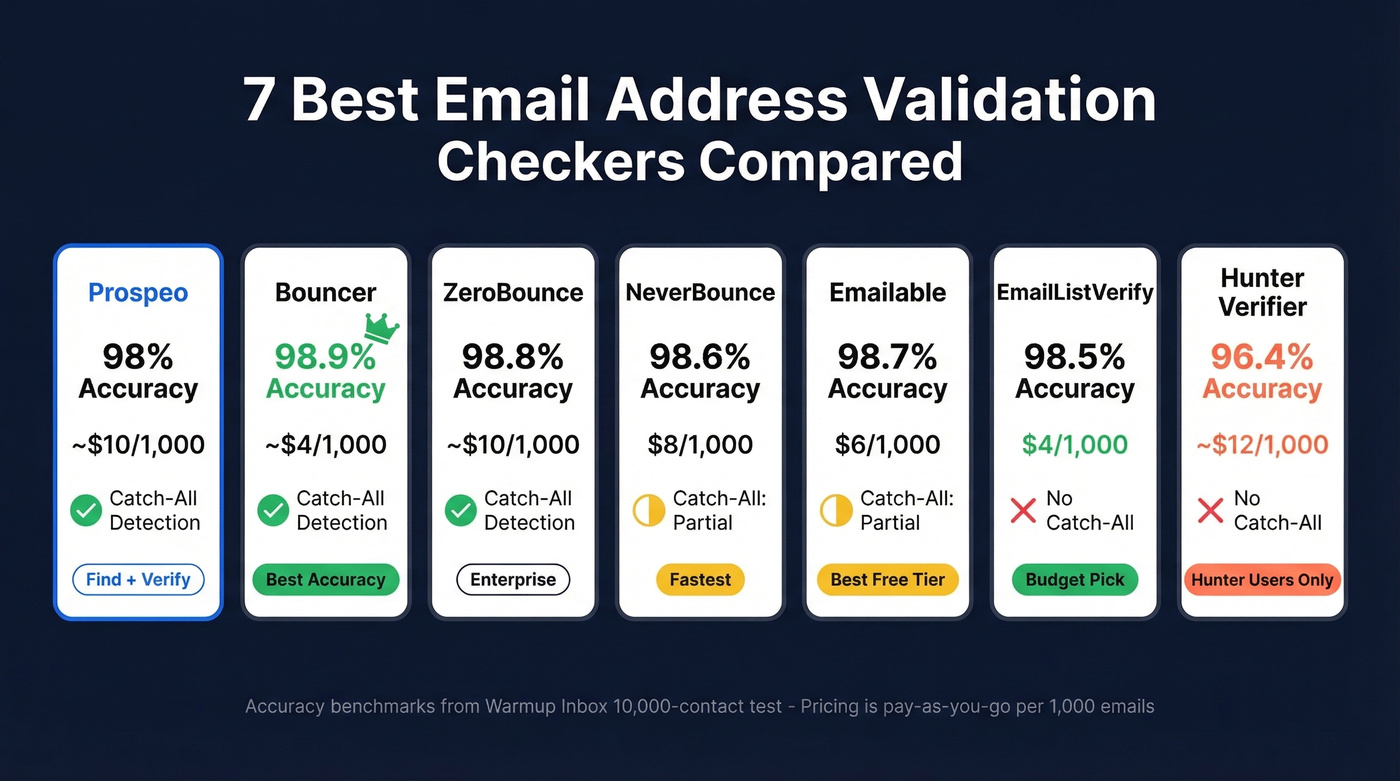
- Prospeo - Best for teams that find and verify emails in one platform. 98% accuracy with 5-step verification and catch-all handling. ~$0.01/email.
- Bouncer - Highest independent accuracy at 98.9%. Simple pay-as-you-go at $20/5,000 (~$4/1,000). No subscriptions, no gimmicks.
- ZeroBounce - Enterprise-grade with AI scoring and deliverability tools. 98.8% accuracy. PAYG starts at $20/2,000.
Tool Comparison Table
| Tool | Accuracy | $/1,000 | Free Tier | Catch-All | Best For |
|---|---|---|---|---|---|
| Prospeo | 98% | ~$10 | 75/mo | ✓ | Prospecting + verification in one platform |
| Bouncer | 98.9% | ~$4 | 100 credits | ✓ | Pure accuracy, PAYG |
| ZeroBounce | 98.8% | ~$10 | 100/mo | ✓ | Enterprise features |
| NeverBounce | 98.6% | $8 | 10 credits | Partial | Speed + reliability |
| Emailable | 98.7% | $6 | 250 credits | Partial | Best free tier |
| EmailListVerify | 98.5% | $4 | 3 checks | ✗ | Budget bulk sends |
| Hunter Verifier | 96.4% | ~$12* | 50 credits | ✗ | Existing Hunter users |
*Hunter uses shared credits across finder + verifier, making per-verification cost variable.
Best Validation Checkers Reviewed
Prospeo
Use it if you're tired of paying for one tool to find emails and another to verify them. Prospeo combines 5-step verification - syntax check, DNS/MX lookup, SMTP ping, catch-all detection, and spam-trap/honeypot removal - with a database of 143M+ verified emails on a 7-day refresh cycle. That freshness matters because stale data is the most common reason "verified" emails still bounce.
The real differentiator is that Prospeo is a full prospecting platform with 300M+ professional profiles, so you find contacts and verify them in one workflow. No CSV exports between tools, no credit juggling. Snyk's team dropped their bounce rate from 35-40% to under 5% after switching. At ~$0.01/email with 75 free verifications per month plus 100 Chrome extension credits, there's no reason not to test it.
Bouncer
Bouncer is the tool you pick when accuracy is the only thing that matters. A Warmup Inbox benchmark across 10,000 contacts put Bouncer at 98.9% - the top score in the test. Pricing is dead simple: $20 for 5,000 emails on pay-as-you-go, no subscription required. Processing 10,000 emails takes about 7 minutes.

Bouncer earns a 4.8/5 on G2, and 100 free credits let you test before committing. It does one thing - verification - and does it extremely well. No email finder, no CRM, no feature bloat. If you also need to find emails, you'll need a separate prospecting tool, but for pure list cleaning, nothing in this roundup beats Bouncer's accuracy numbers.
If you're comparing options beyond this shortlist, see our breakdown of Bouncer alternatives.
ZeroBounce
Skip this if you're a lean outbound team that just needs clean/dirty results. ZeroBounce is built for enterprise email programs that need more than valid/invalid verdicts. It scored 98.8% accuracy in the same Warmup Inbox benchmark and layers on AI scoring, deliverability monitoring, and inbox placement tools. G2 reviewers give it a 4.6/5. Credits never expire, and unknown results don't cost you - both rare perks.
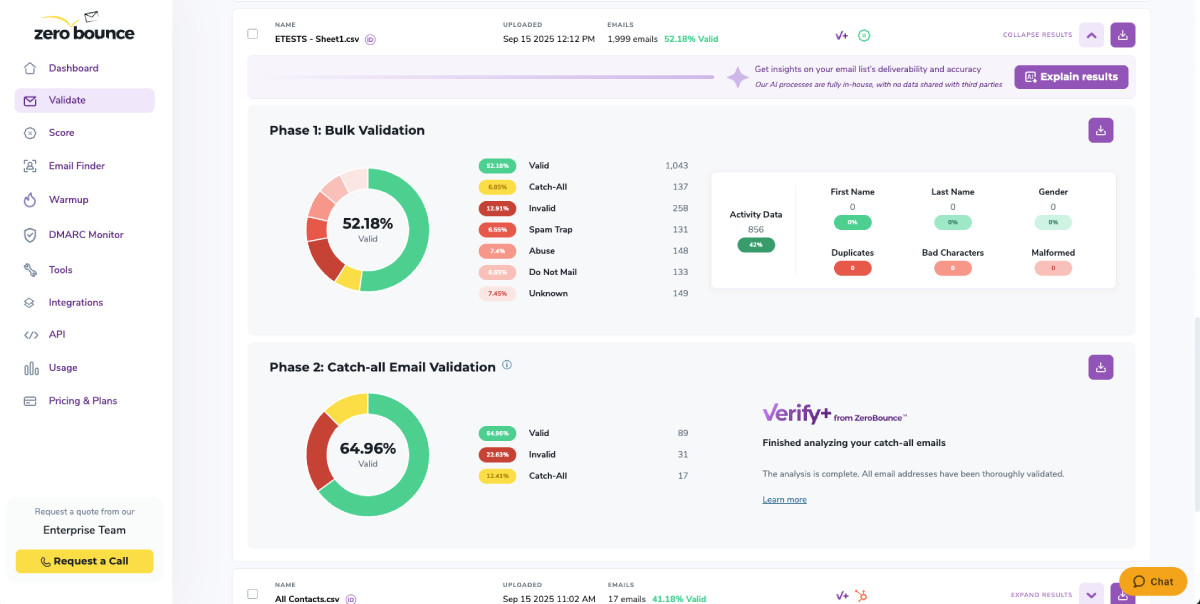
Pricing starts at $20 for 2,000 emails on PAYG, or $99/mo for 25,000 on a subscription. It's one of the priciest pure validators on this list, but the feature depth justifies it for teams running large-scale email programs with deliverability monitoring needs. You get 100 free monthly validations when you sign up with a business or premium domain.
NeverBounce
NeverBounce hit 98.6% accuracy and was one of the fastest tools in the Warmup Inbox test - roughly 3 minutes for 10,000 emails. At $8/1,000 PAYG, it sits in the sweet spot between budget and premium. The consensus on r/sales and r/Emailmarketing is that NeverBounce is a solid primary validator, with several practitioners recommending it alongside a second provider for extra coverage. The free tier is thin at just 10 credits, so plan on paying from day one.
If you're troubleshooting bounces alongside verification, this guide on email bounce rate benchmarks and fixes helps.
Emailable
Emailable delivers 98.7% accuracy with the most generous free tier in this roundup: 250 credits, no credit card required. Paid plans start at $30 for 5,000 emails ($6/1,000), and it matches NeverBounce's ~3-minute processing speed for 10K records. G2 reviewers give it a 4.8/5.
If you're verifying small batches regularly and want to minimize spend, Emailable's free tier alone might cover you for months. Strong option for anyone who wants to validate email addresses free before committing to a paid plan.
For more tools in this category, compare other free lead generation tools that pair well with list cleaning.
EmailListVerify
The budget king. At $4/1,000 emails, EmailListVerify is the cheapest option here by a wide margin. Accuracy came in at 98.5%, which is respectable. The free tier is almost nonexistent at just 3 single checks, so this is really a tool for high-volume bulk verification where per-email cost is the primary concern. Catch-all handling is limited - pair it with a second validator for enterprise domains.
If you're building lists at scale, it’s worth reviewing email list providers to reduce junk at the source.
Hunter Email Verifier
Hunter's verifier scored 96.4%, the lowest accuracy in this comparison. A $49/mo Starter plan gives you 4,000 verifications per month (2,000 credits at 0.5 per check), but those credits also cover email finding and domain searches. If you're not already deep in Hunter's ecosystem, there's no reason to start here for verification alone.
If you’re mainly looking for a finder + verifier combo, check these Hunter alternatives first.

Most teams pay for a finder, then pay again for a validator. Prospeo's 5-step verification is built into every email it finds - syntax, DNS, SMTP, catch-all, and spam-trap removal. 143M+ emails verified on a 7-day refresh cycle, not the 6-week industry average that causes "verified" addresses to bounce.
Get 75 free verified emails this month. No credit card, no bounce anxiety.
How Email Validation Actually Works
Every decent online validator runs a version of this pipeline:
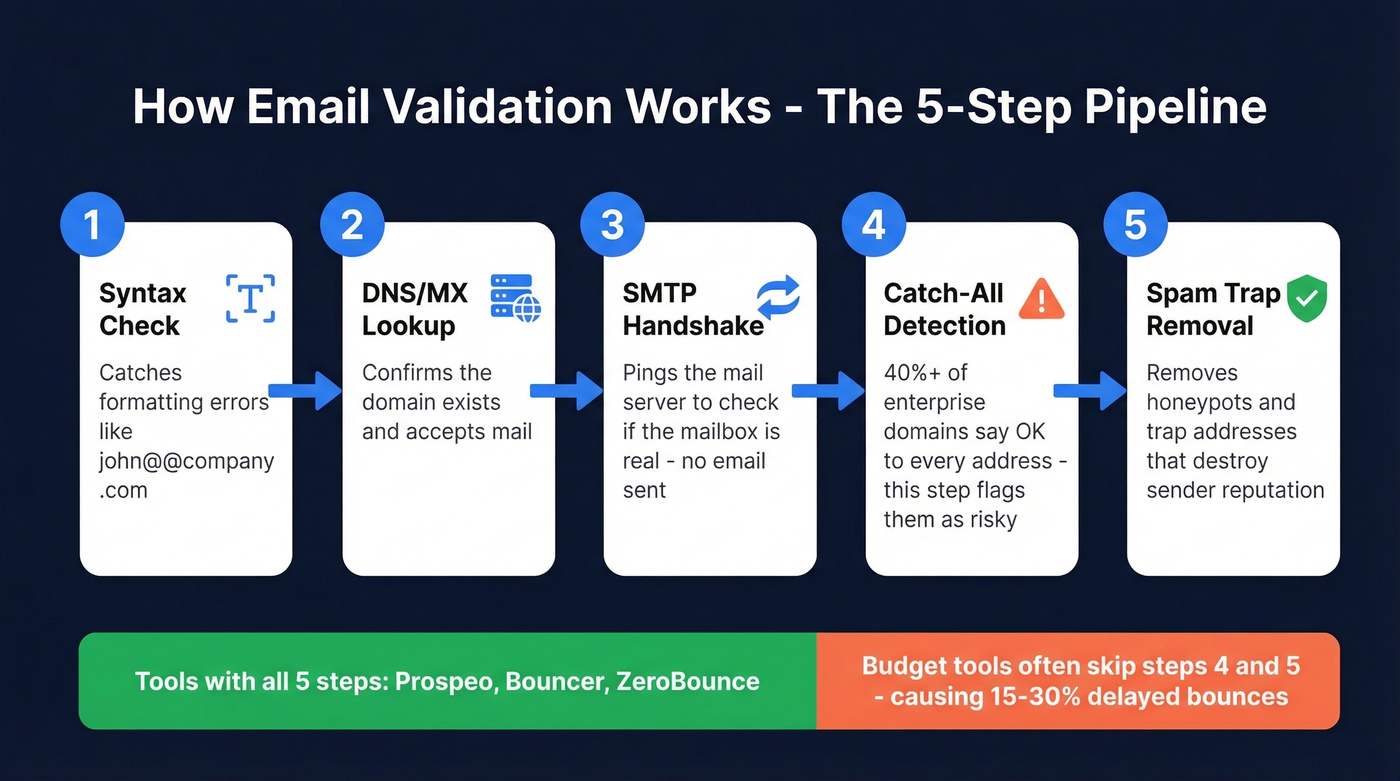
- Syntax check - catches formatting errors like "john@@company.com."
- DNS/MX lookup - confirms the domain exists and accepts mail.
- SMTP handshake - pings the mail server to ask "would you accept mail for this address?" without sending anything. A "550 user not found" means the mailbox doesn't exist.
- Catch-all detection - 40%+ of enterprise domains are catch-all, meaning the server says "250 OK" for every address, real or fake. Good validators test with a random fake address to identify these domains and flag results as "risky."
- Spam-trap and honeypot removal - catches addresses designed to identify spammers. Hit one and your sender reputation takes a lasting hit.

One thing we've noticed across our own testing: accuracy benchmarks vary depending on methodology. Some tests only simulate SMTP handshakes, while others actually send emails to measure hard bounces - a fundamentally different approach that explains why you'll see different accuracy numbers for the same tool across different reviews. In our experience, catch-all domains are the #1 source of post-verification bounces, which is why tools that include catch-all detection as a standard step consistently outperform those that skip it. Cheap validators that skip this step are why a "99% valid" result can still produce 15-30% delayed bounces.
If you want a step-by-step on manual checks, see how to check if an email exists.
Stack Your Validators
Here's the thing: a single validator is good enough for 90% of outbound teams. But if you're sending 10,000+ emails per month, stacking two validators catches more bad addresses and the math makes it a no-brainer.
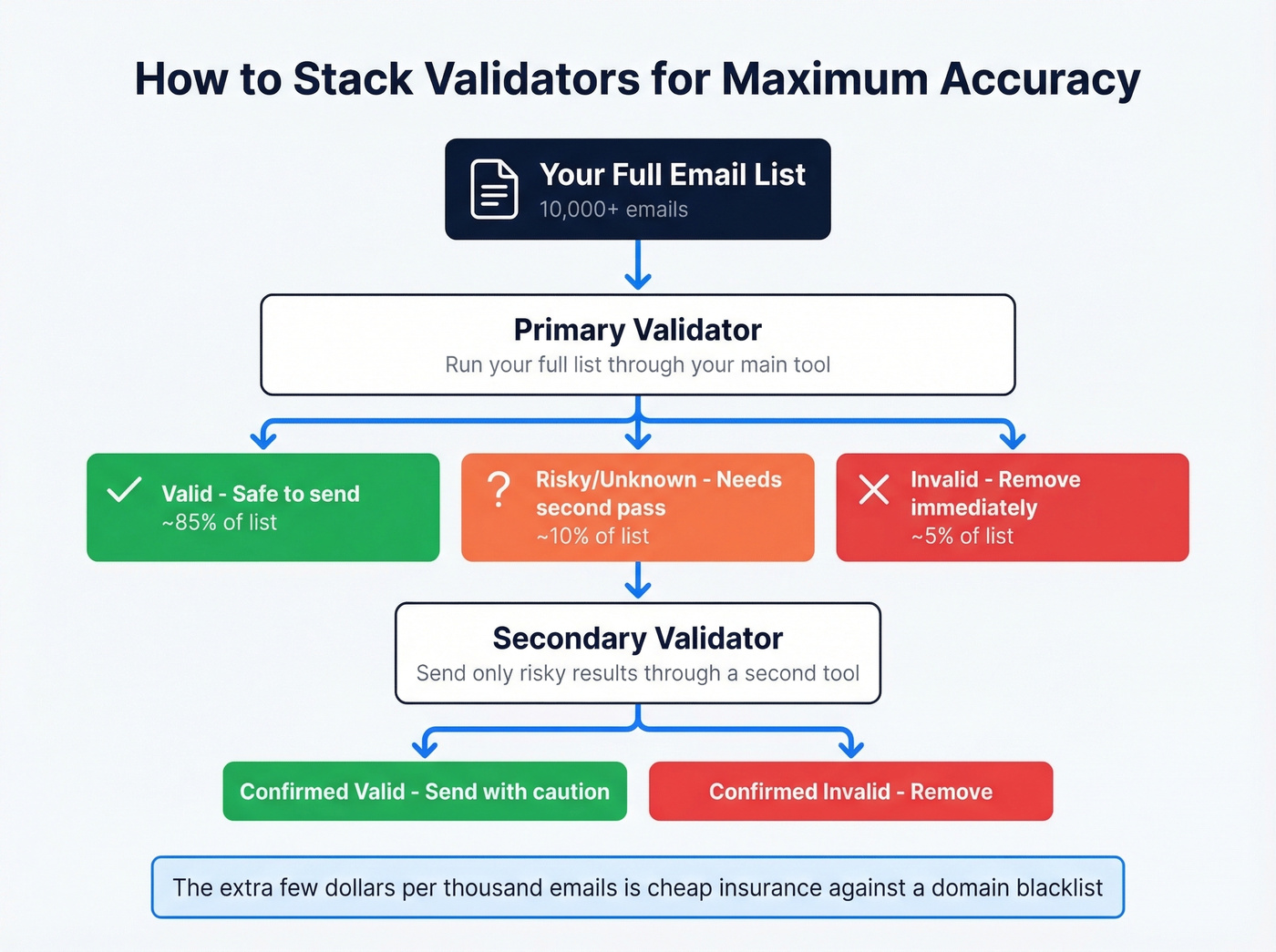
Run your primary email address validation checker on the full list, then send the "risky" or "unknown" results through a second tool. Reddit threads consistently mention MillionVerifier as a solid secondary option. The extra few dollars per thousand is cheap insurance against a domain blacklist.
If you’re scaling outbound, pair this with a safe sending plan like email velocity.
Validation Isn't Enough
Even a perfectly clean list doesn't guarantee inbox placement. Global inbox placement sits around 84% - roughly one in six emails never reaches the inbox. Verification eliminates one variable, but sender reputation, SPF/DKIM/DMARC configuration, and content quality all factor in. Gmail's spam complaint threshold is 0.3%. Cross it and your deliverability craters regardless of list quality. Validate first, but don't stop there.
For the rest of the deliverability stack, use an email deliverability guide and keep an eye on email reputation tools.
Snyk cut their bounce rate from 35-40% to under 5% and generated 200+ new opportunities per month. The difference wasn't a better validator - it was fresher data. Prospeo refreshes every 7 days and removes spam traps and honeypots before you ever see an email.
Kill your bounce rate at $0.01 per email. Test it on your worst list.
FAQ
What's the difference between email validation and verification?
The terms are used interchangeably in practice. Technically, "validation" checks format and syntax while "verification" confirms the mailbox exists via SMTP. Every tool on this list does both. Pick based on accuracy and pricing, not naming conventions.
Can a validation checker catch all bad addresses?
No. Catch-all domains accept every address, real or fake, so validators can't confirm individual mailboxes. About 40% of enterprise domains are catch-all. The best tools flag these as "risky" instead of "valid," letting you decide whether to send.
How often should I clean my email list?
Re-verify every 30-60 days. Email addresses decay at roughly 2-3% per month due to job changes, domain shutdowns, and mailbox deactivation. If you're sending to a list older than 90 days without re-validation, expect bounce rates above 5%.