

Free Email Address Verification: What Actually Works in 2026
You just uploaded 5,000 contacts to your sequencer and 400 bounced on the first send. Bounce rate hit 8%, domain reputation tanked, and now every email - even to verified contacts - lands in spam. That's not a hypothetical. It's a Tuesday for teams running outbound without verification in their workflow.
Email lists decay at 25%+ per year. People change jobs, inboxes get shut down, domains expire. The industry threshold is clear: keep bounces under 2%, spam complaints under 0.1%. Cross those lines and your sending infrastructure works against you.
Here's the thing most guides skip: should you be verifying at all? If you start with pre-verified data, you eliminate 80% of the problem before it exists. Free verification tools have a place, but they're a band-aid on a data quality wound.
Our Picks (TL;DR)
- Prospeo - 75 free verified emails/month from 143M+ verified emails at 98% accuracy. You're not verifying emails you already have; you're getting clean ones from the start.
- Hunter - No-signup single checks. Paste an email, get a result. Best for quick one-off verification before hitting send.
- Email Hippo - 100 free checks per day, resetting at midnight UTC. The most generous daily quota of any free tool we've found.
Under 75 emails/month? Prospeo's free tier handles it. Spot-checking a handful? Hunter. Running daily batches? Email Hippo.
How Email Verification Works
Every email verifier runs the same basic pipeline, regardless of price.
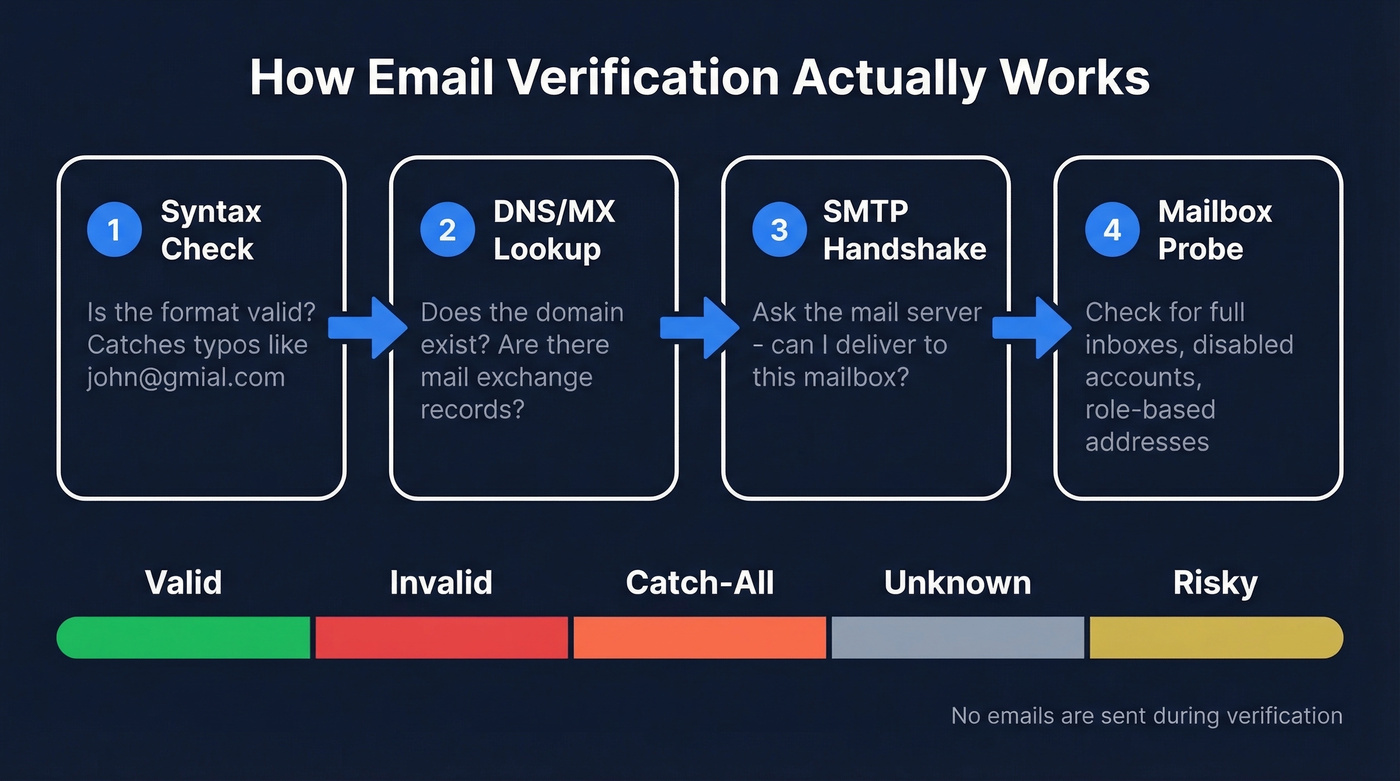
Step 1: Syntax check. Is the email formatted correctly? Does it have an @ symbol, a valid domain structure, no illegal characters? This catches typos like "john@gmial.com."
Step 2: DNS/MX lookup. Does the domain exist, and does it have mail exchange records? No MX record means the domain can't receive email. Dead end.
Step 3: SMTP handshake. The verifier connects to the mail server and asks "Can I send to john@company.com?" The server confirms the mailbox exists, rejects it, or accepts everything indiscriminately - a catch-all.
Step 4: Mailbox probe. Some verifiers go deeper, checking for full inboxes, disabled accounts, or role-based addresses like info@ and support@. No actual email is sent.
The output falls into five buckets: Valid (safe to send), Invalid (don't send), Catch-All (server accepts everything - can't confirm), Unknown (server didn't respond clearly), and Risky, which covers role-based, disposable, or full-inbox addresses. What you do with catch-all and unknown results is where most teams get stuck.
The Accuracy Problem
Every free verifier markets 97-99% accuracy. The actual numbers tell a different story.
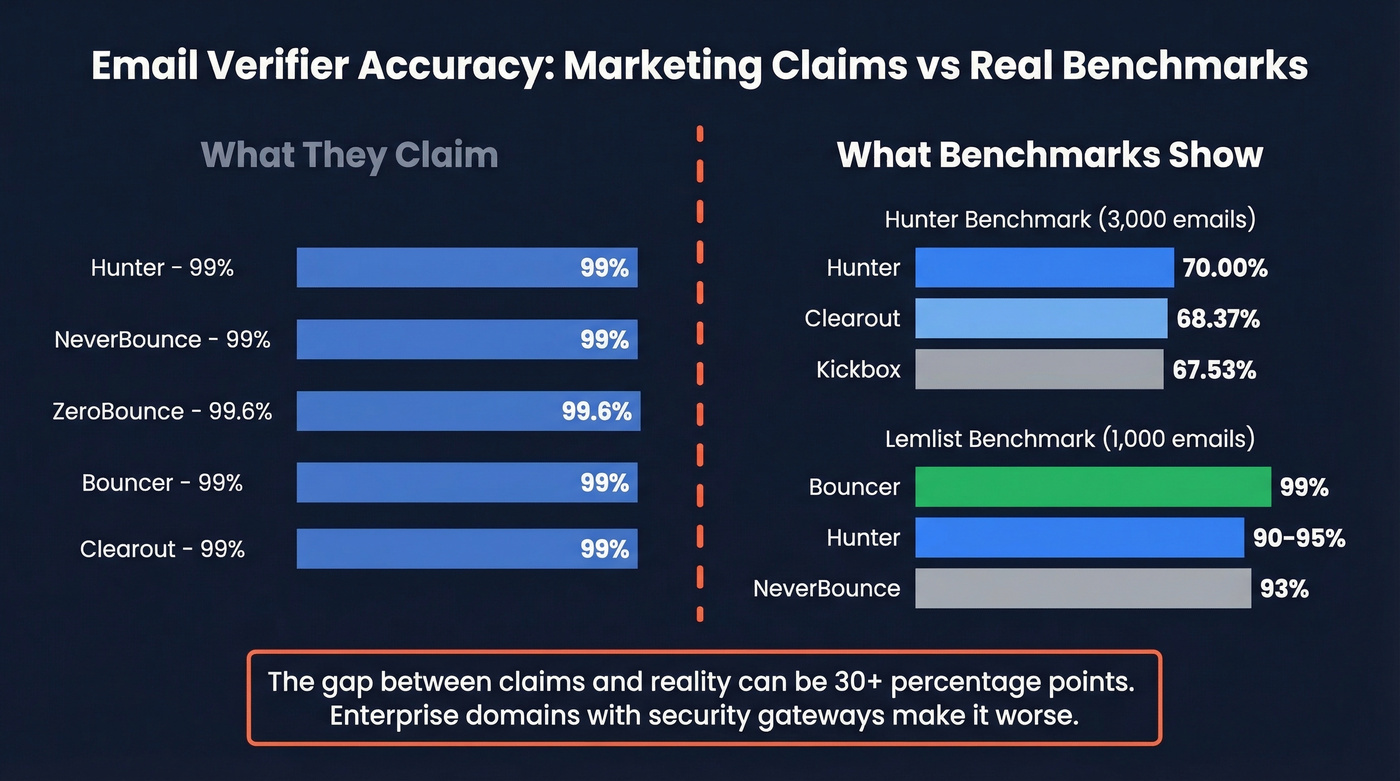
Hunter ran a benchmark of 15 email verifiers using roughly 3,000 real business emails segmented by company size. The top accuracy score was 70%. Not 99%. Not 95%. Seventy percent. Hunter scored highest at 70.00%, followed by Clearout at 68.37% and Kickbox at 67.53%. Hunter acknowledges potential bias since they used their own activity data for labeling, but the gap between marketing claims and tested reality is enormous.
A separate Lemlist benchmark tested tools on 1,000 emails (800 known good, 200 known bounce) and got different numbers: Bouncer hit 99%, Hunter landed at 90-95%, NeverBounce came in at 93%. The discrepancy between benchmarks reveals something important - accuracy depends heavily on the test dataset, the domain mix, and how you define "correct."
Let's be honest: when vendors promise "99%+ accuracy," these benchmarks show why you should treat that as a best-case number on friendly domains, not what you'll see on a messy B2B list full of enterprise domains running Proofpoint, Mimecast, or Barracuda gateways gateways. Those servers actively block SMTP verification attempts, so the verifier returns "unknown" and your effective accuracy drops hard.
If you're trying to keep deliverability stable at scale, it helps to treat verification as part of a broader email deliverability system, not a one-off tool.

Free verifiers top out at 70% real-world accuracy. Prospeo skips the problem entirely - 143M+ emails pre-verified through a 5-step process with catch-all handling, spam-trap removal, and honeypot filtering. 98% accuracy, refreshed every 7 days.
Stop fixing bad data. Start with clean data at $0.01 per email.
The Catch-All Problem
You ran your list through a free verifier, got 1,200 results marked "unknown," and now you're staring at a spreadsheet wondering what to do.
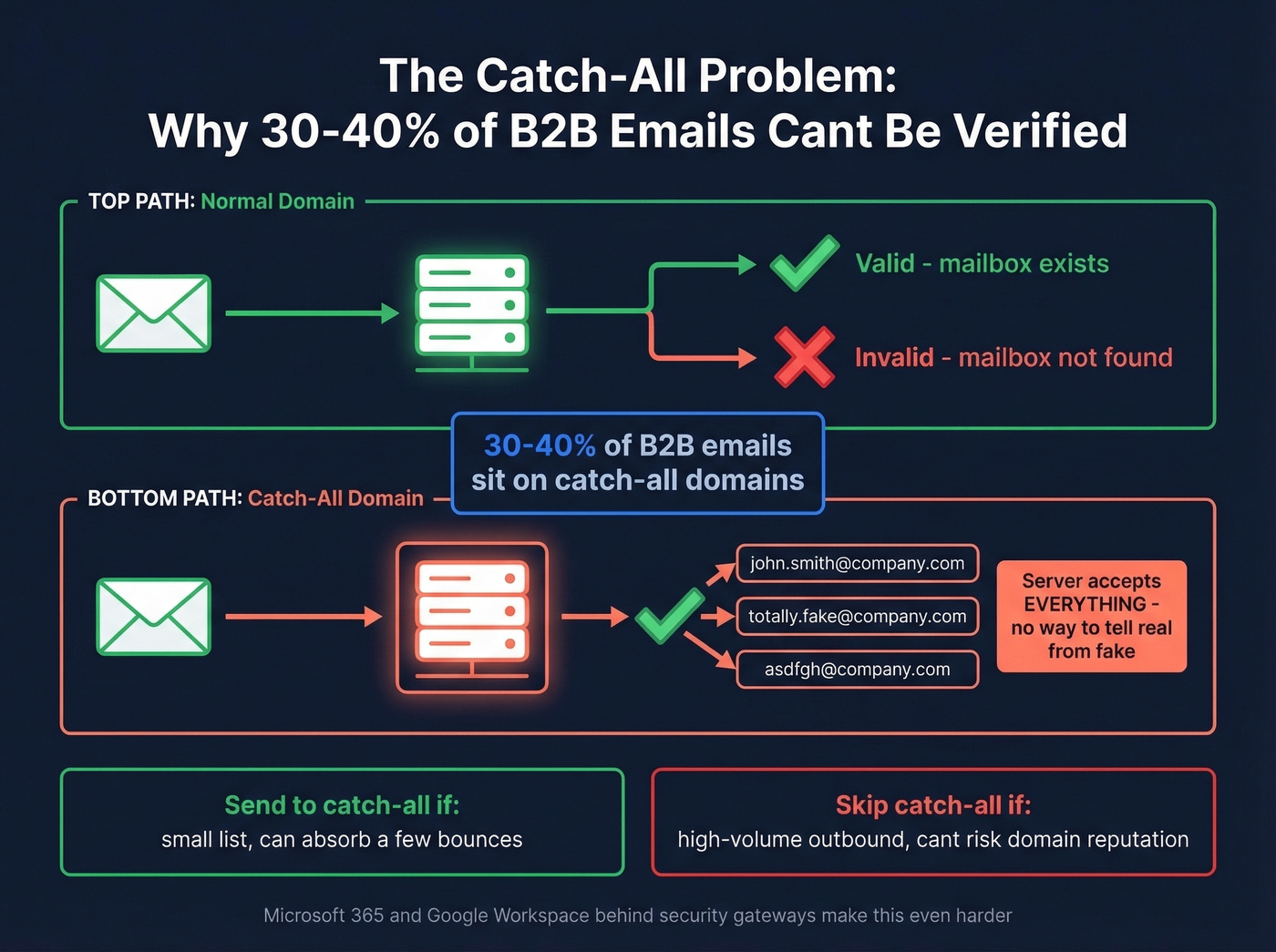
An estimated 30-40% of B2B email addresses sit on catch-all domains. These servers accept mail for any address - real or fake - so the SMTP handshake can't distinguish john.smith@company.com from gibberish@company.com. Microsoft 365 and Google Workspace deployments behind security gateways make it worse by greylisting, rate-limiting, or flat-out rejecting verification probes.
The waterfall strategy helps: run unknowns through a second verifier to see if a different tool gets a clearer signal. But the smarter upstream fix is starting with pre-verified data so you aren't left guessing about 1,200 unknowns in the first place.
Send to catch-all results if your list is small and you can absorb a few bounces. Skip them if you're running high-volume outbound and can't afford domain reputation damage.
Best Free Email Validation Tools Compared
| Tool | Free Limit | Bulk? | Cost/1K (Paid) | Best For |
|---|---|---|---|---|
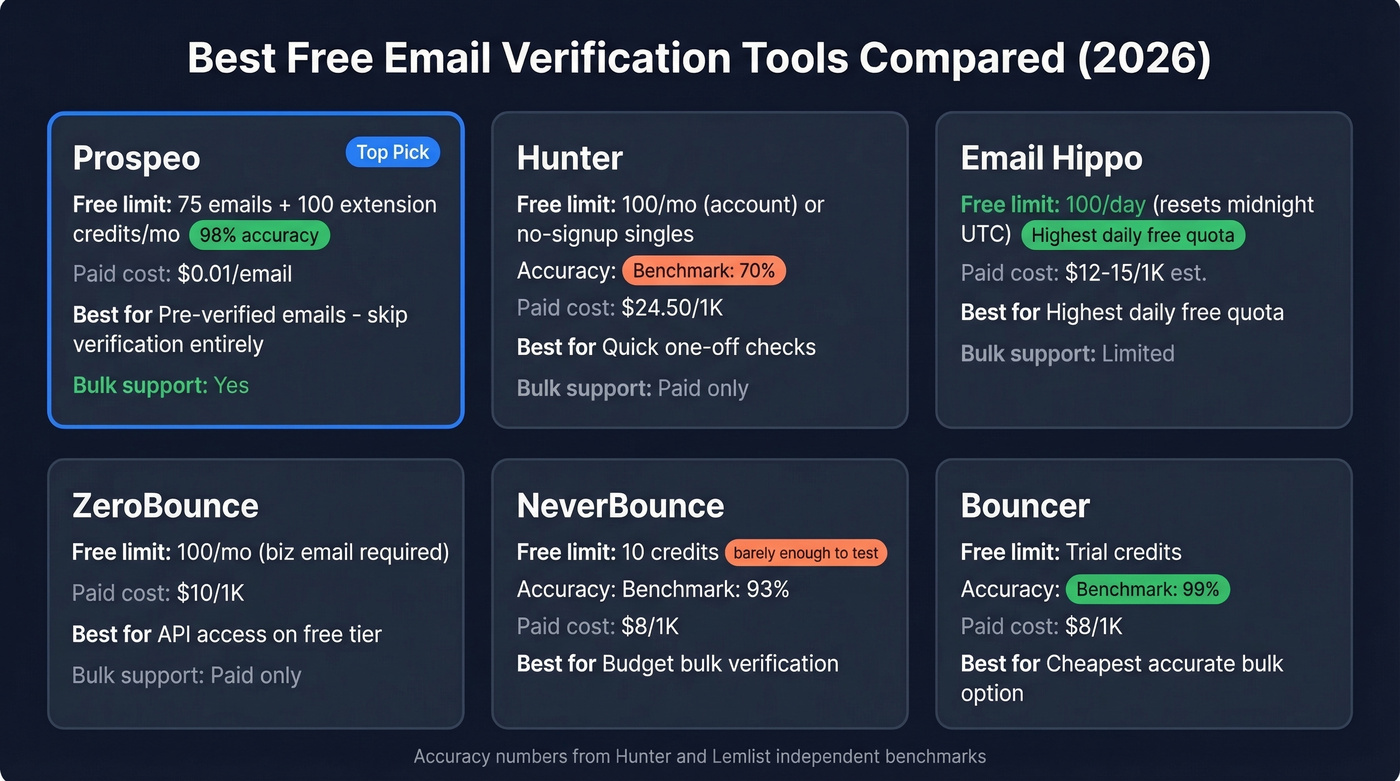
| Prospeo | 75 emails + 100 ext./mo | Yes | ~$0.01/email | Pre-verified emails (skip verification) |
| Hunter | No-signup singles; 100/mo (account) | Paid only | ~$24.50 | Quick one-offs |
| Email Hippo | 100/day | Limited | ~$12-15 est. | Highest daily free quota |
| ZeroBounce | 100/mo (biz email signup) | Paid only | $10 | API access |
| NeverBounce | 10 credits | Paid only | $8 | Budget bulk |
| Verifalia | ~25/day, no rollover | Paid only | $7.90 | PAYG flexibility |
| Bouncer | Trial credits | Paid only | $8 | Cheapest PAYG bulk |
| Clearout | Trial credits | Yes | $7/1K | Benchmark accuracy |
| Mailmeteor | 50/mo via Sheets | Via Sheets | Freemium | Google Sheets users |
| Skrapp | 100/mo | Paid only | ~$15-20/1K | Lead gen + verify |
Here's what's worth your time.
Prospeo
Unlike every other tool on this list, Prospeo doesn't verify emails you already have - it gives you emails that are already verified. The database covers 143M+ verified emails drawn from 300M+ professional profiles, all refreshed on a 7-day cycle. Email accuracy sits at 98%, backed by a 5-step verification process that includes catch-all handling, spam-trap removal, and honeypot filtering.
The free tier gives you 75 emails plus 100 Chrome extension credits per month - enough to cover a week's worth of targeted outreach for a solo SDR without opening a second tab. Paid plans run about $0.01 per email, a fraction of what standalone verifiers charge for the verification step alone. We've seen teams cut their bounce rates from 35%+ down to under 4% just by switching their data source rather than adding another verification layer on top of bad data.
If you're building lists from scratch, pairing pre-verified sourcing with data enrichment keeps your CRM clean long-term.
Hunter
Hunter is the tool most people think of first, and for good reason. You can verify a single email without creating an account - just paste it in and get a result. That zero-friction experience is genuinely useful when you need to check one address before sending a critical email.
With an account, you get 100 verifications per month. Hunter checks syntax, domain info, server response, and cross-references against their own B2B database. They also offer proprietary catch-all verification for major email providers, which is a differentiator if it holds up. With 6M+ users and ratings of 4.4 on G2 and 4.6 on Capterra, it's the most widely adopted tool in this category. Paid plans start at ~$49/month with unified credits, working out to roughly $24.50 per 1K verifications depending on how you split credits between search and verification.
If you're comparing options beyond Hunter, see our breakdown of Hunter alternatives.
Email Hippo
Email Hippo offers the most generous daily quota available: 100 checks per day, resetting at midnight UTC. For teams verifying small batches regularly - a daily drip of inbound leads, for instance - that's 3,000 checks per month without paying anything. Results come back quickly, and the interface stays out of your way. The free tier handles individual and small-batch checks, not CSV uploads of 10,000 contacts.
ZeroBounce
ZeroBounce offers 100 free verifications per month and markets 99.6% accuracy. The catch: you need a business or premium domain email to sign up - no Gmail, no Yahoo. In third-party testing, it processed a batch in under 2 minutes and correctly flagged invalid, catch-all, and do-not-mail addresses. PAYG runs $20 for 2,000 credits, and subscription pricing includes $18 for 2,000 credits/month. The API access on the free tier is a nice touch for developers testing before committing.
NeverBounce
NeverBounce gives you just 10 free credits. Barely enough to test the tool. But the paid offering has a compelling angle: a money-back guarantee promising no more than 3% bounce rate, with refunds if they miss. At ~$8 per 1K verifications, it's one of the cheapest bulk options. The Lemlist benchmark scored NeverBounce at 93% accuracy - solid, but notably below their own 99% marketing claim.
If you're optimizing around bounce thresholds, it’s worth knowing the benchmarks and error codes behind email bounce rate reporting.
Bouncer
Bouncer scored 99% accuracy in the Lemlist benchmark - the highest of any tool tested. At $8 per 1K on PAYG, it's tied with NeverBounce for cheapest bulk verification, with entry-tier subscriptions starting at $24/month. If you're running Lemlist sequences, the integration is tight and the accuracy data is encouraging.
Clearout
Clearout hit 68.37% in Hunter's 3,000-email benchmark - the second-highest score. Starter plan runs $21/month for 3,000 credits. Worth testing if you're processing mid-market lists where accuracy on enterprise domains matters.
Quick Hits
Verifalia gives you ~25 free checks per day, but credits don't roll over. PAYG pricing starts at $15.80 for 2,000 credits. The daily-credit model works for steady, predictable verification needs - less ideal for teams that batch-process lists once a week.
Mailmeteor lives inside Google Sheets - 50 free verifications per month, run directly in a spreadsheet. Convenient if your entire workflow is Google Workspace. Not built for scale.
Skrapp gives you 100 free credits per month and combines email finding with verification. Accuracy isn't independently benchmarked, so treat it as a lead gen tool with verification as a bonus feature.
Skip EmailListVerify - three free checks isn't a free tool, it's a signup funnel.
Pre-Campaign Verification Workflow
Before every outbound campaign, run this five-step checklist:
- Export your list from your CRM, sequencer, or spreadsheet. Clean obvious duplicates first.
- Run through a free verifier - Hunter for one-offs, Email Hippo for daily batches.
- Remove hard invalids immediately. These are confirmed dead addresses. Sending to them is pure reputation damage.
- Decide on catch-all and unknowns. Run them through a second verifier using the waterfall approach, or exclude them if your list is large enough to absorb the loss.
- Re-verify before every campaign. Not every quarter - every campaign. We treat this as non-negotiable. A 3-month-old "verified" list isn't verified anymore.
If you're sending at scale, align verification with safe email velocity so you don’t spike bounces and throttle your domains.
Operational guardrails: keep bounces under 2%, spam complaints under 0.1%, and ramp sending at no more than 50 emails per day per inbox. One burned domain costs more than a year of verification tools.
When Free Isn't Enough
Look, if your deal sizes sit below five figures, you probably don't need ZoomInfo-level data - but you absolutely need clean data. And free tiers won't cut it past 500 emails per month.
The time cost of managing daily limits, exporting in batches, and juggling multiple free accounts exceeds the $8 you'd spend on 1,000 paid verifications. In our experience, teams that try to stretch free tiers past their limits end up spending more in lost productivity than they save. The consensus on r/sales backs this up - most reps who've tried the free-tools-only approach eventually burn a domain and wish they hadn't.
Here's the quick math on paid cost per 1K:
| Tool | Cost/1K | Why Pick It |
|---|---|---|
| NeverBounce | $8 | Money-back bounce guarantee |
| Bouncer | $8 | Highest benchmark accuracy |
| ZeroBounce | $10 | API-first, most established |
| Hunter | ~$24.50 | Unified search + verify credits |
One domain blacklisting from a bad send costs you weeks of recovery and thousands in lost pipeline. Paying $8-10 per thousand verifications is insurance, not an expense. For teams that want to skip the verification step altogether, starting with pre-verified data eliminates the problem at the source.
If you’re also tightening the rest of your outbound stack, our guide to best way to send bulk email without getting blacklisted pairs well with verification.
If 30-40% of your list comes back as catch-all or unknown, you don't have a verification problem - you have a data source problem. Prospeo's 5-step verification handles catch-all domains before you ever see the email. Teams using Prospeo cut bounce rates from 35% to under 4%.
Eliminate unknowns from your list before they exist.
FAQ
How accurate is free email address verification?
Independent benchmarks show 68-70% accuracy on real B2B data, despite marketing claims of 97-99%. The gap comes from enterprise mail servers blocking SMTP probes and catch-all domains accepting everything. Free tools use the same pipeline as paid ones - accuracy depends on domain mix, not price.
How often should I verify my email list?
Before every campaign. Lists decay at 25%+ per year, meaning a 6-month-old list has roughly 1 in 8 dead addresses. Quarterly verification is the bare minimum; pre-campaign verification is the standard for teams that care about deliverability.
What's the difference between validation and verification?
Validation checks syntax and format - is this string shaped like an email? Verification confirms the mailbox exists via SMTP handshake. Most tools do both automatically. Don't pay extra for "validation" sold as a separate product; any competent verifier includes it.
Can I verify catch-all emails for free?
Standard SMTP verification can't confirm individual mailboxes on catch-all domains because the server accepts everything. A waterfall approach - running unknowns through a second verifier - catches some. Pre-verified databases sidestep the problem entirely by confirming addresses before you ever see them.
Why do free verifiers return "unknown" results?
Enterprise servers running Proofpoint, Mimecast, or Barracuda gateways block SMTP probes via greylisting and rate limiting. Catch-all domains accept all recipients indiscriminately. Both produce "unknown" - it's a structural limitation of SMTP-level verification affecting roughly 30-40% of B2B addresses, not a bug in any specific tool.