

Best Email Automation Tools in 2026 (Tested & Compared)
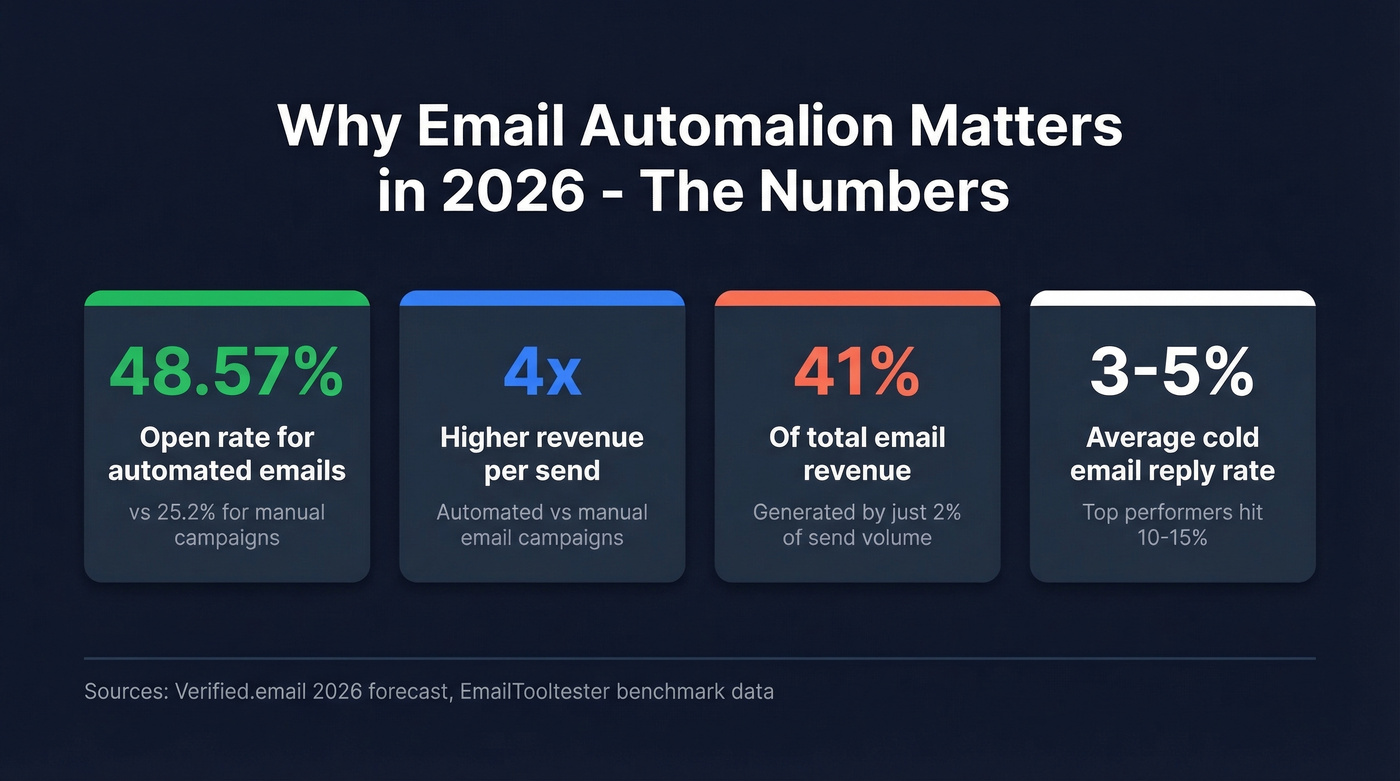
Two percent of email send volume generates 41% of total email revenue. Automated emails pull a 48.57% open rate versus 25.2% for manual campaigns, and revenue per send is 4x higher. The right email automation tools aren't optional anymore - they're where the money lives.
But "email automation" means wildly different things depending on who you are. A DTC brand running abandoned cart flows on Shopify needs a completely different tool than an SDR team blasting cold sequences to VP-level prospects. Picking the wrong category wastes months and money.
We've tested and compared the tools below across three buckets - marketing automation, cold outreach automation, and ecommerce - because that's how the decision actually works. Every tool gets a clear verdict on its automation builder, deliverability performance, and pricing at scale.
Our Picks at a Glance
| Tool | Category | Best For | Starting Price | Free Plan | Key Edge | G2 |
|---|---|---|---|---|---|---|
| ActiveCampaign | Marketing | Deep workflows + CRM | ~$19/mo | No | Branching logic | 4.5/5 |
| Brevo | Marketing | Budget teams, big lists | $8.08/mo | Yes (300/day) | Unlimited contacts | 4.5/5 |
| Klaviyo | Ecommerce | Shopify/Woo revenue | $20/mo (500 profiles) | Yes (250 profiles, 500 emails/mo) | 5-star deliverability | 4.6/5 |
| Prospeo | Data layer | Verified contact data | ~$0.01/email | Yes (75 emails/mo) | 98% accuracy | - |
| Instantly.ai | Outreach | High-volume cold sending | $37/mo | No | Built-in warmup | 4.8/5 (~3,900 reviews) |
Pick Your Category First
Before you compare features, answer one question: are you emailing people who opted in, or people who don't know you yet?
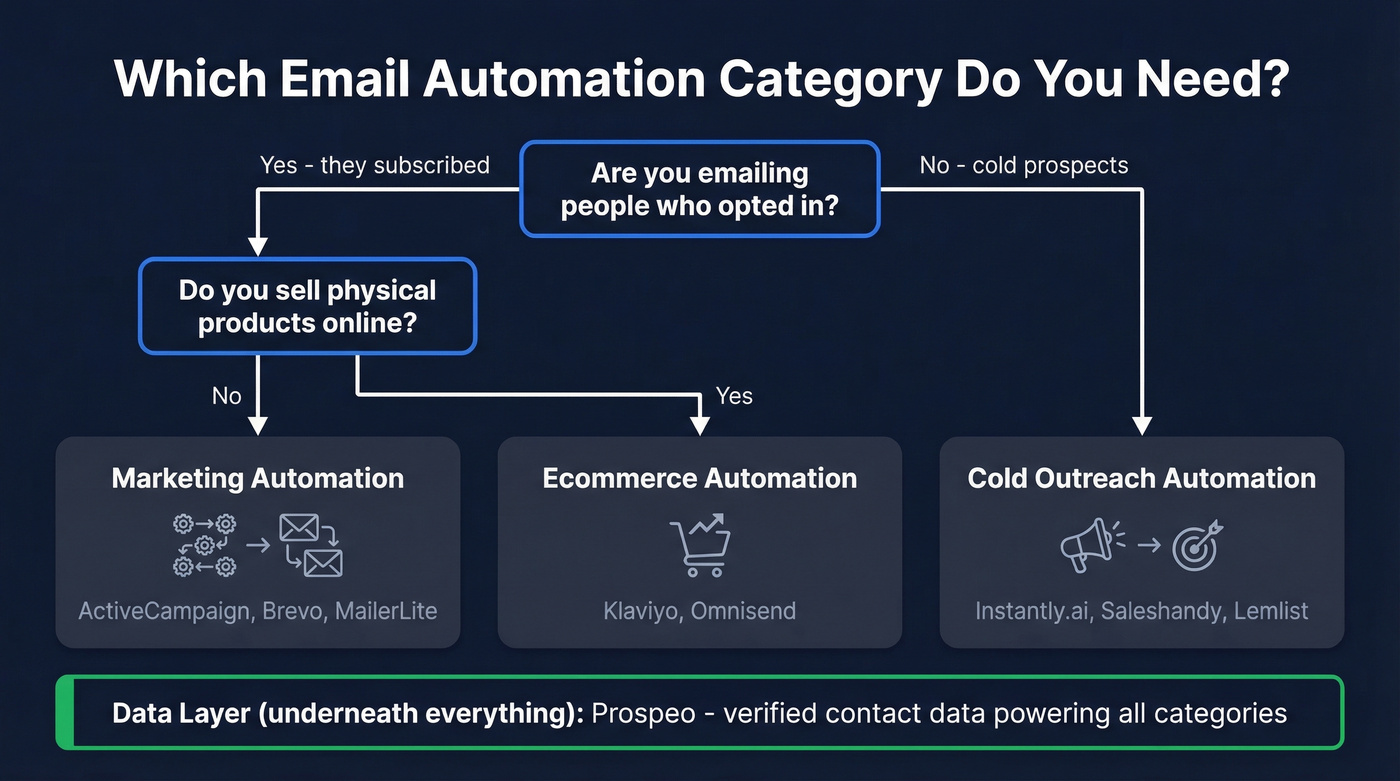
Marketing automation handles opted-in subscribers. Someone signs up, triggers a welcome flow, browses a product page, abandons a cart - and the system responds with the right message at the right time. The logic is Trigger, Condition, Action. Platforms like ActiveCampaign, Klaviyo, and Brevo live here.
Cold outreach automation is a different animal entirely. You're reaching people who've never heard of you, using separate sending infrastructure - multiple mailboxes, warmup protocols, rotation - to protect deliverability. Average cold email reply rates sit at 3-5%, with top-performing sequences hitting 10-15%. Tools like Instantly.ai, Saleshandy, and Lemlist handle this. The compliance rules differ, the sending mechanics differ, and mixing them up gets your domain blacklisted.
Within marketing automation itself, there's a complexity spectrum worth understanding. Simple automation covers welcome emails, basic autoresponders, and time-based drip campaigns - any tool handles these. Advanced automation means behavioral scoring, conditional branching, and predictive send-time optimization. If you need the advanced stuff, your shortlist shrinks to ActiveCampaign, HubSpot, and Klaviyo.
The data layer sits underneath both categories. Whether you're enriching a subscriber list or building a prospect list from scratch, the quality of your contact data determines everything downstream - bounce rates, sender reputation, and whether your carefully crafted emails reach anyone at all. (If you're evaluating providers, start with this breakdown of data enrichment services.)
Best Marketing Automation Platforms
ActiveCampaign
Use this if you need serious automation logic - branching workflows, behavioral triggers, lead scoring, and a built-in CRM that actually works. ActiveCampaign is the tool teams graduate to when Mailchimp stops being enough.
Skip this if you want something you can set up in an afternoon. Users on r/MarketingAutomation consistently flag the learning curve, and they're right. Expect to spend 3+ hours just building your first real workflow. The Starter plan's 5-action automation limit is basically a demo - you'll need Plus at $49/mo to do anything meaningful. At 5,000 contacts, you're looking at roughly $145/mo on Plus. A 14-day free trial is available, but that's barely enough time to scratch the surface.

Deliverability scores 4 stars in EmailTooltester's testing, and the G2 rating sits at 4.5/5. The pricing ramps with contact count - the number-one complaint on Reddit - but the automation depth justifies it for teams that actually use it.
Brevo
Here's the thing about most free email plans: they cap contacts around 250-500. Brevo's free tier gives you 300 emails per day to up to 100,000 contacts. That's not a typo. The platform charges by email volume, not list size, which is a fundamentally different pricing model that favors teams with big lists and moderate send frequency.
The trade-off is polish. The editor is functional, not beautiful, and some features sit behind paid tiers. Starter runs $8.08/mo, which is still cheaper than almost everything else in this category. Deliverability scores 4 stars, and Reddit users consistently praise the value. For a team that needs to send 9,000 emails/month without paying a dime, Brevo is the obvious starting point.
Klaviyo
Klaviyo owns ecommerce email. The Shopify and WooCommerce integrations are genuinely best-in-class - abandoned cart flows, browse abandonment, post-purchase sequences, and predictive analytics all work natively with your store data. Klaviyo scores 5-star deliverability, top-rated in EmailTooltester's testing.
If you're not in ecommerce, walk away. Reddit users are blunt about this: Klaviyo is overpriced and overpowered for B2B or content businesses.
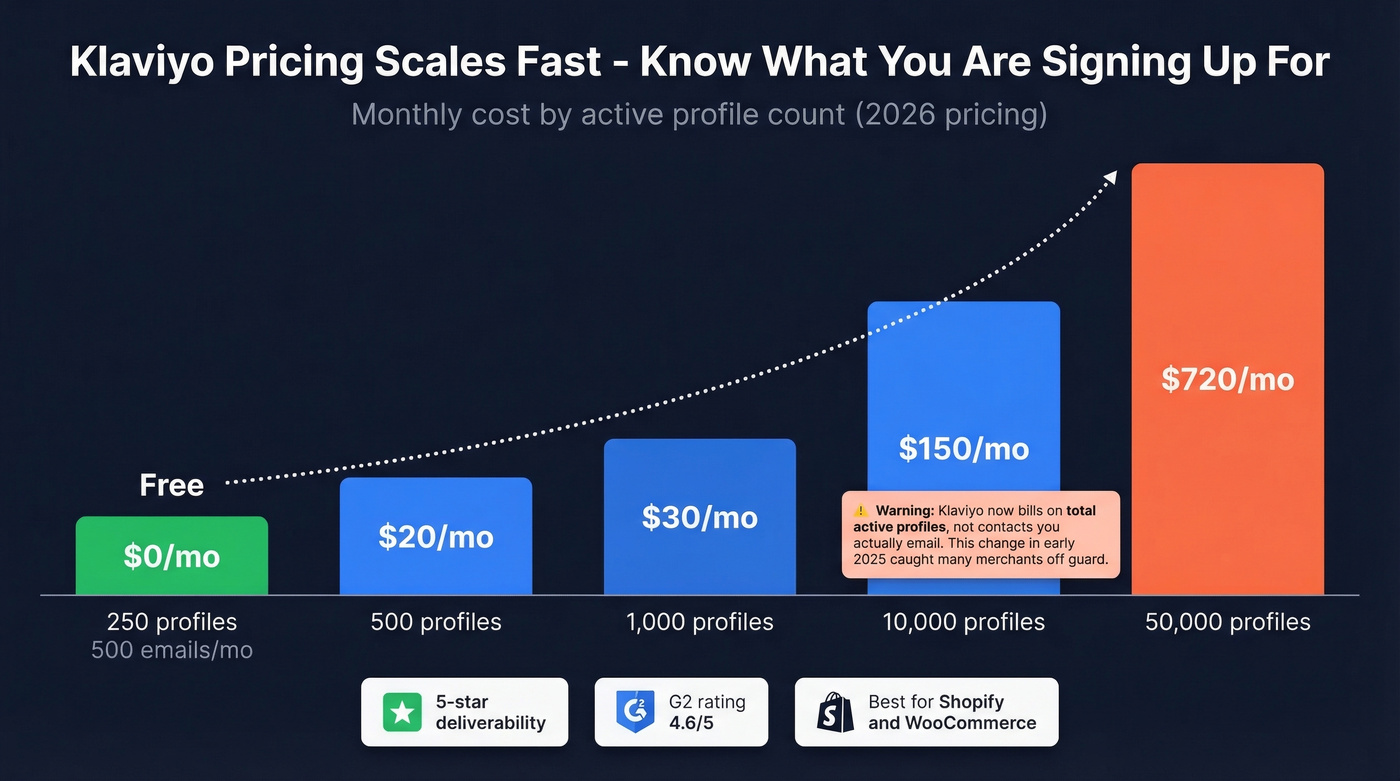
The scaling ladder runs like this: free for 250 profiles and 500 emails/month, then $20/mo at 500 profiles, $30/mo at 1,000 profiles, $150/mo at 10,000, and $720/mo at 50,000. In early 2025, Klaviyo switched from billing based on contacts you actually emailed to billing on total active profiles. That change stung a lot of merchants who kept large lists but only emailed segments - and it's worth factoring into your cost projections for 2026.
Omnisend
Omnisend positions itself as the cheaper Klaviyo alternative for ecommerce, and it delivers on that promise. Free for 250 contacts and 500 emails, with Standard plans starting at $16/mo. The G2 rating of 4.6/5 actually edges out Klaviyo, largely because users appreciate the simpler interface and more predictable pricing. Deliverability scores an impressive 4.5 stars. If you're running a mid-size Shopify store and Klaviyo's scaling costs make you nervous, Omnisend handles the same core flows - cart abandonment, welcome series, browse triggers - at a lower cost.
MailerLite
MailerLite is the tool we recommend to teams that find ActiveCampaign intimidating. Free for 1,000 subscribers and 12,000 emails/month, paid plans from $9/mo. The automation builder is visual and intuitive - you can have a working welcome sequence running in under an hour. It won't handle complex branching logic or dynamic workflows, but for straightforward drip campaigns and basic autoresponders, it's the best value in the category. One caveat: deliverability scores 3.5 stars, which puts it in the lower tier alongside GetResponse.
Automation Feature Matrix
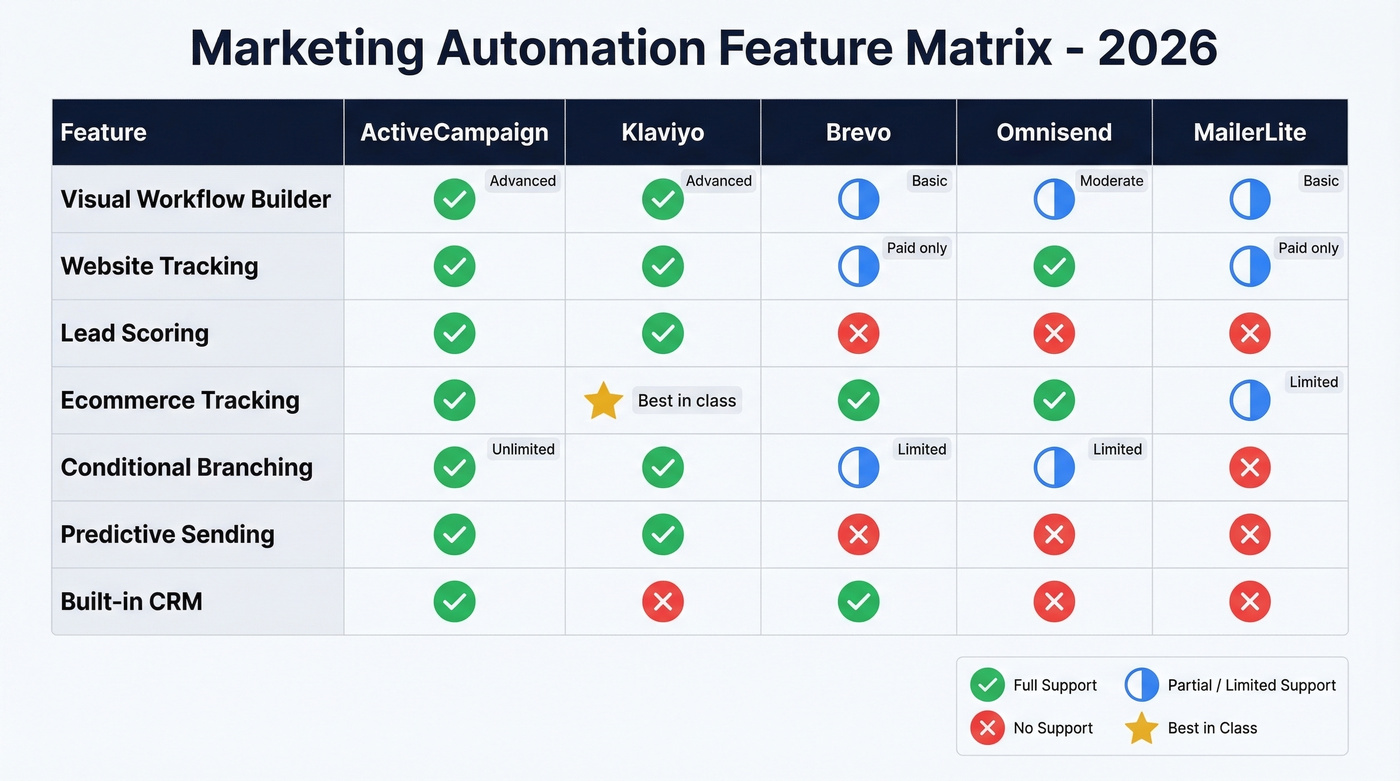
This is the table most comparison articles skip. Features vary wildly across these platforms, and the gap between "has automation" and "has useful automation" is enormous.
| Feature | ActiveCampaign | Klaviyo | Brevo | Omnisend | MailerLite |
|---|---|---|---|---|---|
| Visual workflow builder | Advanced | Advanced | Basic | Moderate | Basic |
| Website tracking | Yes | Yes | Paid only | Yes | Paid only |
| Lead scoring | Yes | Yes | No | No | No |
| Ecommerce tracking | Yes | Best-in-class | Yes | Yes | Limited |
| Conditional branching | Unlimited | Yes | Limited | Limited | No |
| Predictive sending | Yes | Yes | No | No | No |
| Built-in CRM | Yes | No | Yes | No | No |
ActiveCampaign wins on automation depth. Klaviyo wins on ecommerce intelligence. Everything else is a trade-off between price and capability.
Quick Verdicts for the Rest
| Tool | Starting Price | One-Line Verdict | Key Limitation |
|---|---|---|---|
| Mailchimp | $13/mo | Familiar editor, huge template library | Charges for inactive contacts; no automations on free plan; 3-star deliverability |
| HubSpot | $890/mo (Professional) | Enterprise CRM + marketing suite | Onboarding fees; overkill for email-only needs |
| GetResponse | $48.38/mo (Marketer) | Solid all-in-one with webinars | Automation locked behind mid-tier plan |
| Kit (ConvertKit) | Free (10K subs) | Creator-focused, clean UX | Only 1 automation on free; limited ecommerce |
| Moosend | $7/mo | Budget pick with decent automation | No free plan; smaller ecosystem |
Mailchimp has 25% market share and 3-star deliverability. That's a lot of emails landing in spam. HubSpot commands 28% market share and its Marketing Professional at $890/mo makes sense if you're already deep in the HubSpot ecosystem - otherwise, you're paying for a CRM you didn't ask for.
Let's be honest: most teams don't need the tool with the most features. They need the tool that matches their actual workflow complexity. If your entire automation strategy is a welcome series and a monthly newsletter, paying for ActiveCampaign is like buying a semi-truck to pick up groceries. Start with MailerLite or Brevo, and upgrade when you genuinely hit a ceiling - not when a sales rep convinces you that you might need lead scoring someday.
Best Cold Email Automation Tools
Instantly.ai
Instantly's core strength is infrastructure. Unlimited email accounts, automatic rotation, and warmup included at every tier. Outreach Growth starts at $37/mo for 5,000 emails/month; Hypergrowth at $97/mo unlocks 100,000 emails/month. Annual billing drops Outreach Growth to $30/mo.
Saleshandy
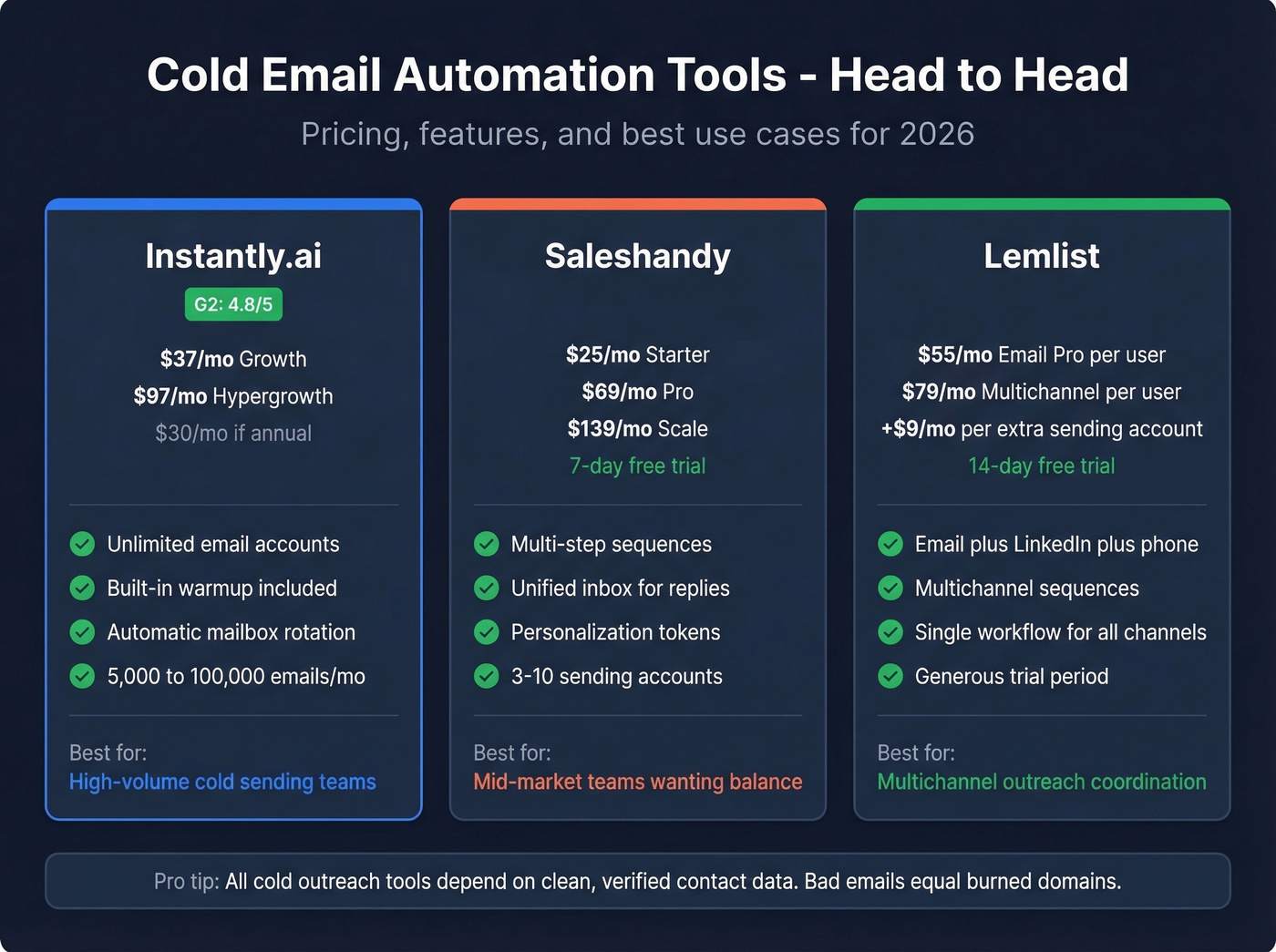
Saleshandy targets the mid-market sweet spot between "free tool" and "enterprise platform." Starter at $25/mo, Pro at $69/mo, and Scale at $139/mo - all with a 7-day free trial so you can actually test before committing. The sequence builder handles multi-step follow-ups and personalization, and the unified inbox keeps replies organized across multiple sending accounts. It's a solid choice for teams running 3-10 sending accounts who don't need Instantly's unlimited account infrastructure. (If you're building outbound as a system, pair this with proven sales prospecting techniques.)
Lemlist
Lemlist's differentiator is multichannel - email, LinkedIn touches, and phone calls in a single sequence. Email Pro runs $55/mo per user, Multichannel Expert at $79/mo per user. Additional sending accounts cost $9/mo each. The 14-day free trial is generous enough to build and test a real campaign. Lemlist works best for teams that want to coordinate outreach across channels without juggling separate tools, though the per-user pricing adds up fast for larger teams.

Every email automation tool on this list has one thing in common: they all fail when your contact data is bad. Prospeo's 98% verified email accuracy and 7-day refresh cycle mean your sequences actually reach real inboxes - not bounces that torch your sender reputation.
Fix the data layer and your automation tools finally perform.
Cold outreach or marketing flows - bounce rates above 5% destroy deliverability. Teams using Prospeo cut bounce rates from 35%+ to under 4% and book 26% more meetings. At $0.01 per verified email, clean data costs less than a single bounced campaign.
Stop feeding bad data into great automation tools.
Best Ecommerce Drip Campaign Platforms
Three flows drive 87% of all automation-generated orders: abandoned cart, welcome series, and browse abandonment. If you're in ecommerce and haven't built these three, stop reading and go set them up. Everything else is optimization.
Klaviyo remains the gold standard - 5-star deliverability, the deepest Shopify integration, and predictive analytics that improve over time. Omnisend is the budget alternative that handles the same core flows at lower cost. Both are covered in detail above.
The third option worth knowing is Drip, which starts at $39/mo for 2,500 subscribers with unlimited sends and a 14-day trial. Drip sits between Klaviyo and Omnisend in both pricing and complexity - strong visual workflow builder, good ecommerce integrations, but a smaller ecosystem and community. It's a solid pick for stores that find Klaviyo too expensive and Omnisend too basic.
What to Automate First
Not all workflows are created equal. The gap between good and lazy automation is roughly 8x in revenue per recipient.
| Workflow | Top 10% Revenue/Recipient | Average Revenue/Recipient |
|---|---|---|
| Abandoned cart | $28.89 | $3.65 |
| Welcome series | $21.18 | $2.65 |
| Browse abandonment | $7.21 | $1.07 |
| Post-purchase | $5.14 | $0.41 |
The top 10% of email workflows generate $16.96 per recipient versus $1.94 average. That's not a marginal difference - it's the difference between email being a cost center and email being your highest-ROI channel.
Start with abandoned cart. It's the highest revenue per recipient and the easiest to implement on any ecommerce platform. Welcome series comes second - it sets the tone for the entire customer relationship and converts at rates that make paid acquisition look expensive. Browse abandonment and post-purchase sequences round out the core four.
The common mistake is building all four at once and launching them half-baked. Pick one, optimize it until it's performing in the top quartile, then move to the next.
Deliverability - The Hidden Metric
Every tool markets open rates and click-throughs. Almost none show you inbox placement - the percentage of emails that actually reach the inbox versus landing in spam or disappearing entirely. No matter how sophisticated your automation software is, it's worthless if messages never arrive.
The numbers are sobering. Across 15 tested ESPs, average deliverability is 83.1%. That means 16.9% of your emails never reach the inbox - 10.5% land in spam, 6.4% vanish completely.
ISP inbox placement varies dramatically:
| ISP | Inbox Placement |
|---|---|
| 89.8% | |
| Yahoo | 87.3% |
| Apple | 82.0% |
| Microsoft | 77.4% |
If your prospects are heavy Outlook users, nearly a quarter of your emails won't arrive. That's not a tool problem - it's an ecosystem reality you need to plan around by segmenting sends and monitoring placement by ISP.
Tool-specific deliverability scores tell a clear story:
| Tool | Deliverability Rating |
|---|---|
| Klaviyo | 5 stars |
| Omnisend | 4.5 stars |
| ActiveCampaign | 4 stars |
| Brevo | 4 stars |
| Kit (ConvertKit) | 4 stars |
| MailerLite | 3.5 stars |
| GetResponse | 3.5 stars |
| Mailchimp | 3 stars |
These scores matter more than feature lists. A tool with beautiful templates and 3-star deliverability is sending a huge chunk of your emails into the void.
Beyond Your ESP
Your sending platform handles authentication and reputation. But deliverability monitoring requires separate tooling. Google Postmaster Tools is free and essential - it shows your domain reputation, spam rate, and authentication status. For deeper testing, GlockApps (from $85/mo) runs seed tests across ISPs, and Everest by Validity (from $29/mo) provides ongoing monitoring.
The fastest deliverability fix isn't a monitoring tool, though. It's list verification. Running your contacts through a verification service that catches spam traps, honeypots, and catch-all domains before they tank your sender reputation makes every other optimization more effective. We've seen teams cut bounce rates from 35% to under 4% just by cleaning their lists before launching a single sequence. (If you want the benchmarks and fixes, see our full email deliverability guide.)
Five Mistakes That Kill ROI
1. Delayed welcome emails. Your welcome email should fire within minutes of signup, not hours. The subscriber's attention and intent peak at the moment they opt in. Every hour of delay cuts engagement.
2. Over-sending. More emails doesn't mean more revenue. When unsubscribe rates climb above 0.3% or open rates drop below 15%, you're burning your list. Segment by engagement and reduce frequency for cold subscribers before they mark you as spam.
3. Batch-and-blast to your entire list. Sending the same email to everyone is the fastest way to kill engagement metrics. Segment by behavior - purchase history, browse activity, email engagement - not just demographics. Even basic segmentation dramatically improves performance.
4. Launch-and-forget workflows. Automations aren't "set it and forget it." Review metrics weekly, audit workflows quarterly, and update copy and offers at least every 90 days. In our experience, we've found teams running welcome sequences with outdated pricing and broken links for months without noticing. 5. Ignoring data quality. Bad email addresses don't just bounce - they damage your sender reputation with every send. Run your list through a verification tool before launching any sequence. One bad batch can wreck domain reputation for weeks, and recovery is slow. This applies doubly to cold outreach, where you're already working with addresses that haven't opted in. (If you're troubleshooting, start with email bounce rate benchmarks and root causes.)
FAQ
What's the difference between email automation and email marketing?
Email marketing is sending campaigns manually - you write a newsletter, pick a segment, hit send. Email automation uses triggers like signups, cart abandonment, or behavioral events to send the right message automatically. Automation runs 24/7 and generates 4x the revenue per send compared to manual campaigns.
Can I use a cold outreach tool for marketing automation?
No. They serve different purposes and use separate infrastructure. Cold outreach tools like Instantly and Saleshandy send to people who haven't opted in, while marketing platforms like ActiveCampaign manage subscriber journeys. Using the wrong type risks CAN-SPAM violations and domain blacklisting.
What's a good email deliverability rate?
Above 89% is good; above 95% is excellent. The industry average across 15 tested ESPs is 83.1%, meaning nearly 17% of emails never reach the inbox. Below 80% signals a serious list hygiene or authentication problem that needs immediate attention.
How much should I budget?
Marketing automation runs $0-50/mo for small lists (Brevo free, MailerLite $9/mo) and $50-200/mo for mid-size operations (ActiveCampaign, Klaviyo). Cold outreach costs $37-100/mo for sending plus $0-47/mo for a leads database. Budget separately for data verification - Prospeo starts at ~$0.01/email and keeps bounce rates under control.
How do I improve results without switching platforms?
Start with data quality - verify your list to remove invalid contacts and protect sender reputation. Then audit your workflows quarterly, segment by behavior instead of demographics, and prioritize high-revenue automations like abandoned cart and welcome series first. These changes typically deliver more lift than migrating to a new platform.