

Email Cadence: Benchmarks, Templates, and Best Practices for 2026
A RevOps lead we know launched a 7-email cadence last quarter. Polished copy, tight spacing, solid subject lines. Reply rate: 0.8%. Bounce rate: 28%. The cadence wasn't the problem - the list was. Nearly a third of those emails never reached a human inbox, and the domain reputation damage took weeks to undo.
Here's the thing: if you spend a week perfecting your email cadence but skip list verification, you're tuning a guitar with broken strings. Fix the data first.
The Short Version
The optimal sending rhythm is 4-7 touches over 14-21 days, spaced 3-4 days apart, with each touch adding new value. Tuesday and Wednesday are peak send days. Keep cold emails under 80 words. And before you optimize any of this, verify your contact list. 16.9% of emails never reach the inbox, and bad data tanks everything downstream.
What Is Email Cadence?
Most people confuse cadence with frequency. They're not the same thing.
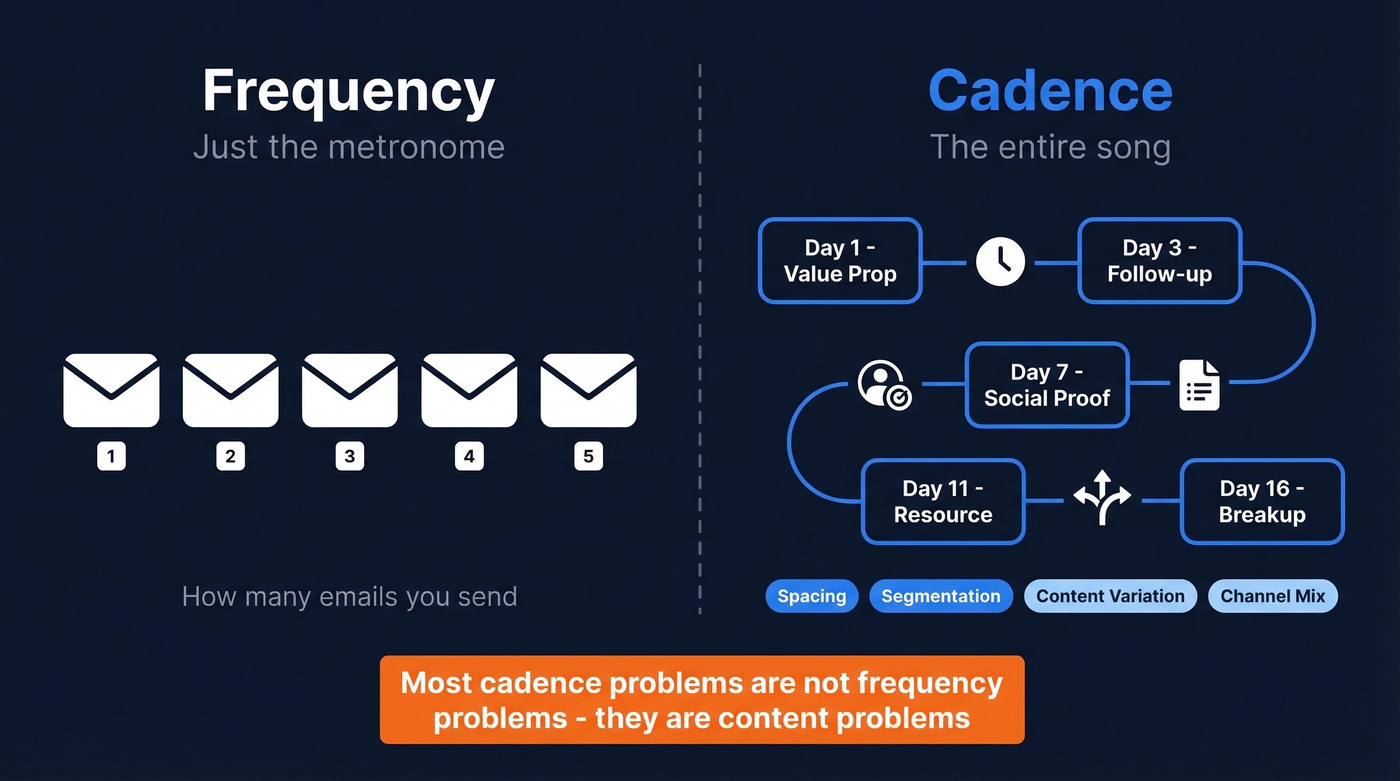
Frequency is just "how many" - three emails a week, ten a month, whatever. Cadence is the full orchestration: when you send, how often, to whom, and with what message. Think of frequency as the metronome. Cadence is the entire song - the rhythm, the dynamics, the arrangement. A cadence accounts for spacing between touches, audience segmentation, content variation across each step, and channel mix across email, phone, and social.
This distinction matters because most cadence problems aren't frequency problems. Sending five emails instead of three won't fix a sequence where every follow-up says "just checking in." The cadence framework forces you to think about what each touch adds, not just how many touches you're sending.
2026 Benchmarks Worth Knowing
Cold Email
The Instantly 2026 benchmark report is the best dataset for cold outbound right now. Here's what the numbers look like across billions of interactions:
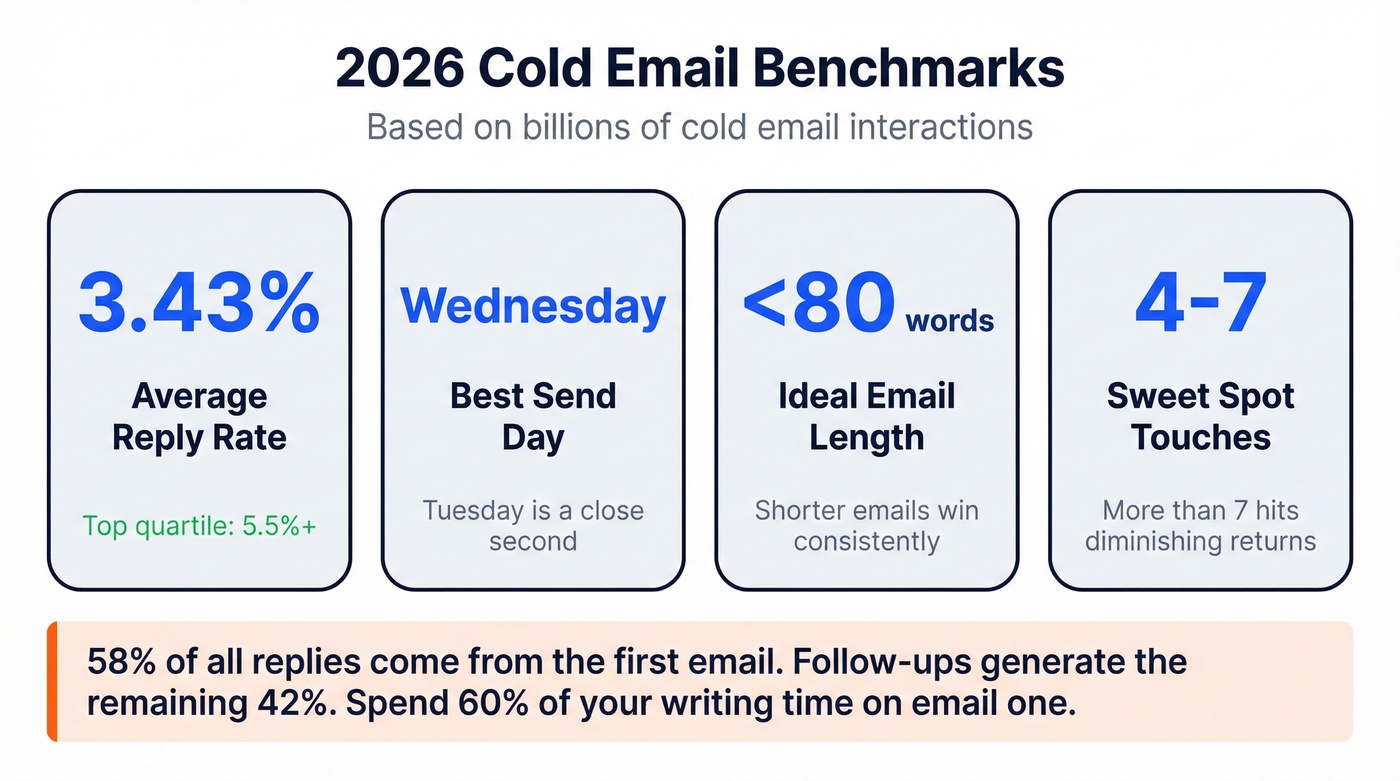
| Metric | Average | Top Quartile | Elite |
|---|---|---|---|
| Reply rate | 3.43% | 5.5%+ | 10%+ |
| Best day | Wednesday | Tue-Wed | Tue-Wed |
| Ideal length | <80 words | <80 words | <80 words |
| Sweet spot touches | 4-7 | 4-7 | 4-7 |
The most important stat: 58% of all replies come from the first email. Follow-ups generate the remaining 42%. That means follow-ups absolutely matter, but your first touch carries disproportionate weight. If email one doesn't land, the rest of the sequence is fighting uphill.
Marketing Email
Marketing cadences operate on different math. Klaviyo's benchmark data across 183,000+ customers reveals something striking: automated flows generate roughly 41% of total email revenue from just 5.3% of send volume. Flow click rates run 5.58% versus 1.69% for campaigns - over 3x higher.
| Industry | Open Rate | CTR | CTOR |
|---|---|---|---|
| Ecommerce | 38.58% | 1.34% | N/A |
| SaaS/Tech | 38.14% | 1.19% | 6.81% |
| B2B Services | ~36% | ~2.0% | N/A |
Email marketing ROI sits at 36:1 to 40:1 on average, with some US-focused studies reporting as high as 68:1. The takeaway is clear: triggered, behavior-based cadences dramatically outperform batch campaigns.
How Many Emails Should You Include?
RAIN Group's research across 489 outbound sellers found it takes 8 touchpoints on average to secure an initial meeting. But here's the nuance: top performers convert 52 out of every 100 target contacts versus just 19 for everyone else. More touches doesn't mean better results - better touches do.
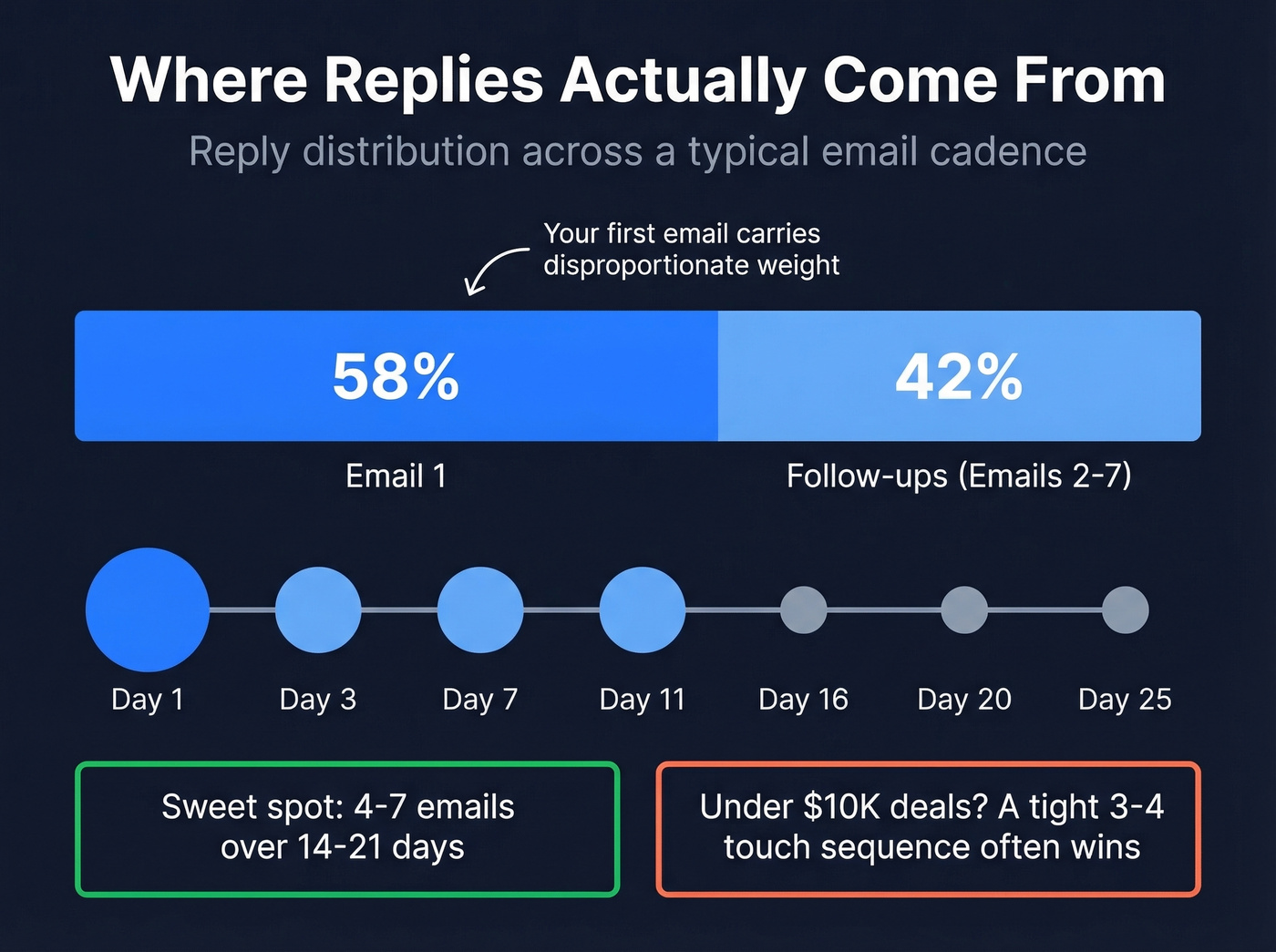
The Instantly data narrows the sweet spot to 4-7 emails for cold outbound specifically. Fewer than 4 and you're giving up too early, since 42% of replies come from follow-ups. More than 7 and you're hitting diminishing returns unless each message genuinely introduces new value.
That 58%/42% first-touch vs. follow-up split should shape how you allocate effort. Spend 60% of your writing time on email one. Make it sharp, personalized, and under 80 words. Then design follow-ups that each bring something new - a case study, a relevant data point, a different angle. "Just checking in" emails are dead weight. Stop writing them.
Let's be honest: if your average deal size is under $10K, you probably don't need a 7-step sequence at all. A tight 3-4 touch sequence with verified data will outperform a bloated 10-touch sequence built on a dirty list every single time. The consensus on r/sales is that prospects find most cadences "out of control" with "awful templates" and "annoying frequency." Shorter and sharper beats longer and lazier.
The Deliverability Reality Check
Your cadence strategy doesn't matter if your emails don't reach the inbox. Average inbox placement sits at just 84%. That means 16.9% of emails never reach the intended recipient, and 10.5% land directly in spam. For a 1,000-contact sequence, that's 169 emails that vanish before anyone sees your carefully crafted subject line.
The technical basics - SPF, DKIM, DMARC authentication - are table stakes. But the biggest deliverability killer is bad data. Invalid emails generate hard bounces, which torch your sender reputation, which pushes even your valid emails into spam. It's a death spiral, and we've watched teams spend months recovering from it.


A 28% bounce rate doesn't just kill your cadence - it torches your domain reputation for weeks. Prospeo's 5-step verification and 7-day data refresh cycle keep your list clean so every email in your sequence reaches a real inbox. At $0.01 per email, fixing your data costs less than one wasted send day.
Stop tuning a cadence built on broken data.
58% of replies come from email one - but only if it reaches the inbox. Teams using Prospeo's 98% accurate emails book 35% more meetings than Apollo users and 26% more than ZoomInfo users. Your cadence templates are ready. Make sure your contact data is too.
Build your next cadence on data that actually delivers.
Best Days and Times
A Bloomreach roundup of send-time research found 27% of US marketers report Tuesday as their highest-engagement day, followed by Monday at 19% and Thursday at 17%. The 10am-2pm window is consistently the peak across nearly every study.
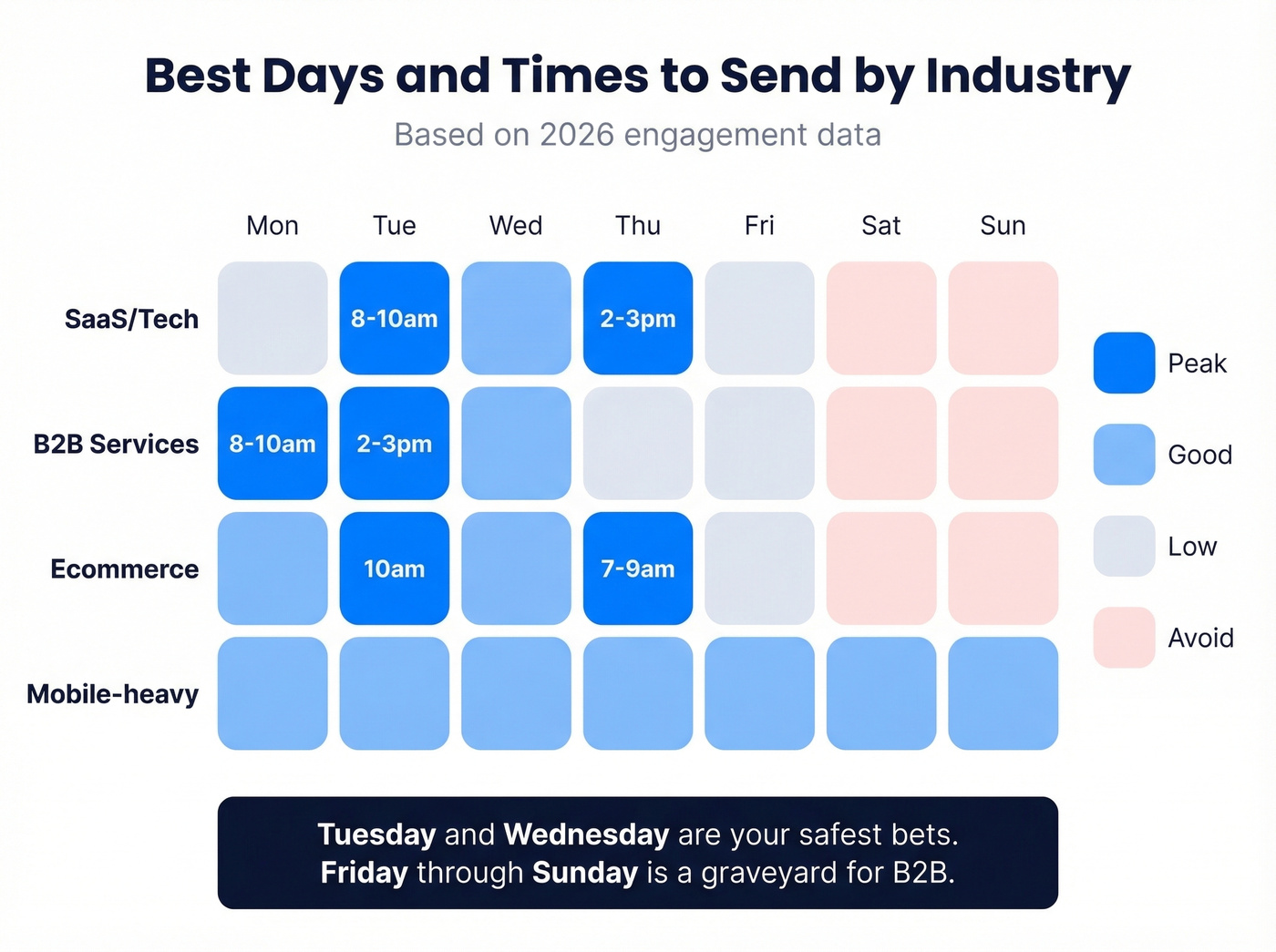
| Industry | Best Days | Best Times |
|---|---|---|
| SaaS/Tech | Tue, Thu | 2-3pm |
| B2B Services | Mon, Tue | 8-10am |
| Ecommerce | Tue, Thu | 10am |
| Mobile-heavy | Daily | 7-9am, 7-10pm |
Tuesday and Wednesday are your safest bets. Friday through Sunday is a graveyard for B2B - open rates crater and you're competing with weekend noise. If your audience skews mobile, consider early morning or evening sends when people are scrolling on their phones.
Sales Cadence Templates
Cold Outbound (5-Email Sequence)
Space your first two emails 1-2 days apart to build momentum, then widen to 3-4 days for the remaining touches. This front-loaded spacing mirrors how top-performing cadences are structured - urgency early, patience later.
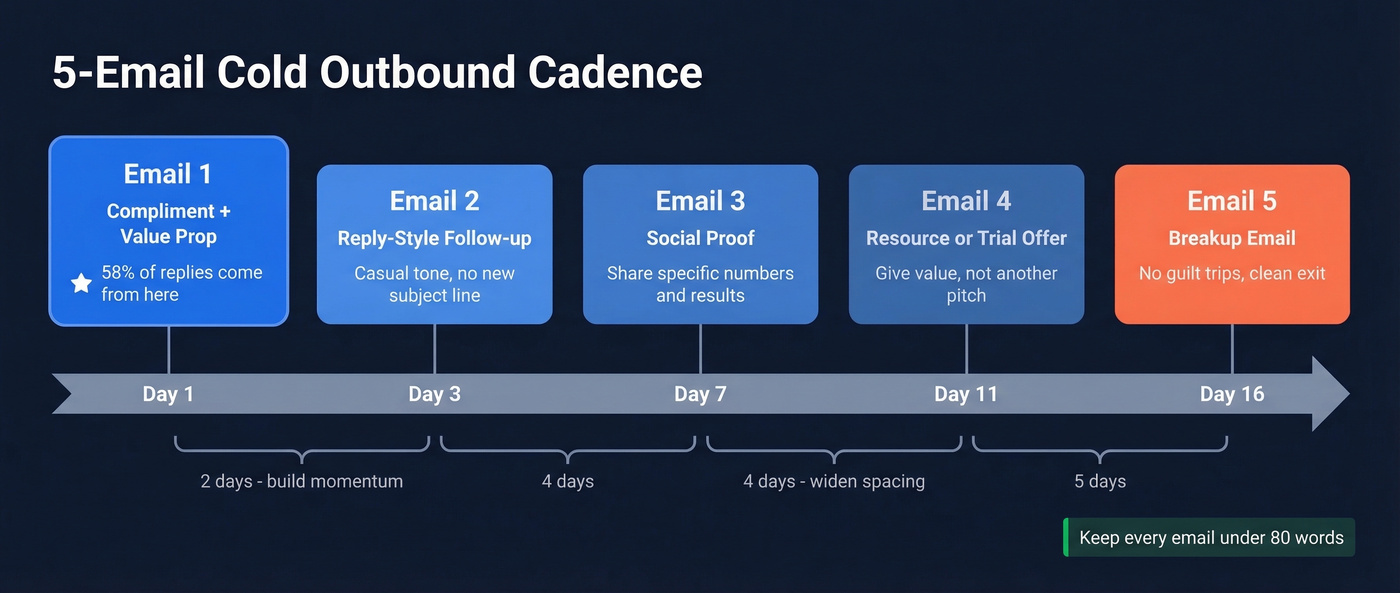
Email 1 (Day 1) - Compliment + Value Prop
This email carries 58% of your total reply potential. Make it count.
Subject: Quick question about [specific initiative]
Hi [Name],
Saw [Company] just [specific trigger - funding round, new hire, product launch]. When teams hit that stage, [specific problem] usually becomes a bottleneck fast.
We helped [similar company] cut [metric] by [result] in [timeframe]. Worth a 15-min call to see if that's relevant?
Keep it under 80 words. One specific observation, one clear value prop, one ask.
Email 2 (Day 3) - Reply-Style Follow-Up
Write it like you're replying to your own email - no new subject line, casual tone. Reply-style follow-ups outperform formal follow-ups by roughly 30%.
Figured this might've gotten buried. The short version: we helped [similar company] [specific result]. Happy to share how - would [day] work for a quick call?
Email 3 (Day 7) - Social Proof
Share a specific result with numbers. "We helped [company in their vertical] increase [metric] by [percentage] in [timeframe]." Numbers beat adjectives every time.
Email 4 (Day 11) - Resource or Trial Offer
Give them something useful - a relevant case study, a free audit, a trial. This is your value-add touch, not another pitch.
Email 5 (Day 16) - Breakup
Subject: Should I close your file?
Hi [Name], I'll assume the timing isn't right - totally get it. If [problem] becomes a priority down the road, here's where to find us: [link]. Either way, wishing you a strong Q[X].
Clean, no guilt trips. Breakup emails often generate the strongest reply rates in a sequence because they remove pressure.
Warm Inbound (3-Email Sequence)
Inbound leads already raised their hand, so the cadence compresses. Space emails 1-2 days apart and reference the specific action they took. Email 1 goes out within an hour of the trigger. Email 2 adds context or a case study. Email 3 is a direct ask for a conversation.
Stalled Deal Re-engagement
For deals that went dark, run 2-3 emails over 10 days. Each touch must introduce genuinely new information - a product update, a relevant industry shift, a new case study from their vertical. Skip this approach entirely if the deal went cold more than 90 days ago; at that point you're better off treating them as a fresh cold prospect.
Marketing Cadence Templates
Welcome Series
Your welcome series is the highest-ROI cadence you'll build. Automated flows generate 41% of email revenue from just 5.3% of sends, and the welcome series is the most common flow driving those numbers.
Structure 3-5 emails over the first two weeks. Email 1 delivers whatever they signed up for plus a brand introduction. Email 2 on Day 2 features your best content or top product. Email 3 on Day 5 provides social proof. Emails 4-5 across Days 8-14 prompt segmentation or present a first offer.
Lifecycle Cadences
Sending the same newsletter to a new subscriber and a three-year customer is lazy, and your engagement metrics will reflect it. Build distinct cadences for each stage: awareness gets educational content at 2-3x per week for B2C and 1-2x for B2B, consideration gets case studies and product deep-dives, and retention gets loyalty offers and re-engagement triggers.
Re-engagement Sequence
For subscribers who haven't opened or clicked in 60-90 days, run a tight 2-3 email re-engagement sequence. If they don't respond, suppress them. Continuing to email unengaged contacts hurts your deliverability and inflates your list costs. Let them go.
Practices That Actually Move the Needle
Signal-based personalization achieves 18% response rates versus 3.4% for generic outreach. That's a 5x difference from a single variable. Reference job changes, funding rounds, tech stack, or hiring patterns - not just first names. In our experience, this one change moves reply rates more than any subject line test.
With that as your foundation:
Segment before you send. A cadence that works for enterprise CFOs won't work for startup founders. Build separate sequences for distinct ICPs (see Ideal Customer Profile scoring).
Keep subject lines to 6-10 words. Shorter subjects in the 21-40 character range hit the highest open rates (use these cold email subject line examples as a starting point).
Body length matters. Under 80 words for cold email. 50-125 words is the optimal range for response rates (more in our email copywriting guide).
Mix channels. Phone calls drive disproportionate responses despite representing only 20-30% of touches in top-performing multichannel cadences. Even one well-timed call between emails can double your conversion rate.
A/B test weekly. Top-performing campaigns test messaging constantly - subject lines, CTAs, send times, email length.
Stop sequences on negative signals. Out-of-office, unsubscribe, "not interested" - pull them immediately. Continuing to email after a negative signal is how you end up on blocklists (and need Spamhaus blacklist removal).
And track reply rate, not open rate. Apple Mail Privacy Protection has made open rates unreliable. Reply rate for sales and click-through rate for marketing are the metrics that actually correlate with revenue. Go one step further and track response time variance across sequence steps to identify where your cadence loses momentum.
Best Tools for Email Cadence
| Tool | Type | Starting Price | Best For |
|---|---|---|---|
| Prospeo | Data / verification | Free (75/mo), ~$0.01/email | Clean lists before sequences |
| Instantly | Cold email | ~$30/mo | Cold outbound at scale |
| Apollo | Sales engagement | Free, ~$49/user/mo | All-in-one prospecting |
| Outreach | Enterprise engagement | ~$1,000-$2,500/seat/yr | Multichannel enterprise |
| Salesloft | Enterprise engagement | ~$1,000-$2,500/seat/yr | Revenue workflows |
| HubSpot Sales Hub | CRM + sequences | Free, ~$20-$100+/user/mo | Teams already in HubSpot |
| Mailchimp | Marketing email | Free (500 contacts), ~$13/mo+ | SMB marketing |
| ActiveCampaign | Marketing automation | ~$29/mo | Complex automations |
| Brevo | Marketing email | Free (300/day), ~$25/mo+ | Budget-conscious teams |
| Klaviyo | Ecommerce email | Free (250 contacts) | Ecommerce lifecycle |
Sales teams should pair Instantly or Apollo for sequencing with Prospeo for verified contact data - 98% accuracy with native integrations that push clean data directly into your sequencer (see our email deliverability guide and email reputation tools). Enterprise orgs running multichannel cadences should evaluate Outreach or Salesloft. For marketing, Klaviyo dominates ecommerce, ActiveCampaign handles complex automations well, and Brevo is the budget pick per Reddit consensus.
Email Cadence FAQ
What's the difference between cadence and sequence?
A sequence is the specific series of emails you send - the actual messages in order. A cadence is the broader system governing that sequence: timing, spacing, segmentation, channel mix, and content strategy. Every sequence follows a cadence, but a cadence can span multiple sequences across different audience segments and channels.
How many follow-up emails should I send?
Four to seven total touchpoints is the sweet spot for cold outreach based on 2026 data. Beyond seven, returns diminish sharply unless each email introduces genuinely new value. For marketing, build 3-5 emails in a welcome series, then transition subscribers into ongoing lifecycle cadences segmented by engagement level.
What's the best sales email cadence for B2B?
A 5-email sequence over 14-16 days, with 1-2 day spacing early and 3-4 day spacing later. Lead with a personalized value prop under 80 words, follow up with social proof and a resource offer, and close with a clean breakup email. Layer in one phone call between emails 3 and 4 for the best results. Verify your list before sending - a 28% bounce rate will undo everything else.
How do I know if my cadence is working?
Track reply rate for sales and click-through rate for marketing - not open rate, which Apple Mail Privacy Protection has made unreliable. A cold email reply rate above 5% is strong; above 10% is elite. For marketing, benchmark your CTR against industry averages, which typically fall between 1.3% and 2.6% depending on vertical.
What free tools help with email cadence and list quality?
Prospeo offers 75 free email verifications per month plus 100 Chrome extension credits - enough to validate a starter list before launching your first sequence. Apollo and HubSpot Sales Hub both have free tiers for basic sequencing. Pair a free sequencer with verified data to avoid the bounce-rate spiral that kills sender reputation.