

Email Cadence Examples: Templates, Timing, and Benchmarks That Work
You load 500 contacts into your sequencer, hit send, and 47 bounce before lunch. Your domain takes the hit, your open rate craters, and the cadence you spent two hours writing never gets a fair shot.
Cold email open rates dropped from 36% to 27.7% between 2023 and 2024. A bad cadence accelerates that decline. A good one fights it. The email cadence examples below are the ones we've seen actually work - not theory, not recycled "best practices" from 2019.
The Quick Version
- Keep emails 40-60 words with a specific offer and a soft CTA.
- Use the 3-7-7 timing framework (Day 0, Day 3, Day 10, Day 17) - 93% of replies come by Day 10.
- Lead with a trigger or news hook. They pull 2.3x more replies than problem-based openers.
- Segment into cohorts of 50 or fewer contacts - smaller batches pull 2.76x higher reply rates.
- Verify your list before you send. Bounces kill your domain and your cadence.
How Many Emails and When
It takes an average of 5 touches to engage a prospect. Executives typically need around 9. Lower-level contacts often respond by touch 4. The mistake most teams make isn't sending too few emails - it's spacing them wrong.
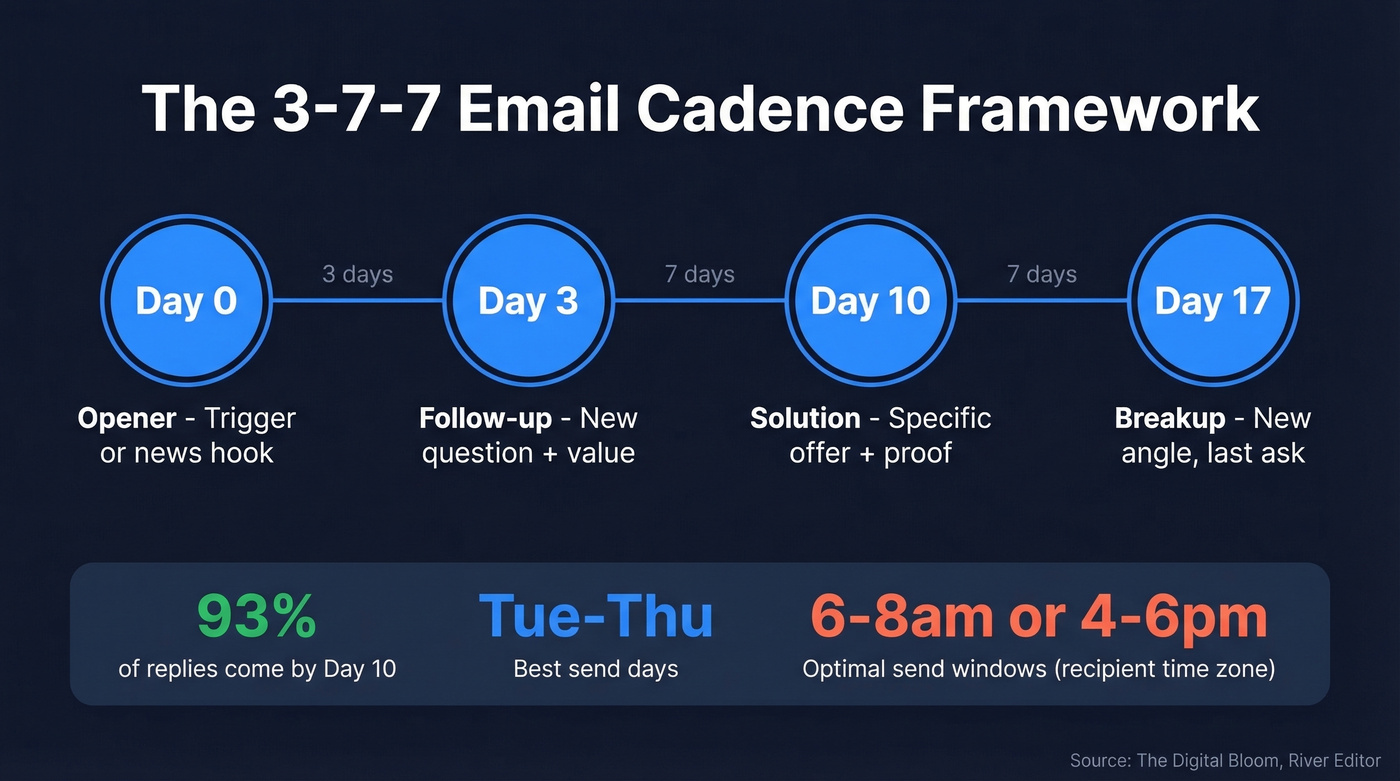
The 3-7-7 framework gives you a reliable skeleton: send your opener on Day 0, follow up Day 3, then Day 10, then Day 17. That captures the vast majority of replies. Best send days are Tuesday through Thursday, either 6-8am or 4-6pm in the recipient's time zone - before the inbox floods or after the afternoon lull.
If you're closing deals under five figures, you probably don't need a 9-touch cadence. Five emails with tight copy will outperform nine mediocre ones every time. Volume is a crutch for weak messaging.
The Email Format Getting Replies in 2026
The emails getting replies right now are absurdly short - 40-60 words. Offer quality matters more than personalization depth. "I read your blog post" doesn't move anyone if the offer is weak.
Here's a 47-word template following the format practitioners on r/copywriting are reporting results with:
Subject: Saw you're hiring 3 AEs
Hi {{first_name}}, noticed you're scaling the sales team. We helped [similar company] go from 12 to 40 booked demos/month in 90 days without adding headcount. Built a quick breakdown of how it'd work for {{company}}. Worth a conversation?
Four elements: context hook, ICP-relevant outcome, proof, soft CTA. "Worth a conversation?" outperforms hard meeting asks every time.
3 Proven Cadence Templates
Cold Prospect Cadence (5 Emails, 18 Days)
| Day | Touch | Content Focus |
|---|---|---|
| 0 | Email 1 | Trigger/news hook + question |
| 3 | Email 2 | Follow-up question + brief value |
| 10 | Email 3 | Solution-focused, specific offer |
| 14 | Email 4 | Case study with metrics |
| 18 | Email 5 | Breakup - new angle, last ask |
Email 1 leads with a trigger - a hiring post, a funding round, a product launch. Timeline hooks pull a 10.01% reply rate vs. 4.39% for generic problem hooks. Don't mention your company in this first touch. Ask a question that shows you understand their world.
Email 2 template (follow-up):
Hi {{first_name}}, quick follow-up on my note about {{trigger}}. Curious - are you handling {{pain point}} in-house or exploring outside help? Happy to share what's working for teams like yours. Either way, no pressure.
This touch adds a new question and a low-friction offer. It doesn't rehash Email 1 - it advances the conversation.
Emails 3-4 layer in your solution and a case study. "[Company X] cut churn by 30% in 90 days" beats another paragraph about your platform. Case study touches work mid-sequence because they make the outcome concrete and give the prospect something to forward internally.
Email 5 template (breakup):
Hi {{first_name}}, I'll keep this short - looks like the timing isn't right, and I don't want to clog your inbox. If {{outcome}} ever becomes a priority, here's a 2-min case study: [link]. Wishing you a strong Q{{quarter}}.
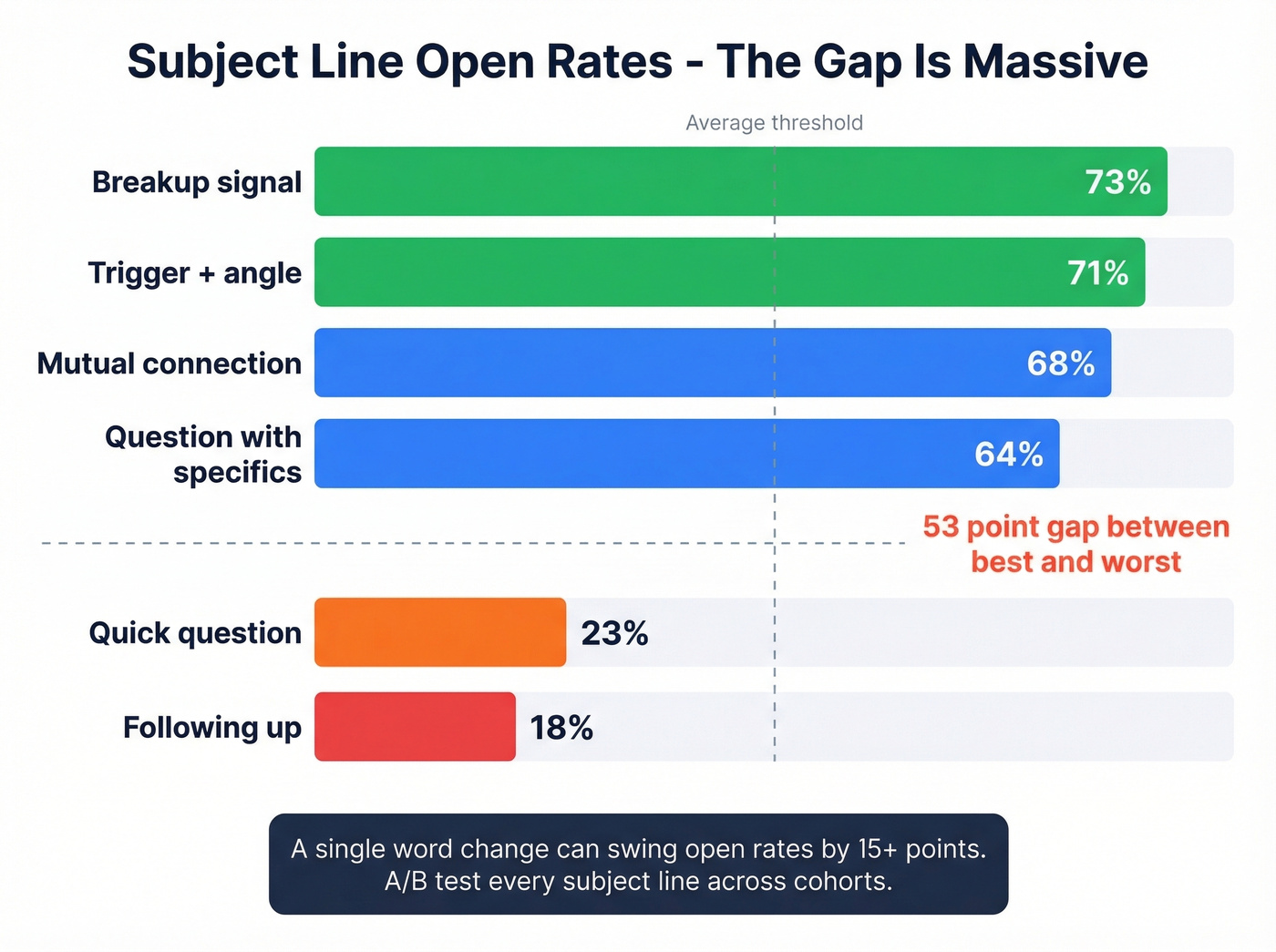
Breakup subject lines hit 73% open rates. People pay attention when you signal you're leaving. Change the angle entirely from your previous touches.
Warm Lead Cadence (3 Emails, 10 Days)
Warm inbound leads often convert with 3-5 emails. They need speed and relevance, not nurturing.
Day 0 - Reference the shared context immediately:
Hi {{first_name}}, great connecting at {{event}}. You mentioned {{specific detail from conversation}}. I put together a quick {{resource}} based on what we discussed - think it'll save your team real time on {{pain point}}. Want me to send it over?
Day 3 - Deliver the value-add resource tied to the original conversation. Don't re-pitch. Just give them something useful and let the quality of the resource do the selling.
Day 10 - Direct ask with social proof. Mutual-connection subject lines hit 68% open rates. By this point, you've earned the right to be direct: "Would Thursday or Friday work for 20 minutes?"
The cadence is tighter because the relationship already exists. You're converting attention into action, not building awareness from scratch.
Re-Engagement Cadence (4 Emails, 21 Days)
Re-engagement means they've gone cold - either from a previous sequence or a stalled deal. Every touch needs a completely different angle. Don't reference the old conversation. Start fresh with a new trigger.
- Day 0: New trigger or company news. "Saw you just opened a Chicago office - congrats. That changes the math on {{solution}}."
- Day 7: Different angle entirely - share an industry insight or resource they haven't seen.
- Day 14: Case study from their specific industry. Make it impossible to ignore the relevance.
- Day 21: Breakup with a fresh offer. New angle, last ask.
The Day 30+ and Day 60+ re-engagement touches from high-performing sequences use trigger-based timing rather than fixed intervals - wait for a signal, then strike.

47 bounces before lunch means your cadence never had a chance. Prospeo's 5-step email verification delivers 98% accuracy - so your 3-7-7 framework hits real inboxes, not spam traps. Teams using Prospeo cut bounce rates from 35%+ to under 4%.
Stop writing perfect cadences for bad data. Fix the list first.
Subject Lines That Get Opened
Keep subject lines under 33 characters for mobile. Avoid "Re:" tricks and spam triggers like "Free" or "Guarantee."
| Subject Line Style | Open Rate |
|---|---|
| Trigger + angle | 71% |
| Breakup signal | 73% |
| Mutual connection | 68% |
| Question w/ specifics | 64% |
| "Quick question" | 23% |
| "Following up" | 18% |
The gap between a trigger-based subject line and "Following up" is 53 percentage points. That's not a marginal improvement - it's a different sport entirely. We've seen a single word change in a subject line swing open rates by 15+ points, so A/B test across cohorts religiously.
When the Cadence Ends
No opens after 5 emails? Move them to a long-term nurture. Six pieces of valuable content over six months. Don't keep hammering - you're training their inbox to ignore you.
Multiple opens but no reply? They're interested but not ready. Escalate to a personalized video via Vidyard or Loom, layer in phone and other channels, then fall back to nurture. The best-performing teams we've worked with blend at least three channels in their sequences.
Here's the thing: if your messaging isn't resonating after 5 well-crafted emails, the problem isn't volume. Stop adding touches and fix the message.
Mistakes That Kill Your Sequences
Research shows 71% of cold emails are ignored for lacking relevance, and 43% fail on personalization. Here are the five fastest ways to destroy a cadence:
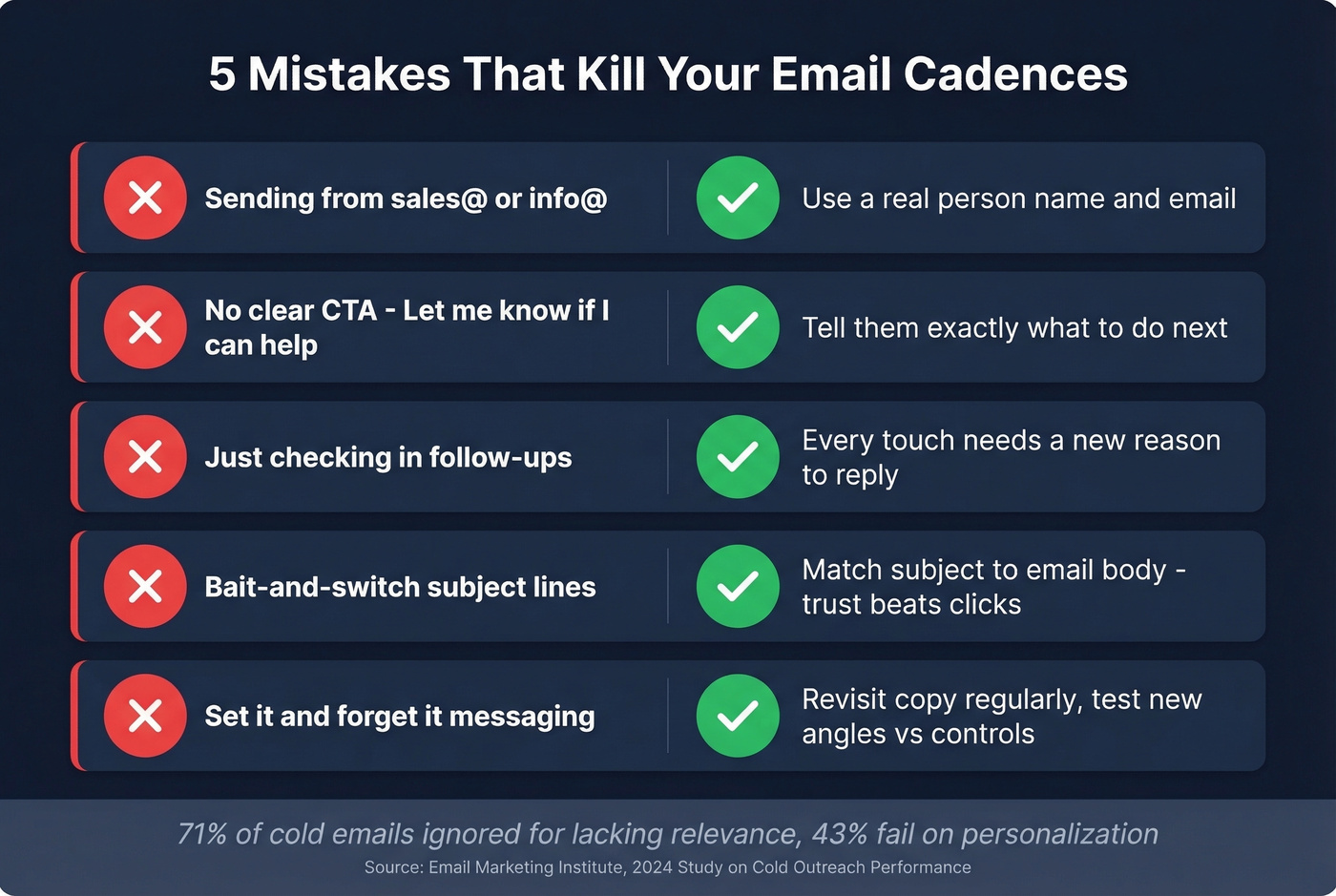
- Sending from sales@ or info@. Use a real person's name. Impersonal sender addresses get filtered before anyone reads a word.
- No clear CTA. "Let me know if I can help" isn't a CTA. Tell them exactly what to do next.
- "Just checking in" follow-ups. Every touch needs a new reason to reply. If you don't have one, don't send. (If you need alternatives, see checking in.)
- Bait-and-switch subject lines. A clever subject line that has nothing to do with the email body tanks trust instantly. Your open rate looks great; your reply rate tells the real story.
- Set-it-and-forget-it messaging. Cadences go stale. Revisit copy regularly and test new angles against your controls.
Your Data Is the Real Problem
Let's be honest - the best cadence in the world fails silently when your contact data is bad. Bad emails lead to bounces, bounces tank your domain reputation, future emails land in spam, and your sequence is dead before you even realize what happened. If you're seeing this pattern, start with email deliverability basics and fix the list before you touch copy.
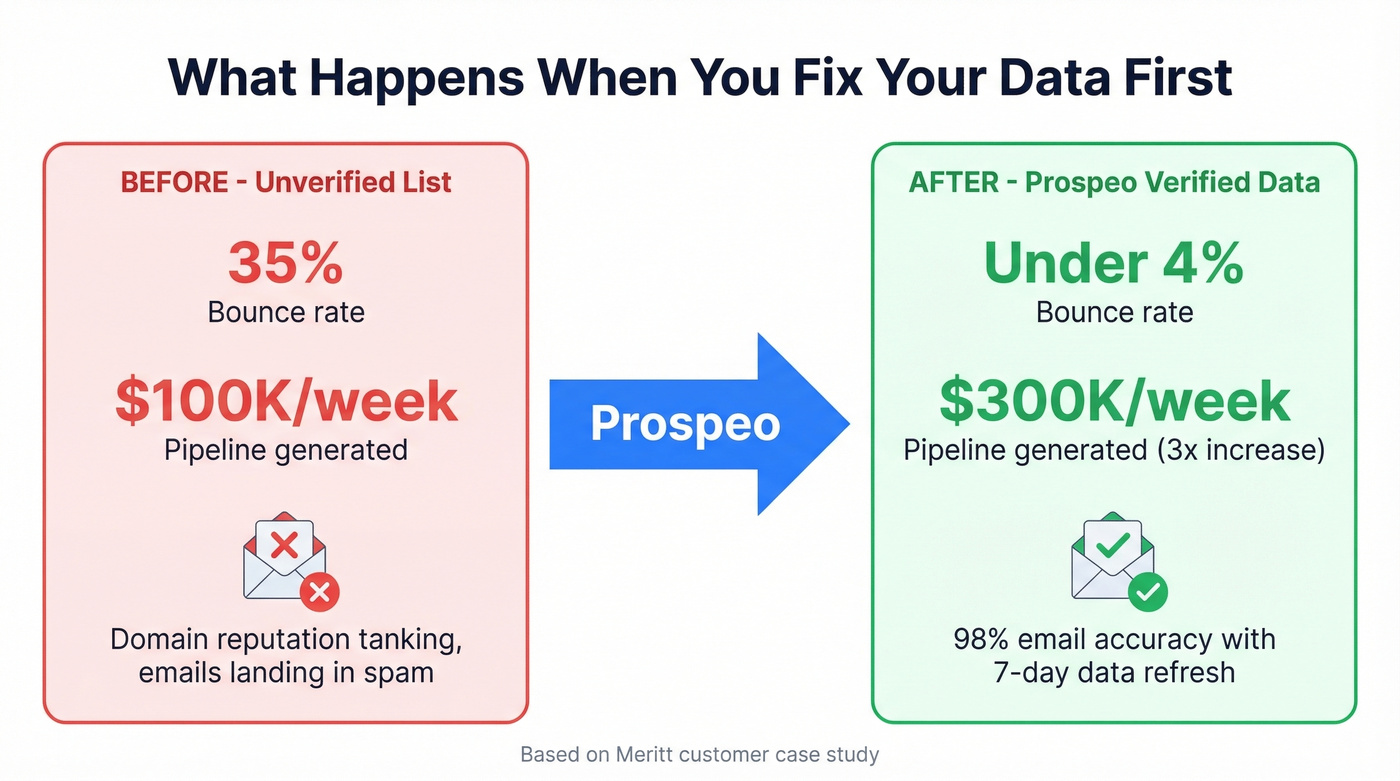
One of our customers, Meritt, lived this firsthand. Their bounce rate sat at 35% before switching to Prospeo's verified data, then dropped under 4%. Pipeline tripled from $100K to $300K per week. With 98% email accuracy and a 7-day data refresh cycle, stale records get caught before they damage your sender reputation. Verify every list before loading a sequence - that's the prerequisite step, not an afterthought. (If you want the benchmarks and fixes, start with bounce rate.)

Trigger-based openers pull 2.3x more replies - but only if you know when prospects change jobs, raise funding, or scale teams. Prospeo tracks job changes, headcount growth, and 15,000 intent topics so every Email 1 lands with a real hook.
Find the trigger. Write the hook. Send to a verified inbox. All in one platform.
Tools to Run Your Cadences
| Tool | Best For | Price Range |
|---|---|---|
| Prospeo | Data verification + enrichment | Free tier, ~$0.01/lead |
| Apollo | Starting out, all-in-one | ~$49-99/user/mo |
| Instantly | Cold email at scale | ~$30-97/mo |
| Outreach | Scaling sales teams | ~$100-200/user/mo |
| Salesloft | Enterprise workflows | ~$100-200/user/mo |
Prospeo isn't a sequencer - it's the data layer that sits before any of these tools. Run your list through its 5-step verification, export clean contacts, then push them into whichever sequencer fits your workflow. The integrations with Instantly, Lemlist, Smartlead, and Salesloft make this a two-click handoff.
Skip Outreach and Salesloft if you're a small team or solo founder. They're built for orgs with 10+ reps and the budget to match. Apollo or Instantly paired with clean data will get you further for less. If you're still building your outbound motion, start with a tighter set of sales prospecting techniques and a clean list.
FAQ
How many emails should a sales cadence have?
Five touches is the standard for engaging a prospect, though executives often need around 9. Since 93% of replies come by Day 10, front-load your strongest messaging. If 5 well-crafted emails get silence, fix the copy before adding volume.
What's the best spacing between emails?
Use the 3-7-7 framework: follow up 3 days after the opener, then 7 days, then another 7. Daily follow-ups build resentment, not curiosity. Best send windows are Tuesday-Thursday, 6-8am or 4-6pm in the recipient's time zone.
How long should cold emails be?
Aim for 40-60 words with a specific offer and a soft CTA. Anything over 100 words and you're writing for yourself, not your prospect. The four essentials: context hook, ICP-relevant outcome, proof, and a low-friction ask.
How do I improve my cadence reply rate?
Start with data quality - verify your list so bounces don't crater your domain reputation. Then use trigger-based hooks (2.3x more replies than problem hooks), keep emails under 60 words, and bring a new reason to reply in every touch.