

Email Check vs ZoomInfo: Verification Approaches Compared
Your SDR just exported 500 contacts from ZoomInfo, loaded them into Instantly, and 47 bounced on the first send. That's a 9.4% bounce rate on "verified" data - enough to torch your sender reputation in a single sequence.
The email check vs ZoomInfo debate isn't really two products going head-to-head. It's three distinct approaches: ZoomInfo's built-in verification, standalone email verifiers that clean lists after export, and platforms that deliver data fresh enough to skip re-verification entirely. We've tested ZoomInfo exports across multiple campaigns, and they consistently needed a second verification pass before they were safe to send.
30-Second Verdict
Use ZoomInfo if you need the full sales intelligence suite and can justify $15K-$40K+/year - but budget for a verification step before you send.
Use a standalone verifier (NeverBounce, ZeroBounce, Bouncer) if you're already exporting from ZoomInfo and need a $5-$10/1,000 safety net.
How ZoomInfo Verifies Emails
ZoomInfo's verification infrastructure is genuinely impressive. After acquiring NeverBounce in 2019, they integrated that technology into the core platform, building a multi-layered system running 20+ steps that checks each contact up to 75 times. Beyond standard SMTP pings, ZoomInfo supplements with proprietary send-and-bounce data, 90,000+ daily research surveys, and a 200,000+ member contributory network. They verify 20M+ email signatures per month and update 4M+ individuals and 1M+ companies daily, backed by 300+ human researchers.
The problem isn't the methodology. It's what happens between verification and the moment your SDR hits "send."
Why "Verified" Still Bounces
Email lists decay at roughly 3% per month. The math gets ugly fast: even a few weeks of delay between "verified" and "sent" can turn a clean export into a bounce problem that flags your domain.
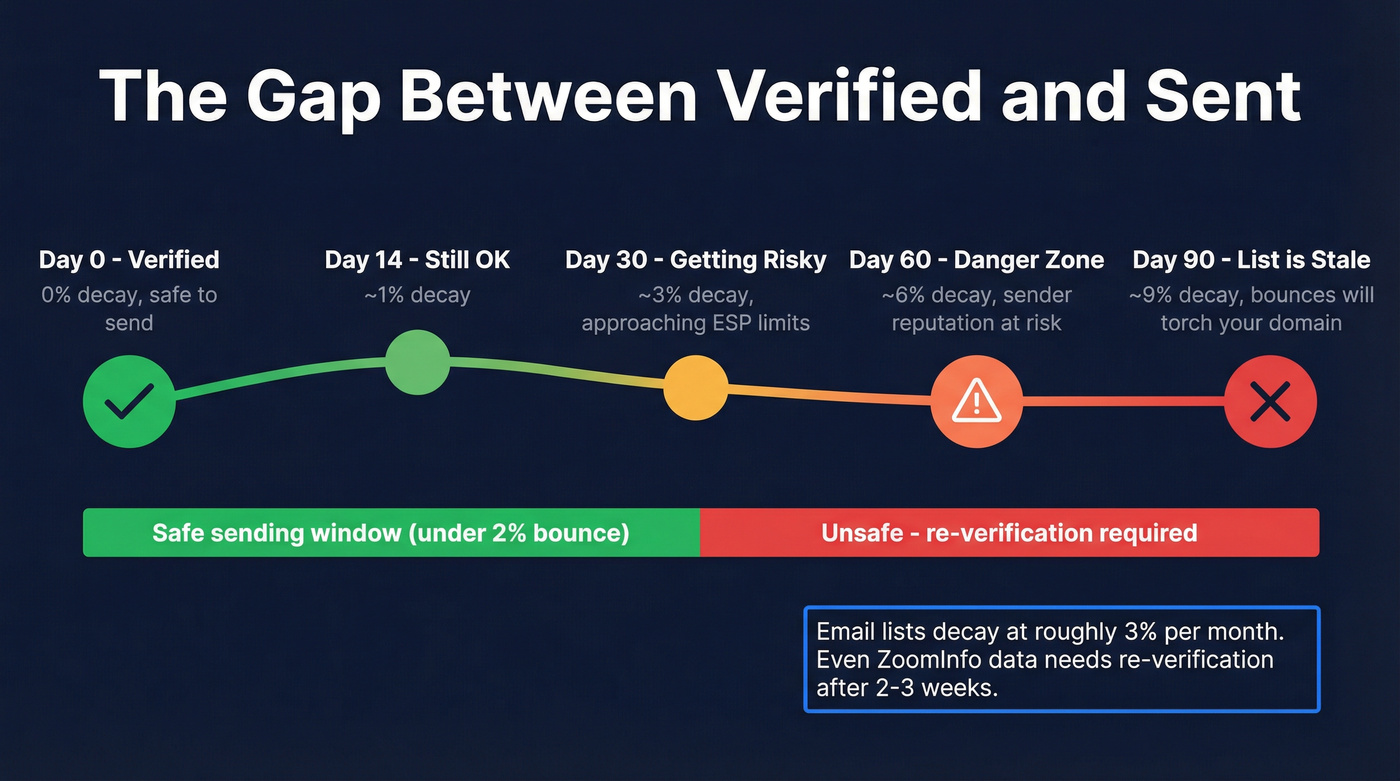
Then there's the SMTP ceiling. ZoomInfo's own documentation acknowledges that SMTP checks accurately validate only about 50% of business domains. Catch-all configurations, enterprise security layers like Mimecast and Proofpoint, and misconfigured mail servers all return false positives. Here's the thing: "verified" and "deliverable" aren't the same thing, and that gap is where your bounce rate lives.

Your ZoomInfo exports decay 3% per month. Prospeo's 7-day refresh cycle and 5-step verification - including catch-all handling and spam-trap removal - deliver 98% email accuracy straight out of the box. No NeverBounce add-on. No second verification pass.
Send directly from your export. Zero re-verification tax.
What Standalone Verifiers Actually Do
Standalone verifiers follow three steps: syntax check to confirm format, DNS/MX lookup to confirm the domain accepts mail, and SMTP handshake to confirm the mailbox exists. Tools like NeverBounce ($8/1,000), ZeroBounce ($16/2,000), and Bouncer ($7/1,000) run this pipeline on any list you upload.
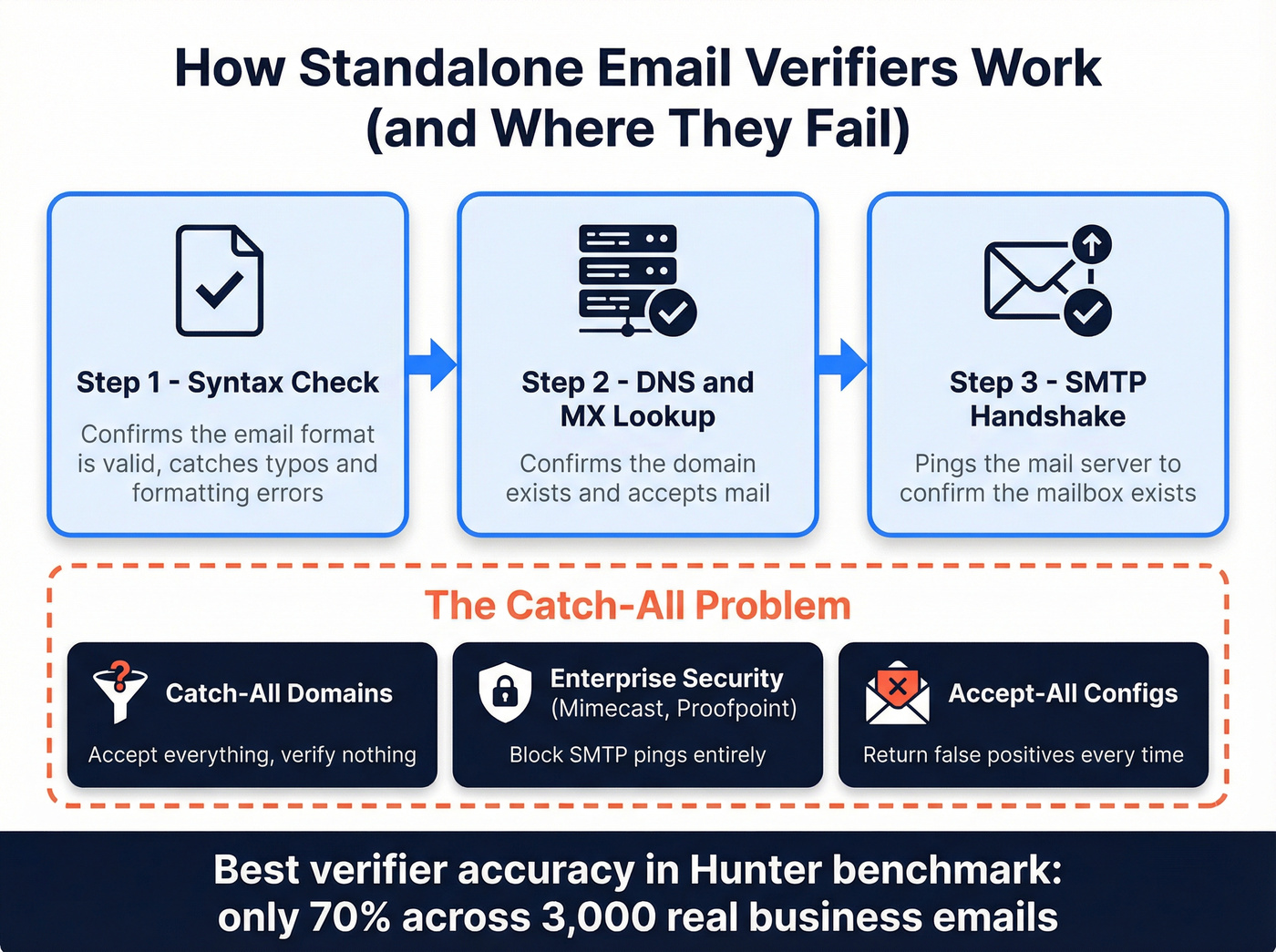
They're useful. They're also a band-aid.
A Hunter benchmark testing 15 verifiers across 3,000 real business emails found the best tool hit just 70% accuracy - largely because catch-all and accept-all domains defeat SMTP-level checks entirely. If you're selling into enterprise accounts (which tend to run catch-all configurations), that number should worry you.
Pricing Reality Check
The real cost of ZoomInfo email verification isn't the platform fee. It's the platform fee plus the verification add-on plus the credits you burn re-checking stale data.
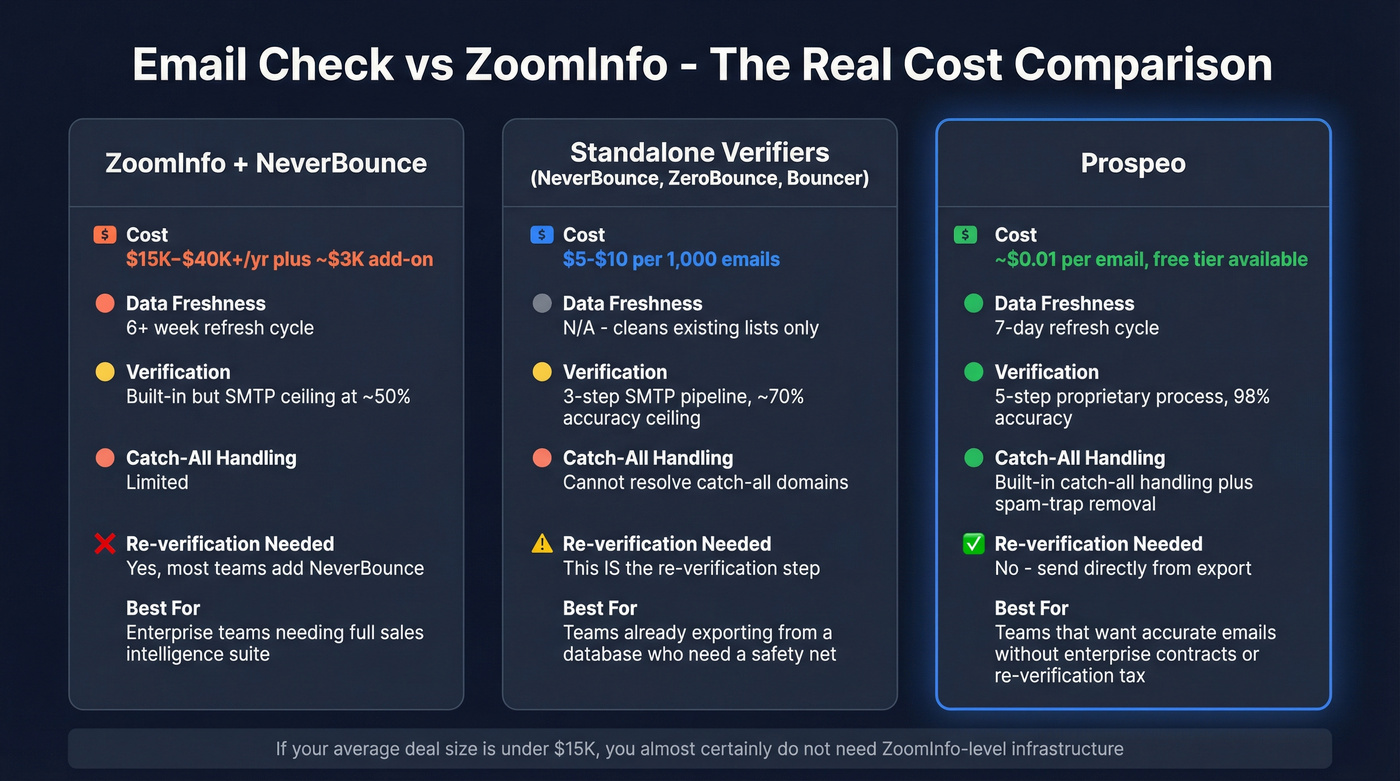
| Tool | Cost | What You Get |
|---|---|---|
| ZoomInfo | $15K-$40K+/yr | Full suite + built-in verify |
| Prospeo | ~$0.01/email, free tier | Pre-verified data + finder |
| NeverBounce add-on | ~$3,000 extra | Re-verification on ZoomInfo data |
| NeverBounce standalone | $8/1,000 PAYG; $49/mo Growth | List cleaning, 12-mo credit expiry |
| ZeroBounce | $16/2,000 PAYG | List cleaning + AI scoring |
| Bouncer | $7/1,000 PAYG | List cleaning + real-time API |
ZoomInfo users can also get 20% off their first NeverBounce credit purchase with code zoominfosave (valid through June 30) - a tacit acknowledgment that many teams still run a second verification pass. And watch out for the auto-renewal clause: cancel 60 days before renewal or you're locked in for another year.
Let's be honest - if your average deal size is under $15K, you almost certainly don't need ZoomInfo-level infrastructure. The verification gap eats most of the data advantage anyway.
Fresh Data Beats Re-Verification
The entire debate assumes you need to verify after the fact. What if you started with data accurate enough to send directly?

Prospeo's 7-day refresh cycle - compared to the industry average of roughly 6 weeks - means records rarely have time to decay. Every email runs through a proprietary 5-step verification process with catch-all handling, spam-trap removal, and honeypot filtering, covering 143M+ verified emails across 300M+ professional profiles. GDPR compliant with opt-out enforced globally. It integrates natively with Salesforce, HubSpot, Smartlead, Instantly, Lemlist, Clay, Zapier, and Make.
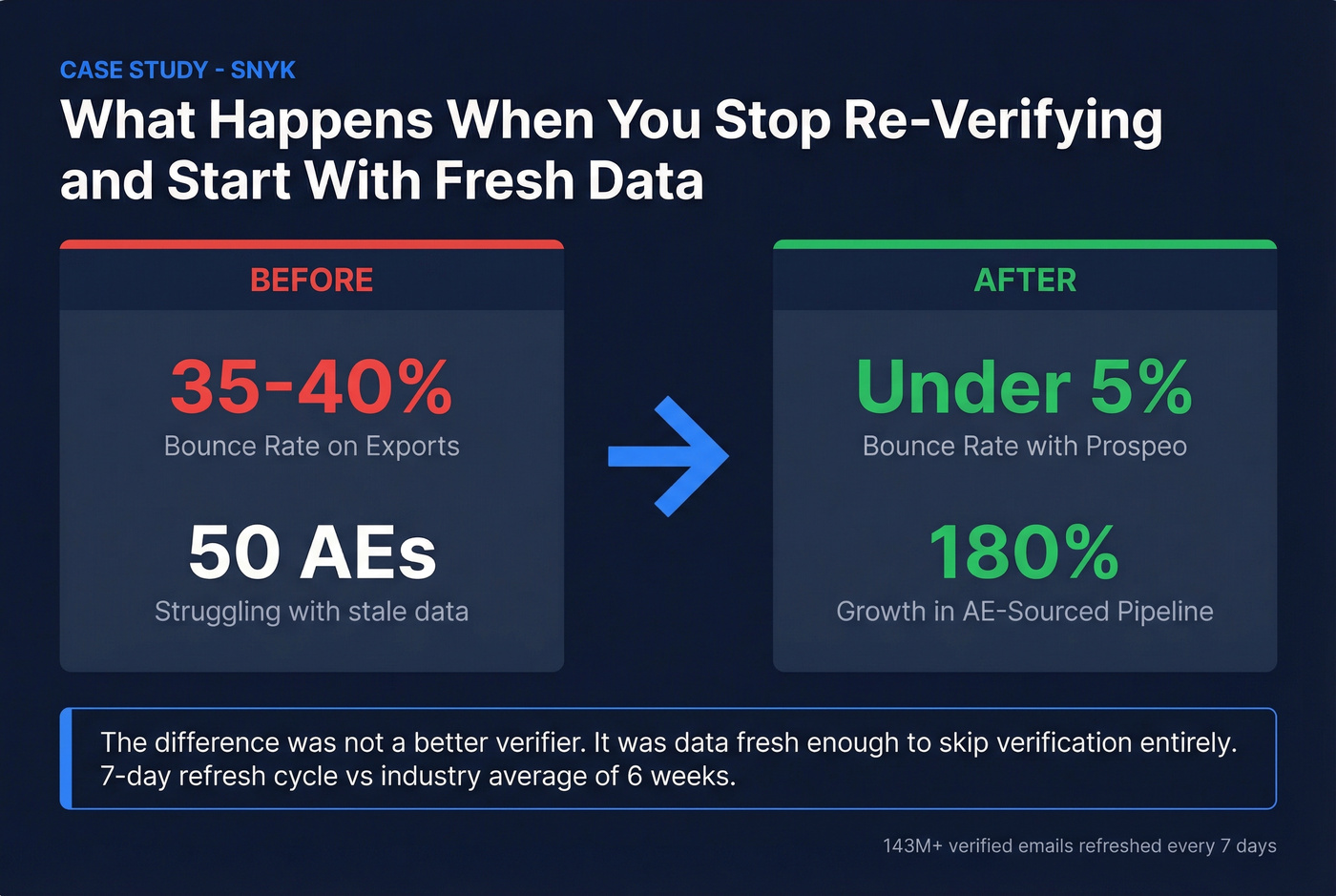
The numbers hold up in practice. Snyk rolled out this approach across 50 AEs who'd been dealing with 35-40% bounce rates. Bounces dropped to under 5%, and AE-sourced pipeline jumped 180%. That's not a marginal improvement - it's a fundamentally different workflow where you stop treating verification as a separate step and start treating it as a property of the data itself.
Snyk's 50 AEs went from 35-40% bounce rates to under 5% - and grew AE-sourced pipeline 180%. The difference wasn't a better verifier. It was data fresh enough to skip verification entirely. Prospeo refreshes 143M+ emails every 7 days at $0.01 each.
Stop verifying stale data. Start with data that's already accurate.
When to Use What
ZoomInfo makes sense when you need the full sales intelligence suite - intent signals, org charts, technographics - and can justify $15K+/yr. Just budget for a verification step on every export.
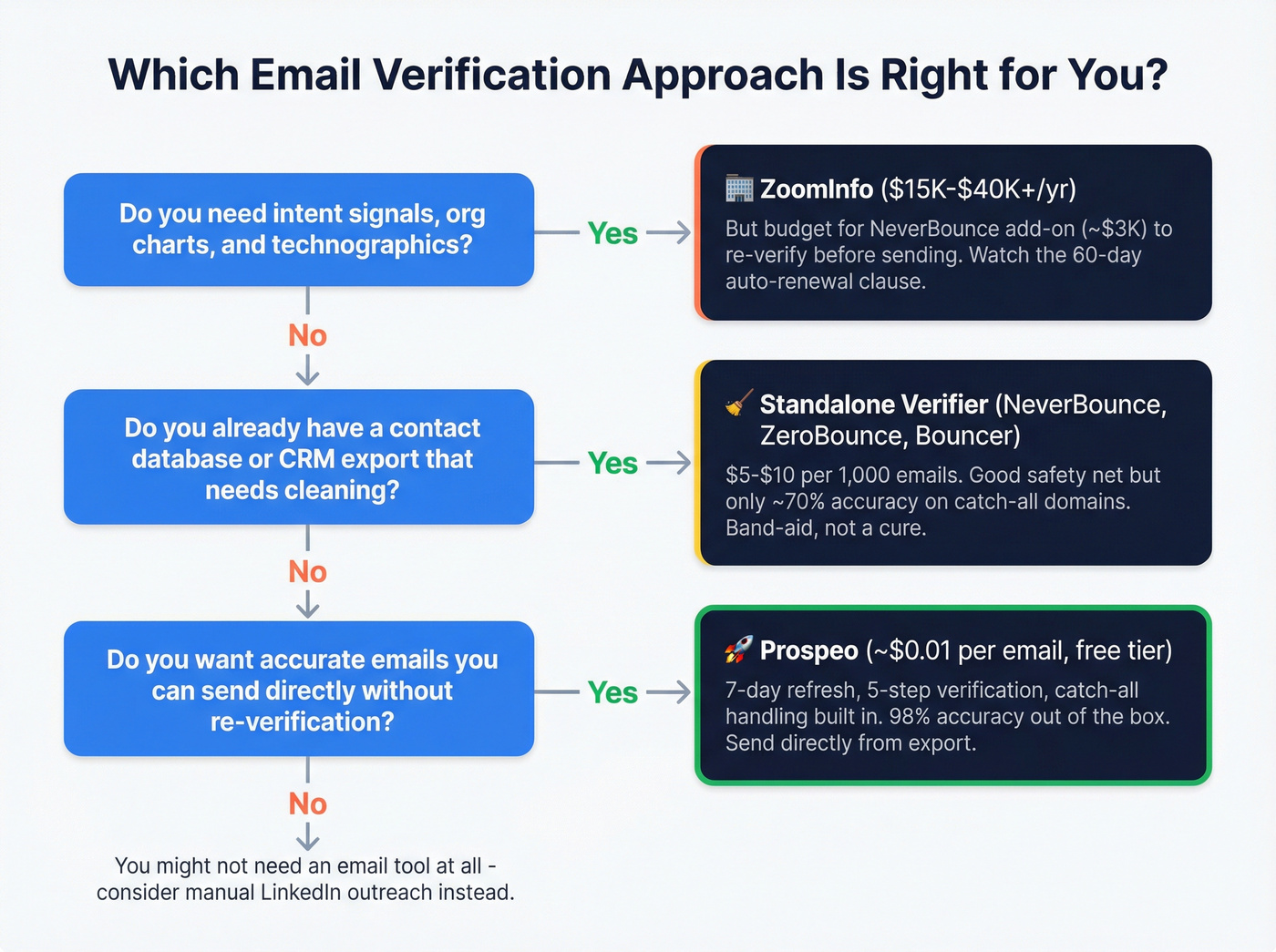
Standalone verifiers earn their keep when you're already exporting from a database and need a $5-$10/1,000 safety net to catch decay. They won't solve the catch-all problem, but they'll catch the obvious dead addresses.
For teams that want accurate emails without the enterprise contract or the re-verification tax, a fresh-data platform is the cleaner path. One tool, one cost, data fresh enough to send directly. Skip this approach if you specifically need ZoomInfo's intent data or org chart features - those aren't something an email finder replaces.
FAQ
Does ZoomInfo include email verification in all plans?
NeverBounce verification typically requires an add-on costing roughly $3,000 depending on your tier. Always confirm verification access during contract negotiations - it's not guaranteed in base packages.
What bounce rate should I expect from ZoomInfo exports?
Without re-verification, expect 5-10% bounces on lists older than 30 days. Email data decays at roughly 3% per month, so a 90-day-old export can easily cross the 2% safe-sending threshold most ESPs enforce. The consensus on r/sales is that re-verification isn't optional if you care about deliverability.
Are there alternatives that skip re-verification entirely?
Prospeo's 7-day refresh cycle and built-in catch-all handling deliver 98% accuracy out of the box. Most teams send directly from those exports without a separate verification step - at ~$0.01/email with a free tier of 75 credits per month.