

Best Email Checker Software in 2026 (We Tested 12 Tools)
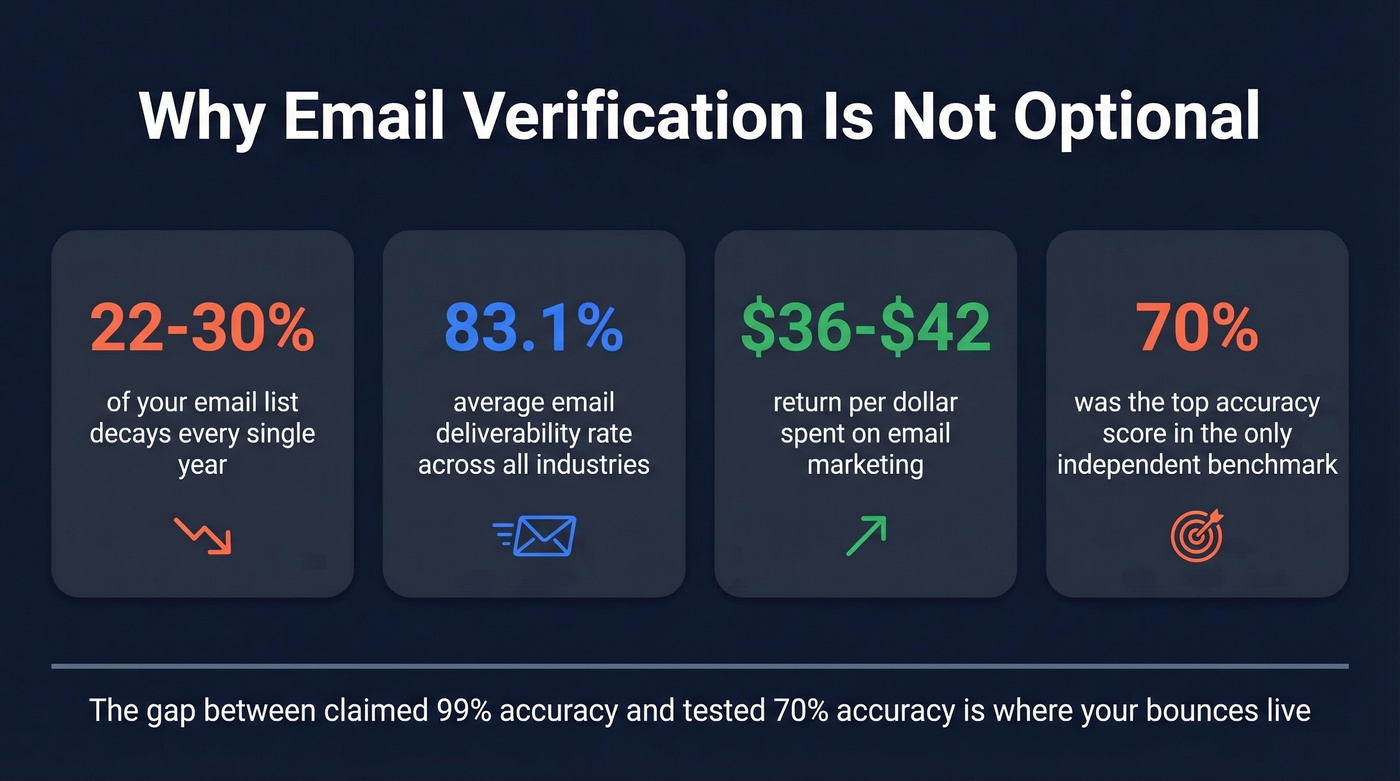
Every email checker software vendor claims 99% accuracy. It's on their homepage, their G2 profile, their sales deck. The most transparent benchmark anyone's published - Hunter's test of 3,000 real business emails - showed the top tool hitting just 70% overall accuracy. That's a 30-point gap between marketing and reality.
Meanwhile, your email lists are decaying at 22-30% per year, the average deliverability rate sits around 83.1%, and your ESP is one bad campaign away from throttling your sending domain. Email marketing returns $36-$42 per dollar spent - but only if your emails actually reach inboxes. The verification tool you pick matters far more than the accuracy number on any landing page.
How we evaluated: We signed up for free tiers or test credits across all 12 tools, ran batches against known-valid and known-invalid addresses, and cross-referenced results against Hunter's published benchmark. Where independent accuracy data existed, we weighted it heavily. Where it didn't, we relied on our own test results, G2 reviews, and community feedback from places like r/sales and r/software.
Top Picks at a Glance
| Use Case | Pick | Why |
|---|---|---|
| Accuracy + data sourcing | Prospeo | 98% email accuracy, verification built into sourcing, 7-day refresh |
| Standalone bulk verifier | Bouncer | Transparent pricing, unknowns free, credits never expire |
| Deliverability toolkit | ZeroBounce | Verification + inbox placement + blocklist monitoring |
| High-volume speed | Emailable | 30K+ verifications/min, anti-greylisting |
| Budget at scale | EmailListVerify | Lowest per-email cost for large lists |
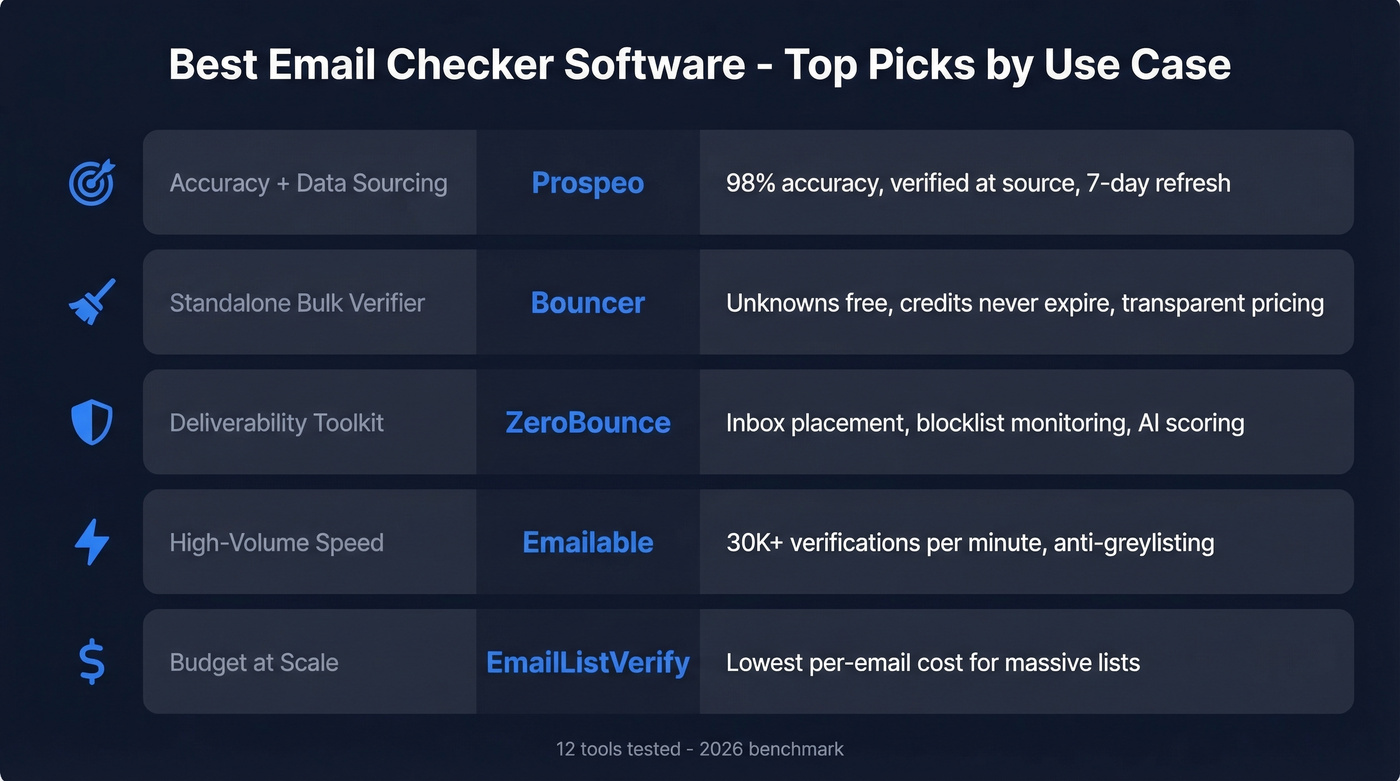
Most picks here have a free tier or test credits. Prospeo gives you 75 verified emails plus 100 Chrome extension credits per month. Bouncer and ZeroBounce don't charge for unknowns. You can test all three in an afternoon without spending a dollar.
The 12 Best Email Verification Tools
Prospeo
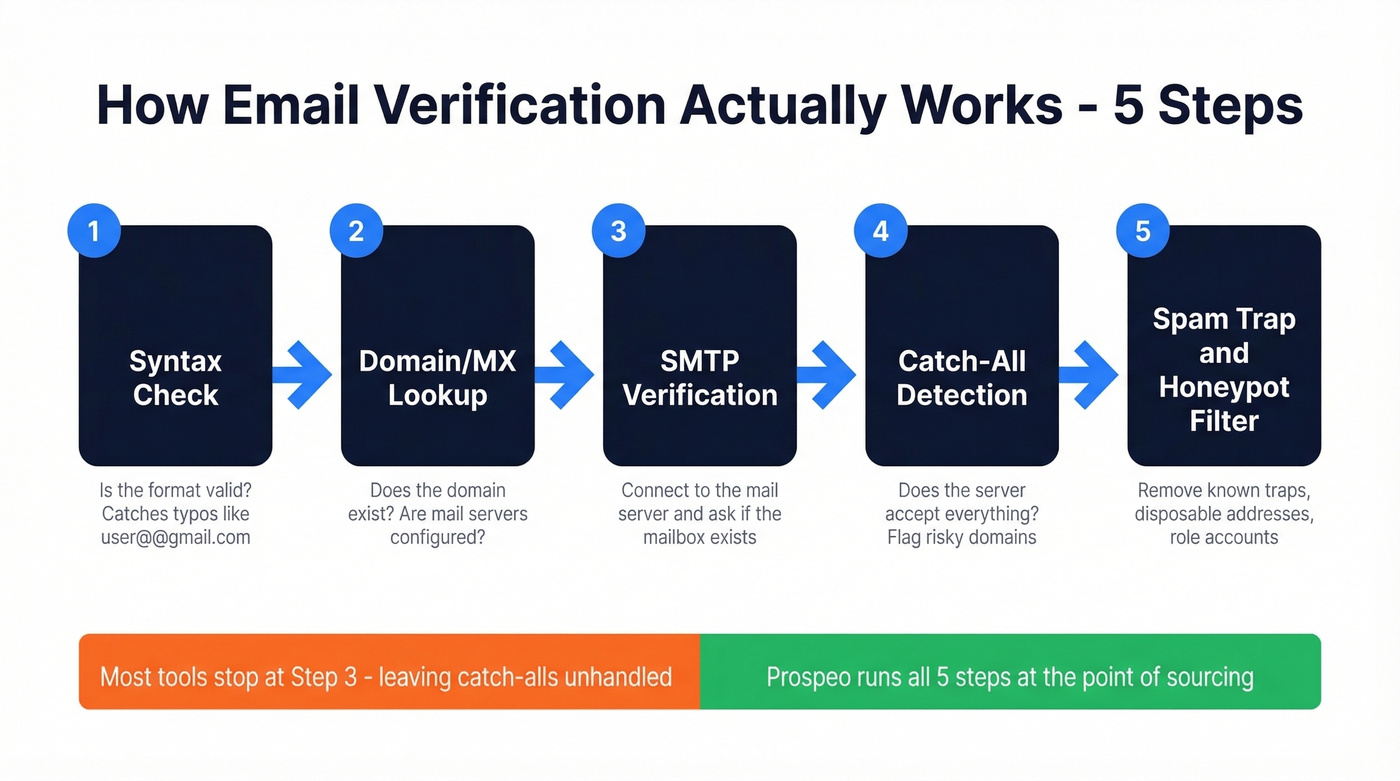
Most verification tools check addresses after you've already sourced them. Prospeo flips that - emails are verified at the point of sourcing through a 5-step process that includes catch-all handling, spam-trap removal, and honeypot filtering. You're not buying a list and then cleaning it. You're getting pre-verified contacts from a database of 143M+ verified emails across 300M+ professional profiles.
Snyk's 50-person AE team went from a 35-40% bounce rate to under 5% after switching. Stack Optimize built to $1M ARR with 94%+ client deliverability and zero domain flags across all clients. That's what happens when verification isn't an afterthought.
Prospeo runs its own proprietary email-finding infrastructure rather than depending on third-party providers, and every record refreshes on a 7-day cycle - the industry average is six weeks. That gap alone eliminates most of the "verified email that bounced anyway" problem. The platform integrates natively with Salesforce, HubSpot, Smartlead, Instantly, Lemlist, Clay, and Zapier, so verified contacts flow directly into your outbound stack without manual exports. Free tier starts at 75 emails plus 100 Chrome extension credits per month, with paid plans running roughly $0.01 per email. No contracts, no sales calls.

Every tool on this list checks emails after you source them. Prospeo verifies at the point of sourcing - 5-step verification, catch-all handling, spam-trap removal. 143M+ emails at 98% accuracy, refreshed every 7 days.
Skip the verification step entirely. Start with clean data.
Bouncer
Use it if you need a dedicated bulk verifier with dead-simple pricing and no gotchas. Bouncer's pay-as-you-go model runs from $8 per 1,000 credits up to $2,000 per 1,000,000 - credits never expire, duplicates aren't charged, and unknowns are free. That's three policies most competitors get wrong.

Skip it if you want email finding bundled with verification. Bouncer is a pure verifier. In the 3,000-email independent benchmark, it scored 65.43% overall accuracy - solid but not chart-topping. Where it shines is the Deliverability Kit add-on ($25-$250/mo) that bundles inbox placement tests, blocklist checks, and SPF/DKIM/DMARC validation. For teams that already have a data source and just need a reliable cleaning layer, Bouncer is the obvious pick.
If you're comparing options in the same category, see our breakdown of Bouncer alternatives.
ZeroBounce
ZeroBounce goes beyond verification into full deliverability management. AI scoring, blocklist monitoring, inbox placement testing, and activity data all sit alongside standard SMTP verification. One credit equals one verification, and credits never expire. Unknowns are free. The free tier gives you 100 monthly verifications with a business domain.

Here's the catch: ZeroBounce's credit system gets expensive fast. Their Email Finder burns 20 credits per successful query, and AI Scoring costs 1 credit per email on top of verification. Expect roughly $0.007-$0.01 per verification at lower volumes, with discounts at scale. The value is in the full deliverability stack - inbox placement testing, sender reputation monitoring, the works - not the per-email price. If you're only doing bulk list cleaning on a budget, look elsewhere.
If deliverability is the real problem, start with an email deliverability guide and add verification after.
Clearout
Clearout verifies 15M+ email addresses daily and scored 68.37% in Hunter's independent benchmark - second overall in the 15-tool test. That held up in our testing too. The G2 rating sits at 4.6/5 from 507 reviews, which is strong social proof for a verification-focused tool. Real-time API validation and form-level verification make it a solid choice for teams building verification into signup flows.
The tradeoff is the interface. Multiple reviewers flag it as cluttered and dated, and the learning curve is steeper than Bouncer or Emailable. Pay-as-you-go runs around $35 for 5,000 credits (about $0.007 per email), with subscriptions starting around $18/month for roughly 3,000 credits. If you're running enough volume to care about that 68% benchmark score, the UI friction is worth tolerating.
Emailable
Use it if speed is the constraint. Emailable processes 30,000+ verifications per minute with built-in anti-greylisting - meaning it won't get tripped up by servers that temporarily reject connections to slow down bulk checks. You get 250 free credits to test, pay-as-you-go from roughly $0.006 per credit, and monthly plans starting at $25.50/month.
Skip it if you need deep deliverability analytics or catch-all scoring. Emailable is a fast, clean verifier - not a deliverability platform. It does one thing well. For teams running large outbound campaigns where verification speed bottlenecks the workflow, it's the right tool. For teams that need inbox placement testing or blocklist monitoring, pair it with Bouncer's Deliverability Kit or use ZeroBounce.
If you're building a cold outreach stack, pair verification with a solid AI bulk email sender.
NeverBounce
NeverBounce is a solid mid-tier verifier with one dealbreaker: credits expire after 12 months. If you're a seasonal sender or you buy credits in bulk to use over time, that policy will cost you. Pay-as-you-go runs $0.008 per credit, and the Growth plan starts at $49/month for up to 10,000 verifications. Accuracy is respectable - it's a common recommendation on Reddit threads - but the expiration policy puts it behind Bouncer and ZeroBounce for teams that don't verify on a strict monthly cadence.
Hunter
Hunter is best known as an email finder, not a verifier. But they published the most transparent benchmark in the space - 3,000 real emails, methodology disclosed, bias acknowledged - and their own tool topped it at 70% accuracy. Verification comes bundled with email finding and outreach at $49/month for 1,000 credits shared across all features. If you're already using Hunter for prospecting, the built-in verifier is convenient. If verification is your primary need, dedicated tools outperform it.
If you're shopping for a finder-first platform, compare Hunter alternatives.
Kickbox
Developer-first email verification with a clean API and "sendex" scoring that rates deliverability risk on a 0-1 scale. Kickbox scored 67.53% in the independent benchmark - third overall, which is quietly impressive for a tool that gets less marketing buzz than NeverBounce or ZeroBounce. Pricing starts at $5 for 500 credits with 100 free to test. It's the right pick for engineering teams building verification into signup flows or internal tools. For marketing teams doing bulk list cleaning, the UX is more technical than necessary.
Verifalia
The privacy-focused option. Verifalia offers an on-premises deployment for teams in regulated industries that can't send email addresses to third-party cloud services. You get roughly 25 free verifications per day, pay-as-you-go from $15.80 for 2,000 credits, and monthly plans from $9.90/mo. It's not the cheapest or fastest, but if your compliance team has opinions about where PII gets processed, Verifalia is one of the few verifiers that actually solves that problem.
EmailListVerify
The budget king. EmailListVerify runs roughly $0.0003-$0.0004 per email at high volumes, making it the cheapest option for teams cleaning massive lists. Basic but effective - don't expect advanced catch-all scoring or deliverability analytics. It works best as the first pass in a stacking workflow: strip the obvious invalids cheaply, then run survivors through a higher-accuracy tool.
If you're also sourcing contacts, consider starting with free lead generation tools so you’re not cleaning junk data.
Snov.io
Verification is a feature inside Snov.io's outreach platform, not a standalone product. If you're already running sequences through Snov.io, the built-in verifier saves you from adding another tool. If you need dedicated verification, you'll get better accuracy and more granular results elsewhere. Plans start around $39/mo, with verification credits shared across finder and outreach features.
DeBounce
Budget-friendly at $15 for 10,000 verifications with 100 free to test. DeBounce covers the basics - syntax checks, MX record validation, SMTP verification - without the advanced scoring or deliverability features of pricier tools. Good for small lists on a tight budget, and a solid cheap-pass option before running a premium verifier.
If you want a head-to-head, see DeBounce vs Apollo.io.
Notable mention: Allegrow takes a fundamentally different approach with its "Safety Net" feature, which blocks risky sends before they happen rather than verifying addresses in advance. It's not a traditional email validation tool, but if pre-send blocking appeals to you more than pre-send verification, it's worth a look.
Pricing Comparison
Here's what you'll actually pay.
| Tool | Free Tier | ~Cost/1K | ~Cost/10K | Credits Expire? |
|---|---|---|---|---|
| Prospeo* | 75 emails/mo | ~$10 | ~$100 | No |
| Bouncer | 100 test credits | $8 | $60 | No |
| ZeroBounce | 100/mo | ~$7-10 | ~$65-90 | No |
| Clearout | ~100 | ~$7 | ~$58-70 | No |
| Emailable | 250 | ~$6 | ~$50 | No |
| NeverBounce | None (PAYG) | $8 | ~$49/mo plan | Yes (12 mo) |
| Hunter** | 50 credits/mo | ~$49/1K | N/A | Monthly reset |
| Kickbox | 100 | ~$10 | ~$80 | No |
| Verifalia | ~25/day | ~$8 | ~$50 | No |
| EmailListVerify | 100 | ~$0.40 | ~$4 | No |
| Snov.io** | 50/mo | ~$8 | N/A | Monthly reset |
| DeBounce | 100 | ~$1.50 | ~$15 | No |
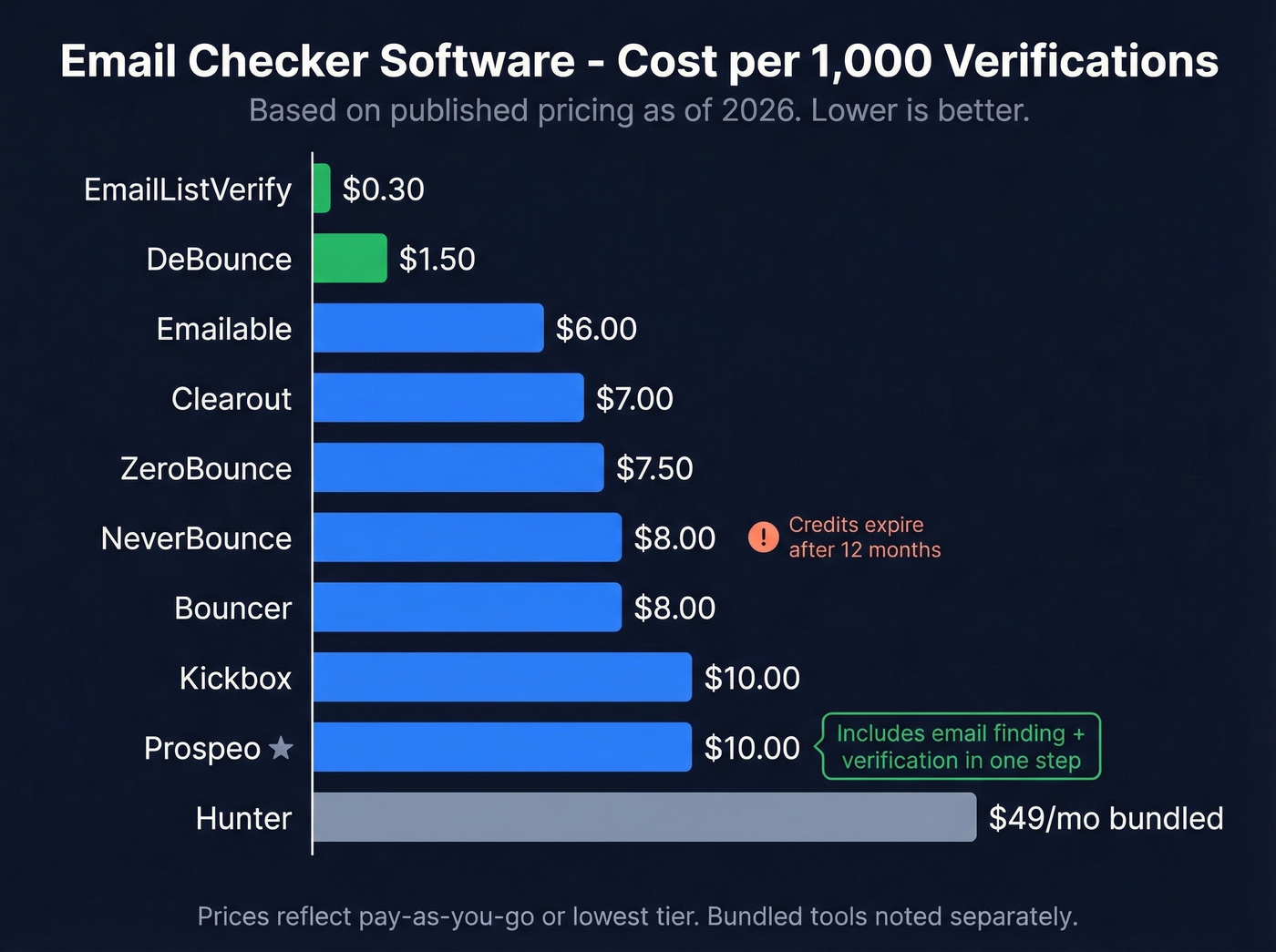
\Prospeo pricing includes email finding - verification is built in.* \*Hunter and Snov.io credits are shared across finder, verifier, and outreach.*
| Tool | Bundled Features | Unknowns Free? |
|---|---|---|
| Prospeo | Finder + verification + enrichment | Yes |
| Bouncer | Deliverability Kit add-on | Yes |
| ZeroBounce | AI scoring + inbox placement | Yes |
| Clearout | Real-time API + form validation | Varies |
| Emailable | None (pure verifier) | Yes |
| NeverBounce | None (pure verifier) | Yes |
| Hunter | Finder + outreach | Yes |
| Kickbox | Sendex scoring | Yes |
| Verifalia | On-premises deployment | Yes |
| EmailListVerify | None (pure verifier) | Yes |
| Snov.io | Finder + outreach + CRM | Yes |
| DeBounce | None (pure verifier) | Yes |
The biggest pricing gotcha isn't the per-email rate - it's credit expiration. NeverBounce's 12-month expiry means you're paying a hidden tax if you don't verify consistently. The second gotcha is unknowns: most tools don't charge for them, but check before you commit.
If you’re trying to keep bounces low, track your email bounce rate alongside verification results.
Snyk dropped from 35-40% bounce to under 5%. Stack Optimize hit 94%+ deliverability across every client with zero domain flags. The difference? Verification built into sourcing at $0.01/email - not bolted on after.
Your email checker shouldn't exist. Your data source should be accurate.
The Catch-All Problem
Accuracy scores don't capture the hardest problem in email verification - catch-all domains. A catch-all server returns SMTP 250 OK for any address at the domain, whether it's the CEO's real inbox or totallynotreal@company.com. Standard SMTP verification can't tell the difference.
The common detection approach is sending a test to a random nonexistent address at the domain. If the server accepts it, the domain gets flagged as catch-all. But that only tells you the domain is catch-all - it doesn't tell you whether your specific contact's address is valid.
Most verifiers dump catch-all results into an "unknown" bucket and call it a day. A significant share of B2B domains run catch-all configurations, which means a verifier that can't give you an actionable verdict on these addresses is leaving a huge chunk of your list in limbo. You're either losing valid contacts or risking bounces on invalid ones. In our experience, the tools that score and flag catch-all addresses individually - rather than labeling everything unknown - deliver meaningfully better results for outbound teams.
Let's be honest: if your average deal size is under five figures, you probably don't need the most expensive email validation tool on the market. But you absolutely need one that handles catch-all domains well. That's where cheap tools fall apart and where the accuracy gap between a $0.003/email verifier and a $0.01/email verifier actually shows up in your pipeline.
How Often Should You Verify?
Email lists decay at roughly 22.5% per year. People change jobs, companies switch email providers, domains expire. A list that was 95% valid in January could be 85% valid by December - and that's enough to trigger deliverability problems with your ESP.
The cadence depends on your sending volume:
- High-volume senders running daily or weekly campaigns should verify monthly.
- Regular campaigns on a bi-weekly or monthly schedule should verify quarterly at minimum.
- Before any major campaign, always verify regardless of your regular schedule.
Segment your results into three buckets: valid (send freely), risky like catch-all and role accounts (re-verify in 30 days), and invalid (remove immediately). This framework keeps your bounce rate under the 2% threshold that ESPs care about - ideally under 1%.
One way to reduce the verification burden entirely is to use a data source with a short refresh cycle. When contacts are re-verified weekly rather than monthly, most of the decay problem gets handled before it starts.
Why Smart Teams Stack Verifiers
A thread on r/software put it bluntly: "using multiple providers does a better job than just using a single email verification tool." One user ranked their stack as Instantly.ai, then NeverBounce, then MillionVerifier - best to worst.

The math supports this. A tool with 70% accuracy at $0.005 per email sounds cheap - until you realize 30% of your "verified" list is wrong. A 98% accurate tool at $0.01 per email costs twice as much per verification but saves you on bounces, domain reputation damage, and wasted sequence slots. Cost-per-correct-verification is the metric that matters, not cost-per-check.
The practical stacking workflow looks like this: run your list through a cheap bulk cleaner first - EmailListVerify or DeBounce - to strip obvious invalids, then pass the survivors through a high-accuracy verifier for the final pass. We've found this two-pass approach catches 15-20% more bad addresses than any single tool alone. Or skip the stack entirely and source from a platform where verification happens before the email ever hits your list, eliminating the multi-tool workflow altogether.
If you’re doing outbound at scale, it helps to standardize your sales prospecting techniques so list quality doesn’t vary rep-to-rep.
Email Checker Software FAQ
How accurate are email verification tools really?
Vendor claims of 99% accuracy are marketing. The best independent benchmark - 3,000 real business emails - showed the top tool at 70% overall accuracy. Real-world performance depends heavily on list composition; catch-all domains and enterprise addresses are significantly harder to verify than small-business emails.
What should I do with catch-all results?
Segment unknowns into a separate list, wait 30 days, and re-verify. If they still return unknown, remove them. The best tools handle catch-all domains with dedicated scoring rather than dumping everything into an "unknown" bucket.
How often should I clean my email list?
Monthly if you send high-volume campaigns, quarterly at minimum. Email lists decay 22-30% per year. Always verify before major campaigns regardless of your regular cadence - one bad send can damage your sender reputation for weeks.
Are free email verification tools good enough for production use?
Free tiers of 50-250 credits work fine for testing a tool or verifying small batches. For lists over 1,000 contacts, you need a paid plan. Free tools typically lack API access, bulk upload, and catch-all handling - the features that matter at scale.
Do I need a separate verifier if my data provider already checks emails?
It depends on the provider's refresh cycle. If your data source refreshes weekly and includes built-in multi-step verification, a separate checker adds minimal value. If your data is older than 30 days, run it through a dedicated verifier before sending - stale data is the top cause of unexpected bounces.