

The 7 Email Deliverability Factors That Actually Decide Inbox Placement
Your bounce rate just spiked to 8% after importing a new list, and your domain reputation dropped from "High" to "Low" overnight in Google Postmaster Tools. Now every email - even to engaged contacts - lands in spam.
That's not a content problem. It's a data problem, and understanding the email deliverability factors behind it is the difference between an 85% and 97% inbox rate - roughly $1.4M on a $10M email-driven revenue program. The global average sits at just 83.1% across 15 ESPs tested. Most senders are leaving serious money on the table.
Start With Data, Not Content
Most guides open with subject-line tips. That's backwards. Here's the checklist that actually moves the needle:
- Authenticate properly. SPF + DKIM + DMARC with alignment. Google, Yahoo, Microsoft, and Apple now mandate publishing a DMARC record for bulk senders.
- Keep complaint rate under 0.1%. Google's hard ceiling is 0.3%, but anything above 0.1% starts degrading placement.
- Verify every address before sending. Bad data is the #1 controllable factor. Only 60% of senders regularly conduct list hygiene - and the other 40% wonder why they're in spam.
- Monitor with Google Postmaster Tools. It's free. It shows domain reputation, spam rate, and authentication status. 70% of senders don't use it.
The 7 Factors Affecting Email Deliverability
1. Sender Reputation
Domain reputation matters more than IP reputation. Full stop. Your domain reputation follows you even if you change ESPs and IPs - switching providers doesn't reset it. Every bounce, complaint, and ignored email accumulates over time, and some ISPs also factor in your domain's broader web presence, including site quality and registration age. Treat your sending domain like a credit score: it takes months to build and one bad campaign to wreck.
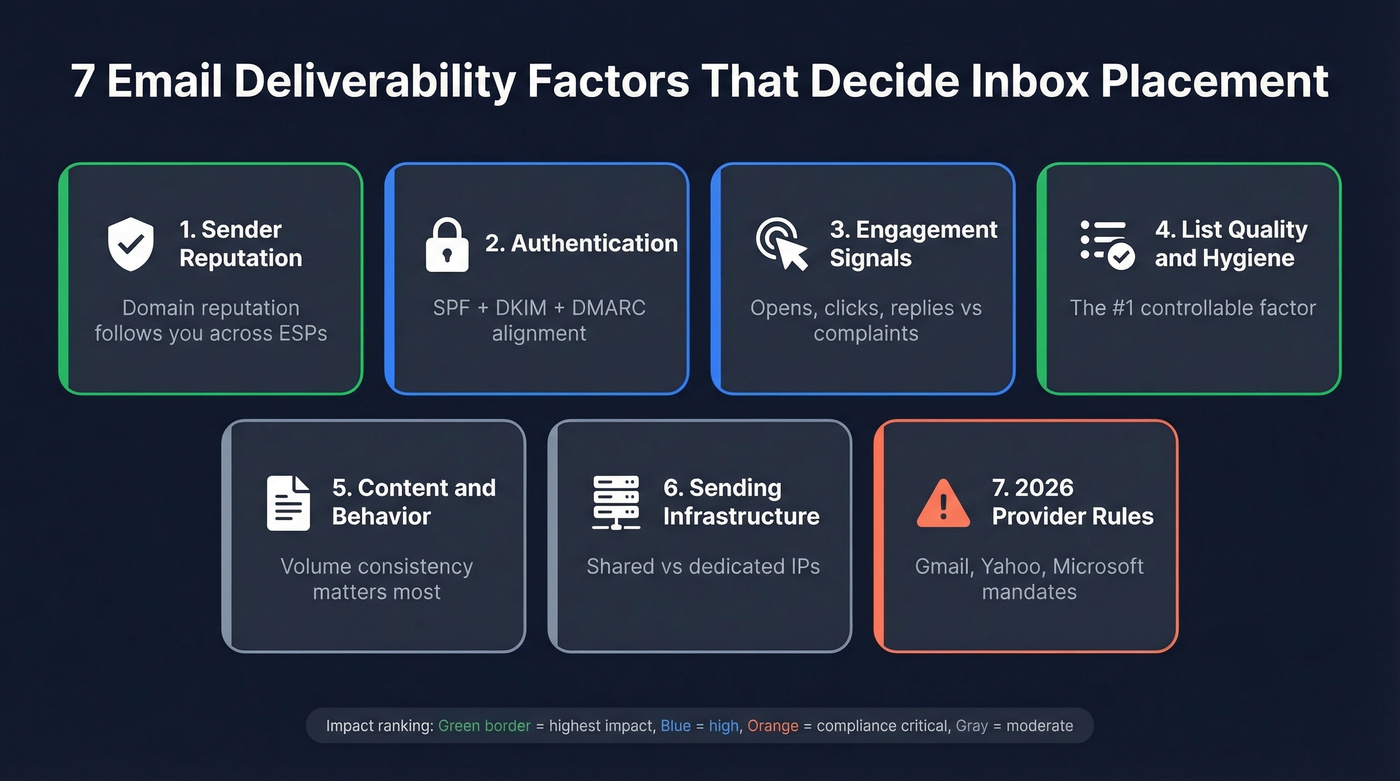
2. Authentication
Your From: domain must align with either the SPF domain or the DKIM signing domain for DMARC alignment to pass. DMARC adoption hit roughly 54% in 2024, meaning nearly half of senders still fly without it. If you haven't set up SPF + DKIM + DMARC, you're already behind every major provider's requirements.
3. Engagement Signals
Opens, clicks, and replies tell ISPs your email is wanted. Spam complaints tell them the opposite - and the damage is asymmetric. 78% of recipients mark an email as spam if it "looks like spam." One bad campaign can tank placement for weeks, even for messages going to people who actually want to hear from you.
4. List Quality and Hygiene
This is the #1 controllable factor. Bad addresses generate hard bounces. Hard bounces destroy sender reputation. Destroyed reputation means the spam folder - for everyone on your list, not just the bad addresses.

We've seen teams cut bounce rates from 15% to under 2% just by verifying before every send. Prospeo's 5-step verification process delivers 98% email accuracy with catch-all handling, spam-trap removal, and honeypot filtering. The results are concrete: Snyk's sales team went from a 35-40% bounce rate to under 5% after switching, and their AE-sourced pipeline jumped 180%.
Keep your bounce rate under 2%. That's the line.
5. Content and Sending Behavior
HTML quality, text-to-image ratio, link reputation, and volume consistency all influence ISP scoring - but less than you'd think. ISPs now weight engagement and sender reputation far more heavily than keyword triggers. Sudden volume spikes, however, remain a fast path to throttling. Double your send volume gradually, not overnight.
6. Sending Infrastructure
Shared IPs pool your reputation with other senders - fine for low volume, risky at scale. Dedicated IPs give you full control but require proper warm-up. The 83.1% average deliverability across ESPs masks wide variance between providers, and your ESP choice matters more than most teams realize.
7. 2026 Provider Compliance Rules
Gmail and Yahoo's bulk sender requirements went live in February 2024. Microsoft began rejecting non-compliant mail in May 2025. The requirements: SPF + DKIM + DMARC, one-click unsubscribe via RFC 8058, and complaint rate under 0.1% with 0.3% as the hard ceiling. Gmail escalated enforcement to permanent rejections in November 2025. If you're seeing 550 5.7.26 or 550 5.7.350 error codes, compliance is your problem.

List quality is the #1 controllable deliverability factor - and bad data is the fastest way to destroy sender reputation. Prospeo's 5-step verification with catch-all handling, spam-trap removal, and honeypot filtering delivers 98% email accuracy. Snyk cut their bounce rate from 35-40% to under 5% and grew AE-sourced pipeline 180%.
Stop sending to addresses that wreck your domain reputation.
Benchmarks - How You Compare
Here's the thing: not all inboxes are created equal. If your audience skews B2B or enterprise, Microsoft Outlook is your real bottleneck - and most guides ignore it entirely.
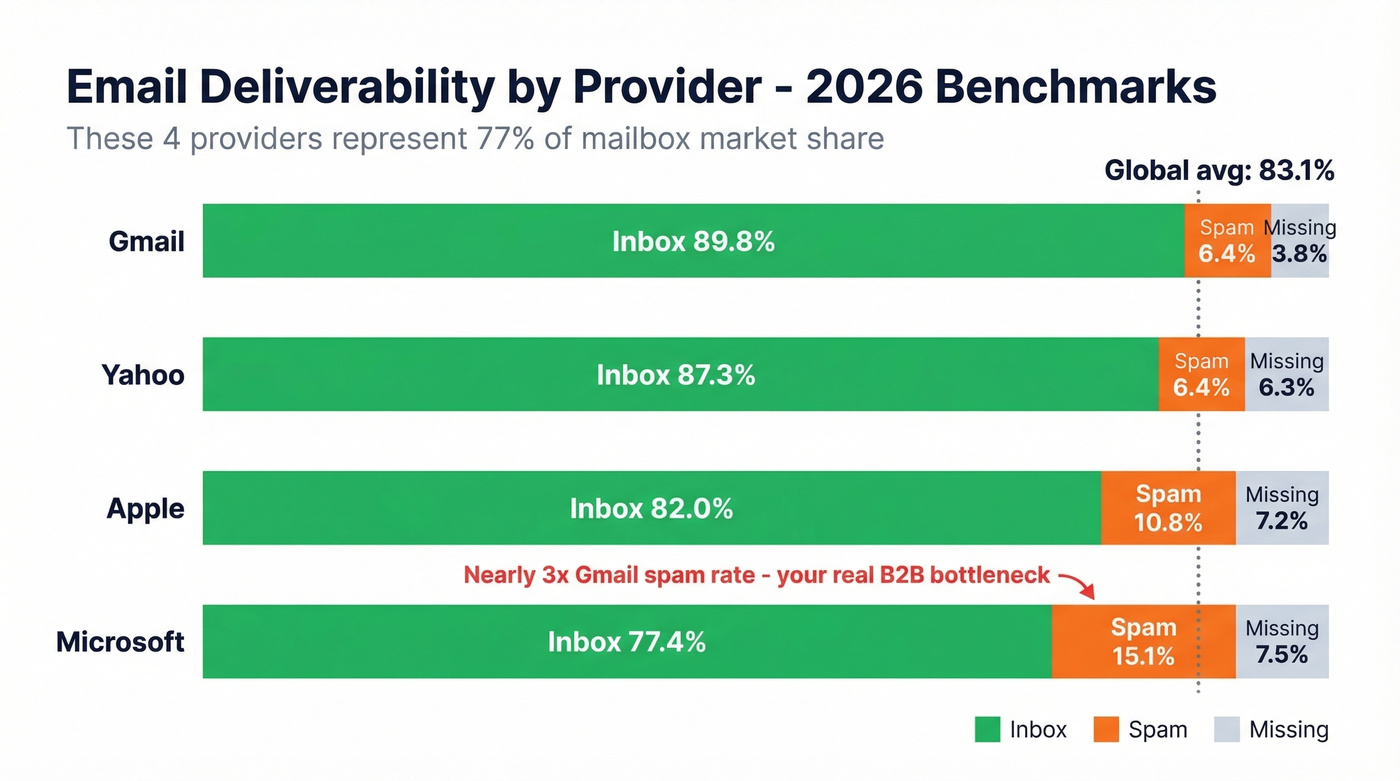
| Provider | Inbox | Spam | Missing |
|---|---|---|---|
| Gmail | 89.8% | 6.4% | 3.8% |
| Yahoo | 87.3% | 6.4% | 6.3% |
| Apple | 82.0% | 10.8% | 7.2% |
| Microsoft | 77.4% | 15.1% | 7.5% |
These four providers represent 77% of mailbox market share. Microsoft's 15.1% spam rate is nearly triple Gmail's. If you're only optimizing for Gmail, you're solving the wrong problem.
Let's be honest: most B2B teams obsess over Gmail deliverability because it's easiest to monitor. But your CFO, your VP of Procurement, and half your enterprise prospects are on Outlook. Optimize for the hard inbox first.
Warm-Up and Monitoring Playbook
Spinning up a dedicated IP or new sending domain? Here's the ramp schedule we recommend:
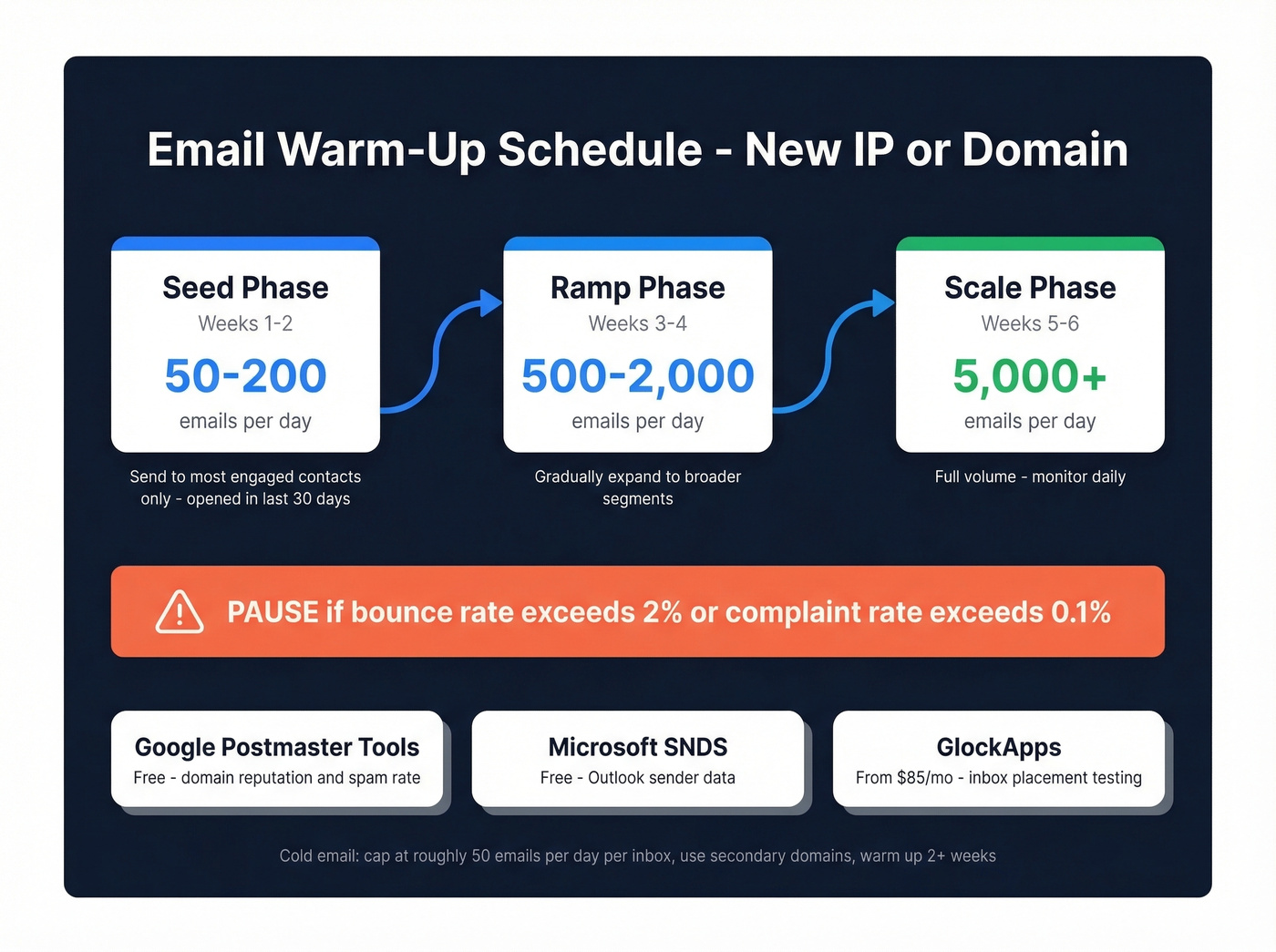
| Phase | Daily Volume | Duration |
|---|---|---|
| Seed | 50-200 | Weeks 1-2 |
| Ramp | 500-2,000 | Weeks 3-4 |
| Scale | 5,000+ | Weeks 5-6 |
Start with your most engaged recipients - people who've opened in the last 30 days. Pause if bounce rate exceeds 2% or complaints exceed 0.1%. Watch your validation metering too; one sender reported a >$30,000 surprise invoice after unexpected validation volume spikes on their account.
For monitoring, three tools cover the essentials: Google Postmaster Tools (free), Microsoft SNDS (free), and GlockApps (from $85/mo) for inbox placement testing. For cold email specifically, cap at roughly 50 emails/day per inbox, use secondary domains, and warm up for at least two weeks. Common baseline advice on r/coldemail is that these aren't optional extras - they're hygiene.
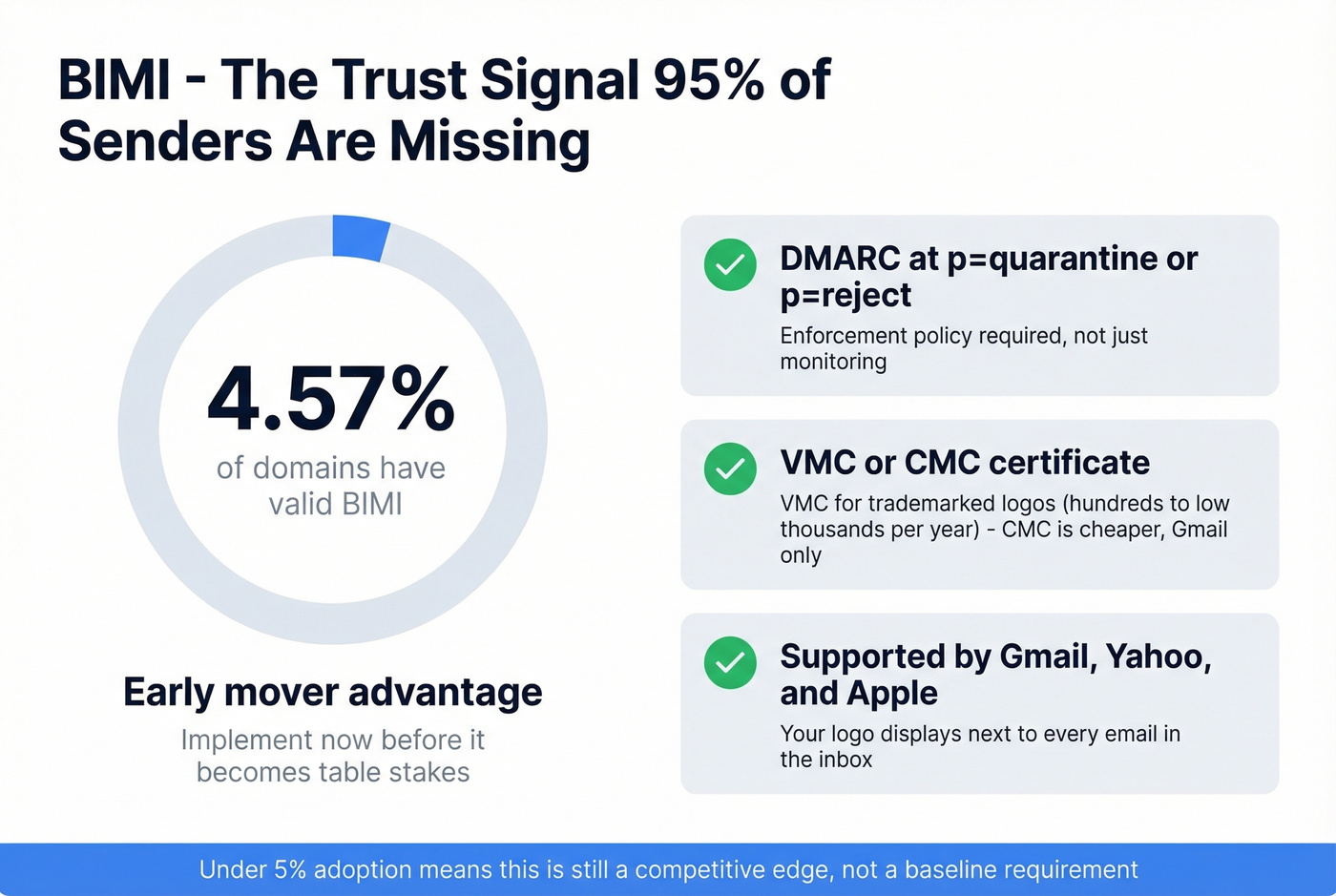
BIMI - The Trust Signal Most Senders Skip
Only 4.57% of domains have a valid BIMI record. That's a massive missed opportunity. BIMI displays your brand logo next to emails in Gmail, Yahoo, and Apple inboxes when you meet the requirements, and it needs DMARC enforcement at p=quarantine or p=reject. You'll need a VMC for trademarked logos (hundreds to low-thousands per year) or a CMC, which is cheaper and currently Gmail-only. Under 5% adoption means implementing it now gives you a visibility edge before it becomes table stakes.
Every hard bounce chips away at the sender reputation you spent months building. Prospeo refreshes all 300M+ profiles every 7 days - not the 6-week industry average - so your lists stay clean between sends. At $0.01 per verified email, protecting your deliverability costs less than a single spam-folder campaign.
Week-old data stays accurate. Six-week-old data fills spam folders.
FAQ
What's the difference between email delivery and deliverability?
Delivery means the receiving server accepted your message without returning a hard bounce. Deliverability means it reached the inbox instead of spam. You can have 99% delivery and 70% deliverability - inbox placement is the metric that matters.
How often should I clean my email list?
Before every campaign, or monthly at minimum. Addresses decay around 2-3% per month as people change jobs and companies shut down mailboxes. For smaller lists, Prospeo's free tier covers 75 verifications per month to keep things clean between major sends.
Which factors affect inbox placement the most?
Data quality and sender reputation carry the most weight. ISPs prioritize engagement signals and authentication far more heavily than keyword triggers or subject-line wording. Fix your list hygiene and authentication first - those are the email deliverability factors that move inbox placement the fastest.