

Best Email Hygiene Solutions to Keep Your Lists Clean in 2026
Your SDR team uploaded a purchased list last month. Nobody cleaned it. Now your outbound domain is flagged, reply rates cratered from 8% to 1.5%, and the VP of Marketing is asking what happened. That's the cost of skipping email hygiene - and the right tools make it entirely preventable.
Mailing lists decay by about 22% every year. People change jobs, companies shut down, inboxes get abandoned. Roughly one in six emails never reach the inbox, with global inbox placement hovering around 84%. Microsoft inboxes are the hardest to crack at ~75.6% placement versus Gmail's ~87.2%. Most top verifiers advertise around 99% accuracy, but the real differentiator is catch-all handling - that's where bounces hide.
Our Picks (TL;DR)
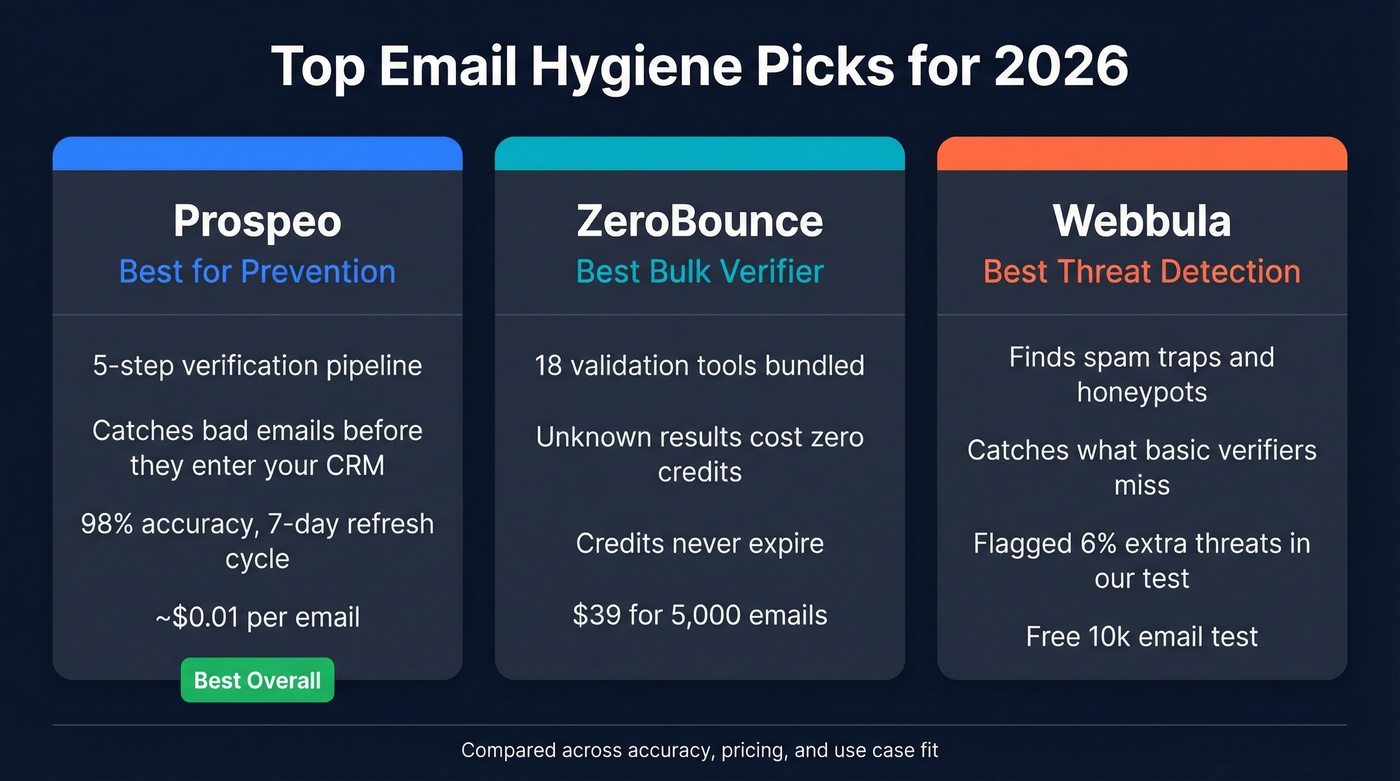
- Prospeo - Best for preventing hygiene problems before they start. Its 5-step verification pipeline catches bad emails at the point of collection.
- ZeroBounce - Best standalone bulk verification. Unknowns don't cost credits, and credits never expire.
- Webbula - Best for legacy list threat detection. Flags spam traps, honeypots, and bot-generated addresses that basic verifiers miss.
Best Tools for Email List Cleaning
Prospeo
Most hygiene guides tell you to clean quarterly. That's backwards. The real move is to stop putting bad data on your list in the first place.
Prospeo runs every email through a 5-step verification pipeline before it reaches your CRM: syntax validation, domain checks, mailbox verification, catch-all handling, and spam-trap removal. The result is 98% email accuracy across 143M+ verified emails, refreshed on a 7-day cycle - the industry average is six weeks. An email verified last month might already be dead. Weekly refresh eliminates that risk.
The proof is in the numbers. Snyk's outbound team went from a 35-40% bounce rate to under 5% after switching. Stack Optimize maintains under 3% bounce rates with 94%+ deliverability across all their clients. Those aren't marginal improvements - they're the difference between a healthy domain and a blacklisted one.
Pricing runs ~$0.01/email with a free tier of 75 emails per month. No contracts, no sales calls, self-serve from day one.
Best for: Teams that want clean data at the source instead of cleaning up messes downstream.
ZeroBounce
ZeroBounce is the most recognized standalone email verifier, and its credit mechanics are genuinely generous. You get 100 free monthly validations on a business domain, unknown results don't consume credits, and credits never expire. That last point matters - some competitors force you to use credits within 12 months.
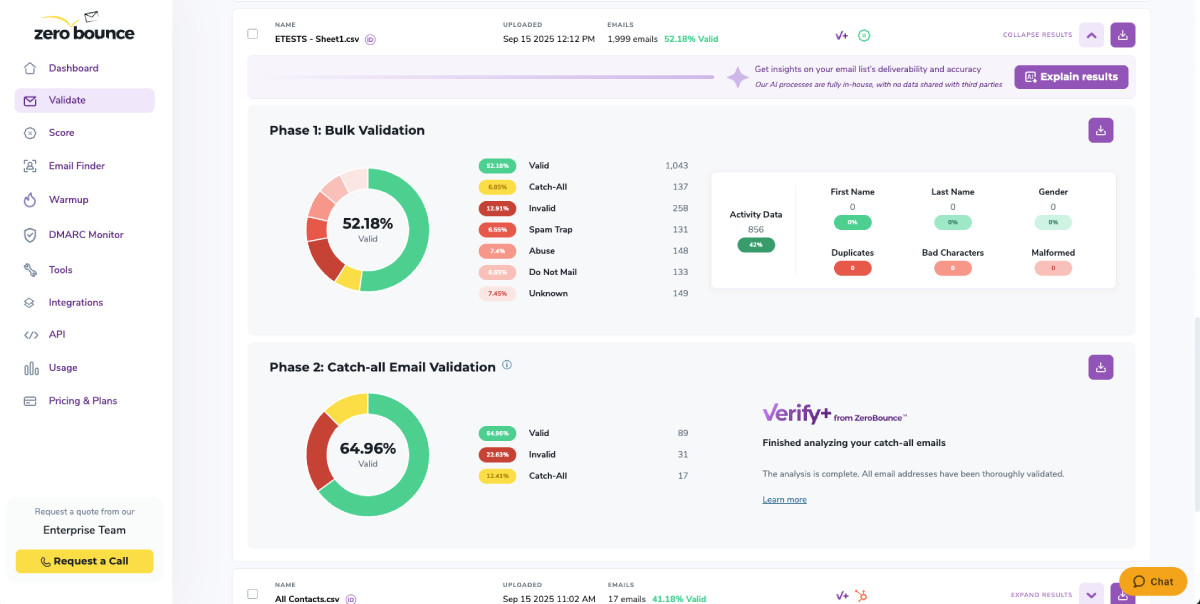
The platform bundles 18 validation tools including an AI scoring feature and an email finder at 20 credits per successful lookup. Pay-as-you-go pricing: $39 for 5k, $65 for 10k, $325 for 50k, $390 for 100k. Both ZeroBounce and NeverBounce are battle-tested at scale, which is why they show up in nearly every "best verifier" thread on r/Emailmarketing.
Best for: Mid-volume teams that want a reliable bulk verifier with no credit pressure.
Skip if: You need upstream data quality - ZeroBounce cleans lists after the fact; it doesn't prevent bad data from entering your pipeline.
NeverBounce
NeverBounce is the strongest option for teams that prefer subscription pricing. The Growth plan at $49/month covers up to 10,000 verifications and only charges for new, unique emails - duplicates are free. Pay-as-you-go runs $0.008/credit, though credits expire 12 months after purchase. Integrations with HubSpot, Mailchimp, Zapier, and n8n make it easy to wire into existing workflows.
Best for: Teams running 5-10k verifications monthly who want predictable costs.
Skip if: You verify sporadically - those expiring credits will burn you.
Bouncer
Bouncer is the value play at scale. At $400 for 100k verifications and $1,250 for 500k, it undercuts most competitors at high volumes. Accuracy sits at 99.5%, it offers 50+ integrations, and it runs on EU data centers with GDPR-ready workflows that auto-delete results after 60 days. European team sending high volume? Bouncer should be your first call.
Best for: High-volume senders who prioritize cost efficiency and EU data residency.
Kickbox
Kickbox carries a 4.5/5 on G2 with 573 reviews - one of the largest review bases in this category. The verification workflow is fast and well-designed. The tradeoff? It's expensive. Pay-as-you-go runs $40 for 5k, $80 for 10k, and $800 for 100k. G2 reviewers consistently flag pricing as the main con, along with limited detail on why specific emails get flagged as risky.
Best for: Teams that value UX and don't mind paying a premium for it.
Webbula
Webbula isn't a standard verifier - it's a threat detection layer. Where most tools check if an email exists, Webbula scans for spam traps flagged as "critical threat," disposable addresses, bot activity, and typo domains. If you've got a legacy list that's been sitting untouched for years, this is the tool that finds the landmines basic verification misses.
We ran a 25,000-record inherited list through both a standard verifier and Webbula side by side. The standard verifier flagged about 8% as invalid. Webbula caught an additional 6% as spam traps, honeypots, and bot-generated addresses that the first tool marked "valid." That hidden 6% is exactly the kind of data that gets your domain blacklisted without warning.
Pricing is custom. Expect mid-to-high four figures per month for enterprise volumes. They offer a free 10,000-email test with no credit card required.
Best for: Enterprise teams cleaning inherited or purchased lists with unknown provenance.
BriteVerify
Straightforward per-email pricing at $0.01/email up to 250k verifications. One G2 reviewer reported deliverability jumping from under 90% to 99% after cleaning. Rated 4.2/5 with 74 reviews. No credits, no subscriptions - just a clean per-email rate.
DeBounce
Budget-friendly bulk verifier aimed at high-volume users. DeBounce typically prices under ~$0.005/email at higher volumes, making it one of the lowest-cost options on this list. The interface is no-frills, but it gets the job done for teams that just need a clean pass before a campaign blast.
Pricing at a Glance
| Tool | 5k | 10k | 100k | Free Tier |
|---|---|---|---|---|
| Prospeo | ~$50 | ~$100 | ~$1,000 | 75/mo |
| ZeroBounce | $39 | $65 | $390 | 100/mo |
| NeverBounce | $40 | $50 | $400 | First list free |
| Bouncer | $35 | $60 | $400 | - |
| Kickbox | $40 | $80 | $800 | 100 credits |
| BriteVerify | $40 | $80 | $600 | - |
| Webbula | Custom | Custom | Custom | 10k test |
| DeBounce | ~$20 | ~$35 | ~$250 | 100 free |
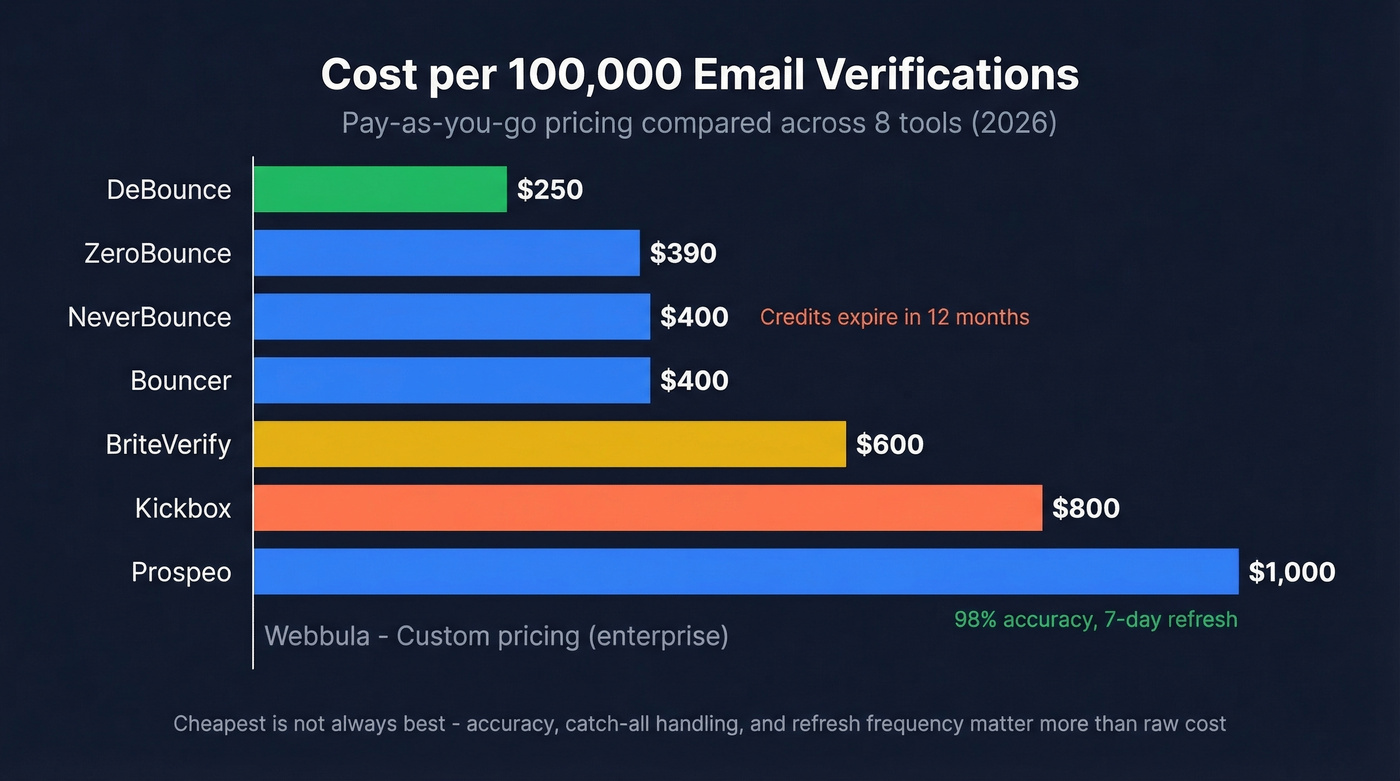
NeverBounce credits expire after 12 months. ZeroBounce and Kickbox credits never expire. DeBounce and Bouncer often sell non-expiring credit packs.

Email hygiene shouldn't be a quarterly fire drill. Prospeo's 5-step verification catches spam traps, dead mailboxes, and catch-all risks before emails ever hit your CRM. 143M+ verified emails at 98% accuracy, refreshed every 7 days - so your lists never decay in the first place.
Fix the source, not the symptoms. Start free with 75 verified emails.
When to Clean Your List

Don't wait for deliverability to crater. Clean when any of these hit:
- Bounce rate crosses 2%. Healthy programs stay below 1%; above 5% is a red flag.
- SenderScore drops below 80. Monitor weekly - it's your early warning system.
- 6+ months since your last clean. That's roughly 11% list decay at a 22% annual rate.
- You just imported a new list. Never send to an uncleaned import. Ever.
- You're about to run a mail merge campaign. Email deliverability in mail merge depends entirely on list quality - one bad batch can torch your sending domain mid-sequence.
How to Build a Complete Hygiene Stack
Email hygiene isn't a single tool - it's four layers. Upstream data quality eliminates most downstream cleaning needs, so start there.
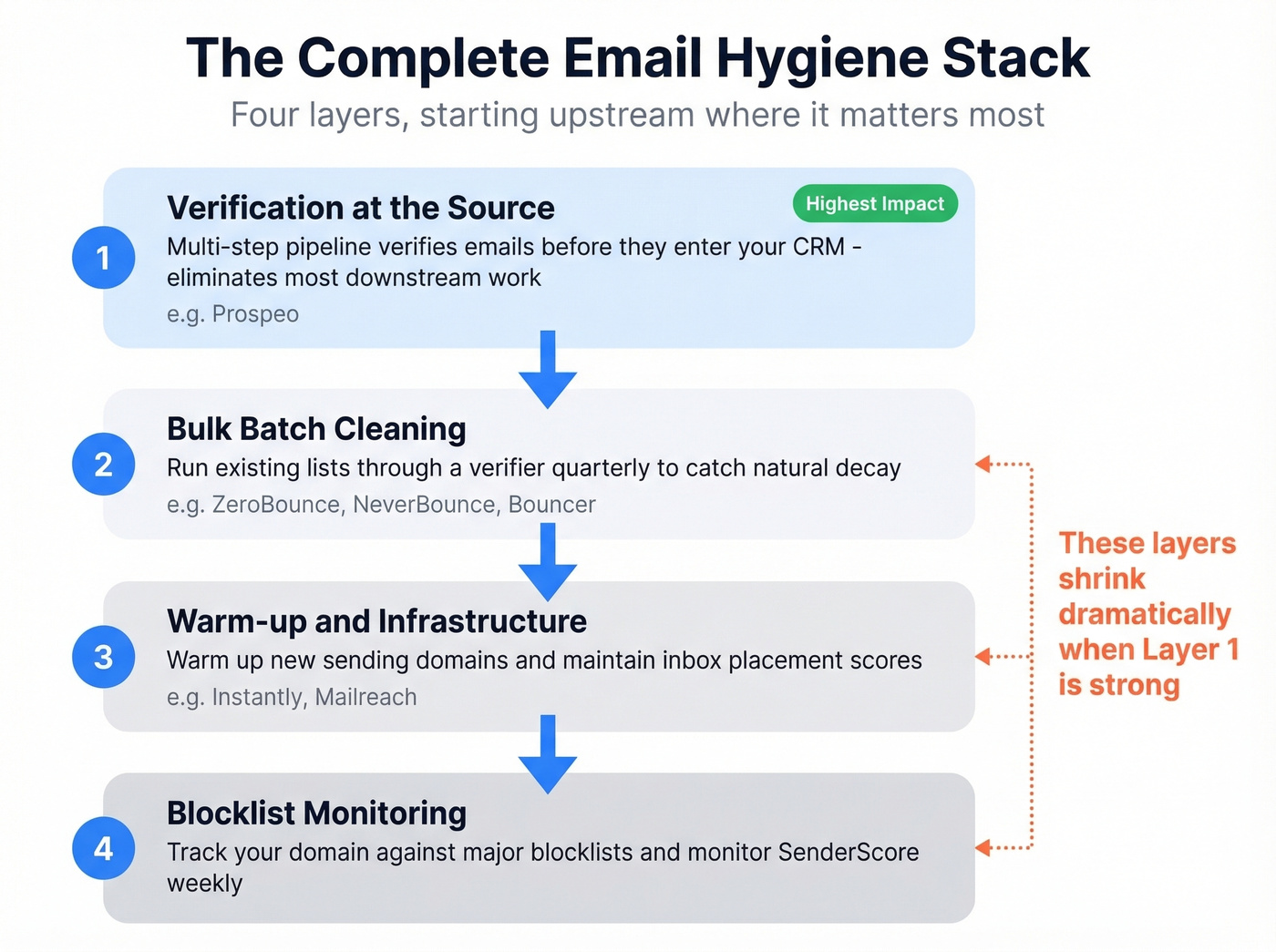
Verification at the source. Use a platform that verifies emails through a multi-step pipeline before they enter your CRM. This single step eliminates the majority of downstream cleaning work.
Bulk batch cleaning. Run existing lists through ZeroBounce, NeverBounce, or Bouncer quarterly. Catch the decay before it catches you.
Warm-up and infrastructure. Tools like Instantly or Mailreach warm up new sending domains and maintain inbox placement. A clean list means nothing if your sending reputation is already damaged. (If you need a stack, start with a domain warm-up tool.)
Blocklist monitoring. Track your domain against major blocklists and monitor SenderScore. Problems show up here before they show up in reply rates. Use a blacklist checker and a domain reputation checker to catch issues early.
Mistakes That Tank Deliverability
Most deliverability problems aren't technical - they're operational. We've run lists through multiple verifiers side by side, and the differences in catch-all detection are stark. Here's what kills domains:
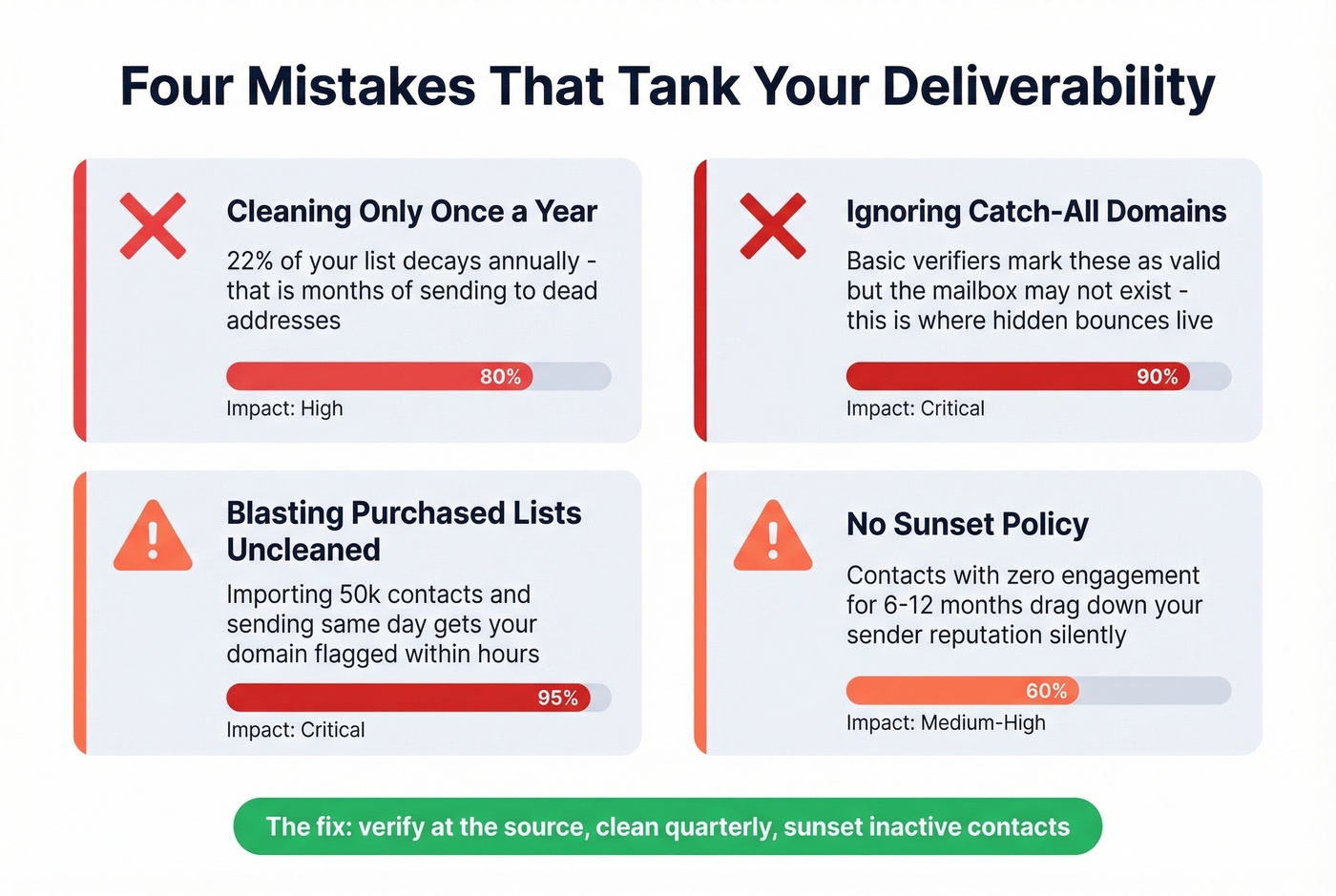
Cleaning only once a year. With 22% annual decay, you're sending to dead addresses for months. Quarterly is the minimum; monthly is better if you're doing heavy outbound.
Ignoring catch-all domains. These accept every email regardless of whether the mailbox exists. Most basic verifiers mark them as "valid" - and that's where your bounces hide. Look for tools with explicit catch-all handling, because a "valid" result on a catch-all domain is essentially meaningless.
Buying lists without cleaning them. We've seen teams import 50,000 purchased contacts and blast them the same day. The domain gets flagged within hours.
Never implementing a sunset policy. If a contact hasn't opened or clicked in 6-12 months, stop mailing them. A sunset policy protects your sender reputation by removing chronically unengaged addresses before ISPs start treating your messages as spam.
Here's the thing: if your deal sizes run below five figures, you probably don't need the most expensive option on this list. A $39 ZeroBounce pack paired with clean sourcing will often outperform an enterprise hygiene contract when upstream data is sloppy. Spend on data quality upstream, not cleanup downstream. (For a deeper framework, follow an email deliverability guide and track your email bounce rate like a hawk.)
Snyk cut bounce rates from 35-40% to under 5%. Stack Optimize holds under 3% across every client. The difference? They stopped cleaning lists after the fact and started sourcing verified data at $0.01/email with no contracts.
Your domain reputation is too expensive to gamble on stale data.
FAQ
What's the difference between email verification and email hygiene?
Verification checks if an address exists and can receive mail. Hygiene goes further - it detects spam traps, honeypots, bot-generated addresses, and reputation threats that basic verification misses. Verification is a pass/fail test; hygiene is a full diagnostic.
How often should I clean my email list?
At minimum, quarterly. Clean immediately after importing any new data, and before every major campaign if you haven't cleaned in 60+ days. With 22% annual list decay, waiting longer means sending to dead addresses for months.
Can I skip cleaning if my data provider verifies emails?
If your provider runs real-time verification at the point of collection - with catch-all handling and spam-trap removal - you'll need far less downstream cleaning. But re-verify any data older than 90 days, since people change jobs fast.
Does deliverability matter for follow-up sequences?
Absolutely. ISPs track engagement across your entire sending history. If early messages bounce or land in spam, every subsequent follow-up from that domain suffers. Cleaning your list before launching a multi-step sequence isn't optional.