

Email Enrichment: The Practitioner's Guide to Better Data, Fewer Bounces
You upload 500 leads to your sequencer on Sunday night. By Monday morning, 170 have bounced. Your domain reputation takes a hit, deliverability craters, and the SDR who sourced those contacts is back to square one.
This happens every week at companies that skip email enrichment or trust a single data source. B2B contact data decays at 22.5% per year - roughly 2.1% every month. An analysis of 11 billion emails confirmed that at least 23% of any email list degrades annually. In high-turnover industries like tech and recruiting, that number climbs past 70%. If you're not actively enriching and verifying, you're sending into a void.
Here's the thing: most teams don't need a $25K/year data platform. They need one accurate enrichment provider, a verification layer, and the discipline to re-enrich quarterly. Everything else is overhead.
What Email Enrichment Actually Is
"Enrichment" gets thrown around loosely. Four terms sound similar but mean different things, and confusing them leads to bad tool choices.
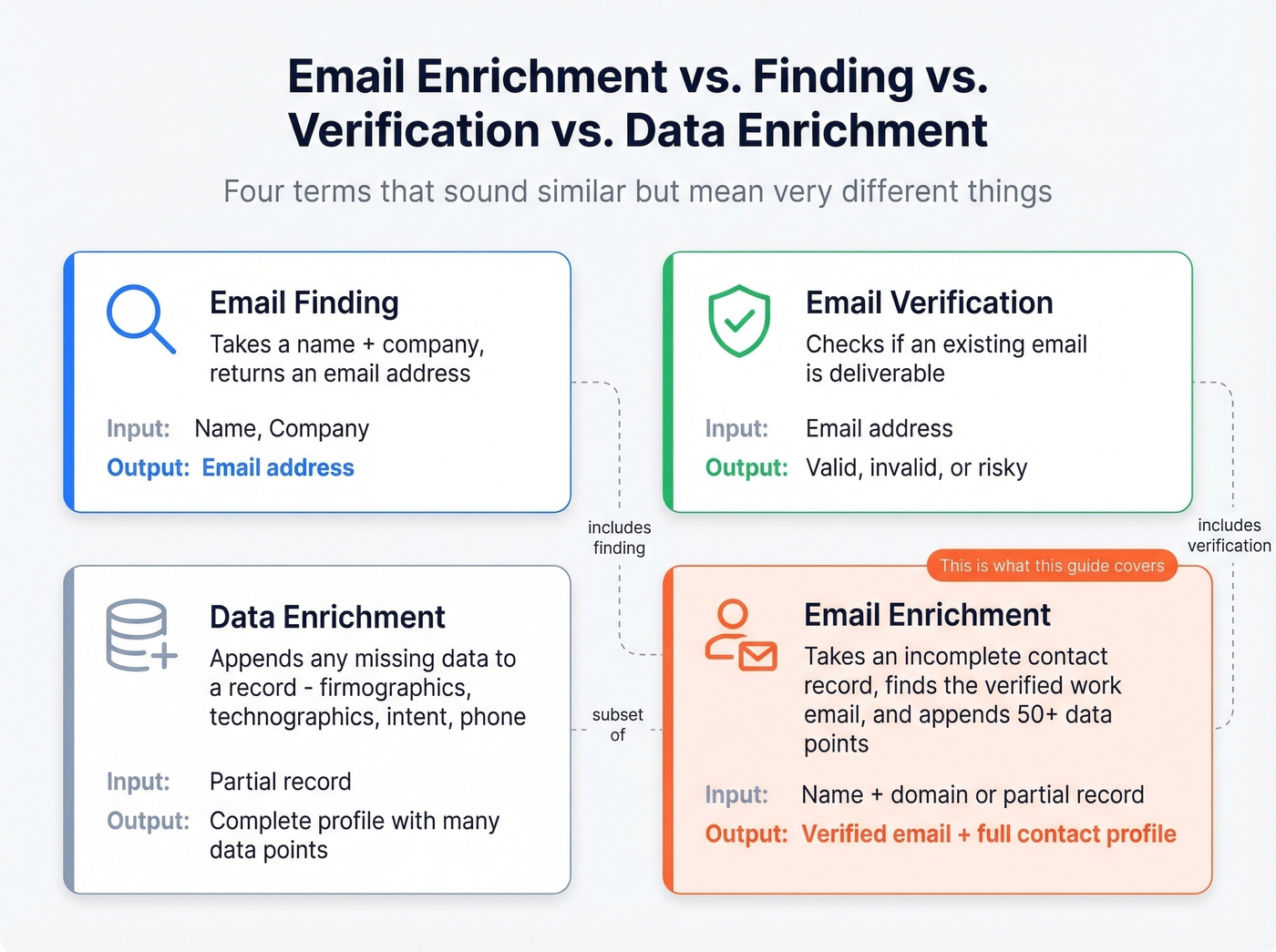
Email finding takes a name and company and returns an email address. Email verification checks whether an existing address is deliverable. Data enrichment is the umbrella term for appending any missing data to a record - firmographics, technographics, intent signals, phone numbers. Email enrichment sits at the intersection: it takes an incomplete contact record, runs it through database lookups, appends the verified work email plus surrounding data points, and returns a complete profile. When teams talk about enriching from an email address or partial record, this is the workflow they mean - starting from what you have and building outward.
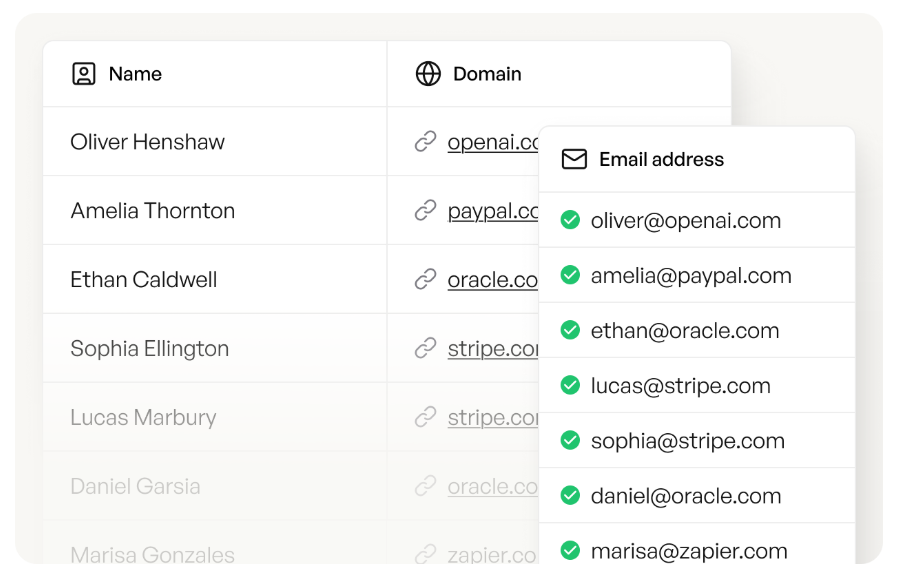
The pipeline starts with a partial record, usually a name and company domain. The enrichment tool queries its database, matches the record, appends the email, layers on firmographic and technographic data, verifies the email in real time, and outputs a contact with 50+ data points attached. The best tools do all of this in a single API call. The worst hand you an unverified email and call it a day.
Why It Matters More Than Ever in 2026
With 15-20% of professionals changing jobs annually and work emails decaying at 20-30% per year, a CRM that was accurate in January is meaningfully degraded by April.
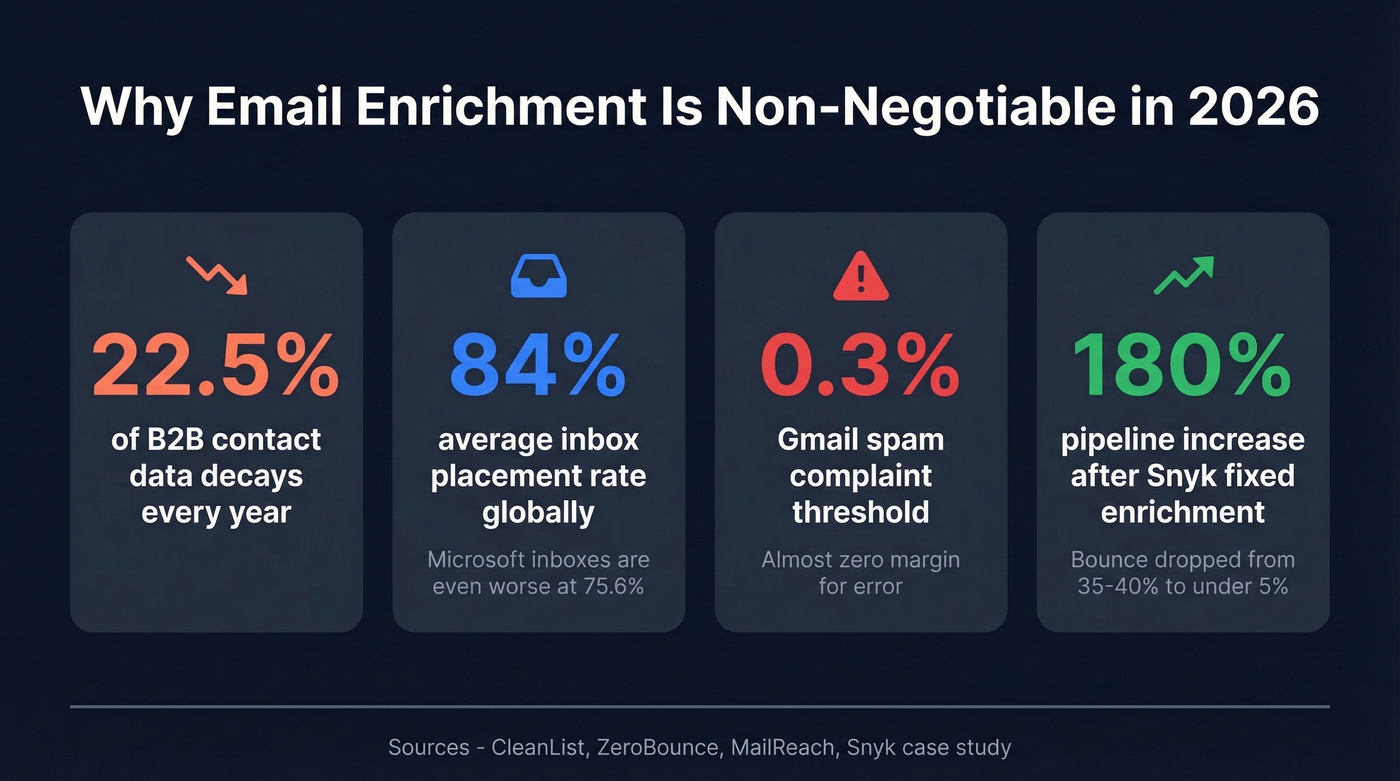
Global inbox placement averages around 84%, meaning roughly one in six emails never reaches the inbox even under ideal conditions. Microsoft inboxes are worse - just 75.6% placement. Every hard bounce signals to mailbox providers that you're sending to bad addresses, and enough bounces erode your domain reputation fast. Gmail's spam complaint threshold sits at 0.3%. There's almost no margin for error.
What does good look like? Snyk ran 50 AEs at 35-40% bounce. After switching to a proper enrichment pipeline, bounce dropped below 5%, AE-sourced pipeline jumped 180%, and the team generated 200+ new opportunities monthly. The cost of not enriching isn't just bounced emails - it's wasted SDR hours, burned sequences, damaged sender reputation, and pipeline that never materializes.
How Waterfall Enrichment Works
No single data provider covers the entire B2B universe. A comparative study across six providers found individual match rates between 35% and 52%. The consensus on r/coldemail echoes this: no single tool is enough anymore.
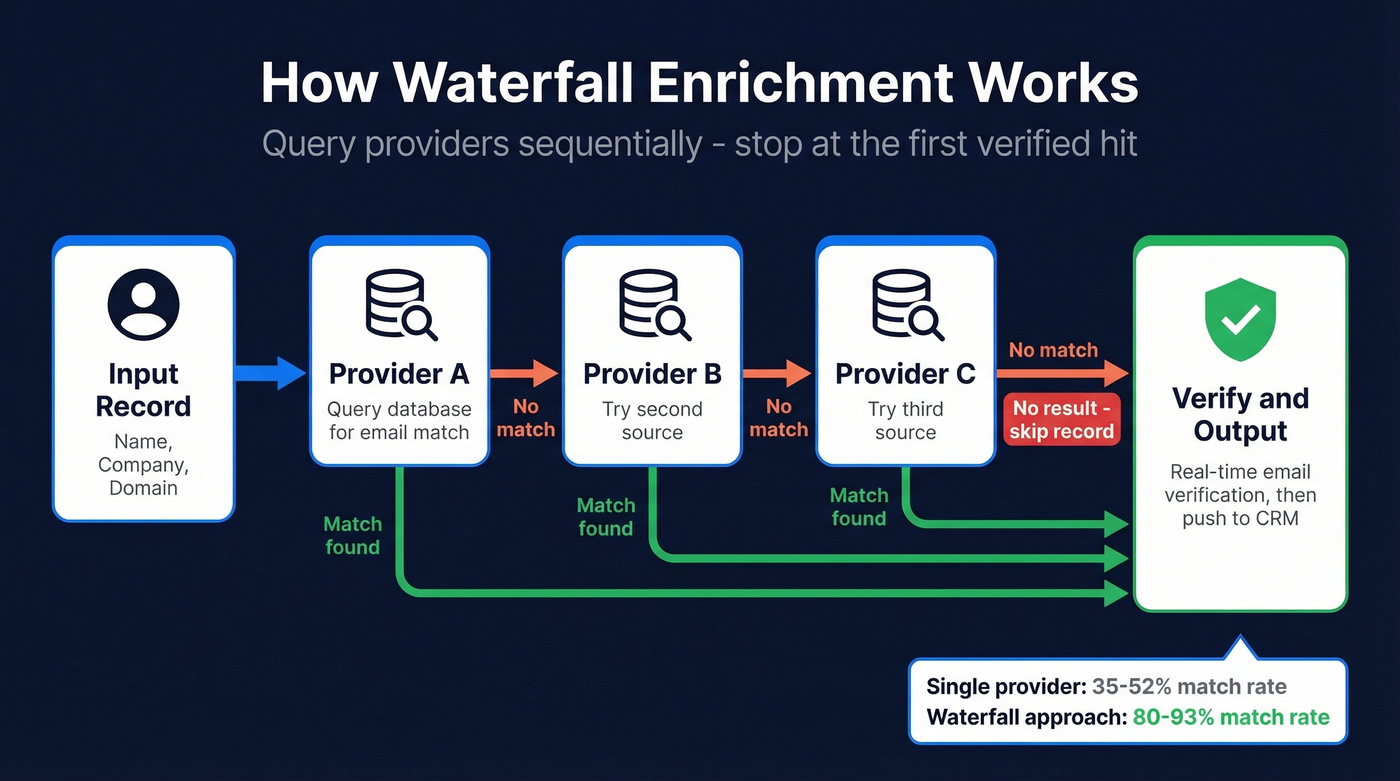
Waterfall enrichment fixes the gap by querying providers sequentially until a valid result is found. The process works in four steps:
- Input your record - name, company, domain, whatever you have.
- Query Provider A - if it returns a match, verify the email immediately. If it misses, move on.
- Query Provider B, then C, then D - each provider checks its own database. You stop the cascade the moment you get a verified hit.
- Verify and output - the final email goes through real-time verification before it ever touches your CRM.
This approach pushes match rates from that 30-60% single-provider ceiling up to 80-93%. The economics work too: many waterfall tools charge only when they find valid data, so misses don't cost you. If you're targeting accounts across multiple regions, ordering your providers by geographic strength - EMEA-first for European prospects, US-first for domestic - squeezes out a few extra percentage points.

Most teams bounce 20-35% of emails because they enrich against stale databases. Prospeo refreshes 300M+ profiles every 7 days - not every 6 weeks - and runs every email through 5-step verification with catch-all handling and spam-trap removal. The result: 98% accuracy, 92% API match rate, and bounce rates under 4%.
Stop sending into the void. Enrich against data that's actually fresh.
Best Tools Compared
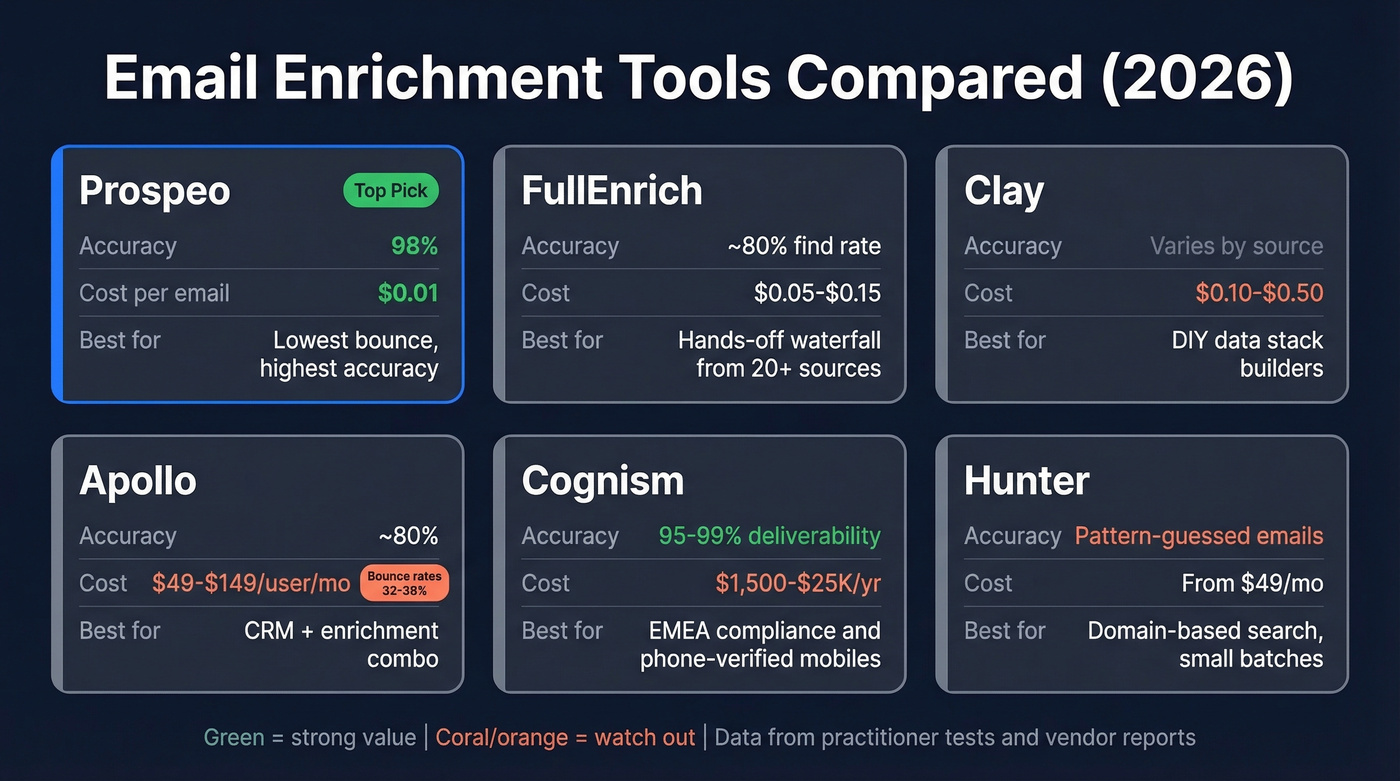
| Tool | Accuracy Range | Pricing | Best For | Watch Out For |
|---|---|---|---|---|
| Prospeo | 98% email | ~$0.01/email | Lowest bounce, lowest cost | Email-focused - pair with CRM |
| FullEnrich | ~80% find rate | From $29/mo | Hands-off waterfall | Phone credits costly |
| Clay | Varies by source | From $149/mo | DIY data stacks | Steep learning curve |
| Apollo | ~80% email accuracy | $49-$149/user/mo | CRM + enrichment combo | Bounce rates rising |
| Cognism | 95-99% deliverability | $1,500-$25K/yr | EMEA compliance | Pricey for US-only |
| Hunter | - | From $49/mo | Domain-based search | Guessed emails |
| Lusha | - | From $36/user/mo | Quick lookups | Credits burn fast |
| Snov.io | - | From $30/mo | Budget teams | Higher bounce rates |
| Breeze (Clearbit) | ~85% | $45-$700/mo | HubSpot-native | Credit reset trap |
Prospeo
Use this if: You need the highest email accuracy available without stitching together multiple tools. Prospeo's 300M+ profiles run through a 5-step verification process with catch-all handling, spam-trap removal, and honeypot filtering - resulting in 98% email accuracy, a 92% API match rate, and an 83% enrichment match rate on CRM/CSV uploads. The 7-day data refresh cycle, compared to the 6-week industry average, means you're not enriching against stale records.
CRM and CSV enrichment returns 50+ data points per contact, and intent data powered by Bombora covers 15,000 topics. Native integrations with Salesforce, HubSpot, Clay, Instantly, and Lemlist mean enriched contacts flow straight into your workflows. Pricing starts free with 75 emails/month, and paid plans run about $0.01/email.
We've seen the results firsthand: Meritt went from a 35% bounce rate to under 4%, and their pipeline tripled from $100K to $300K per week.
Pairs best with: Your existing CRM. Prospeo handles the data layer; Salesforce, HubSpot, or whatever you're running handles the workflow.
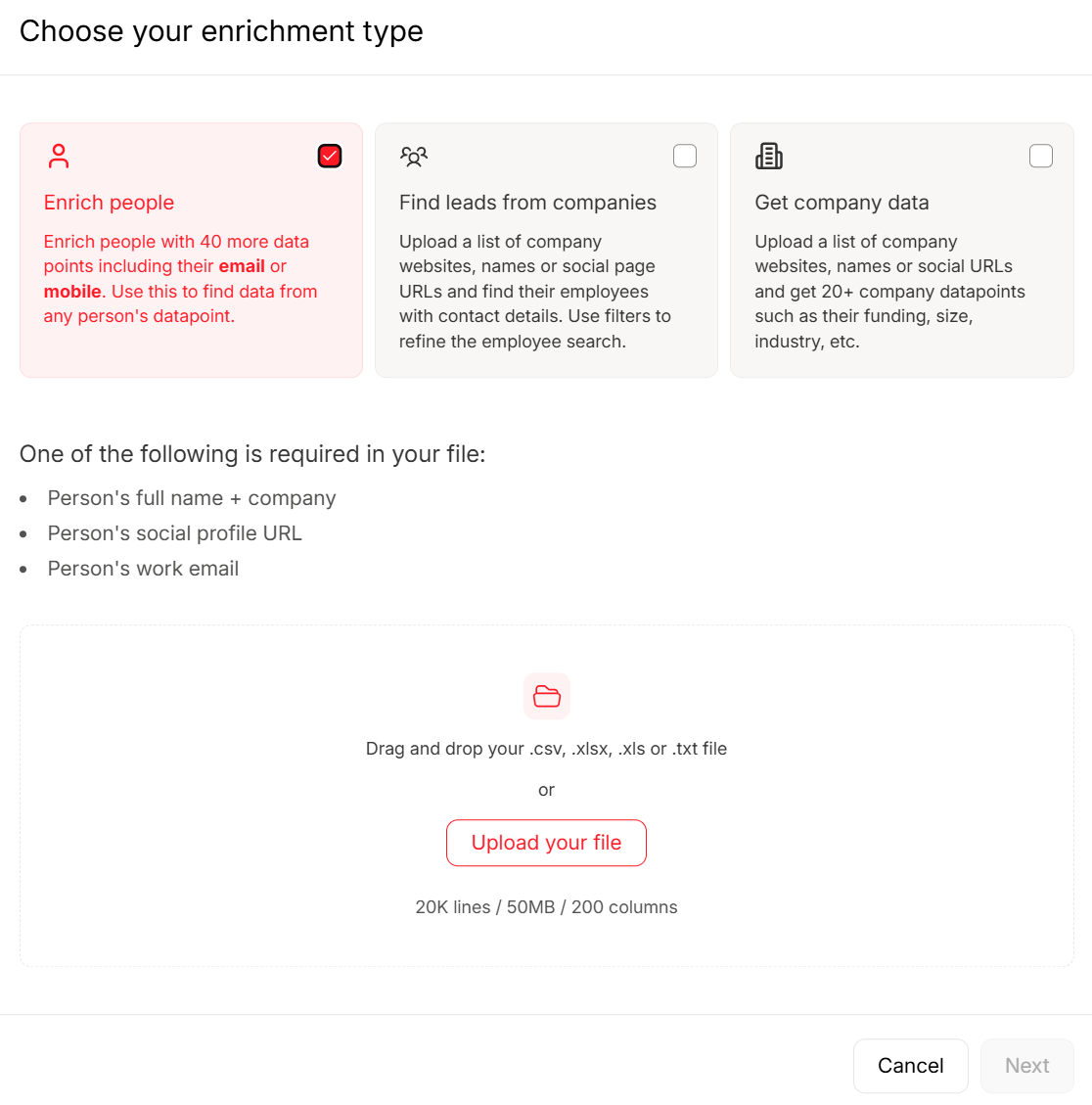
FullEnrich
Use this if: You want waterfall enrichment from 20+ data sources without managing the cascade yourself. FullEnrich charges 1 credit per work email, 10 credits per mobile number, and only deducts on success - invalid results don't cost you. Monthly plans include 3-month credit rollover. Starts at $29/month. They report an average find rate around 80%, and Guideflow saw pipeline grow 37% after switching.
Skip this if: You need heavy phone enrichment. At 10 credits per mobile number, phone-heavy workflows get expensive fast.
Clay
Clay is pure orchestration - it doesn't own data, it stacks providers. For RevOps teams who want to build custom waterfall sequences with conditional logic, nothing else comes close. But it's not a plug-and-play enrichment tool. Starts at $149/month, plus you still pay for every underlying data source. We've watched teams spend two weeks configuring Clay tables that a simpler tool could've handled in an afternoon. Worth it if you're running complex, multi-signal workflows. Overkill for a team that just needs clean emails.
Apollo
The user-reported bounce rates tell the story. On r/coldemail, practitioners consistently report 32-38% bounce on Apollo-sourced lists - a number that's been climbing. The database is large, the free tier is generous, and paid plans run $49-$149/user/month. If you're already in the Apollo ecosystem for CRM and sequencing, it's convenient. But run every Apollo-sourced email through a verification layer before sequencing. The bounce rates speak for themselves.
If you're evaluating providers beyond the shortlist above, start with a ranked breakdown of the best data enrichment tools and cross-check coverage against the best B2B database options for your ICP.
Cognism
Selling into Europe? Cognism is the answer. Their EMEA coverage is genuinely strong, with phone-verified mobile numbers and GDPR-first data handling. They report 95-99% email deliverability. Pricing ranges from $1,500 to $25,000/year depending on team size. Where Cognism wins over ZoomInfo: EMEA compliance and mobile verification. Where ZoomInfo still wins: US database depth. If your entire ICP is US-based, you're paying a premium for European coverage you won't use.
Other Options Worth Knowing
Hunter starts at $49/month and works well for domain-based email search. A meaningful percentage of results are pattern-guessed rather than verified, which means bounce rates in the 28-35% range. Fine for small-batch prospecting, risky at scale. If you're comparing similar tools, see our Hunter alternatives.
Lusha starts at $36/user/month with decent accuracy in practitioner tests, but credits burn fast on anything beyond a few hundred contacts per month.
Snov.io is the budget option at $30/month. You get what you pay for - bounce rates run 28-35%, and the data skews toward smaller companies.
Breeze Intelligence (formerly Clearbit) is baked into HubSpot. One enrichment costs 10 HubSpot Credits, and credits reset monthly with no rollover. On a 500-credits/month allowance, that's roughly 50 enrichments per month. Convenient for light enrichment in a HubSpot shop; painful at volume.
Waterfall enrichment works - but only if your primary provider covers most of your list. Prospeo's 83% enrichment match rate on CRM and CSV uploads means fewer records ever cascade to a second source. At $0.01/email with 50+ data points returned per contact, you get the coverage of a waterfall from a single call.
One provider. 50+ data points. 98% accuracy. No waterfall needed.
What It Actually Costs
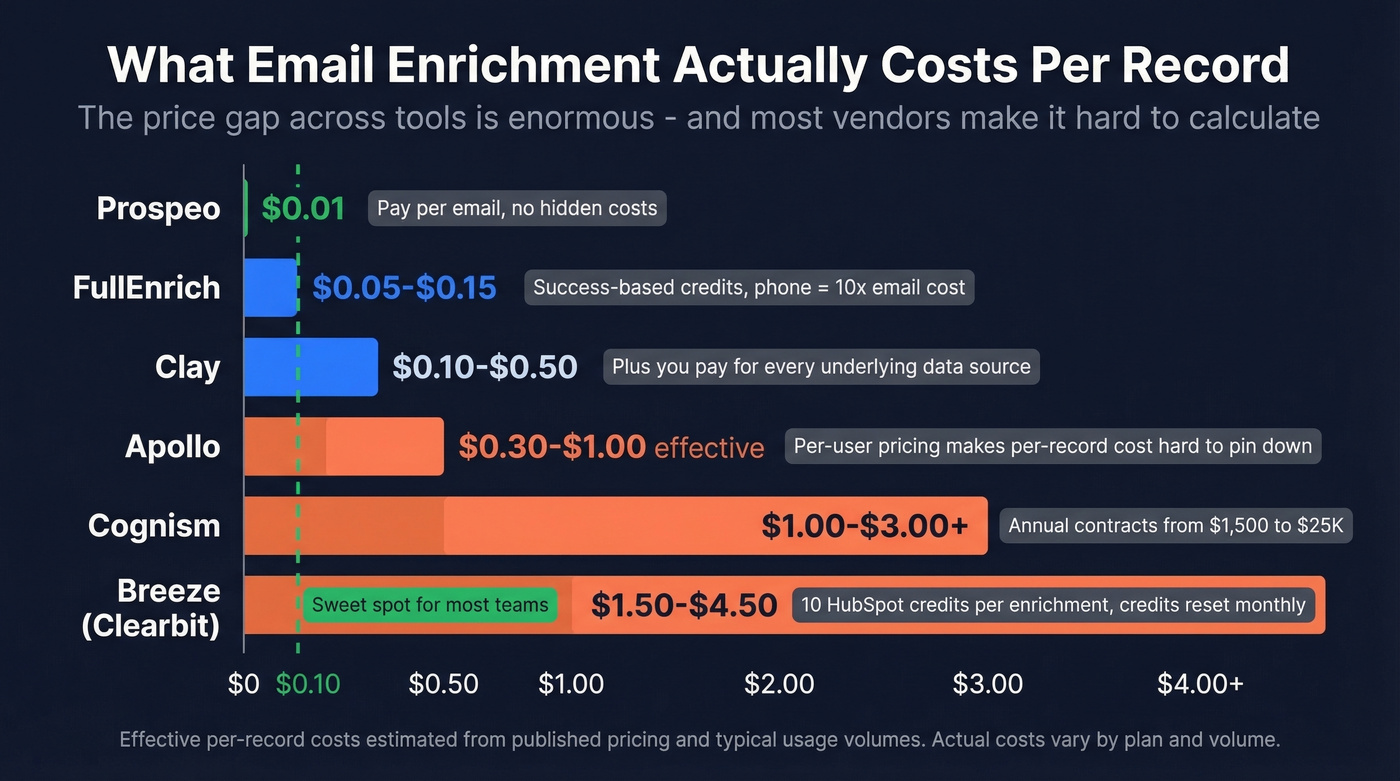
The price-per-record gap across tools is enormous, and most vendors make it deliberately hard to calculate.
| Tool | Cost per Record | Credit Model | Hidden Costs |
|---|---|---|---|
| Prospeo | ~$0.01 | Pay per email | None - transparent |
| FullEnrich | ~$0.05-$0.15 | Success-based credits | Phone = 10x email |
| Clay | ~$0.10-$0.50 | Credits + data sources | Underlying provider fees |
| Apollo | ~$0.15-$0.40 | Per-user subscription | Bounced emails waste seats |
| Cognism | ~$0.30-$1.00+ | Annual contract | Long commitments |
| ZoomInfo | ~$0.50-$1.00+ | Enterprise contract | $15-40K/yr minimum |
| Breeze | ~$0.10 per credit | HubSpot credits | Monthly reset, no rollover |
Building your own waterfall in-house sounds appealing until you factor in $1,000-$10,000 in development time plus ongoing maintenance as APIs change and providers update their schemas. For most teams, buying beats building - especially if you're using pay-as-you-go pricing instead of annual contracts.
Mistakes That Kill Your Pipeline
Relying on a single provider. We've seen this pattern repeatedly: a team picks one database, enriches their entire CRM, and wonders why 40% of their sequences bounce. Single-provider match rates cap at 30-60%. Waterfall or bust.
Skipping verification after enrichment. An enriched email isn't necessarily a deliverable email. If your enrichment tool doesn't include built-in verification, bolt on a verification layer before anything hits your sequencer. Enriching contacts without that step is just expensive list-building with extra bounces. If you need a shortlist, start with these email verifier options.
"Set and forget" enrichment. At 2.1% monthly decay, a database you enriched in January is ~6.3% degraded by April. Quarterly re-enrichment is the minimum cadence; monthly is better for high-velocity outbound teams.
Over-enriching records. Appending 50 data points to every lead in your funnel is wasteful. Use tiered enrichment by funnel stage - basic firmographics at the top, full contact details for qualified leads, real-time intent signals for accounts in active buying cycles. Let's be honest: most top-of-funnel leads don't need a phone number and Bombora intent score on day one.
Keeping It Legal
Email enrichment is completely legal when done correctly. The key word is "correctly."
Under GDPR, fines reach EUR 20M or 4% of global turnover - whichever is higher. CCPA penalties hit $7,500 per intentional violation. These aren't theoretical numbers; enforcement is active and growing.
The requirements are straightforward: use publicly available or lawfully obtained data, honor opt-out requests promptly, maintain consent records, and ensure your enrichment provider has proper data processing agreements in place. Compliance isn't the exciting part of B2B data enrichment, but one regulatory action can cost more than a decade of data subscriptions. Pick providers that take it seriously - especially if you're building a GDPR compliant database or operating under broader B2B compliance requirements.
FAQ
Email enrichment vs. email verification?
Email enrichment appends missing data - addresses, phone numbers, firmographics, intent signals - to incomplete contact records. Verification checks whether an existing address is deliverable. Enrichment finds the data; verification confirms it works. The best workflows run both in sequence.
How often should I re-enrich my database?
Quarterly at minimum. B2B data decays at 22.5% per year, meaning ~6% of records go stale every quarter. High-velocity outbound teams should re-enrich monthly. A database enriched once and never revisited has one in four contacts outdated within 12 months.
Is email enrichment GDPR compliant?
Yes, when done properly. GDPR allows processing publicly available business data under legitimate interest, but you must honor opt-out requests, maintain processing records, and use providers with proper data processing agreements. Penalties reach EUR 20M or 4% of global turnover - compliance isn't optional.
What's a good match rate to expect?
A single provider typically matches 30-60% of records. Anything above 50% from one source is solid. Waterfall enrichment pushes match rates to 80-93% by querying multiple providers sequentially. If a vendor claims 90%+ from a single database, run your own test before committing budget.
What's a good free tool for contact enrichment?
Prospeo offers 75 free email credits per month with full verification and 50+ data points per contact - enough for small teams running real campaigns. Hunter gives 25 free searches monthly but caps enrichment depth. Apollo's free tier is generous on volume but bounce rates run 32-38% in practitioner tests.