

The 10 Best Email Finding Tools in 2026
You imported 500 leads into your sequencer last Tuesday. By Thursday, 180 had bounced, your domain reputation took a hit, and your ops lead was asking why you're paying for an email finding tool that produces dead emails.
That gap between what these tools promise and what they deliver is where campaigns die. Every vendor claims 95%+ accuracy. A 20,000-contact benchmark test found that real enrichment rates - after subtracting hard bounces and wrong-domain emails - range from roughly 31% to 55% for the best tools. The rest pad numbers with unverified guesses and catch-all addresses.
We've tested these tools with real prospect lists, tracked bounce rates, and calculated what you actually pay per delivered email. Here's what's worth your time and budget.
Our Picks (TL;DR)
If you don't want to read 4,000 words, here's the short version.
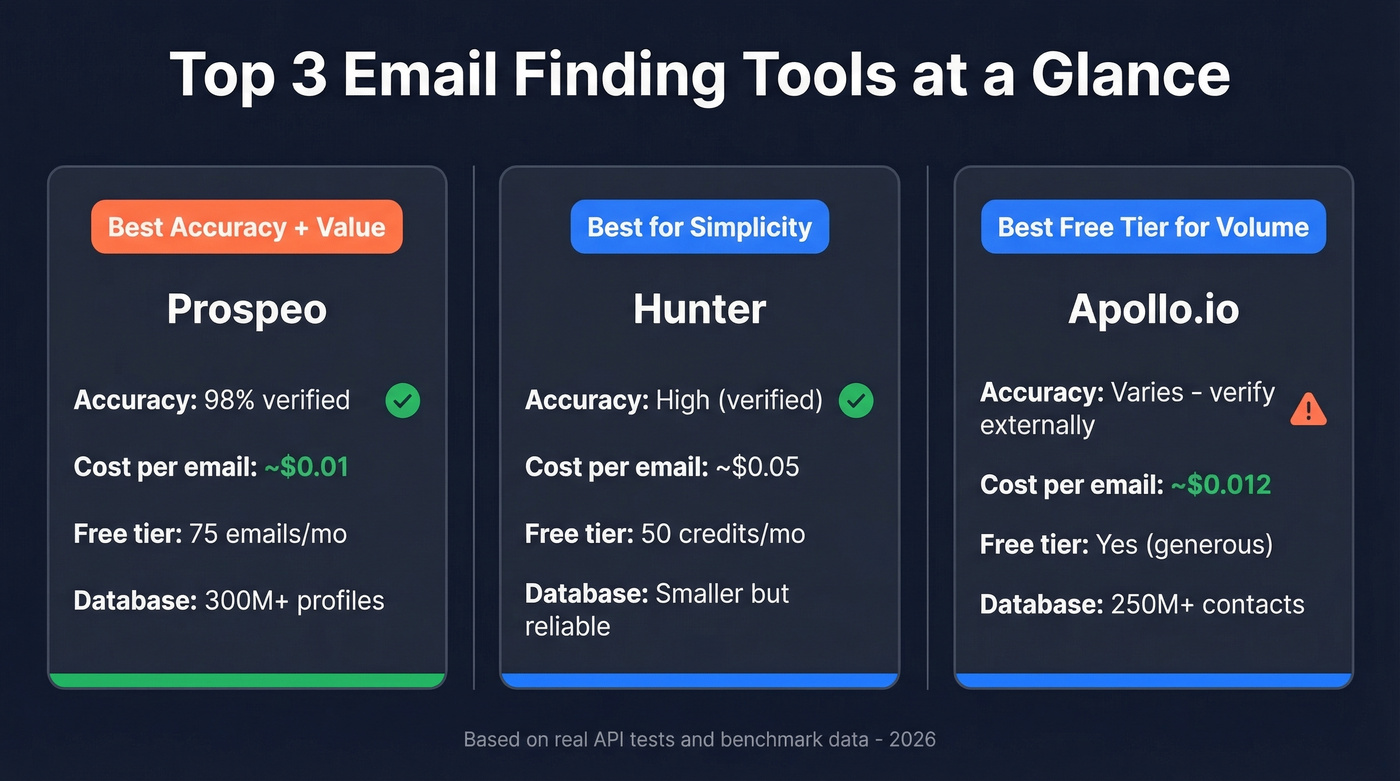
Best for accuracy and value: Prospeo. 98% verified email accuracy with a 5-step verification process that handles catch-all domains, spam traps, and honeypots. At ~$0.01 per email with a free tier of 75 emails/month, it's the best cost-to-quality ratio on this list. Full review below.
Best for simplicity: Hunter. Clean interface, strong verification engine, and a brand everyone recognizes. The database is smaller than competitors - an API test on 1,000 leads returned just 281 emails - but what it finds tends to be reliable. Starts at $34/mo annual. Full review below.
Best free tier for volume: Apollo.io. The biggest database in the space at 250M+ contacts, and the free tier is one of the most generous. That same API test found 430 emails per 1,000 leads at just $11.8/1k. The catch? Reddit threads consistently flag stale data and bounce issues. Verify externally. Full review below.
10 Best Email Finder Tools Compared
Here's what each tool actually does well, where it falls short, and what you'll pay.
Prospeo
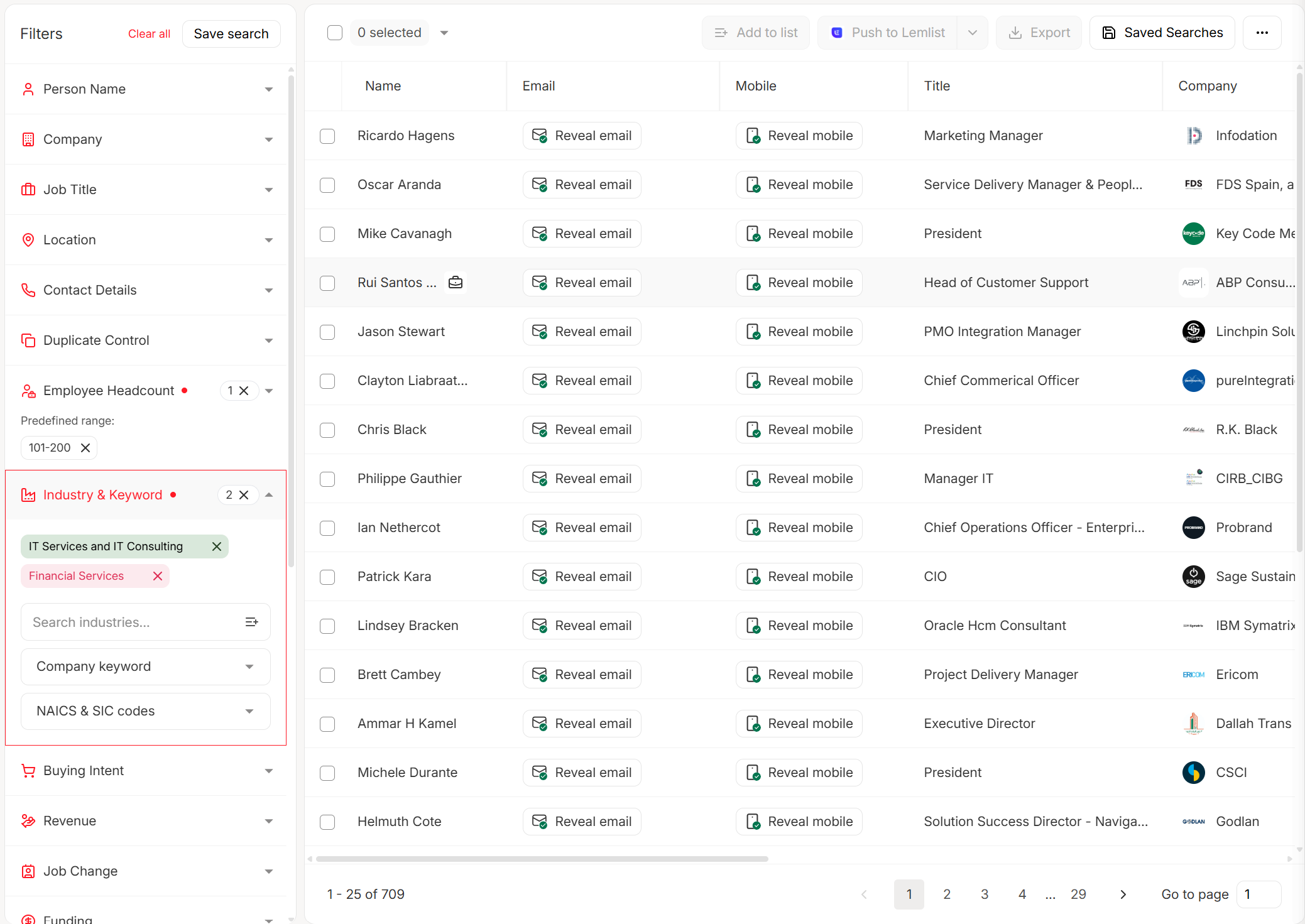
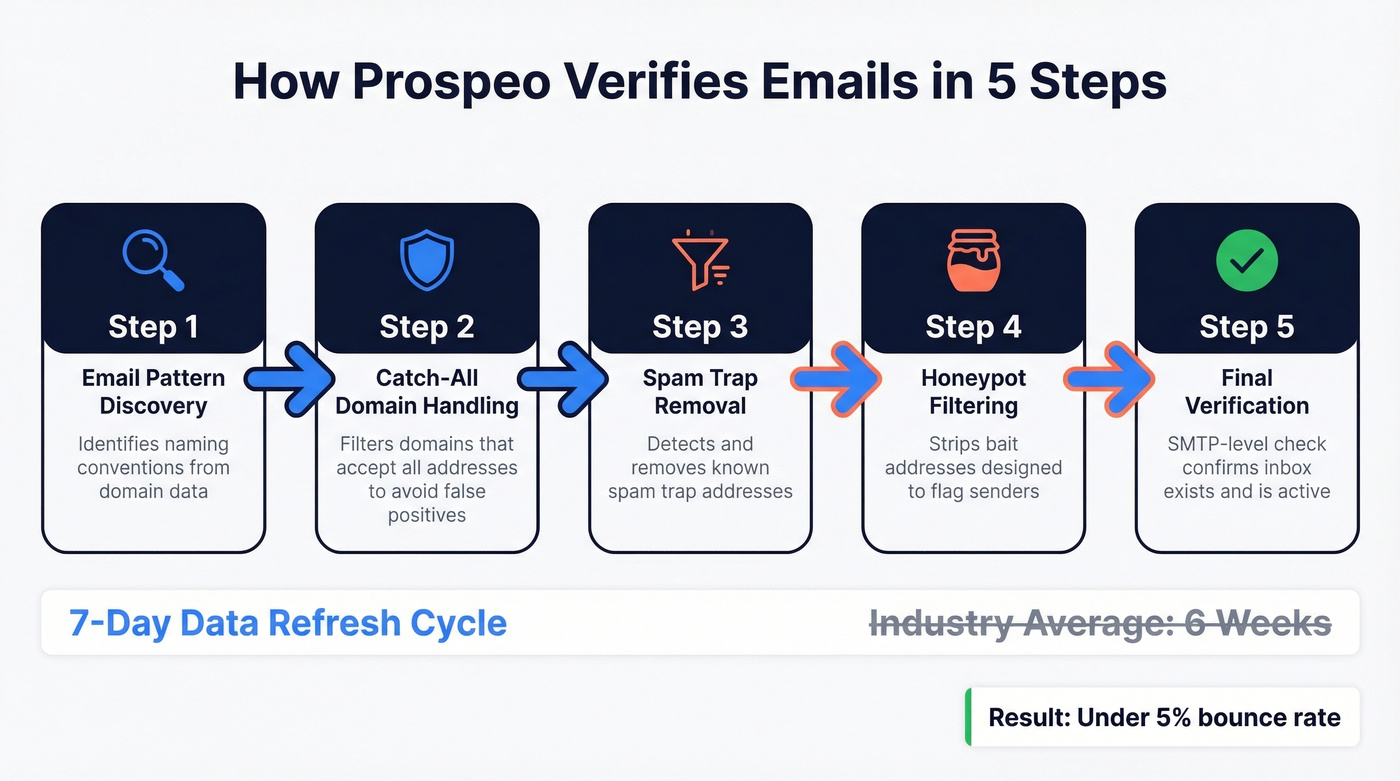
Prospeo's database covers 300M+ professional profiles with 143M+ verified emails, all running through a proprietary email-finding infrastructure that doesn't depend on third-party providers. The 5-step verification process - catch-all handling, spam-trap removal, honeypot filtering - runs on a 7-day data refresh cycle. The industry average is 6 weeks. That difference shows up in bounce rates.
If you're comparing vendors, it's also worth looking at broader data enrichment services (not just email finding) so you can standardize fields across your CRM.
Snyk's team of 50 AEs saw bounce rates drop from 35-40% to under 5% after switching, generating 200+ new opportunities per month. Stack Optimize built to $1M ARR with client deliverability consistently above 94% and zero domain flags. Beyond email, the platform includes 125M+ verified mobile numbers with a 30% pickup rate - useful if your outbound strategy includes cold calling.
The Chrome extension has 40,000+ users and works across company websites and professional profiles. CRM enrichment returns 50+ data points per contact at a 92% API match rate. For teams that need to find in-market buyers specifically, Prospeo tracks 15,000 intent topics via Bombora, letting you filter by buying signals before you start enriching.
Pricing: ~$0.01 per email. Free tier includes 75 emails and 100 Chrome extension credits per month. No contracts, no annual commitment, self-serve signup.
Use it if: You need verified emails that actually land in inboxes, without enterprise pricing or sales calls.
Hunter
Hunter is the tool everyone's heard of, and for good reason - the verification engine is genuinely strong, and the UX is the cleanest in the category. If you've never used a dedicated email finder before, Hunter will make sense in about 90 seconds.
The tradeoff is database size. In the Lobstr API bake-off, Hunter returned 281 emails from 1,000 leads at $50/1k - roughly half what Apollo found. But those 281 emails are far more likely to be deliverable. Hunter's verification costs 0.5 credits per email, an important nuance that effectively doubles your credit burn if you're verifying everything you find.
If you're evaluating options in this category, you may also want to compare Hunter alternatives based on find rate vs verification quality.
Pricing: Free plan with 50 credits/month. Starter at $49/mo ($34/mo annual) for 2,000 credits. Growth at $149/mo ($104 annual). Scale at $299/mo ($209 annual).
Use it if: You want a simple, reliable tool and your ICP is US or Western Europe.
Skip it if: You need volume or strong international coverage - the database isn't big enough.

Apollo.io
Apollo is the Costco of email data. Massive selection, rock-bottom prices, and you should probably check the expiration dates before you consume anything.
If you're building a full outbound stack, it helps to map where an email finder sits among other SDR tools (sequencing, dialing, enrichment, and verification).
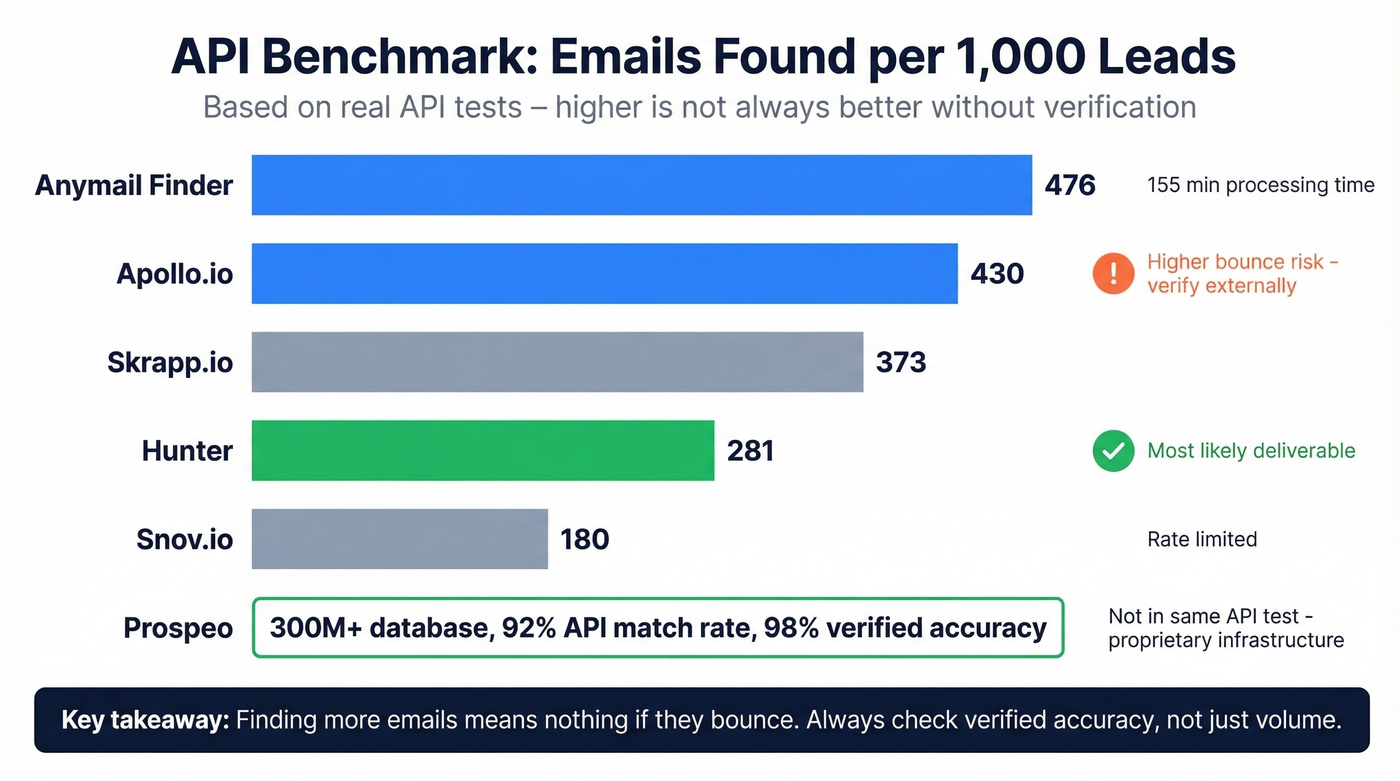
The database covers 250M+ contacts, and the free tier is one of the most generous in the category. In API testing, Apollo returned 430 emails per 1,000 leads at just $11.8/1k - the cheapest per-email cost in bulk by a wide margin. Speed is solid too, at roughly 8 minutes per 1,000 lookups.
The problem is well-documented on Reddit. Posters flag outdated contacts and higher-than-expected bounce rates. One agency poster summed it up: big database, but "data feels bad sometimes." If you're running Apollo at volume, you need an external verification step - full stop. The savings on the front end evaporate fast when 15% of your list bounces and your domain takes the hit.
Pricing: Free tier with limited credits. Paid plans from ~$49-$99/mo per user.
Use it if: You need volume on a budget and you'll run every list through a verifier before sending.
Skip it if: Your bounce rate matters more than your list size.
Snov.io
Snov.io is an email finder, verification tool, and outreach platform rolled into one credit-based system. For teams doing international prospecting, it's a common pick - especially when you need coverage beyond the US.
The API test showed 180 emails found per 1,000 leads at $39/1k. That's one of the lowest find rates in the test, partly due to rate limiting that slows down bulk operations. The credit model covers search, verification, and prospect storage, so budget accordingly - credits go faster than you'd expect when every action costs one.
One nice detail: unused credits roll over with plan autorenewal. The automation add-on runs $69/mo per slot, a separate line item that catches people off guard.
Pricing: Starter at $29.25/mo (annual) with 1,000 credits. Pro at $74.25/mo (annual) with 5,000 credits. Trial plan offers 50 credits free.
Use it if: You need an all-in-one outreach and finding tool with decent international data.
Skip it if: You need high-volume API enrichment - the rate limits will frustrate you.
Anymail Finder
Anymail Finder's billing model deserves more attention than it gets: you only pay for valid emails. Risky emails (70%+ delivery rate) are free, and "not found" results don't cost credits. The API test returned 476 emails per 1,000 leads at $49/1k. The tradeoff is speed - 155 minutes to process 1,000 lookups makes it a non-starter for real-time enrichment. For batch processing where you can wait, it's a strong accuracy play. Plans start at ~$14/mo, and you get 100 free credits to test.
Use it if: You run batch enrichment and want a pay-for-verified-only model.
Skip it if: You need results in minutes, not hours.
GetProspect
GetProspect is the tool you recommend to a founder who just started doing outbound and doesn't need anything fancy. The Chrome extension handles bulk lookups, the interface is straightforward, and the learning curve is basically zero. Free tier gives you 50 emails/month. Paid plans start at $49/mo for 1,000 valid emails plus verifications.
It won't win any benchmarks, but for a solo operator or two-person sales team that needs to get moving without evaluating 10 tools, it does the job.
RocketReach
Here's the thing about RocketReach: the data is fine, but the pricing is genuinely insulting in 2026.
Individual plans run $80-$300/user/month. The Pro plan at $150/mo gives you 375 lookups - that's $0.40 per email, and they can still bounce. Team Pro drops to $83/user/mo billed annually with 3,600 lookups, which is more reasonable but still expensive relative to what you get. Additional credits cost $0.30-$0.45 each.
A domain broker on Reddit paying ~$50/mo reported low reply rates and was actively seeking alternatives. That tracks with what we've seen - the cost-per-delivered-email math just doesn't work for most teams. If you're enterprise with budget and need phone + email in a single platform, RocketReach is functional. For everyone else, the value isn't there.
Skrapp.io
Skrapp focuses on finding emails from professional profiles and company domains, making it popular with recruiters and marketers running targeted campaigns. The API test returned 373 emails per 1,000 leads at $49/1k with a 20-minute processing time - decent volume and speed, though the tester flagged accuracy as lower than top performers. Free tier available. A solid lightweight option if you're not running high-stakes outbound where every bounce matters.
Kaspr
Kaspr is an EU-focused tool that checks and verifies data against 120 sources. G2 rating sits at 4.4/5 from 500+ reviews. The Chrome extension works across professional profiles and search results, and the platform is GDPR and CCPA aligned. Free tier available. Best for teams prospecting primarily in Europe who need compliant data without enterprise pricing.
Cognism
Cognism is an enterprise-grade platform with Diamond Data phone verification and DNC list checking. There are no credits - pricing is custom, typically $1,000-$3,000/mo for small teams, with a flat platform fee covering onboarding and integrations. Best for mid-market and enterprise teams with budget who need EU/UK phone data and full compliance. If you're a 5-person SDR team, this isn't for you.
Comparison Table
| Tool | Accuracy | Cost/1k Emails | Free Tier | Best For |
|---|---|---|---|---|
| Hunter | High (verified) | ~$50 | 50 credits/mo | Simplicity |
| Apollo.io | Varies (verify externally) | ~$12 | Yes (limited) | Volume on budget |
| Snov.io | High | ~$39 | 50 credits trial | International outreach |
| Anymail Finder | 97%+ (valid-email model) | ~$49 | 100 credits | Budget accuracy |
| GetProspect | Moderate | ~$49 | 50 emails/mo | Small teams getting started |
| RocketReach | Unverified | ~$200-$640 | No | Enterprise (if budget allows) |
| Skrapp.io | Moderate | ~$49 | Yes | Recruiters |
| Kaspr | High (120 sources) | Paid | Yes | EU compliance |
| Cognism | High (Diamond Data) | ~$1,000-$3,000/mo | No | Enterprise EU |
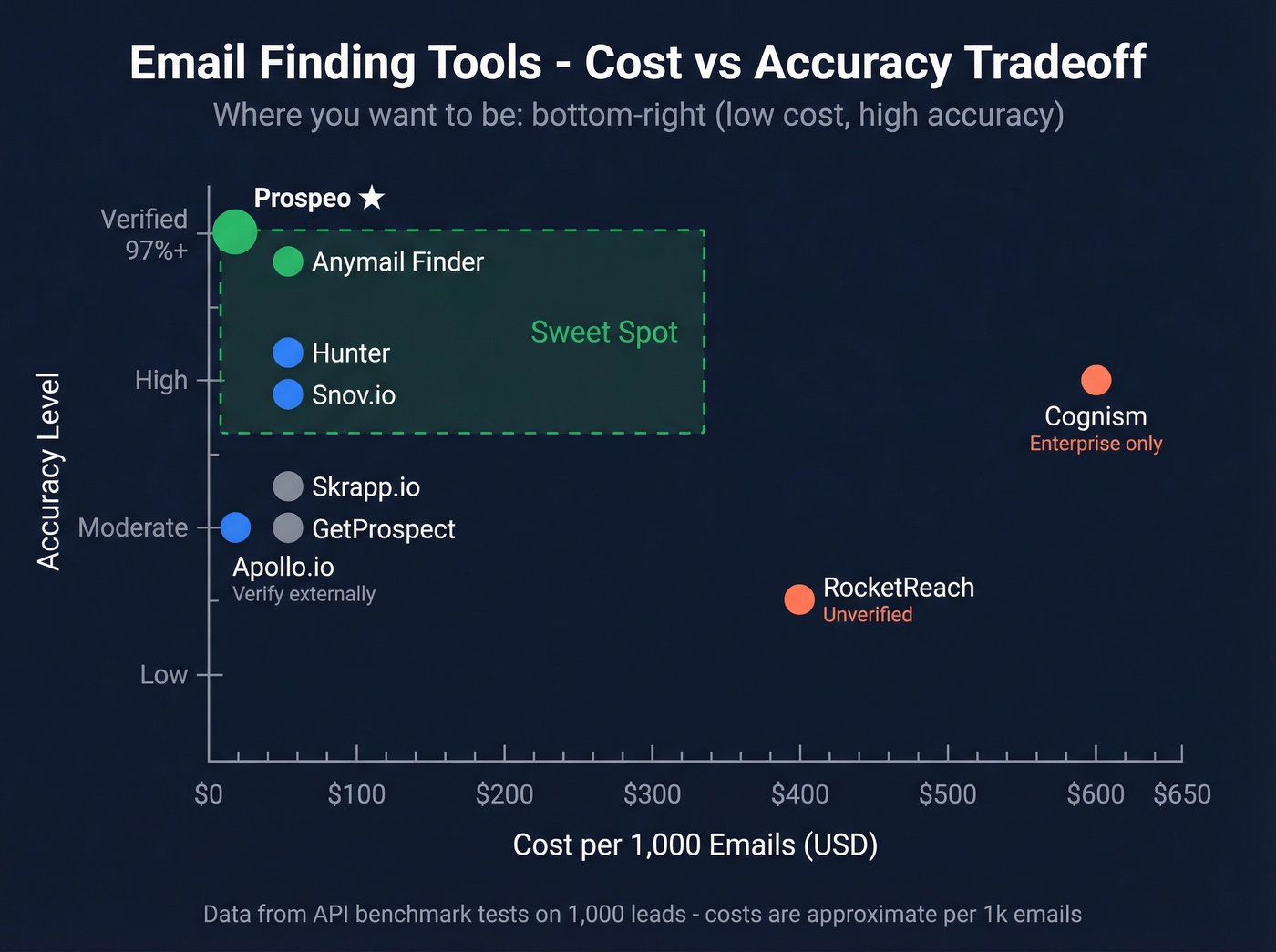
Hot take: If your average deal size is under $10k, you don't need Cognism or RocketReach-level pricing. A $0.01/email tool with 98% accuracy will outperform a $0.40/email tool with unverified data every single time. Stop overpaying for databases that don't verify what they sell you.
What "Accuracy" Actually Means
Every email finder throws around accuracy percentages. "95% accurate." "97% verified." These numbers are almost meaningless without context.
A benchmark study testing 15 tools on 20,000 real contacts - split roughly 9,800 US, 9,700 Europe, and 500 rest of world - measured something far more useful: real enrichment rate. That's the raw enrichment rate minus hard bounces minus wrong-domain emails. They didn't simulate verification checks. They actually sent emails to every found address and manually verified domains.
The results are sobering. Dropcontact hit 54.9% real enrichment with just 0.9% hard bounces. Fullenrich found more emails overall at 48.3%, but had an 11.7% wrong-domain rate - meaning roughly 1 in 9 emails went to someone at the wrong company entirely. Findymail landed at 39.9% real enrichment. Hard bounce rates among the best tools ranged from 0.9% to 3.6%. Among the worst? Much higher.

Let's make this concrete. Say you test Hunter and Apollo on the same 1,000-lead list. Hunter returns 281 emails, mostly clean. Apollo returns 430 emails, but 15% bounce and 3% go to wrong domains. After the math, Hunter delivered ~270 usable contacts. Apollo delivered ~350 - more, but with domain reputation damage baked in. Which tool "won" depends entirely on whether you value volume or deliverability.
The catch-all domain problem makes this worse. Many large enterprises use catch-all configurations, meaning any email sent to their domain gets accepted - even if the address doesn't exist. Most verification tools flag these as "risky" and either discard them or pass them through unverified. Verified emails typically deliver at 90%+ rates, while "risky" emails (often catch-all) hover around 70%. Either way, you're losing high-value targets or taking on risk. This is exactly why the best platforms invest in multi-step verification rather than relying on simple SMTP checks alone.
If you're trying to reduce bounces systematically, start with the mechanics behind email bounce rate and then work backward into list building and verification.

The benchmark tests don't lie - real enrichment rates top out around 55% for most email finding tools. Prospeo's 5-step verification and 7-day data refresh deliver 98% email accuracy with bounce rates under 5%. At ~$0.01 per email, you stop paying for dead contacts.
Stop burning your domain on unverified emails. Try it free with 75 emails.
Cost-Per-Email Breakdown
The sticker price tells you almost nothing. What matters is cost per delivered email - the price you pay for contacts that actually reach an inbox.
Here's the math from the Lobstr API bake-off, tested on 1,000 identical leads:
| Tool | Cost/1k Lookups | Emails Found | Cost/Found Email | Speed (1k) |
|---|---|---|---|---|
| Apollo.io | $11.80 | 430 | ~$0.03 | 8 min |
| Snov.io | $39 | 180 | ~$0.22 | 18 min |
| Anymail Finder | $49 | 476 | ~$0.10 | 155 min |
| Hunter | $50 | 281 | ~$0.18 | 30 min |
| Skrapp.io | $49 | 373 | ~$0.13 | 20 min |
| RocketReach | ~$200-$640 | N/A | ~$0.36-$0.64 | N/A |
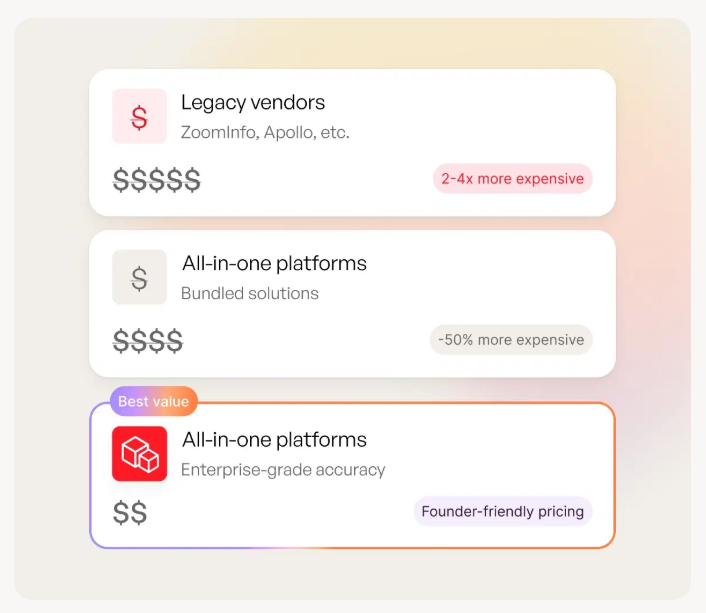
RocketReach stands out for all the wrong reasons. At the Pro plan ($150/mo for 375 lookups), you're paying $0.40 per email before you even know if it's valid. Factor in bounces and you're easily above $0.50 per delivered contact.
Cheapest per-lookup doesn't equal cheapest per-delivered-email. Apollo wins on raw lookup cost, but if 15% of those emails bounce, your effective cost jumps - and your domain pays the price. The real calculation is (plan cost) / (emails that actually land in inboxes). Always run this math before committing to an annual plan.
If you're sending at scale, pair this with a deliverability-first workflow (warming, throttling, and monitoring) from an email deliverability guide.
Every email finding tool on this list charges you credits before you know if the data is fresh. Prospeo refreshes every 7 days - not 6 weeks - and runs every address through catch-all handling, spam-trap removal, and honeypot filtering before it ever reaches your list.
Snyk's 50 AEs dropped bounce rates from 40% to under 5%. See why.
5 Mistakes That Kill Your ROI
1. Trusting accuracy claims without testing. Every tool says 95%+. The Dropcontact benchmark showed real enrichment rates topping out at 55% for the best performers. Run your own test on 200-500 leads before committing to an annual plan. Track hard bounces, wrong domains, and catch-all rates separately.
2. Not verifying close to send time. Email addresses decay faster than most teams realize. People change jobs, companies restructure, domains expire. Anymail Finder's research recommends verifying within a month of sending. If you're building lists in January and sending in March, re-verify before launch.
3. Using historical scraped databases. Some tools rely on databases built from years of web scraping with infrequent updates. The older the data, the higher your bounce rate. Look for tools with documented refresh cycles - weekly is ideal, monthly is acceptable, "we don't disclose" is a red flag. (If you're considering scraping, read up on web scraping lead generation tradeoffs first.)
4. Ignoring catch-all domain handling. Catch-all domains accept every email sent to them, making verification impossible through standard SMTP checks. Layering a standalone verifier on top of your primary tool can reduce your valid list by up to 20%, mostly by flagging catch-all addresses as risky. You need a solution that handles these intelligently rather than just discarding them.
5. Sending risky emails from your primary domain. If you're going to send to unverified or catch-all addresses, isolate those sends to secondary domains and IPs. One bad campaign from your primary domain can tank deliverability for your entire organization. We've seen teams learn this the hard way - it takes weeks to recover.
How to Choose the Right Tool
Your pick depends on four variables: team size, budget, geography, and workflow.
Solo founders and tiny teams running under $50/mo should start with a generous free tier. GetProspect gives you 50 emails/month with zero learning curve. Once you outgrow free, paid plans at ~$0.01/email keep costs negligible at any scale.
Small sales teams of 3-10 reps spending $50-200/mo have the most options. Hunter works well if you want simplicity and your ICP is US or Western Europe. Snov.io bundles finding and outreach into one platform, which saves tool sprawl. Apollo delivers raw volume if you'll verify externally before sending.
Teams selling into the US will find strong coverage from Hunter and Apollo. For international teams, Snov.io offers broad coverage and Kaspr handles EU-specific compliance. One r/DigitalMarketing thread captured the frustration well - multiple posters had cycled through 3-4 providers before finding one that worked for their region. We've heard the same story from our own users more times than we can count.
If you're still building your outbound motion, these sales prospecting techniques help you avoid wasting credits on low-fit accounts.
Mid-market and enterprise teams above $200/mo should evaluate Cognism for selling into EU/UK with phone-verified data and DNC compliance. RocketReach is functional if you have budget and need combined phone + email, though the per-email cost is hard to justify unless your deal sizes are large enough to absorb it.
When budget is tight, Apollo is the starting point for volume - then verify everything with a standalone verifier before sending.
When accuracy is the priority, the 98% verified rate and 5-step verification from Prospeo aren't marketing fluff. Snyk's team cut bounce rates from 35-40% to under 5% in production, not in a controlled test.
For compliance-first teams, Cognism serves enterprise and Kaspr serves SMB, both EU-focused.
FAQ
What's the most accurate email finding tool in 2026?
Prospeo delivers 98% verified email accuracy through a 5-step verification process with catch-all handling, spam-trap removal, and honeypot filtering. Third-party benchmarks show the best tools achieve 40-55% real enrichment rates with hard bounce rates between 0.9% and 3.6%. Always test on your own list before committing.
Are free email finders reliable?
Free tiers from Apollo, Hunter, and Prospeo (75 emails/month) are useful for testing workflows and building small initial lists. The real risk is accuracy - free tools without built-in verification can produce 30%+ bounce rates that damage sender reputation. Always verify before sending.
How many email finders do I need?
One good tool with built-in verification is enough for most teams. If yours doesn't verify, add a standalone verifier as a second step. More than two tools creates data conflicts and wastes credits on duplicate lookups without meaningfully improving results.
What's a safe bounce rate for cold email?
Keep hard bounces under 3%. Above 5%, ESPs start throttling your sending domain. Above 10%, you risk blacklisting that takes weeks to resolve. Verify emails before sending and isolate risky sends to secondary domains.
Do email finding tools work for international contacts?
Coverage varies significantly by provider. Snov.io offers strong international data across regions. Hunter skews toward US and Western Europe. Cognism and Kaspr specialize in EU/UK contacts with compliance built in. Test 100-200 contacts in your target region before committing.