

Email Harvester in 2026: What It Is, Why It's Dying, and What Replaced It
One of the most-cited legacy tools in this space, EmailHarvester by maldevel, is a historical artifact at this point. The real question isn't how to use an email harvester anymore. It's whether you should, and what actually works instead.
What You Need (Quick Version)
- Security professional doing OSINT recon? Use theHarvester - open-source, actively maintained, 15,900+ GitHub stars.
- Already sitting on a scraped list? Verify everything before you send a single message. Keep bounces under 2% or your domain is toast.
What Is Email Harvesting?
Email harvesting is the automated collection of email addresses from web sources - websites, search engine results, directories, public databases, anywhere an address appears in plaintext. The technique dates back to the early spam era, when bots crawled the web and vacuumed up every mailto: link they found.
The methods haven't changed much. Web crawlers scan pages for anything matching an email pattern. Directory harvest attacks guess addresses by brute-forcing common formats against a mail server. Google dorking uses search operators like site:example.com "@gmail.com" to surface indexed pages containing email addresses. One Reddit poster described exactly this workflow - acknowledging it's spam, then asking how to automate it anyway.
What has changed is the context. Email harvesting evolved from a pure spam tool into a legitimate OSINT technique. By the mid-2010s, tools like theHarvester were bundled into Kali Linux and adopted by penetration testers as standard reconnaissance. But for anyone in sales or marketing, the technique is now a liability.
Scraper vs. Finder: Why It Matters
Think of it as shotgun vs. rifle. An email scraper blasts across web pages and pulls every address it finds - role-based inboxes, former employees, spam traps, whatever. An email finder takes a specific person's name and company, then returns a verified work email for that individual.
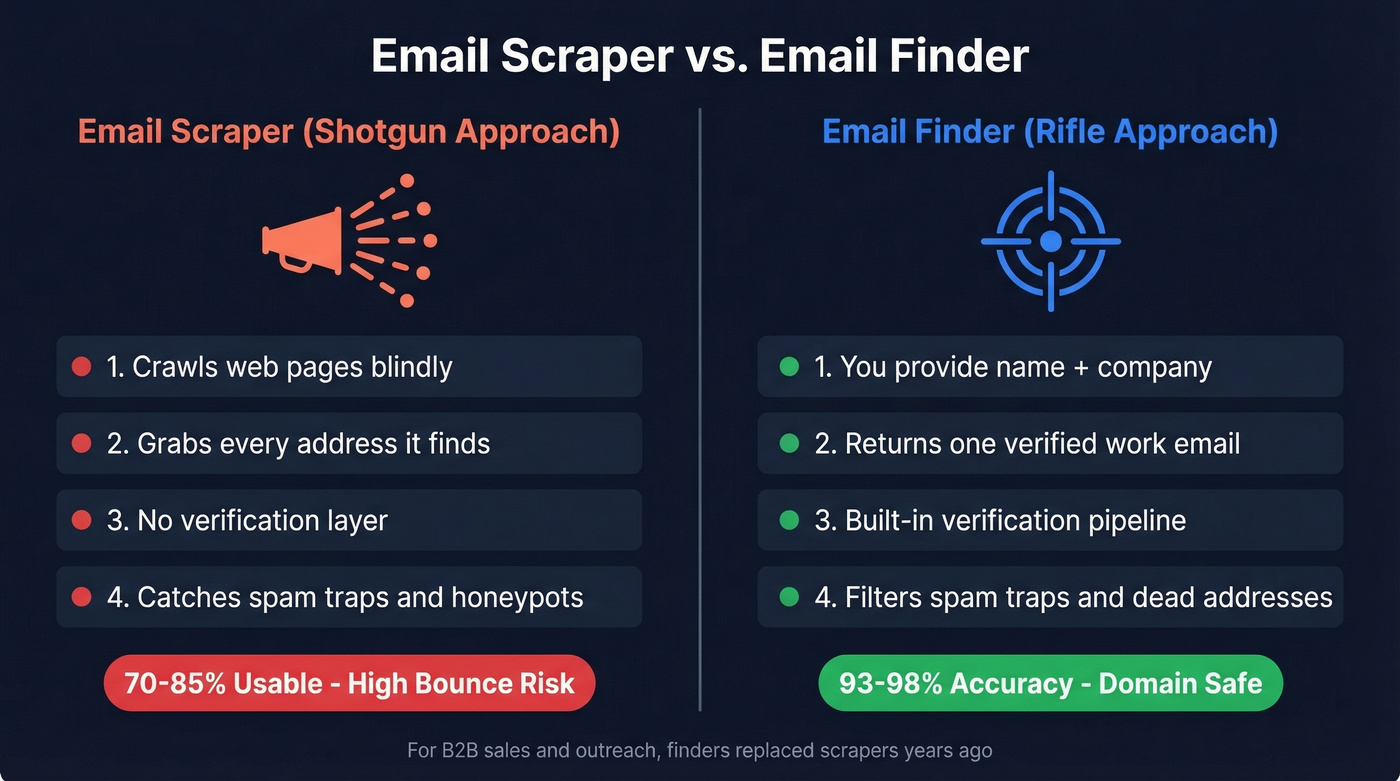
The accuracy gap is enormous. Unverified scraped lists often bounce in the double digits, commonly 10-30%, because there's no verification layer. Top finder tools land around 93-98% accuracy when verification is built in. That's the difference between a healthy sending domain and one that's flagged within a week.
| Approach | How It Works | Typical Accuracy | Legal Risk | Best For |
|---|---|---|---|---|
| Email Scraper | Bulk extraction from pages | Often 70-85% usable before verification | High (unsolicited use) | OSINT, security testing |
| Email Finder | Targeted lookup by name + company | 93-98% (verified) | Low (targeted, compliant) | B2B sales, outreach |
Finder tools work the opposite way - you search by company, role, or industry and get pre-verified results back. No scraping, no cleaning, no guessing.
Legal Risks You Can't Ignore
Here's the thing: most people looking for an email extractor don't realize the legal exposure they're taking on. CAN-SPAM doesn't just apply to consumer email. The FTC's compliance guide is explicit: "The law makes no exception for business-to-business email." Each non-compliant message carries penalties up to $53,088.
That's just the US. The global picture is worse.
| Regulation | Consent Model | Max Penalty |
|---|---|---|
| CAN-SPAM (US) | Opt-out | $53,088 per email |
| GDPR (EU) | Opt-in (explicit) | EUR 20M or 4% global turnover |
| CASL (Canada) | Opt-in (express/implied) | $10M CAD (organizations) |
That Google dorking trick from the Reddit thread - querying site:example.com "@gmail.com" and scraping the results - is exactly the kind of activity that generates non-compliant lists. You've got no consent, no opt-out mechanism, and no idea if those addresses are even active. Send to that list and you're stacking violations.

Harvested emails bounce at 10-30%. Prospeo's 5-step verification delivers 98% email accuracy across 143M+ verified addresses. No scraping, no honeypot traps, no legal risk - just search by role, company, or industry and get verified contacts back.
Ditch the scraper. Get verified emails at $0.01 each.
Why Email Harvesting Is Dying
Even if you're comfortable with the legal risk, the technical reality has shifted against you. Automated bot traffic now accounts for 57% of web activity, with 31% classified as malicious - doubled from 16% in 2022. Websites have responded accordingly.
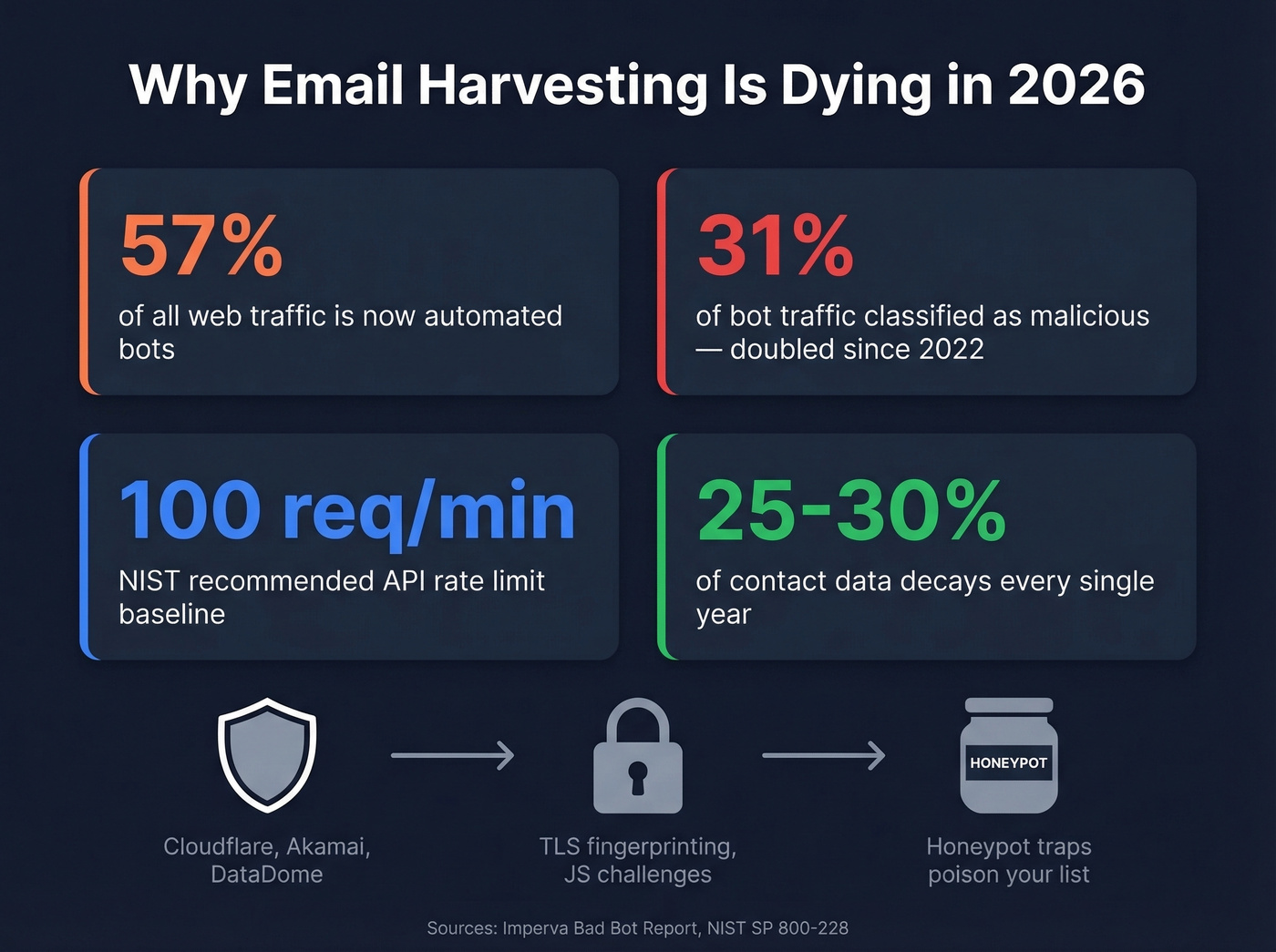
Anti-bot vendors like Cloudflare, Akamai, DataDome, and PerimeterX now deploy layered defenses: TLS fingerprinting, behavioral scoring, JavaScript challenges, and canvas fingerprinting working in concert. NIST's SP 800-228 guidance recommends API rate limits of 100 requests per minute and 1,000 per day as a baseline. Most major sites enforce something similar or stricter.
Beyond bot detection, websites have gotten smarter about not exposing email addresses at all. Contact forms replaced mailto: links years ago. JavaScript obfuscation renders addresses invisible to crawlers. Honeypot email addresses - fake addresses planted specifically to catch scrapers - are a common anti-scraping tactic that can poison any list built through automated harvesting. If your scraper picks up a honeypot, you're flagged as a spammer before you send your first email.
We've watched this play out firsthand. Picture an SDR spending two hours running theHarvester against a target domain. They get 47 addresses back. Thirty are role-based (info@, support@, sales@). Ten belong to former employees. Anti-bot systems block the tool after a few hundred requests. The SDR has spent half their morning and has maybe seven usable contacts - none verified. That's the modern harvesting experience for anyone outside of security research.
OSINT Email Harvesting Tools
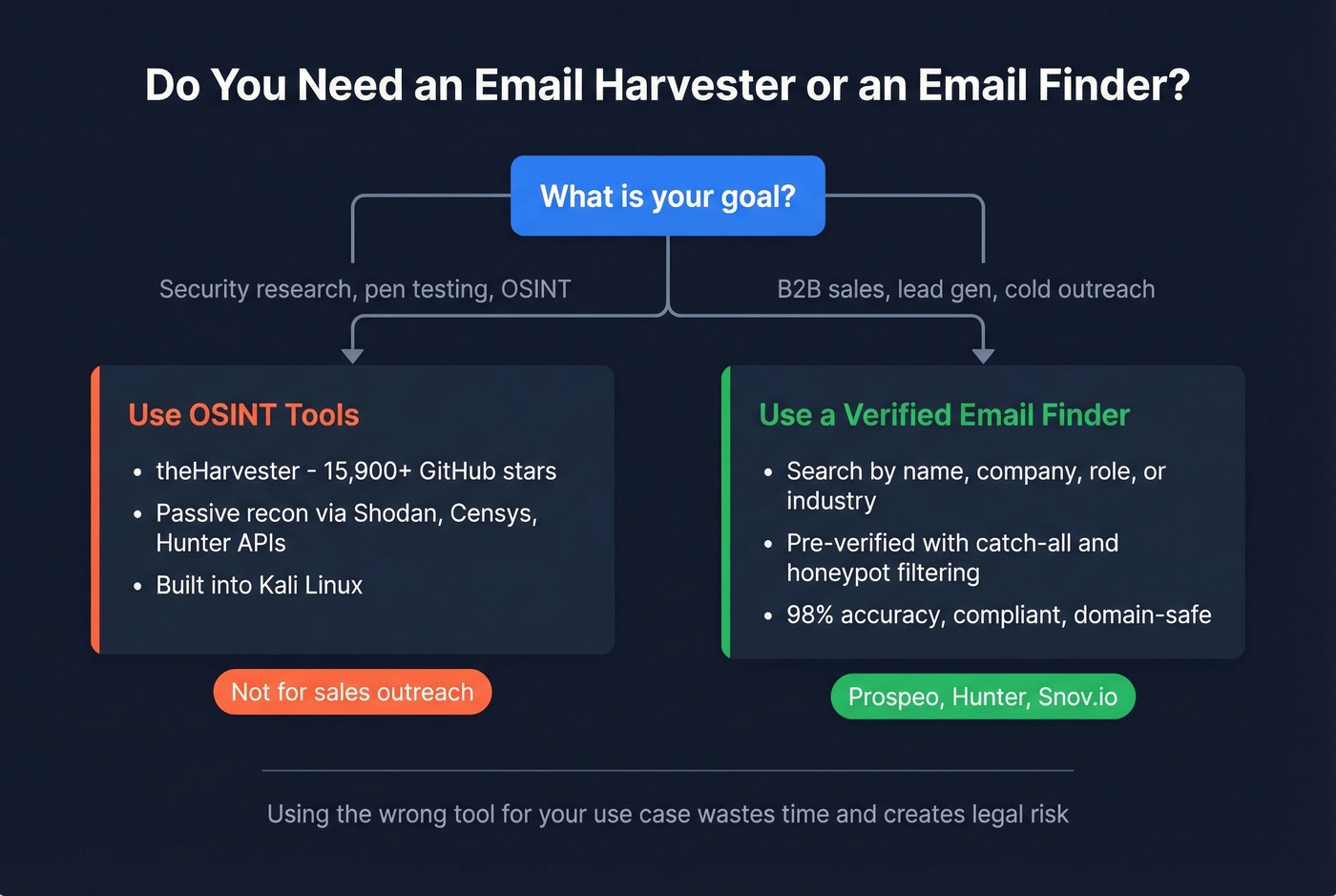
These tools serve a legitimate purpose for penetration testers, red teams, and security researchers. If that's you, here's what's worth using.
theHarvester
Use this if you're doing reconnaissance on a target domain and need emails, subdomains, IPs, and URLs from a single tool. It's the standard - 15,900+ stars on GitHub, 4,241 commits, requires Python 3.12+. The passive modules pull from Censys, Shodan, SecurityTrails, Hunter, HaveIBeenPwned, and dozens more. Many of the most useful modules are API-backed now: Hunter gives you 50 free credits/month, HIBP runs $4.50 for 10 searches/minute, DNSDumpster offers 50 free queries/day then $49.
A typical command looks like this:
theHarvester -d example.com -b hunter,shodan -l 200
That pulls up to 200 results from Hunter and Shodan for the target domain. Simple, fast, effective for recon.
Skip this if you're building a sales prospect list. It's a reconnaissance tool, not a lead gen platform.
EmailHarvester (maldevel)
Legacy tool. Historical reference only. Don't use it for anything production-grade.
Atomic Email Hunter
A commercial Windows tool at $89.90 one-time with a 7-day trial. Functional but dated - better suited for niche crawling than serious OSINT work.
What Replaced Harvesting Software
The practitioners who've moved past harvesting aren't going back. One cold email operator who ran 464K emails across clients put it bluntly: bought data is stale, expensive, and everyone's emailing the same contacts from the same databases. Data decays 25-30% annually. Scraping yourself costs $0.05-0.08 per 100 records versus $0.50-1.00 for buying lists.
Let's be honest: if your average deal size is under $15K, you don't need a DIY scraping stack. The practitioners building custom pipelines with Phantombuster, Apify, Outscraper, and Clay are spending 10+ hours a week maintaining infrastructure that breaks every time a website updates its DOM. That makes sense at scale. For everyone else, a verified finder with pre-verified data is faster, cheaper, and doesn't require a developer on staff.
That same 464K-email practitioner found that competitor-follower scraping produced a 2.1% reply rate versus 0.7% from database tools like Apollo. The takeaway isn't that databases are useless - it's that freshness and targeting matter more than database size.
Prospeo
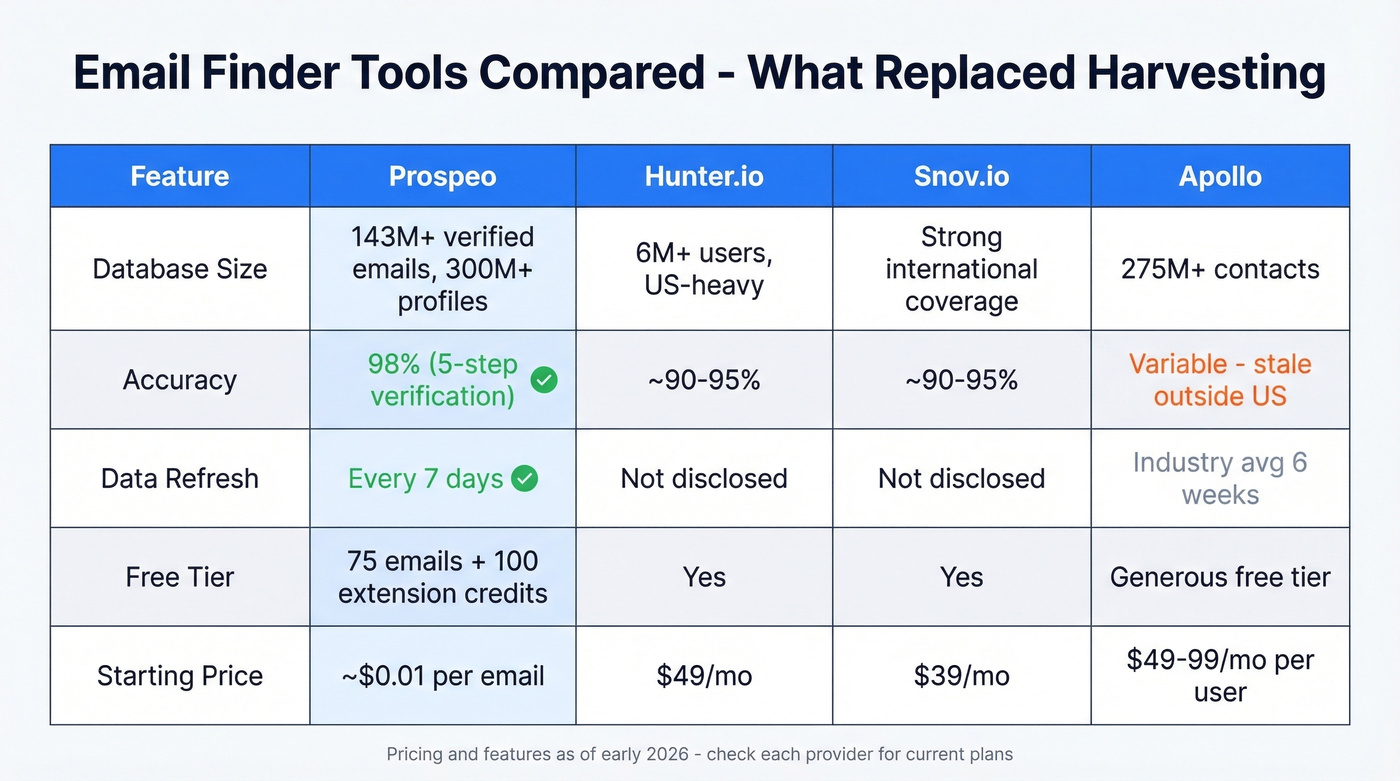
Prospeo eliminates the scrape-clean-verify pipeline entirely. You search by company, role, or industry and get pre-verified emails back. The database covers 143M+ verified emails across 300M+ professional profiles, with 98% accuracy powered by a proprietary 5-step verification process that handles catch-all domains, removes spam traps, and filters honeypots.
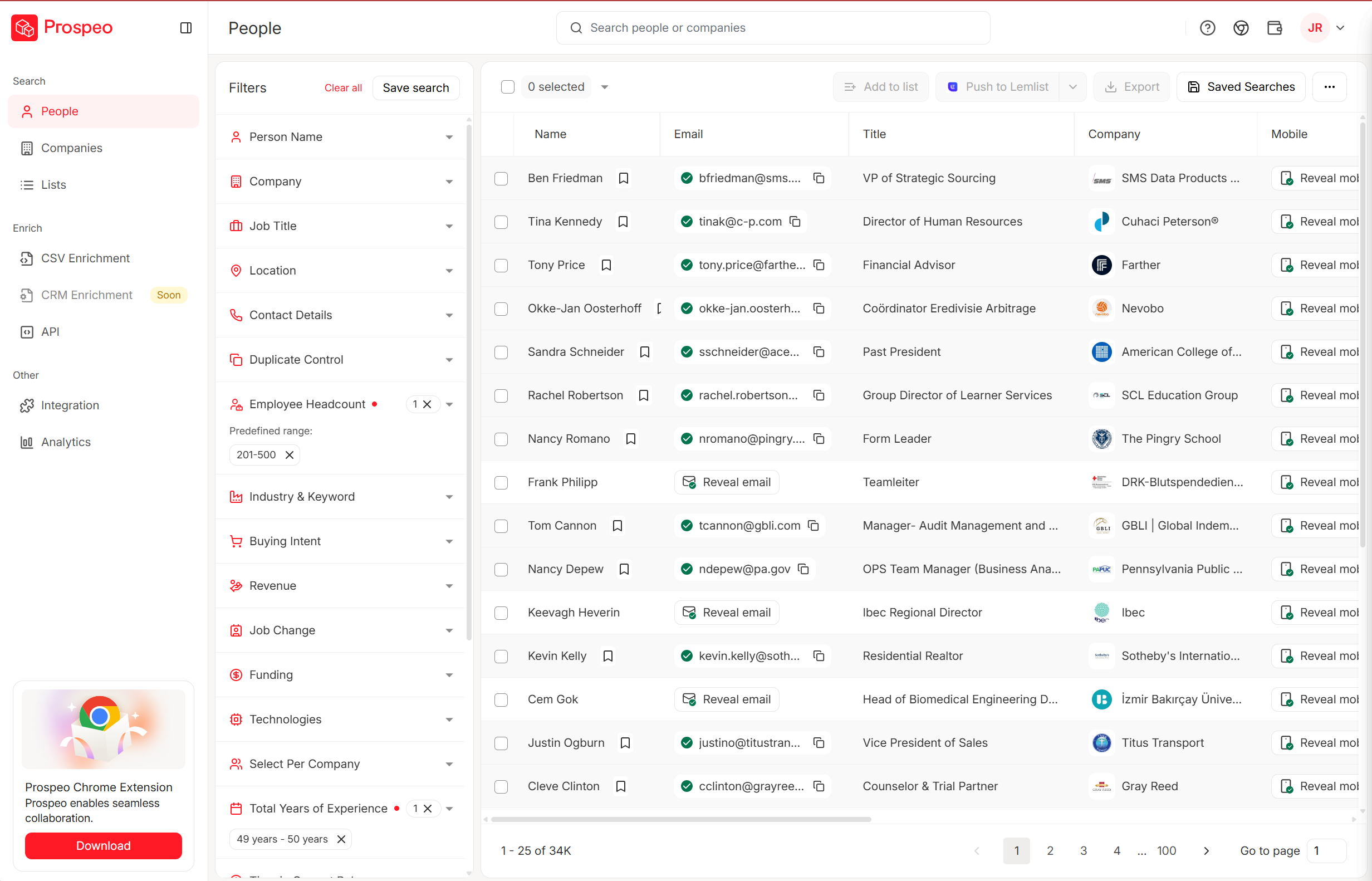
Data refreshes every 7 days - the industry average is 6 weeks, which explains why so many "verified" databases still bounce. The Chrome extension has 40,000+ users and works on any website or CRM. At roughly $0.01 per email with a free tier of 75 emails plus 100 Chrome extension credits per month, the cost comparison against scraping setups isn't close. You skip the infrastructure, the proxy costs, the verification step, and the legal exposure all at once.
Hunter.io
Hunter has 6M+ users and does three things well: domain search, individual email finding, and verification. It scores 4.6 on Capterra and 4.4 on G2, with a free tier and paid plans starting around $49/month. It's solid for domain-level discovery - paste in a company URL and see who works there. The database skews US-heavy, but pairing it with a tool like Ahrefs for finding company pages extends its reach.
Snov.io
Strong international coverage is Snov.io's calling card. The consensus on r/DigitalMarketing is that it's "pretty solid for international leads" with verification and automation built in. Free tier available, paid plans starting around $39/month. If you're prospecting outside the US and English-speaking markets, test it alongside your primary tool.
Apollo
Massive database - commonly cited at 275M+ contacts - with a generous free tier and paid plans from ~$49-99/month per user. But big and fresh aren't the same thing. Reddit sentiment is consistent: a lot of emails are stale outside the US, and "everyone's emailing the same people." Apollo works best as a supplementary source rather than your primary data provider.
That SDR spent two hours harvesting 47 addresses and got seven usable contacts. With Prospeo's 30+ search filters, you'd have a verified list of decision-makers in minutes - with 98% accuracy and a 7-day data refresh cycle.
Replace hours of scraping with seconds of searching.
Why Verification Is Non-Negotiable
Whether you're using a finder tool or sitting on a scraped list, deliverability lives and dies on verification. The threshold is clear: keep total bounces below 2%, with hard bounces under 1%. Exceed that and your sending domain gets flagged - sometimes permanently.
A 50,000-email benchmark test ranked the top verification tools: ZeroBounce at 98.4% accuracy, NeverBounce at 97.9%, MillionVerifier at 97.5%, Hunter Verify at 96.6%, and Clearout at 94.5%. The gap between 98.4% and 94.5% sounds small until you do the math - that's 3,900 additional misclassifications per 100,000 emails. At scale, those misclassifications destroy your sender reputation.
Real talk: we've seen teams load 10K scraped emails into a sequence, watch the bounce rate hit 12% by email #500, and get their domain flagged before lunch. Verification pricing is trivial - ZeroBounce runs ~$0.008 per check, MillionVerifier ~$0.003. There's no excuse to skip it.
If you want the deeper mechanics behind bounce thresholds and remediation, start with bounce rate benchmarks and a full deliverability checklist. Then lock down your sending posture with sender reputation fundamentals and a spam trap removal plan.
FAQ
Is email harvesting illegal?
Harvesting itself isn't always illegal, but using harvested addresses for unsolicited commercial email violates CAN-SPAM (up to $53,088 per email), GDPR (up to EUR 20M), and CASL ($10M CAD). The legality hinges on how you use the data, not how you collect it.
What's the best free tool for finding emails?
For OSINT reconnaissance, theHarvester is the standard - free, open-source, 15,900+ GitHub stars. For B2B prospecting, Prospeo's free tier gives you 75 emails plus 100 Chrome extension credits per month, all pre-verified. Hunter also offers 25 free searches per month.
What's the difference between harvesting and scraping?
The terms are used interchangeably - both mean automated extraction of email addresses from web sources. The meaningful distinction is between scrapers (bulk extraction, unverified, high bounce risk) and email finders (targeted lookup by name and company, verified in real time).
Is this type of software still worth using in 2026?
For security professionals running penetration tests or OSINT engagements, tools like theHarvester remain valuable for reconnaissance. For sales and marketing teams, the combination of anti-bot defenses, legal risk, and poor data quality means verified email finders deliver better results at lower cost and risk.