

Email Hunter Verifier: What It Costs, How Accurate It Is, and When to Use Something Else
You just scraped 5,000 webinar registrants, loaded them into your sequencer, and hit send. By morning, 400 bounced. Your domain reputation took a hit, deliverability tanked, and now you're wondering whether Hunter's email verifier would've caught those before they torched your sender score.
Let's find out.
The Short Version
Hunter's verifier is solid for light use - the free tier gives you 100 verifications per month, no credit card required. At scale, Hunter works out to about $6-$12 per 1,000 verifications on its standard plans, depending on your tier. On the Starter plan, that's roughly 1.2-1.5x more expensive than standalone verifiers like ZeroBounce or NeverBounce, though Hunter's higher tiers close the gap.
But the bigger question isn't which verifier is cheapest. It's whether you need a separate verifier at all. Prospeo collapses finding and verification into one step at ~$0.01/email with 98% accuracy and a 7-day data refresh cycle. That changes the economics entirely.
How Hunter.io Verification Works
Hunter runs a four-step process on every email you submit. Understanding what happens under the hood helps you evaluate whether it's doing enough - or whether you need something more rigorous.
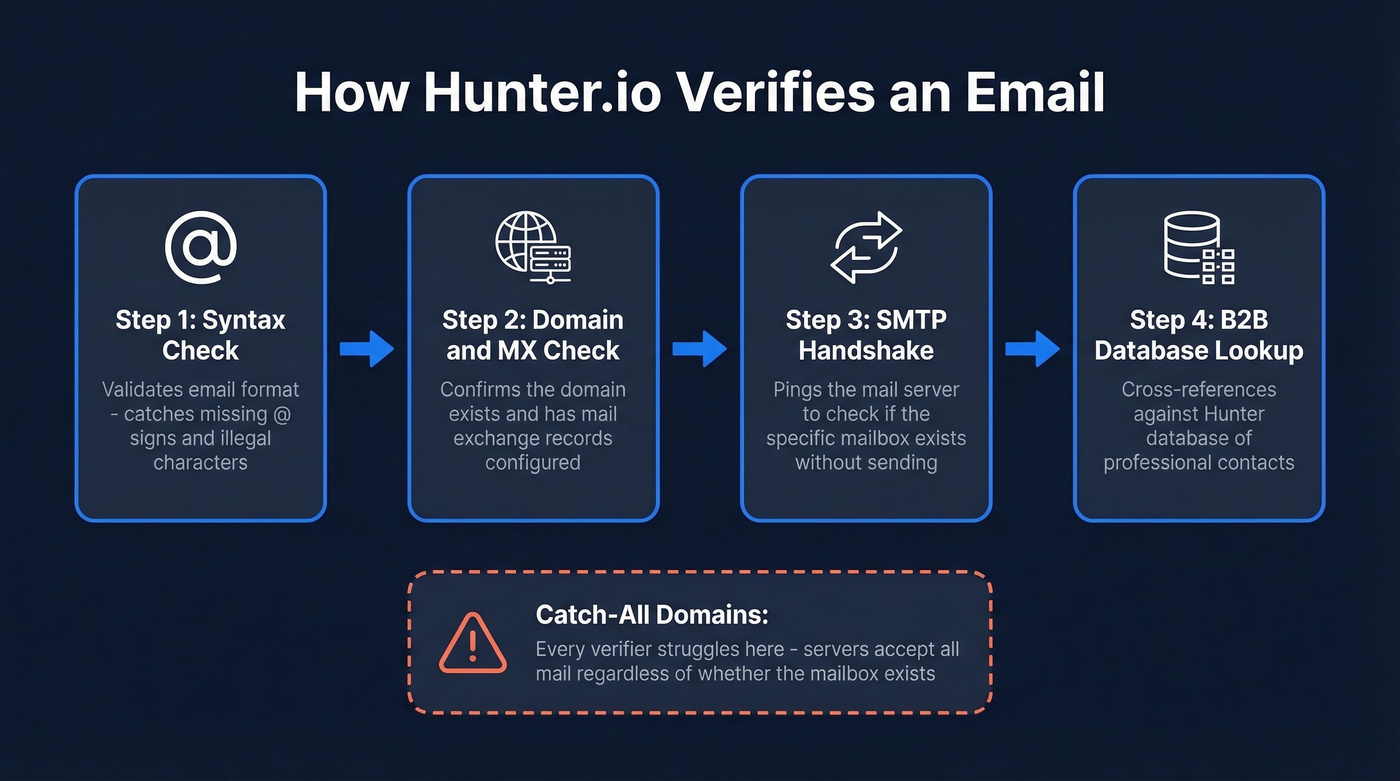
Syntax check confirms the email follows valid formatting rules, catching missing @ signs or illegal characters. Domain and MX record check verifies the domain exists and has mail exchange records configured to receive email. If the domain's dead, the email's dead. SMTP handshake pings the mail server to check whether the specific mailbox exists without actually sending anything - the verifier initiates a connection and reads the server's response. Finally, a B2B database lookup cross-references the email against Hunter's database of professional contacts, adding a layer most basic verifiers skip.
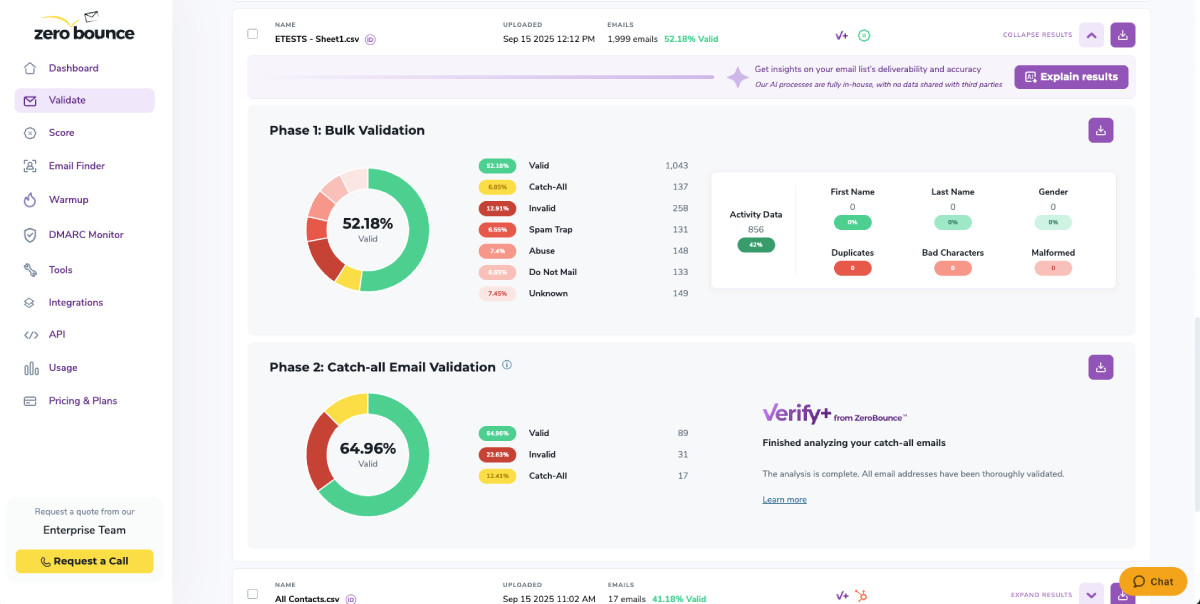
Hunter also touts proprietary catch-all verification "with several major email providers." Catch-all domains are the bane of every verifier - these servers accept all incoming mail regardless of whether the mailbox exists, making true verification borderline impossible. Clearout has argued that Hunter assigns high confidence scores to catch-all addresses without actually resolving them as safe-to-send, a criticism worth investigating if catch-all domains make up a big chunk of your list. In our testing, catch-all domains are where every verifier's accuracy claims fall apart.
The product supports bulk verification via CSV upload, a real-time API, and a Google Sheets add-on. For one-off checks or small batches, the workflow is clean and fast.

Hunter Verification Pricing
Hunter uses a unified credit system across its entire platform - email finding, domain search, and verification all draw from the same pool. That sounds flexible until you realize verification costs 0.5 credits per email, which means the math isn't intuitive.
| Plan | Monthly Price | Annual Price (per mo) | Credits/Month | Verifications/Month | Cost per 1K Verifications |
|---|---|---|---|---|---|
| Free | $0 | $0 | 50 | 100 | - |
| Starter | $49 | $34 | 2,000 | 4,000 | $12.25 (monthly) |
| Growth | $149 | $104 | 10,000 | 20,000 | $7.45 (monthly) |
| Scale | $299 | $209 | 25,000 | 50,000 | $5.98 (monthly) |
On annual billing, those per-1K costs drop further - Starter lands around $8.50/1K, Growth around $5.20/1K. But there's a catch the pricing page doesn't make obvious.
The Credit Math Nobody Shows You
Credits are shared. If you use Hunter to find emails and verify them, both activities eat from the same pool. Find an email (1 credit) then verify it (0.5 credits) and you've spent 1.5 credits on a single contact. On the Starter plan, that's 1,333 fully found-and-verified contacts per month - not 4,000.
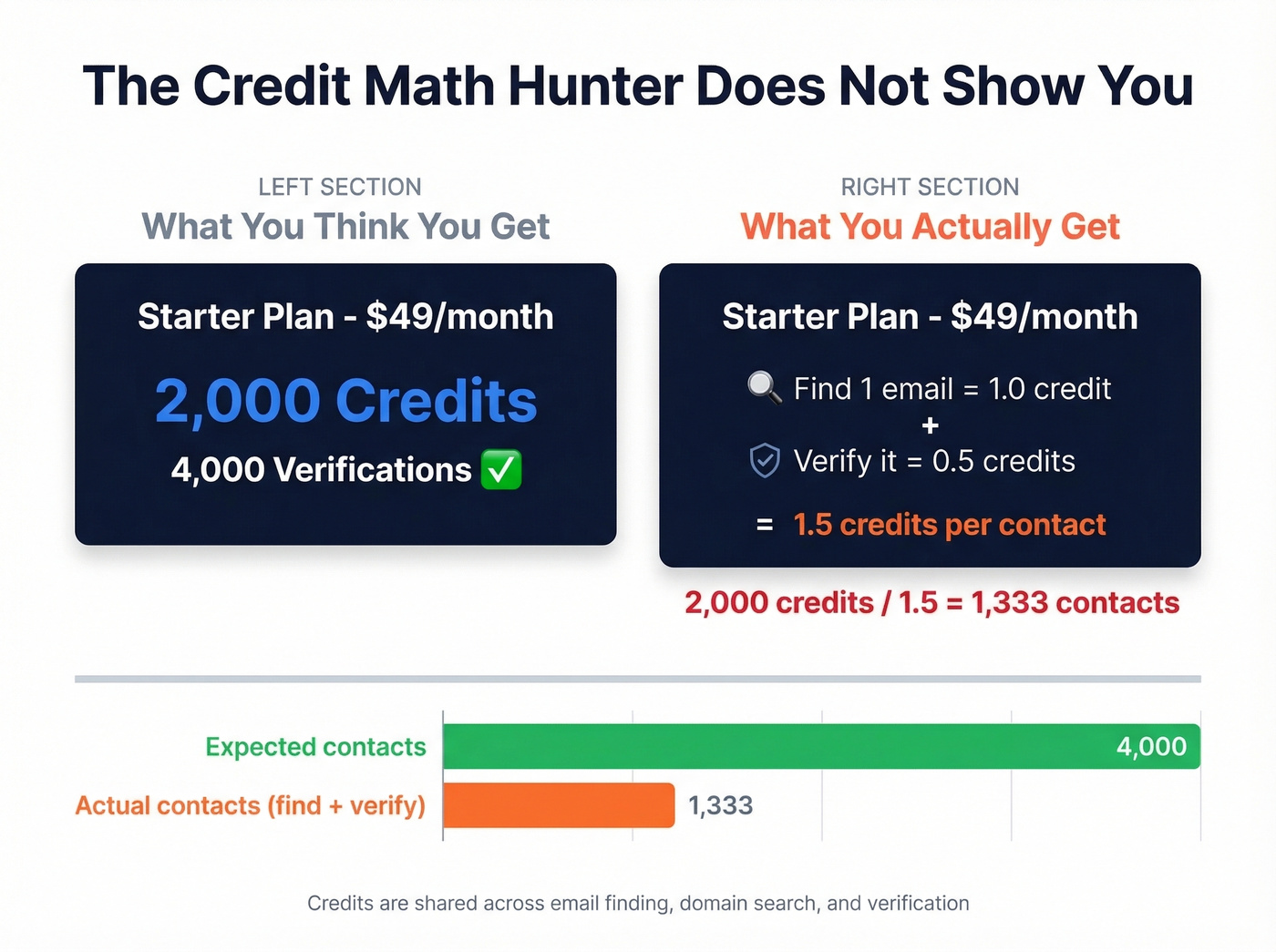
The fact that Hunter's email checker still requires you to do arithmetic to figure out your actual capacity is genuinely frustrating. Most standalone verifiers publish straightforward per-email pricing. Hunter makes you divide by 0.5 and then remember to subtract your finder usage. We've watched teammates miscalculate this and blow through credits mid-campaign.
Hunter also offers bulk credit purchases - $6,500 for 200,000 verification credits plus 1,000 search credits, usable within 12 months. That works out to roughly $3.25/1K verifications, which is competitive, but it's a $6,500 upfront commitment.

Hunter charges shared credits for finding AND verifying - 1.5 credits per contact. Prospeo finds and verifies emails in a single step at ~$0.01 each, with 98% accuracy and no credit math required.
Stop splitting credits between finding and verifying. Get both for a penny.
Is Hunter's Verifier Accurate?
Accuracy is the only metric that actually matters. A cheap tool that lets bad emails through costs you more in bounced sends and domain damage than an expensive tool that catches them.
Hunter published its own benchmark of 15 email verifiers using roughly 3,000 real business emails segmented by company size, plus 300 known-invalid addresses - over 40,000 total verifications run through Clay integrations. Hunter scored 70% overall accuracy, followed by Clearout at 68.37% and Kickbox at 67.53%. Hunter themselves acknowledge that the dataset's validity labels were based on email activity recorded in their own database, which "may have given Hunter an edge." Treat the 70% figure as directional rather than gospel.
Clay's data tests paint a more favorable picture. Across multiple test segments, Hunter's validation showed 94-98% data quality and 95-97% coverage. Those numbers are strong, though Clay's methodology isn't fully transparent in how they define "quality" versus "accuracy."
For context, the industry rule of thumb is to keep total bounces under 2% and hard bounces under 1%. Any verifier that can't hold you below those thresholds isn't doing its job. (If you want a deeper breakdown of bounce types and benchmarks, see our guide to bounce rate.)
Why Different Verifiers Give Different Results
If you've ever run the same list through two verifiers and gotten conflicting results, you're not alone. The consensus on r/coldemail is that this happens constantly - one tool marks an email valid while another flags it invalid.
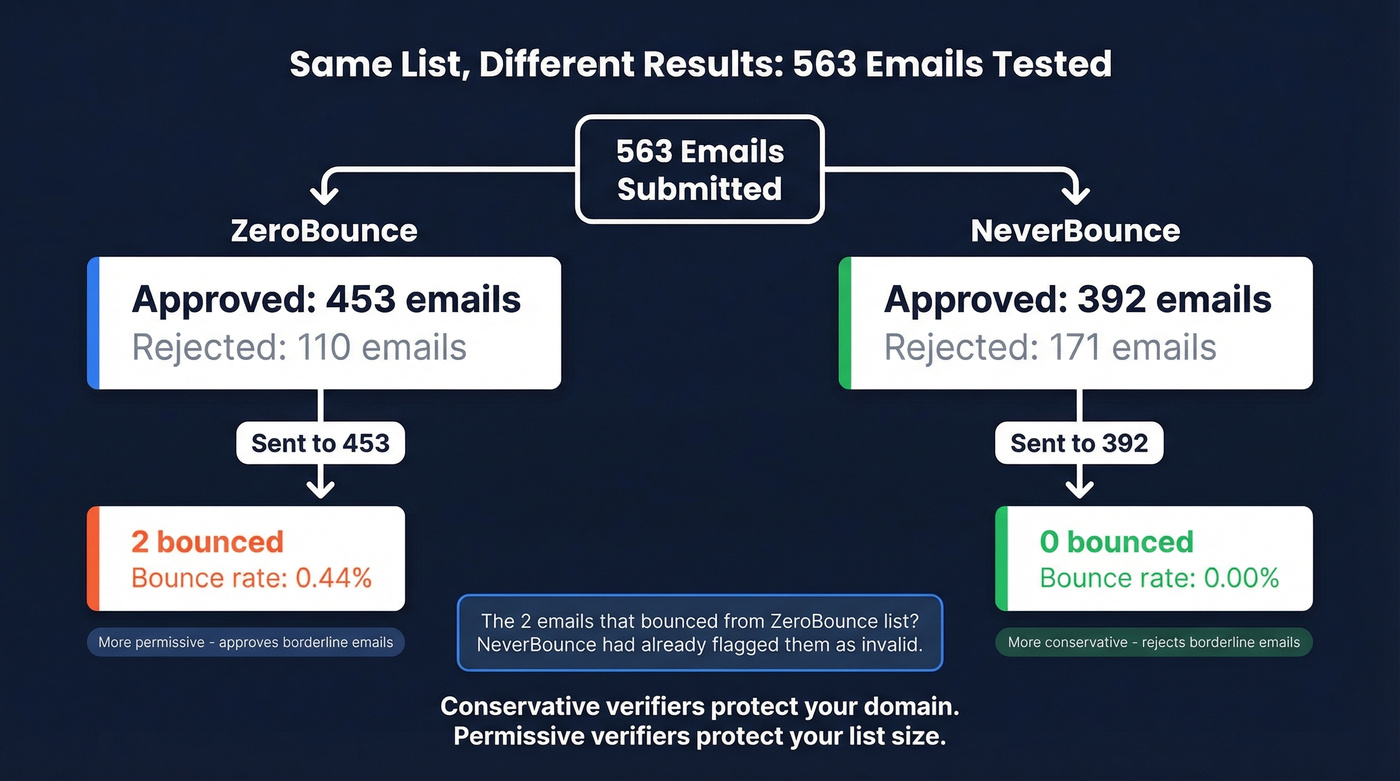
A test of 563 emails through both ZeroBounce and NeverBounce illustrates why. ZeroBounce marked 61 more emails as safe than NeverBounce did. When the tester actually sent to ZeroBounce's approved list of 453 emails, 2 bounced. NeverBounce had flagged those same 2 as invalid. NeverBounce's approved list of 392 emails had a 0% bounce rate.
Conservative verifiers protect your domain. Permissive verifiers protect your list size. Pick based on what you can't afford to lose.
What Users Actually Say
Hunter carries a 4.4/5 on G2 from 634 reviews and a 4.6/5 on Capterra. That's a strong showing across both platforms, and the review volume gives it statistical weight.
People consistently praise the clean interface and minimal learning curve. The Google Sheets add-on and API make it easy to plug into existing workflows, and the free tier is genuinely useful for light prospecting. On the flip side, credit limits feel restrictive - especially when credits are shared across finder and verifier. The tool gets expensive fast at scale, which is the #1 complaint on Reddit. Occasional outdated or incorrect emails still slip through. One r/coldemail poster summed it up: the verifier is "solid, but kinda pricey" just for email verification.
The consensus across G2 and Reddit is consistent: Hunter works well for small-to-medium volumes, but teams doing serious outbound start feeling the credit pinch quickly. (If you're evaluating other options, our roundup of Hunter alternatives is a good next read.)
Top Alternatives to Hunter's Email Verifier
If Hunter's pricing or credit structure doesn't fit your workflow, here's how the alternatives stack up.
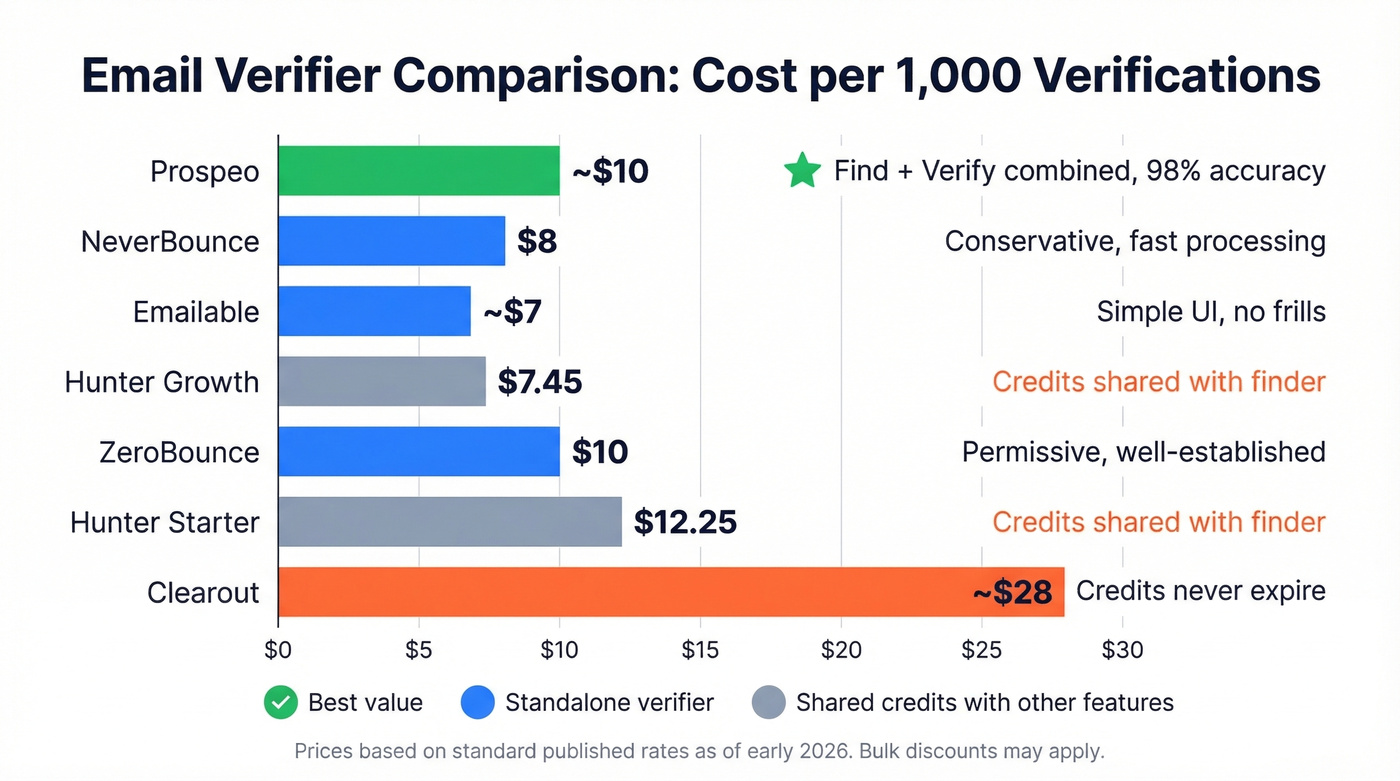
| Tool | Cost per 1K | Key Differentiator |
|---|---|---|
| Prospeo | ~$10 (find + verify combined) | 98% accuracy, no separate verify step |
| ZeroBounce | $10 | Permissive, well-established |
| NeverBounce | $8 | Conservative, fast |
| Clearout | ~$28/1K (pay-as-you-go) | Credits never expire |
| Hunter (Starter) | $12.25 | Credits shared with finder |
| Hunter (Growth) | $7.45 | Credits shared with finder |
| Kickbox | ~$5-10 | API-first, developer-friendly |
| Emailable | ~$6-8 | Simple UI, no-frills verification |
ZeroBounce
Use this if you need a standalone verifier and you'd rather approve more emails than miss valid ones. ZeroBounce runs $10/1K with a 2,000-email minimum. It's the more permissive option - it'll mark borderline emails as safe where other tools would reject them. The API is well-documented and the platform is mature. Worth pairing with a conservative second pass if you're running high-stakes cold sequences. (If you're building a broader stack, compare options in our list of SDR tools.)
Skip this if sender reputation is your top priority and you can't afford even a 1-2% bounce rate.
NeverBounce
NeverBounce is the conservative counterpart. At $8/1K, it's one of the cheapest standalone options. Processing is fast - under a minute for small batches. The tradeoff is that NeverBounce rejects more borderline emails, which means fewer false positives but also a smaller approved list. For teams running cold outbound where every bounce damages domain health, that conservatism is a feature, not a bug. (If you're sending at volume, also watch your email velocity.)
Clearout
Clearout sells pay-as-you-go credits that never expire - a genuine advantage over monthly use-it-or-lose-it subscriptions. For teams with irregular verification needs, the no-expiry model is the real selling point. Pricing varies by volume tier, so check their site for current rates if you're buying in bulk.
Kickbox
API-first verifier built for developers who want to embed verification into custom workflows. Competitive pricing in the $5-10/1K range. Kickbox appeared in Hunter's own benchmark at 67.53% overall accuracy. Worth evaluating if you're building verification into a product or internal tool rather than running manual batch jobs.
When to Use What
The right verifier depends entirely on what else you're paying for.
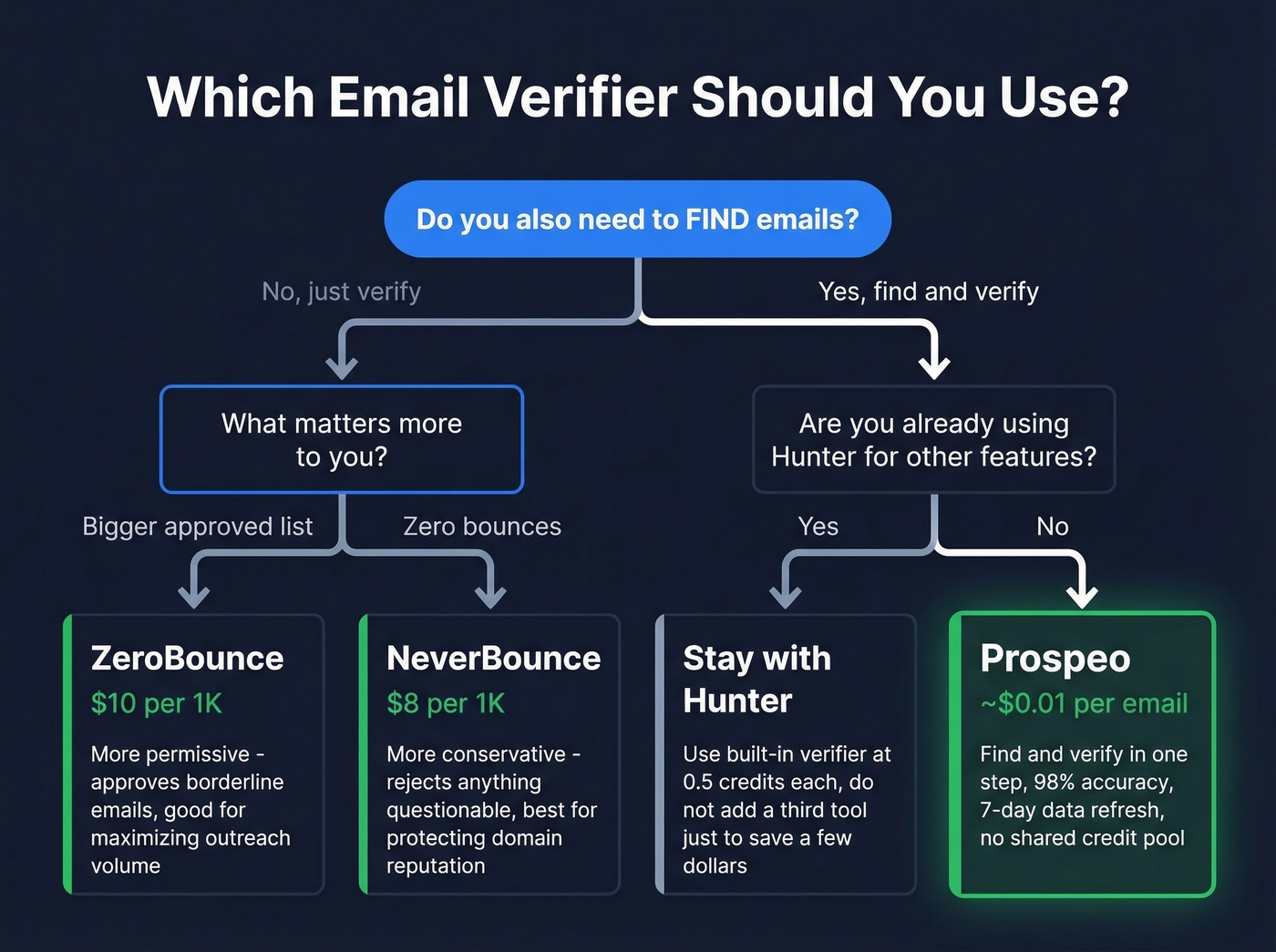
You just need verification, and budget matters. Go with ZeroBounce or NeverBounce. Both are standalone, both are proven, and neither forces you into a shared credit pool with features you don't use.
You're already deep in Hunter's ecosystem. If you're running Hunter for finding, domain search, and sequences, using the built-in verifier makes sense. The 0.5-credit cost is reasonable when you're already paying for the platform. Don't add a third tool just to save a few dollars per thousand.
You need finding and verification without the duct tape. This is where Prospeo fits. Every email returned is already verified through a 5-step process with catch-all handling, spam-trap removal, and honeypot filtering. The data refreshes every 7 days, compared to the industry average of roughly 6 weeks. For teams currently paying Hunter for finding plus a separate tool for verification, it eliminates an entire line item from the stack. (If you're also layering enrichment, see our breakdown of data enrichment services.)
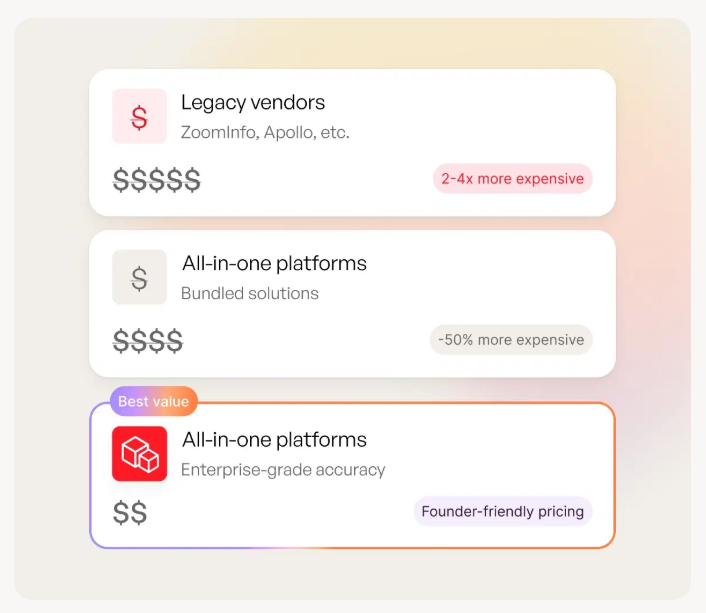
Here's the thing: Hunter's biggest competitor isn't another verifier. It's the realization that standalone email verification is a shrinking category. The best prospecting tools verify at the point of data creation, which makes a separate verification step redundant. We've watched teams spend months stitching together finder + verifier + enrichment workflows that a single platform handles out of the box. If your average deal size is modest, you almost certainly don't need the complexity of a multi-tool verification stack - you need cleaner data at the source. (For more on building repeatable outbound, see sales prospecting techniques and our email deliverability guide.)
Catch-all domains break every verifier's accuracy claims. Prospeo's 5-step verification includes dedicated catch-all handling, spam-trap removal, and honeypot filtering - refreshed every 7 days, not 6 weeks.
Keep bounces under 1% without running emails through a second tool.
FAQ
Is the email hunter verifier free?
Yes - Hunter's free plan includes 100 email verifications per month (50 credits at 0.5 credits per verification). No credit card required. For higher volumes, paid plans start at $49/month for 4,000 verifications on the Starter tier.
How accurate is Hunter's email verifier?
Hunter's own benchmark reports 70% accuracy across ~3,000 test emails - the highest in its self-published study, though Hunter acknowledges potential bias. Clay's independent tests show 94-98% data quality, which better reflects real-world performance. Keep total bounces under 2% as your baseline.
Why do different email verifiers give different results?
Verifiers use different risk thresholds for borderline addresses. Conservative tools like NeverBounce reject more emails to minimize bounces (0% bounce rate in testing), while permissive tools like ZeroBounce approve more and accept slightly higher bounce risk. Choose based on whether you prioritize sender reputation or list volume.
What's a good free alternative to Hunter for verification?
Prospeo's free tier includes 75 emails per month with built-in verification at 98% accuracy - no separate verify step needed. Hunter's free plan offers 100 verifications monthly but shares credits with its finder. For verification-only, Mailmeteor and Mail Tester offer limited free checks.
Does Hunter verify catch-all emails?
Hunter touts proprietary catch-all verification "with several major email providers," but specifics are limited. Catch-all domains accept all emails regardless of whether the mailbox exists, making true verification extremely difficult. Treat catch-all results from any tool as probabilistic, not definitive.