

The 10 Best Email List Cleaning Services in 2026
A RevOps lead we know inherited a 200K-contact CRM last year. First campaign out the door: 19% bounce rate, domain flagged within 48 hours, three weeks of warm-up to recover. The list hadn't been touched since 2022.
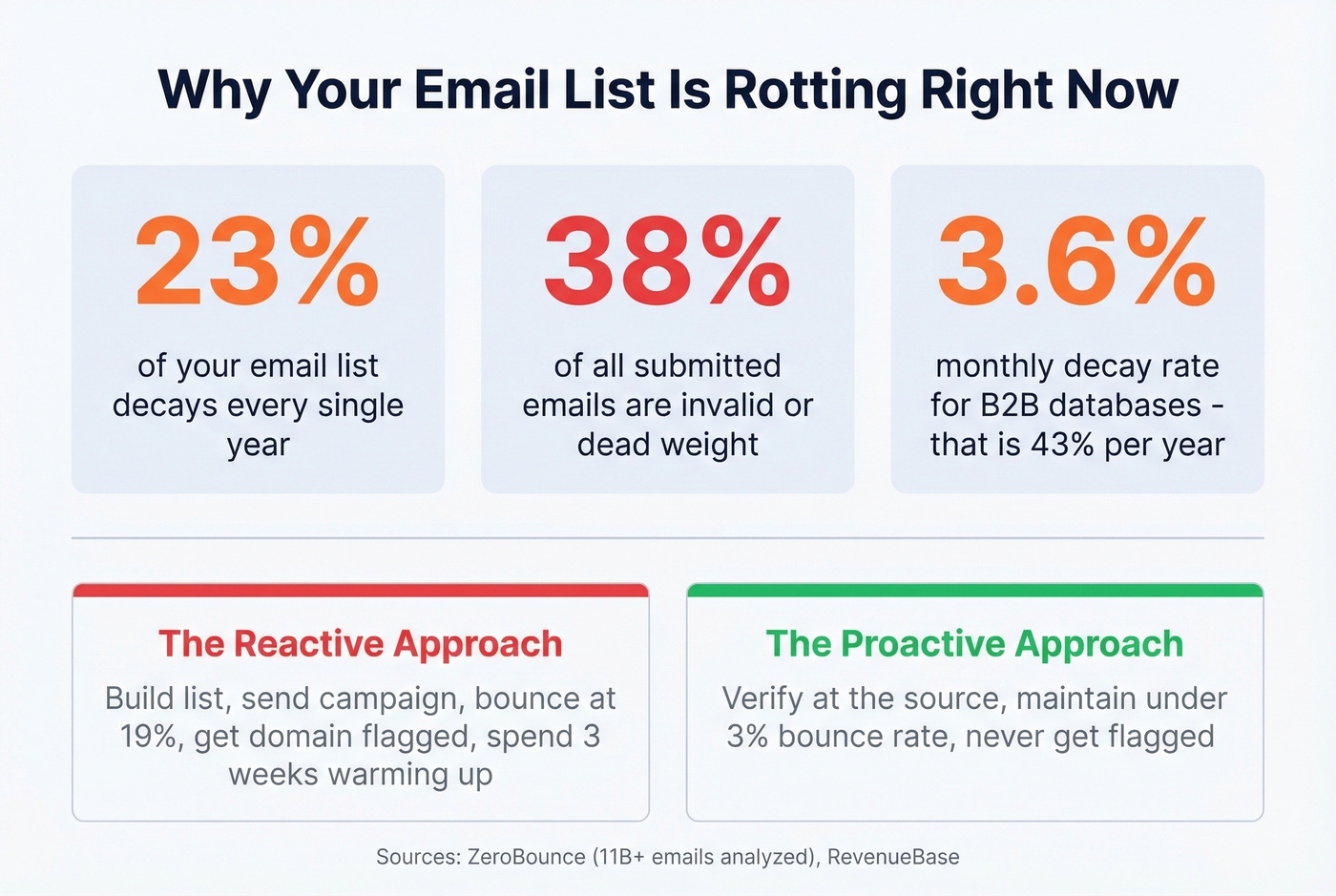
That's not an edge case. It's what happens when you treat list cleaning as optional. At least 23% of an email list degrades every year, and B2B databases are worse - decay can spike to 3.6% in a single month. ZeroBounce processed 11+ billion addresses and found only 62% of all submitted emails were valid, meaning nearly four in ten contacts in the average database are dead weight.
Here's the thing most "best of" lists won't tell you - largely because they're written by the vendors themselves: you don't need to clean constantly. You need cleaner data at the source. Prevention beats remediation every time. The best tool is the one that means you rarely need to scrub at all.
We tested and compared 10 services across pricing, accuracy benchmarks, credit policies, and the gotchas vendors don't put on their homepage.
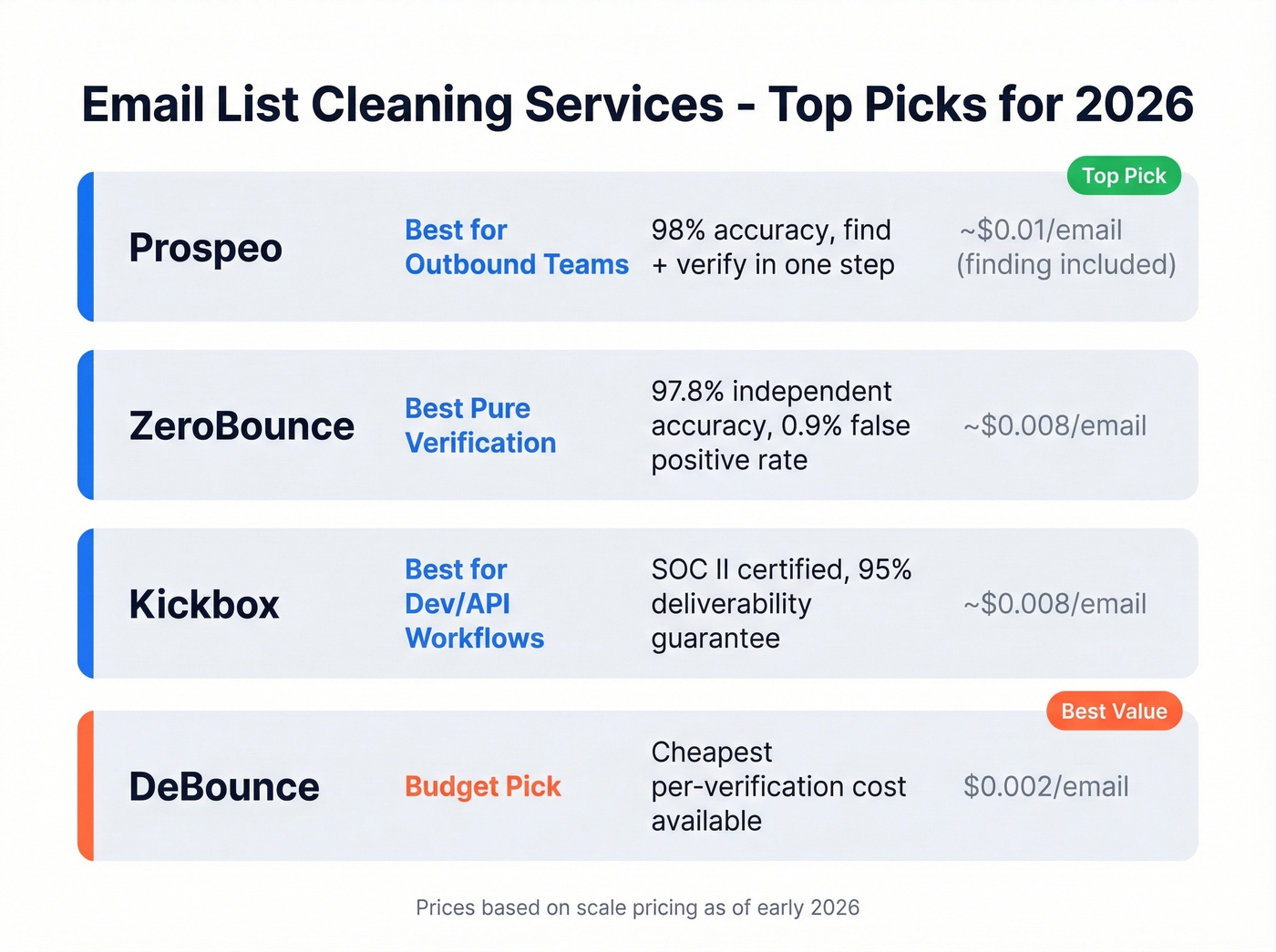
Our Top Picks at a Glance
| Category | Pick | Why |
|---|---|---|
| Best for outbound teams | Prospeo | Find + verify in one step, 98% accuracy |
| Best pure verification | ZeroBounce | 97.8% independent accuracy, credits never expire |
| Best for dev/API workflows | Kickbox | SOC II, transparent pricing, 95% guarantee |
| Budget pick | DeBounce | $0.002/email - cheapest per-verification cost |
How Email List Cleaning Works
Every reputable cleaning service runs your emails through roughly the same verification pipeline. Twilio's breakdown captures the six core layers well:
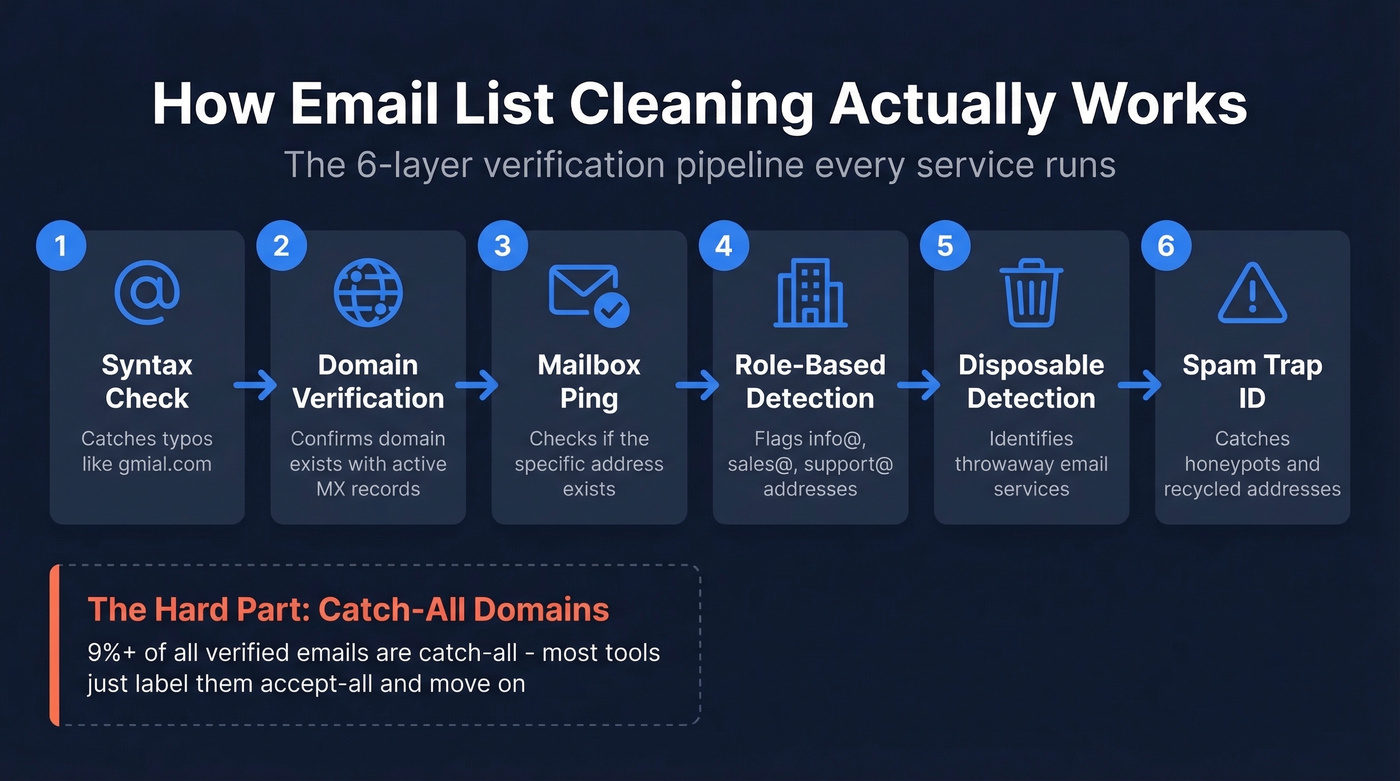
- Syntax validation - catches typos like "gmial.com" or missing @ symbols
- Domain verification - confirms the domain exists and has active MX records
- Mailbox verification - pings the mail server to check if the specific address exists without sending an email
- Role-based detection - flags addresses like info@, sales@, support@ that aren't tied to a person
- Disposable detection - identifies throwaway services like Guerrilla Mail or Temp Mail
- Spam trap identification - catches recycled addresses and honeypots ISPs use to flag senders
The tricky part is catch-all domains - mail servers configured to accept every email sent to their domain, regardless of whether the specific mailbox exists. Most verification tools can't tell you if john.smith@catchall-company.com is real. They just label it "accept-all" and move on. Catch-all emails made up 9%+ of all addresses verified through ZeroBounce in 2026, so how a tool handles them is a genuine differentiator.
Greylisting adds another wrinkle. Some mail servers temporarily reject the first connection attempt) as a spam filter, and tools without anti-greylisting logic misclassify those valid addresses as undeliverable. A few advanced services also offer email age detection and social media cross-validation, but for most teams, the six layers above cover 95% of what matters.
10 Best Email Cleaning and Verification Services
Prospeo
Most list cleaning services assume you already have a database full of questionable data. Prospeo flips that model - it finds and verifies B2B emails in one step, so you're working with clean data from the start. Every email runs through a proprietary 5-step verification process before it ever reaches your CRM: syntax, domain, mailbox, catch-all handling, and spam-trap removal.
The database holds 143M+ verified emails with 98% accuracy, refreshed on a 7-day cycle - six times faster than the industry average. Stack Optimize built their agency to $1M ARR on Prospeo data, maintaining 94%+ deliverability, under 3% bounce rates, and zero domain flags across all clients. Native integrations cover HubSpot, Salesforce, Smartlead, Instantly, and Zapier.
Use this if: You're running outbound and want to eliminate the "find emails in one tool, verify in another" workflow. At ~$0.01/email with finding included, it's cheaper than most tools that only verify. Free tier: 75 emails and 100 Chrome extension credits per month. No contracts.
ZeroBounce
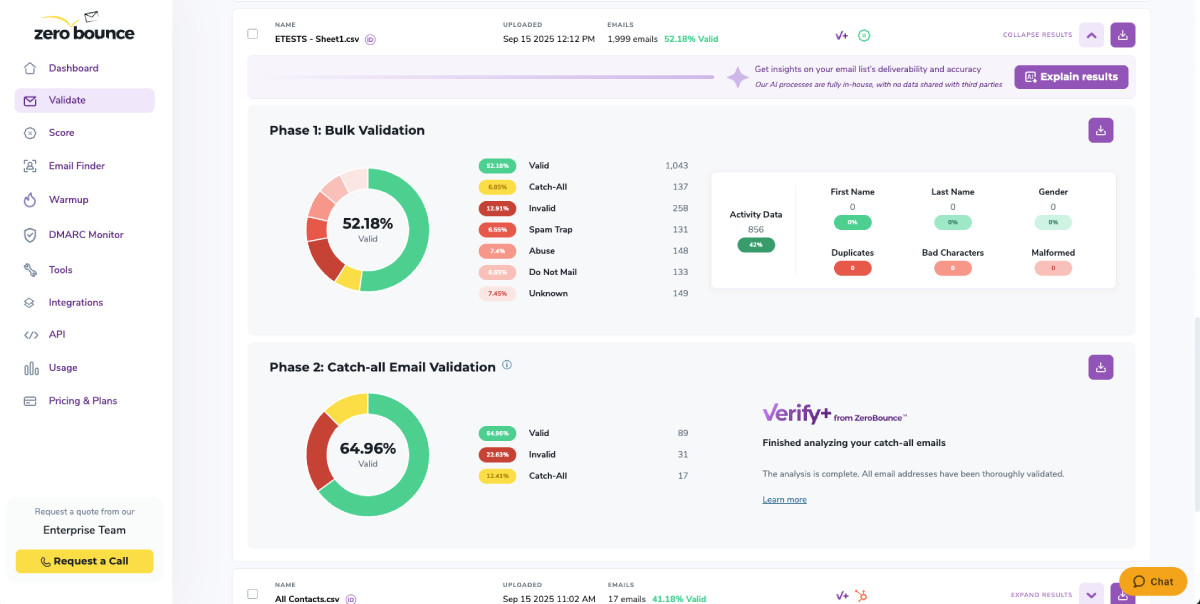
ZeroBounce posted 97.8% accuracy in a 10,000-email independent benchmark, with a 0.9% false positive rate - the lowest in the test. Their catch-all resolution rate hit 12%, meaning they actually attempt to verify addresses on accept-all domains rather than just shrugging. For context, ZeroBounce's own site claims 99.6% accuracy; the independent benchmark measured 97.8%. Both are strong - the gap likely reflects real-world B2B complexity versus controlled testing.
Use this if: You already have a list and need the most accurate bulk verification available.
Skip this if: You need email finding bundled with verification. ZeroBounce's Email Finder costs 20 credits per successful lookup, which gets expensive fast compared to dedicated prospecting tools like an email ID finder.
Pricing runs ~$0.008-0.009/email at scale. The free tier gives you 100 monthly verifications and requires a business domain to sign up. Credits never expire, and unknown results don't cost you anything. ZeroBounce supports integrations with 60+ website builders, CRMs, and email delivery providers.
Kickbox
Kickbox is SOC II certified, GDPR compliant, and publishes pricing tiers on their site - $5 for 500 verifications up to $4,000 for 1M. Unknown results are free. They guarantee 95% deliverability. 100 free verifications to start.
Use this if: You're building verification into a product or workflow via API and need a vendor your security team won't reject.
Skip this if: You're price-sensitive at high volumes. At $0.008/email for 10K verifications, Kickbox isn't the cheapest option. One flag worth noting: Snov.io's benchmark test reported that Kickbox banned their account during testing, which suggests aggressive rate-limiting that could affect large batch jobs. Kickbox lists 30+ native ESP integrations.
NeverBounce
NeverBounce is the tool you pick when you clean consistently and never let credits sit idle. At $0.008/email pay-as-you-go or $49/month for 10K verifications on the Growth plan, pricing is competitive. Duplicates are free on subscription plans, and you get unlimited parallel list cleaning. Accuracy hit 96.9% in the LeadMagic benchmark - solid but not best-in-class.
The catch: credits expire 12 months after purchase. This is the email verification industry's gym membership - you pay, forget, and lose what you didn't use. Catch-all resolution at 8% is the weakest among top-tier tools tested. If you're a sporadic cleaner, look elsewhere. NeverBounce lists 80+ integrations.
Clearout
For compliance-heavy teams in fintech or healthcare-adjacent industries, Clearout's dual ISO and SOC 2 Type II certification is a real differentiator. Subscription credits never expire and carry forward month to month - the best credit policy on this list. Pricing lands around ~$0.007/email based on a commonly listed $21 for 3,000 credits, with 100 free credits to start.
The rollover policy alone makes Clearout worth considering over NeverBounce if you clean on an irregular schedule. It also handles real-time and bulk validation in a single platform.
Bouncer
If your list is heavy on catch-all domains - common in enterprise B2B where companies run Microsoft 365 or Google Workspace with catch-all enabled - Bouncer is the specialist pick. It posted the highest catch-all resolution rate in the LeadMagic benchmark at 15%, three percentage points above ZeroBounce. Overall accuracy hit 96.5% at ~$0.008/email ($40 for 5,000 verifications).
The tradeoff: a higher false negative rate of 2.3% means more valid emails get incorrectly flagged. 100 free credits, non-expiring.
EmailListVerify
The budget leader at $0.0034/email ($17 for 5,000 verifications). If you're cleaning a massive legacy list and accuracy within a percentage point isn't critical, EmailListVerify gets the job done at roughly half the cost of ZeroBounce. It handles syntax, domain, mailbox, and disposable checks - all the essentials without the premium price tag. 100 free verifications included.
Snov.io
More of a prospecting platform than a pure cleaner, but the verification component is solid. Free plan includes 50 monthly credits - 0.5 credits per verification, so that's 100 emails. Catch-all emails aren't charged. Their anti-greylisting technology is a genuine differentiator, reducing false negatives from servers that temporarily reject first-time connections.
DeBounce
The cheapest per-email option at $0.002/email ($10 for 5,000). If you're cleaning a 500K legacy database and need to minimize cost, DeBounce is the obvious starting point. Accuracy and catch-all handling won't match ZeroBounce or Bouncer, but for raw price-per-verification, nothing touches it.
Mailfloss
The only subscription-based model on this list. Starting at $29/month, Mailfloss connects directly to your ESP and runs automated daily or weekly cleaning - no manual uploads, no credit counting. Plans scale with subscriber count. Seven-day free trial. Best for marketing teams who want set-it-and-forget-it hygiene rather than batch cleaning.

Why clean a dirty list when you can start with a clean one? Prospeo's 5-step verification catches catch-alls, spam traps, and honeypots before emails ever hit your CRM. 143M+ verified emails, 98% accuracy, refreshed every 7 days.
Skip the cleaning step entirely - start with data that's already verified.
Pricing Comparison
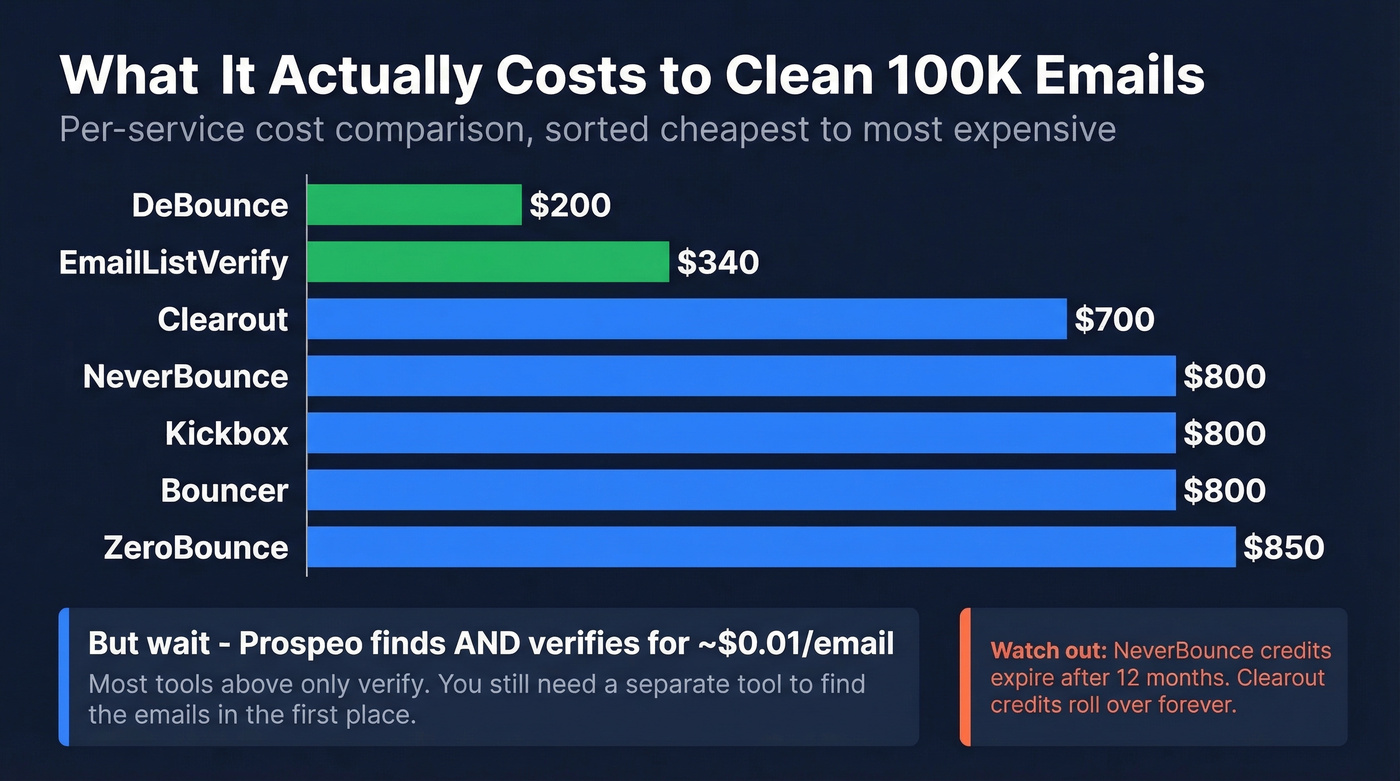
Here's what it actually costs to clean a list, plus the hidden policies that affect your real spend. The right tool often comes down to these per-email economics more than headline features.
| Tool | Cost per 10K | Cost per 100K |
|---|---|---|
| DeBounce | $20 | $200 |
| EmailListVerify | $34 | $340 |
| Clearout | ~$70 | ~$700 |
| NeverBounce | $80 | $800 |
| Kickbox | $80 | $800 |
| ZeroBounce | ~$85 | ~$850 |
| Bouncer | ~$80 | $800 |
| Mailfloss | $29/mo (flat) | $29+/mo (by list size) |
| Tool | Free tier | Credit expiration | Unknown/catch-all charged? |
|---|---|---|---|
| ZeroBounce | 100/mo | Never | No |
| Kickbox | 100 | Not public | No |
| NeverBounce | Free start | 12 months | Not public |
| Clearout | 100 | Never (rollover) | Not public |
| Bouncer | 100 | Not public | Not public |
| EmailListVerify | 100 | Not public | Not public |
| Snov.io | 50 credits/mo | Monthly reset | No (catch-all) |
| DeBounce | 100 | Not public | Not public |
| Mailfloss | 7-day trial | N/A (subscription) | N/A |
Let's put this in perspective. You've inherited a CRM with 200K contacts from 2019. At DeBounce rates, that's $400. At ZeroBounce rates, roughly $1,700. Real money, but far less than the cost of a domain reputation collapse (see our email deliverability guide).
Why only 10? We also evaluated BriteVerify (pricing hidden behind a demo request - a red flag in 2026), MillionVerifier (limited benchmark data), Emailable (no meaningful differentiator at its price point), and Verifalia (strong API but niche). These tools work, but none earned a spot over what's already here.
Verification Accuracy Benchmarks
Marketing claims are one thing. Independent testing is another. The most useful benchmark we've found comes from LeadMagic's 10,000-email test, which ran real B2B addresses across 10 tools within a 48-hour window.
The dataset: 42% corporate emails, 28% catch-all, 15% known invalid, 5% disposable, 4% role-based, 4% free providers, and 2% typo domains. That 28% catch-all slice is where tools separate themselves.
| Tool | Accuracy | Catch-all resolution | Error rates (FP / FN) |
|---|---|---|---|
| ZeroBounce | 97.8% | 12% | 0.9% / 1.3% |
| NeverBounce | 96.9% | 8% | 1.4% / 1.7% |
| Bouncer | 96.5% | 15% | 1.2% / 2.3% |
Catch-all resolution is the real differentiator here. Most tools punt on catch-all domains entirely - they label the address "unknown" and move on. Bouncer resolves 15% of catch-all addresses, ZeroBounce 12%, and NeverBounce just 8%. On a 100K list where 28K are catch-all, that's the difference between resolving 4,200 addresses and resolving 2,240 - nearly double the actionable contacts from the same data.
A secondary data point: Snov.io ran a smaller 1,200-email test (600 confirmed valid, 600 synthetically invalidated). Their methodology is more limited - patterned invalid addresses can advantage certain detection approaches - but it flagged the Kickbox account-banning issue mentioned above.
Our take: If your deals close under $10K, you probably don't need the most accurate verifier on this list. DeBounce or EmailListVerify at a fraction of the cost will keep your bounce rate low. Save the premium tools for high-stakes outbound where every misfire costs you a real opportunity.
When to Clean Your List
Clean your list when any of these triggers hit:
- Bounce rate crosses 2% - anything above 2% signals a problem; above 5% is a red flag (more detail in our email bounce rate guide)
- Sender score drops below 80 - check via SenderScore; below 80 means ISPs are watching you
- You haven't cleaned in 6+ months - schedule recurring hygiene rather than waiting for problems
- Before any major campaign - product launch, event invite, seasonal push
Minimum cadence: quarterly. Monthly if you're sending to 100K+ contacts. B2B lists decay faster than B2C because of job changes, company closures, and domain migrations. One Reddit user shared their ZeroBounce results: 2015-era contacts came back 75% valid, while recent contacts hit 88%. That 13-point gap is a decade of decay in one number.
Here's what "normal" bounce rates look like by industry, so you know when yours is off:
| Industry | Avg bounce rate |
|---|---|
| Ecommerce | 0.19% |
| Beauty/personal care | 0.26% |
| Business/finance | 0.55% |
| Consulting | 0.79% |
| IT/tech/software | 0.90% |
| Financial services | 1.20% |
| Construction/mfg | 2.20% |
Source: ListMint industry benchmarks. ActiveCampaign reports slightly different figures for some categories, so treat these as directional.
If you're in IT running a 3% bounce rate, you've got a list problem. In construction at 2.2%? You're actually average - but still above the 2% threshold where ESPs start paying attention.
Mistakes That Kill Deliverability
Not removing inactive subscribers. Engagement signals matter to ISPs. A list full of people who never open your emails trains Gmail and Outlook to treat you as noise. Segment and sunset contacts who haven't engaged in 6+ months.
Ignoring hard bounces. Hard bounces mean the address is permanently dead. Remove them immediately - not on your next quarterly clean. Now.
Relying on single opt-in. Without a confirmation step, you're inviting typos, fake addresses, disposable emails, and spam traps into your list. Double opt-in adds friction but dramatically improves list quality from day one.
Purchasing or renting lists. Look, if you're cleaning a list you bought, you've already lost. The consensus on r/sales and r/emailmarketing is unanimous on this one - purchased list blasts can hit 25% bounce rates and 2% spam complaint rates. Either alone is enough to get you blacklisted. If you're still building lists this way, start with a safer how to generate an email list approach instead.
Cleaning only once a year. At 23% annual decay - and up to 3.6% monthly in B2B - annual cleaning means you're sending to a list that's a quarter dead by the time you get to it. Quarterly is the minimum.
Stack Optimize built a $1M agency with zero domain flags and under 3% bounce rates - all on Prospeo data. At ~$0.01/email with finding and verification included, you pay less than most tools charge just to verify.
Find and verify in one step. No second tool, no wasted credits.
FAQ
How much does email list cleaning cost?
Most services charge $0.002-$0.01 per email. DeBounce is cheapest at $0.002/email. ZeroBounce and Kickbox sit around $0.008. Prospeo charges ~$0.01 but bundles finding with verification, eliminating the need for a separate prospecting subscription.
How often should I clean my email list?
Quarterly at minimum, monthly if you send to 100K+ contacts. B2B lists decay up to 3.6% per month - waiting a full year means roughly a quarter of your addresses are dead. Automated tools like Mailfloss can run daily hygiene passes.
What's the difference between verification and validation?
The terms are used interchangeably across the industry. Technically, validation checks format and syntax; verification confirms the mailbox exists on the server. Every tool on this list does both. Focus on accuracy rates and catch-all handling instead of terminology.
What happens with catch-all emails?
Catch-all domains accept all incoming email regardless of whether the specific address exists. Most tools label these "unknown" and don't charge you. Bouncer leads at 15% resolution, ZeroBounce hits 12%. On enterprise-heavy lists, this capability saves thousands of wasted sends.
Can cleaning fix a damaged sender reputation?
Cleaning removes bad addresses causing bounces and spam complaints, but rebuilding domain reputation takes weeks of consistent clean sending at low volumes. Starting with pre-verified data avoids the reputation damage in the first place - which is why we've always argued that prevention beats remediation.
The throughline is simple: every email list cleaning service on this list will reduce your bounce rate. The difference is whether you're constantly mopping up bad data or preventing it from entering your pipeline. If you're still scrubbing the same list every quarter, the real problem isn't your cleaning tool - it's your data source (and often your sales prospecting techniques).