

Email Marketing Click-Through Rate Benchmarks: 2026 Data From 4 Platforms
Most email marketers still lead with open rate when reporting campaign performance. That metric's been unreliable since 2021, and it's getting worse every quarter. Every email marketing click-through rate benchmark worth referencing in 2026 starts with CTR - the percentage of recipients who actually click a link - because it's the engagement number that holds up under privacy changes, bot filtering, and inbox pre-fetching.
Here's what a good click rate looks like right now, using data from four platforms that don't agree with each other.
What's a Good Email CTR in 2026?
A good email click-through rate is 2-5% for marketing campaigns. The latest median across 3.6 million campaigns tracked by MailerLite is 2.09%. But that single number hides enormous variation. Automated flows average 5.58%. Welcome emails hit 16-26%. And the platform reporting the benchmark changes the number dramatically - ActiveCampaign's overall average is 6.21%, more than triple MailerLite's median.
If you're only tracking one email metric in 2026, make it unique CTR. Not CTOR, not open rate. A single average figure without knowing the email type, industry, and data source is nearly useless.
CTR vs CTOR: Which Are You Reading?
ESPs use these terms inconsistently. Per Braze's definitions:
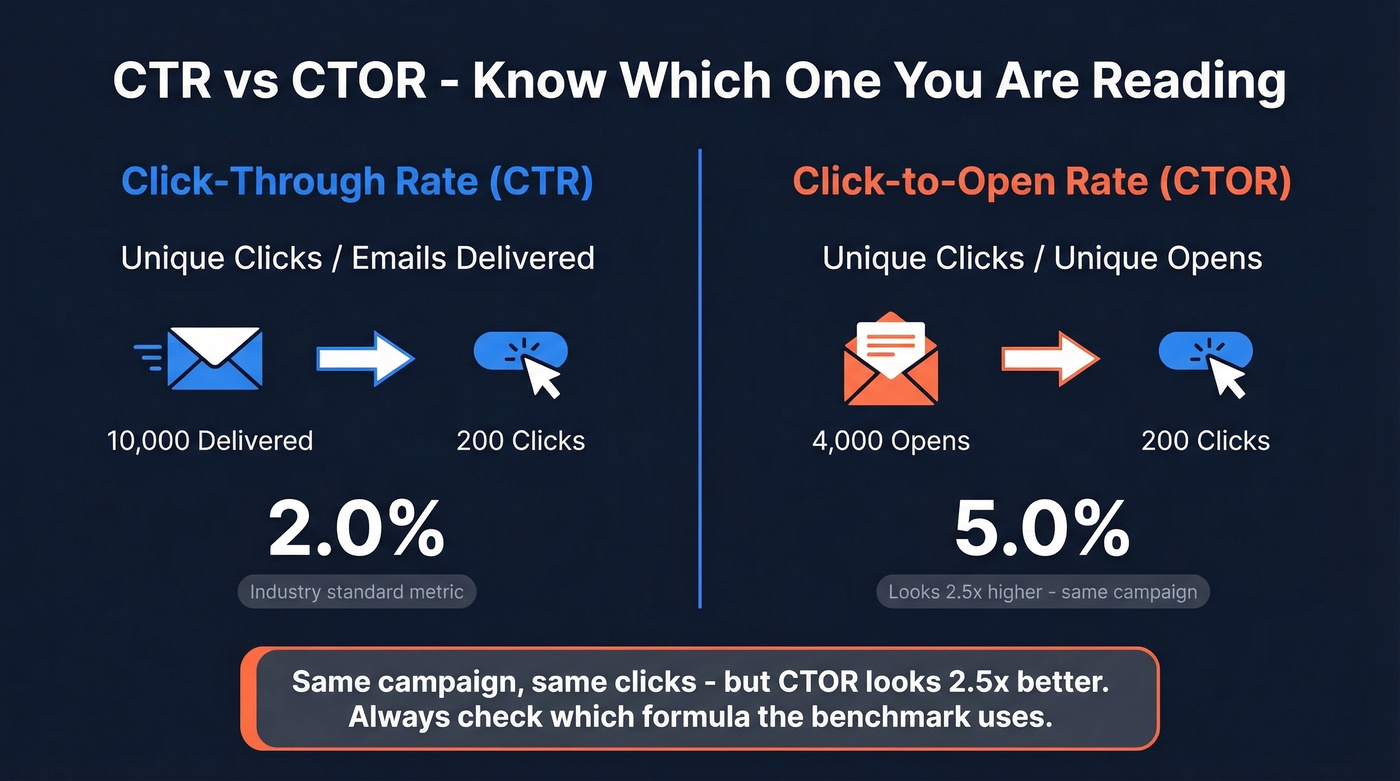
- Click rate (CTR): total clicks / emails delivered
- Unique click-through rate: unique recipient clicks / emails delivered
- Click-to-open rate (CTOR): unique clicks / unique opens
Quick example: you send 10,000 emails, 4,000 are opened, and 200 recipients click. Your CTR is 2%. Your CTOR is 5%. When you see a benchmark of 8-10%, check whether it's CTOR or CTR. The difference is massive, and many reports don't specify.
Why CTR Beats Open Rate
Apple's Mail Privacy Protection is enabled on roughly 97% of iPhones. It pre-fetches email content and fires tracking pixels automatically, so an "open" often isn't a human opening anything. We've watched open rates jump from 15-25% to 40-60% overnight - pure inflation. Apple's Link Tracking Protection, extended in 2023, strips UTM parameters too, complicating attribution further.
Here's the thing: MPP doesn't stop clicks from being recorded by your ESP, but Link Tracking Protection can strip UTMs and muddy downstream analytics. Clicks still represent intentional human action. Opens don't. Any serious engagement conversation in 2026 should start with click-through rate.
2026 CTR Benchmarks by Industry
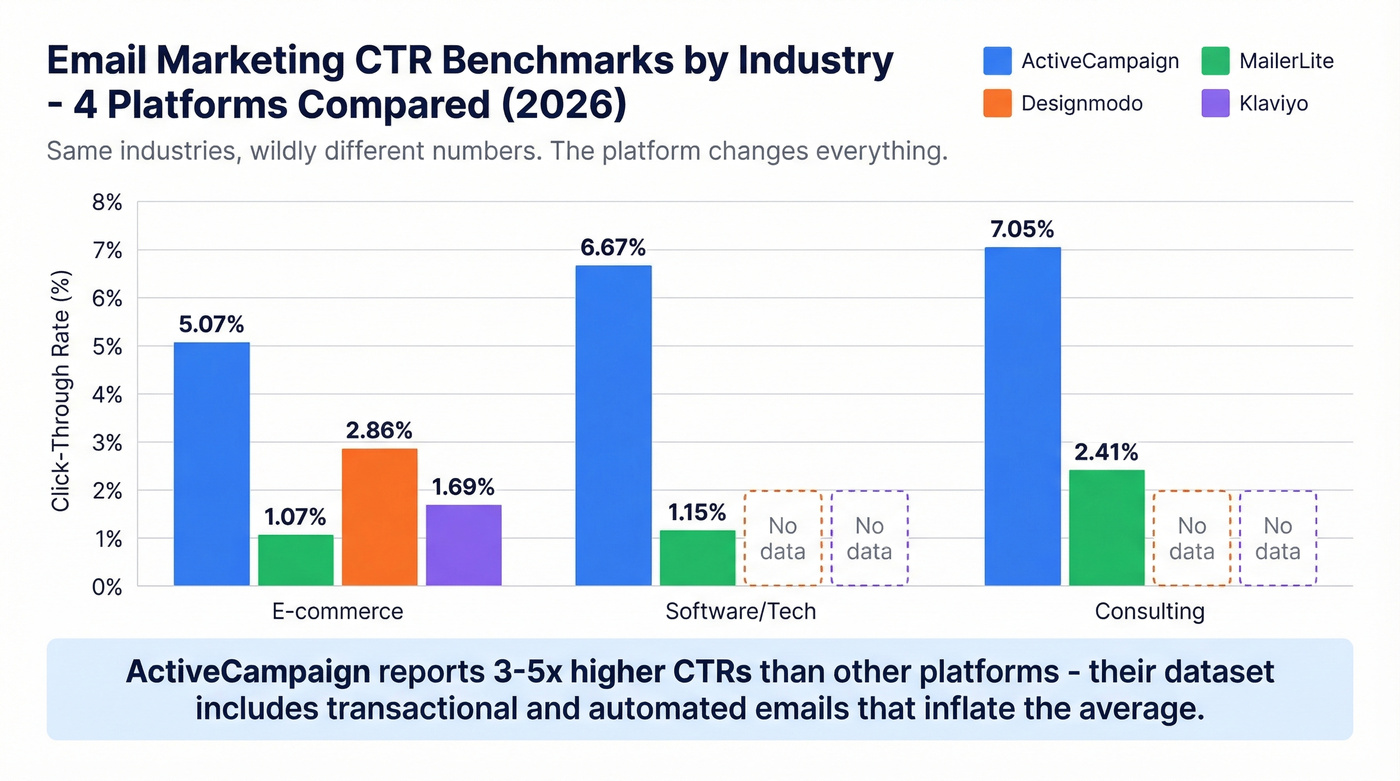
Four platforms, four very different numbers. We've trimmed this to industries where at least two sources report data so you can actually compare, then listed single-source industries separately.
Multi-Source Comparison
| Industry | ActiveCampaign | MailerLite | Designmodo | Klaviyo |
|---|---|---|---|---|
| E-commerce | 5.07% | 1.07% | 2.86% | 1.69% |
| Software/Tech | 6.67% | 1.15% | - | - |
| Consulting | 7.05% | 2.41% | - | - |
Single-Source Industries
| Industry | CTR | Source |
|---|---|---|
| Media/Publishing | 7.32% | ActiveCampaign |
| Healthcare | 5.64% | ActiveCampaign |
| Real Estate | 5.42% | ActiveCampaign |
| Travel | 5.28% | ActiveCampaign |
| Entertainment | 5.00% | Designmodo |
| Energy | 4.78% | Designmodo |
| Business/Finance | 3.36% | Designmodo |
| Advertising | 3.29% | Designmodo |
| Nonprofits | 2.90% | MailerLite |
Sources: ActiveCampaign (Jan 2026), MailerLite (Dec 2025), Designmodo (2025 aggregated), Klaviyo (2026).
Don't average these columns. They're measuring different things.

Benchmarks only matter when your emails actually reach inboxes. Prospeo's 5-step verification delivers 98% email accuracy - the same system that dropped Snyk's bounce rate from 35% to under 5% across 50 AEs. Every bounced email drags your CTR denominator up without adding a single click.
Stop benchmarking against inflated denominators. Start with clean data.
Why Benchmarks Don't Match
ActiveCampaign reports 6.21%. MailerLite reports 2.09%. Klaviyo reports 1.69%. None of these are wrong - they're measuring different populations.
ActiveCampaign's dataset includes transactional, marketing, and other campaign types, and transactional and automated emails naturally get higher engagement, pulling the average up. Klaviyo separates campaign sends from automated flows for ecommerce-focused brands - a segment where promotional fatigue is real and CTRs run lower. MailerLite reports medians across 3.6M campaigns from 181K accounts spanning Dec 2024-Nov 2025, which is the most methodologically transparent of the bunch.
Pick one platform's benchmarks as your baseline and stick with it. Comparing your MailerLite CTR against ActiveCampaign's benchmarks is meaningless. And honestly, skip industry benchmarks entirely if you have 6+ months of your own data. Your historical baseline is more useful than any cross-platform average.
Click-Through Rate by Email Type
The type of email matters far more than the industry. This is where the real variation lives.
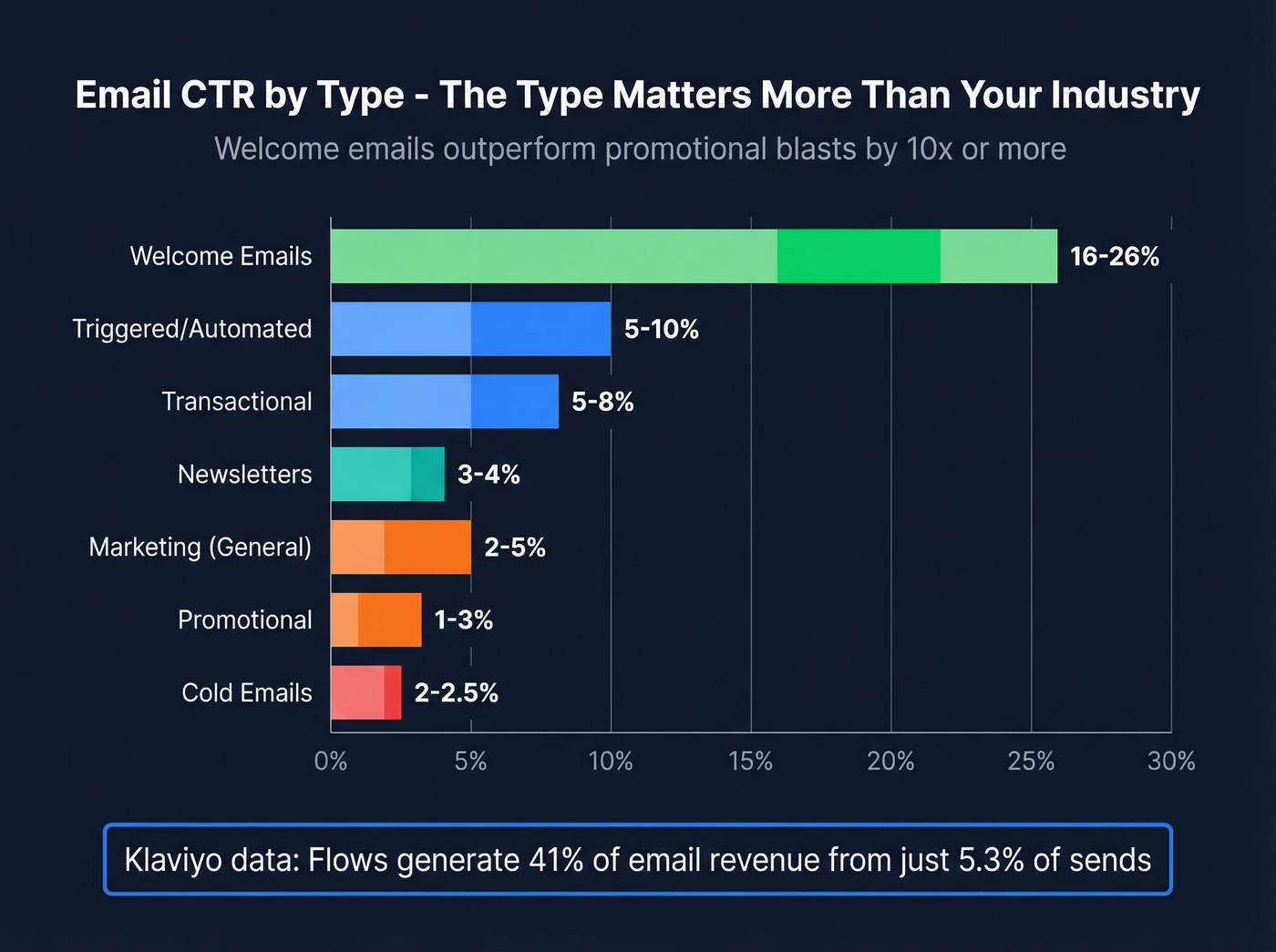
| Email Type | Typical CTR |
|---|---|
| Welcome emails | 16-26% |
| Triggered/automated | 5-10% |
| Transactional | 5-8% |
| Newsletters | 3-4% |
| Marketing (general) | 2-5% |
| Promotional | 1-3% |
| Cold emails | 2-2.5% |
Klaviyo's data makes the automation case clearly: flows average 5.58% CTR vs 1.69% for campaigns, and flows generate 41% of total email revenue from just 5.3% of sends. If your CTR is below 2%, automated flows should be your first investment - not another subject line test. This pattern has held steady since 2022 data first showed automation pulling ahead of batch sends.
B2B vs B2C: The Split Nobody Publishes
Most ESP benchmark datasets skew B2C and ecommerce, which makes clean B2B numbers hard to find. B2B newsletters typically land at 1-3% CTR, while B2B nurture sequences run 2-4%. SQ Magazine pegs the overall B2B average at 5.1% when all email types are included - with nurture campaigns at 6.8% and one-off promotional sends at 3.9%.
The takeaway for B2B teams: if your newsletter CTR is 2%, you're normal. If your nurture sequences aren't beating 3%, something's off with your targeting or content. B2C brands tend to see lower promotional CTRs because of higher list fatigue and broader audience targeting.
How to Improve Your CTR
Every tactic below has a quantified lift. In our experience, list hygiene moves click-through numbers more than any subject line hack - so start there. If you want to sanity-check your math, use the standard click-through rate formula first.
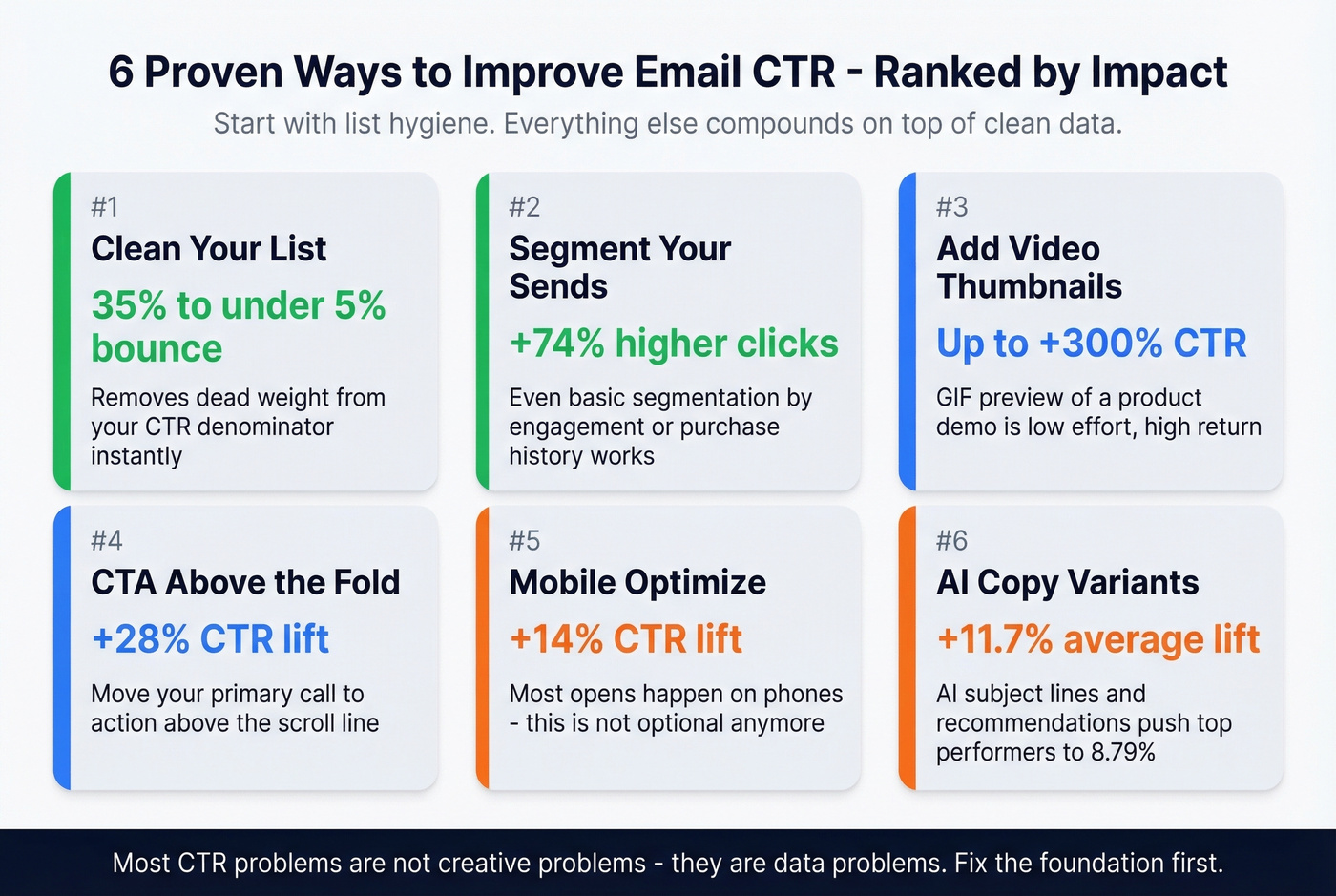
Clean your list first. Every bounced email inflates your delivered count without generating a single click, dragging CTR down mechanically. If you're seeing spikes, compare against current email bounce rate benchmarks before you change creative. Snyk, a security platform with 50 AEs prospecting weekly, saw bounce rates drop from 35-40% to under 5% after implementing Prospeo's 5-step email verification - that alone moved their CTR before any copy changes.
Segment aggressively. Segmented campaigns see 74% higher click rates than non-segmented blasts. Even basic segmentation by engagement recency or purchase history makes a measurable difference. If you're still sending the same email to your entire list, this is the single highest-ROI change you can make. For B2B teams, start with an ideal customer profile and build segments from there.
The remaining lifts are smaller individually but compound fast. Emails with video thumbnail previews see up to +300% CTR versus static-only emails - a GIF preview of a product demo is low-effort, high-return. Moving your primary CTA above the scroll line lifts CTR by roughly 28%. Mobile-optimized emails improve CTR by about 14%, and given that the majority of opens happen on phones, this isn't optional anymore. AI-generated subject line and copy variants improve CTR by 11.7% on average; Klaviyo's AI product recommendations push click rates to 3.75% average and 8.79% for top performers.
Let's be honest: most CTR problems aren't creative problems. They're data problems. You're sending to dead addresses, unengaged contacts, or the wrong segment entirely. Fix the foundation before you A/B test button colors. If you're running outbound, align this with your email deliverability work so clicks aren't capped by inbox placement.
Your CTR won't improve if you're emailing the wrong people. Prospeo's 30+ filters - buyer intent, job changes, technographics, headcount growth - let you build segments that actually click. Stack Optimize hit 94%+ deliverability and under 3% bounce across every client campaign.
Beat every benchmark in this article by fixing who you send to first.
FAQ
What's a good click-through rate for email marketing?
A good CTR is 2-5% for marketing campaigns, with the current median at 2.09% across 3.6 million campaigns per MailerLite. Automated flows and welcome emails perform much higher - typically 5-26% depending on the trigger and audience quality. The median hasn't shifted dramatically since 2022.
What's the difference between CTR and CTOR?
CTR measures clicks as a percentage of emails delivered; CTOR measures clicks as a percentage of emails opened. CTOR is always higher because its denominator is smaller. When evaluating any benchmark, always confirm which formula the source is using - the gap can be 2-3x.
How does list quality affect email CTR?
Every bounced email inflates your delivered count without generating clicks, dragging CTR down mathematically. Reducing bounce rates from 35-40% to under 5% through verification directly improves reported CTR before you optimize copy, design, or segmentation.
Have email click rates changed since 2021?
The average CTR in 2021 sat around 2.3% across most platforms. Apple's MPP didn't directly affect click tracking, but it shifted marketer attention toward CTR as the primary engagement metric. That increased focus on click optimization has kept average rates relatively stable even as send volumes have grown significantly.