

The Best Email Scrubbers in 2026 (Honest Picks, Real Pricing)
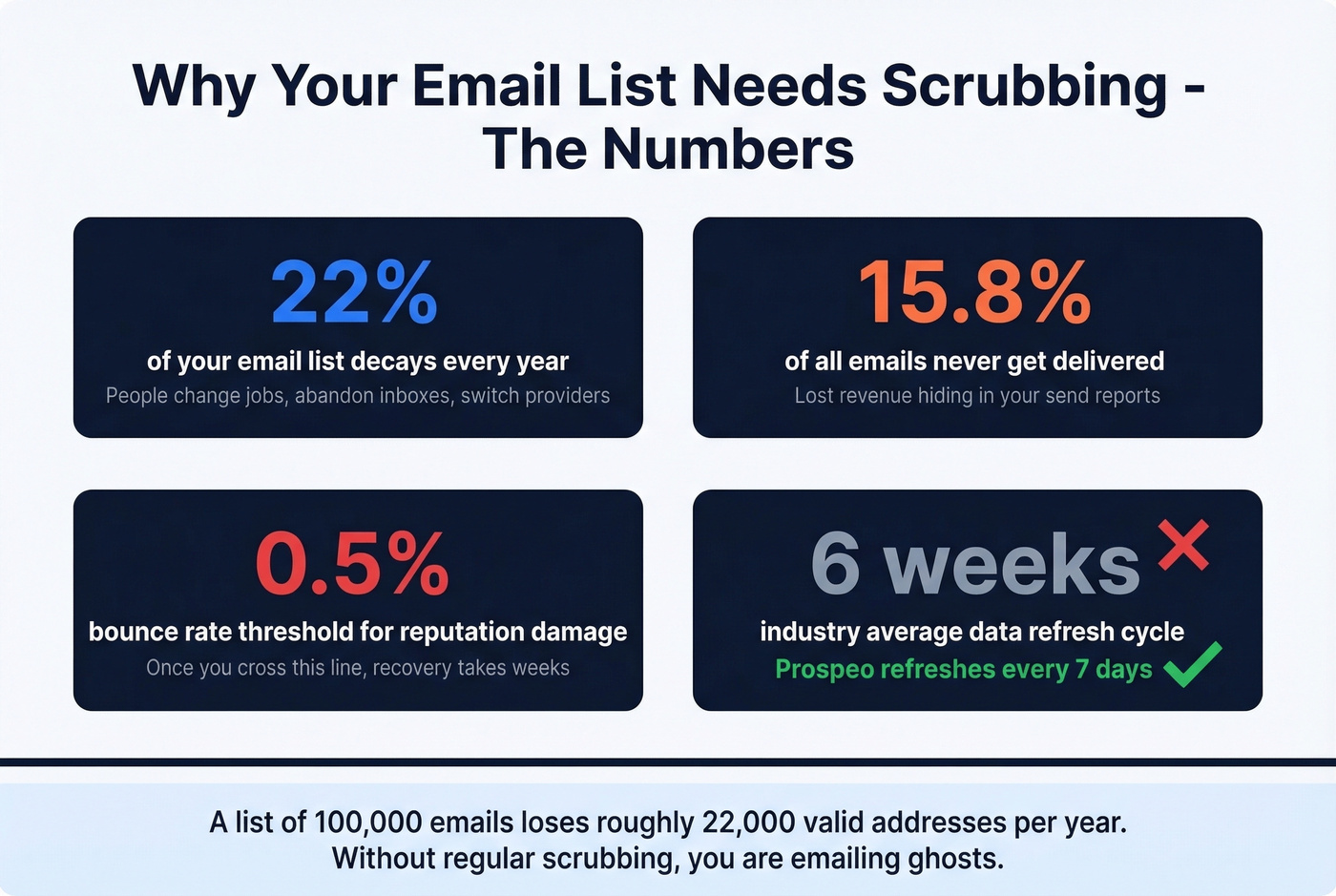
Your last campaign bounced at 8%. Your ESP sent a warning. Your domain reputation just took a hit that'll take weeks to recover - and the "verified" list you bought three months ago is the culprit. Email lists decay about 22% per year, and roughly 15.8% of all emails never get delivered in the first place. Once your bounce rate crosses 0.5%, sender reputation damage compounds fast.
The hard part isn't finding a tool. It's picking the right one when there are dozens of options, wildly different pricing models, and accuracy claims that all sound identical. We've tested most of these tools across real campaigns, and here's what's actually worth your money.
Our Top Picks (TL;DR)
Prospeo - Best for teams that want clean data from the source. 98% email accuracy, 5-step verification, 7-day data refresh. You scrub less because the data arrives pre-verified. Starts at ~$0.01/email with 75 free emails/month.
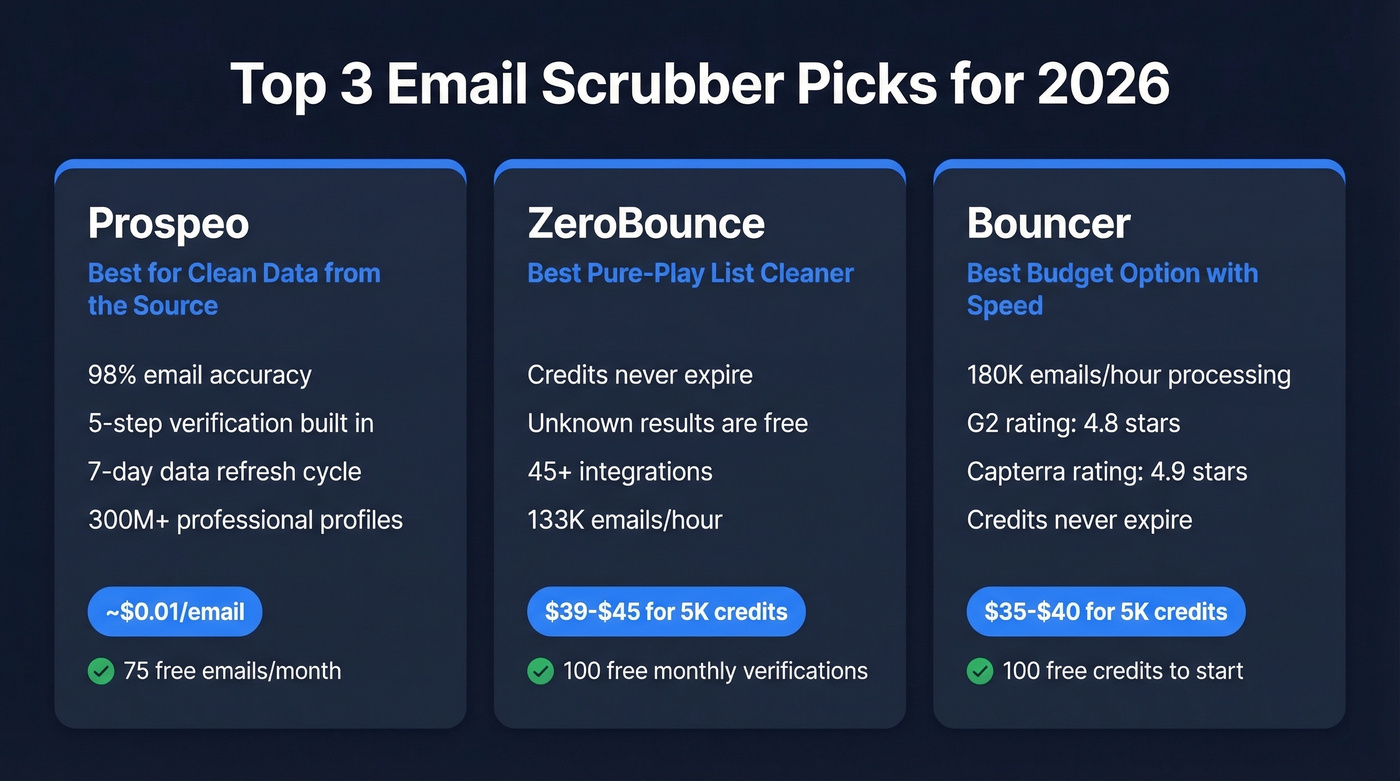
ZeroBounce - Best pure-play list cleaning tool. Credits never expire, unknown results are free, and 45+ integrations mean it plugs into almost any stack. $39-$45 for 5,000 credits.
Bouncer - Best budget option with speed. 180K emails/hour, ~$35-$40 for 5,000 credits, and review scores that are hard to argue with (G2 4.8, Capterra 4.9).
What Does an Email Scrubber Actually Do?
Validation and verification get used interchangeably, but they're different things. Validation is the surface check - does the syntax look right, does the domain exist, does the mail server respond? Verification goes deeper by pinging the actual mail server to confirm the mailbox exists, then cross-referencing against spam trap and blacklist databases.
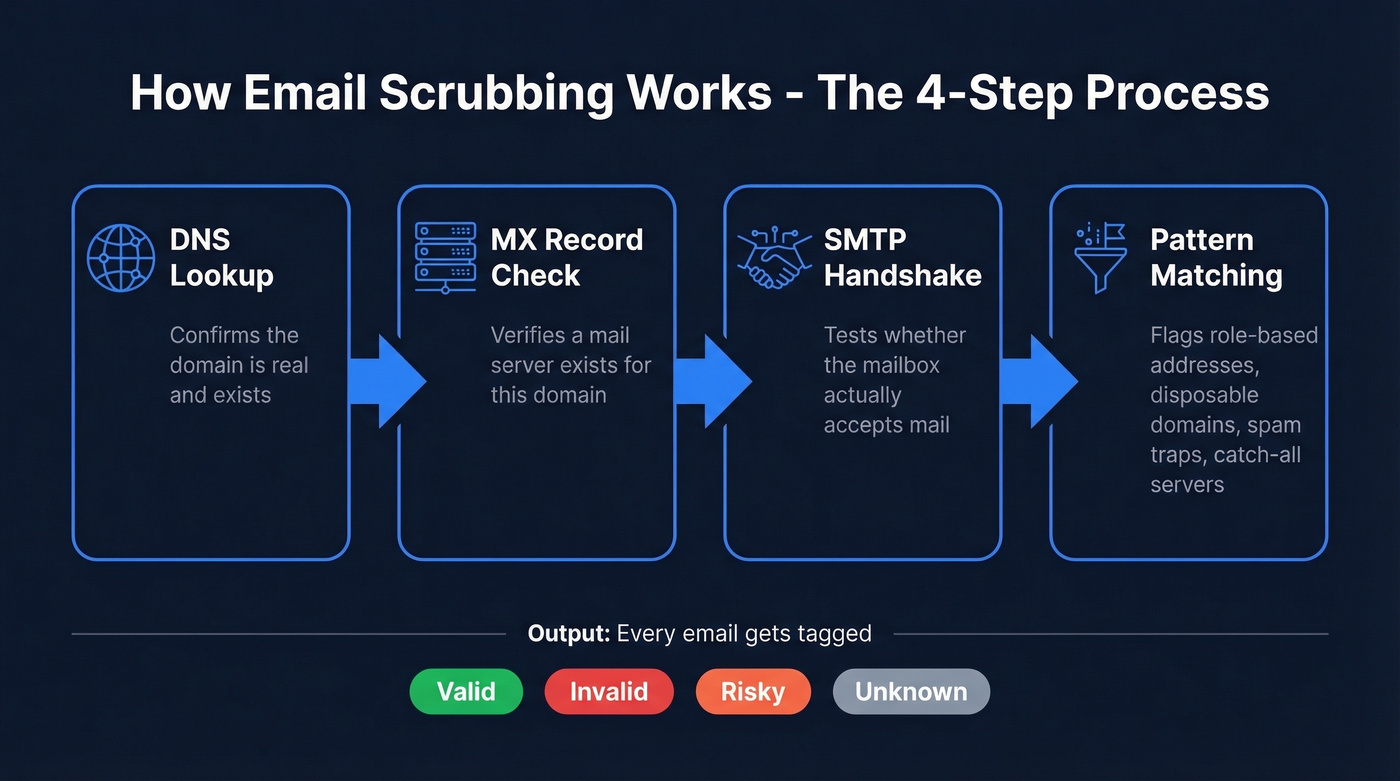
A good list scrubbing tool runs a four-step process on every address. First, a DNS lookup confirms the domain is real. Then an MX record check verifies a mail server exists. An SMTP handshake tests whether the mailbox accepts mail. Finally, pattern matching flags known-bad categories - role-based addresses like info@ and support@, disposable email domains like Guerrilla Mail, spam traps planted by ISPs, and catch-all servers that accept everything regardless of whether the mailbox exists.
The output is simple: each email gets tagged as valid, invalid, risky, or unknown. You keep the valid ones, trash the invalid ones, and make a judgment call on the rest. The tools differ in how accurately they sort that middle bucket - and that's where the real value gap shows up.
9 Best Email Scrubbing Tools in 2026
Prospeo
Use this if: you want to solve the data quality problem at the source instead of scrubbing dirty lists after the fact.
Skip this if: you only need to clean an existing legacy list with no ongoing prospecting needs.
Prospeo isn't a traditional email scrubber - it's a B2B data platform where every record runs through 5-step verification before it reaches you. Catch-all handling, spam-trap removal, and honeypot filtering happen upstream, not as an afterthought. The database covers 300M+ professional profiles with 98% email accuracy and a 7-day data refresh cycle, while the industry average sits around six weeks.
The results speak for themselves. Meritt dropped their bounce rate from 35% to under 4% after switching. Stack Optimize runs under 3% bounce with zero domain flags across all their clients. That's not scrubbing - that's starting with clean data.
Pricing runs ~$0.01/email with 75 free verified emails per month. Native integrations with Salesforce, HubSpot, Smartlead, Instantly, Lemlist, Clay, Zapier, and Make let you pipe clean contacts directly into your sequencer without an export step.
ZeroBounce
Use this if: you need a reliable, no-surprises list cleaner with credits that never expire and a mature integration library.
Skip this if: you also need email finding - their Email Finder costs 20 credits per successful lookup, which adds up fast.
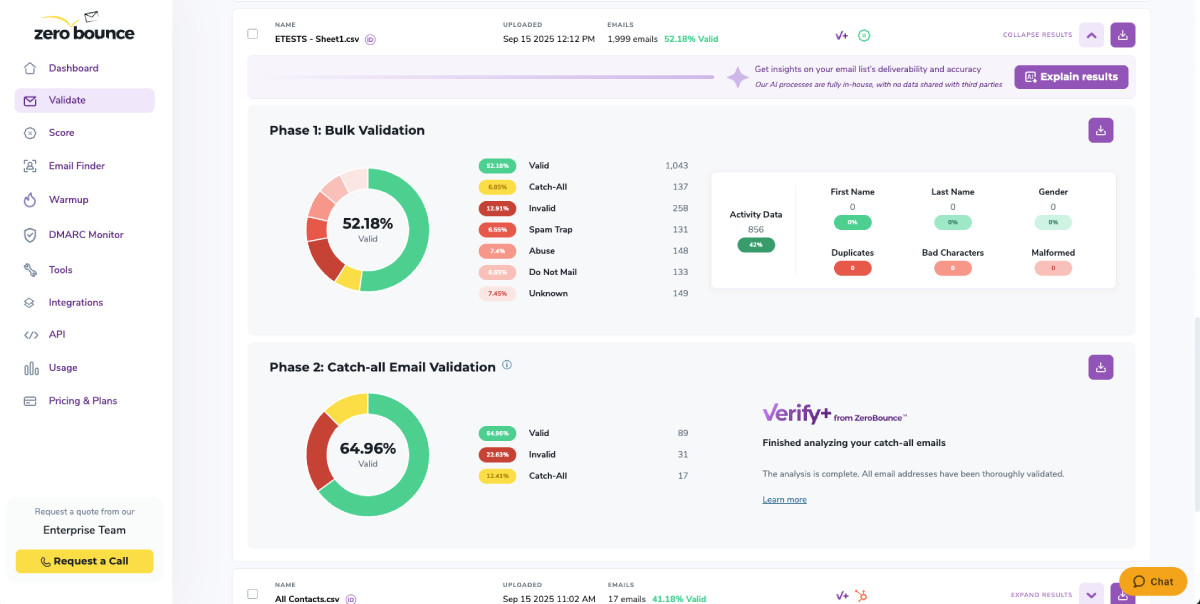
ZeroBounce is the safe choice. Credits never expire, unknown results don't cost you anything, and 45 integrations cover most ESP and CRM setups. Speed is solid at 133K emails/hour - not the fastest, but fast enough for most list sizes.
Pricing lands at $39-$45 for 5,000 credits depending on the plan structure. You get 100 free monthly verifications with a business/premium domain email signup. The brand premium is real - you're paying more per credit than budget alternatives - but the credit policies and integration depth justify it for teams that scrub regularly.
Here's the thing: that Email Finder at 20 credits per hit is a hidden cost most people don't notice until they've burned through half their credits on lookups instead of verifications. If you need both finding and scrubbing, do the math before committing.
NeverBounce
Use this if: you want enterprise backing (NeverBounce is owned by ZoomInfo) and need automation features like auto-sync and deduplication.
Skip this if: you scrub infrequently - credits expire after 12 months, which is a quiet cash grab for teams that only clean lists a couple times a year.
NeverBounce runs $0.008 per credit on pay-as-you-go, making it slightly cheaper per email than ZeroBounce. The $49/month Growth plan covers up to 10,000 verifications and includes automation features that the PAYG tier doesn't. Enterprise plans are custom-priced and typically used for 250,000+ emails per month.
The credit expiration policy is the dealbreaker for a lot of teams. We've seen people lose hundreds of dollars in expired NeverBounce credits because they bought in bulk and only scrubbed twice a year. Buy 50,000 credits, use 20,000 in a year, and the remaining 30,000 vanish. For high-volume senders who clean monthly, it's fine. For everyone else, ZeroBounce or Bouncer's non-expiring credits are a better deal.
Kickbox
Use this if: you want a deliverability guarantee with teeth - Kickbox credits you back if more than 5% of "Deliverable" emails bounce.
Skip this if: you think "95% deliverability guarantee" means 95% accuracy. It doesn't - it means 1 in 20 "deliverable" emails can still bounce and you're within the guarantee terms.
Kickbox charges $40 for 5,000 credits with 100 free credits on a new account. The guarantee is genuinely unique in this space - credits back on bounced "deliverable" results. They also recommend quarterly cleaning at minimum, which is solid advice regardless of which tool you use.
Let's be honest about the math, though. On a 10,000-email campaign, 5% means 500 bounces before you get any credits back. That's still enough to damage sender reputation. The guarantee is a safety net, not a substitute for good list hygiene.
Bouncer
Bouncer is the budget pick that doesn't feel like a compromise. At ~$35-$40 for 5,000 credits, it's one of the cheapest Tier 1 options on this list. Processing speed hits 180K emails/hour, credits never expire, and you get 100 free credits to start.
The review scores are genuinely impressive - G2 4.8 across 232 reviews, Capterra 4.9 across 233 reviews. The tradeoff is a smaller connector ecosystem than ZeroBounce and less brand recognition, which means fewer enterprise case studies. But if your priority is price-to-quality ratio, Bouncer wins. The consensus on r/sales and r/emailmarketing tends to agree - Bouncer punches well above its weight class for the price.
Clearout
GDPR compliant with ISO and SOC 2 Type II certification, Clearout has the strongest compliance story on this list. Credits roll over and never expire, with pricing starting at $21-$23/month for 3,000 credits. A real test of 2,500 emails took 26 minutes and returned 88% valid, 7% invalid, and 5% catch-all - solid accuracy but slower than Bouncer or Emailable.
For compliance-heavy teams in regulated industries, those certifications aren't nice-to-haves; they're requirements. The 100 free credits let you test before committing.
Emailable
The fastest email scrubber on this list at 2M emails/hour. If you're cleaning lists of 500K+, that speed difference is measured in hours saved - we're talking 15 minutes versus four hours compared to mid-tier tools. You get 250 free credits to start, but premium pricing at $50 for 5,000 credits means you're paying for that speed. Worth it only if your list volumes justify the premium.
EmailListVerify
The ultra-budget pick at $17 for 5,000 emails - less than half the price of most competitors. You get 100 free verifications included. Fewer integrations and less documentation than the bigger players, but for basic list hygiene on a tight budget, it gets the job done. Use the free tier to test accuracy before upgrading.
Jitbit
Completely free, no signup required, handles up to 20K emails per run. If you need a quick one-off scrub and don't want to create yet another account, Jitbit is hard to beat. No API and limited features, but the price is right.

Why scrub emails after the fact when you can start with clean data? Prospeo's 5-step verification - catch-all handling, spam-trap removal, honeypot filtering - runs before you ever see a record. That's why teams like Meritt dropped from 35% bounce to under 4%.
Start with 98% accurate emails instead of cleaning up 22% annual decay.
Pricing Comparison
The average cost per verification runs $0.003-$0.01 depending on volume and tool. Here's how the nine stack up:
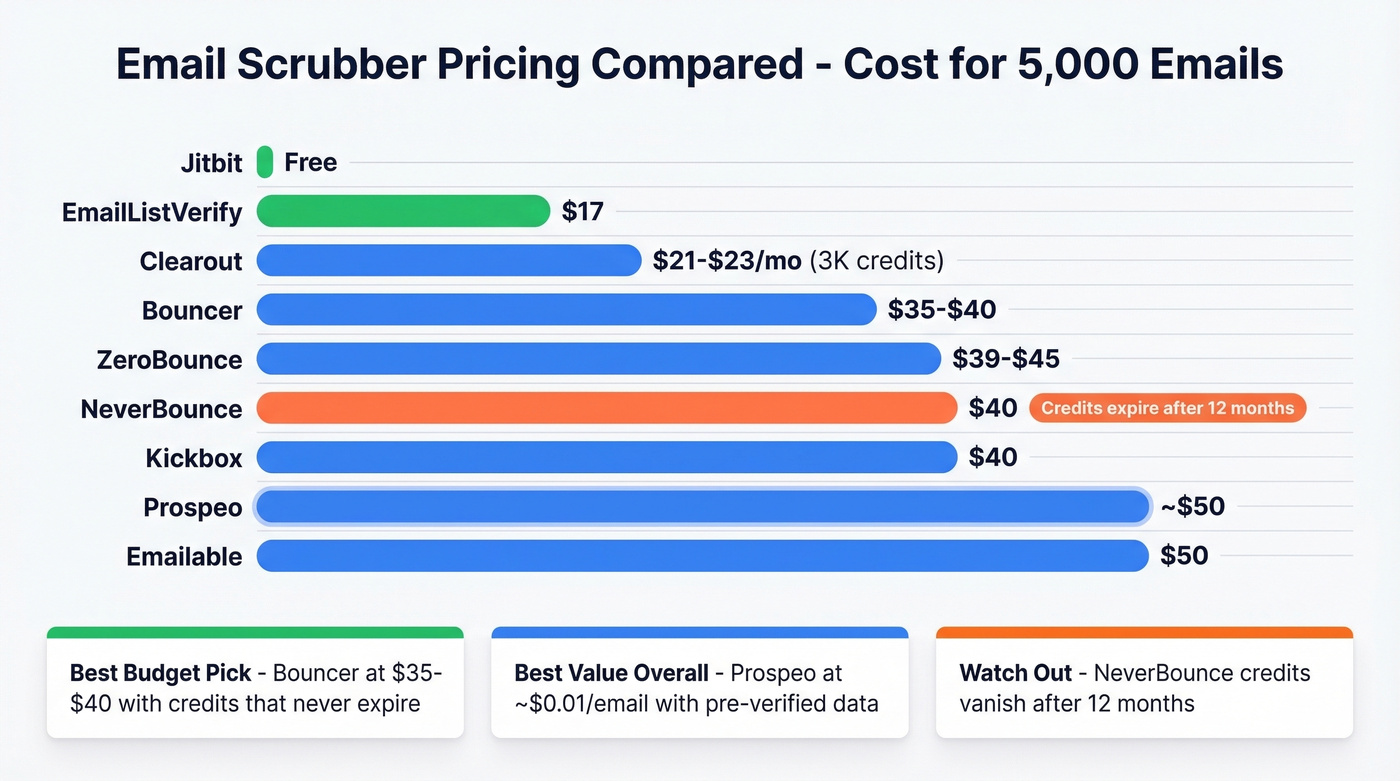
| Tool | 5K Emails | 10K Emails | 50K Emails | Free Tier | Credits Expire? | Best For |
|---|---|---|---|---|---|---|
| Prospeo | ~$50 | ~$100 | ~$500 | 75/mo | No | Pre-verified data |
| ZeroBounce | $39-$45 | $78-$90 | ~$350 | 100/mo | No | All-around reliability |
| NeverBounce | $40 | $49/mo plan | ~$250 | 10 free | Yes (12 months) | Enterprise automation |
| Kickbox | $40 | ~$80 | ~$350 | 100 free | No | Deliverability guarantee |
| Bouncer | $35-$40 | ~$70-$80 | ~$300 | 100 free | No | Budget + speed |
| Clearout | $21-$23/mo (3K) | $58/mo | ~$250/mo | 100 credits | No | Compliance |
| Emailable | $50 | ~$100 | ~$400 | 250 free | No | High-volume speed |
| EmailListVerify | $17 | ~$34 | ~$150 | 100 free | No | Ultra-budget |
| Jitbit | Free | Free | Free (20K cap) | 20K/run | N/A | One-off scrubs |
NeverBounce's 12-month credit expiration is the outlier. If you're scrubbing quarterly or less, that policy can cost you real money in unused credits.
Hot take: If your deal sizes are modest and you're sending fewer than 50,000 emails a month, you probably don't need premium email scrubbing software. Bouncer or EmailListVerify will get you 90% of the way there at a fraction of the cost. Save the budget for better copy.
What Email Scrubbers Can't Do
Even the best verification tool has blind spots.
Catch-all domains - servers configured to accept mail for any address - return "undetermined" results because the server says "yes" to everything. There's no way to verify whether a specific mailbox actually exists behind that catch-all. Spam traps are another limitation. ISPs create them constantly and keep them secret. Scrubbers catch known traps from databases, but they're always playing catch-up against new ones.
And here's the uncomfortable truth: "valid" doesn't mean "safe." An email can pass every technical check and still be a disengaged subscriber who marks you as spam. In our testing, accuracy claims above 99% were almost always inflated - the real-world gap between tools shows up in how they handle catch-alls and edge cases, not in their marketing numbers. The smarter approach is pairing periodic scrubbing with pre-verified data sources so you're doing maintenance rather than triage.

Most email scrubbers charge you to fix someone else's bad data. Prospeo refreshes 300M+ profiles every 7 days - not every 6 weeks - so there's less to scrub in the first place. At ~$0.01/email with native CRM integrations, it's cheaper than any scrubber + data provider combo.
Ditch the scrub-and-pray workflow. Get pre-verified contacts at a penny each.
How Often Should You Scrub?
Every six months is the bare minimum. If you're sending to 100,000+ subscribers, monthly is safer. Lists decay ~22% annually, which means waiting a full year guarantees roughly a quarter of your list is garbage addresses.
Here's a practical cadence:
- Under 10K contacts: scrub every 6 months
- 10K-100K contacts: scrub quarterly
- 100K+ contacts: scrub monthly
- Before any major campaign: always scrub, regardless of schedule
For context, the average unsubscribe rate across 3.6M campaigns is just 0.22% - but that number climbs fast when you're hitting invalid addresses that trigger spam complaints. Ecommerce averages a 0.29% bounce rate, while software and web apps run higher at ~0.93%. If you're above those numbers, you're overdue. Anything above 5% bounce is critical territory - most ESPs will flag or suspend your account.
Don't overlook real-time verification at the point of capture, either. Most scrubbers offer an API that validates emails as they're entered into signup forms, preventing bad data from entering your list in the first place. Pair that with double opt-in and you'll cut your cleaning workload dramatically.
How to Choose the Right Tool
Five criteria matter more than everything else.
Accuracy methodology, not accuracy claims. Every tool says "99% accuracy." That number is meaningless without knowing how they tested it. Lemlist ran a test with 800 known-valid and 200 known-bounce emails - that's the kind of methodology that actually tells you something. Ask vendors how they measure accuracy, not what number they put on the marketing page. If they can't answer, walk.
Speed at your volume. Emailable processes 2M emails/hour, Bouncer hits 180K/hour, and ZeroBounce runs 133K/hour. For a 10K list, it doesn't matter. For 500K, it's the difference between 15 minutes and four hours.
Integration depth. A tool that doesn't connect to your ESP or CRM means manual CSV exports. ZeroBounce's 45 integrations lead the pack here.
Pricing model. PAYG works for infrequent scrubbers. Monthly subscriptions work for steady-volume teams. Make sure you understand what "credits" actually mean - some tools charge differently for verification vs. email finding.
Credit expiration. NeverBounce's 12-month expiration can burn infrequent users. Bouncer, ZeroBounce, and Clearout don't expire credits. Check before you buy.
If you want to go deeper on deliverability beyond list hygiene, see our Email Deliverability Guide and the benchmarks in our Email Bounce Rate breakdown. If you're also sourcing contacts (not just cleaning them), compare email list providers and data enrichment services so you're not scrubbing junk inputs.
FAQ
How much does email scrubbing cost?
Most tools charge $0.003-$0.01 per email. Budget options like EmailListVerify run $17 for 5,000 emails. Premium tools like ZeroBounce charge $39-$45 for the same volume. Nearly every tool offers a free tier ranging from 50 to 250 credits, so you can test before committing.
What's the difference between email validation and verification?
Validation checks surface-level elements - syntax, domain existence, and MX records. Verification goes deeper by pinging the mail server to confirm the mailbox actually exists, then cross-referencing against spam trap and blacklist databases. Most modern scrubbers do both, but the terms aren't interchangeable.
Can I scrub my email list for free?
Jitbit is completely free for up to 20,000 emails per run with no signup required. Prospeo offers 75 free verified emails per month, and most paid tools include 50-250 free credits for testing. For lists over 5,000 emails, expect to pay - free tiers won't cover full-scale cleaning.
How often should I clean my email list?
Every six months at minimum, monthly if you send to 100,000+ subscribers. Lists decay about 22% per year, so waiting a full year means roughly a quarter of your addresses are invalid. Always scrub before any major campaign regardless of your regular schedule.
What's a good bounce rate to aim for?
Under 0.5% is the target. The average hard bounce rate across industries is about 0.21%. Anything above 0.5% starts damaging sender reputation. Cross 5% and most ESPs will flag or suspend your account - that's the emergency threshold.