

Email to Phone Number: The Honest Guide for 2026
If you've been sending emails to [phonenumber]@txt.att.net and wondering why they stopped arriving, you're not alone. The email to phone number workflow has changed dramatically - AT&T shut down its email-to-text gateway on June 17, 2025, T-Mobile went dark in December 2024, and Sprint's been dead since 2022. Most guides haven't caught up. They still list carrier domains that bounce.
We reviewed the current status of every major carrier gateway for 2026. Here's what actually works, what doesn't, and what to use instead.
What This Phrase Actually Means
Two distinct use cases hide behind "email to phone number," and confusing them wastes your time.
Path 1: Send an email that arrives as a text message. This used to work via carrier gateways. It mostly doesn't anymore. If you need this, skip to the gateway section below - then read the modern alternatives, because you'll need them.
Path 2: Find someone's phone number using their email address. This is a B2B enrichment problem, sometimes called reverse email lookup. Sales teams, recruiters, and founders need this daily. It's also the use case most people actually need. If that's you, jump straight to the phone lookup tools section.
How Email-to-SMS Gateways Work
The Carrier Gateway Concept
Every carrier used to assign a domain to its phone numbers. You'd compose an email to 5551234567@txt.att.net, and the carrier converted it into an SMS. Replies came back as emails. Simple, free, and surprisingly useful for IT alerting and lightweight notifications.
The catch: SMS caps at 160 characters. Anything longer gets split into multiple texts or fails silently. Attachments require a separate MMS gateway domain like @mms.att.net with different size limits, typically 1MB or less. You also needed to know the recipient's carrier to pick the right domain, which brings us to the current mess.
Which Gateways Still Work in 2026
Short answer: almost none of the major US carriers.
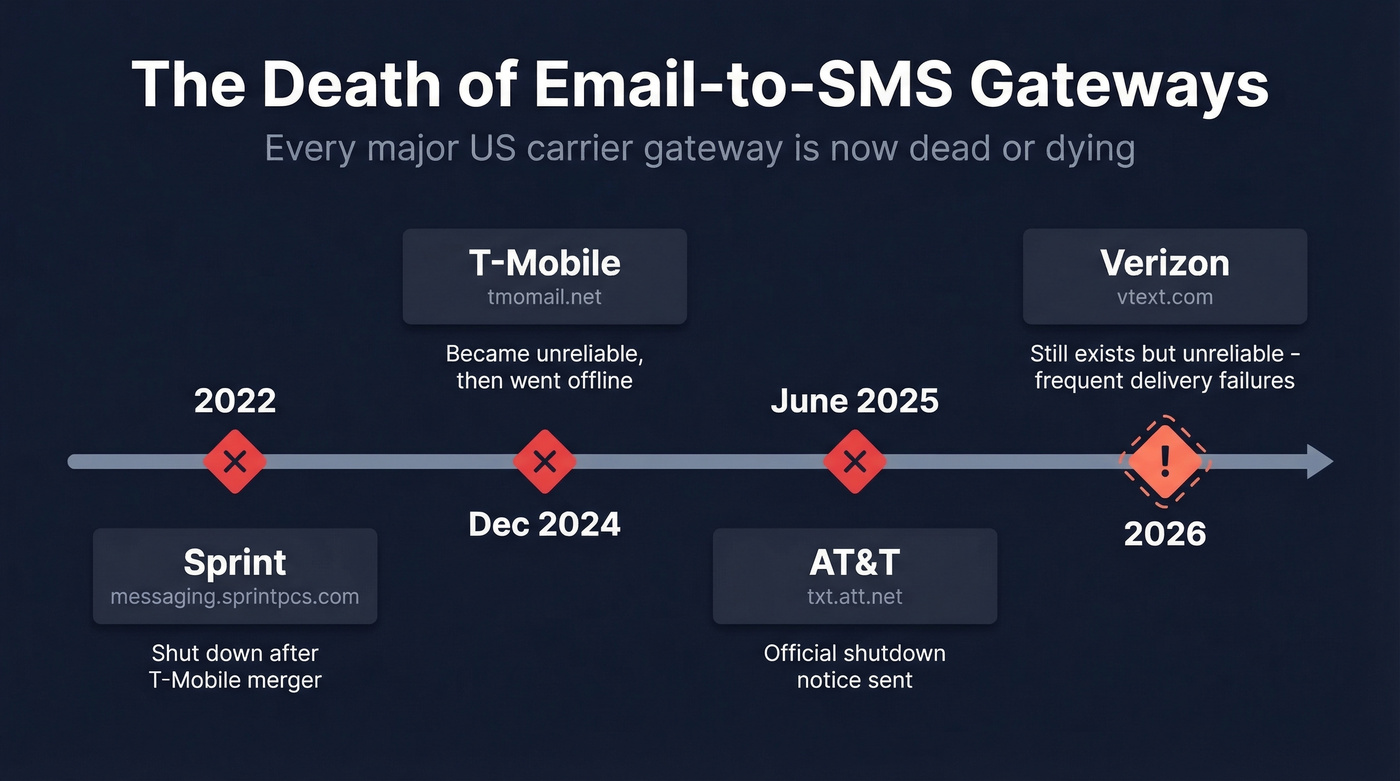
| Carrier | Gateway Domain | Status (2026) | Notes |
|---|---|---|---|
| AT&T | txt.att.net | Dead (June 2025) | Official shutdown notice circulated widely |
| T-Mobile | tmomail.net | Dead (Dec 2024) | Became unreliable by late 2024, then went offline |
| Sprint | messaging.sprintpcs.com | Dead (2022) | Shut down after the T-Mobile merger |
| Verizon | vtext.com | Unreliable | Delivery fails frequently; Verizon recommends businesses stop using it |
MVNOs like Mint Mobile and Spectrum Mobile shared gateway URLs with their parent carriers, so those went down too.
Email2sms.info maintains a downloadable list of carrier gateway domains in CSV and JSON formats. It's volunteer-maintained and openly warns entries may be outdated - treat it as a starting point, not gospel. Some smaller regional carriers and international providers still operate gateways, but reliability varies wildly.
How to Find a Number's Carrier
Even if a gateway technically exists, you need to know which carrier the recipient uses. Number porting makes this harder than it sounds - someone who signed up with AT&T five years ago might be on T-Mobile now.
IPQS offers a free carrier lookup covering 150+ countries. It returns the current service provider, country, and line type. Critically, it checks ported number data via NPAC, so you get the current carrier, not the original one.
Modern Alternatives to Carrier Gateways
The gateway era is over for any serious use case. SMS still has a 98% open rate compared to roughly 20% for email - businesses aren't abandoning the channel, they're just moving to tools that actually deliver.
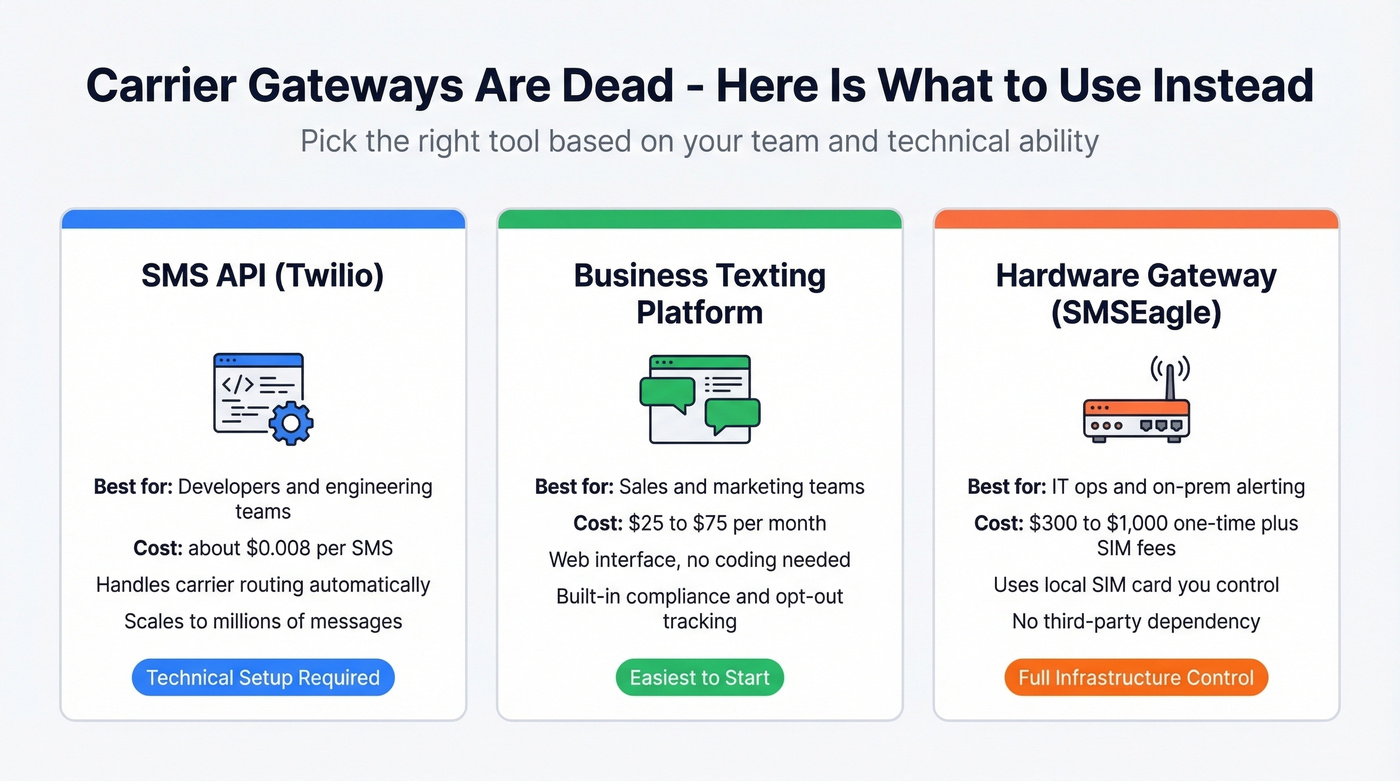
Developers should use an SMS API. Twilio charges around $0.008 per SMS in the US, handles carrier routing automatically, and scales to millions of messages. You never think about gateway domains.
Non-technical teams should grab a business texting platform. Heymarket, Sinch, and similar tools give you a web interface for sending texts at scale, handling compliance, opt-outs, and delivery tracking out of the box. Expect $25-75/month for small teams.
IT and ops teams running on-prem alerting - server-down notifications, infrastructure monitoring - should consider a hardware SMS gateway like SMSEagle. It uses a local SIM card, so you control the infrastructure. One-time hardware cost of $300-$1,000 plus carrier SIM fees.
Skip carrier gateways entirely if you're sending more than a handful of messages. The deliverability is too unreliable, you can't track opens or opt-outs, and you're one TCPA complaint away from a very expensive problem.

Carrier gateways are dead, but your need to reach people by phone isn't. Prospeo's reverse email lookup matches emails against 125M+ verified mobile numbers with a 30% pickup rate - the highest in the industry. At $0.10 per number, you pay only when a verified mobile is found.
Turn any email address into a direct dial in seconds.
TCPA Compliance: Not Optional
Any text message - including those sent via email gateways - falls under TCPA regulation. This isn't a suggestion. It's federal law with real teeth.
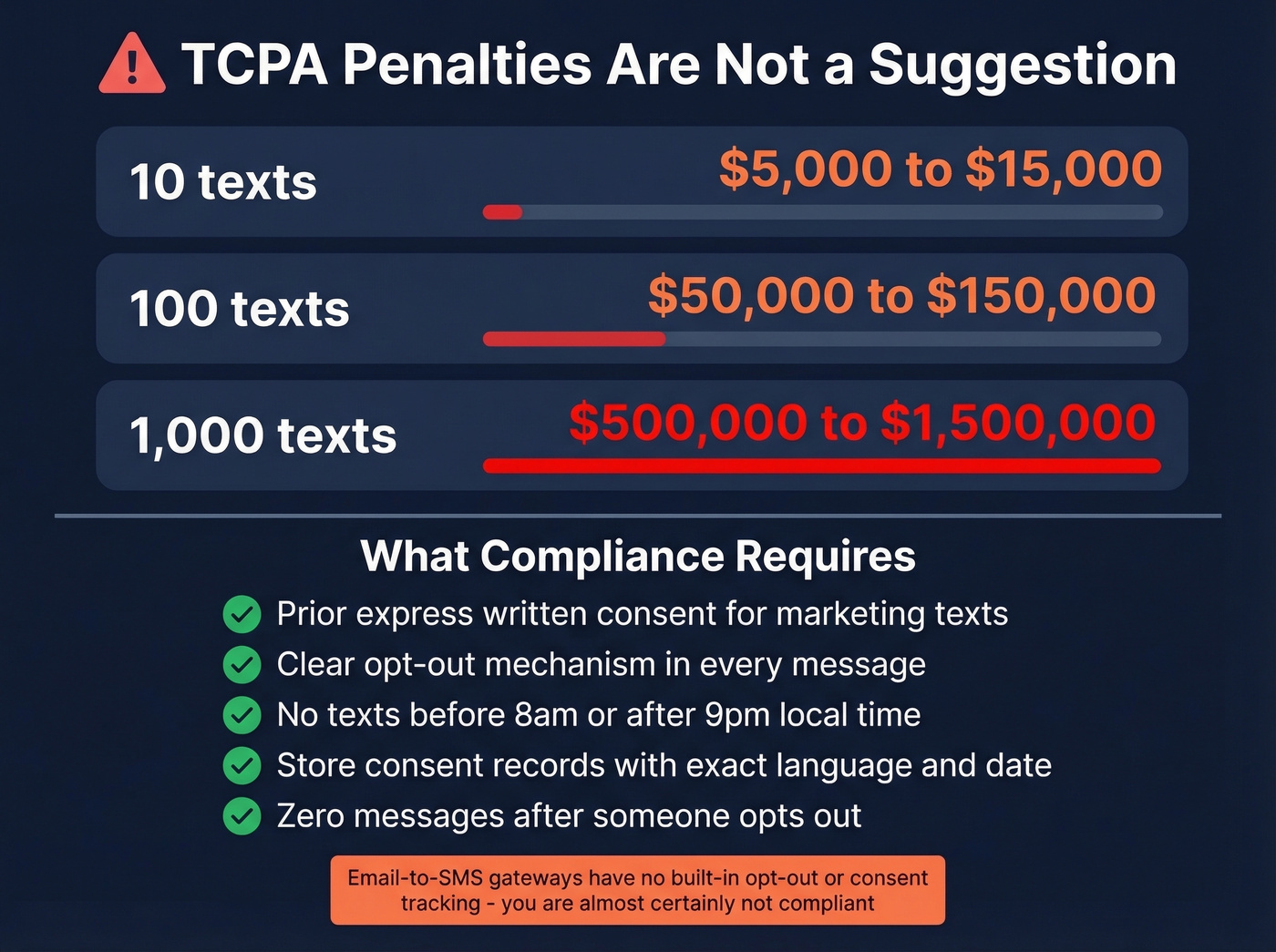
The math that should scare you: TCPA penalties run $500-$1,500 per violation. Send 1,000 texts without proper consent and you're looking at $500,000 to $1.5 million in exposure. That's not a typo.
Here's what compliance requires:
- Prior express written consent for any marketing text. Verbal consent isn't enough.
- Clear opt-out mechanism in every message. Process opt-outs within 10 business days.
- Quiet hours enforced: no texts before 8am or after 9pm in the recipient's local time zone.
- Recordkeeping: store when consent was obtained, the exact language, and the recipient's number.
- No texts after opt-out. Not even "sorry to see you go" messages.
Here's the thing: if you're using email-to-SMS gateways for marketing, you're almost certainly not compliant. There's no built-in opt-out mechanism, no delivery confirmation, and no consent tracking. Move to a proper SMS platform before someone files a complaint.
How to Find a Phone Number From an Email Address
This is the use case most people actually need - and the one the old guides completely ignore.
The logic is straightforward. You have a prospect's email address. You need their direct phone number to call them. Cognism's State of Cold Calling Report puts the success rate for having a conversation from a cold call at 65.6% - but only if you're dialing a number that actually connects. CRM platforms like Pipedrive now offer reverse email lookup that can surface phone numbers, confirming this is a mainstream workflow, not a niche hack.
Before reaching for paid tools, try the free methods. Google the email address in quotes alongside "phone" - you'd be surprised how often a number shows up in conference speaker bios, press releases, or public directories. Check the person's email signature if you have any prior correspondence. Google My Business listings often include direct numbers for small business owners. These manual approaches work well for a handful of contacts, but they don't scale.
When manual methods run dry, reverse email lookup tools match email addresses against databases of verified phone numbers. The quality gap between providers is enormous, and we've tested enough of them to have strong opinions. If you're building this into a repeatable motion, treat it like data enrichment, not a one-off hack.
Prospeo - Best for Verified Mobiles
Prospeo's Mobile Finder searches 125M+ verified mobile numbers globally and delivers a 30% pickup rate - nearly a third of numbers returned get answered on the first attempt. That's the metric that matters. A database of 500 million numbers is worthless if reps hear voicemail all day.
The pricing model is pay-per-result: you only pay when a number is found. Each mobile lookup costs 10 credits, and at roughly $0.01 per email, the unit economics are hard to beat. The free tier gives you 75 email lookups plus 100 Chrome extension credits per month, enough to test data quality before committing. The enrichment works in both directions, so you can also find email addresses from phone numbers.
The 7-day data refresh cycle is the real differentiator here. Most enrichment providers refresh around every 6 weeks, which means you're often calling numbers that were accurate two months ago but have since changed. Weekly refreshes dramatically reduce stale data, and in our experience, that translates directly to fewer "wrong number" conversations.
Apollo - Large Database, Free Start
Apollo covers 210M+ contacts with a genuinely useful free tier. Paid plans start at $59/user/month and scale to $149/user/month. The database is massive, but phone number accuracy doesn't match dedicated verification platforms. A HubSpot Community thread describes enrichment results as "all over the place" - Apollo is a great prospecting starting point, just budget for some wrong numbers mixed in. If you're comparing sources, it helps to understand what a sales prospecting database is actually optimized for.
ZoomInfo - Enterprise Depth, Enterprise Price
ZoomInfo's B2B database is one of the deepest in the US market, particularly for director-and-above contacts at mid-market and enterprise companies. No free tier, no self-serve signup, no published pricing. Expect $15,000-$40,000/year.
For a 500-person sales org, that's reasonable. For a 5-person startup, it's absurd. ZoomInfo is still the best all-in-one platform for enterprise sales teams, but most teams don't need all-in-one - they need accurate phone numbers at a price that doesn't require board approval.
Lusha - Quick One-Off Lookups
Lusha offers a small free monthly credit allowance and paid plans from around $49/user/month. It's fast for individual lookups and works as a lightweight reverse lookup tool when you're doing quick research. The recurring Reddit complaint is coverage: the consensus on r/sales is that Lusha "often returns no phone numbers found," which makes scaling outreach frustrating. Skip this if you need high hit rates across a large list.
Truecaller - Consumer Reverse Lookup
Truecaller has 450 million active users and works well for identifying unknown callers or looking up consumer phone numbers. The free app is ad-supported; Premium runs a few dollars per month. It's not a B2B tool - don't use it for sales prospecting.
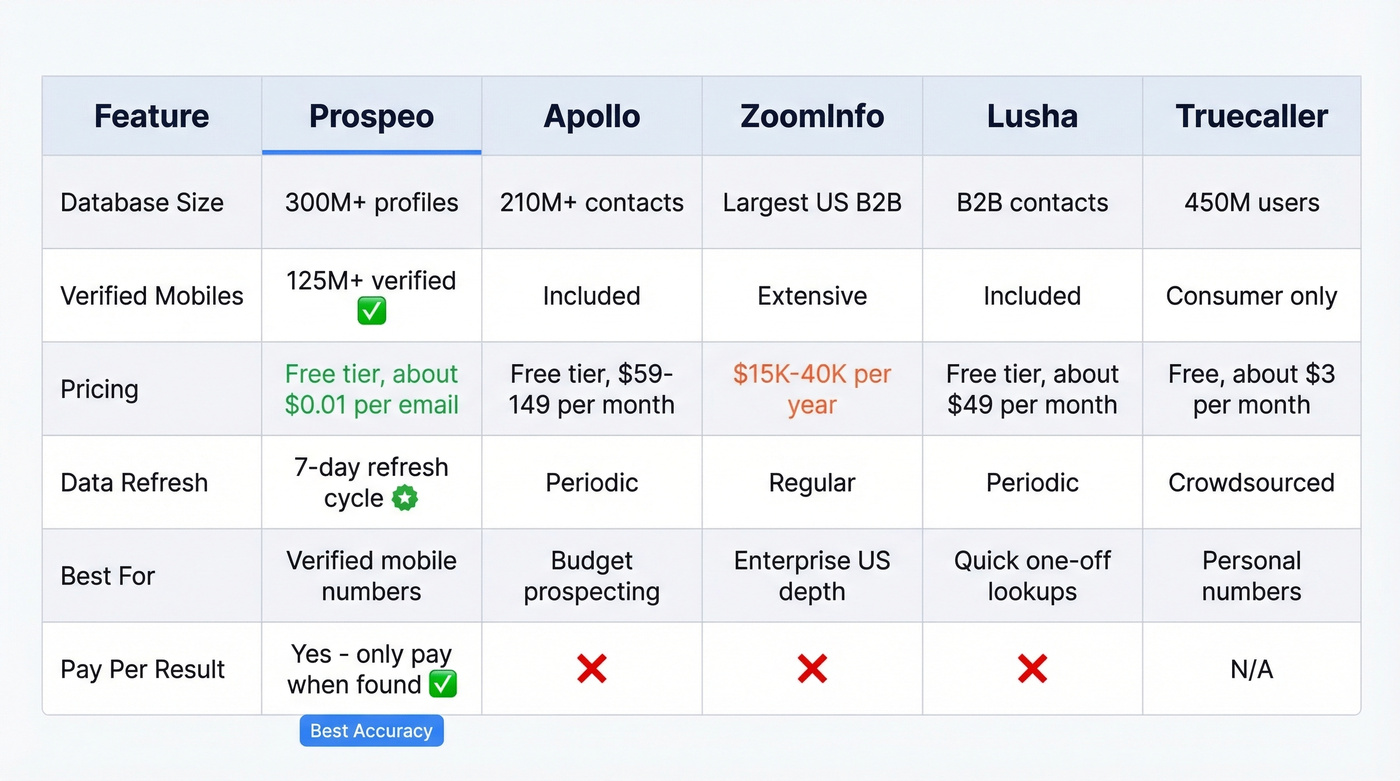
Tool Comparison
| Feature | Prospeo | Apollo | ZoomInfo | Lusha | Truecaller |
|---|---|---|---|---|---|
| Database | 300M+ profiles | 210M+ contacts | Largest US B2B | B2B contacts | 450M users |
| Mobiles | 125M+ verified | Included | Extensive | Included | Consumer focus |
| Pricing | Free; ~$0.01/email | Free; $59-149/mo | ~$15-40K/year | Free; ~$49/mo | Free; ~$3/mo |
| Best For | Verified mobiles | Budget prospecting | Enterprise US depth | Quick lookups | Personal numbers |
| Standout | Best accuracy | Best free tier | Best for large orgs | Niche use | Non-B2B only |
A quick note on data privacy: any reverse email lookup should use GDPR-compliant providers that source from public, permissioned data. This matters especially if you're enriching contacts in the EU. If you're operationalizing this, document it in your lead generation workflow.
The Waterfall Enrichment Approach
No single provider covers every contact. The smartest teams run a waterfall - feeding an email address through multiple enrichment providers sequentially until a phone number comes back.
Let's be honest about why this matters. A HubSpot Community thread from September 2025 captures the frustration perfectly: users reported enrichment results full of outdated landlines and "verified" numbers that never pick up. The fix? Layer multiple tools. BetterContact takes this approach with 20+ data providers baked in, starting at $15/month. Clearbit and UpLead are also worth testing as secondary sources.
A well-run waterfall that starts with the freshest data source and then backfills with broader databases catches 80%+ of available numbers. Data freshness is the key variable - stacking two stale providers doesn't help. Start with a provider that refreshes weekly, then fall back to the larger but slower databases for the contacts that didn't match. This is also where data-driven selling beats gut feel.
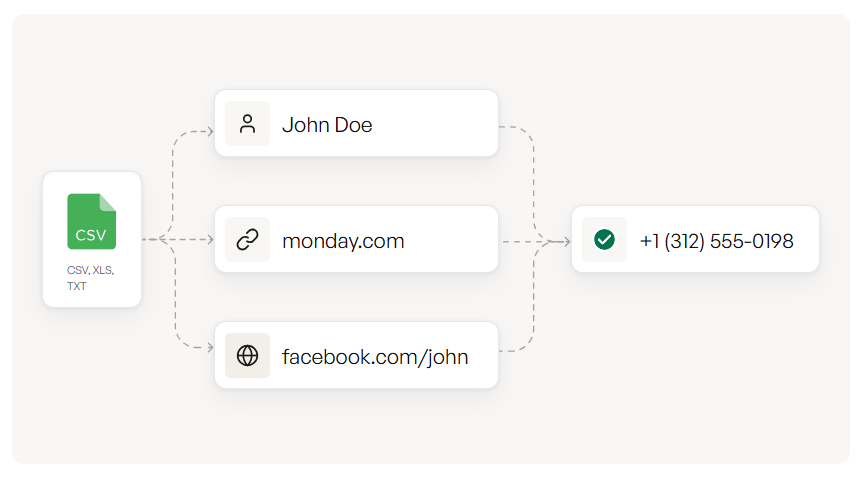
Manual reverse lookups work for five contacts. They don't work for five hundred. Prospeo enriches emails with verified phone numbers at scale - 92% match rate via API, 50+ data points per contact, and a 7-day refresh cycle so you're never dialing disconnected numbers.
Skip the guesswork. Get numbers that actually connect.
FAQ
Can I still email a Verizon number as a text?
Verizon's vtext.com gateway technically exists but is unreliable - delivery fails frequently, and Verizon itself recommends businesses stop using it. Switch to an SMS API like Twilio at $0.008/message or a business texting platform like Heymarket that handles carrier routing automatically.
Why did my email-to-text stop working?
AT&T shut down its gateway on June 17, 2025. T-Mobile's went offline in December 2024. Sprint's ended in 2022. If your automated alerts broke recently, one of these shutdowns is the cause. Audit your systems for any @txt.att.net or @tmomail.net addresses and migrate to an API-based solution.
Is there a free way to find someone's phone number from their email?
Google the email address in quotes alongside "phone" - conference bios and press releases surface numbers surprisingly often. For B2B prospecting, Prospeo's free tier includes 75 email lookups and 100 Chrome extension credits monthly, while Apollo offers a generous free plan with 210M+ contacts. Both let you validate data quality before paying for volume.
What's the character limit for email-to-SMS?
Standard SMS caps at 160 characters per segment. Longer messages split into multiple texts or fail entirely depending on the carrier. Attachments require an MMS gateway with a separate domain and different size limits, typically 1MB or less.
Is it legal to send texts via email gateways?
TCPA applies to any text message regardless of delivery method, including email gateways. Marketing texts require prior express written consent, and violations carry penalties of $500-$1,500 per message. Gateway-sent texts lack built-in opt-out tracking, making compliance especially risky. Use a proper SMS platform instead.