

Email Tracking Without Branding: What Actually Works in 2026
You just sent a proposal to a VP of Procurement, and right below your signature it reads "Sent with Mailtrack ✓✓." Congratulations - you've told your prospect you're surveilling them with a free tool.
People have been griping about forced tracker branding on Reddit since at least 2019, and the frustration hasn't changed one bit. Free trackers slap their logo on your emails. Paid plans feel like a tax on basic functionality. Here's what actually works for email tracking without branding right now, plus the deliverability and legal context that most tracking guides skip entirely.
Quick Picks
- Best free (Gmail): MailTracker by Hunter - 20 tracked emails/month, no branding.
- Best free unlimited (Gmail): Snov Email Tracker - unlimited tracking, no branding.
- Best paid (Gmail + Outlook): Salesflare - $29/user/month annual, CRM included with email, link, and website tracking.
Why Tracker Branding Kills Deals
You've spent 45 minutes crafting a proposal email to a C-suite buyer. They open it and see "Sent with Mailtrack" stamped below your name. Instantly, you look like you're running a surveillance operation from a free tool. That's not a great first impression when you're asking someone to sign a six-figure contract.
MailSuite's own pricing page lists "Mailsuite branding in signature" as an explicit plan differentiator - branding removal is the carrot to get you to pay $11.99/month. The consensus on r/coldemail and r/EmailProspecting is that this is a top reason people switch trackers. And yes, there are GitHub-hosted Chrome extensions that strip Mailtrack's signature automatically, but loading unpacked extensions from random repos is a security risk most teams shouldn't take.
Beyond optics, forced branding can hurt deliverability. A visible "Sent with ..." stamp makes recipients more likely to hit spam. Tracking pixels and redirect links can also trip security filters when they resemble known surveillance patterns.
For anyone evaluating trackers for business use, branding removal isn't a nice-to-have. It's non-negotiable.
Best Unbranded Email Trackers for 2026
| Tool | Free Tier | Branding? | Paid Price | Platform |
|---|---|---|---|---|
| MailTracker (Hunter) | 20 emails/mo | No | Starts at $34/mo (annual) | Gmail |
| Snov Email Tracker | Unlimited | No | $0 | Gmail |
| Yesware | Limited (24-hr window) | No | ~$15-35/mo | Gmail + Outlook |
| Salesflare | None | No | $29/user/mo (annual) | Gmail + Outlook |
| Streak | Yes | No | Free / $49/mo+ | Gmail |
| Saleshandy | Yes | No | $25/mo | Gmail + Outlook |
| Right Inbox | Yes | No | $7.95/user/mo | Gmail + Outlook |
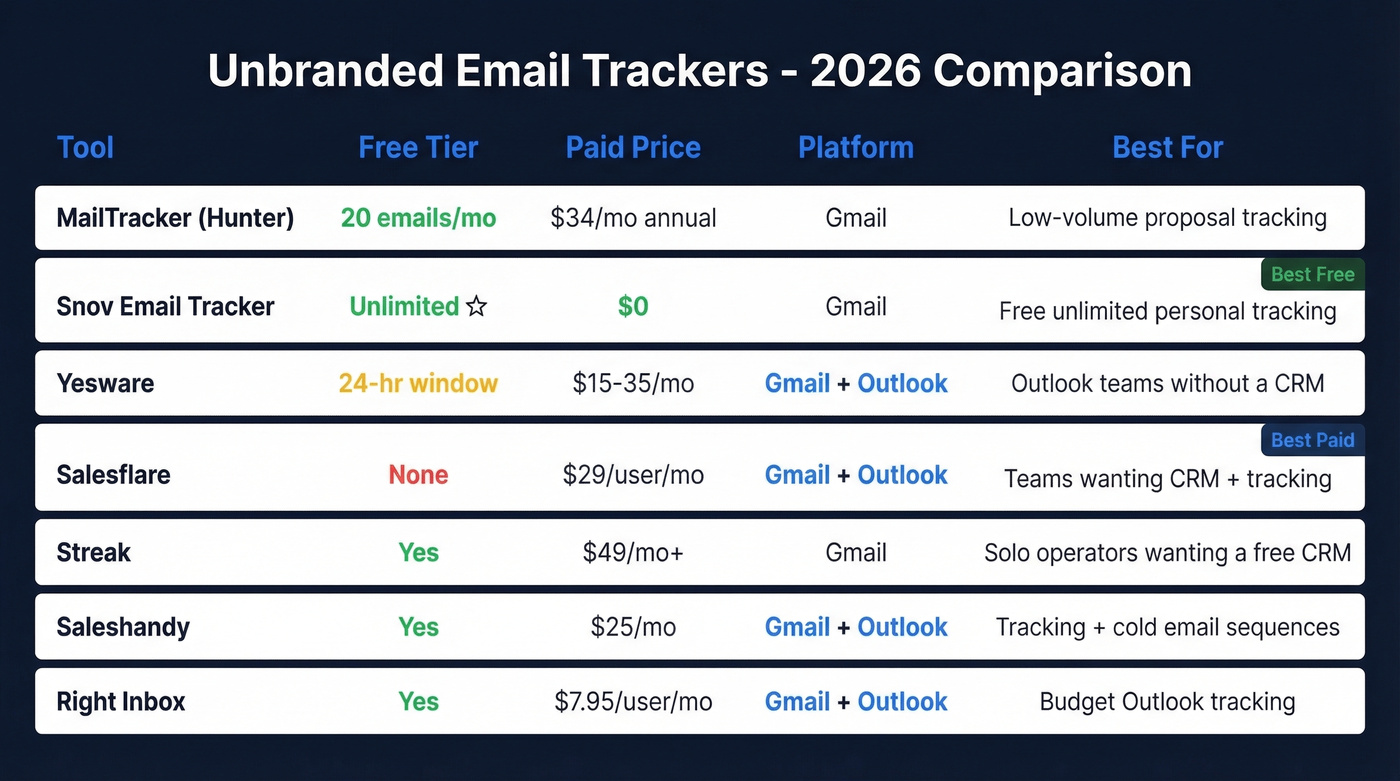
Hunter MailTracker Extension
Use this if: You send fewer than 20 tracked emails per month and want zero friction.
Skip this if: You need Outlook support or high volume.
MailTracker is one of the most commonly recommended free unbranded trackers on Reddit, and in our testing it lives up to the reputation. Install the Chrome extension, compose in Gmail, and you get open notifications without signature injection. The 20-email monthly cap is tight, but for founders or AEs who only need to track key emails - proposals, follow-ups after demos, pricing discussions - it's enough.
Hunter's Starter plan starts at $49/month ($34/month annual) and includes open tracking, link tracking, and a custom tracking domain. That last part is a real deliverability advantage we'll get into below.
Snov Email Tracker
Here's the thing about Snov's standalone tracker: it's free, unlimited, and doesn't add branding. That combination is rare enough to feel suspicious, but we've used it and it works as advertised. It tracks opens and link clicks inside Gmail.
The tradeoff is subtler. It's Gmail-only, and for cold outreach at scale, any tracker running through shared infrastructure can become a deliverability risk if other senders on the same domain abuse it. For low-volume personal tracking - checking whether a hiring manager opened your follow-up, seeing if a prospect clicked your case study link - nothing beats it. For serious outbound, you'll want more control.
Yesware
Yesware is the pick if you need both Gmail and Outlook support without committing to a full CRM. The free tier gives you a 24-hour tracking window, which is enough to see if someone opened your email the same day you sent it. Paid plans ($15-35/month per user) unlock persistent tracking, templates, and meeting scheduling.
A solid mid-range option for reps who live in Outlook but don't want to overhaul their stack.
Salesflare
Salesflare isn't just a tracker - it's a lightweight CRM with email, link, and website tracking baked in. The Growth plan at $29/user/month (annual) makes it a strong paid option for teams that want visibility inside a real CRM workflow instead of stacking yet another inbox extension on top of three others.
No free tier, and the Enterprise plan requires a 5-user minimum. But if you're already shopping for a CRM, the tracking comes free with it - compare options in our guide to examples of a CRM.
The Rest
Streak bundles a CRM with open tracking inside Gmail. No Outlook support, but the free tier is generous for solo operators.
Saleshandy packages tracking with cold email sequences. Free plan available; paid from $25/month. Good if you want tracking and automation in one tool.
Right Inbox is a popular Outlook add-in starting at $7.95/user/month - the cheapest paid option on this list if Outlook is your primary client.

Unbranded tracking tells you who opened. But 98% verified emails at $0.01 each tell you who's real. Prospeo's 5-step verification eliminates bounces, protects your domain, and gives you the deliverability that tracking tools can't fix.
Stop tracking ghosts. Start reaching verified buyers.
Why Tracking Pixels Are Breaking
Every email tracker embeds a 1x1 transparent image in your email's HTML. When the recipient's client loads that image, it registers an "open." Simple in theory. Increasingly broken in practice.
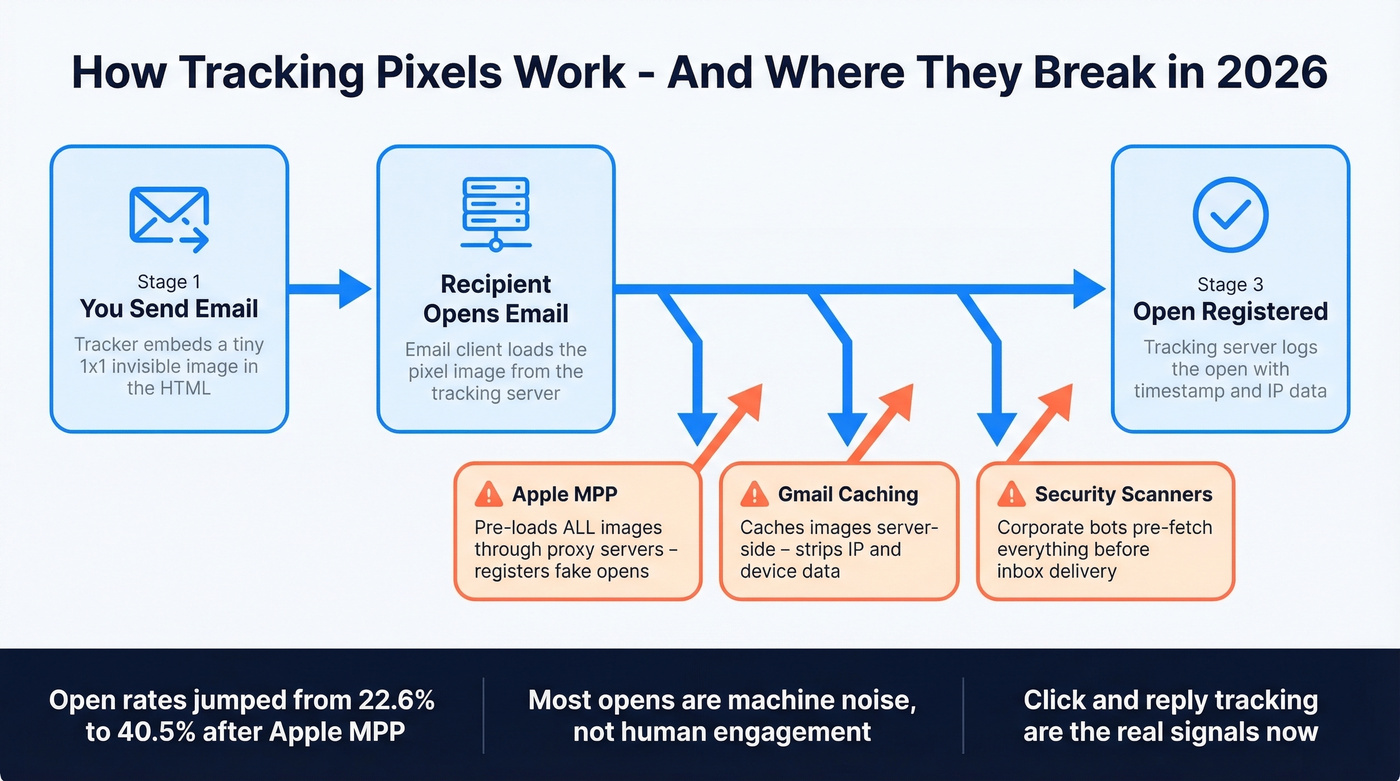
Apple Mail Privacy Protection preloads images through proxy servers regardless of whether the recipient actually reads the email. Open rates jumped from 22.6% to 40.5% after MPP rolled out - not because more people were reading emails, but because Apple was pre-fetching every pixel on their behalf. Gmail caches images server-side, stripping IP and device data. Corporate security scanners trigger "opens" by pre-fetching everything before the email even hits the inbox.
Let's be honest: open rates are a vanity metric in 2026. Between MPP machine opens, Gmail caching, and bot scanners, the number is directional at best. Click tracking and reply tracking are what actually tell you if someone engaged. We've seen teams obsess over 60% open rates that were 80% machine noise, while ignoring the reply rate that would've told them their messaging was off. If your entire outreach strategy hinges on open rates, you're optimizing for noise.
How Tracking Affects Deliverability
The real cost of a free tracker isn't the price. It's the deliverability risk.
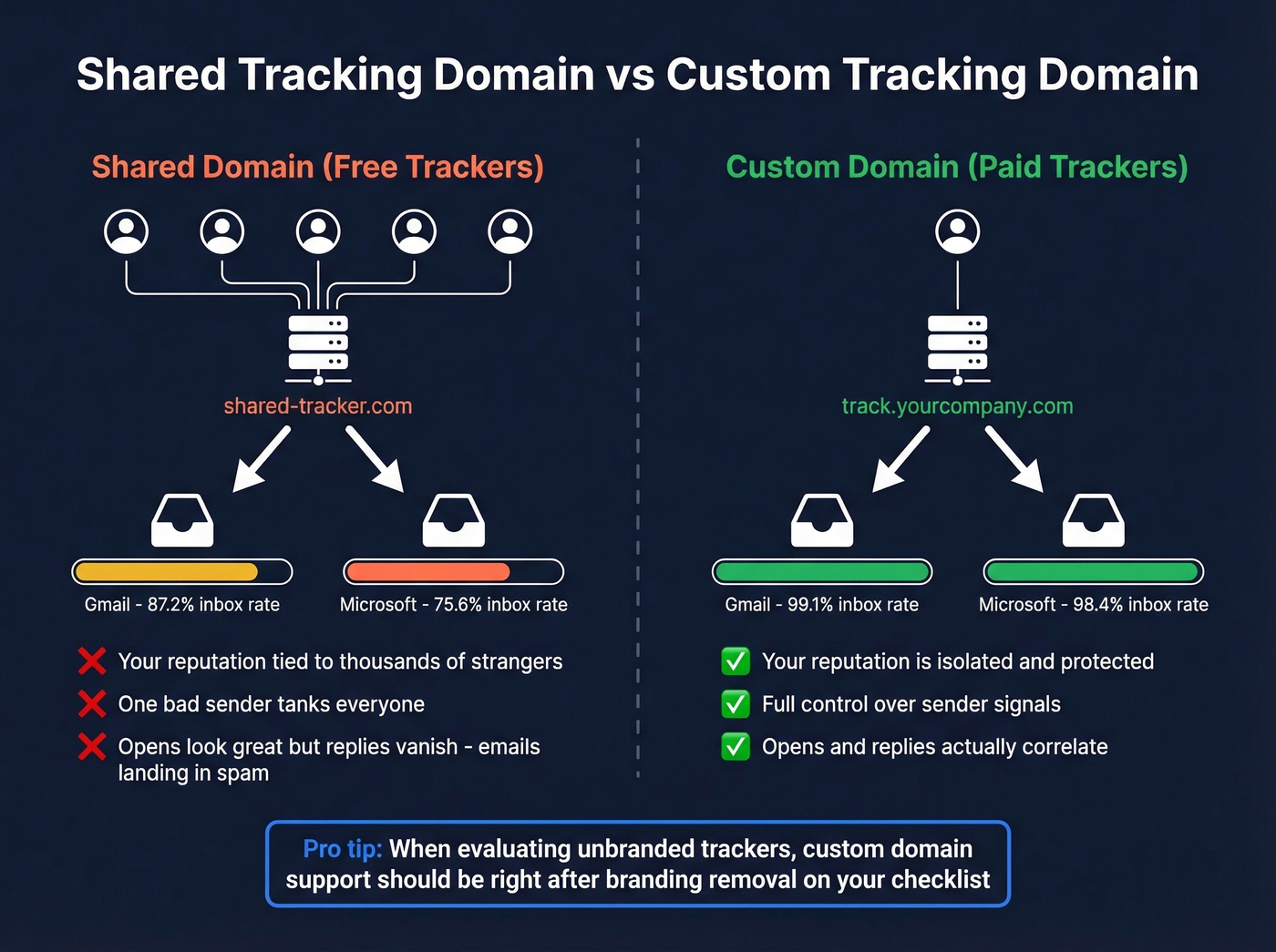
When your tracking pixel loads from a shared domain that thousands of other users also send through, your sender reputation is tied to theirs. Here's a pattern we see constantly: a team reports "great opens" but replies fall off a cliff. The emails are landing in spam, and the "opens" are mostly machine pre-fetches and security scans registering as human activity.
Custom tracking domains fix a big part of this by isolating your reputation from everyone else's. The gap between providers is real - Gmail places 87.2% of emails in the inbox, while Microsoft sits at 75.6%. If you're tracking emails to Outlook recipients through shared tracking infrastructure, you're playing on hard mode. Hunter's paid plans include a custom tracking domain. Most free trackers don't. When evaluating unbranded trackers, custom domain support should be near the top of your checklist, right after "does it add branding." If you want the full setup details, see our guide on tracking domain.
Is Stealth Email Tracking Legal?
Compliance rules are tightening fast, and "unbranded" doesn't mean "undetectable" in the eyes of regulators.
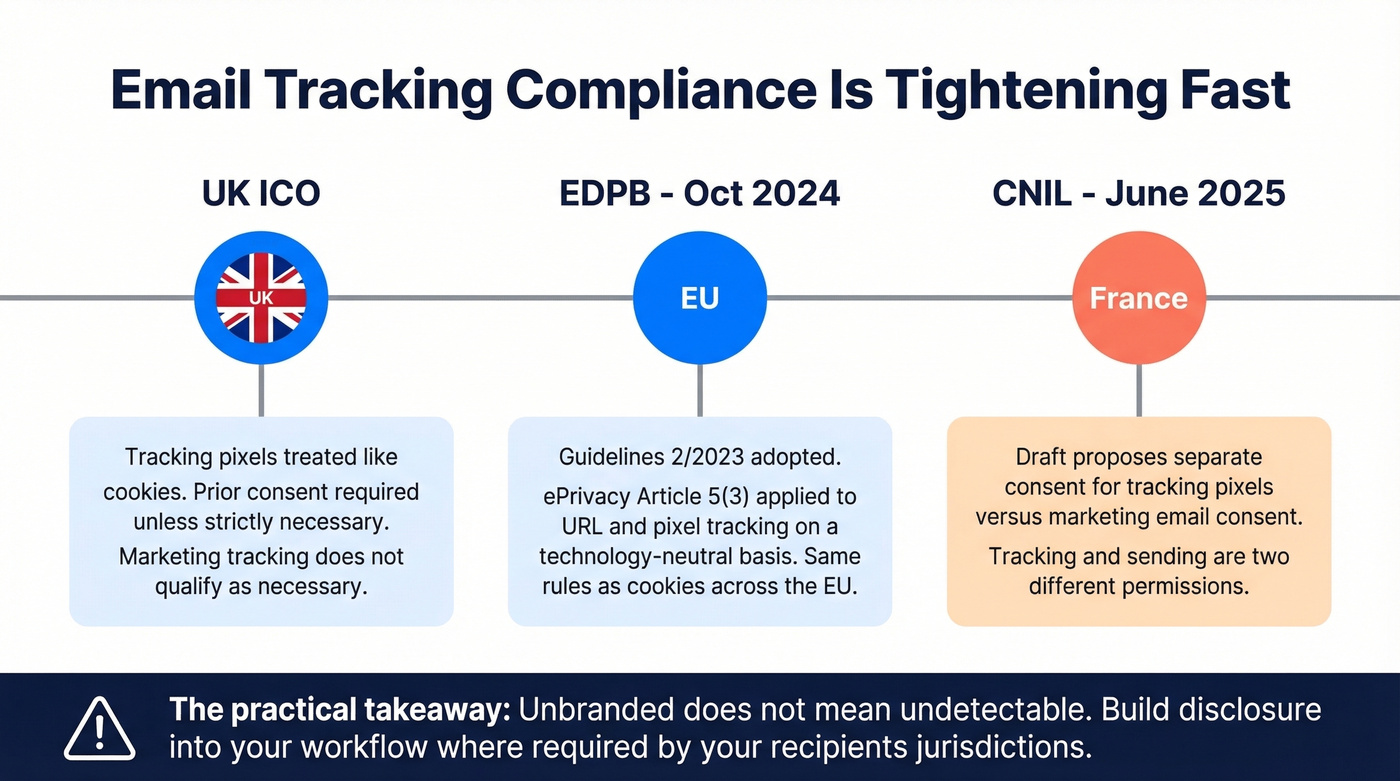
The UK's ICO treats tracking pixels like cookies - prior consent is required unless the pixel is "strictly necessary," and marketing tracking doesn't qualify. The EDPB's Guidelines 2/2023, adopted October 7, 2024, apply ePrivacy Article 5(3) to URL and pixel tracking on a technology-neutral basis: same rules as cookies. France's CNIL draft from June 2025 proposes separate consent for tracking pixels versus marketing email consent itself.
The practical takeaway for sales teams: if you're tracking without disclosure, you're taking a compliance risk that grows every year. This doesn't mean you can't track - it means you should understand the rules in your recipients' jurisdictions and build disclosure into your workflow where required. For a broader framework, see ethics in sales.
Verify Before You Track
If 20% of your list bounces, your open rate is calculated against a broken denominator. You're not measuring engagement. You're measuring noise against a list full of dead addresses.
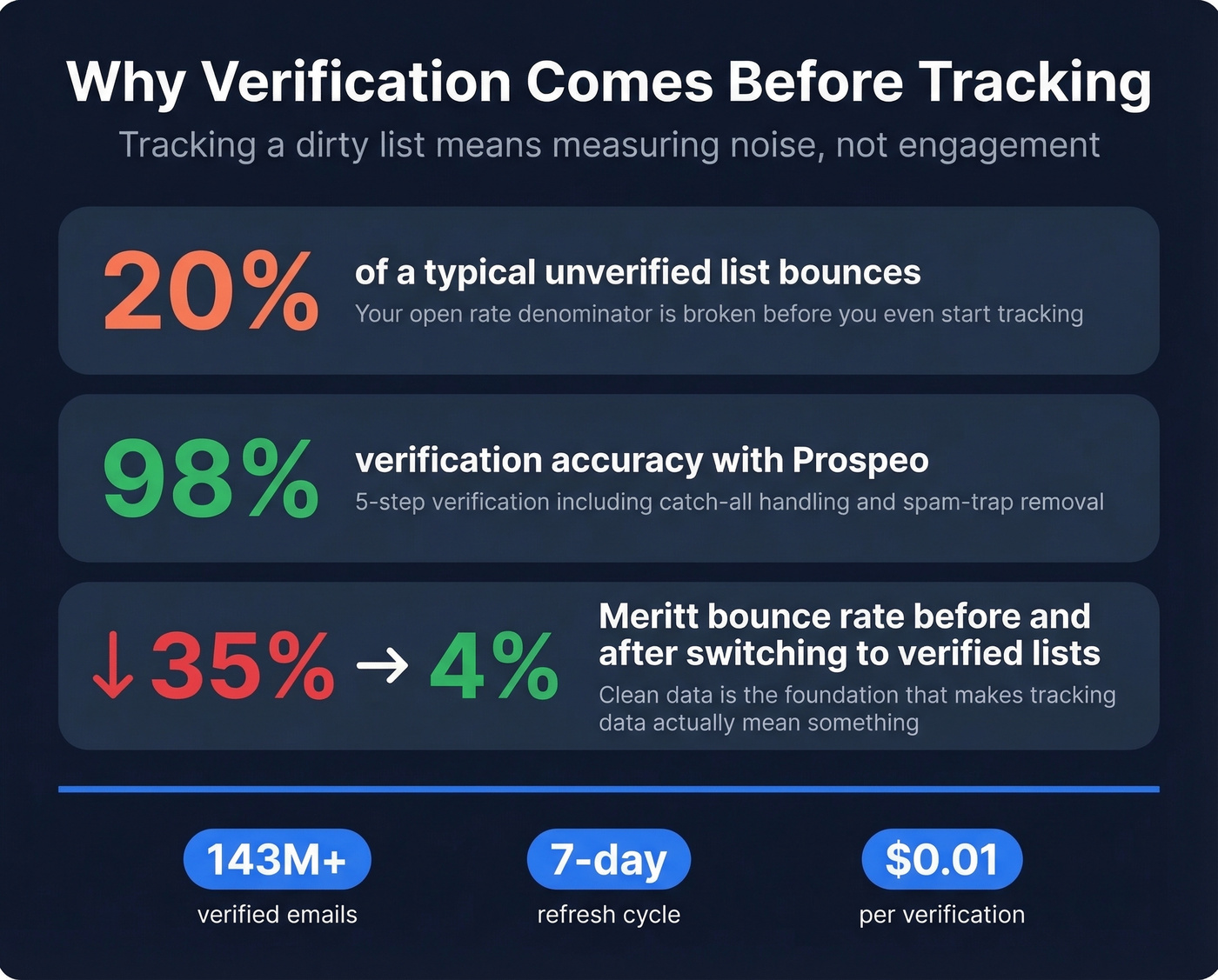
Clean data is the prerequisite that makes any tracking tool useful. Prospeo's 5-step email verification catches bad addresses with 98% accuracy, including catch-all handling and spam-trap removal. Meritt dropped their bounce rate from 35% to under 4% after switching to verified lists - and that's the kind of foundation that makes tracking data actually mean something. With 143M+ verified emails refreshed on a 7-day cycle, the data stays current rather than going stale between quarterly refreshes. If you’re benchmarking and troubleshooting, our email bounce rate guide breaks down what “good” looks like and how to fix it.
Open rates are noise in 2026. Reply rates are the signal - and replies start with accurate data. Prospeo delivers 143M+ verified emails refreshed every 7 days, so your outreach lands in real inboxes instead of bouncing off stale records.
Fix the data and the deliverability fixes itself.
FAQ
Can recipients tell I'm tracking their email?
Pixel-based trackers are invisible in the email body - there's no visual indicator unless the tracker adds branding to your signature. Unbranded trackers hide the mechanism entirely. That said, Apple MPP and Gmail caching often make open tracking unreliable regardless of whether it's visible.
What's the best free tracker without branding for Outlook?
Free Outlook options are thin. Yesware offers a free plan with a 24-hour tracking window. For persistent Outlook tracking without branding, Salesflare at $29/user/month (annual) is a reliable paid option. Right Inbox starting at $7.95/user/month is the budget alternative.
Are tracking pixels legal under GDPR?
Increasingly regulated. The EDPB's 2024 guidelines treat tracking pixels like cookies under ePrivacy Article 5(3), and the UK ICO requires prior consent. Tracking without disclosure carries a growing compliance risk, especially in the EU and UK. Check your recipients' jurisdictions before assuming you're in the clear.
How do I improve email deliverability alongside tracking?
Two things matter most: use a custom tracking domain to isolate your sender reputation, and verify your list before sending. Meritt cut their bounce rate from 35% to under 4% after switching to verified data. Clean lists mean your tracking data reflects real engagement, not noise from bounces and spam folders.