

Best Email Verification Services in 2026, Ranked by Real Accuracy Data
Every email verification service on the market claims 99% accuracy. Run the same list through five of them and you'll get five different results - some wildly different. We've tested most of these tools across real outbound campaigns, and the gap between marketing claims and production performance is the single biggest frustration in this category.
Here are the services actually worth paying for, ranked by what happens when you send, not what the landing page promises.
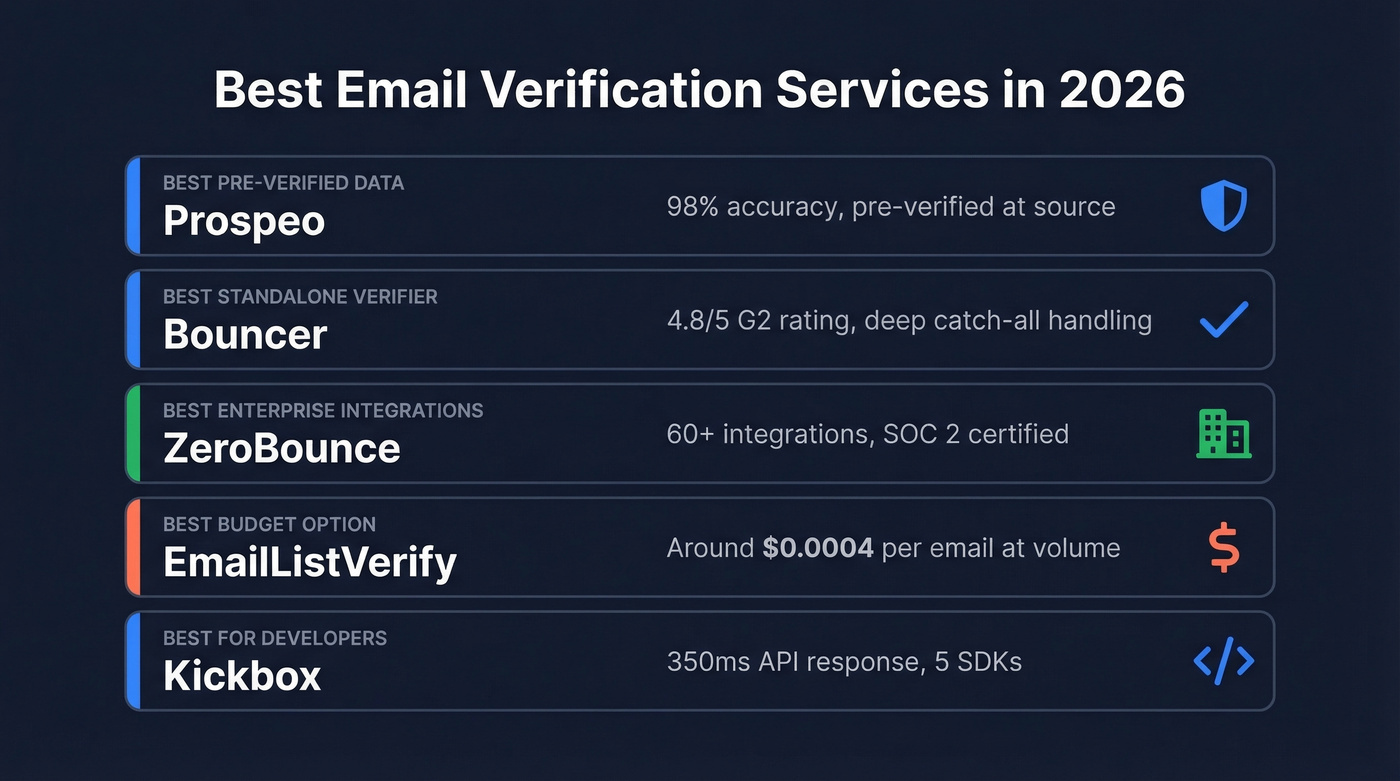
Our Top Picks
| Category | Tool | Why |
|---|---|---|
| Best pre-verified data | Prospeo | 98% accuracy, pre-verified |
| Best standalone verifier | Bouncer | 4.8/5 G2, catch-all depth |
| Best enterprise integrations | ZeroBounce | 60+ integrations, SOC 2 |
| Best budget option | EmailListVerify | ~$0.0004/email at volume |
| Best for developers | Kickbox | ~350ms response, 5 SDKs |
Contact lists decay 22-30% annually. That means roughly a quarter of your "verified" database goes stale every year - people change jobs, companies rebrand domains, mailboxes get deactivated. Once your bounce rate creeps above 2%, ESPs start throttling you. The tools below are how you keep that from happening.
Why Verification Matters for Deliverability
Email marketing still delivers $36-$42 for every $1 spent. But that ROI assumes your emails actually land in inboxes. A 1% increase in invalid or spam-trap addresses can suppress inbox placement by up to 10%. That's not a rounding error - that's the difference between a campaign that books meetings and one that quietly dies in spam folders.
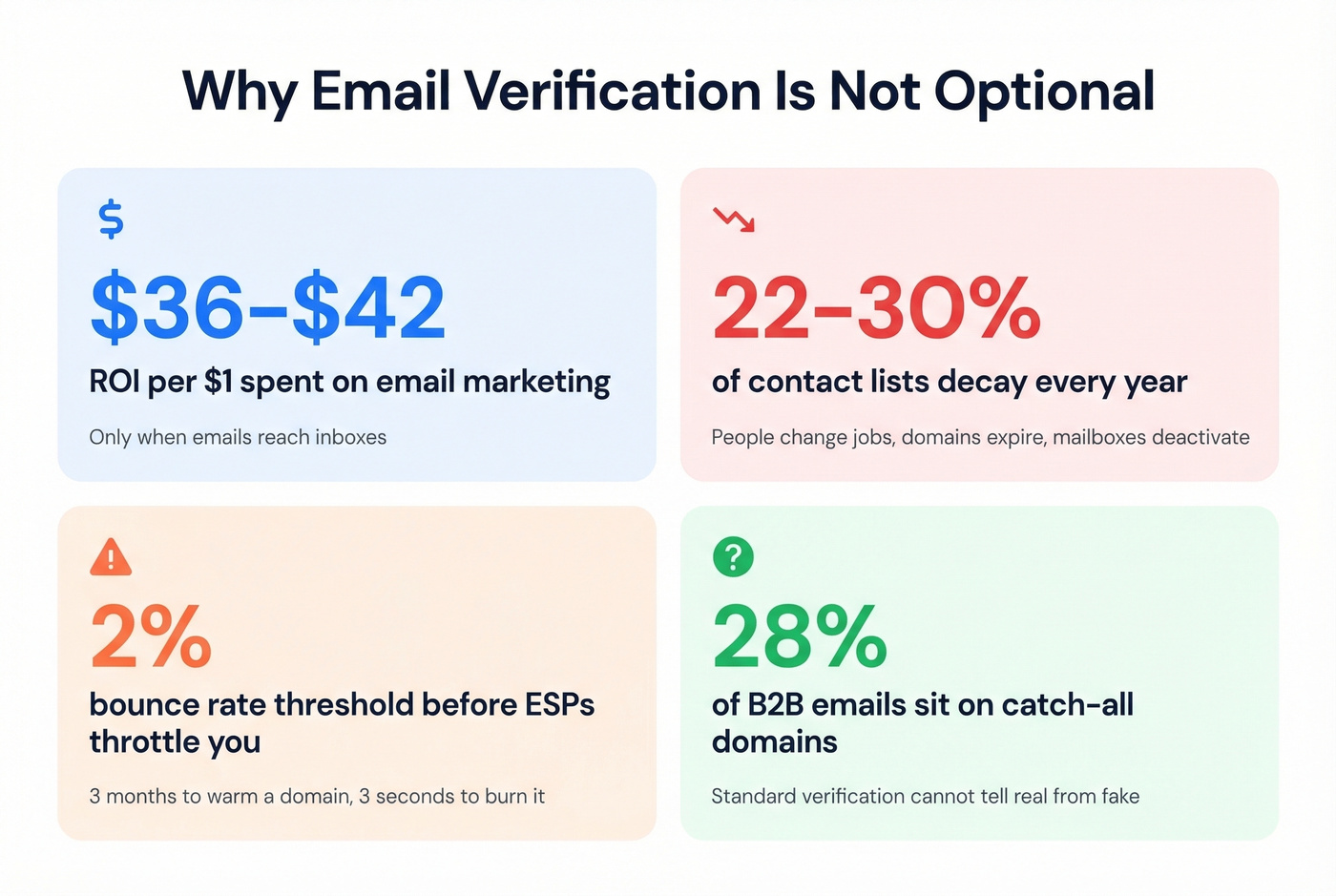
Here's a scenario we see constantly: an SDR downloads a list from a conference, imports 3,000 contacts into their sequencer, and fires off a campaign Monday morning. By Tuesday, their domain reputation is tanked. It takes three months to warm up a domain and three seconds to burn it with a bad list.
An email validation tool isn't optional - it protects your domain. And if you're not also running proper DMARC, SPF, and DKIM authentication alongside verification, you're leaving the door open for deliverability issues from both directions.
If you want the full upstream view (verification + sending practices), start with our email deliverability breakdown.
The Accuracy Myth
Every vendor says "99% accuracy." The problem is that accuracy depends entirely on how you measure it, what dataset you test against, and how you handle the gray zone of unknown and accept-all results.
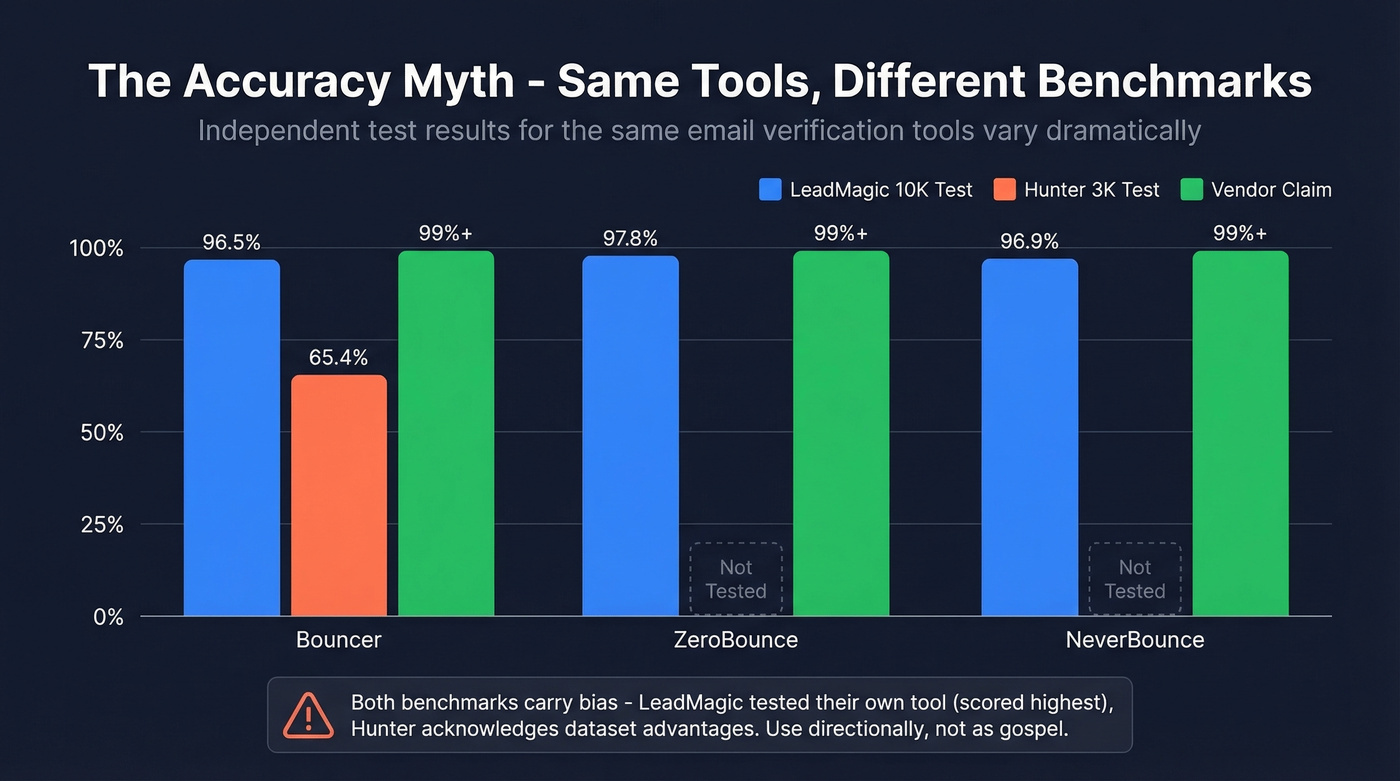
Two independent-ish benchmarks illustrate this perfectly. LeadMagic tested 10,000 real B2B emails across 10 providers within a 48-hour window. Hunter tested 3,000+ real business emails across 15 providers using Clay integrations. The results barely overlap.
| Tool | LeadMagic Test | Hunter Test | Vendor Claim |
|---|---|---|---|
| ZeroBounce | 97.8% | Not in top shown | 99%+ |
| NeverBounce | 96.9% | Not in top shown | 99%+ |
| Bouncer | 96.5% | 65.4% | 99%+ |
| Kickbox | Not tested | 67.5% | 99%+ |
| MillionVerifier | 95.8% | Not tested | 99%+ |
Look at Bouncer: 96.5% in one benchmark, 65.4% in another. Same tool, wildly different scores. Why? Different datasets, different definitions of "accurate," and - critically - different handling of unknown and accept-all results. The Hunter benchmark penalizes tools for returning "unknown" instead of a definitive answer, while the 10K benchmark focuses on whether the tool correctly identifies known-valid and known-invalid addresses. A third benchmark from La Growth Machine (47K emails over 90 days) produced yet another set of numbers, listing Bouncer at 97.8%.
Both benchmarks carry bias disclosures. LeadMagic's author built LeadMagic (their tool scored highest). Hunter acknowledges their dataset classification may advantage Hunter. Neither is gospel. Use them directionally, not as absolute rankings.
Here's the thing: Most teams obsess over which verifier has the highest accuracy percentage when the real question is how the tool handles the 28% of B2B emails sitting on catch-all domains. That's where campaigns actually live or die.
The Catch-All Problem
About 28% of B2B emails sit on catch-all domains. These servers accept mail for any address at the domain - send to totally.fake@company.com and the SMTP server returns a 250 OK as if the mailbox exists. Standard verification can't tell real from fake on these domains.
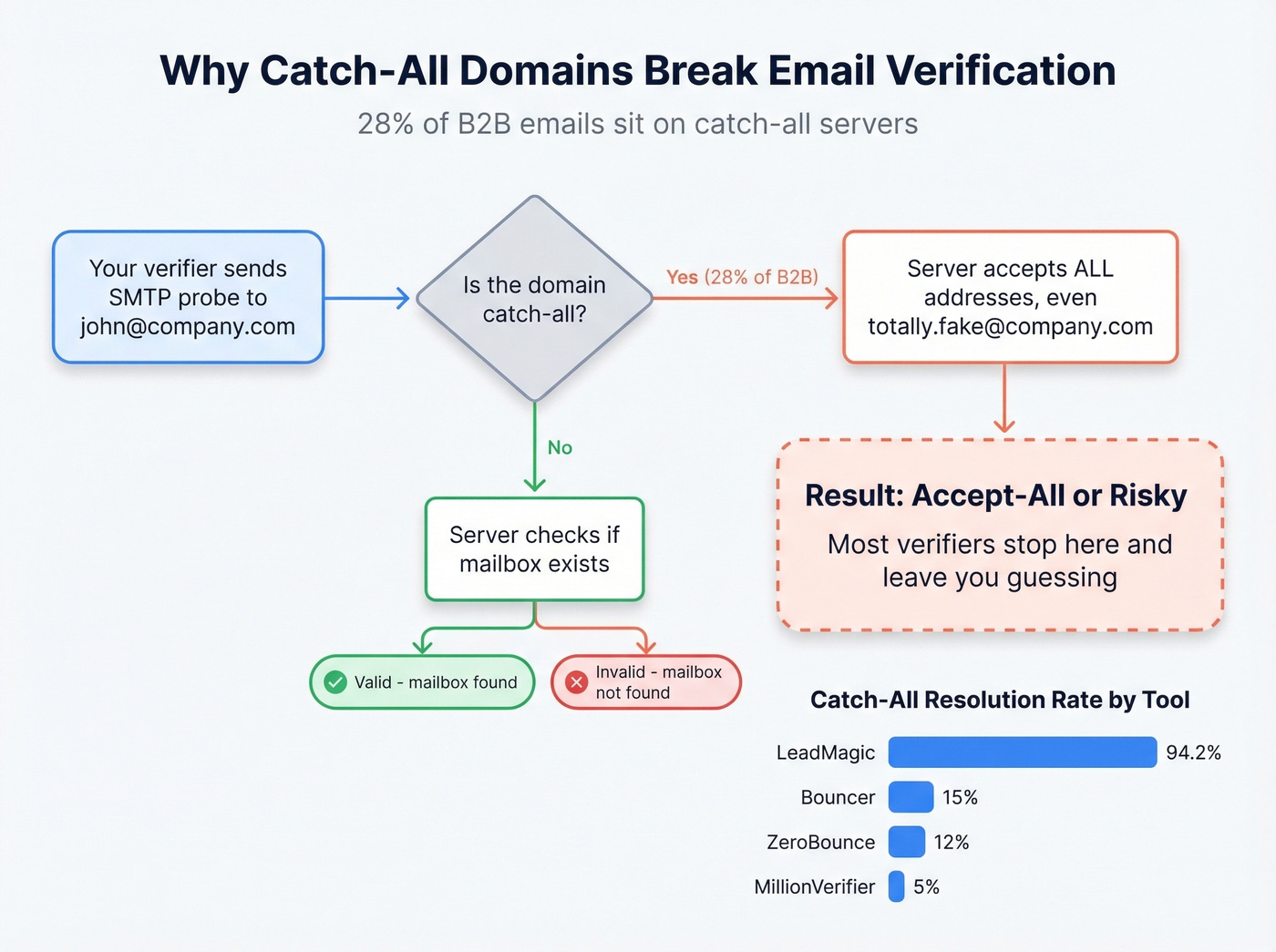
The detection method is straightforward: send an SMTP probe to a random, clearly non-existent address at the domain. If the server accepts it, you've got a catch-all. The hard part is what happens next.
Most verifiers just flag the email as "accept-all" or "risky" and leave you to decide. In the 10K benchmark, catch-all resolution ranged from 5% (MillionVerifier) to 94.2% (LeadMagic) - a massive spread that determines whether you're sending blind or sending smart. On r/coldemail and similar communities, catch-all handling is the single most debated verification topic, and for good reason.
If you’re trying to reduce bounces beyond list cleaning, pair verification with a dedicated email bounce rate playbook.

You just read how catch-all domains make up 28% of B2B emails and most verifiers punt on them. Prospeo's 5-step verification - with catch-all handling, spam-trap removal, and honeypot filtering - runs before data ever reaches you. 98% accuracy. 7-day refresh. No separate cleaning step.
Skip the verification stack. Start with data that's already clean.
Top Tools Compared
Prospeo
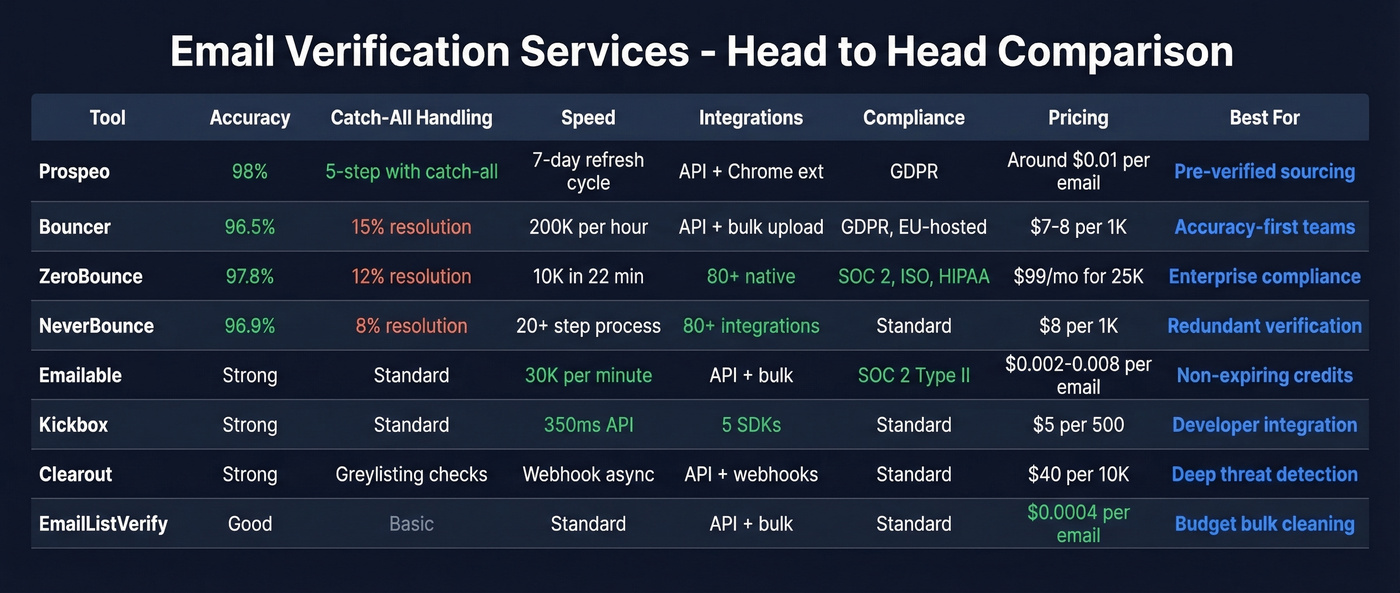
Most verification tools clean data after it's already in your system. Prospeo works upstream - its 5-step verification with catch-all handling, spam-trap removal, and honeypot filtering runs at the point of data collection across 300M+ profiles and 143M+ verified emails. The result is 98% email accuracy on fresh contacts, refreshed on a 7-day cycle versus the 6-week industry average.
The proof points tell the story. Snyk's 50-person AE team saw bounce rates drop from 35-40% to under 5% after switching, with AE-sourced pipeline up 180% and 200+ new opportunities per month. Stack Optimize built from $0 to $1M ARR while maintaining 94%+ deliverability across all clients with bounce rates consistently under 3% and zero domain flags. At ~$0.01/email - with a free tier of 75 emails per month - the cost is a fraction of running a separate data provider plus a standalone verifier.
If you’re comparing “pre-verified data” vs “enrich then clean,” see our guide to data enrichment services.
Use this if: You're sourcing new contacts and want verified data without bolting on a separate verification step. Pair it with your sequencer and skip the cleaning workflow entirely.
Skip this if: You only need to clean an existing legacy list - a standalone verifier will be more cost-effective for that specific job.
Bouncer
Bouncer is the verification purist's pick. A 4.8/5 on G2 with 332 reviews, it consistently earns praise for accuracy and ease of use. The standout feature is deep catch-all verification - while most tools punt on accept-all domains, Bouncer actively resolves them with 15% resolution in the independent benchmark, which is solid for a standalone verifier. They also keep unknown results under 2%, meaning you get definitive answers on almost every email.

Bouncer also offers a deliverability kit with blacklist alerts, which makes it more than just a a verifier for teams serious about inbox placement. Throughput is strong at 200,000 emails per hour. Pricing runs $7-$8 per 1,000 credits depending on volume, putting it mid-range. The most common complaint in cold email communities mirrors G2 reviews: accuracy is excellent, but the price stings at scale. GDPR compliant and EU-hosted, which matters if you're running European campaigns.
If you’re evaluating similar tools, our Bouncer alternatives roundup goes deeper on tradeoffs.
Use this if: You need a reliable standalone verifier with strong catch-all handling and don't mind paying a small premium for accuracy.
Skip this if: You're verifying 100K+ emails monthly on a tight budget - the per-email cost adds up fast.
ZeroBounce
ZeroBounce is the enterprise compliance play. SOC 2, ISO 27001, HIPAA, GDPR, CCPA - if your legal team needs checkboxes, ZeroBounce has them. It also leads on integrations with 60+ native connections, making it the easiest to wire into existing martech stacks without custom API work.
Accuracy landed at 97.8% in the independent benchmark - second only to LeadMagic itself - with 12% catch-all resolution. ZeroBounce processes 10K emails in roughly 22 minutes, and the API responds in about 450ms with 6 SDKs available. Pricing starts free at 100 verifications per month, then jumps to $99/month for 25,000 validations on the ZeroBounce ONE plan. Custom plans start at $274/month for higher volumes.
Use this if: You're mid-market or enterprise, need compliance certifications, and want deep native integrations out of the box.
Skip this if: You're a scrappy startup that just needs to clean a CSV - you're paying for compliance infrastructure you don't need yet.
NeverBounce
NeverBounce runs a proprietary 20+ step cleaning process, verifying each email up to 75 times across multiple global servers. That redundancy produces consistent results - 96.9% accuracy in the independent benchmark with 8% catch-all resolution. The 80+ integrations and developer wrappers in Node, PHP, Python, Ruby, Go, Java, and .NET make it flexible for technical teams. Pricing scales from $8/1K up to $2,500/1M. One catch: credits expire after one year, which is annoying if your verification needs are seasonal.
Emailable
Emailable is the quiet overperformer. Credits never expire - a genuine differentiator when NeverBounce's expire after 12 months. Processing speed hits 30,000 verifications per minute with a 5-minute cache window, making it a strong real-time validation option. SOC 2 Type II and GDPR compliant. Pricing ranges from $0.0021 to $0.0076 per email with a $38 minimum for 5,000 credits and 250 free verifications to start.
Kickbox
If you're building verification into your product, Kickbox is the developer-first answer. Average API response time of ~350ms - fastest we've seen - with a 10 req/s rate limit, 5 SDKs, and an interactive API explorer that actually makes testing pleasant. They don't charge for unknown results, which is a smart pricing model that aligns incentives. Pricing starts at $5/500 credits, scaling to ~$80/10K. The 100 free credits are enough to validate the integration before committing.
If you’re embedding verification into outbound workflows, it’s worth reviewing cold email API constraints before you ship.
Clearout
Clearout runs an extensive check list: greylisting verification, DNSBL/URIBL lookups, typo autosuggestion, disposable email detection, spam trap detection, MX verification, and role account flagging. Webhook support for async workflows is a nice touch for high-volume pipelines. They guarantee bounce rates at or below 3%. Pricing lands around $40/10K, with 100 free verifications.
EmailListVerify
The budget king. At ~$0.0003-$0.0004/email at volume ($24/10K), it's the cheapest option by a wide margin. 100 free verifications to test. If you're sending 500K+ emails monthly and cost is the primary constraint, this is where you start. Accuracy is decent but not best-in-class - you're trading some precision for significant savings. For high-volume newsletter senders, the math works. For cold outbound where every bounce hurts your domain, pair it with a more thorough tool on your most important segments.
Hunter
Hunter offers 50 free verifications and $49/month for 1,000 - expensive as a standalone verifier, but that plan includes email finding credits too. It's better understood as an email finder with verification built in rather than a dedicated list-cleaning tool. Use it if you're already in Hunter's ecosystem; don't buy it just for cleaning.
If you’re shopping in that category, compare options in our Hunter alternatives guide.
MillionVerifier
Ultra-budget at ~$6/10K - cheapest in the 10K benchmark. But 95.8% accuracy and only 5% catch-all resolution mean you're trading quality for cost. MillionVerifier also took 35 minutes to process 10K emails versus ZeroBounce's 22 minutes. Fine for low-stakes newsletters, risky for cold outbound where domain reputation is on the line.
Pricing Comparison
The per-email cost only tells half the story. Credit expiration, minimum purchases, and what's included change the math entirely.
Cost Per Volume Tier
| Tool | Free Tier | $/1K | $/10K | $/100K |
|---|---|---|---|---|
| Prospeo | 75/mo | ~$10 | ~$100 | ~$1,000 |
| Bouncer | 100 credits | $7-8 | ~$49-55 | ~$400-500 |
| ZeroBounce | 100/mo | ~$6-8 | ~$65-80 | ~$500-600 |
| NeverBounce | 10 | $8 | $50 | $400 |
| Emailable | 250 | ~$7.60 | ~$69 | ~$500 |
| Kickbox | 100 | $10 | ~$80 | ~$600 |
| Clearout | 100 | ~$4 | ~$40 | ~$350-400 |
| EmailListVerify | 100 | ~$2.40 | $24 | ~$30-40 |
| Hunter | 50 | ~$49* | ~$490* | Custom |
| MillionVerifier | 0 | ~$0.60 | ~$6 | ~$50 |
*Hunter's $49/mo includes finder + verifier credits - not a pure verification cost.
Credit Policies and Compliance
| Tool | Expiration | Min Purchase | Compliance |
|---|---|---|---|
| Prospeo | Never | Free tier | GDPR |
| Bouncer | Never | Pay-as-you-go | GDPR |
| ZeroBounce | Roll over | $99/mo plan | SOC 2, ISO, HIPAA |
| NeverBounce | 1 year | $8 | GDPR |
| Emailable | Never | $38 (5K) | SOC 2, GDPR |
| Kickbox | Never | $5 (500) | SOC 2 |
| Clearout | Never | $21 (3K) | GDPR |
| EmailListVerify | Never | $24 (10K) | GDPR |
| Hunter | Monthly | $49/mo | GDPR |
| MillionVerifier | Never | $37 (10K) | GDPR |
Prospeo's ~$0.01/email includes finding and verifying the contact - not just cleaning an existing address. NeverBounce's 1-year credit expiration is worth flagging if you buy in bulk and verify seasonally.
API and Developer Comparison
For teams embedding verification into products or workflows, API performance matters as much as accuracy.
| Tool | Avg Response | Rate Limit | SDKs |
|---|---|---|---|
| Kickbox | ~350ms | 10 req/s | 5 |
| ZeroBounce | ~450ms | 5 req/s | 6 |
| NeverBounce | ~500ms | 8 req/s | 4 |
| Bouncer | ~600ms | Standard | REST |
Kickbox is the clear winner for latency-sensitive applications. ZeroBounce offers the broadest SDK support with six languages covered. BriteVerify is the slowest of the group but integrates well with Validity's broader deliverability suite.
How to Choose the Right Tool
Let's simplify the decision. Start with what you actually need.
Finding contacts AND verifying them? Running a separate data provider plus a standalone verifier costs more and adds workflow complexity. A combined approach at ~$0.01/email eliminates the cleaning step entirely. (If you’re building lists from scratch, see our guide on how to generate an email list.)
Just cleaning an existing list? Your volume determines the tool. Under 10K/month, Bouncer or Kickbox give you the best accuracy-to-cost ratio. Between 10K and 100K, ZeroBounce or NeverBounce offer better volume pricing with strong integrations. Over 100K, EmailListVerify keeps costs manageable.
Building verification into your product? Kickbox. The ~350ms response time and developer experience are unmatched.
Compliance is non-negotiable? ZeroBounce or Emailable - both carry SOC 2 Type II, and ZeroBounce adds ISO 27001 and HIPAA.
For teams that need lead verification alongside email checks - validating phone numbers and company data in the same pass - look for a platform that bundles multiple data checks into a single workflow rather than stitching together three or four point solutions. Our overview of sales prospecting databases covers what “bundled” typically includes.
Choosing the right email verification service comes down to three variables: volume, budget, and whether you need data sourcing bundled with cleaning. For most outbound teams, pre-verified data eliminates the need for a standalone verifier entirely. For legacy list hygiene, pick based on volume tier and compliance requirements.
Snyk dropped bounce rates from 35-40% to under 5%. Stack Optimize hit $1M ARR with zero domain flags. The difference wasn't a better verifier bolted on after the fact - it was starting with pre-verified data from 300M+ profiles at ~$0.01/email.
Stop paying twice - once for data, once to verify it.
FAQ
What's the difference between email verification and email validation?
Validation checks syntax and format - is the address structured correctly, does the domain exist? Verification goes further, confirming via SMTP that the actual mailbox exists and can receive mail. Most modern tools do both automatically, so the distinction matters more in technical documentation than in practice.
How often should I verify my email list?
Re-verify static lists every 3-6 months. Contact data decays 22-30% annually, so a list cleaned in January is noticeably degraded by summer. Tools with a 7-day refresh cycle make re-verification unnecessary for recently exported contacts.
Why do verifiers return "unknown" or "accept-all" results?
Catch-all servers accept mail for any address at the domain, so SMTP checks can't confirm whether a specific mailbox actually exists. About 28% of B2B emails sit on these domains. Most tools flag them as "risky" rather than guessing - how a given service handles these ambiguous results is one of the biggest differentiators in the category.
What bounce rate should I target after verification?
Keep total bounces under 2%. Top-performing outbound teams target hard bounces under 1%. Anything above 2% risks ESP throttling and domain reputation damage that takes months to recover from. Running a reliable email verification service consistently is the most effective way to stay under that threshold.