

The Best Email Verification Software in 2026: Real Accuracy Data, Real Pricing
Every email verification software vendor claims 99% accuracy. Here's what actually happened when Hunter ran a controlled benchmark of 15 tools against 3,000 real business emails: the top performer scored 70% accuracy and the worst hit 31.2%. Separately, ZeroBounce's large dataset shows 23% of email lists decay each year, 9%+ of emails checked were catch-all, and only 62% of submitted emails were valid to begin with. That gap between marketing copy and reality is costing teams deliverability, domain reputation, and pipeline.
We've tested most of these tools, run side-by-side comparisons, and tracked what actually matters - real-world accuracy, pricing transparency, and whether the tool fits your workflow or just adds another tab to manage.
Our Picks (TL;DR)
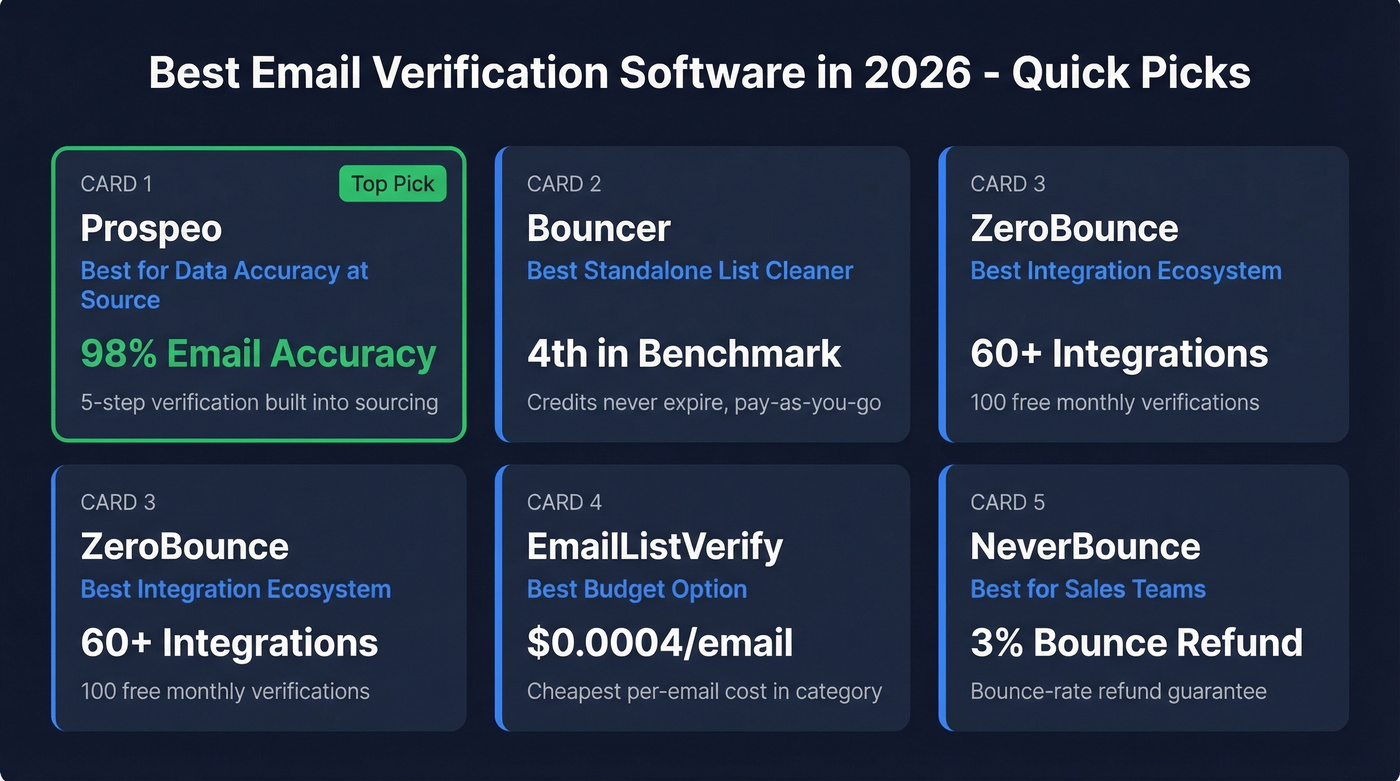
- Best for data accuracy at the source: Prospeo - 98% email accuracy with 5-step verification built into data sourcing. Free tier available.
- Best standalone list cleaner: Bouncer - strong benchmark scores, credits never expire, transparent pay-as-you-go.
- Best integration ecosystem: ZeroBounce - 60+ integrations, AI scoring, 100 free monthly verifications.
- Budget pick: EmailListVerify - cheapest per-email cost in the category at ~$0.0004/email.
- Best for sales teams in sequences: NeverBounce - bounce-rate refund policy and one of the most customer-friendly guarantees around.
How Email Verification Works (And Fails)
Email verification sounds simple: give a tool an address, it tells you if it's real. Under the hood, the process runs through several layers. Syntax checks confirm proper formatting. DNS and MX lookups confirm the domain exists and can receive mail. SMTP verification pings the mail server to ask whether the specific mailbox exists.
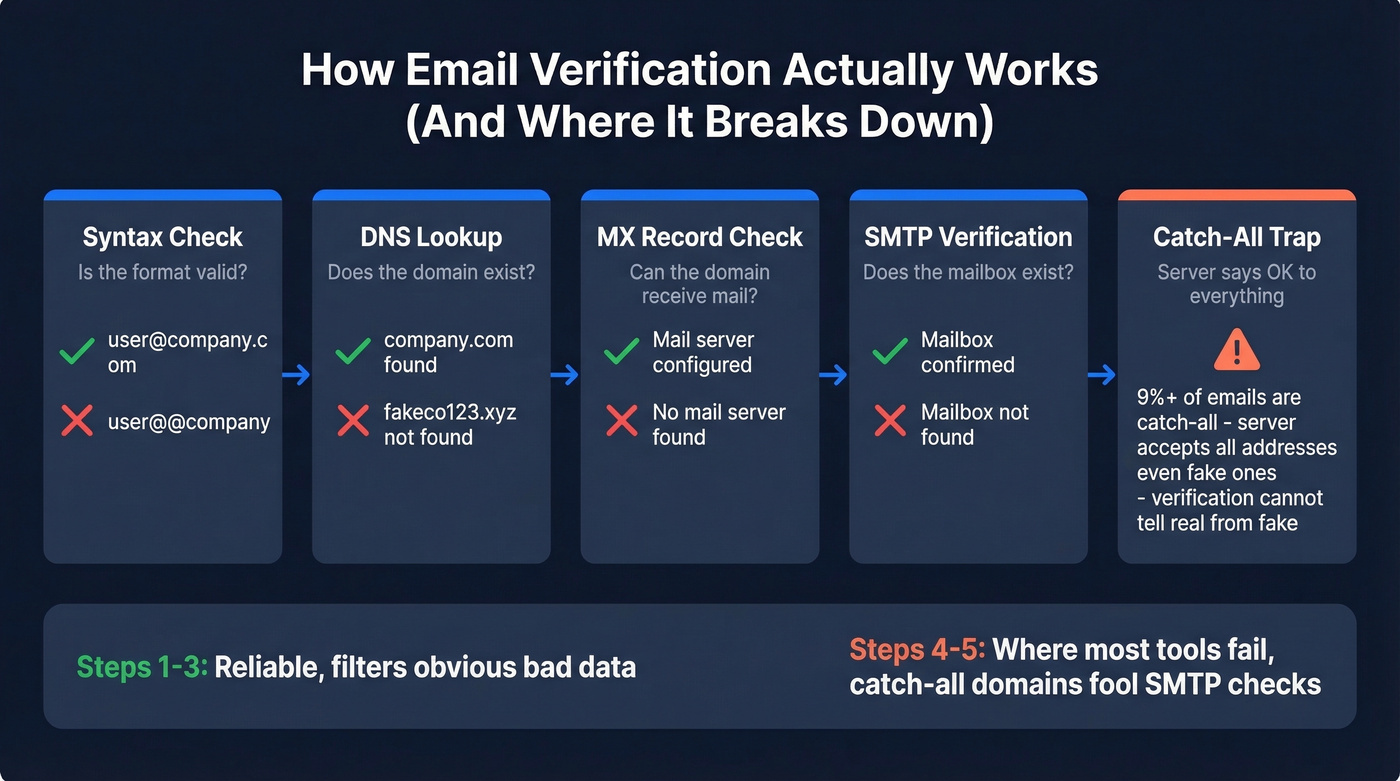
That last step is where things break down. Catch-all domains - servers configured to accept every email sent to their domain - return "OK" for addresses that don't actually exist. In ZeroBounce's 2026 validation dataset, 9%+ of checked emails were catch-all. Nearly one in ten addresses on a typical list can't be reliably verified through SMTP alone.
Roughly one in six emails never reaches the inbox, with global inbox placement averaging around 84%. Verification won't fix every deliverability problem, but sending to invalid addresses is the fastest way to tank your sender reputation. It's the one variable you can control before you hit send.
Bulk vs. Real-Time API
Most tools below offer both bulk verification and a real-time API. You probably need both.
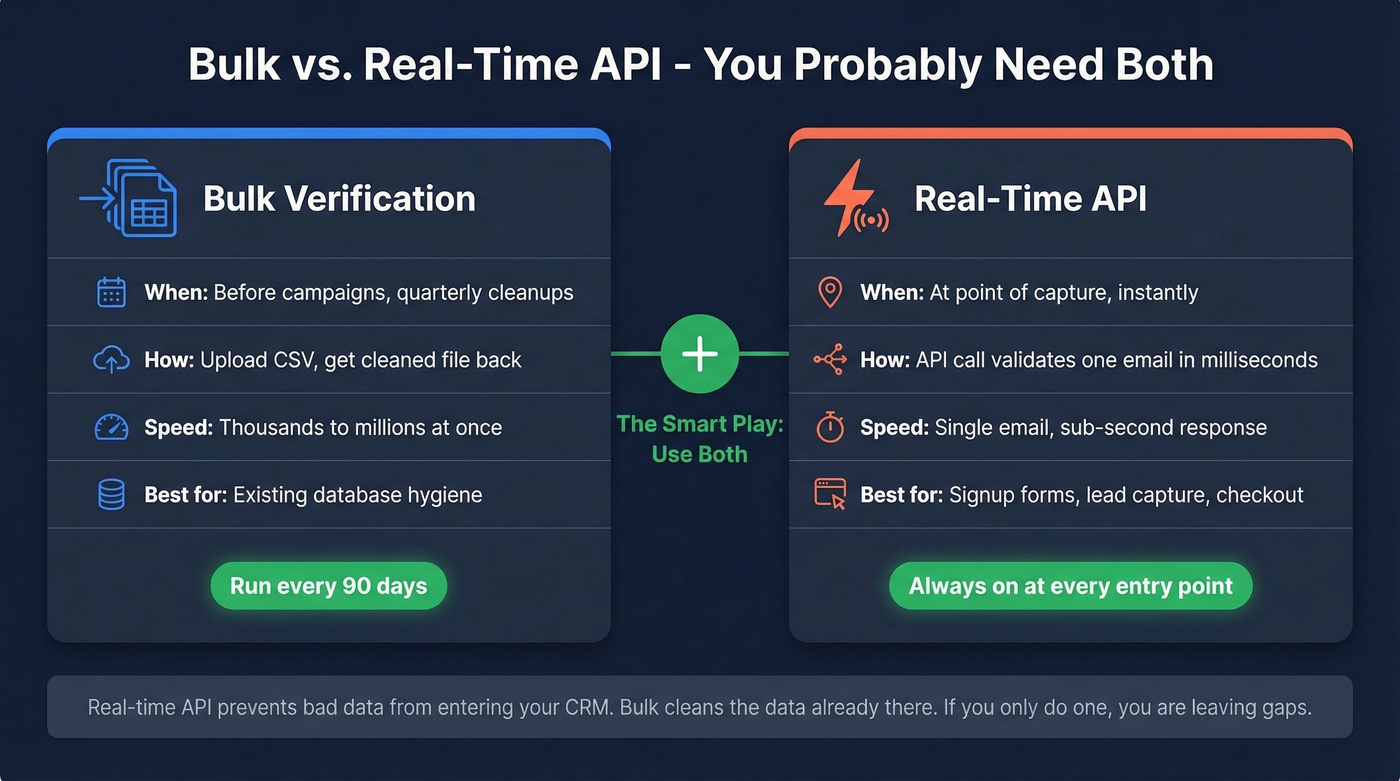
Real-time API validates at the point of capture: signup forms, checkout pages, lead capture widgets. One email at a time, in milliseconds, before it enters your system. This prevents bad data from ever touching your CRM (and your contact management software).
Bulk verification cleans existing lists. Upload a CSV, the tool processes thousands or millions of addresses, and you get back a cleaned file. Run this quarterly on your database, or before a major campaign.
The smart play is a hybrid approach: real-time API at every entry point, plus scheduled bulk cleanups every 90 days. If you're only doing one, you're leaving gaps.

The top verification tool in Hunter's benchmark scored 70%. Prospeo's sourced emails hit 98% accuracy because verification is built into the data - not bolted on after. Snyk dropped from 35-40% bounce rates to under 5% after switching.
Stop paying twice - once for data, again to clean it.
Top Email Verification Tools Compared
| Tool | Benchmark Accuracy | Price per 10K | G2 Rating | Best For |
|---|---|---|---|---|
| Prospeo | 98% (sourced-email accuracy) | ~$100 | - | Accuracy at source |
| Bouncer | 65.43% (Hunter) | $60 | 4.8 (228) | List cleaning |
| ZeroBounce | 60.70% (Hunter) | ~$80 | 4.6 (449) | Integrations |
| NeverBounce | 63.17% (Hunter) | $80 | - | Sales teams |
| Emailable | 59.93% (Hunter) | ~$60 | - | Speed |
| Kickbox | 67.53% (Hunter) | ~$80 | 4.5 (220) | Developers |
| Clearout | 68.37% (Hunter) | ~$58 | 4.7 (211) | Compliance |
| EmailListVerify | 63.87% (Hunter) | ~$24 | - | Budget |
| MillionVerifier | Not independently tested | - | - | Budget |
| Hunter | 70% (own test) | $149/mo plan (10K verifications) | 4.4 (545) | Finding + verifying |
| Snov.io | 31.20% (Hunter) | ~$39/mo plan | - | Outreach suites |
| Verifalia | Not independently tested | ~$79 | - | Enterprise speed |
| Instantly | Not independently tested | ~$37/mo plan | 4.8 (3,400+) | Cold email stacks |
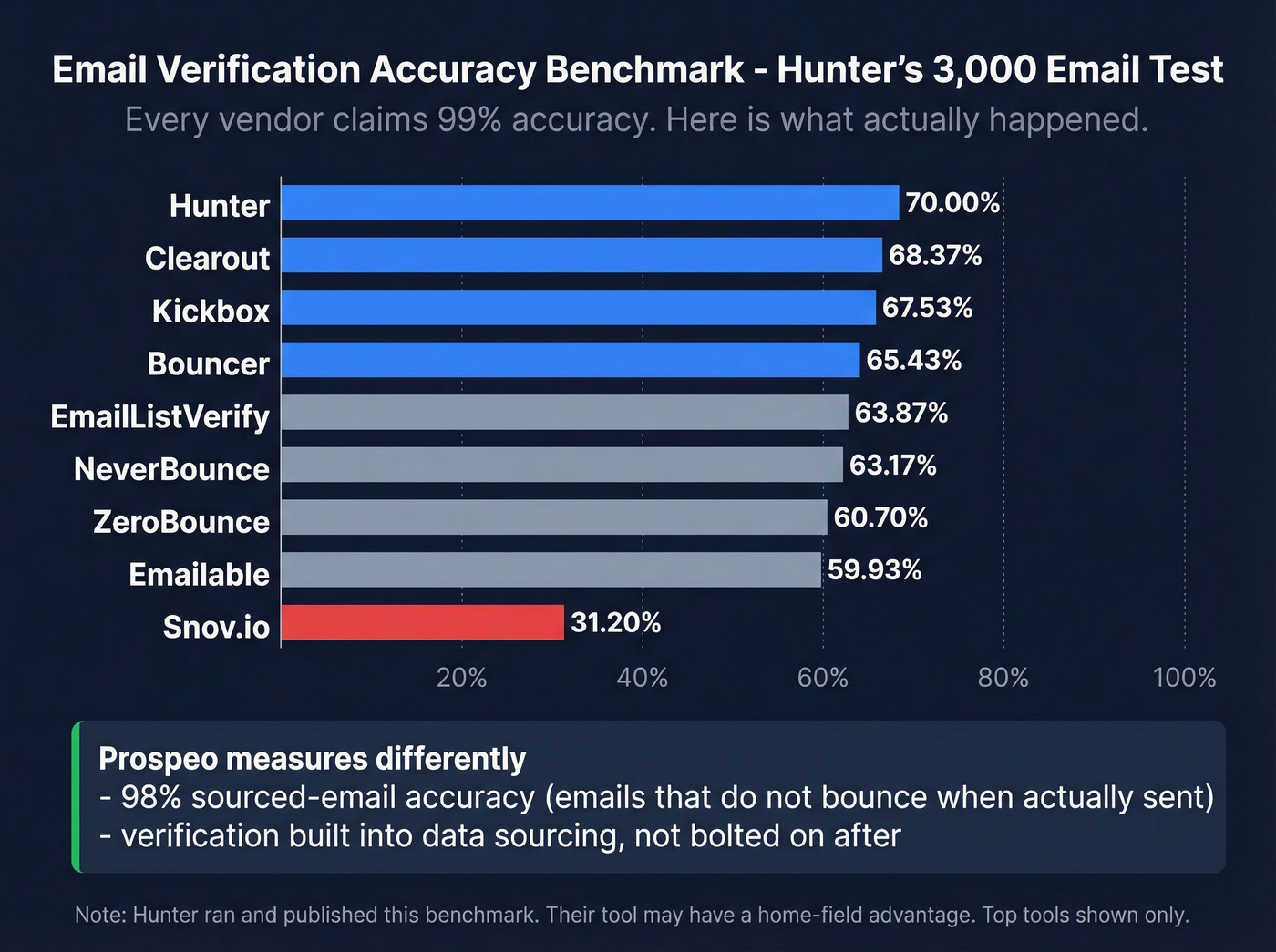
A note on accuracy columns: Hunter's benchmark numbers come from a controlled test of 3,000 real business emails - a test Hunter ran and published themselves, and they acknowledge their tool may have a home-field advantage. Prospeo's 98% measures sourced-email accuracy, meaning the rate at which emails don't bounce when actually sent (see email bounce rate). That's a different and arguably more useful metric than a one-time verification pass rate.
Prospeo
Why clean a dirty list when you can start with a clean one? Most email verifiers sit downstream - you buy data from somewhere, then pay again to verify it. Prospeo builds verification into the data sourcing itself.
The platform runs a 5-step verification process: syntax validation, domain checks, MX record verification, SMTP handshake, plus catch-all handling with spam-trap and honeypot removal (more on spam trap removal). That's how every one of the 143M+ emails in the database gets validated. The result is 98% email accuracy that holds up in production - Snyk went from a 35-40% bounce rate with their previous provider to under 5% after switching.
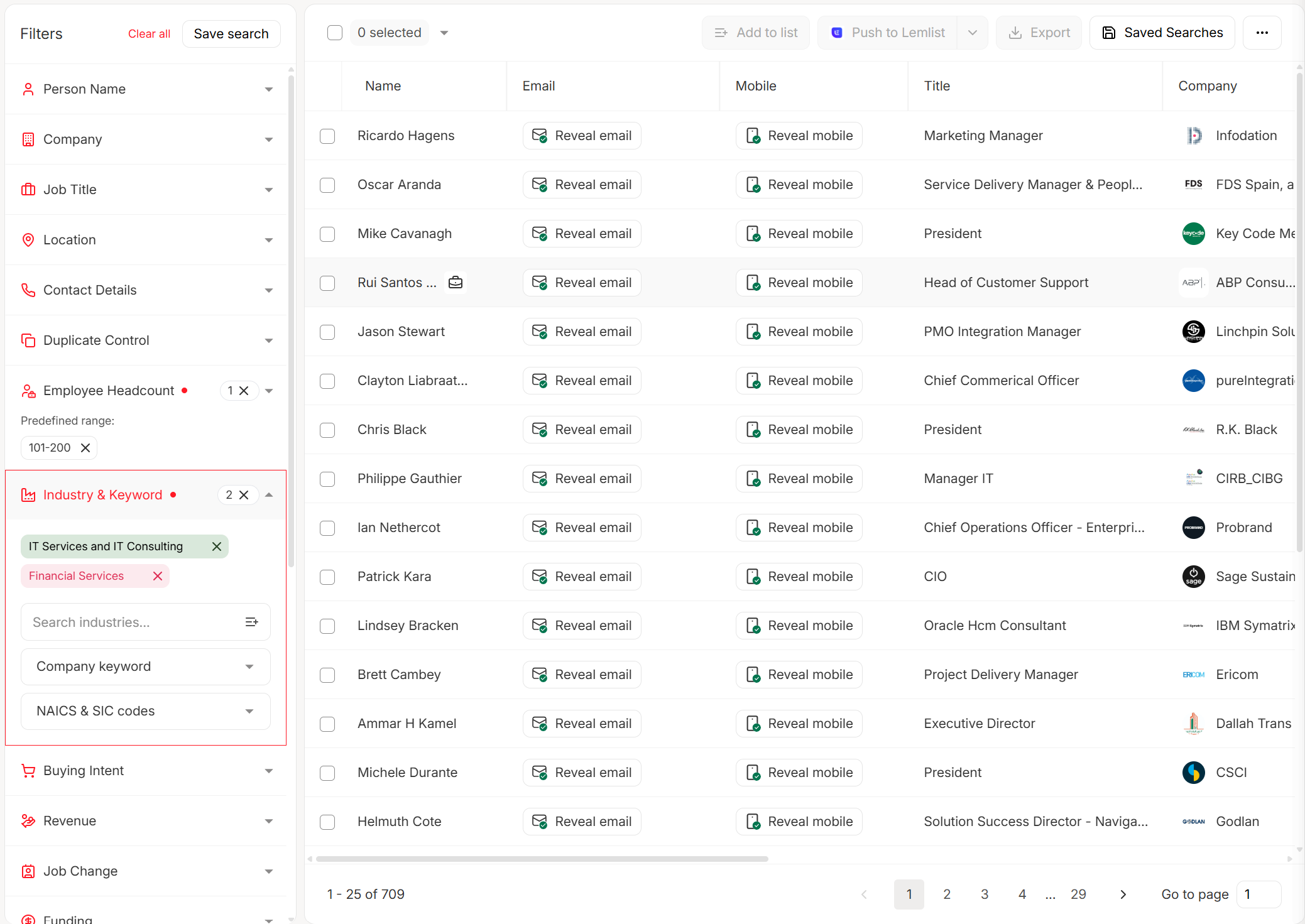
Use this if: you're sourcing new contacts and want verified data from the start. The 300M+ professional profile database with 30+ search filters means you're not just verifying - you're prospecting with pre-verified data (see sales prospecting techniques). Native integrations with Salesforce, HubSpot, Instantly, Lemlist, Clay, Zapier, and Make mean it drops into most stacks without extra setup.
Pricing: Free tier gives you 75 verified emails plus 100 Chrome extension credits per month. Paid plans run ~$0.01/email with no contracts.
Catch-all domains fool 9%+ of verification checks. Prospeo's 5-step process includes catch-all handling, spam-trap removal, and honeypot filtering across 143M+ emails - refreshed every 7 days, not every 6 weeks.
Get emails that survive the inbox at $0.01 each.
Bouncer
Bouncer consistently shows up near the top of published benchmarks - 65.43% overall accuracy in Hunter's test, placing 4th out of 15 tools. That sounds low compared to vendor claims, but remember: the best tool in that test only hit 70%. Bouncer's real-world performance is genuinely strong.

Credits never expire, you don't get charged for unknowns or duplicates, and pricing is straightforward: $8/1K, $60/10K, $400/100K, $2,000/1M. G2 reviewers back it up at 4.8 stars across 228 reviews, Capterra at 4.9 with 230 reviews.
Use this if: you need a reliable standalone list cleaner with transparent pricing and no expiration games.
Skip this if: you need a full prospecting platform. Bouncer is a verification specialist - it does one thing and does it well. The Deliverability Kit ($25-$250/mo) adds inbox placement testing and blacklist monitoring, a nice complement for high-volume outbound (see our email deliverability guide), but the core verification product is where Bouncer earns its reputation.
ZeroBounce
ZeroBounce bundles verification with AI scoring, deliverability diagnostics, and a massive integration library. They processed 11+ billion emails in 2025, which gives their catch-all detection and spam-trap systems a huge training dataset.
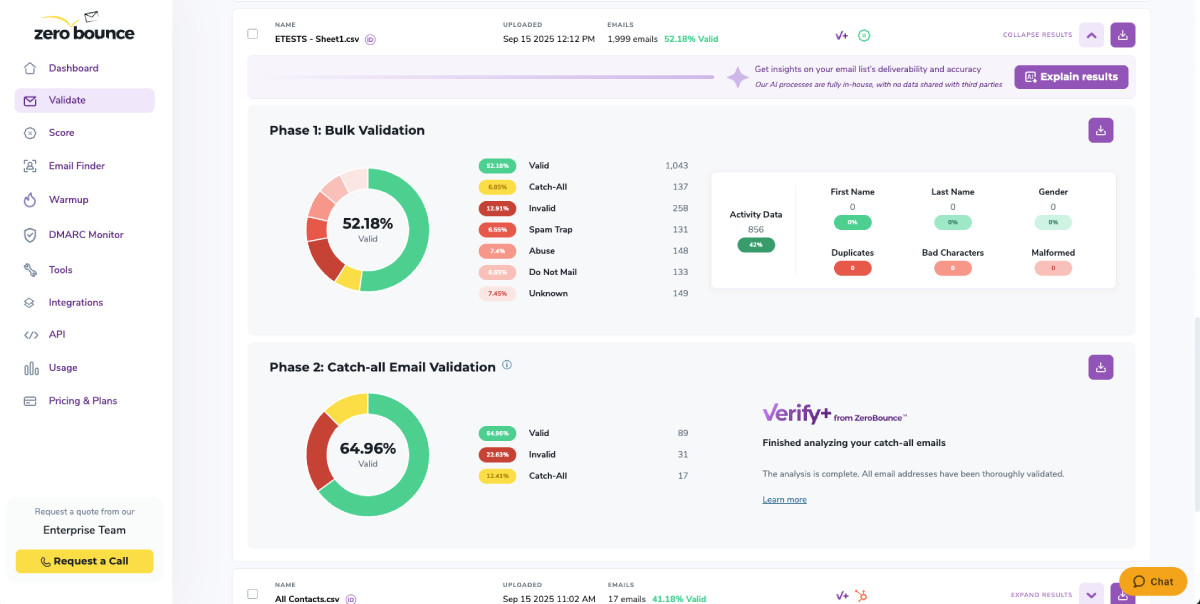
The 60+ integrations mean ZeroBounce plugs into virtually any ESP, CRM, or automation platform without custom API work. The 100 free monthly verifications (with a business/premium domain) let you test before committing.
Skip this if: you're purely price-sensitive. ZeroBounce runs ~$0.008/email at low volumes, scaling down to ~$0.003 at 250K+. Competitive but not the cheapest. Credits never expire and unknowns are free, which helps the effective cost. G2 sits at 4.6 (449 reviews) and Capterra at 4.7 (436 reviews).
NeverBounce
NeverBounce's standout feature isn't technical - it's their bounce-rate refund policy. If your "deliverable" results bounce above 3%, they refund the difference. That's a financial safety net most competitors won't offer.
Pay-as-you-go runs $8/1K, with a Growth plan at $49/mo for up to 10,000 verifications. The catch: credits expire after 12 months, and there's no free tier. Capterra rates it 4.4 across 43 reviews. Best fit for sales teams who want that guarantee in writing.
Emailable
Speed is Emailable's calling card - 30k+ emails per minute, with a deliverability guarantee of 1% or less bounce on addresses marked "Deliverable." You get 250 free credits to start, with pay-as-you-go from ~$0.006/email and monthly plans starting around $25.50/mo. No flashy AI scoring or intent data - just fast, reliable list cleaning. If you're a developer building verification into a product, Emailable's API is clean and well-documented.
Kickbox
Kickbox placed 3rd in the benchmark at 67.53% accuracy - one of the strongest showings in Hunter's test. Their SendEx quality score goes beyond binary valid/invalid to give you a confidence rating per address, which is useful for catch-all domains where the answer isn't clear-cut. Pricing starts at $5/500 credits, scaling to ~$80/10K. You get 100 free credits, and unknowns aren't charged. G2 rates it 4.5 (220 reviews). If you're building address validation into a SaaS product, Kickbox's API documentation is one of the best in the space.
Clearout
Clearout scored 68.37% in the benchmark - second overall, ahead of Kickbox and Bouncer. That's a strong result that doesn't get enough attention. Pricing is credit-based across monthly, annual, and pay-as-you-go options, and unused subscription credits roll over. It's ISO & SOC 2 Type II certified and fully GDPR compliant, which matters if you're in a regulated industry or selling into the EU. G2 rates it 4.7 (211 reviews).
EmailListVerify
The budget king. At ~$0.0004/email on pay-as-you-go, EmailListVerify is the cheapest verification tool in the category by a wide margin. Monthly plans start at $139/mo for 5K/day. If you're cleaning massive lists and accuracy requirements aren't mission-critical, this is where you start. Don't expect the deepest catch-all handling or the slickest UI - you're paying for volume, not polish.
MillionVerifier
At ~$0.0003-$0.001/email, MillionVerifier is a consistent favorite in cold email communities. It's the tool budget-conscious practitioners recommend when someone asks "what's cheapest and actually works?" Not the most feature-rich, but the price-to-performance ratio is hard to beat for teams running verification on a tight budget.
Hunter
Hunter published the benchmark we've been citing - and scored 70% accuracy on their own test. That's both impressive and refreshingly honest (they acknowledged the potential home-field advantage). Free tier gives 50 credits/month, paid plans from $49/mo. G2 rates it 4.4 (545 reviews). Best if you already use Hunter for email finding and want verification in the same workflow (or compare options in our Hunter alternatives guide).
Snov.io
Snov.io bundles verification into a broader sales engagement suite - email finding, drip campaigns, and CRM. Plans start at $39/mo for 1,000 credits. Useful if you're already running outreach through Snov.io. Otherwise, better standalone options exist. The 31.2% benchmark score is hard to ignore.
Verifalia
Verifalia gives ~25 free verifications per day, with pay-as-you-go from ~$15.80/2K emails. The $499/mo tier unlocks their fastest processing speeds. A solid enterprise option if speed on massive lists is your primary constraint, but the pricing puts it out of reach for most SMB teams.
Instantly
Instantly doesn't market itself as a verification tool - it's a cold email platform - but its built-in verification is a favorite in cold email communities. One practitioner on r/software ranked their stack: Instantly first, NeverBounce second, MillionVerifier third. Plans start around $37/mo and include verification alongside sending, warmup, and lead management. If you're already running cold email through Instantly, the built-in verification eliminates one more tool from your stack (and pairs well with a dedicated unlimited email warmup tool).
Why Smart Teams Stack Multiple Tools
The teams with the best deliverability don't rely on a single verification provider. A practitioner on r/software put it well - using multiple providers "does a better job than just using a single email verification tool." We've seen this play out with our own campaigns too.
Here's the practical workflow: source your contacts from a platform with built-in verification, then run high-stakes campaign lists through a standalone verifier like Bouncer or ZeroBounce as a secondary check. The first layer removes most bad addresses. The second catches edge cases - catch-alls that went stale, recent job changes, domains that changed MX records. Even the best tools miss things, which is why cross-referencing results across providers is standard practice for high-volume senders.
With a 7-day data refresh cycle, a standalone verifier becomes less critical for day-to-day prospecting. But before a 50,000-email campaign launch? That secondary check is cheap insurance.
Pricing Gotchas That Cost Thousands
Here's the thing: the per-email price isn't what gets you. It's the billing model.
One company using Mailgun/Sinch for deliverability and list validation reported unexplained spikes - 10 million validations on Christmas Day 2024, another 6 million weeks later - leading to an invoice over $30,000 after their contract ended. That's an extreme case, but billing surprises in this category are more common than vendors want to admit (see Mailgun vs Prospeo).
Three gotchas to watch for:
Credit expiration quietly burns budgets. NeverBounce credits expire after 12 months. Bouncer and ZeroBounce credits never expire. If you buy in bulk for volume discounts, expiration policies can turn a "deal" into wasted spend. Let's be honest - credit expiration on a verification tool is a cash grab. You paid for the credits, and the marginal cost of honoring them later is near zero.
Unknown-result billing varies wildly. Some tools charge you for emails they can't verify. Bouncer, ZeroBounce, and Kickbox don't charge for unknowns. Others do. On a list with 15-20% unknowns, that's a meaningful cost difference.
Volume assumptions trip up growing teams. When someone on Reddit says $37/month feels "hefty" for a cold email tool, that's real budget context. Stack verification costs on top of your data provider, sequencer, and warmup tool, and the per-email economics matter a lot more than they look on a pricing page.
When NOT to Verify (The Upstream Fix)
Most verification articles won't give you this take: if you're re-verifying every list before every campaign, you don't have a verification problem. You have a data sourcing problem.
The best email validation tool is the one you never have to open. If your data provider gives you emails that are 60% accurate, and your verification tool catches 70% of the bad ones, you're still sending to addresses that'll bounce. You've paid twice - once for bad data, once to partially clean it - and your effective cost per accurate email is way higher than the sticker price suggests.
Data freshness is the multiplier most teams ignore. The industry average refresh cycle is around 6 weeks. A lot changes in 6 weeks - people change jobs, companies switch email providers, domains expire. A 7-day refresh cycle doesn't eliminate the need for verification, but it dramatically reduces the volume of bad addresses you need to catch downstream. The cheapest verification is the one you don't need to run.
FAQ
How accurate is email verification software really?
Hunter's benchmark of 15 tools found the top performer hit 70% accuracy; the worst scored 31.2%. Vendor claims of 97-99% reflect controlled conditions, not real-world business email lists with catch-alls and recently churned contacts. Focus on independent benchmark data rather than self-reported numbers when evaluating providers.
What's a catch-all email and why can't verifiers handle it?
A catch-all domain accepts every email sent to it regardless of whether the mailbox exists, so SMTP checks return "OK" for nonexistent addresses. Tools need layered signals - historical bounce data, domain reputation, engagement patterns - to assess risk rather than truly verify. Expect 9%+ of any B2B list to be catch-all.
How often should I re-verify my email list?
Re-verify quarterly at minimum. Lists decay by roughly 23% per year, meaning about 6% goes stale every quarter. Combine scheduled bulk re-verification every 90 days with real-time API verification at every point of capture for the best results.
Is there a good free email verification tool?
ZeroBounce gives 100 free monthly verifications, Bouncer provides 100 free credits, and Prospeo's free tier includes 75 verified emails plus 100 Chrome extension credits per month. These are enough to evaluate accuracy, but production-volume campaigns need a paid plan.
Should I use one verification tool or stack multiple?
Practitioners consistently prefer stacking 2-3 tools because each provider uses different algorithms and catch-all handling logic. Cross-referencing results catches edge cases any single tool misses - especially on high-stakes campaigns above 10,000 recipients.