

Free Email Verifier: What Actually Works in 2026
One in six emails never reaches the inbox. That's 16% of your outreach evaporating before anyone reads a word. Email lists decay by roughly 25% annually, bad data costs an estimated $847 per sales rep per year, and a free email verifier sounds like the obvious fix.
It's not that simple. Free tiers are tiny, accuracy claims are inflated, and catch-all domains - about 30% of B2B domains - break standard verification entirely. Here's what actually works, what doesn't, and where the gotchas hide.
The Shortcut
- Quick single-email check, no signup: Hunter or Verifalia.
- Bulk lists on a budget: Emailable or Clearout for the lowest cost per 10K when you outgrow free tiers.
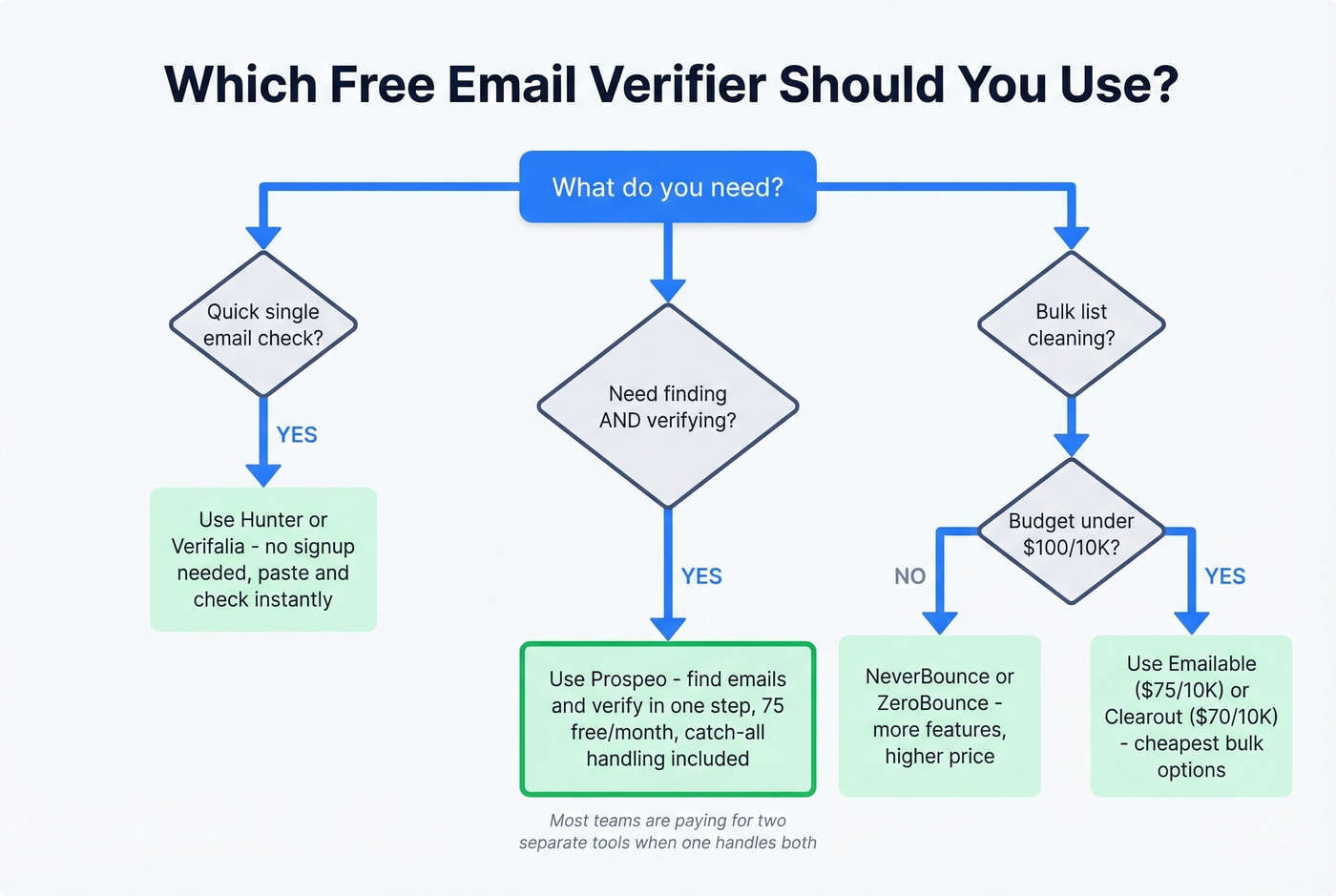
Here's the thing: you might not need a standalone verifier at all. If your email finder verifies as it finds, you skip an entire tool in your workflow. Most teams are paying twice - once to find emails, once to verify them - for no good reason.
Every Free Tool Compared
| Tool | Free Checks | Recurring? | Signup? | Best For |
|---|---|---|---|---|
| Hunter | Unlimited single + up to 100/mo | Yes | Optional | Quick one-off checks |
| ZeroBounce | 100/mo | Yes | Yes (biz domain email) | Recurring free checks |
| Verifalia | Unlimited single | Yes | No | No-signup spot checks |
| NeverBounce | 1,000 one-time | No | Demo required | One-time list clean |
| Emailable | 250 one-time | No | Yes | Budget bulk verification |
| Bouncer | 100 one-time | No | Yes | Mid-range paid plans |
| Kickbox | 100 one-time | No | Yes | Testing before committing |
| Clearout | Free tier varies | Varies | Yes | Cheapest paid scaling |
| EmailListVerify | 3 free single checks | No | Yes | Basic list cleaning |
| Skrapp | 100/mo | Yes | Yes | Email finding + verify |
| Email Hippo | 100/day | Yes | No | Daily spot checks |
| Mailmeteor | Free single + 50/mo (Sheets add-on) | Yes | No | Gmail/Sheets users |
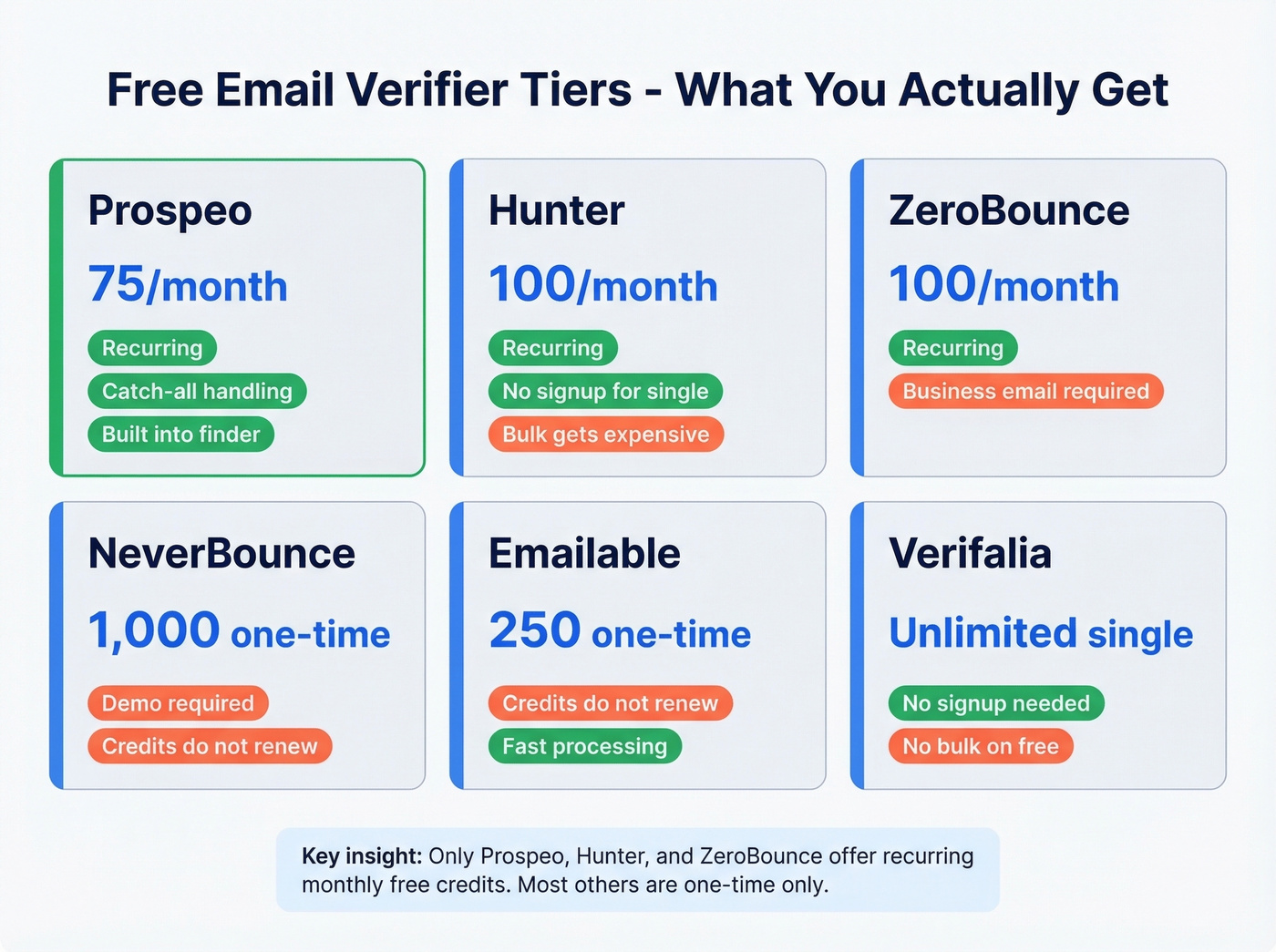
Catch-all handling and pricing at scale:
| Tool | Catch-All Handling | Gotchas | Paid Price/10K |
|---|---|---|---|
| Prospeo | Yes (5-step) | None | ~$100 |
| Hunter | Proprietary accept-all checks | Bulk costs spike fast | ~$149 |
| ZeroBounce | Returns catch-all/unknown | Requires business domain email | ~$90 |
| Verifalia | Returns catch-all/unknown | No bulk on free | ~$100-130 |
| NeverBounce | Returns catch-all/unknown | Must attend a demo | ~$80 |
| Emailable | Returns catch-all/unknown | Credits don't renew | ~$75 |
| Bouncer | Returns catch-all/unknown | Small free allotment | ~$80 |
| Kickbox | Returns catch-all/unknown | One-time only | ~$80-100 |
| Clearout | Returns catch-all/unknown | Free tier varies | ~$70 |
| EmailListVerify | Returns catch-all/unknown | Limited features | ~$60-80 |
| Skrapp | Returns catch-all/unknown | Primarily a finder | ~$80-100 |
| Email Hippo | Returns catch-all/unknown | Quotas reset daily | ~$70-100 |
| Mailmeteor | Returns catch-all/unknown | Bulk via Sheets add-on only | ~$50-80 |
Now let's dig into what matters for each tool.
Prospeo
Prospeo's free tier gives you 75 email verifications per month plus 100 Chrome extension credits - recurring, no credit card, no demo call. That alone puts it ahead of most tools here that burn through one-time credits and leave you empty.
What actually matters is that verification is built into the email-finding workflow. When you find an email through Prospeo, it runs a 5-step verification process: syntax check, domain/MX lookup, SMTP mailbox ping, catch-all domain verification, and spam-trap removal. You don't find an email, export it, upload it to a separate verifier, wait, then download results. It's one step. We've watched teams cut their prospecting workflow in half just by eliminating that second tool.
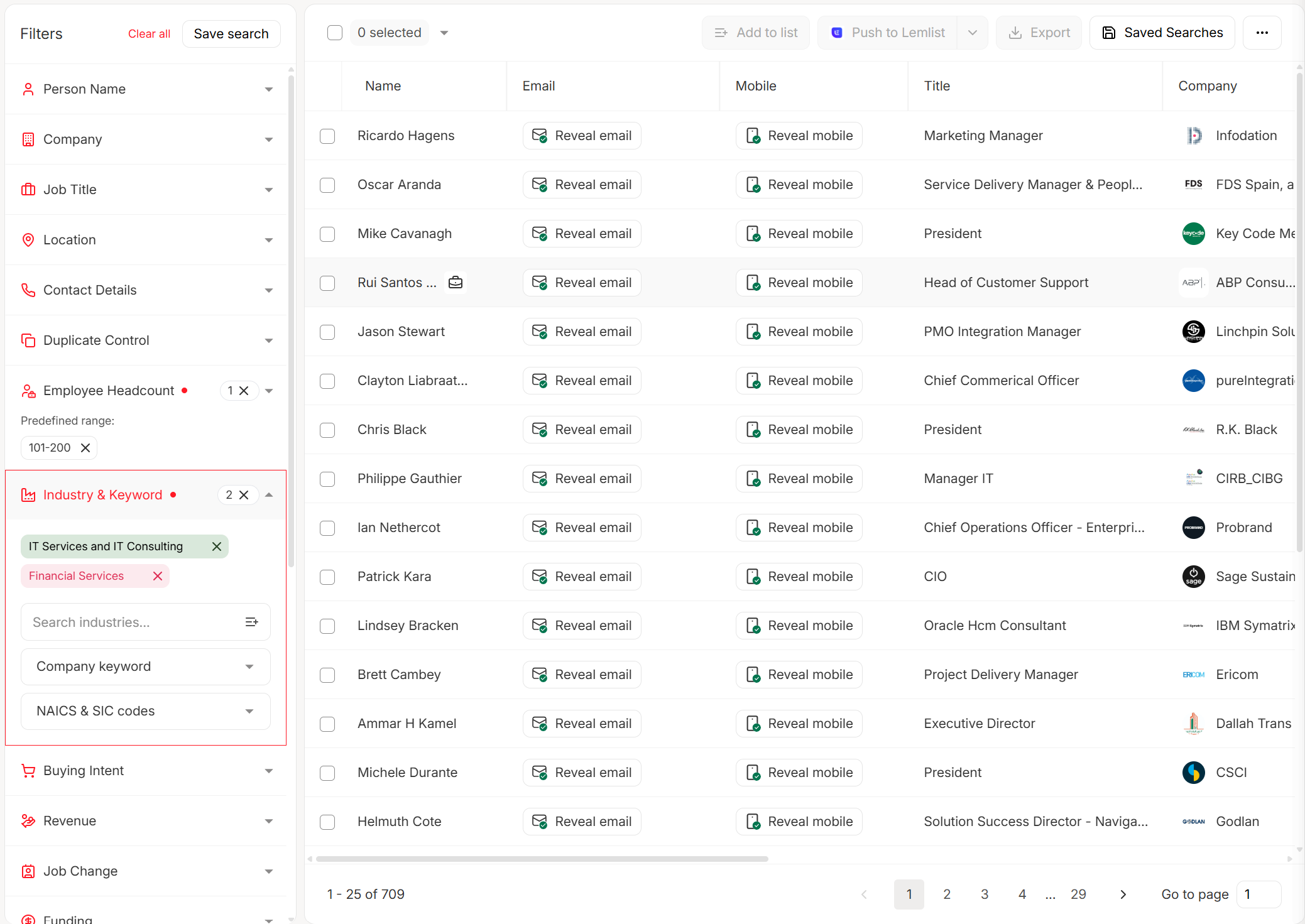
The platform sits on 300M+ professional profiles with a 7-day data refresh cycle - compared to the 6-week industry average. That freshness matters for verification: an email confirmed valid today stays accurate next week, not just at the moment you checked it. With 143M+ verified emails and 98% accuracy on returned results, it's the strongest free-tier option for teams doing ongoing outbound.
Hunter
Hunter is the tool most people try first - and for good reason, since you can check a single address without creating an account. Paste an address on their verifier page, get a result. For quick spot checks, nothing's faster.
A free account gets you up to 100 verifications per month. Hunter runs syntax checks, domain validation, server response analysis, and cross-references against its own B2B database. They've also built a proprietary accept-all (catch-all) solution that works with several major email providers - a real advantage among free tools.

The catch: Hunter's own benchmark of 15 verifiers puts Hunter at #1 with 70% overall accuracy. Most tools landed between 60-68%. Credit to them for publishing that honestly, but paid bulk verification at ~$149/10K is steep compared to alternatives. Ratings sit at 4.6 on Capterra and 4.4 on G2.
ZeroBounce
ZeroBounce gives you 100 free verifications per month, recurring, serving 500K+ customers. You need a business or premium domain email to sign up - Gmail and Yahoo won't work.
Their paid product, ZeroBounce ONE, starts at $99/mo and bundles verification with deliverability tools. Reliable for recurring monthly checks if you've got a company email address handy.
Verifalia
Verifalia earns its spot with the simplest UX possible: paste an email, get a result, no signup. If you just need to verify one address before sending a cold email, this is the fastest path. The tradeoff is depth - no bulk processing on free, no enrichment. A single-purpose tool that does one thing cleanly.
NeverBounce
NeverBounce offers 1,000 free credits, but you have to book and attend a demo to unlock them. Skip this if you want something quick - that demo requirement disqualifies it from any "quick and free" recommendation. Paid pricing runs ~$80/10K, which is competitive if you can stomach the sales call.
Emailable
Emailable drops 250 free credits on signup - one-time, no renewal. Processing speed is impressive at 0.012 seconds per email, and paid plans come in at ~$75/10K, making them one of the cheapest bulk options. Check their best practices guide for setup tips.
Bouncer
Bouncer gives you 100 free credits on signup (one-time) and charges ~$80/10K on paid plans. Reliable verification, clean interface, fair pricing. Nothing flashy, nothing broken. If you're comparing options, see these Bouncer alternatives.
The Rest (Quick Hits)
Kickbox - 100 free credits on signup. Refunds credits on unknown results, which is a policy worth checking before committing to any verifier's paid plan. Paid pricing ~$80-100/10K.
EmailListVerify - 3 free checks on the free validator. Basic verification without frills, paid plans around $60-80/10K.
Skrapp - 100 free credits per month, but it's primarily an email finder with verification included. Worth a look if you need both.
Email Hippo - 100 free checks per day, no signup. One of the more generous free tiers for daily spot checks.
Mailmeteor - Free single-email checks with no signup, plus a Google Sheets add-on that includes 50 verifications/month free. If you live in Sheets, this fits your workflow.
Clearout - the real story is paid pricing at ~$70/10K - among the cheapest of the major tools.

Most teams pay for an email finder, then pay again for a verifier. Prospeo's 5-step verification runs automatically when you find an email - catch-all handling, spam-trap removal, and 98% accuracy included. 75 free verifications every month, no credit card.
Kill the second tool. Find and verify in one step.
How Email Verification Works
Every email verifier - free or paid - runs some version of the same pipeline. Understanding it helps you spot which tools cut corners.
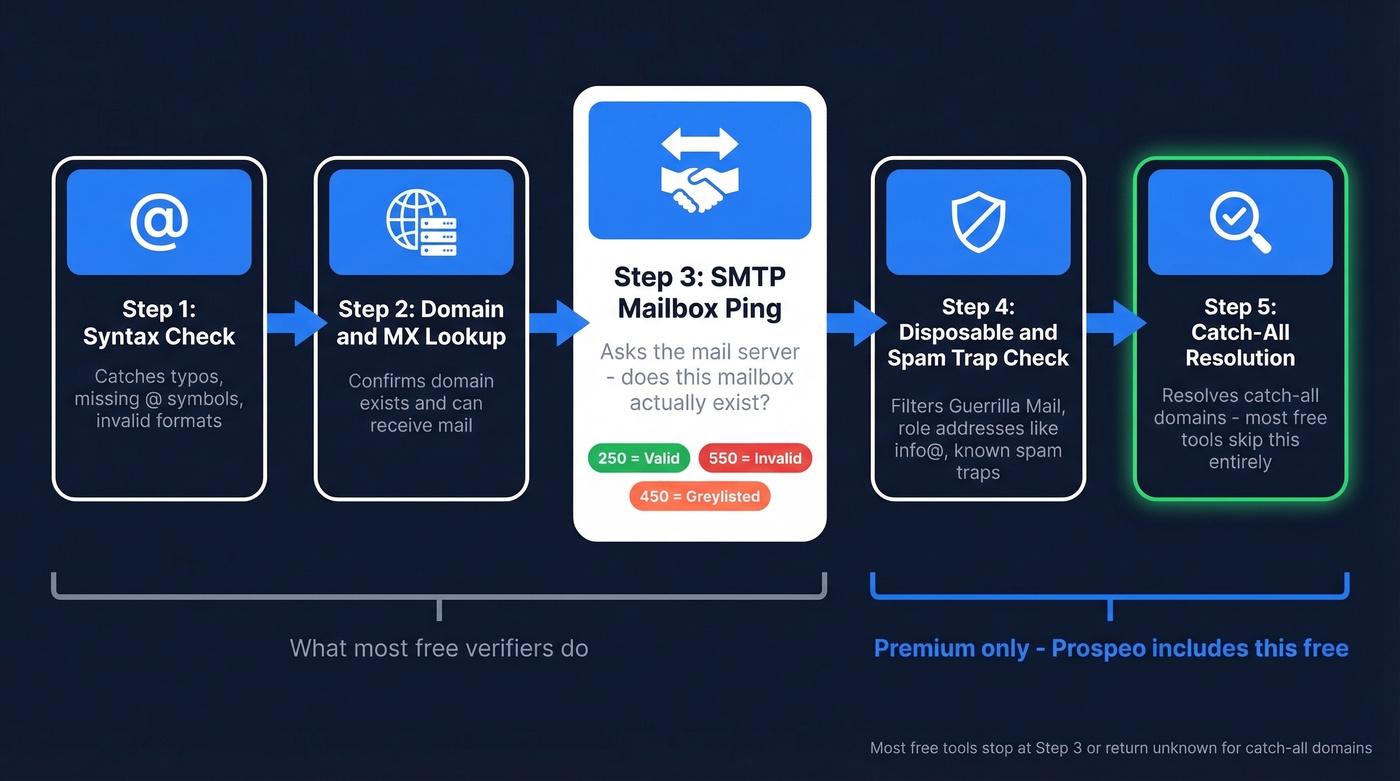
Syntax check. The tool confirms the email follows a valid format. This catches typos, missing @ symbols, and obviously fake addresses. Every tool does this.
Domain and MX lookup. The verifier queries DNS records to confirm the domain exists and has mail exchange records configured. No MX record means the domain can't receive email.
SMTP mailbox ping. This is where real verification happens. The tool initiates an SMTP handshake with the mail server, asking "does this mailbox exist?" A 250 response means accepted, a 550 means invalid, and a 450 response indicates greylisting - the server deliberately delays first-time senders to filter spam. Most free tools stop here or run a basic version of the next step.
Disposable, role, and spam-trap checks. The tool cross-references the address against known disposable providers like Guerrilla Mail and Mailinator, role-based addresses like info@ and support@, and known spam traps. These addresses might technically exist but sending to them damages your reputation.
Premium verification adds catch-all domain handling, honeypot filtering, and cross-referencing against large verified databases - the difference between "this email has valid syntax" and "this email will reach a real person." When a tool returns "unknown," it usually means the SMTP ping got a 250 response from a catch-all server but couldn't confirm the specific mailbox.
Free verifiers flag catch-all domains as "unknown" and leave you guessing. Prospeo actually resolves them with proprietary catch-all verification - across 143M+ emails refreshed every 7 days, not every 6 weeks. That's why teams see bounce rates under 4%.
Catch-all domains aren't a mystery when your verifier actually handles them.
What "99% Accuracy" Really Means
Almost every verifier claims 95-99% accuracy. These numbers aren't lies - they're just measuring something different from what you think.
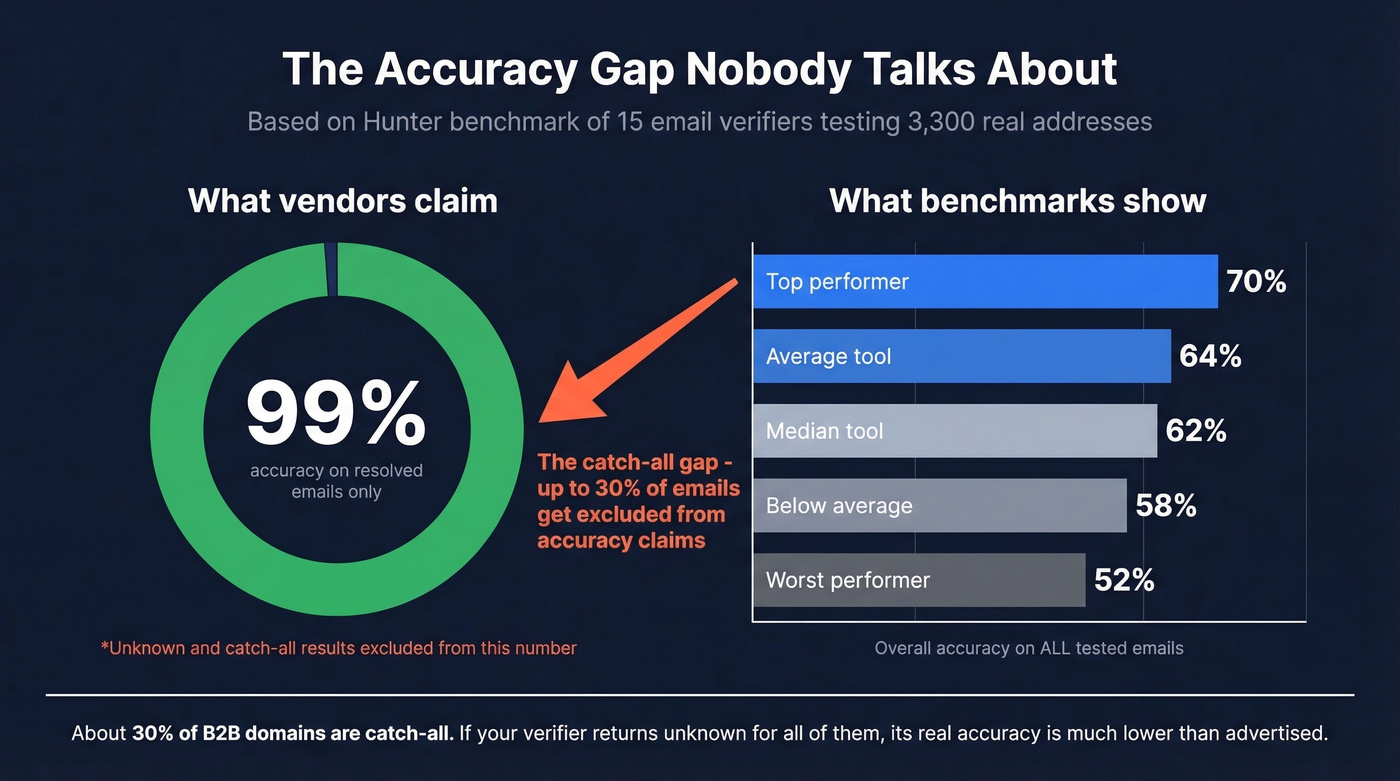
When a vendor says "99% accuracy," they mean: of the emails where they returned a definitive result, 99% of those calls were correct. But emails that came back as "unknown" or "catch-all" get excluded from the calculation entirely. That's a huge asterisk.
Hunter's benchmark of 15 verifiers tested ~3,000 real business emails plus 300 known invalids. Hunter ranked #1 at 70.00% overall accuracy. Most tools landed between 60-68%. The gap between "99% on resolved emails" and "70% on all tested emails" is the unknown/catch-all gap - and it's enormous. Worth noting: this benchmark was run by Hunter using their own dataset, so it isn't fully independent, but it's the most transparent public test we've found.
Let's be honest - no verifier is 99% accurate across all email types. The realistic number, once you include catch-alls and unknowns, is closer to 60-70% for most tools. Plan accordingly.
The Catch-All Problem
Roughly 30% of B2B domains use catch-all configurations. These domains accept email sent to any address - real or fake - returning an SMTP 250 response regardless. Standard verification can't distinguish john.smith@company.com from gibberish@company.com on these domains.
What to do with catch-all results:
- Quarantine them. Don't send to catch-all addresses in your primary sequences. Separate them into a dedicated segment.
- Micro-batch test. Send to small groups of 50-100 catch-all addresses at a time. Monitor bounce rates before scaling.
- Cap catch-all share per sequence. If more than 15-20% of a sequence is catch-all addresses, your bounce risk is too high.
- Suppress on bounce. Any catch-all address that bounces gets permanently removed. No second chances.

Don't delete catch-all results entirely - some are valid contacts at real companies. But don't send to them blindly in your main campaigns either. A bounce rate above 5% damages reputation and can trigger spam filtering. And don't trust any tool that claims it can definitively verify catch-all addresses through SMTP alone. It isn't possible. The best you can do is cross-reference against verified databases and layer additional signals on top of the SMTP response, which is exactly what Prospeo's 5-step process does with its catch-all verification stage.
Free vs. Paid - When to Upgrade
Free tiers work for spot checks and small lists. Once you're verifying more than 500 emails per month, you'll burn through free credits in days.
| Tool | Price per 10K |
|---|---|
| EmailListVerify | ~$60-80 |
| Clearout | ~$70 |
| Emailable | ~$75 |
| NeverBounce | ~$80 |
| Bouncer | ~$80 |
| ZeroBounce | ~$90 |
| Verifalia | ~$100-130 |
| Hunter | ~$149 |
The "growth tax" with standalone verifiers is that per-credit costs scale linearly. Verify 10K emails this month, pay $70-150. Verify 50K next month, pay 5x that. No efficiency gain at scale.
When verification is bundled into a prospecting platform, you're not paying separately for verification on top of your email-finding tool. That eliminates a line item entirely. At $847 per rep annually in bad-data costs, even modest improvements in deliverability pay for verification many times over - especially when email marketing returns $36-40 for every $1 spent.
The benchmark to aim for: keep your bounce rate under 2%. Top performers target hard bounces under 1%. If you want the full breakdown, see our email bounce rate benchmarks and fixes.
Five Mistakes That Kill Results
Treating verification as a one-time cleanup. Lists decay 25% annually. Re-verify every 3-4 months minimum. In our experience, teams that set a quarterly re-verification cadence see bounce rates stay consistently under 2%.
Ignoring catch-all and unknown results. Don't delete them. Don't send blindly. Quarantine, micro-batch test, suppress on bounce. These need a separate workflow entirely.
Not deduplicating before verifying. We've seen teams waste half their free credits verifying the same email three times because their CRM had duplicates. Deduplicate first, verify second. (If you're building lists from scratch, start with a cleaner lead generation workflow.)
Skipping disposable email detection. Addresses from Guerrilla Mail and Mailinator pass syntax, domain, and SMTP checks. They'll never convert. Make sure your verifier flags them.
Trusting "valid" without monitoring bounces. Verification is a prediction, not a guarantee. Track your actual bounce rate after every campaign and suppress anything that bounces. The consensus on r/sales and r/coldemail is that post-send monitoring matters more than pre-send verification - and they're right. If you're scaling outbound, pair verification with an email deliverability guide and a plan to improve sender reputation.
FAQ
Can a verified email still bounce?
Yes. Catch-all domains, greylisting, and full mailboxes cause bounces after verification. The most transparent public benchmark shows top tools hitting 70% accuracy across all email types. Always monitor post-send bounce rates and suppress addresses that hard-bounce.
How often should I re-verify my list?
Every 3-4 months. Lists lose roughly 25% of addresses annually from job changes, company closures, and abandoned inboxes. Teams sending high-volume outbound should re-verify monthly.
How accurate are free email verifiers?
On resolved results, most claim 95-99%. Across all email types including catch-alls and unknowns, the realistic number is 60-70%. Free tiers mainly limit volume, not accuracy - a free email verifier typically uses the same engine as the paid plan.
What's the best free option for ongoing verification?
Prospeo offers 75 recurring monthly credits with 5-step verification and catch-all handling - the strongest combination of volume, accuracy, and renewal among free tiers. Hunter and ZeroBounce also provide recurring monthly credits (100 each) if you want to combine multiple tools.
What should I do with "unknown" results?
Quarantine them. Test in micro-batches of 50-100, monitor bounces, and permanently suppress anything that bounces. Treating unknowns as "probably fine" is how deliverability problems start.