

Email vs Direct Mail: Which Channel Actually Wins in 2026?
Every email vs direct mail comparison ends the same way: "use both!" That's not advice - it's a cop-out from someone who didn't do the math. Your CMO just asked whether the direct mail budget should move to email, and you need actual numbers. Let's do the math.
The Quick Verdict
Email wins on cost and speed for most teams. Direct mail wins on response rate and memorability for high-value offers. But the variable that actually determines whether either channel works is data quality - bad addresses waste money regardless of format.
- Email: ~$1.80 per conversion in the example scenario below, B2B returns ~$46 per $1 spent (B2C ranges $45-$72), sub-1% response rates
- Direct mail: ~$100 CPA in a typical worked example, 3-5% response rates, 79% of enterprise execs rank it their best-performing channel
- The multiplier: High-ROI teams are 163% more likely to have high-quality data than low performers
2026 Performance Benchmarks
Response rate is the most misleading metric in this debate. Direct mail pulls 3-5% response rates - roughly 30x higher than email's sub-1%. That sounds like a blowout until you factor in cost per touch.
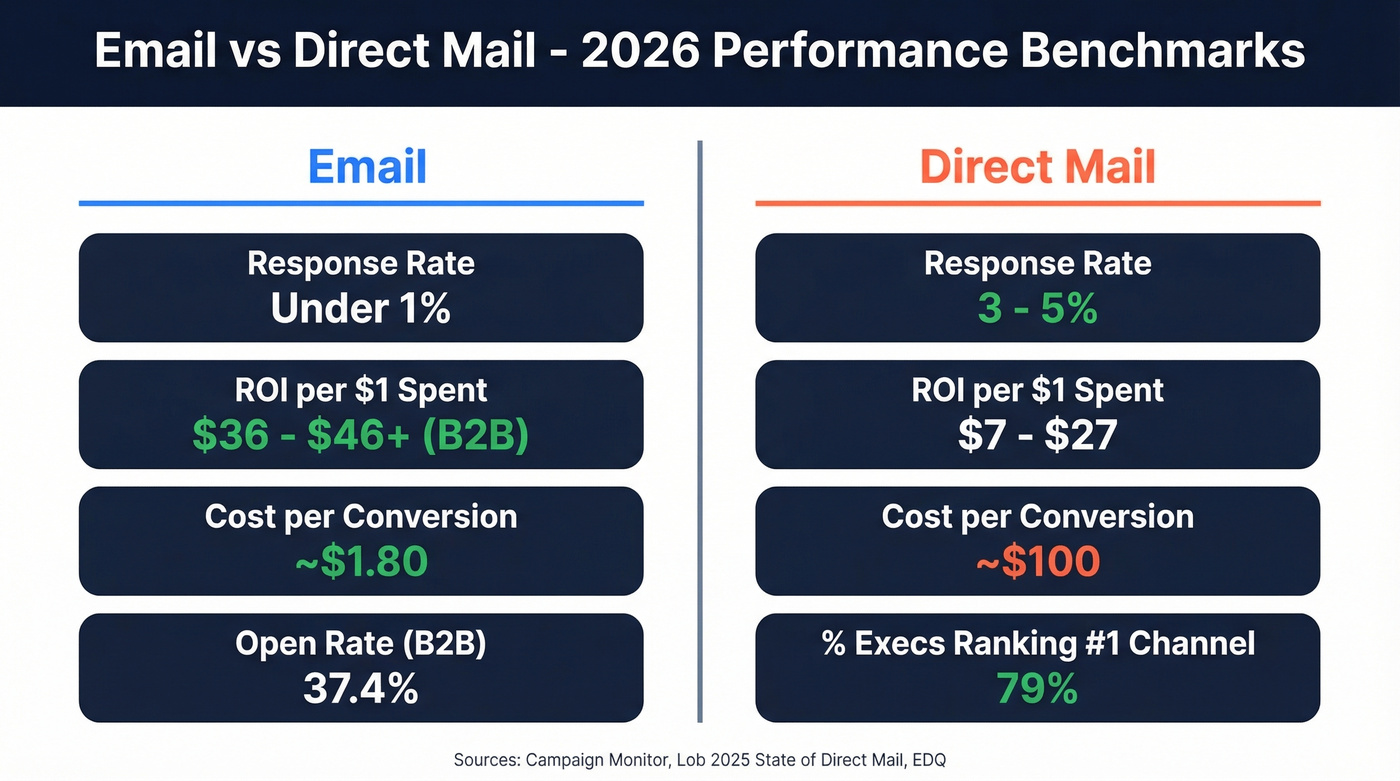
On the email side, B2B open rates sit around 37.4% with a 3.2% click-through rate. B2C flips that: higher opens (40%) but lower CTR (2.1%). Apple Mail Privacy Protection inflates open rates across the board, so lean on CTR and click-to-open rate as your real engagement signals.
Email returns $36-46+ per $1 spent depending on vertical; direct mail returns roughly $7-$27 per $1 based on format and audience. But here's what pure ROI misses: 79% of enterprise executives rank direct mail as their best-performing channel, and 82% plan to increase investment. They're not ignoring the math - per-response value on direct mail is significantly higher for physical products, local services, and reactivation campaigns. Meanwhile, 72% of consumers engage with physical mail weekly, which tells you the channel isn't dying anytime soon.

B2B vs B2C: Different Playbooks
B2B email's 3.2% CTR beats B2C's 2.1% - B2B recipients click when the content maps to their job. Direct mail in B2B is rarer, which is exactly why it works for account-based selling or executive outreach. In B2C, direct mail's physical presence drives the memorability advantage - 49% more memorable than email, per MarketReach data.
Your average office worker gets 120+ emails a day. They get maybe five pieces of physical mail worth reading. That asymmetry is the entire direct mail thesis.
Real Cost Comparison
Here's the table nobody else publishes. These are all-in ranges, not just the sticker price.
| Cost Element | Direct Mail | Email Marketing |
|---|---|---|
| Cost per unit | $0.55-$1.20/postcard; $0.75-$1.75/letter | $0.001-$0.002/email |
| Platform/postage | USPS from $0.395/pc | Klaviyo $720/mo at 50K |
| Hidden costs | List acquisition, printing | Dedicated IP $30-200/mo |
| Example CPA | ~$100 | ~$1.80 |
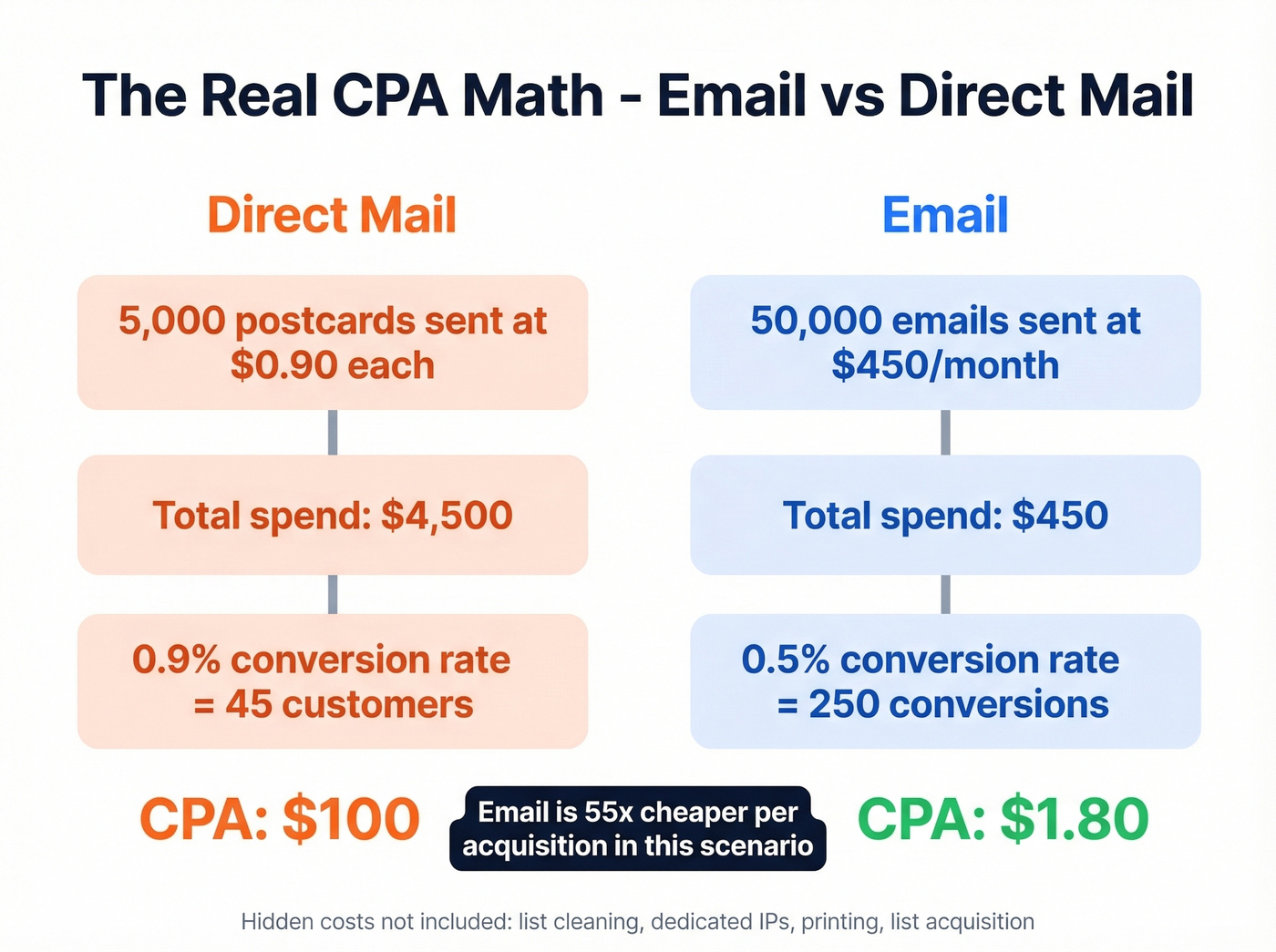
Send 5,000 postcards at $0.90 each - that's $4,500 all-in. At a 0.9% conversion rate, you get roughly 45 customers. CPA: $100.
Now send 50,000 emails through Mailchimp at $450/month. At a 0.5% conversion rate, you get 250 conversions. Cost per conversion: $1.80. Email is 55x cheaper per acquisition in this scenario. That's not a rounding error - it's a fundamentally different cost structure.
CPA isn't the whole picture, though. Direct mail's hidden costs include list acquisition and variable data printing, which can materially change your all-in cost per piece. Email's hidden costs are subtler but real: a dedicated IP runs $30-200/month, inbox monitoring tools cost $50-500/month, and list cleaning runs about $15 per 10,000 emails. And that's before labor - agency email retainers run $2,500-$5,000/month, freelancers charge $40-$120/hour.
Here's the thing: skip the list cleaning, and your sender reputation tanks. We've seen teams burn through three sending domains before they figured out the problem was data, not copy. At that point, email's theoretical $1.80 CPA becomes very expensive very fast.

You just read that teams burn through sending domains because of bad data - not bad copy. Prospeo's 5-step email verification and 7-day data refresh cycle keep your bounce rate under 4%, so your $1.80 CPA stays at $1.80.
Stop paying for bounces. Start with 98% accurate emails at $0.01 each.
When to Use Each Channel
Email wins decisively when...
You're running B2B outbound at scale, nurturing existing leads, or operating on a budget where $100 CPAs aren't viable. If your average contract value sits below $10K, direct mail's cost structure almost never pencils out for prospecting. Save it for retention.
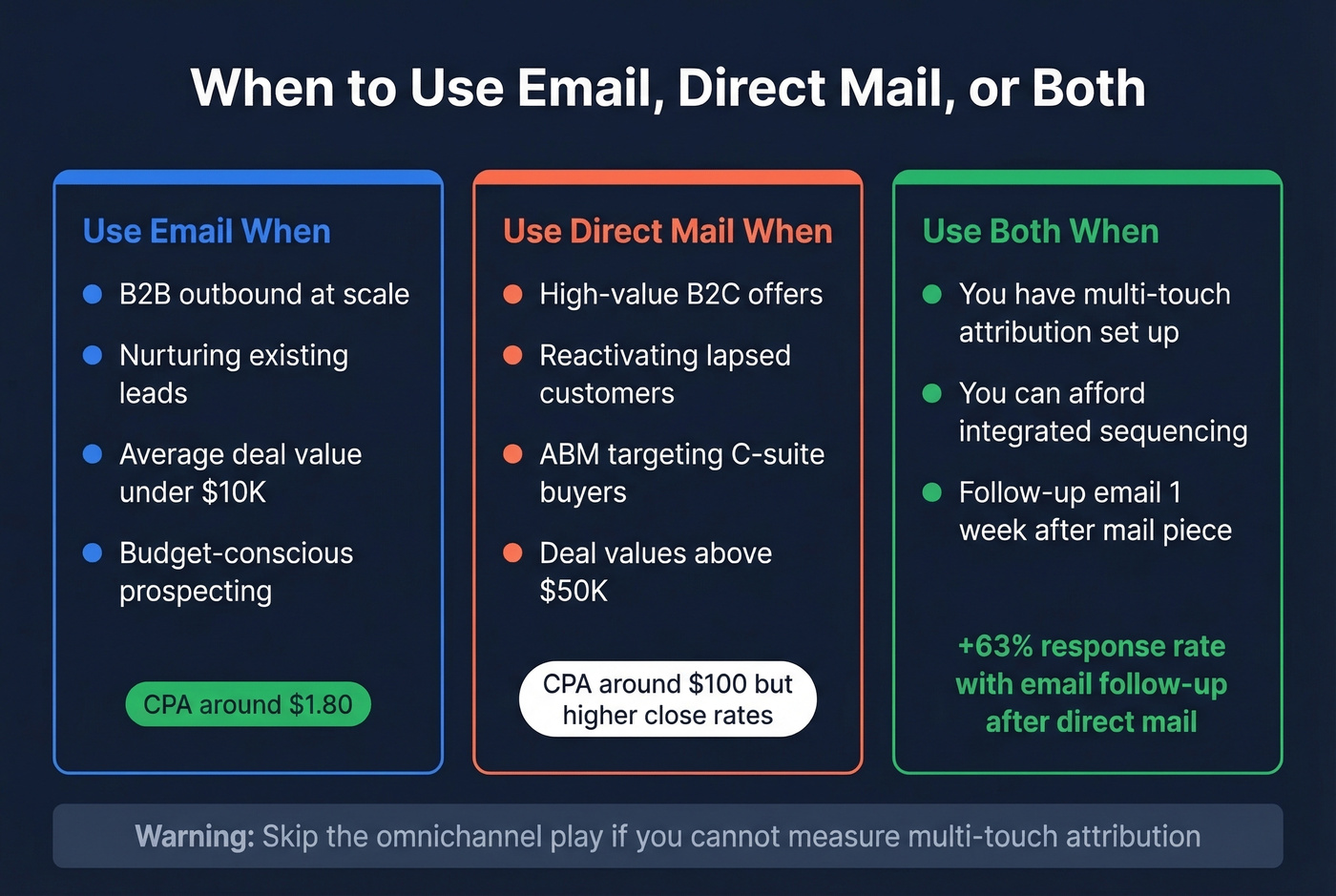
Direct mail wins when...
You're targeting high-value B2C offers, reactivating lapsed customers, or running ABM campaigns where a physical touchpoint cuts through inbox noise. For teams selling $50K+ deals to C-suite buyers drowning in email, a well-designed mailer stands out in ways a subject line never will.
Use both when...
You can afford the integrated play and have the attribution infrastructure to measure it. A lawn care company combining direct mail with targeted digital ads saw +28% overall sales. A banking campaign that added direct mail to its email-only sequence reduced inbound call volume by 24%. The sequencing matters too - sending a follow-up email one week after a direct mail piece is delivered can increase response rates by 63%.
Skip the omnichannel play if you don't have multi-touch attribution set up. Without it, you're spending more money and learning nothing about what's actually driving conversions.
Measuring Direct Mail in 2026
Direct mail's biggest weakness isn't cost - it's attribution. Here's how modern teams close that gap:
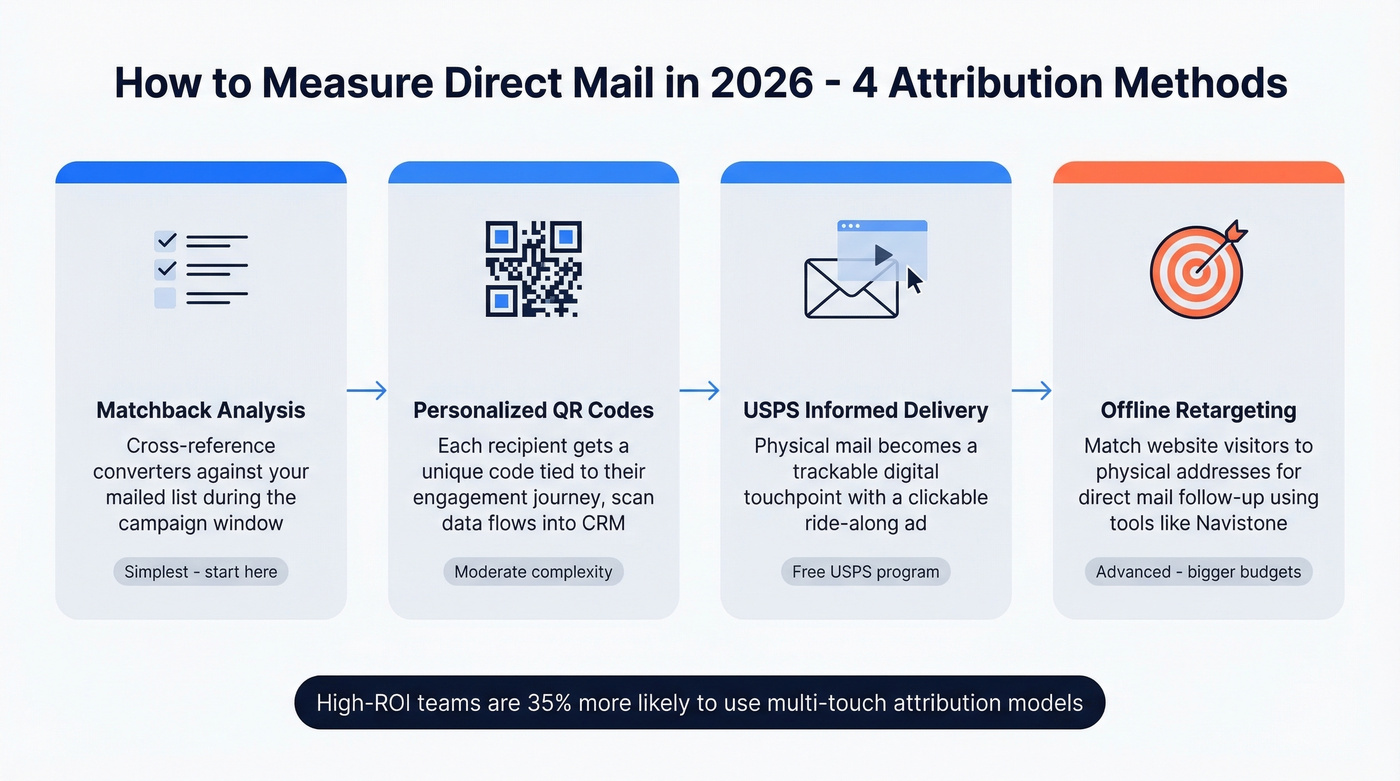
Matchback analysis is the simplest approach: cross-reference converters against your mailed list during the campaign window. It's effective and wildly underused. Personalized QR codes take it further - each recipient gets a unique code tied to their engagement journey, with scan data flowing straight into your CRM. USPS Informed Delivery turns physical mail into a trackable digital touchpoint, giving recipients an email preview with a clickable ride-along ad. And for teams with bigger budgets, offline retargeting tools like Navistone match website visitors to physical addresses for direct mail follow-up.
Last-touch attribution undercounts direct mail almost every time, because mail creates intent that converts later via search or retargeting. Start with position-based attribution and move toward data-driven as your signal coverage improves. High-ROI teams are 35% more likely to track attribution with multi-touch models - that's not a coincidence.
Data Quality: The Hidden Variable
If your email bounce rate is above 5%, you don't have a channel problem. You have a data problem.
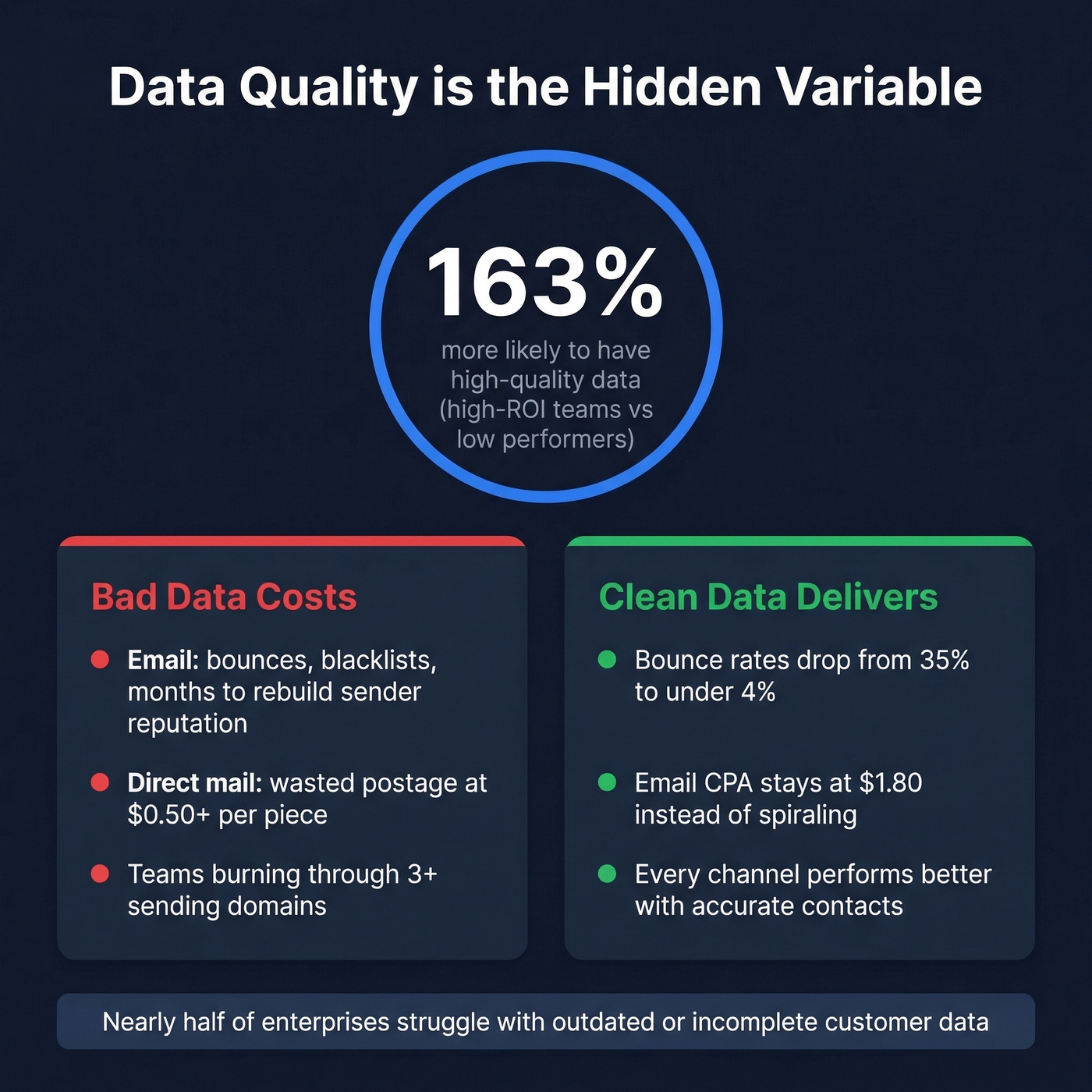
Nearly half of enterprises struggle with outdated or incomplete customer data. Bad email data means bounces, blacklists, and a sender reputation that takes months to rebuild. Bad mailing data means wasted postage at $0.50+ per piece. High-ROI teams are 163% more likely to have high-quality data than their underperforming peers.
For email specifically, this is where the channel's cost advantage lives or dies. Prospeo's 5-step email verification - catch-all handling, spam-trap removal, honeypot filtering - runs at 98% accuracy and keeps bounce rates under control before you hit send. At roughly $0.01 per email verified, with a free tier of 75 emails/month, it's cheap insurance against the deliverability spiral that turns email's low cost-per-conversion into a blacklist nightmare. We've watched teams go from 35% bounce rates to under 4% just by verifying before sending - the math on that is hard to argue with.
If you want to go deeper on deliverability mechanics, start with bounce rate, then work through sender reputation and the full email deliverability stack.

High-ROI teams are 163% more likely to have quality data. Whether you choose email, direct mail, or both, it starts with accurate contact records. Prospeo gives you 300M+ verified profiles with 30+ filters to target exactly the right buyers.
Fix the data problem and every channel performs better.
FAQ
Is direct mail still effective in 2026?
Yes - 79% of enterprise executives rank it as their best-performing channel, and response rates of 3-5% far exceed email's sub-1%. It works best for high-value offers above $10K and reactivation campaigns where physical presence drives action.
What's the ROI of email marketing vs direct mail?
Email returns $36-46+ per $1 spent; direct mail returns $7-27 per $1. Email wins on pure ROI, but direct mail drives higher per-response value for physical products and local services.
How do you keep email bounce rates low before a campaign?
Use a real-time verification tool that runs catch-all handling and spam-trap removal. A 5-step verification process catches invalid addresses at 98% accuracy - at $0.01 per email, that's far cheaper than rebuilding a burned sender domain.
Is email or direct mail better for B2B prospecting?
Email dominates B2B prospecting at scale because cost per conversion can be 55x lower. Direct mail works for ABM and executive outreach where a physical touchpoint justifies the higher per-piece cost on deals worth $50K+.