


EmailGuard Pricing, Reviews, Pros & Cons (2026)
EmailGuard gets confused with MailGuard constantly - they're completely different products. MailGuard is email security; EmailGuard is a deliverability monitoring platform built for cold emailers and agencies. It bundles domain masking proxies alongside inbox placement testing, and this review covers exactly what you're getting before you commit.
30-second verdict: EmailGuard is the strongest all-in-one deliverability monitoring tool for cold email agencies right now. The domain masking proxies alone justify the Pro plan at $49/mo. The free plan is genuinely useful if you're a solopreneur who just needs a weekly inbox-vs-spam check. But if your real problem is bad contact data - bounces, invalid emails, dead addresses - EmailGuard won't fix that. You need to verify your list before worrying about placement tests.
What EmailGuard Actually Does
EmailGuard monitors your email infrastructure and tests whether your messages land in the inbox or spam. It covers the full deliverability stack: SPF/DKIM/DMARC authentication checks, blacklist monitoring, inbox placement testing, spam scoring across 162 data points, and content spam analysis.

The standout feature is domain masking proxies with hosted domain redirects. If you're running cold outreach at scale, you know the 0.3% spam complaint threshold from Gmail and Yahoo can torch your primary domain fast - three complaints per thousand emails is all it takes. EmailGuard lets you mask your primary domain behind secondary domains on clean shared IPs or a dedicated IP, with managed SSL and full API access for programmatic domain management.
It also includes basic contact verification for syntax, domain validity, and mailbox existence, though the credit limits are modest compared to dedicated verification platforms. Think of it as a bonus, not a core feature.
EmailGuard Pricing Breakdown
EmailGuard runs four tiers, with unlimited team members on all plans and unlimited workspaces on paid plans. Here's the full breakdown per their pricing page:
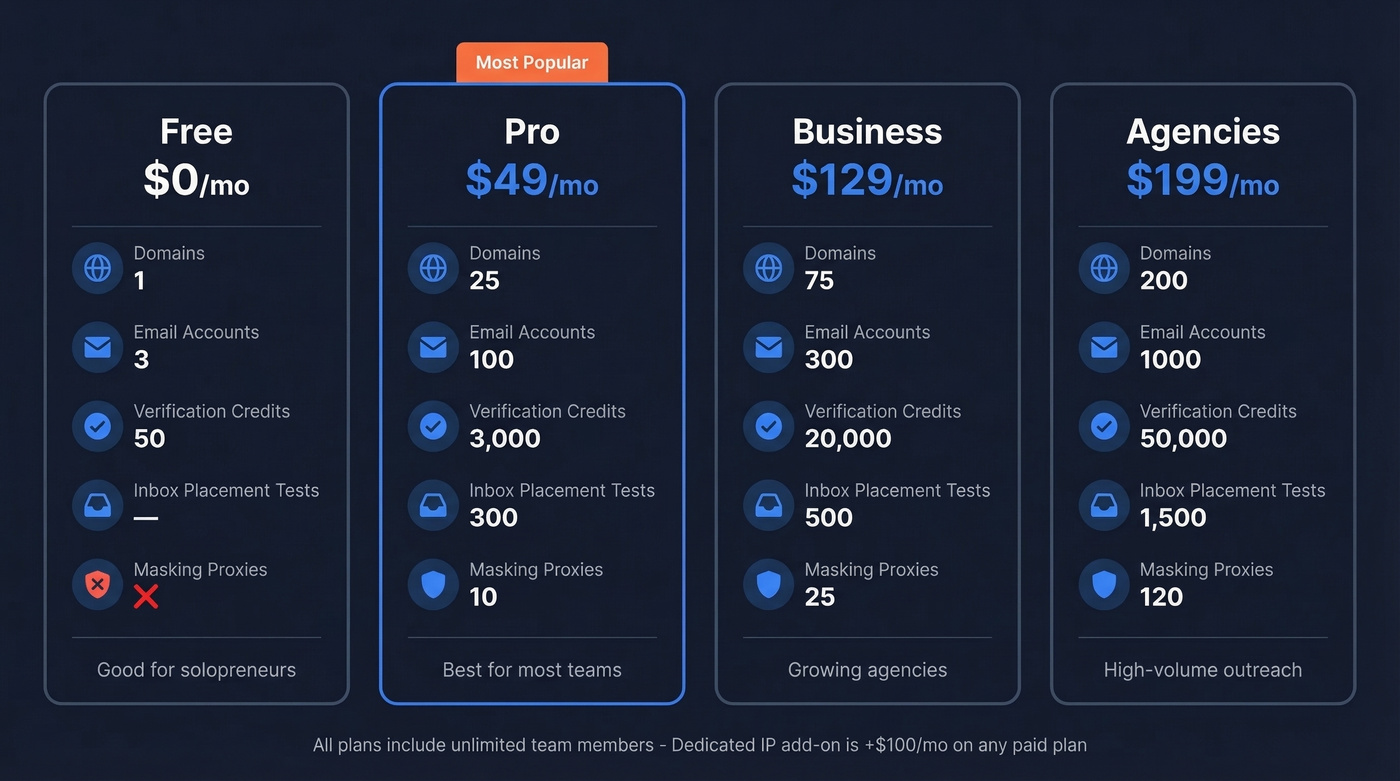
| Feature | Free | Pro ($49/mo) | Business ($129/mo) | Agencies ($199/mo) |
|---|---|---|---|---|
| Domains | 1 | 25 | 75 | 200 |
| Email accounts | 3 | 100 | 300 | 1,000 |
| Team members | Unlimited | Unlimited | Unlimited | Unlimited |
| Verification credits | 50 | 3,000 | 20,000 | 50,000 |
| Inbox placement tests | - | 300 | 500 | 1,500 |
| Spam-filter email tests | 10 | 500 | 1,000 | 2,000 |
| Content spam checks | 20 | 500 | 1,000 | 3,000 |
| Masking proxies | ❌ | 10 | 25 | 120 |
| Spamhaus credits | ❌ | 75 | 300 | 500 |
| Dedicated redirect IP add-on | ❌ | +$100/mo | +$100/mo | +$100/mo |
Is the free plan enough? For a single domain with light volume, yes. You get 10 spam-filter email tests per month, unlimited DMARC monitoring, weekly automated blacklist monitoring, and weekly automated SPF/DKIM/DMARC checks. But you don't get placement tests or domain masking - the two features that make EmailGuard worth paying for.
Most teams will land on Pro at $49/mo, which is genuinely competitive for what you get. The dedicated redirect IP add-on at $100/mo is worth flagging, though. If you're running masking proxies on shared IPs and want full control, that upsell pushes your real cost to $149/mo on Pro.

EmailGuard's 3,000 verification credits on Pro won't last a week for most agencies. Prospeo gives you 98% email accuracy from 143M+ verified addresses - with 5-step verification, catch-all handling, and spam-trap removal built in. Fix your list before you fix your placement.
Stop monitoring bounces. Eliminate them at the source for $0.01 per email.
Pros and Cons
What works well:
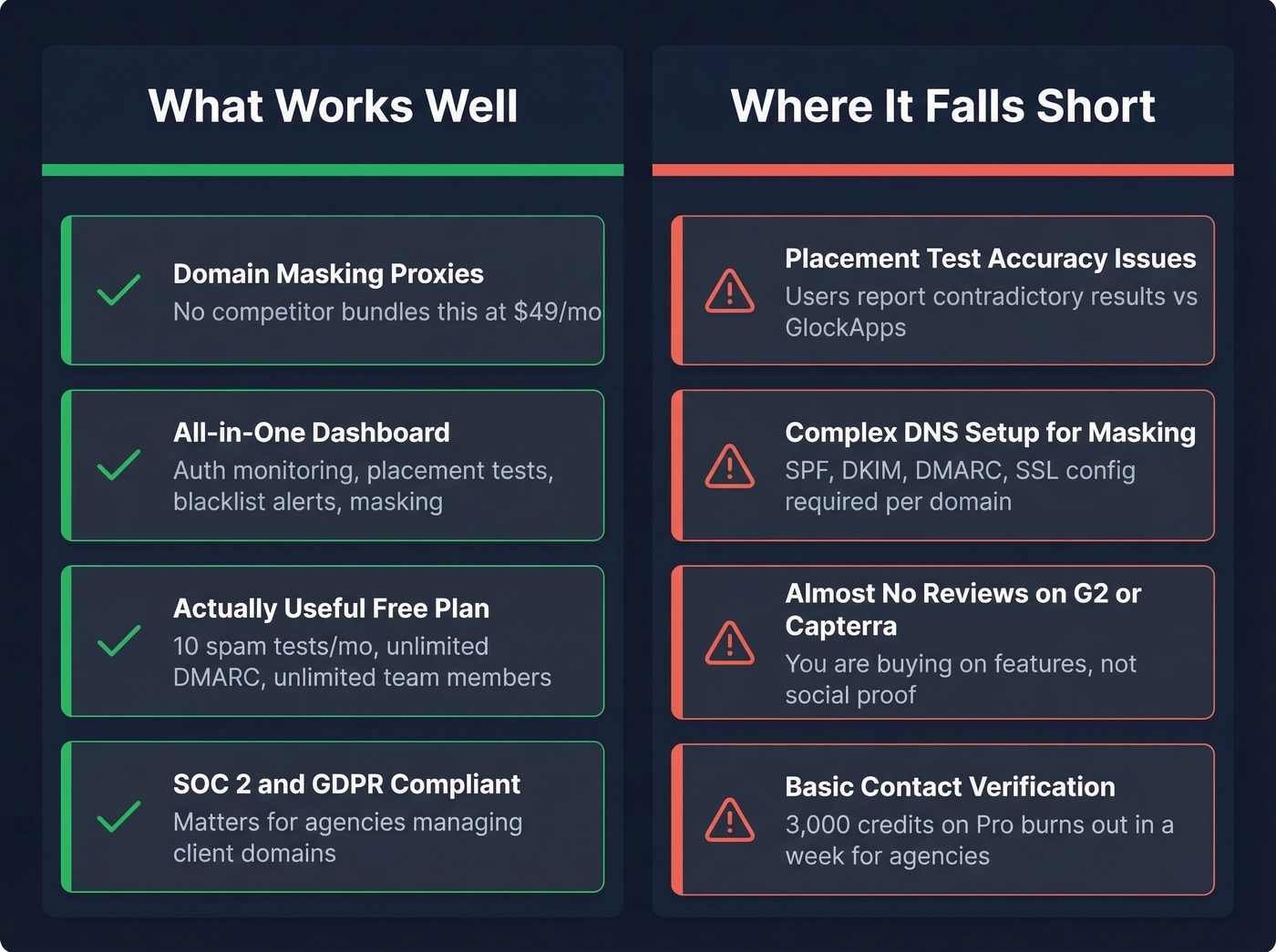
- Domain masking proxies are the differentiator. No competitor at this price point bundles managed masking proxies with clean IP options, hosted redirects, and API access. This is the feature cold email agencies actually need.
- All-in-one deliverability stack. Authentication monitoring, placement testing, blacklist alerts, and domain masking in one dashboard - no stitching together three different tools.
- Genuinely useful free plan. Ten spam-filter tests per month, unlimited DMARC monitoring, and unlimited team members. Most free tiers in this space are barely functional.
- SOC 2 and GDPR compliant. For agencies handling client domains, the compliance posture matters.
Where it falls short:
- Placement test accuracy is questionable. One Reddit user running weekly tests across GlockApps, Folderly Inbox Insights, and EmailGuard reported huge deviations - GlockApps showed 100% Outlook spam while EmailGuard showed everything landing in the inbox. That's not a minor disagreement. Treat placement results as directional, not definitive.
- Setup complexity for domain masking. The masking proxy feature requires DNS configuration for SPF, DKIM, DMARC records, and SSL. One Reddit user managing 17 domains admitted they "hate messing around with DNS settings" and needed hands-on help. Budget time for setup if you're not technical.
- No meaningful review volume on G2 or Capterra. You're buying on features and pricing, not social proof.
- Contact verification is basic. The 50 free credits or 3,000 on Pro won't cut it for serious list cleaning. We've seen agencies burn through the Pro credits in the first week.
How EmailGuard Compares
| Feature | EmailGuard Pro ($49) | GlockApps Essential ($59) | InboxAlly Starter ($149) | Folderly (~$96/mailbox) |
|---|---|---|---|---|
| Placement / spam testing | 300 tests/mo | 360 credits | 100 seed emails/day | 2/mo free, 100/mo at $79 |
| Domain masking | 10 proxies | ❌ | ❌ | ❌ |
| Verification | 3,000 credits | ❌ | ❌ | ❌ |
| DMARC monitoring | Unlimited | 600K messages included | ❌ | ❌ |
| Free plan | ✅ (useful) | ✅ (2 credits) | ❌ | ✅ (2 tests) |
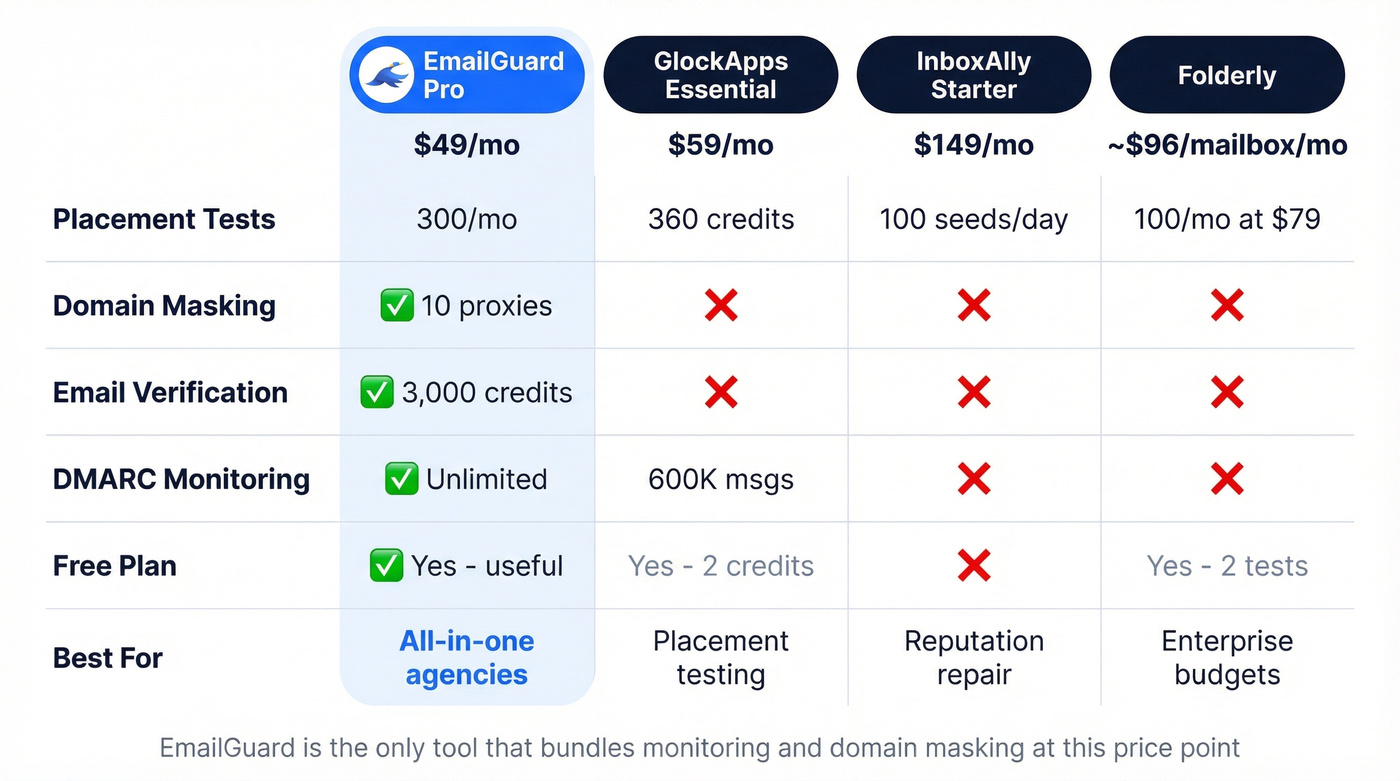
EmailGuard wins this comparison not because it's the best at any single thing, but because it's the only tool that bundles monitoring and masking. If you only need placement tests, GlockApps gives you more credits per dollar. But if you're running 25+ sending domains, EmailGuard Pro at $49/mo replaces two separate tools.
GlockApps: More Tests, Less Trust
GlockApps offers more spam test credits at a similar price point - 360 on Essential at $59/mo - and strong DMARC analytics with up to 600,000 messages included. The problem is everything around the product. Common complaints include sudden price increases of 400-500% after one month and being asked for bank statements and photo ID just to upgrade a plan. That's a trust issue. And there's no domain masking.
InboxAlly: Skip This Unless You're in Crisis
$149/mo for just 100 seed emails per day - 3x EmailGuard Pro's price. InboxAlly takes a fundamentally different approach: instead of monitoring placement, it trains inbox providers to trust your sending domain through engagement simulation. It works for reputation repair after a deliverability crisis, but it's overkill for ongoing monitoring. If your domain isn't actively on fire, save the money.
Folderly: The Math Gets Ugly
At ~$96/mailbox/month on annual billing, a 10-mailbox setup costs nearly $1,000/mo. The seed list for placement testing is limited to four ESPs - Google Workspace, Microsoft Outlook 365, Gmail, and Outlook - and implementation often takes 7+ days. Let's be honest: for most teams, that pricing just doesn't make sense when EmailGuard covers the same ground for a fraction of the cost.

When Bad Data Is the Real Problem
Here's the thing we keep seeing: agencies obsess over inbox placement scores while ignoring a 12% bounce rate. That bounce rate is the actual domain killer, and no amount of placement testing will fix it. (If you want the benchmarks and fixes, start with bounce rate fundamentals.)
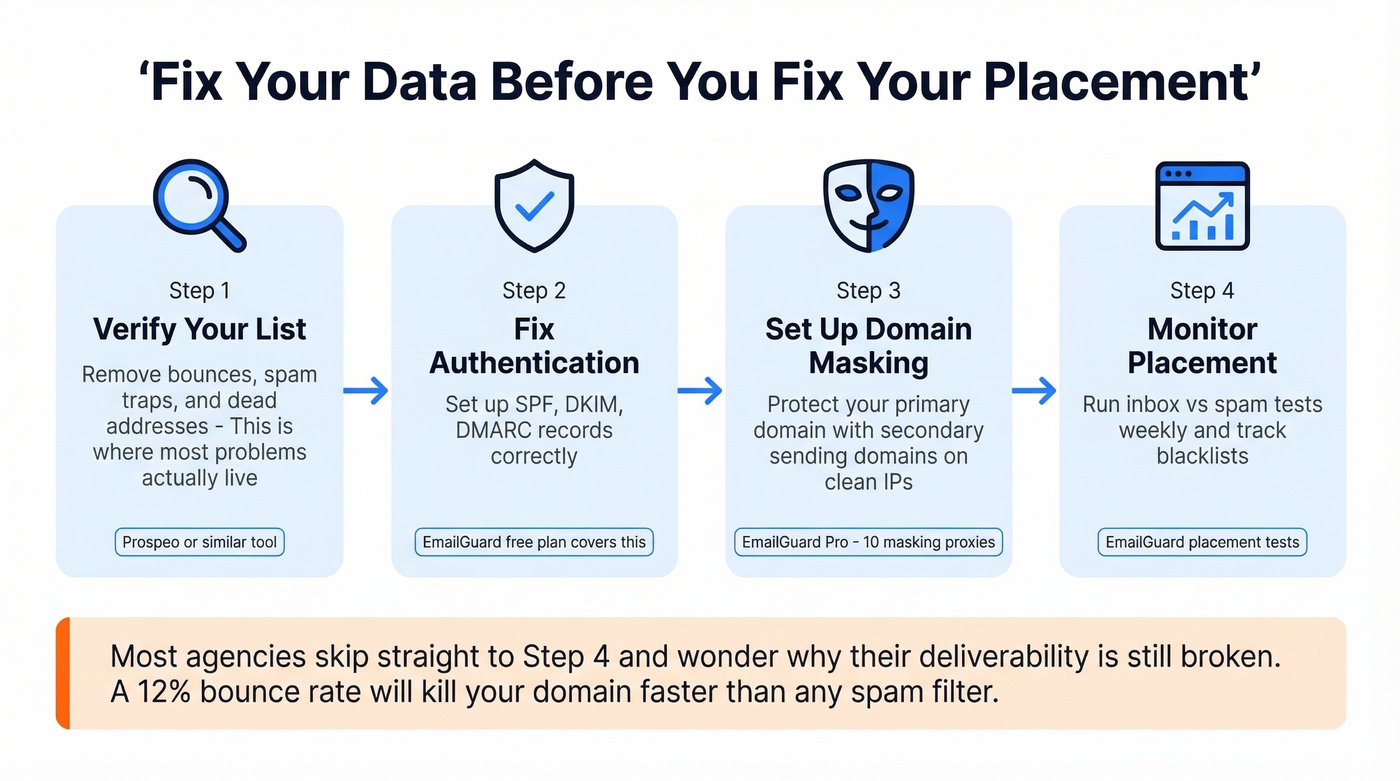
EmailGuard's verification credits are limited - 50 on free, 3,000 on Pro. For real list hygiene at scale, you need a dedicated verification platform. Prospeo handles this with 98% email accuracy across 143M+ verified addresses, using a 5-step verification process that includes catch-all handling and spam-trap removal on a 7-day data refresh cycle. At roughly $0.01 per email, it's the natural complement: clean the data first, then monitor the delivery. (For the bigger picture, see our email deliverability guide and spam trap removal breakdown.)
Domain masking protects your sender reputation, but it can't save you from sending to dead addresses. Prospeo's data refreshes every 7 days - not 6 weeks - so your contact lists stay current and your bounce rate stays under control.
Agencies using Prospeo data see bounce rates under 4%. Yours can too.
FAQ
Does EmailGuard have a free plan?
Yes. The free plan includes 1 domain, 3 email accounts, 10 spam-filter tests per month, 50 verification credits, and unlimited DMARC monitoring. It excludes domain masking proxies and inbox placement tests - the two features most teams actually pay for.
Is EmailGuard the same as MailGuard?
No. MailGuard is an email security and anti-spam product for protecting inboxes from threats. EmailGuard is a deliverability monitoring platform for cold emailers and agencies. Completely different tools solving completely different problems.
How accurate are EmailGuard's placement tests?
Directionally useful but not absolute. Users on r/coldemail report that EmailGuard and GlockApps can show contradictory results for the same mailbox - one showing inbox, the other showing spam. Run multiple tools for a fuller picture, and verify your contact list before sending to reduce the bounces that hurt placement in the first place.
Is EmailGuard worth it for cold email agencies?
For teams running more than 5 sending domains, absolutely. The Pro plan at $49/mo gives you domain masking, placement testing, and DMARC monitoring in one dashboard. For a single domain with low volume, the free plan covers the basics. Most deliverability problems stem from both infrastructure gaps and bad data - EmailGuard handles the first half, a verification tool handles the second.