

Emojis in Email Subject Lines: Overhyped or Underused?
Your marketing manager just Slacked you a draft campaign with 🔥🎉✨ crammed into the subject line. "It'll pop in the inbox," they say. Meanwhile, a recent r/marketing thread puts it bluntly: "Every time I see anything with an emoji in the subject I think spam."
So who's right? The data leans in one direction pretty clearly, and it's not the direction most marketers expect.
Quick Verdict
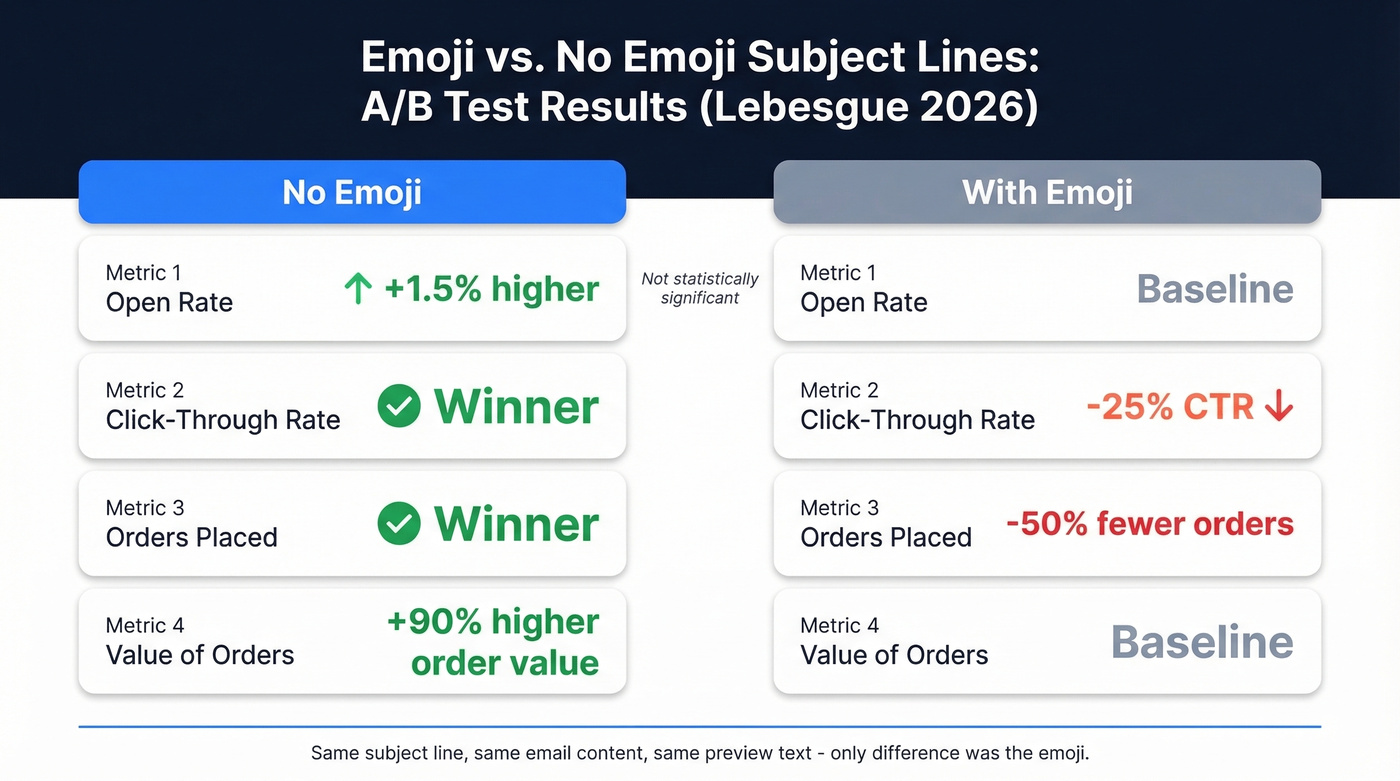
Most controlled studies show emojis don't increase opens and can actively hurt downstream metrics. A 2026 A/B test by Lebesgue found the emoji version generated 25% lower CTR and 50% fewer orders - with nearly identical open performance. The non-emoji version had a +1.5% higher open rate, which wasn't statistically significant.
If you're going to use emojis anyway:
- One emoji, max
- Place it at the end of the subject line
- A/B test before rolling out (use a subject line tester if you need a quick baseline)
- Never use them as a substitute for strong copy
Here's the thing: the real email performance lever isn't subject-line decoration. It's list quality and deliverability. We'll get to that.
How Common Are Emoji Subject Lines?
More common than you'd think. Moosend analyzed 69,315 subject lines and found roughly 28% included at least one emoji. That's not a fringe tactic - it's mainstream.
The most popular picks skew seasonal and promotional. ✨ leads at 4.97% of emoji usage, followed by 🎁 at 4.08% and ✔ at 2.89%. Trust-signal emojis like ✅ show up frequently in transactional and confirmation emails at 1.13%. Money emojis (🤑, 💰, 💸) still appear despite their obvious spam associations - about 1% each. Fun footnote: dog emojis (🐕, 🦮, 🐶, 🐾) appear in 4.25% of emoji subject lines, which is six times more than cat emojis. The internet's dog bias extends to inboxes.
But prevalence doesn't equal effectiveness. Just because a quarter of marketers use emojis doesn't mean they're working.
What the Data Shows About Open Rates
The Lebesgue test is one of the freshest controlled data points we've seen. Same subject line with vs. without an emoji, identical email content and preview text - the only change was the emoji. Open performance was basically flat. But CTR dropped 25% with the emoji version, and placed orders dropped 50%. The non-emoji version also generated 90% higher value of placed orders. That's not a marginal difference.
The most rigorous study comes from Nielsen Norman Group. They ran two controlled experiments. In Study 1, adding emojis to subject lines increased negative sentiment by 26%, statistically significant at p < 0.005. The words participants associated more with emoji subject lines? "Boring" and "dull." Not exactly the vibe marketers are going for.
In their second study, emojis didn't increase desire to open the emails at all.
You'll see articles citing an old Experian stat about 56% higher open rates with emojis. That number gets recycled endlessly, but it's from a single, outdated study that doesn't hold up against controlled research. One r/emailmarketing commenter nailed it: "That Experian stat is doing a lot of heavy lifting for a lot of lazy advice."
Do Emojis Trigger Spam Filters?
No. This myth won't die.
Email on Acid's guidance is clear: emojis aren't likely to trigger spam filters, and "spam trigger words" are mostly a myth in modern filtering. What actually determines inbox placement? SPF, DKIM, and DMARC authentication (see DMARC alignment for the nuance). Sender reputation. Complaint rates. Engagement history. Since the 2024 Gmail and Yahoo sender requirements took effect, authentication and low complaint rates are non-negotiable - emojis don't factor into that equation at all.
If you want the full picture, start with an email deliverability guide and then work on how to improve sender reputation.

Spam filters don't care about emojis - they care about sender reputation. Every bounced email chips away at your deliverability. Prospeo's 5-step email verification and 7-day data refresh keep bounce rates under 3%, so your subject lines actually reach the inbox.
Stop decorating emails that never land. Fix the data first.
B2B vs. B2C: When to Use Them (and When to Skip)
Use emojis if you're running B2C seasonal or promotional campaigns where the emoji reinforces urgency or festivity. A 🎁 for a gift guide or a ⏰ for a deadline can add visual distinction in a crowded inbox.
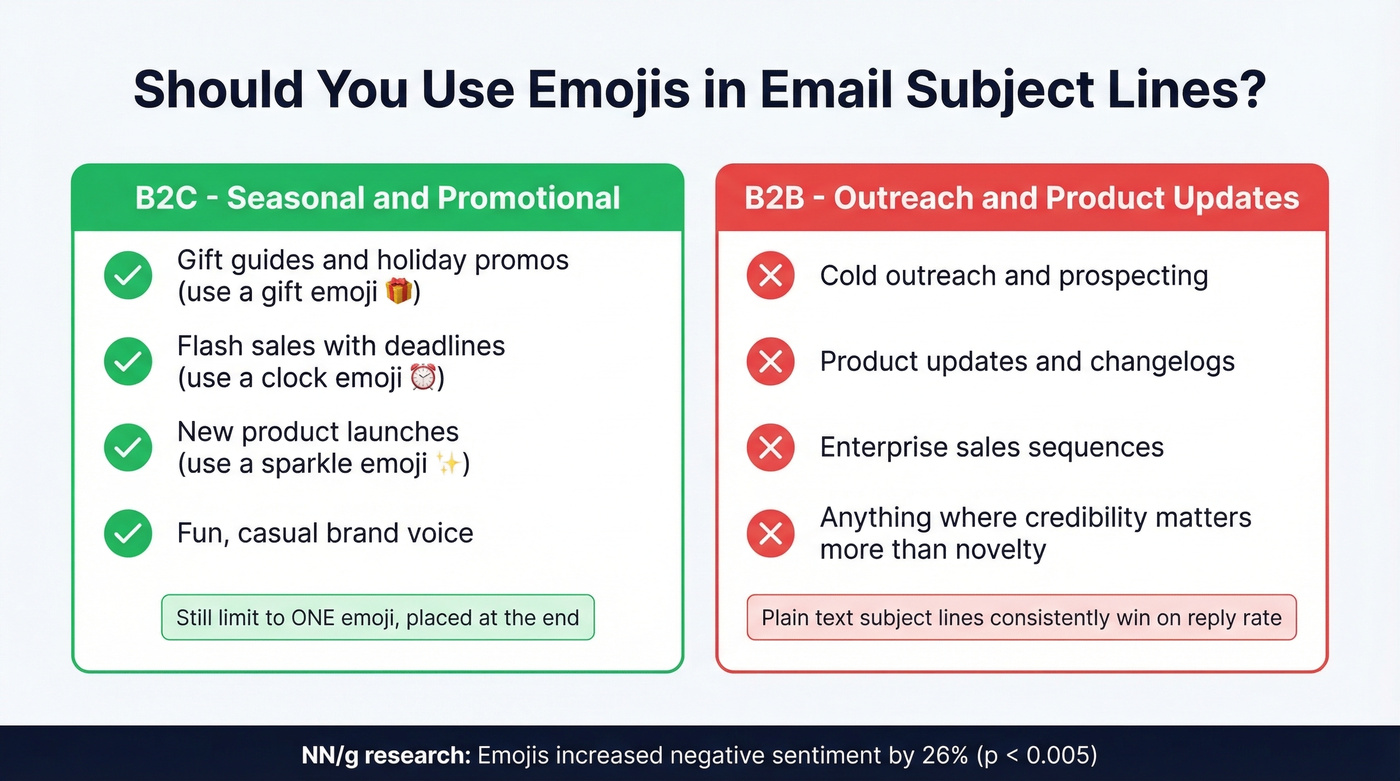
Skip emojis if you're sending B2B outreach, product updates, or anything where credibility matters more than novelty. The NN/g sentiment data backs this up - emojis push perception in a more negative direction. Practitioners consistently flag that emojis "cheapen your image" in B2B contexts, and in our experience working with B2B outbound teams, emoji subject lines consistently underperform plain-text versions on reply rate. We've tested this across dozens of campaigns. Plain text wins.
If you're writing outreach, it’s usually more productive to focus on prospecting email subject lines and proven cold email subject line examples than on emoji tweaks.
Accessibility and Rendering
This is the section most emoji articles skip entirely.
Screen readers read emoji descriptions aloud. A single 🎉 becomes "party popper." Three in a row - 🎉🎉🎉 - becomes "party popper, party popper, party popper." That's a terrible experience for anyone using assistive technology, and it's reason enough to limit yourself to one emoji per subject line. Never use emojis to replace actual words. Emoticons like :-) are even worse because they lack embedded descriptions, so if you're choosing between the two, emojis win on accessibility.
Rendering varies across clients too. Classic Outlook desktop uses the Word rendering engine, which handles email HTML differently than Gmail's sanitized HTML or Apple Mail's WebKit. Up to 41% of audiences open emails in dark mode, and over 55% open on mobile. An emoji that looks great in Gmail on a Pixel can look different - or fall back to missing-glyph boxes - in other environments.
Test before you send. Every time.
Best Practices for Emoji Placement
Place the emoji at the end of the subject line. Litmus reports that end-placement tends to outperform beginning-placement, and they cite a test where adding an emoji increased CTR by 28%. That said, the Lebesgue data shows emojis can still hurt overall, so placement alone won't save a bad strategy.
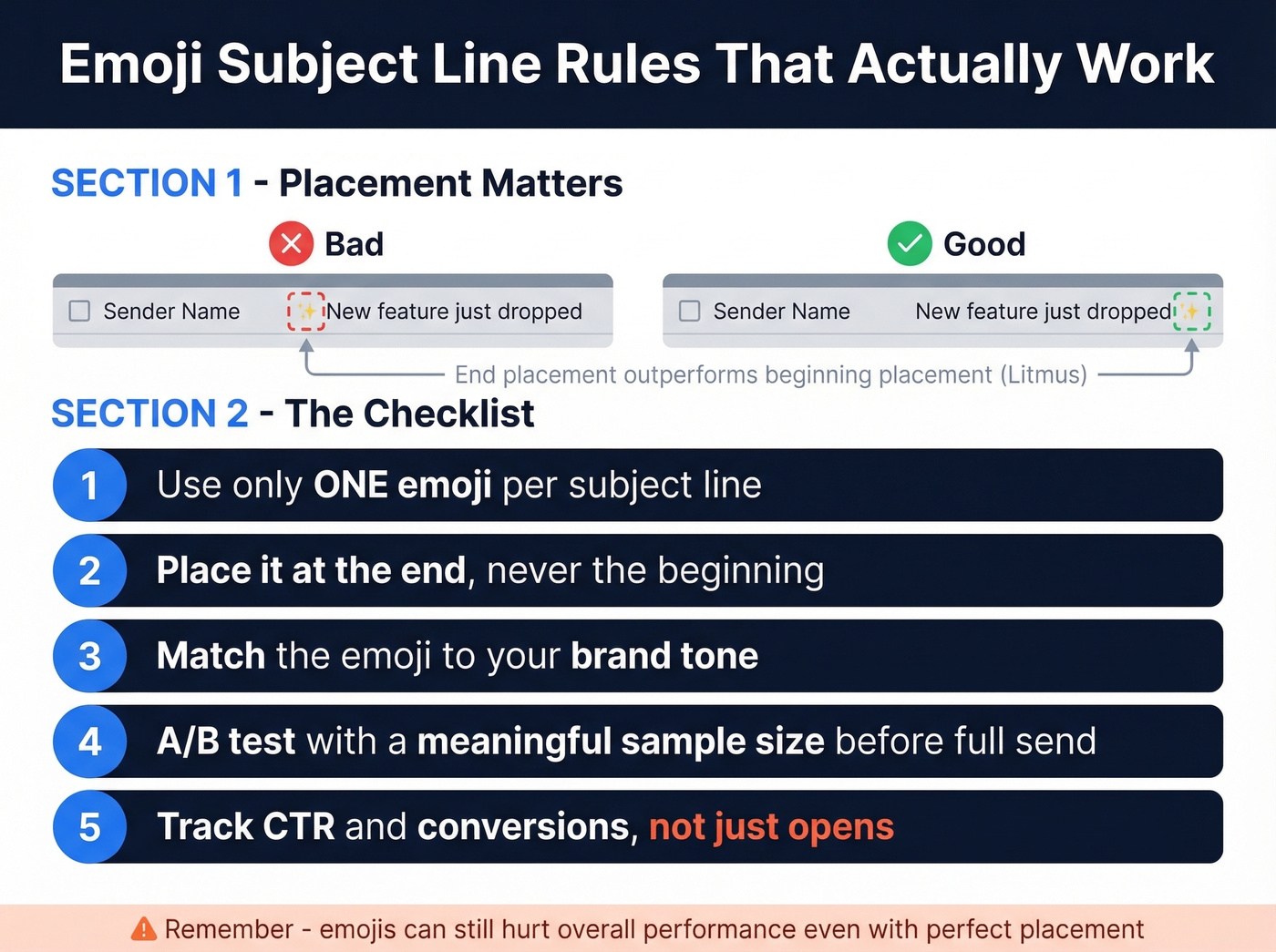
Limit to one emoji per subject line. Match the emoji to your brand tone - a fintech company using 🤪 sends a different signal than a pet brand using 🐾. And always A/B test with a meaningful sample before committing to a full send. Track CTR and conversions, not just opens (use the right click rate formula so you’re comparing apples to apples).
Best Emojis for Subject Lines
| Emoji | Best Use Case | Usage Share |
|---|---|---|
| ✨ | New launches, highlights | 4.97% |
| 🎁 | Promotions, gift guides | 4.08% |
| ✔ / ✅ | Confirmations, trust | 2.89% / 1.13% |
| ⏰ | Urgency, deadlines | Widely used |
| 🔥 | Trending, hot deals | Widely used |
Emojis to avoid: 🤑, 💰, 💸. Money emojis trigger instant spam associations for most recipients, even if they don't technically trip filters.
What Actually Moves the Needle
Let's be honest. We've tested hundreds of B2B campaigns, and the subject-line emoji debate consistently distracts from the real problem. List quality drives most of your results, subject-line copy handles a meaningful chunk, and emoji choice is a rounding error.
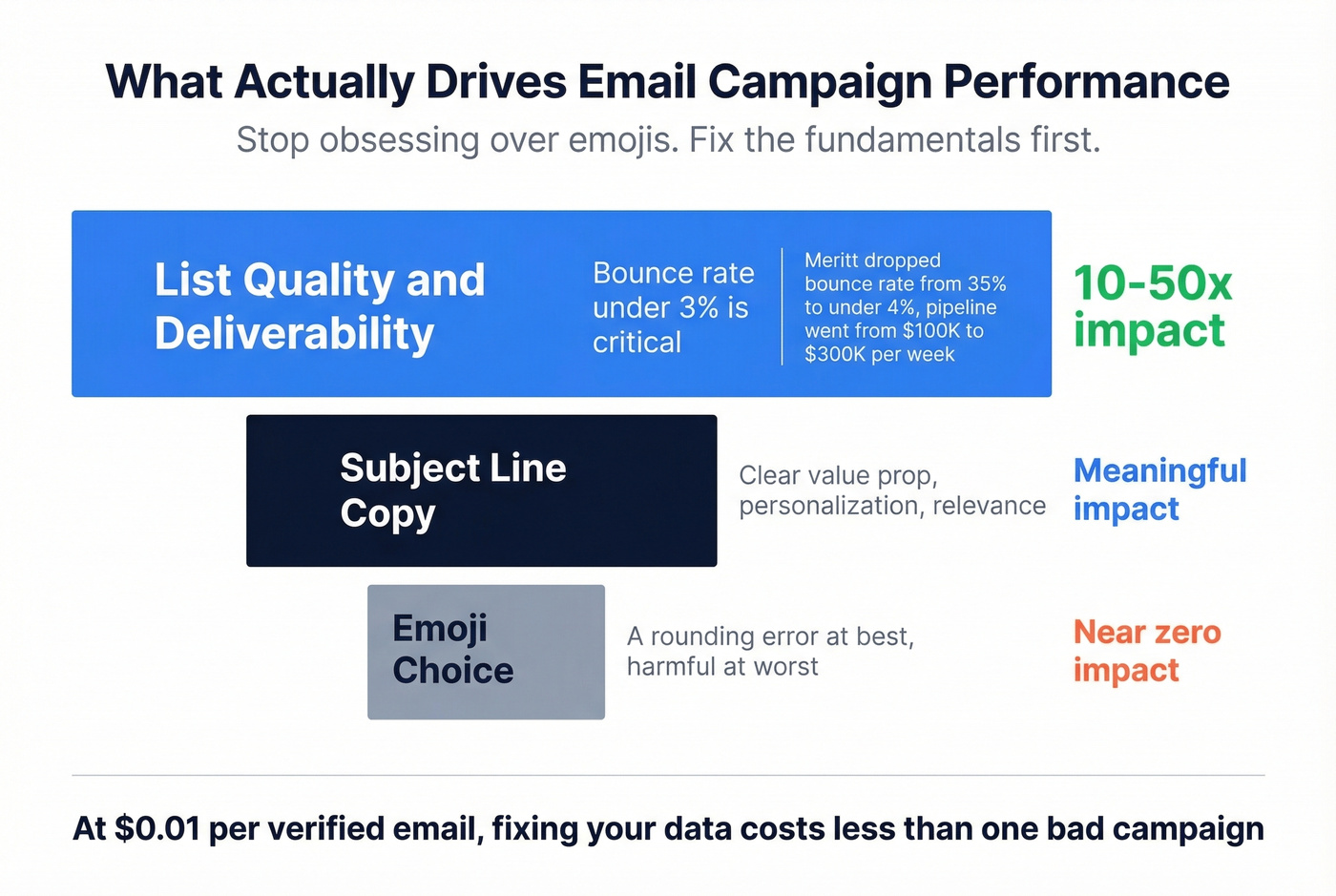
If your bounce rate is above ~3%, your subject line doesn't matter. Neither does your emoji. You're burning sender reputation with every bounced email, which tanks deliverability for everything that follows. Teams obsessing over whether a smiley face will lift open rates would see far greater returns by fixing their contact data first (start with email bounce rate benchmarks and remediation).
One of our customers, Meritt, saw their bounce rate drop from 35% to under 4% after switching to Prospeo's verified data, which tripled their pipeline from $100K to $300K per week. That's the kind of performance lift no emoji can deliver.

You just read that emoji choice is a rounding error compared to list quality. Teams using Prospeo cut bounce rates from 35%+ to under 4% - and saw pipeline jump 140-180%. At $0.01 per verified email, cleaning up your data costs less than one bad campaign.
The real open rate lever isn't an emoji. It's verified contact data.
FAQ
Do emojis increase email open rates?
Controlled studies say no. The Lebesgue test showed basically flat open performance but 50% fewer conversions with emojis. NN/g also found emojis didn't increase desire to open.
Which emojis are safest for email subject lines?
✨, ✅, ⏰, and 🎁 carry neutral-to-positive associations in high-volume campaigns. Avoid money emojis like 💰 - they trigger spam perception even when they don't trigger filters.
What improves email performance more than subject line emojis?
Verified contact data and sender reputation have 10-50x more impact on campaign results than any subject-line tweak. Fixing your bounce rate from 30%+ down to under 4% will do more for your pipeline than any amount of emoji optimization ever could.