

How to Build an Emotional Sales Pitch That Actually Closes
You're 40 minutes into a demo. The prospect nodded in all the right places, asked two decent questions, and said "this looks great." Then they ghost you. No reply to the follow-up. No reply to the breakup email. Nothing.
Your pitch wasn't emotional at all - features, ROI, competitive positioning - and none of it made them feel anything.
Here's the thing: most advice on this topic gives you a list of emotions and calls it a day. That's useless. You need scripts, frameworks, and the judgment to know which emotion to pull for which buyer. In our experience, the reps who close consistently aren't the most charismatic. They're the ones who ask the best questions - questions that surface what the buyer actually cares about and create genuine feeling. Emotional selling isn't some advanced technique you bolt on after mastering the basics. It is the basics. Logic-only selling is the aberration, and it's the reason most demos end in silence.
The Psychology: Why Emotion Comes First
Harvard professor Gerald Zaltman's widely cited estimate puts it bluntly: 95% of purchasing decisions happen subconsciously. People buy based on feelings first, then justify those decisions with logic afterward. The field backing this up - neuromarketing - has grown from a niche academic curiosity into a $1.44 billion market, projected to hit $3.11 billion by 2032 at an 8.9% CAGR.
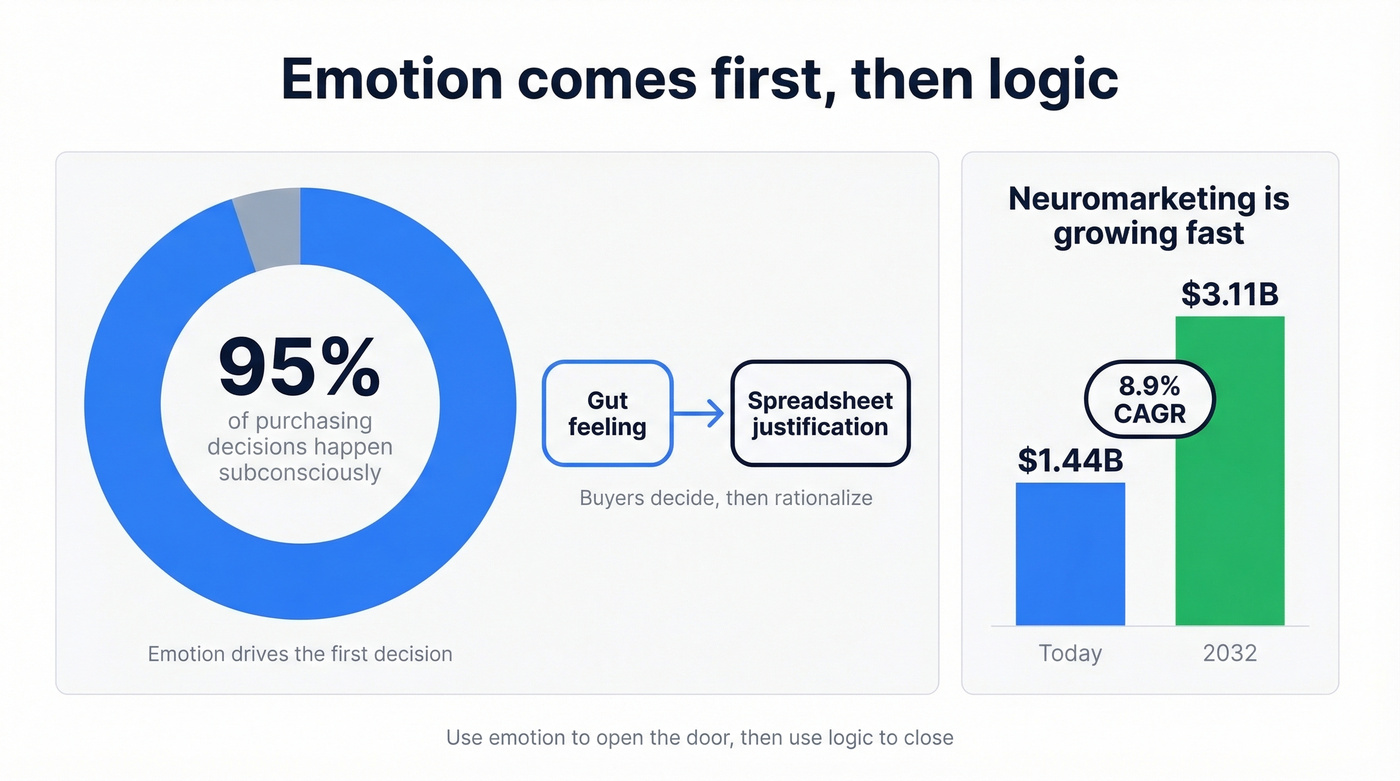
Buyers decide with their gut and rationalize with their spreadsheet. Your pitch needs to speak to both, but the gut comes first.
The Doctor Method: Diagnose Before You Prescribe
This is the single best framework for emotional selling, and it doubles as consultative selling done right. You don't walk into an exam room and immediately prescribe medication. You ask questions, listen, and diagnose. Then you present the cure.
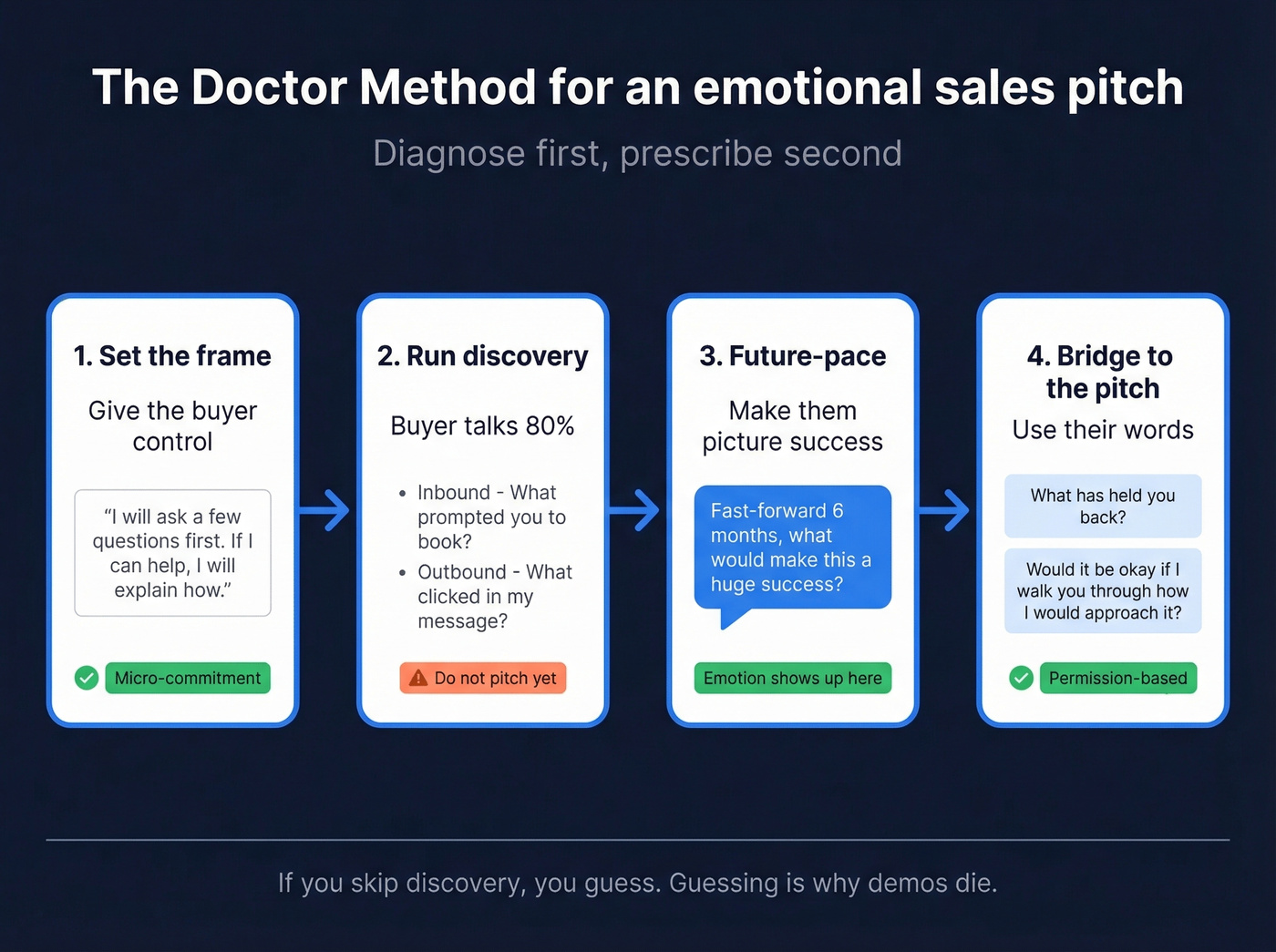
1. Set the frame. Open with a transition that gives the buyer control:
"I'll start by asking a few questions to understand what's going on. If it sounds like I can help, I'll explain how. Sound good?"
This signals professionalism, sets expectations, and gets a micro-commitment.
2. Run discovery (and shut up). The buyer should do 80% of the talking. Your openers depend on how they got on the call:
- Inbound: "What prompted you to book this call today?"
- Outbound: "Something in my message clicked. What was it?"
Then go deeper: "Could you tell me a bit more about that?"
3. Future-pace. This is where emotion enters. Ask: "Let's fast-forward 6 months. What would need to have happened for you to feel like this was a huge success?" Now they're imagining a better future - that's emotional territory, and it's where deals start to form before the buyer even realizes it.
4. Bridge to the pitch. "What's held you back from getting this done on your own?" Their answer hands you the exact pain to address. Then: "Would it be okay if I walk you through how I'd approach it?" The permission-based transition matters. Pushy closes trigger resistance. This works because it feels like a conversation, not a pitch.
Adapt the Script to the Buyer's Core Emotion
The doctor method gives you the structure. But the words you choose inside that structure should shift based on what's driving the buyer. Four archetypes, four adjustments:
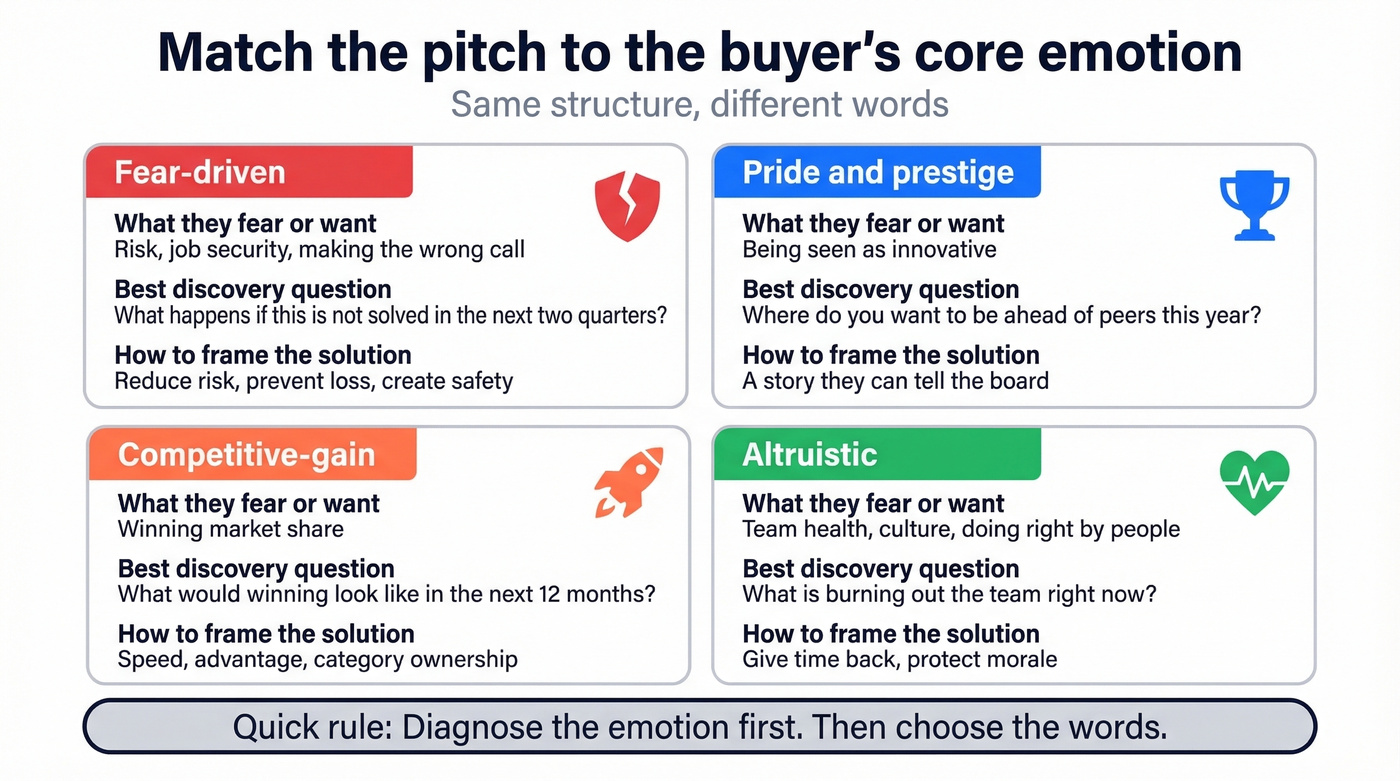
Fear-driven buyer (worried about risk, job security, falling behind): "What happens to your team if this problem isn't solved in the next two quarters?" Lean into loss aversion. Paint the cost of inaction.
Pride/prestige buyer (wants to be seen as innovative, ahead of peers): "Your competitors are still doing this manually. You'd be the first in your space to automate it." Give them a story they can tell their board.
Competitive-gain buyer (focused on winning market share): "The company that figures this out first owns the category for the next 3 years. Right now, that window is open." Frame your solution as a weapon.
Altruistic buyer (cares about team impact, culture, doing right by people): "Your reps are burning 6 hours a week on work that doesn't move the needle. This gives them that time back." Make it about the people they lead.
Let's be honest: most reps default to the competitive-gain pitch because it feels exciting. But fear-driven buyers - the ones terrified of making the wrong choice - are far more common in enterprise deals. We've watched reps lose six-figure opportunities because they pitched ambition to someone who just wanted safety. If you're not diagnosing which archetype you're talking to, you're guessing. And guessing is why demos die.
Story Structure for Every Channel
Every pitch that moves people - call, email, or deck - follows the same arc: Setup → Conflict → Resolution.
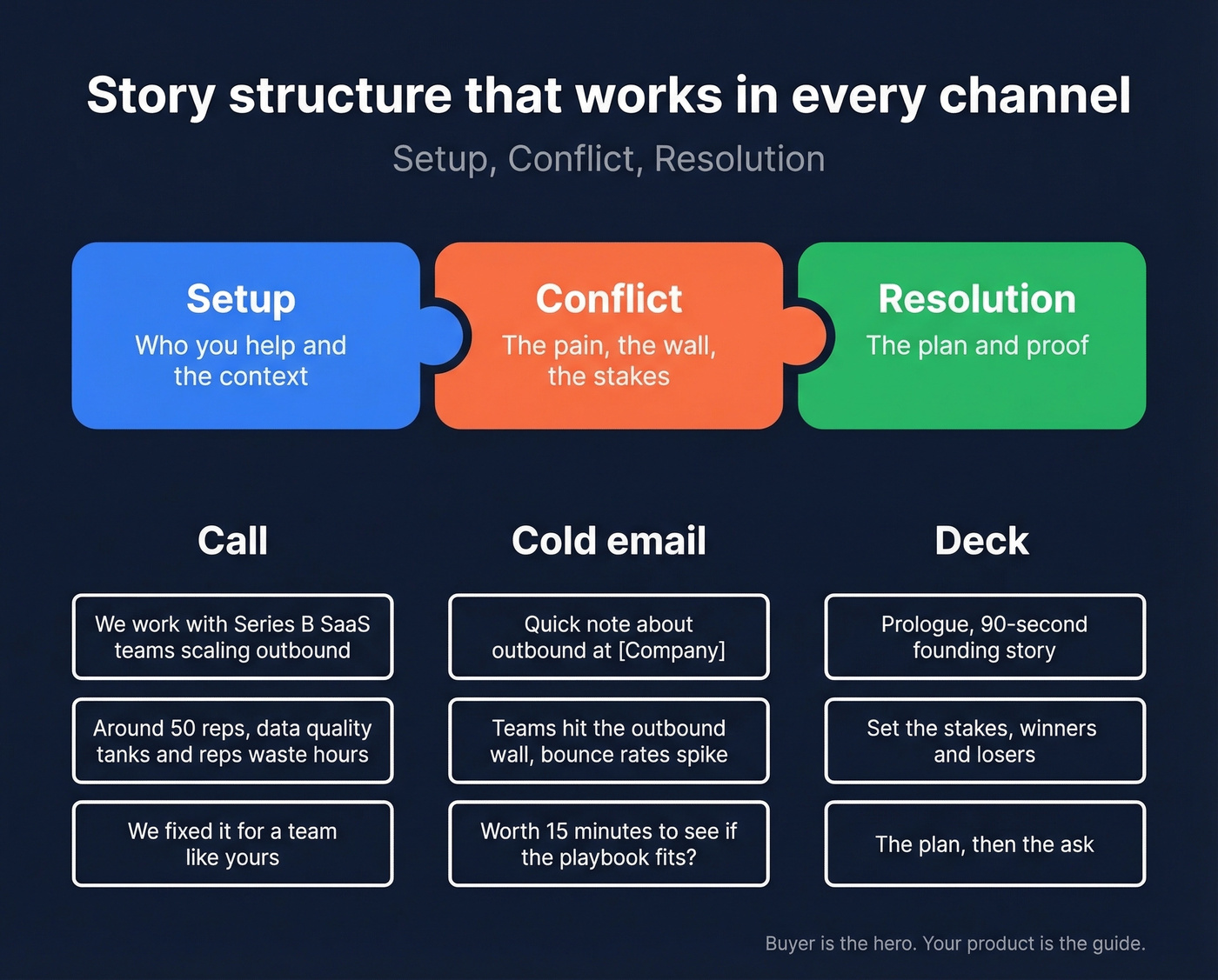
On a call, keep it tight. Setup: "We work with Series B SaaS companies scaling outbound." Conflict: "Most hit a wall around 50 reps - data quality tanks, bounce rates spike, reps waste hours on bad numbers." Resolution: "We fixed that for [company X]." The buyer is always the hero. Your product is the guide.
For decks, expand into the Sales Hero's Journey: (1) Prologue - 90-second founding story, max. (2) Call to Adventure - name the force of change. (3) Set the Stakes - winners and losers. (4) Introduce the Guide - that's you. (5) The Plan - step-by-step. (6) The Ask - clear and time-bound.
The Cold Email Nobody Sends
Most articles on emotional selling skip the actual email. Here's one that uses the Setup → Conflict → Resolution arc in three sentences:
Subject: [Company]'s outbound wall
Hi [Name],
Most Series B sales teams scaling past 50 reps hit the same wall - data quality craters, bounce rates spike, and reps burn hours chasing bad numbers. We helped a team cut bounce rates from 35% to under 4% and triple pipeline from $100K to $300K per week. Worth a 15-minute call to see if the same playbook fits [Company]?
Three sentences. One emotional hook (the wall), one proof point, one ask. Adapt the conflict sentence to match the buyer's archetype from the section above. That email only works, of course, if it reaches a real inbox - which is why we run every address through Prospeo's real-time verification before sending anything.

That cold email template above only works if it lands in a real inbox. Prospeo verifies every email in real time with 98% accuracy - so your carefully crafted emotional hook actually reaches the buyer. At $0.01 per email, bad data is no longer an excuse for dead pipeline.
Stop perfecting pitches that bounce. Verify first, send second.
Emotional Trigger Words
Swapping one word in a subject line can shift response rates. Here's a reference table:
| Category | Power Words |
|---|---|
| Emotional | You, Win, New, Exclusive, Secret |
| Urgency | Hurry, Now, Final, Limited |
| Positive | Guarantee, Imagine, Discover, Best, Easy |
| Value | Free, Premium, Save, Deal |
A/B test one word change at a time. The words compound over time, but only if you're disciplined about isolating variables.
If you want more inspiration, pull from a swipe file of subject lines and then test systematically.
Why Most Pitches Fall Flat
Most pitches fail not because the seller lacks charisma, but because they're pitching what they're proud of instead of what the buyer cares about.
HBR documented a perfect example: a beverage company pitched their production process - craftsmanship, sourcing, quality controls. The retailer didn't care. They cared about price and sluggish sales velocity. The story was emotionally compelling to the seller. It was irrelevant to the buyer. HBR's fix is a three-step reframe: listen for what's actually blocking the buyer, tap into their emotions, and tell a different story.
I've watched this happen in real time - a rep leading with the feature they love most instead of the problem the buyer mentioned 30 seconds ago. The doctor method prevents this by forcing you to diagnose before you prescribe.
If your prospects still go dark after a strong call, tighten your follow-up so the emotion doesn’t evaporate between touches.
The Ethics Line
Emotional selling has a boundary, and it's defined by intent. Zendesk's framework draws it clearly:
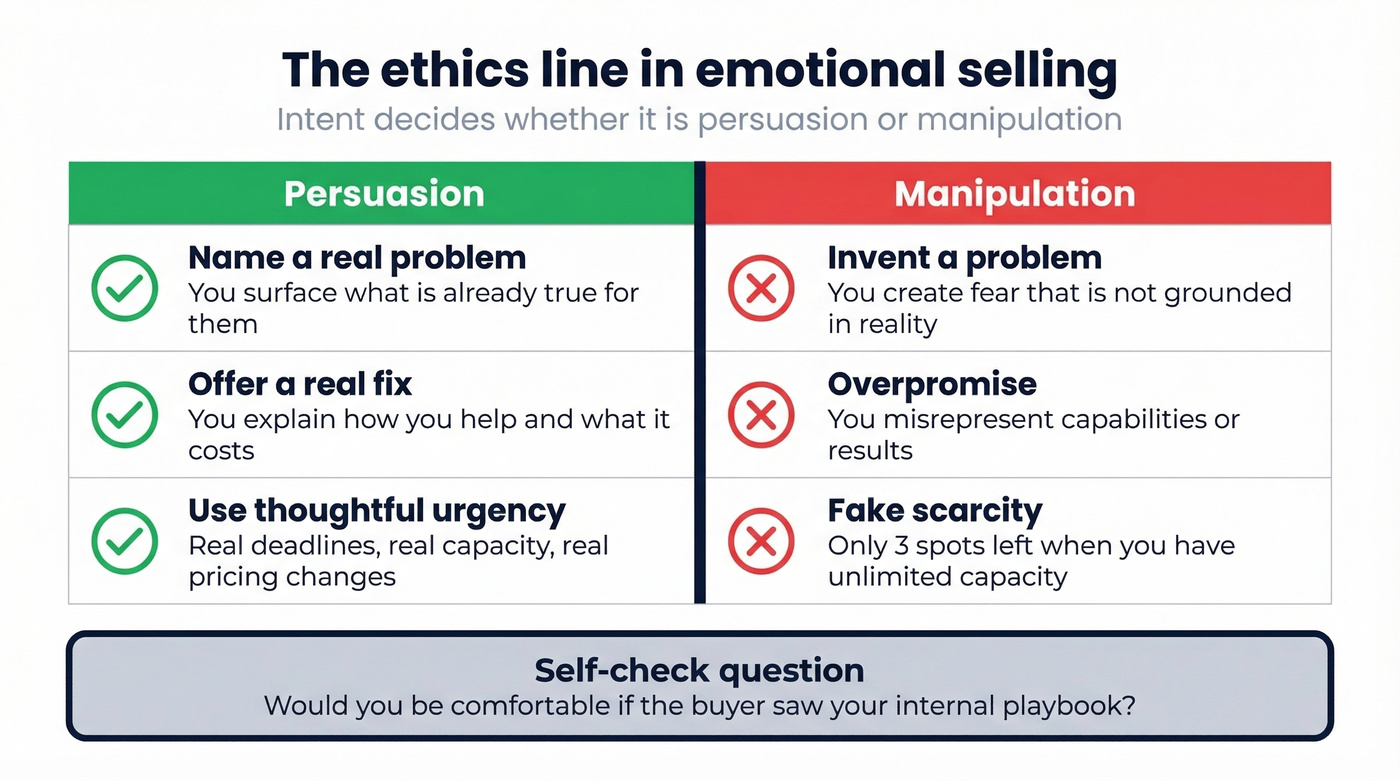
- Making someone aware of a real problem, then presenting a fix → persuasion
- Making someone believe a problem exists when it doesn't → manipulation
- Misrepresenting your product's capabilities → manipulation
The alternative to fake scarcity is thoughtful urgency - real deadlines, genuine capacity constraints, actual pricing changes. "Only 3 spots left" when you have unlimited capacity isn't urgency. It's lying. Buyers talk. The consensus on r/sales is brutal about reps who burn trust with manufactured deadlines, and those threads get screenshotted and shared. The emotional connection should come from genuine understanding, not pressure tactics.
Skip this section if you're already ethical and just want tactics. But if you've ever been tempted to manufacture urgency, read it twice.
For a deeper dive, align your team on ethics in sales so “emotional” never becomes “manipulative.”
Step Zero: Reach the Right Person
You've built a pitch designed to make someone feel something. That only works if it reaches a real human who matches your ICP. Prospeo covers 300M+ professional profiles with 98% email accuracy and 125M+ verified mobile numbers, all refreshed every 7 days. No contracts, no sales calls required - just accurate data so your carefully crafted pitch doesn't bounce.
If you’re still refining your targeting, start with an ideal customer profile and then layer in intent so you’re pitching people already primed to care.
You just learned to diagnose buyer emotions and craft pitches that move people. Now you need the right people to pitch. Prospeo gives you 300M+ profiles with 30+ filters - buyer intent, job changes, headcount growth - so you reach decision-makers already feeling the pain your pitch addresses.
Find buyers who already feel the urgency. Let the data do the targeting.
FAQ
Does emotional selling work in B2B?
B2B buyers are more emotional than B2C buyers, not less. A failed software purchase can cost someone their job - that's visceral, not rational. Kahneman's System 1 decides first, then System 2 rationalizes. Buyer emotions drive purchasing decisions regardless of deal size or committee structure.
When should I lead with facts instead of feelings?
Lead with facts for low-cost commodity products, procurement-led evaluations, and highly analytical buyers who want specs and TCO. But the strongest pitches blend both - emotion opens the door, logic closes it. Aim for a 60/40 emotion-to-logic ratio in discovery, then flip it during negotiation.
How do I verify contact data before pitching?
Before you pitch, verify the contact. Bad data means your emotional sales pitch hits a dead inbox instead of a decision-maker. Tools like Prospeo let you search 300M+ profiles and verify emails in real time at 98% accuracy, starting free at 75 emails per month.
What separates persuasion from manipulation?
Intent. If you're surfacing a real problem and presenting a genuine solution, that's persuasion. If you're manufacturing fear or faking scarcity to force a decision, that's manipulation. The test: would you be comfortable if the buyer saw your internal playbook?