

End of Quarter: The Definitive Guide for Finance and Sales Teams
End of quarter shouldn't be a crisis. It should be a checkpoint. Yet every 90 days, the same scene plays out: a sales rep refreshes the CRM dashboard watching a "verbal yes" sit unsigned, while the controller pings department heads about accrued expenses that should've been submitted last Friday. If the close of the quarter consistently feels like a five-alarm fire, your process is broken - not your people.
What Is End of Quarter?
End of quarter marks the close of one of four three-month periods that make up a company's financial year. Finance teams reconcile the books, sales teams measure quota attainment, and leadership reports performance to the board.
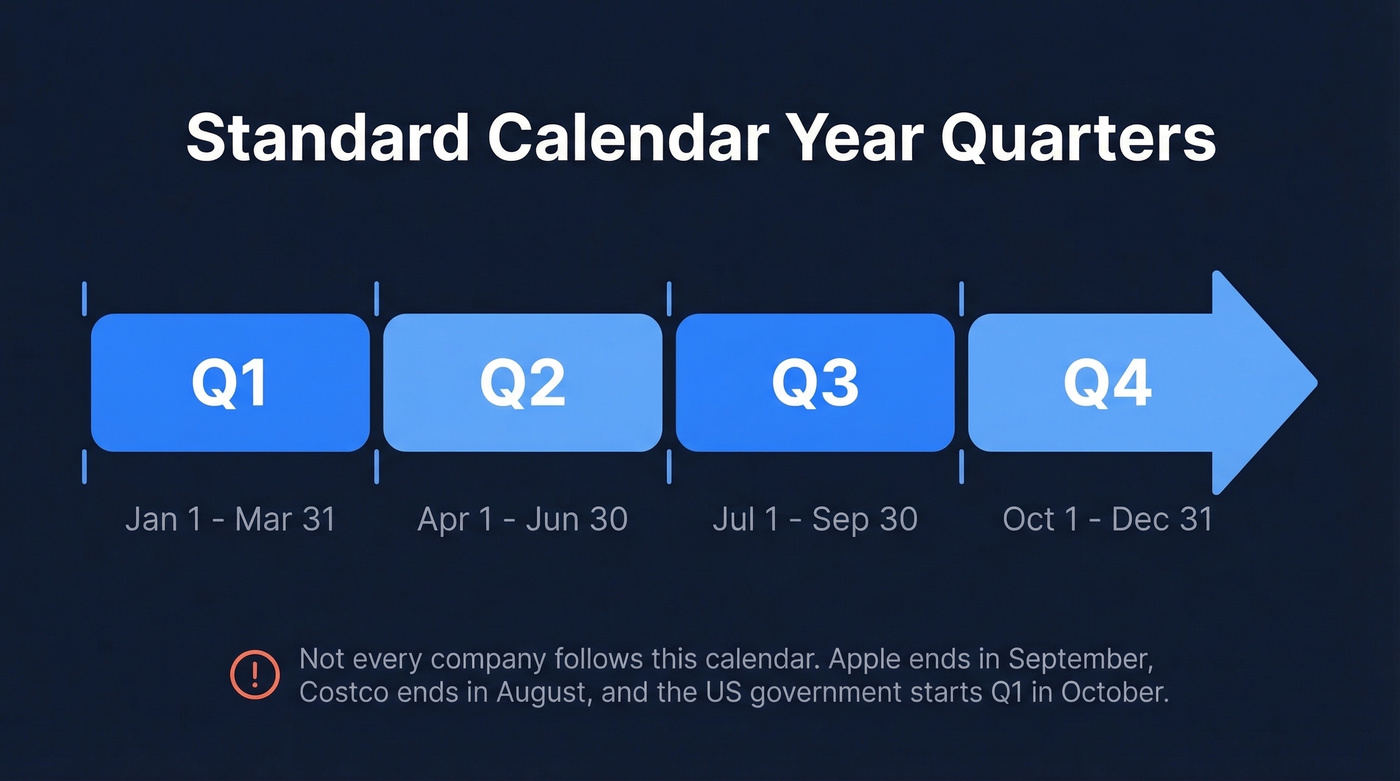
Most companies follow the standard calendar year:
| Quarter | Start Date | End Date |
|---|---|---|
| Q1 | January 1 | March 31 |
| Q2 | April 1 | June 30 |
| Q3 | July 1 | September 30 |
| Q4 | October 1 | December 31 |
Not every organization runs on this calendar, though. Costco's fiscal year runs September through August, meaning its Q4 covers June through August. Apple's fiscal year ends in late September. The U.S. federal government operates on an October 1 through September 30 fiscal year, so a government "Q1" starts in October, not January. When you're reading a company's quarterly financial report, always check which fiscal calendar they're using.
One important nuance: comparing sequential quarters - Q1 to Q2 - misleads for seasonal businesses. Retail Q4 will always dwarf Q1. The standard practice is comparing the same quarter year-over-year, like Q2 2026 vs. Q2 2025, to strip out seasonality. For a rolling view, trailing twelve months (TTM) smooths out quarterly noise entirely.
Let's be honest about the quarterly cadence itself. It has real critics. Quarterly reporting can encourage short-term thinking - executives optimizing for the next 90 days rather than the next 3 years. That tension shapes how aggressively companies push deals at quarter end. But until the reporting cadence changes, you need a system that handles it without burning out your team.
Why the Quarter-End Matters
EOQ ripples through every department. The teams that treat it as a company-wide checkpoint outperform those that silo it.
Finance closes the books, reconciles accounts, prepares financial statements, and files regulatory reports. For public companies, the clock starts ticking on SEC deadlines the moment the quarter ends.
Sales measures quota attainment, reviews pipeline, and locks forecasts for the next quarter. Compensation calculations depend on where deals land relative to the cutoff date.
Marketing finalizes campaign attribution windows, locks in spend-to-pipeline ratios, and makes budget reallocation decisions for the next 90 days.
Leadership builds board decks, sends investor updates, and shifts from projections to actuals.
Investors kick off earnings season. Single stocks often move 3-8% around earnings announcements, and institutional investors rebalance based on quarterly results. For public companies, the quarter-end isn't just an internal milestone - it moves markets.
The Quarter-End Close Process
The 5-Phase Close Framework
The AFP FP&A advisory councils outline a five-phase structure that most mid-market and enterprise finance teams follow, whether they've formalized it or not.
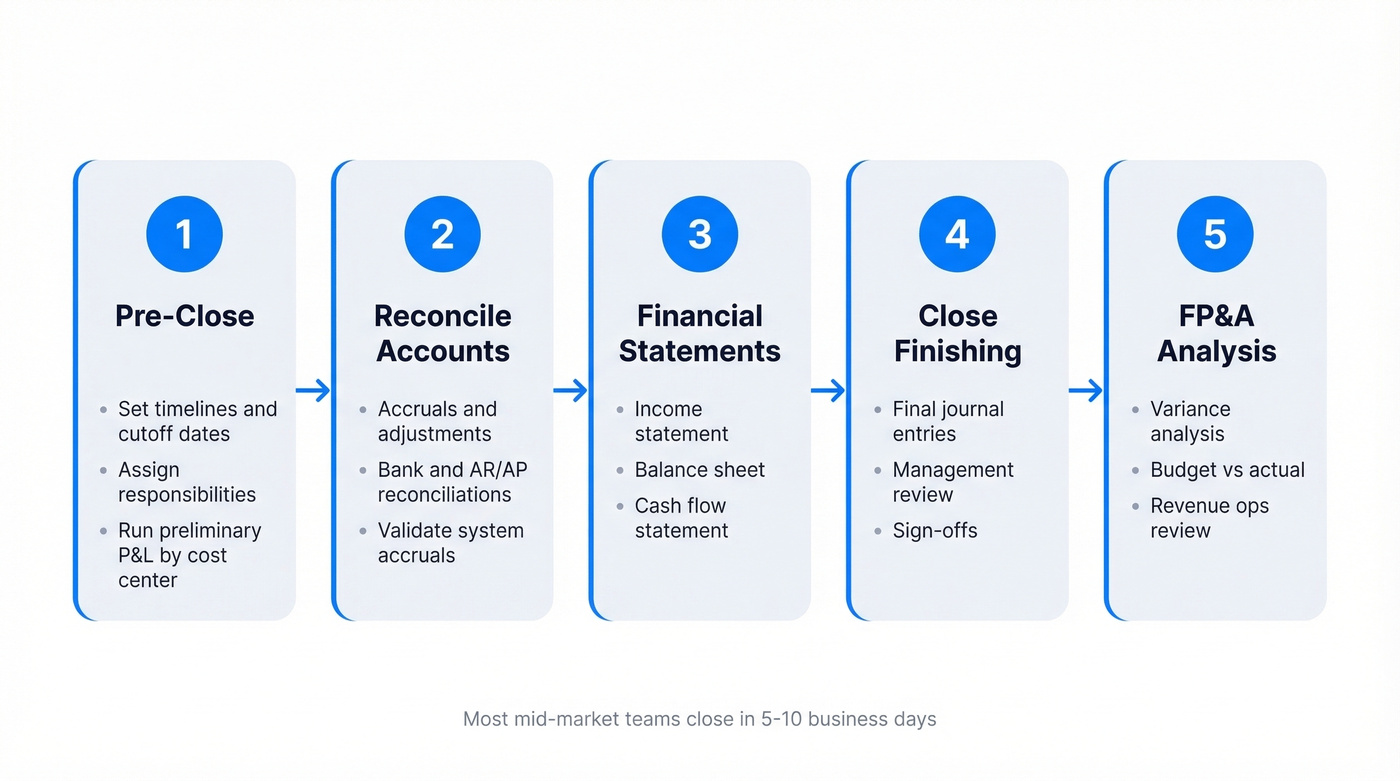
Phase 1 - Pre-close. Set timelines, assign responsibilities, establish cutoff dates, and communicate expectations across departments. FP&A should run preliminary P&L by cost center to spot anomalies early. This is where most close delays originate. If you don't set expectations two weeks out, you'll spend the close chasing people.
Phase 2 - Reconcile accounts. The heavy lifting: accruals and adjustments, bank reconciliations, AR/AP reconciliations. FP&A tests top vendor expenses, flags non-payment stretches, validates system accruals, and applies accruals for bonuses, taxes, fees, and campaign costs. Accounting and FP&A should review simultaneously, not sequentially - catching fixable items before books close saves days.
Phase 3 - Prepare financial statements. Income statement, balance sheet, cash flow statement. For public companies, these feed directly into 10-Q filings.
Phase 4 - Close finishing steps. Final journal entries, management review, sign-offs. This is where the close either wraps cleanly or spirals into "one more adjustment" loops that eat three extra days.
Phase 5 - FP&A analysis and reporting. Variance analysis, budget-to-actual comparisons, and the narrative that explains the numbers to leadership. Revenue operations reviews happen here too, connecting financial results to pipeline performance and forecasting accuracy for the next cycle.
Many mid-market teams close in 5-10 business days. Complex or public companies can run longer when intercompany reconciliations or audit support are involved.
SEC Filing Deadlines
For public companies, the quarter-end triggers hard regulatory deadlines. Here's the current SEC calendar:
| Filing | Large Accelerated | Accelerated | Non-Accelerated |
|---|---|---|---|
| 10-Q | 40 days | 40 days | 45 days |
| 10-K | 60 days | 75 days | 90 days |
NT (Notification of Late Filing) extensions are available: NT 10-Q buys 5 additional calendar days, NT 10-K buys 15. Proxy statements incorporating Part III information must be filed within 120 days after fiscal year-end.
Speeding Up the Close
About 75% of finance teams use some form of automation, but results are wildly uneven. Top-performing teams process invoices at $2.78 each; the average sits at $9.40. Only 32.6% of invoices are processed touchless - best-in-class teams hit 49.2%.
The AR side is even further behind. 70% of companies say their accounts receivable processes still aren't automated. Companies using e-invoicing see a 17% average drop in DSO, which directly impacts how fast cash shows up on the balance sheet at quarter-end. The tools exist. The adoption doesn't.

EOQ panic starts when pipeline is thin. Prospeo gives your reps 300M+ profiles with 30+ filters - buyer intent, job changes, headcount growth - so they enter the final weeks with deals already in motion, not cold leads to chase.
Build next quarter's pipeline now for $0.01 per verified email.
End of Quarter for Sales Teams
Why EOQ Pressure Kills Deals
Here's the thing: leadership urgency and buyer urgency are almost never aligned. The consensus on r/sales is brutal - reps consistently report that executive deal reviews and forced urgency in the final days do more harm than good.
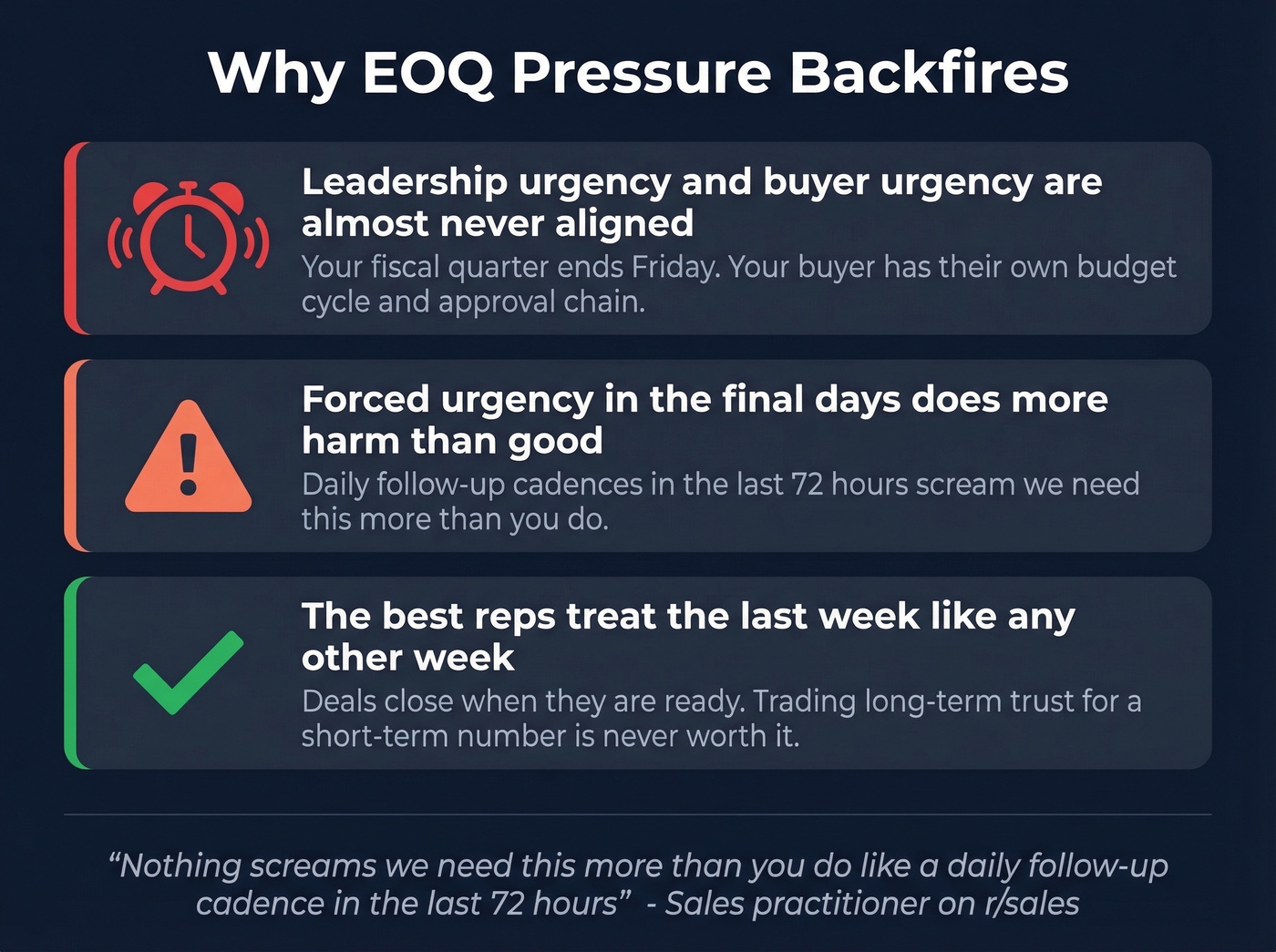
The pattern is predictable. A rep is at ~85% of quota with three business days left. Management tells them to "harass the customer" until the signature comes in. But the buyer has their own budget cycle, their own approval chain, and zero awareness that your fiscal quarter ends Friday. The classic threat - "we'll have to re-approve pricing next quarter" - gets called out repeatedly as a tactic that risks losing deals to competitors who don't impose the same friction. One rep put it bluntly: "Nothing screams 'we need this more than you do' like a daily follow-up cadence in the last 72 hours."
If your manager is telling you to "just get the deal done" with three days left, they're asking you to trade long-term customer trust for a short-term number. The best reps we've talked to treat the last week of the quarter the same as any other week. Deals close when they're ready.
The Discounting Trap
EOQ discounting is a structural trap, not a strategy.
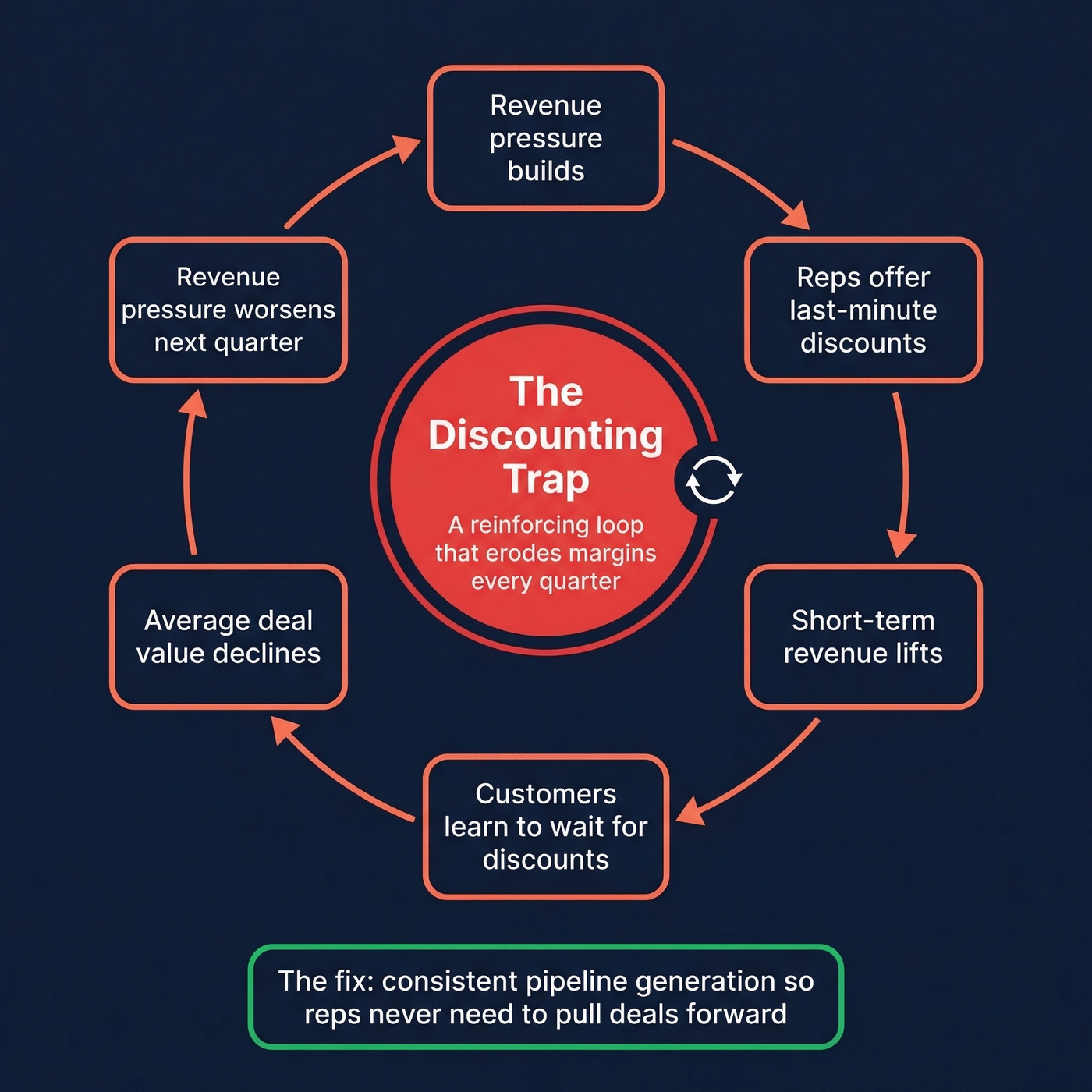
The reinforcing loop works like this: revenue pressure builds, reps offer last-minute discounts to pull deals forward, short-term revenue lifts, customers learn to expect those discounts, average return on sales declines, and revenue pressure worsens next quarter. Rinse, repeat, watch your margins erode.
The systems-thinking view is clear: once customers learn that waiting until the last week produces a discount, they'll wait every time. You've trained them. Practitioners are even sharper - discount deadlines damage credibility because customers expect the discount either way.
The fix isn't willpower. It's incentive design and pipeline consistency. If reps don't need to pull deals forward to hit quota, they won't discount. That's a pipeline problem, not a pricing problem.
Sales Pipeline Management Each Quarter
Weekly Pipeline Tracking
The best defense against end-of-quarter panic is pipeline generation that starts on day one - tracked weekly, not monthly. By the time you realize pipeline is short in week 10, it's too late.
Four numbers to track every week: opportunities created, total value, source, and pacing versus target. The planning math is straightforward: revenue target divided by win rate equals required pipeline. Divide by average deal size for required deal count. Break that down by quarter, source, and segment, and you've got a weekly pacing target that tells you whether you're on track or falling behind before it becomes an emergency.
When pipeline generation isn't tracked weekly, the failure modes stack up fast. Hail Mary outbound pushes in the final weeks. Pipeline stuffing with unqualified opportunities to inflate coverage ratios. Discounting that kills both margin and morale. We've seen all three happen simultaneously at the same company.
If you want a tighter diagnostic layer, use a simple pipeline health scorecard to spot slippage early.
Metrics for the Last Two Weeks
Pipeline coverage ratio is the single most important diagnostic heading into the final stretch. A healthy ratio sits between 3x and 5x of quota. But sales cycles are running 21% longer than they were in 2020, with win rates falling alongside them. The old 3x coverage rule is now closer to 4-5x for most B2B teams.
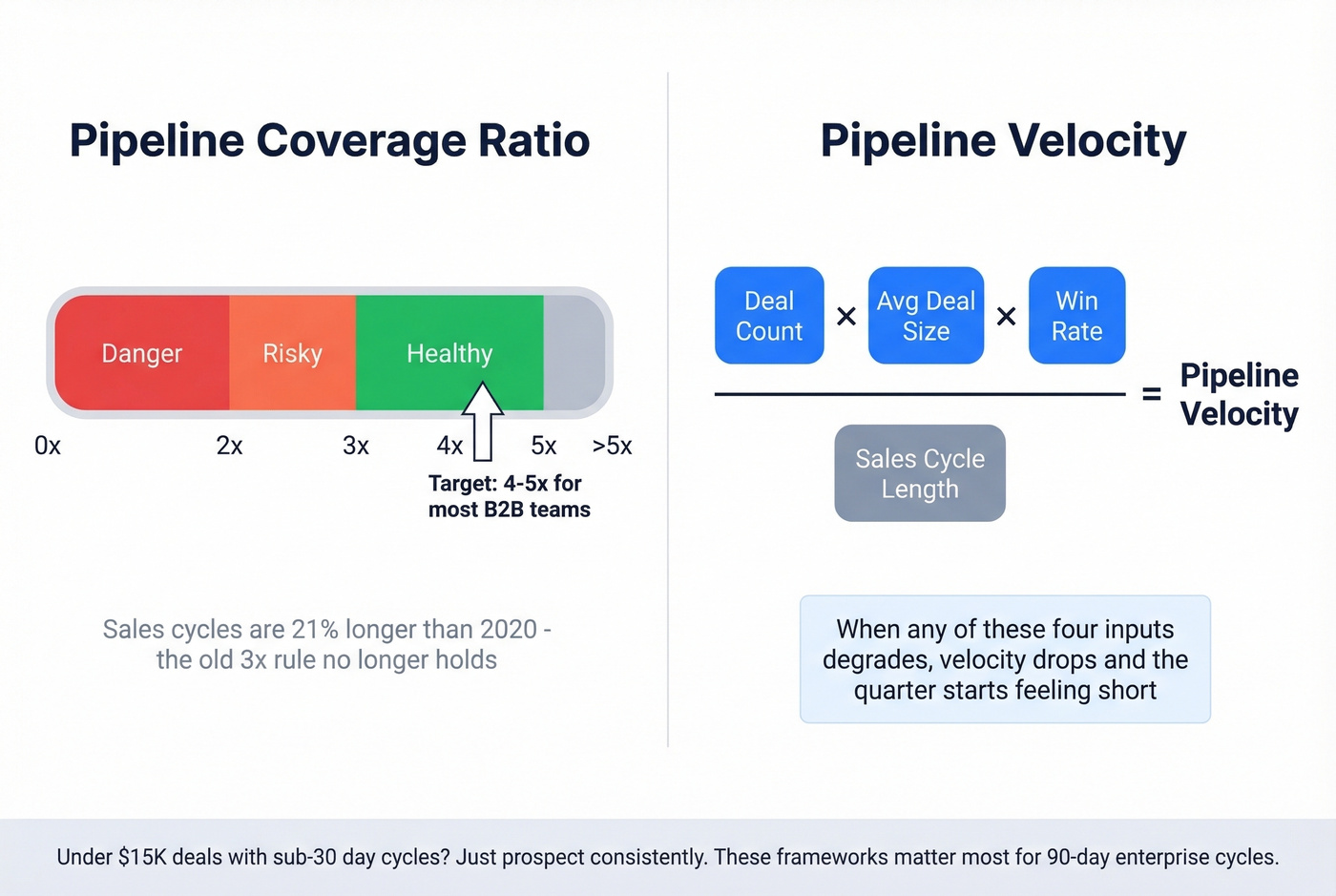
Pipeline velocity - deal count times average deal size times win rate divided by sales cycle length - explains why EOQ panic happens. When any of those four inputs degrades, velocity drops, and the quarter starts feeling short.
If your average deal size is under $15K and your sales cycle is under 30 days, you probably don't need to obsess over coverage ratios at all. Just prospect consistently and the math takes care of itself. The teams that need 5x coverage frameworks are the ones running 90-day enterprise cycles where a single slip pushes a deal into next quarter. Know which game you're playing.
EOQ Prospecting - Data as the Bottleneck
The most pressured weeks of the quarter are also the weeks where reps waste the most time on outreach that never lands. Emails bounce, phone numbers don't connect, and the prospect list that looked solid in the CRM turns out to be 18 months stale. Bad data doesn't just waste time - it amplifies EOQ panic by shrinking the window of productive selling.
Before the final push, run your prospect list through a verification tool. In our experience, teams that verify before sending see bounce rates drop from 30-40% to under 5%, which means more of those last-week emails actually reach a human inbox. Prospeo refreshes its database every 7 days compared to the 6-week industry average, so the data you're pulling isn't already stale by the time you use it.
If you're building lists from multiple sources, data enrichment can help you standardize fields and reduce duplicates before you verify.
Skip this if your CRM data is already clean and your bounce rates are consistently under 3%. But if you're seeing double-digit bounces during EOQ pushes, you don't need a $30K data contract to fix it. A free tier gives you 75 emails and 100 Chrome extension credits per month, and paid plans run about $0.01 per email - enough to verify an entire prospect list for less than the cost of a team lunch.
If you're sending at volume, protect deliverability with an email deliverability guide and keep an eye on email bounce rate benchmarks.
The real fix for end-of-quarter chaos isn't more pressure - it's more pipeline. Teams using Prospeo book 35% more meetings than Apollo users, with 98% email accuracy that protects your domain reputation quarter after quarter.
Stop harassing buyers in week 12. Start reaching them in week 1.
End of Quarter FAQ
When does each quarter end?
For calendar-year companies: Q1 ends March 31, Q2 ends June 30, Q3 ends September 30, and Q4 ends December 31. Fiscal-year companies vary - Costco's Q4 ends in August, Apple's fiscal year ends in late September, and the U.S. federal government's fiscal year runs October through September. Always check SEC filings or investor relations pages to confirm a company's fiscal calendar.
What's the difference between a fiscal and calendar quarter?
A calendar quarter follows the January-through-December year, while a fiscal quarter follows a company's chosen fiscal year, which can start any month. Public companies disclose their fiscal year-end in SEC filings, and all quarterly reporting aligns to that chosen calendar rather than the standard one.
How long does a quarter-end close take?
Most mid-market teams close in 5-10 business days; complex or public companies with intercompany reconciliations often run longer. Finance automation cuts this significantly - top performers process invoices at $2.78 each versus the $9.40 average, and e-invoicing alone drops DSO by 17%.
Should sales teams offer EOQ discounts?
No. EOQ discounts create a reinforcing loop where customers learn to wait for last-minute deals, structurally eroding margins quarter after quarter. Focus on pipeline consistency and deal qualification throughout the period instead of using price as a lever in the final week.
How do you prevent EOQ panic in sales?
Track pipeline weekly from day one. Maintain 3-5x pipeline coverage of quota, verify your prospect data before the final push so outreach actually reaches people, and make sure your CRM data is fresh enough to trust. The best quarter-end is one you planned for 11 weeks ago.