

The Enterprise Sales Strategy Playbook Most Teams Are Missing
Your best champion just went silent. The deal you forecasted for Q2 is "pending security review" with no timeline. Enterprise selling got measurably harder - and most playbooks haven't caught up.
What You Need (Quick Version)
Only 16% of reps hit quota in recent years, and sales cycles have lengthened 22% since 2022. The three things that actually move enterprise outcomes: rigorous MEDDPICC qualification with Paper Process mapped early, multi-threading from week one, and verified contact data for every stakeholder so you can reach the full buying committee - not just the one person your SDR found on a company page.
Enterprise Sales by the Numbers
| Metric | Benchmark |
|---|---|
| $50-100k ACV cycle | ~120 days |
| $100-250k ACV cycle | ~170 days |
| $250-500k ACV cycle | ~220 days |
| $500k+ ACV cycle | 270+ days |
| Buying committee size | ~25 (up from 16 in 2017) |
| Average B2B win rate | ~21% |
| Negotiation-to-close | 35-40% of total cycle |
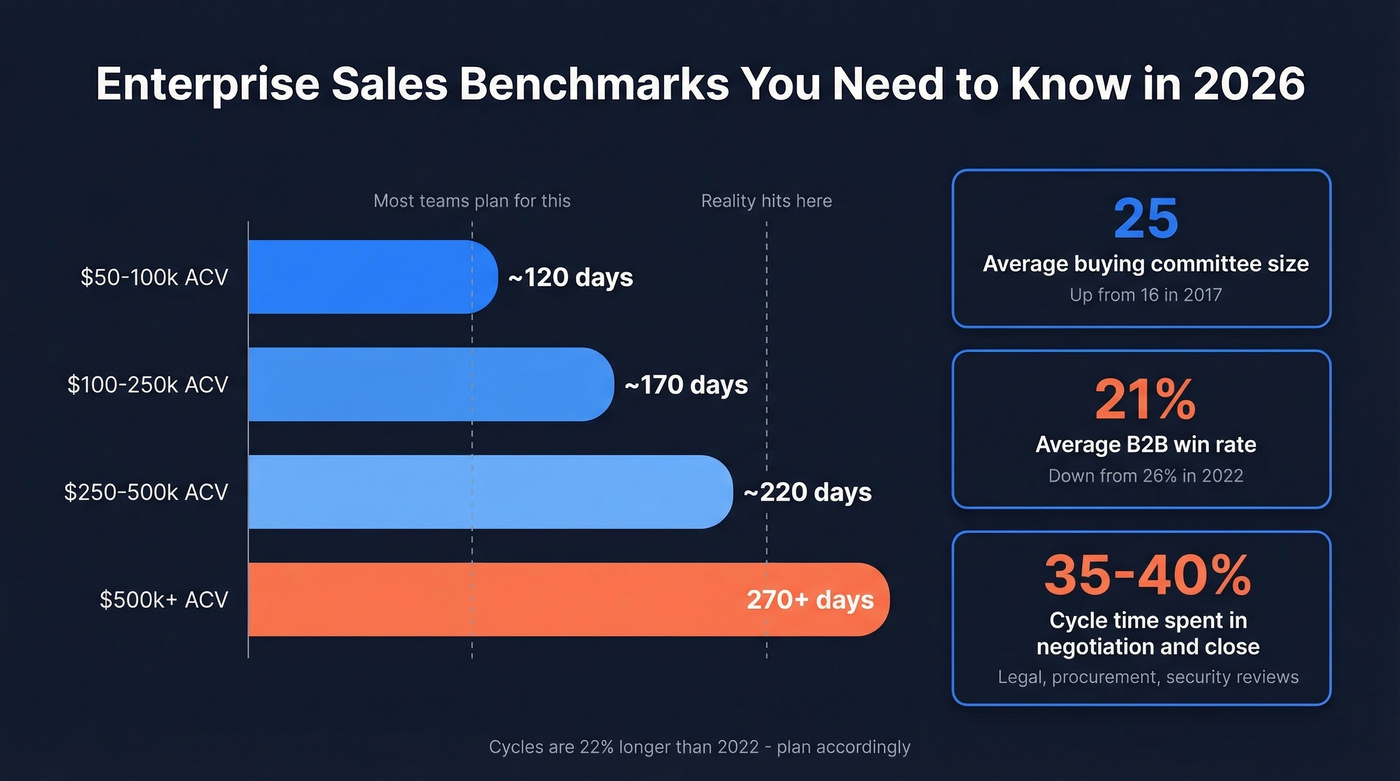
The negotiation-to-close number is the one most teams underestimate. Legal redlines and procurement reviews eat 35-40% of your total cycle time. If you're not planning for that, you're sandbagging your own forecast.
And buying committees averaging 25 stakeholders? That means your single-threaded deal is a dead deal. You can't influence a 25-person committee through one champion, no matter how enthusiastic they are.
Qualify Ruthlessly with MEDDPICC
If you're not using MEDDPICC for $100k+ deals, you're guessing. 73% of SaaS companies selling above $100k ARR use some version of it, and organizations that fully adopt it report 18% higher win rates and 24% larger deal sizes. Challenger and SPIN have their place for certain selling motions, but for complex deal qualification, MEDDPICC is the standard - PTC used it to grow from $300M to $1B in four years.
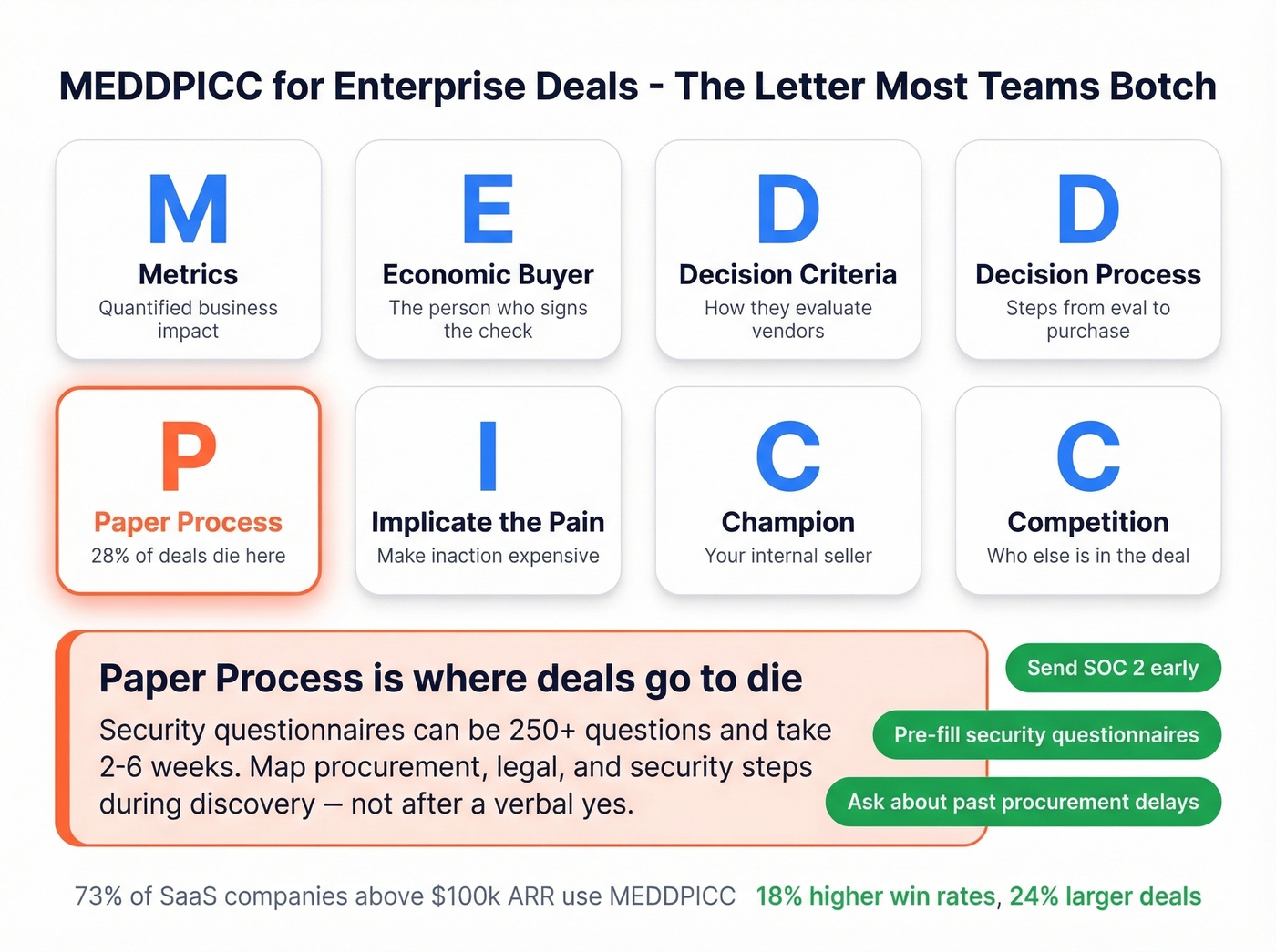
The letter most teams botch is P - Paper Process.
28% of deals fail when buyers can't secure internal approval. That's not a sales objection. It's a procurement, legal, and security gauntlet you need to map during discovery, not after a verbal yes. Security assessments alone can involve 250+ question questionnaires and take 2-6 weeks.
Three discovery questions that save deals:
- "Walk me through what happens after your team says yes - who touches the contract before it's signed?"
- "Does your security team require a vendor risk assessment? What's the typical timeline?"
- "Have any deals at your company stalled in procurement in the last 6 months? What caused it?"
Here's the thing: teams that proactively send SOC 2 reports, DPAs, and security questionnaire responses before they're requested move through procurement dramatically faster. That kind of friction removal - getting ahead of the blocker before it becomes one - is what separates reps who close from reps who forecast.
Multi-Thread Every Deal
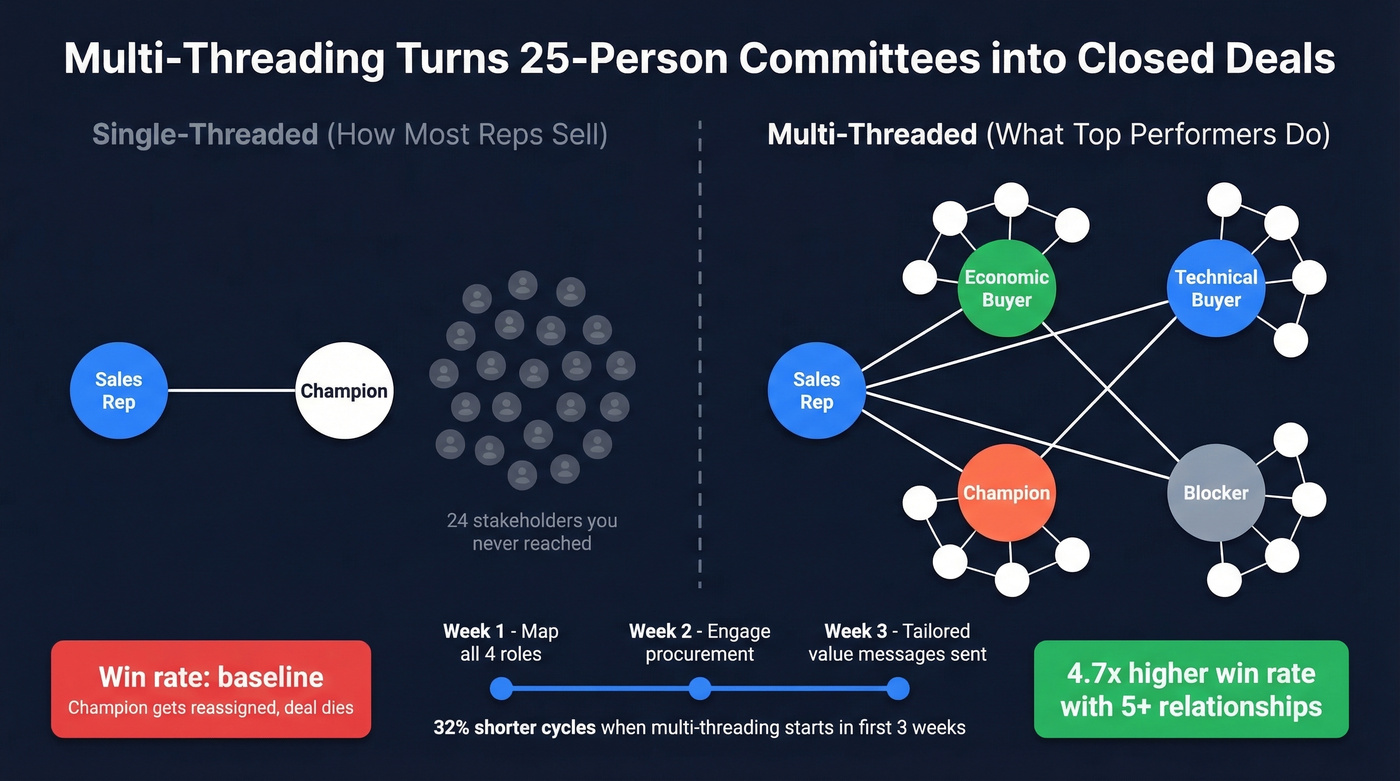
Single-threading is the #1 reason enterprise deals die. Deals with 5+ stakeholder relationships see a 4.7x win rate increase over deals with just 1-2 contacts. Starting multi-threading in the first 3 weeks cuts cycle time by 32%.
Do this:
- Map four roles from day one: Economic Buyer, Technical Buyer, Champion, Blocker. Ask your champion who asks the hardest questions and who signs at this deal size.
- Check calendar invite attendee lists after every meeting - that's your real buying committee revealing itself.
- Engage procurement proactively in week two. Don't wait for them to surface at month four.
Don't do this:
- Rely on your champion to "sell internally." They get reassigned, go on leave, or lose political capital.
- Wait until the proposal stage to identify the economic buyer.
- Treat multi-threading as "CC'ing more people." Each stakeholder needs a tailored value message tied to their specific pain.
To multi-thread a 25-person buying committee, you need verified contact data for every stakeholder - not just the one your SDR happened to find.

You can't multi-thread a 25-person buying committee with one contact per account. Prospeo gives you verified emails and direct dials for every stakeholder - Economic Buyer, Technical Buyer, Champion, and Blocker - with 98% email accuracy and 125M+ verified mobiles.
Reach the full buying committee, not just the one person your SDR found.
Start with Clean Data
We've seen this play out dozens of times. A team builds a target account list of 200 enterprise prospects, crafts personalized sequences, then watches their emails bounce, their domain reputation tank, and the campaign stall before a single meeting gets booked. They didn't have a strategy problem. They had a data problem.
This is exactly what Snyk faced. With 50 AEs each prospecting 4-6 hours per week, their bounce rate sat at 35-40%. After switching to Prospeo, bounces dropped under 5%, AE-sourced pipeline jumped 180%, and they generated 200+ new opportunities per month. With 300M+ professional profiles, 98% email accuracy, and a 7-day data refresh cycle, multi-threading becomes operationally possible when you're working 25-person committees.

Plan for the Real Cycle
I'll be blunt: stop trying to shorten your enterprise sales cycle. Plan for the real one instead.
Too many teams run 3-week outbound cadences for deals that take 12-18 months to close. The consensus on r/sales is that cold calling connect rates have dropped significantly since 2019-2020, and "just dialing" isn't enough anymore. Reps who combine voicemails, emails, and direct messages consistently outperform single-channel grinders.
If your leadership is setting quotas based on 2019 cycle assumptions, that's a conversation worth having now, not at the end of Q3 when the pipeline gap is already baked in. Sales cycles are 22% longer than they were in 2022. Pipeline coverage model models need to reflect that reality.
Where AI Fits In
Enterprise genAI spend hit $37B in 2025 - a 3.2x jump year-over-year - and 81% of sales teams are experimenting with AI tools. Two implications: your buyers are using AI to evaluate vendors faster, and your competitors are using it to outpace you.
Use cases that work right now:
- Lead scoring and buying signals - prioritize accounts showing intent instead of working alphabetically through your TAM (lead scoring)
- Forecasting risk flags - surface deals matching historical loss patterns before they slip (sales forecasting)
- Personalization at scale - tailor messaging across 25 stakeholders without writing 25 individual emails from scratch (AI for sales emails)
- Proposal and contract generation - cut days off the Paper Process bottleneck that kills so many deals in the final stretch
Skip the AI tools that promise to "automate relationship building." That's not a thing. AI handles research, pattern recognition, and content generation well. It doesn't replace the judgment calls that close six- and seven-figure deals.
Win-Rate Planning
Use these ranges to build your pipeline coverage model. If your enterprise win rate is 17%, you need 6x pipeline coverage, not 3x.
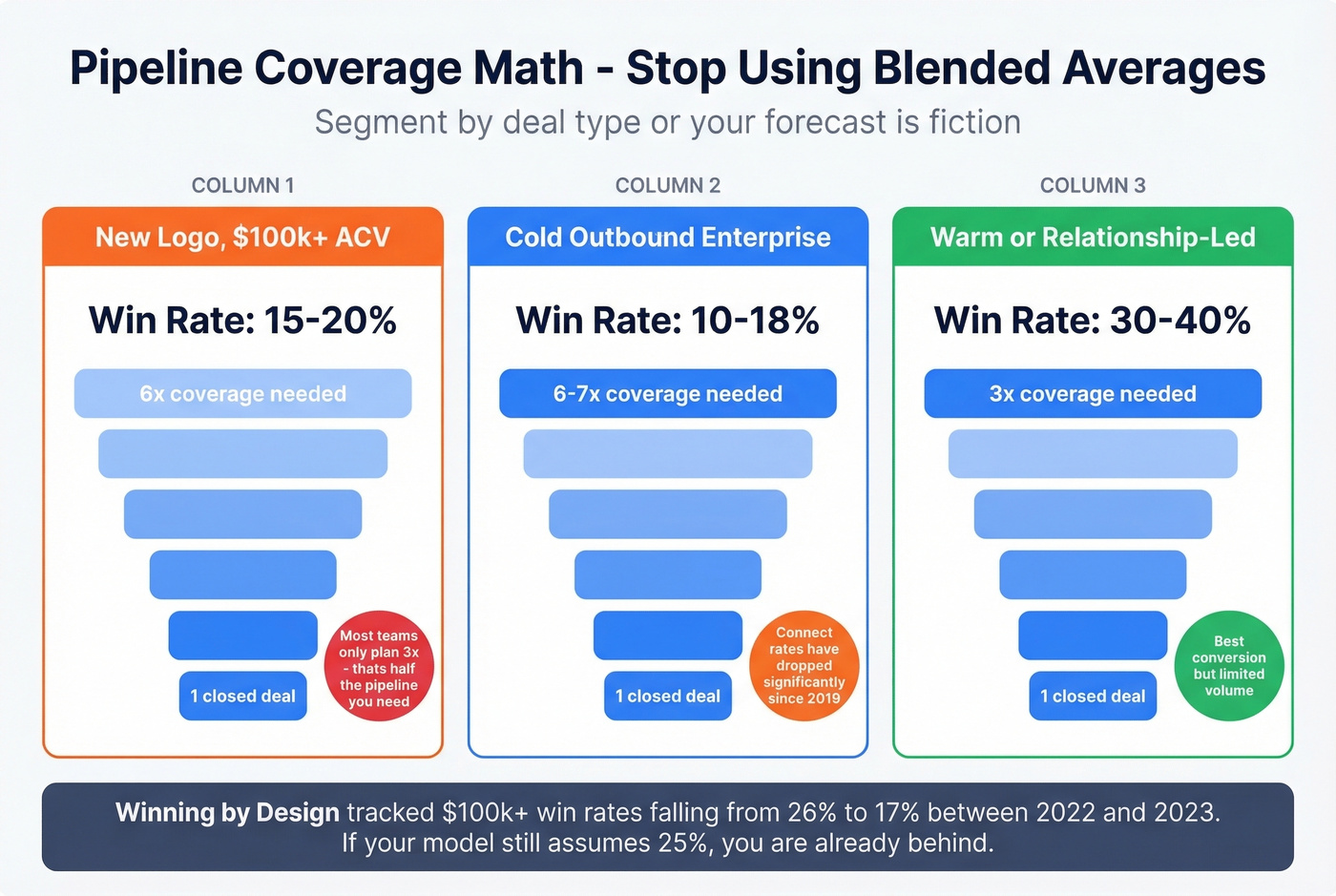
| Scenario | Win Rate Range |
|---|---|
| $100k+ ACV, new logo | 15-20% |
| Cold outbound enterprise | 10-18% |
| Warm / relationship-led | 30-40% |
For context, Winning by Design tracked $100k+ ACV win rates falling from 26% to 17% between 2022 and 2023. The teams that survive this compression are the ones segmenting win rates by new logo vs. expansion, inbound vs. outbound, and deal size. Blended averages hide risk - a 21% overall win rate tells you nothing about where your pipeline is actually leaking.
Let's be honest about what a sound enterprise sales strategy looks like in 2026. It isn't one silver-bullet tactic. It's the compounding effect of disciplined qualification, early multi-threading, realistic pipeline math, and data clean enough to actually execute on all three (sales execution).
Snyk's 50 AEs cut bounce rates from 35-40% to under 5% and grew AE-sourced pipeline 180% with Prospeo. When enterprise cycles run 170-270+ days, bad data doesn't just waste time - it kills deals. A 7-day refresh cycle means your stakeholder data stays current through the entire cycle.
Stop losing enterprise deals to stale data and bounced emails.
FAQ
How long is a typical enterprise sales cycle?
Enterprise sales cycles range from ~120 to 270+ days depending on ACV. Deals in the $50-100k range typically close in ~120 days, while $500k+ deals often exceed 270 days. Overall, cycles are 22% longer than they were in 2022, so pipeline planning should reflect current timelines - not the assumptions your team built quotas around two years ago.
What is MEDDPICC in enterprise sales?
MEDDPICC is a deal qualification framework covering Metrics, Economic Buyer, Decision Criteria, Decision Process, Paper Process, Implicate the Pain, Champion, and Competition. 73% of SaaS companies selling above $100k ARR use it, reporting 18% higher win rates and 24% larger deal sizes on average.
How do you multi-thread an enterprise deal?
Map Economic Buyers, Technical Buyers, Champions, and Blockers from week one, then engage each with a tailored value message. Deals with 5+ stakeholder relationships see a 4.7x win rate increase. The hard part isn't knowing this - it's having verified emails and direct dials for every committee member so you can actually reach them.
What pipeline coverage do enterprise teams need in 2026?
Most enterprise teams need 5-6x pipeline coverage for new-logo deals above $100k ACV, where win rates sit around 15-20%. Warm or relationship-led deals convert at 30-40%, requiring only 3x coverage. Segment your coverage ratios by deal source and size - blended averages hide risk.