

How to Turn Event Leads Into Pipeline (Not Spreadsheet Ghosts)
It's Monday morning after the conference. Your team scanned 300 badges. The spreadsheet is sitting in someone's inbox - unsorted, unscored, already going stale. By Friday, sales will have cherry-picked a dozen names, marketing will claim 300 "leads," and the other 288 will quietly die in your CRM. That spreadsheet cost you roughly $243,000 at $811 per trade show lead. And 80% of those leads won't convert to customers.
Event lead conversion is the gap between those badge scans and actual revenue. Most teams ignore it entirely.
The distance between "leads captured" and "pipeline created" isn't a mystery. It's a systems problem - and it's fixable. Collecting names at a booth is lead generation. Turning those names into pipeline is conversion. Most teams only invest in the first half.
Here's the short version: capture context at the booth, not just badge data - challenge, timeline, next step. Score and route leads before you leave the venue so hot leads get same-day outreach. And verify contact data before your first email, because badge scans are incomplete and often stale.
2026 Benchmarks: What Good Looks Like
Before you can fix your conversion system, you need to know where the bar sits.
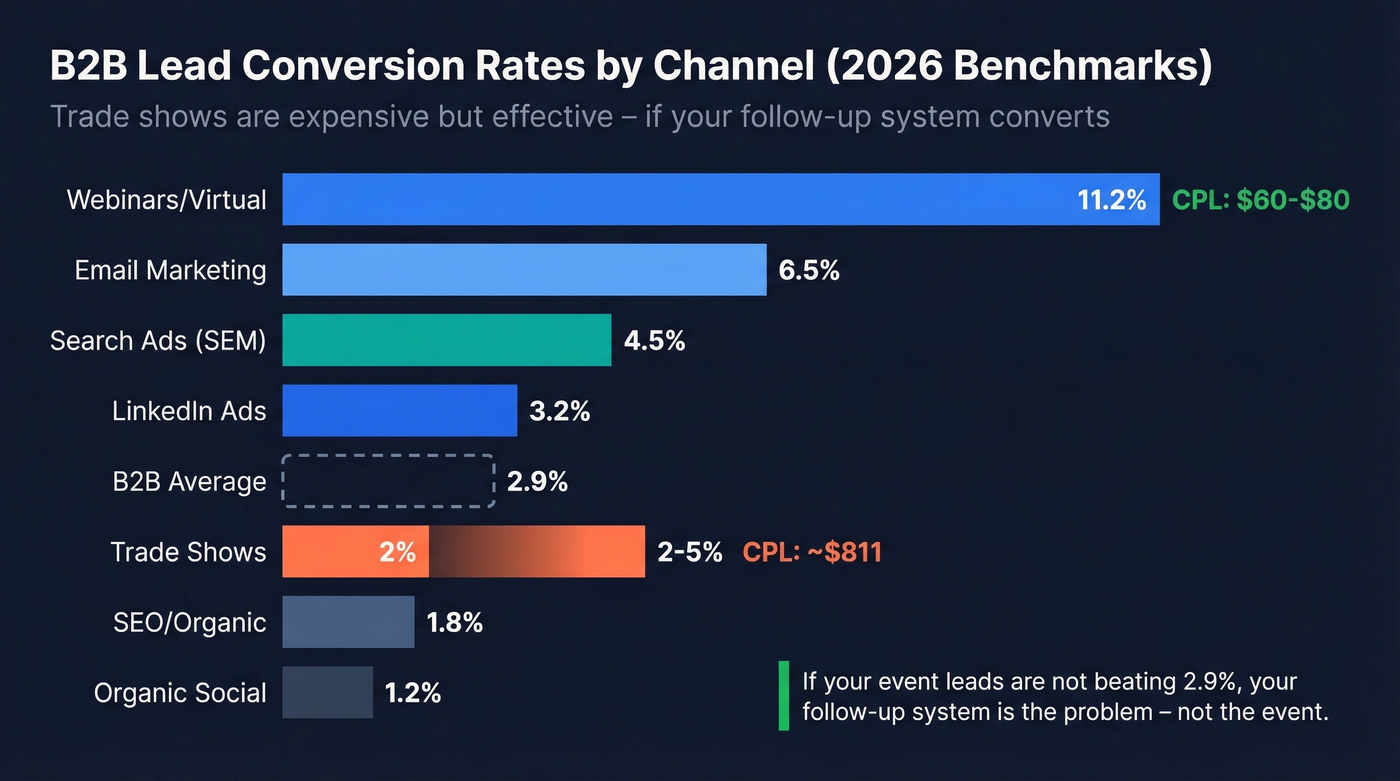
| Channel | Avg. Conversion Rate | Avg. CPL |
|---|---|---|
| Webinars / Virtual | 11.2% | $60-$80 |
| Email Marketing | 6.5% | - |
| Search Ads (SEM) | 4.5% | ~$92 |
| LinkedIn Ads | 3.2% | - |
| B2B Average (all) | 2.9% | - |
| SEO / Organic | 1.8% | - |
| Organic Social | 1.2% | - |
| Trade Shows (in-person) | 2-5% (qualified) | ~$811 |
Webinars and virtual events punch well above their weight on conversion rate and cost. In-person trade shows are one of the most expensive channels, but they're also rated 3.9 out of 5 for significance by B2B marketers, and webinar attendance climbed 20% recently. The channel isn't dying. But the ROI math only works if your post-event system converts.
If your event leads aren't beating the baseline B2B conversion rate of 2.9%, the event usually isn't the problem. Your follow-up system is.
Why Most Teams Fail Post-Event
Two killers account for most of the waste.
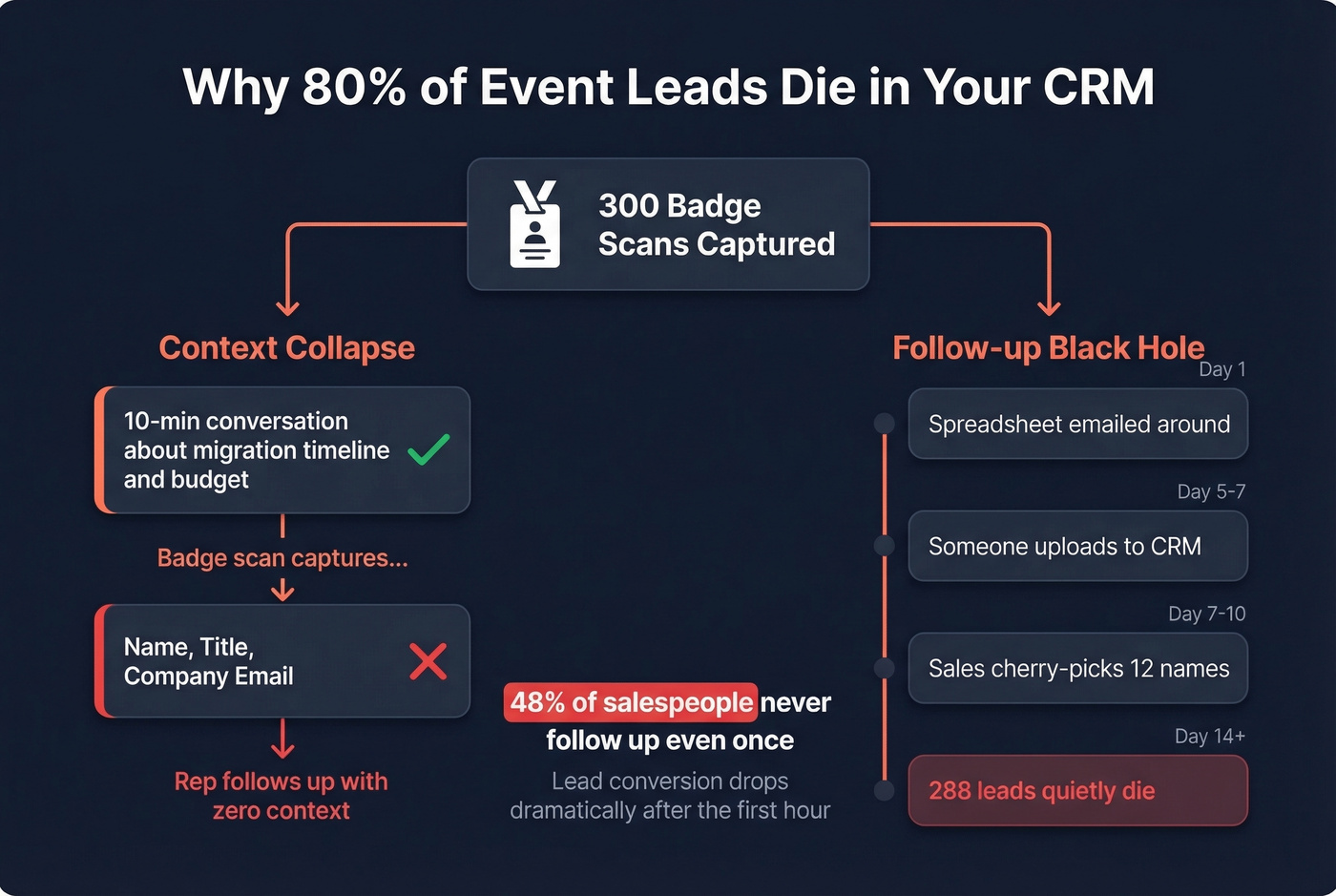
Context collapse happens when a badge scan strips away everything that made the conversation valuable. Your rep had a 10-minute discussion about the prospect's migration timeline and budget frustrations - then scanned a badge that captured a name, title, and company email. Three days later, that lead hits the CRM with zero context. The rep who follows up has nothing to work with.
The follow-up black hole is even more common. Less than 70% of exhibitors have a formal process for converting trade show leads into pipeline. The spreadsheet gets emailed around. Someone uploads it to the CRM next week. By then, the window is closed.
Your chance of converting a lead drops dramatically after the first hour and is largely gone after 24 hours. Meanwhile, 48% of salespeople never follow up even once, and 60% of customers say no four times before saying yes. Speed matters, persistence matters, and most teams fail at both.
We've all been to the post-event debrief where marketing says "we captured 400 leads" and sales says "none of them were qualified." That disconnect is a symptom of these two failures working together.
Before the Event: Set Up to Convert
The conversion system starts before you book the booth.
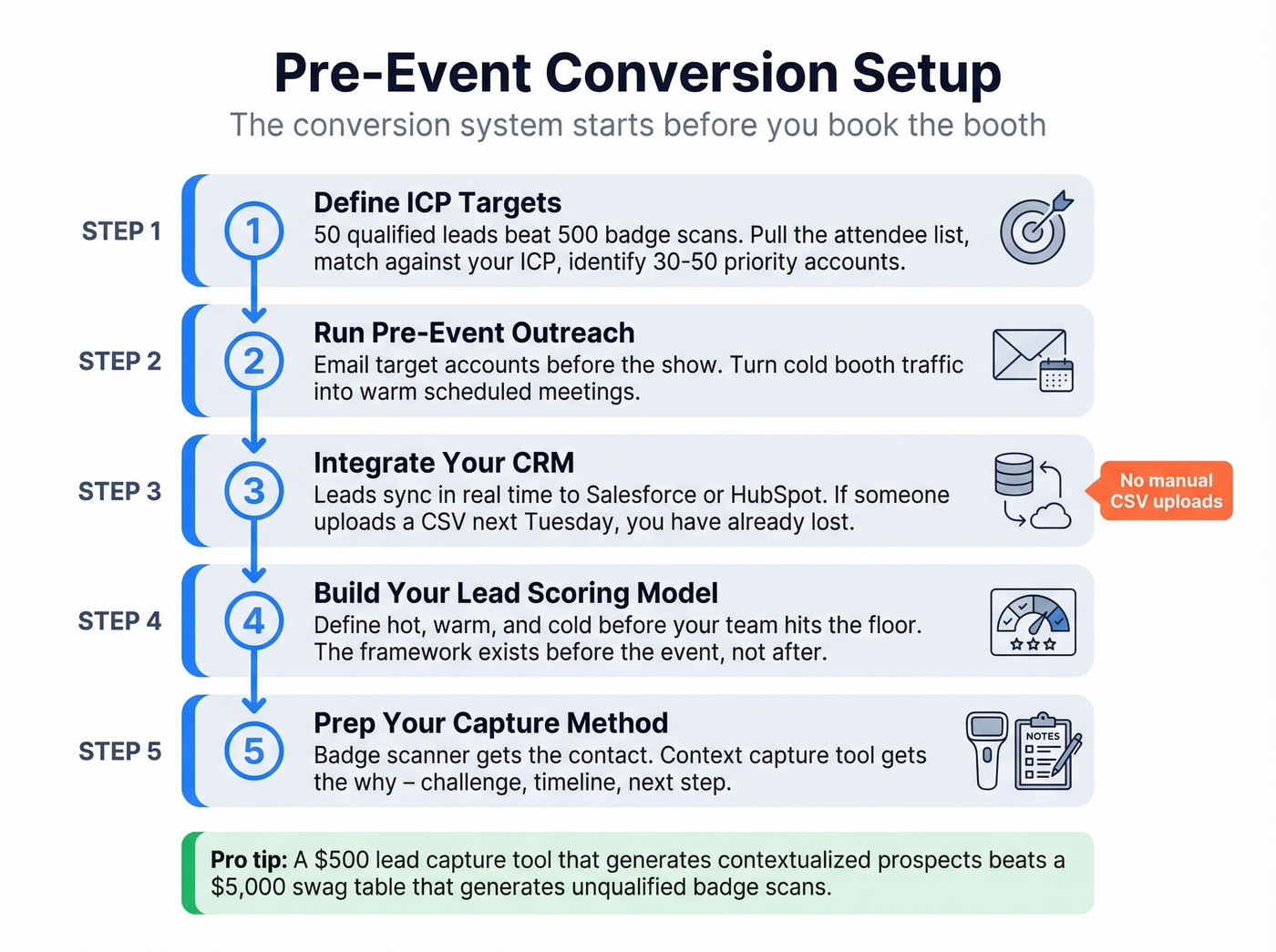
- Define your ICP targets. Fifty qualified leads beat 500 badge scans. Pull the attendee list, match it against your ICP, and identify the 30-50 accounts your team should prioritize.
- Run pre-event outreach. Email or message target accounts before the show. "We'll be at booth 412 - let's grab 15 minutes to talk about [specific challenge]." This turns cold booth traffic into warm meetings.
- Integrate your CRM before the show. Leads should sync in real time to Salesforce, HubSpot, or whatever you're running. If your badge scanner exports a CSV that someone uploads manually next Tuesday, you've already lost.
- Build your lead scoring model. Define what "hot," "warm," and "cold" mean before your team hits the floor. The framework needs to exist before the event, not after.
- Prep your capture method. Badge scanner plus a context capture tool. The scanner gets the contact; the context tool gets the why.
Let's be honest about swag budgets: a $5,000 swag table that generates unqualified badge scans is a worse investment than a $500 lead capture tool that generates contextualized prospects. If you do bring swag, tier it - generic items for cold traffic, premium items for qualified prospects who complete a demo request.
During the Event: Capture Context, Not Contacts
Stop measuring event success by leads collected. A booth that captures 50 qualified, contextualized leads will outperform one that scans 500 badges every single time.
Do this:
Capture 2-3 data points per conversation: what challenge they're facing, their timeline, and the agreed next step. Tag these directly in your capture tool. Tier leads in real time - A = decision-maker with clear need who requested a demo, B = influencer with interest worth nurturing, C = took swag with low intent.
Use the "instant capture" workflow: snap a photo of the business card or badge, push it to your CRM via automation, and trigger a personalized intro email while you're still at the event. One practitioner on r/b2bmarketing described routing card photos through a bot that auto-extracts details and sends a personalized intro within minutes. That's the standard to aim for.
Skip this if you're short on time: Don't rely on the organizer's lead retrieval system alone. Badge scanner rentals run $300-$600 per show, and they often lock you into the organizer's export timeline. Supplement with your own capture method. And don't use forms with more than 3 fields. Three-field forms convert 27% better than five-field forms. Name, email, and one qualifier is enough - enrich the rest later.
In our experience, teams that score leads in real time at the booth convert at 2-3x the rate of teams that sort leads after the event. The difference isn't talent. It's system design.
Lead capture software runs $99-$299 per event or $500-$2,000/year on subscription. If each lead costs $811 to acquire, spending $99 on better capture is the highest-ROI line item in your event budget.

Badge scans give you names and titles. Prospeo gives you verified emails, direct dials, and 50+ data points per contact. Upload your event CSV and get 83% of leads back enriched - with 98% email accuracy and 125M+ verified mobile numbers. At $0.01 per email, enriching 300 event leads costs less than a single booth giveaway.
Stop letting $811-per-lead contacts rot in a spreadsheet.
Event Lead Scoring Template
Lead scoring isn't optional for events. Without it, your sales team treats every badge scan the same - and they shouldn't. Companies using lead scoring report up to 30% higher conversion rates and 25% larger deal sizes.
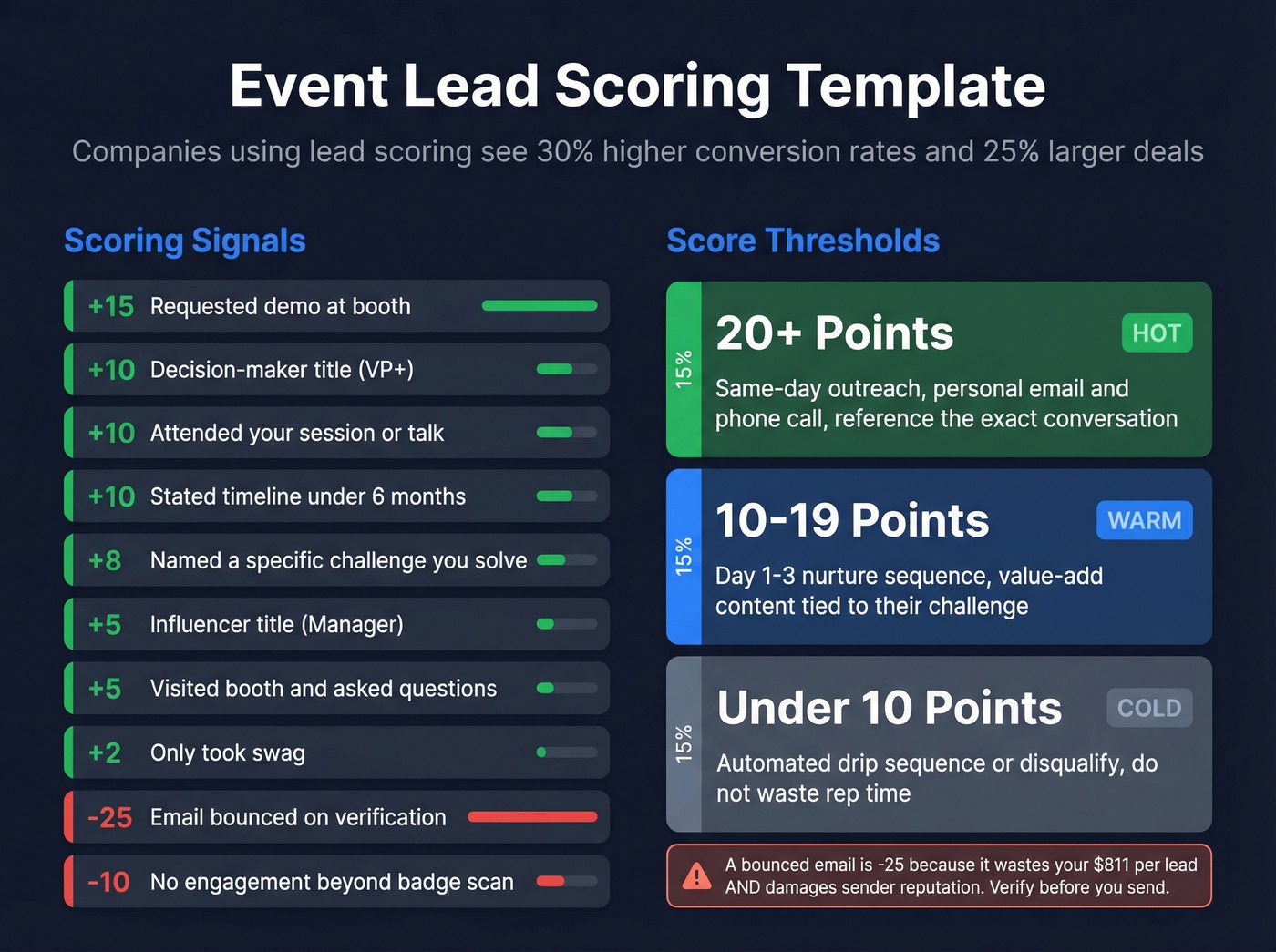
| Signal | Points |
|---|---|
| Requested demo at booth | +15 |
| Decision-maker title (VP+) | +10 |
| Attended your session/talk | +10 |
| Stated timeline (< 6 months) | +10 |
| Named a specific challenge you solve | +8 |
| Influencer title (Manager) | +5 |
| Visited booth, asked questions | +5 |
| Only took swag | +2 |
| Email bounced on verification | -25 |
| No engagement beyond badge scan | -10 |
Thresholds: 20+ points = hot (same-day outreach). 10-19 = warm (Day 1-3 nurture). Under 10 = cold (drip sequence or disqualify).
The negative scoring matters as much as the positive. A bounced email is a -25 because it means your follow-up won't land at all - and it damages your sender reputation. Enrichment tools add the data points that make scoring accurate: verified title, company size, and intent signals that a badge scan simply doesn't capture.
After the Event: The Follow-Up System
This is where pipeline gets created or destroyed. The 24-48 hour follow-up window that most guides recommend is already too late for hot leads. Same-day is the standard.
The Post-Event Email Cadence
| Timing | Action | Channel | Content |
|---|---|---|---|
| Day 0 | Hot leads - personal outreach | Email / Phone | Reference exact conversation, propose next step |
| Day 1 | Thank-you to all leads | Event reference, one resource, single CTA | |
| Day 3 | Value-add | Email + Social | Case study tied to their stated challenge |
| Day 7 | Direct ask | Email + Phone | Demo/meeting offer with specific time slots |
| Day 14 | Final touch | "Closing the loop" - no pressure |
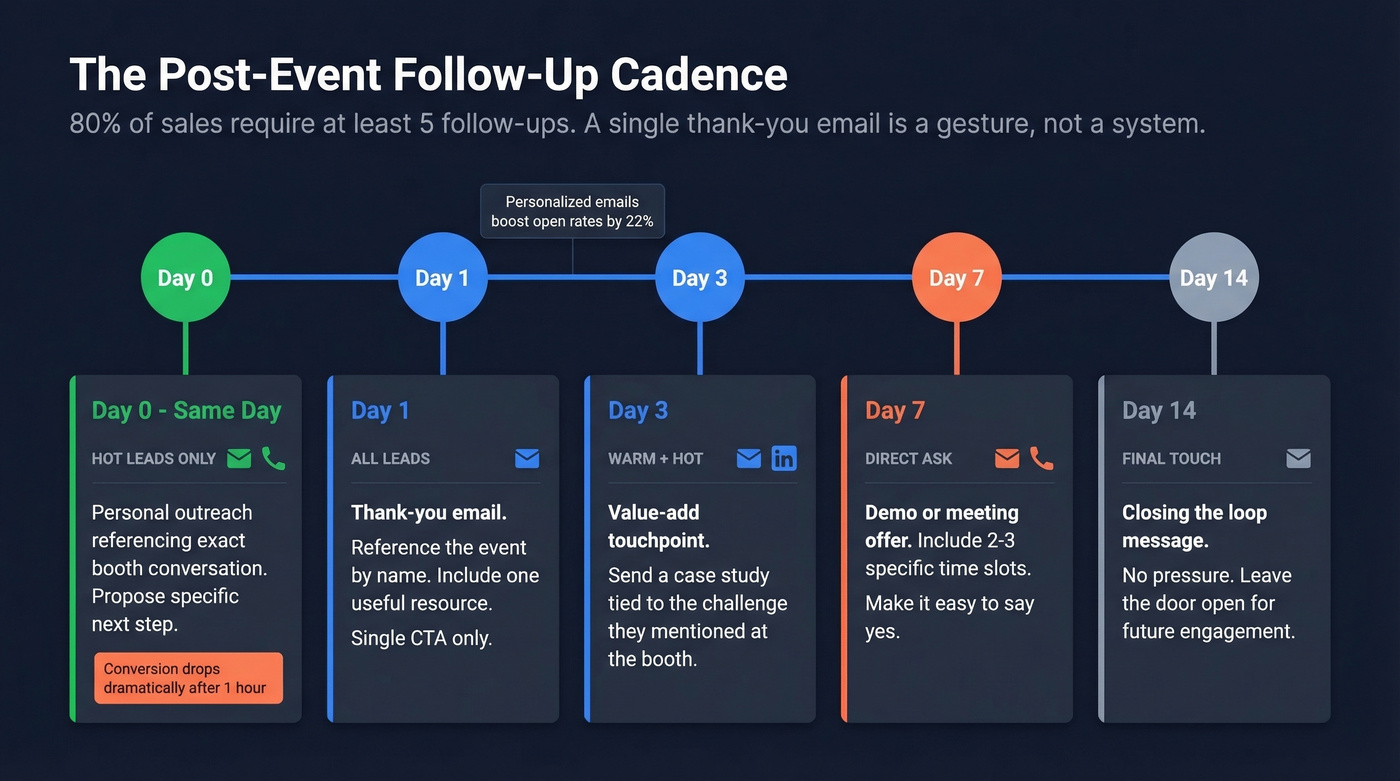
Personalized emails boost open rates by 22%. And 80% of sales require at least five follow-ups, so a single thank-you email isn't a follow-up system. It's a gesture.
Fix the Data Before You Send
Here's where most event follow-up falls apart. Badge scans give you a name and company. They don't give you a verified email, a direct dial, or any context on the prospect's tech stack or buying intent.
Before you launch this cadence, enrich and verify your list. Upload your event CSV to Prospeo and get back verified emails at 98% accuracy, direct dials from 125M+ verified mobiles, and 50+ data points per contact - title, company size, intent signals, and more. The 7-day data refresh cycle means you're working with current data, not whatever was accurate when the prospect registered for the event six months ago.
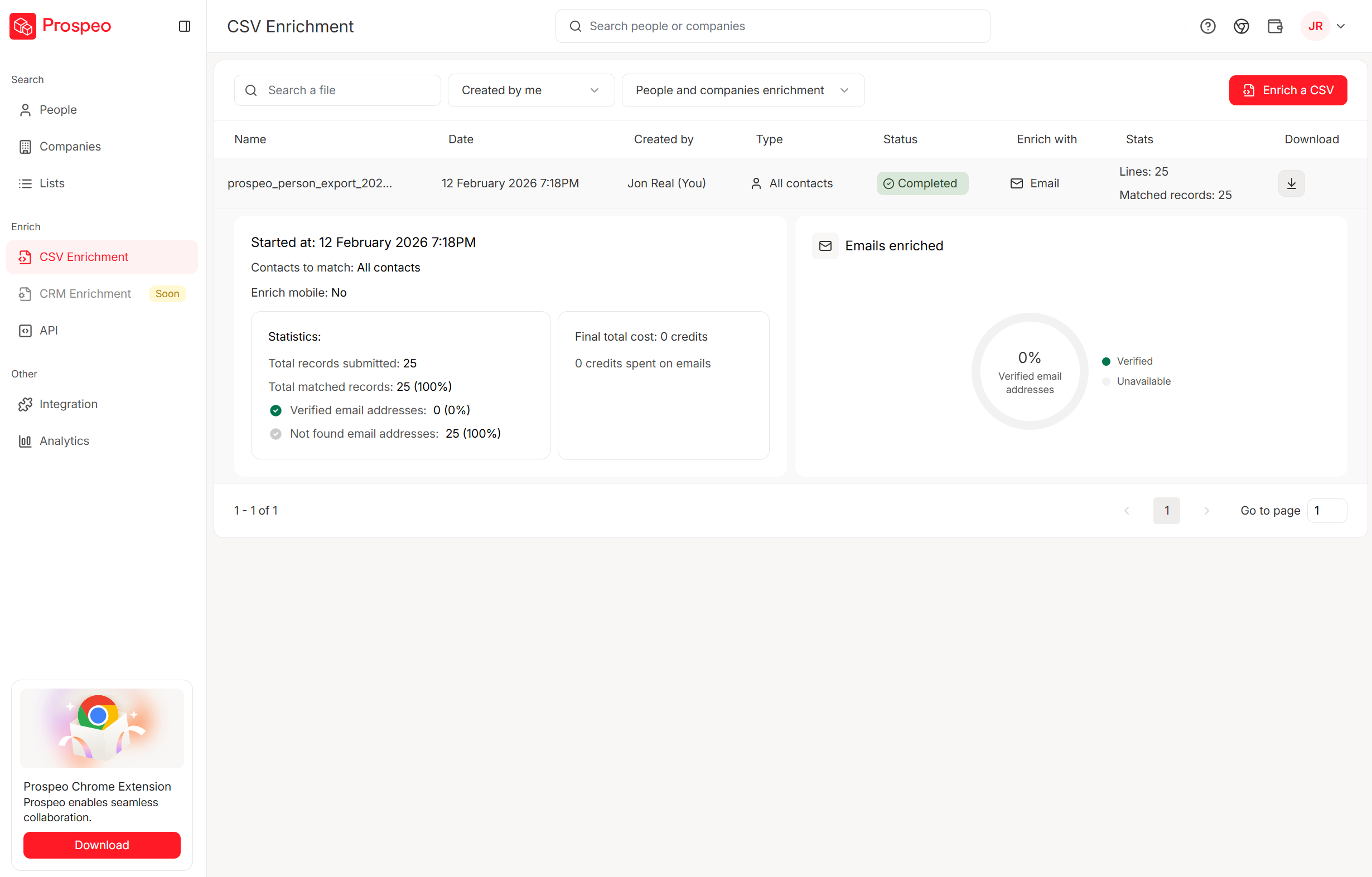
Meritt went from a 35% bounce rate to under 4% - and tripled weekly pipeline from $100K to $300K - after running their outreach lists through verification before the first send. When each lead costs $811 to acquire, a 35% bounce rate means you're wasting about $284 per lead on average before you even get a chance to sell.
Subject Lines and CTAs
Keep subject lines tied to the event and the specific conversation: "Following up from [Event] - your [challenge] question" outperforms generic "Great meeting you!" every time. One CTA per email. Don't ask them to read a case study, book a demo, and follow you on social in the same message.
If you want a swipe file, pull from these sales follow-up templates and adapt them to your event context.
Hot take: If your average deal size is under $15K, you probably don't need a $50,000 trade show booth. Run three targeted dinners instead. The math favors intimate, high-context interactions over mass badge scanning at every price point below enterprise.
From Awareness to Demo Conversion
Not every event lead is ready to buy. Many are still in the awareness stage - they stopped by your booth, attended your talk, or grabbed a resource, but they haven't expressed direct purchase intent.
For warm leads scored 10-19, build a 3-touch sequence that moves them from education to action: a relevant case study on Day 3, a short video walkthrough on Day 7, and a direct demo offer on Day 10. For products under $500/month where buying friction is low, route warm leads to a self-serve trial with in-app onboarding rather than forcing them onto a sales call.
The goal is to match the follow-up channel to the intent level. A decision-maker who requested a demo at the booth gets a phone call. An influencer who attended your session gets a nurture sequence. Treating them the same is how you burn both.
You captured context at the booth. Now you need contact data that actually works. Prospeo's CRM enrichment returns verified emails and direct dials with a 92% match rate - refreshed every 7 days, not 6 weeks. Your follow-up hits inboxes on day one, not bounce logs on day five.
Turn 300 badge scans into 300 verified contacts before Friday.
Measuring Event ROI
The formula is straightforward:
ROI (%) = (Total Revenue - Total Costs) / Total Costs x 100
The hard part is attribution. Which model you use depends on the event type:
- First-touch attribution works for brand awareness events where the goal is net-new pipeline. The event gets credit for sourcing the lead.
- Lead-touch attribution fits conferences where you're accelerating existing opportunities. The event gets credit for the conversion moment.
- W-shaped attribution splits credit across first touch, lead creation, and opportunity creation - best for multi-touch campaigns where events are one of several channels.
Common pitfalls include data silos between your event platform and CRM, delayed results from enterprise deals that close months after the event, and multi-channel complexity where the prospect also clicked an ad and read three blog posts. UTM parameters on every event-related link help, but they won't solve the attribution problem entirely. Pick a model, apply it consistently, and accept that event ROI measurement is directional, not precise.
If you can't connect event leads to closed revenue in your CRM, none of the upstream work matters. Build the tracking before the event, not during the post-mortem.
FAQ
What's a good event lead conversion rate?
Webinars and virtual events average 11.2% conversion to qualified leads. In-person trade shows range 2-5%. If your event leads aren't beating the baseline B2B rate of 2.9%, your follow-up system is usually the bottleneck - not the event itself.
How fast should you follow up after an event?
Hot leads - demo requests, decision-makers with stated timelines - need same-day outreach. All other leads should get a personalized thank-you within 24 hours. Conversion probability drops dramatically after the first hour. Speed is the single biggest lever.
How do you handle bounced emails from event lead lists?
Badge-scan data is often incomplete or outdated. Run your list through an enrichment and verification tool before sending. Prospeo's CSV enrichment returns 98% accurate emails and can cut bounce rates from 35% to under 4%, protecting both your pipeline and sender reputation.
What's the difference between lead generation and lead conversion at events?
Lead generation is capturing contact information - badge scans, form fills, card exchanges. Lead conversion is everything after: scoring, enriching, following up, and turning contacts into qualified opportunities. Most teams over-invest in generation and under-invest in conversion, which is why 80% of event leads never become customers.