

12 Sales Pitch Presentation Examples You Can Actually Steal
It's Sunday night. You're staring at a blank deck, the prospect call is Tuesday morning, and the "template" marketing gave you is 30 slides of logo soup and feature tables. Reps spend 5-10 hours preparing a single pitch. Investors spend under 3 minutes reviewing an entire deck. The average B2B conversion rate sits at 2.9% across 100M+ data points.
These 12 examples of sales pitch presentation decks are built to steal, adapt, and send - not admire from a distance.
The Quick Version
The 7-slide framework - Problem, Cost, Cause, Solution, How it works, Proof, Next steps - works for 90% of B2B pitches. Spend 70% of your presentation time on the problem, not the solution. Keep it to 8-14 slides. Personalize every deck, or don't bother sending it. Canva at $12.99/mo handles design; a good B2B database handles the prospect data that makes personalization real.
What Makes a Sales Pitch Work
Most failed pitches share the same root cause: they're about you. HBR research found the most common storytelling mistake in sales is centering the narrative on your company's strengths instead of the buyer's obstacles. Emotional connection built by listening to pain points closes deals. Technical jargon just shrinks your audience.
The best presentations share six components:
- Hook - a stat, question, or scenario that earns the next 30 seconds
- Problem - framed from the buyer's perspective, not yours
- Value proposition - the outcome you deliver, in one sentence
- Solution - how it works, briefly
- Proof - case studies, numbers, logos
- CTA - one clear next step, not three
The buyer is the hero of this story, not your product. Pitch.com's framework nails this - the deck narrates the buyer's journey from problem to success, with your solution as the tool that gets them there. Decks that combine narrative with data-backed insights are 27% more likely to receive follow-up inquiries. Feature dumps get forwarded to the archive folder.
One stat worth internalizing: 67% of buyers prefer self-service over speaking to a rep. Your deck needs to work without you in the room. If it can't stand alone, it's a crutch, not a presentation.
The 7-Slide Framework
This is your default structure. It works for first calls, expansion pitches, and leave-behind decks. Adapt it, but don't skip the bones.
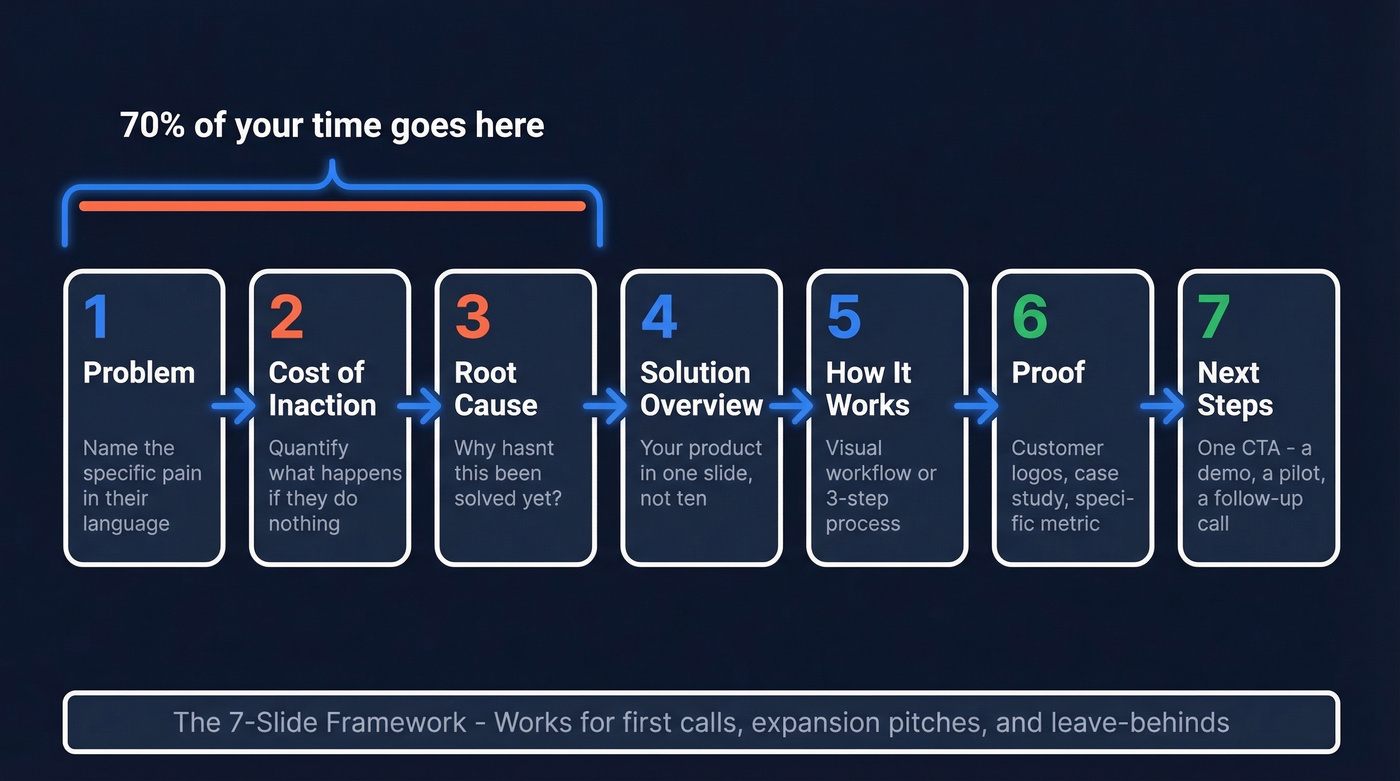
- Problem - Name the specific pain your buyer faces. Use their language, not yours.
- Cost of inaction - Quantify what happens if they do nothing. Lost revenue, wasted hours, churn risk.
- Root cause - Why hasn't this been solved yet? This is where you earn credibility.
- Solution overview - Your product, in one slide. Not ten.
- How it works - A visual workflow or 3-step process. Keep it scannable.
- Proof - Customer logos, a case study snippet, a specific metric.
- Next steps - One CTA. A demo, a pilot, a follow-up call. Not "let us know."
Spend roughly 70% of your time on slides 1-3. If the audience doesn't feel the problem deeply, your solution slides won't land.
For slide count benchmarks, you'll see everything from Intercom's 8-slide minimalist deck to Kolide's 14-slide deck to Asana's 40+ slide enterprise overview. The sweet spot for most B2B deals is 8-14. In our experience, the 7-slide framework closes more deals than any 30-slide monster ever will.
12 Pitch Presentation Examples
Opening and Elevator Pitches
Practitioners on r/smallbusiness are blunt about this: keep your opening pitch under 150 words. The micro-structure is simple - open with a short story about the client's pain point, share your unique approach, then land on a clear next step. Think of it as a one-page sales pitch distilled to its essence.
Example 1 - The cold email opener: "Your SDR team is spending 4 hours a day on manual research before they make a single call. We cut that to 20 minutes for [similar company]. Worth a 15-minute look?"
Example 2 - The phone opener: "Hi [Name], I noticed [Company] just opened a second office in Austin - congrats. Quick question: how's your team handling [specific pain] as you scale?"
Example 3 - The 30-second elevator pitch: "We help mid-market SaaS companies reduce churn by identifying at-risk accounts 60 days before renewal. Our customers see 23% lower churn in the first two quarters. Can I show you how it works for [your vertical]?"
Personalize each line with the prospect's name or a specific detail. Mass-mailed pitches get deleted.
Full Presentation Decks
Example 4 - Zuora (narrative-first). Andy Raskin's breakdown is the most referenced pitch framework in B2B. No product mention until slide 4. Opens with "the subscription economy" as a market shift, builds tension through winners and losers, then positions features as tools to reach the promised land. Use this if you're selling into a market undergoing a genuine shift. Skip it if the shift is manufactured - when every vendor opens with "the world is changing," nobody stands out.
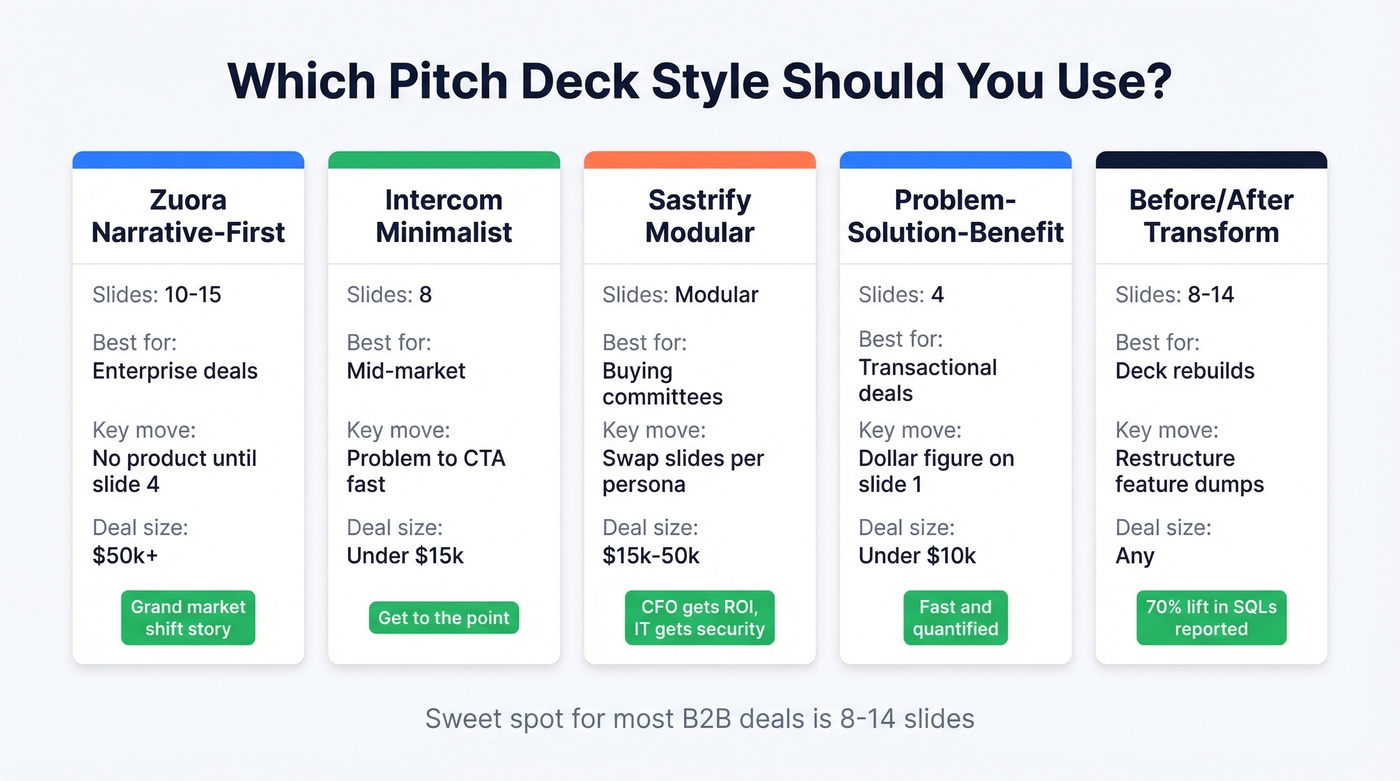
Example 5 - Intercom (minimalist). Eight slides. Problem, solution, three features, social proof, pricing, CTA. Proof that you don't need 30 slides to close a deal. If your product is straightforward, this is the template to steal.
Here's my hot take: if your deal size is under $15k, the Intercom model beats the Zuora model every time. Save the grand narrative for enterprise deals where the buying committee needs to feel a market shift. For mid-market, get to the point.
| Example | Slides | Best For | Key Move |
|---|---|---|---|
| Ex. 6 - Sastrify | Modular | Buying committees | Swappable slide modules per persona: Finance gets cost savings, Procurement gets vendor consolidation, IT gets security |
| Ex. 7 - Problem-Solution-Benefit | 4 | Transactional deals | Slide 1 names the problem with a dollar figure, Slide 4 quantifies the benefit with a case study |
| Ex. 8 - Before/After Transformation | 8-14 | Deck rebuilds | Take a feature-dump deck and restructure using the 7-slide framework |
Storydoc reports that restructured presentations drove a 70% lift in SQLs in one case, 2x more demos in another, and were shared internally by prospects 50% of the time. Structure matters more than design.
Email and Async Pitches
Example 9 - Dynamic variable deck. The Udemy/Storydoc approach uses personalization tokens like [Company], [Pain Point], and [Metric] so each recipient sees a deck tailored to them. Pair this with embedded video and speaker notes so the deck tells the story without a presenter.
Example 10 - The video-embedded leave-behind. Video has convinced 82% of customers to buy products and services. Add a 60-second walkthrough to every async pitch - the prospect watches on their own time, you get view tracking, and the pitch feels personal without requiring a live meeting.
Video Pitch Presentations
Example 11 - Loom-style async walkthrough. Record a 2-3 minute narration over your key slides. Share the link instead of attaching a PDF. Larger fonts, high contrast, minimal text per slide. Build the deck to work without you.
Example 12 - The interactive virtual pitch. Embed polls, clickable sections, or branching paths so the prospect controls the flow. This format works best for complex products where different stakeholders care about different features. For simpler deals, it's overkill - stick with Examples 5 or 11.

Every example above says the same thing: personalize or get deleted. Personalization requires real prospect data - job titles, company signals, verified emails. Prospeo gives you 300M+ profiles with 30+ filters so every deck you send speaks directly to the buyer's world.
Stop pitching blind. Start with data that makes every slide land.
How to Personalize Every Deck
Here's where most teams fall apart. The deck is solid, the framework is right, but every prospect gets the same version. As one r/sales commenter put it, reps either over-invest in editing or do zero personalization - there's no middle ground. The thread also highlights a common org tension: deck ownership sits with reps, marketing, or sales enablement, and when nobody owns it, nobody personalizes it.
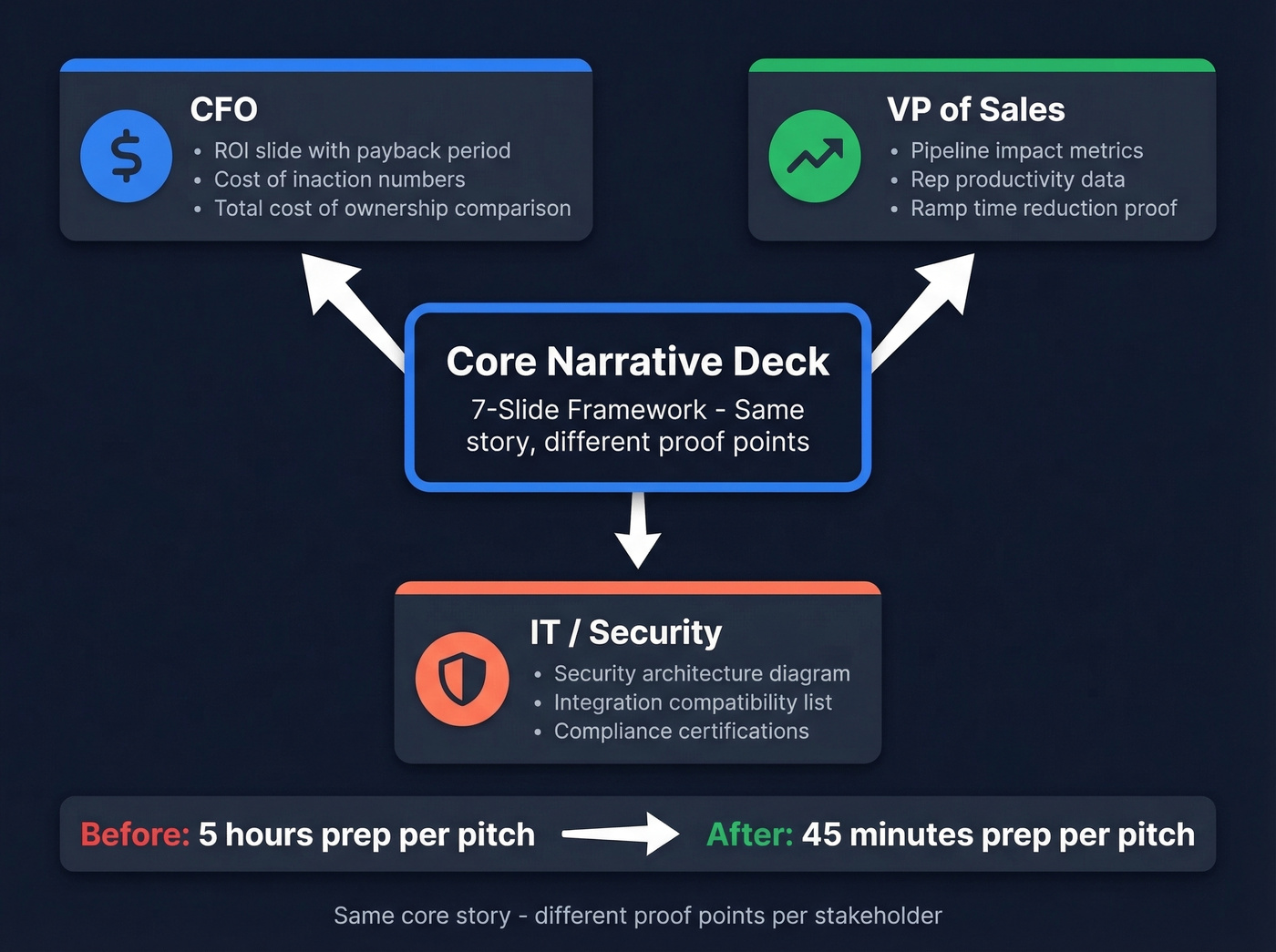
The fix is modular decks with swappable slides per persona. A CFO gets the ROI slide and the cost-of-inaction numbers. A VP of Sales gets pipeline impact and rep productivity data. IT gets the security architecture and integration diagram. Same core narrative, different proof points. We've seen teams cut pitch prep from 5 hours to 45 minutes by going modular.
But the upstream problem is worse than the deck itself. Personalization fails when your prospect data is stale - you're tailoring a pitch to someone who changed roles two months ago. Before you personalize a single slide, confirm you're pitching the right person with a B2B database that refreshes weekly, not every 4-6 weeks.

You just spent hours building the perfect pitch deck. Don't waste it on bounced emails and wrong contacts. Prospeo's 98% email accuracy and 7-day data refresh mean your deck reaches the actual decision-maker - not their predecessor who left six months ago.
Great pitches deserve verified contacts. Get them at $0.01 each.
Mistakes That Kill Your Pitch
Look, you're investing 5-10 hours per pitch. Don't waste it on these.
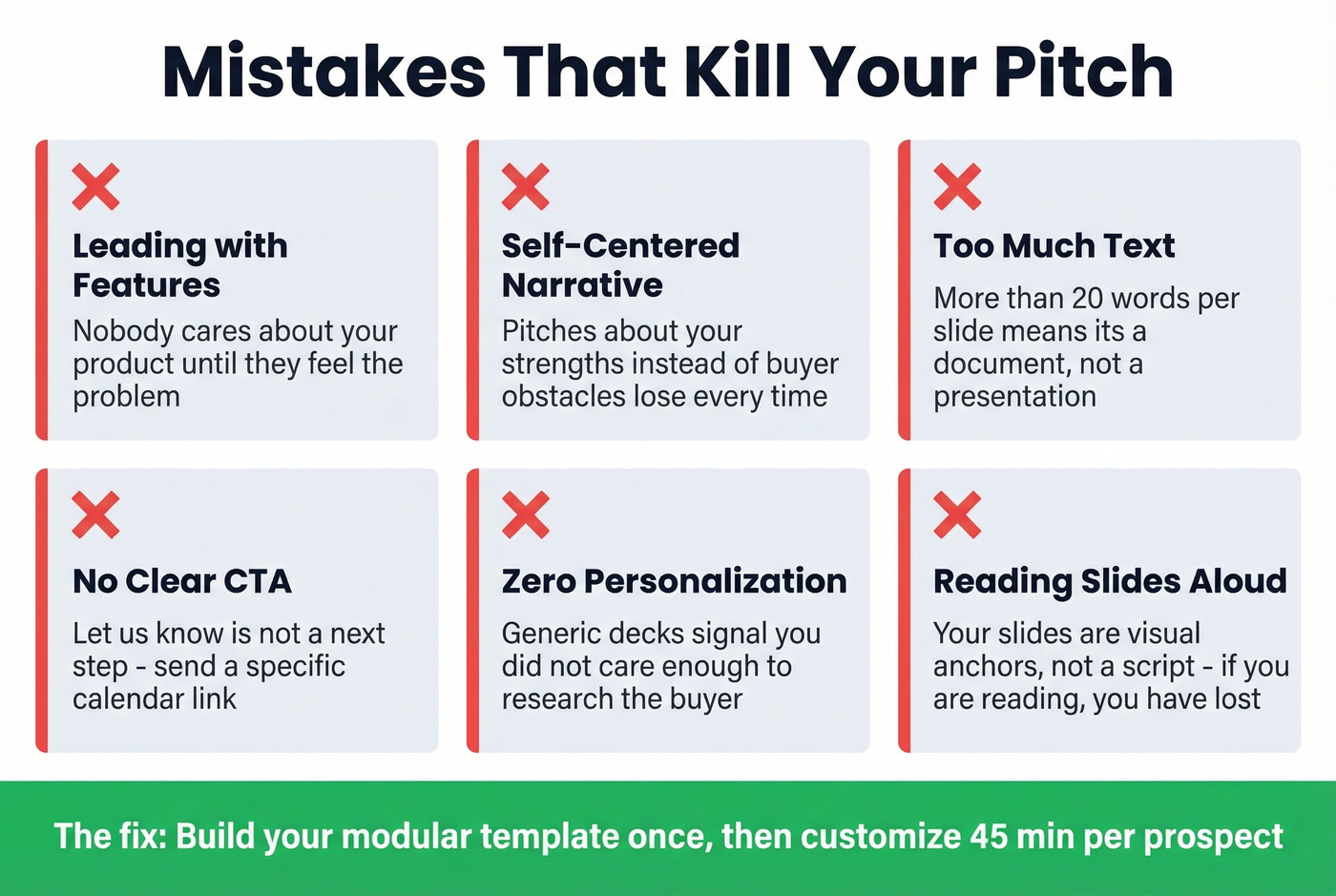
Leading with features. Nobody cares about your product until they feel the problem. Flip the order.
Self-centered narrative. HBR's top finding: pitches that center on your company's strengths instead of the buyer's obstacles lose. Every time.
Too much text and jargon. If a slide needs more than 20 words, it's a document, not a presentation. Cut ruthlessly.
No clear CTA. "Let us know what you think" isn't a next step. "I'll send a calendar link for Thursday at 2pm" is.
Last-minute deck prep. Sunday-night decks look like Sunday-night decks. Build your modular template once, then customize per prospect.
Zero personalization. A generic deck signals you don't care enough to research the buyer. They'll return the favor by not responding.
Reading slides aloud. Your slides are visual anchors, not a script. If you're reading bullet points, you've already lost the room.
Skipping the company overview. A brief slide establishing who you are and why you're credible - two sentences, not two paragraphs - gives the buyer context before you get into the solution.
Aligning Your Sales Plan and Pitch
A common disconnect: the sales plan says you're targeting mid-market fintech, but the pitch deck still uses generic SaaS examples. Your sales plan and sales pitch should share the same ICP definition, value props, and competitive positioning. When they're misaligned, reps improvise - and improvisation at scale produces inconsistent messaging that confuses buyers.
Review your pitch deck every quarter against your current sales plan to make sure the story matches the strategy. We do this internally and it catches drift every single time.
Tools for Building Pitches
| Tool | Function | Starting Price |
|---|---|---|
| Prospeo | Prospect data + verification | Free tier / ~$0.01/email |
| PlusAI | AI slide generation | $10/user/mo |
| Canva Pro | Design + templates | $12.99/mo |
| Pitch | Collaborative decks | Free / $25/mo Pro |
| Beautiful.ai | Smart formatting | $40/user/mo |
| Loom | Video pitches | Free tier |
Start with Canva or PlusAI for the visual layer - they'll handle design without a designer. Use Loom for async video pitches. For the data layer that makes personalization possible, Prospeo gives you 30+ search filters including buyer intent and technographics, with 98% email accuracy on a 7-day refresh cycle. Teams like Snyk saw AE-sourced pipeline jump 180% after switching to verified contact data - the kind of lift that makes every slide in your deck hit harder.
If you want to tighten the rest of the motion around the deck, pair these slides with sales follow-up templates and a repeatable sales prospecting techniques workflow.
FAQ
How many slides should a sales pitch have?
Eight to fourteen works for most B2B deals. Intercom's deck runs 8 slides, Kolide uses 14. Go past 15 and you're losing attention - investors spend under 3 minutes reviewing an entire deck.
What's the difference between a pitch deck and a sales deck?
A pitch deck raises money from investors; a sales deck sells your product to buyers. Different audiences, different goals, different slide structures. A business plan pitch aimed at VCs emphasizes market size and return potential, while a sales deck focuses on the buyer's pain and your solution.
How do you personalize a sales presentation at scale?
Build a modular deck with swappable slides per persona - CFO, VP Sales, IT. Use a B2B database with verified prospect data (intent signals, technographics, headcount) so each version speaks to what that buyer actually cares about. Teams using this approach cut prep time from 5 hours to under 45 minutes.
What's the biggest mistake in sales pitch presentations?
Talking about yourself. HBR research shows the most common error is centering the narrative on your company's strengths instead of the buyer's obstacles. Make the buyer the hero, not your product. Decks that flip this dynamic see 27% more follow-up inquiries.